← Piers Morgan Uncensored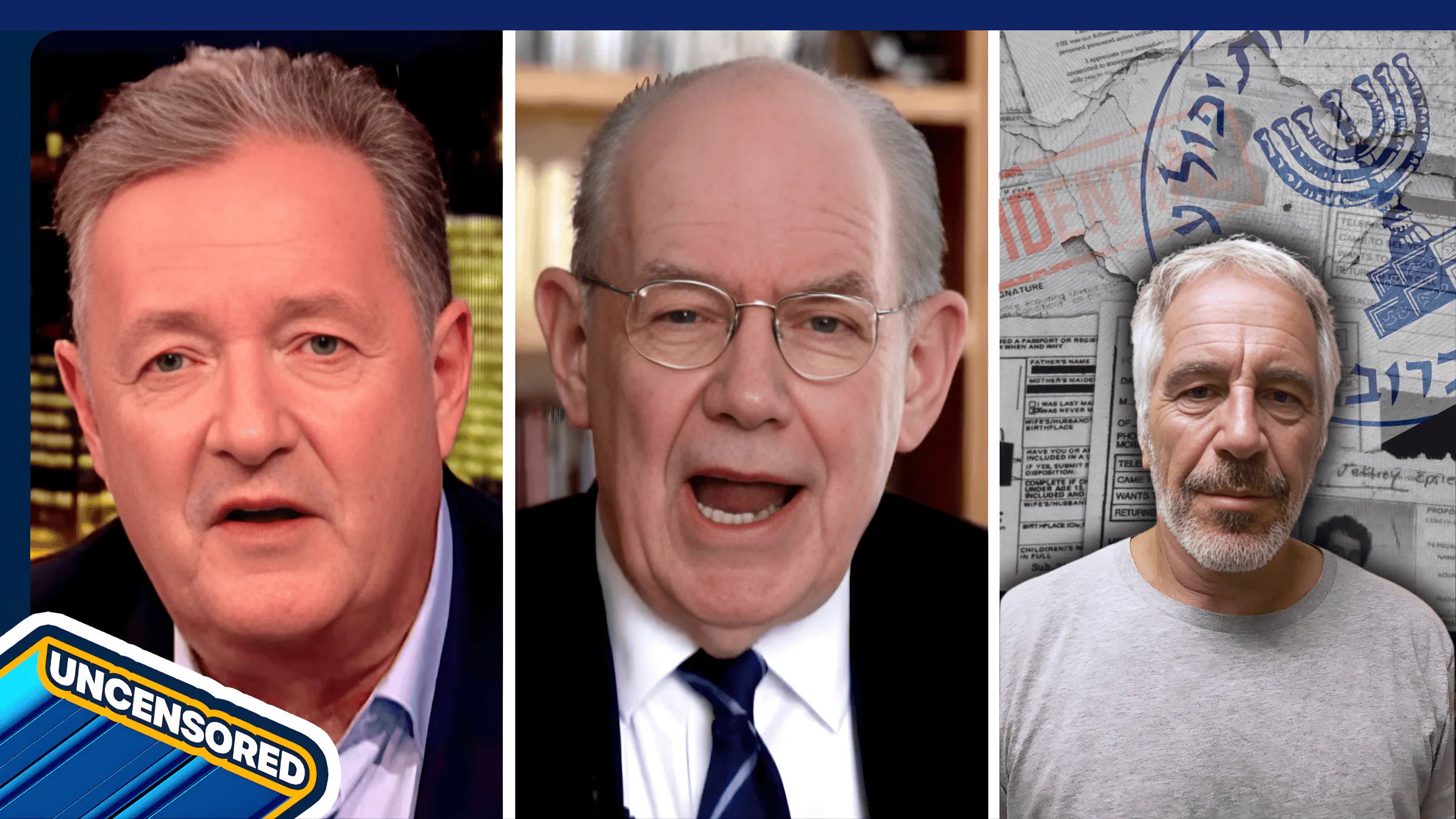
Piers Morgan Uncensored
"He Did Everything To SMEAR" Epstein's Mearsheimer Plot Revealed in Leaks | With Alan Dershowitz
00:37:34
Loading summary
Transcript67 lines
- [00:02]
A
It's hard to deny that the lobby goes to enormous lengths to skew American foreign policy in a pro Israel way. This includes people like Alan Dershowitz work overtime to suppress any discourse that's critical of Israel, critical of the U. S. Israeli relationship or critical of the lobby.
- [00:22]
B
I'm about to speak to Alan Dershowitz. Do you have any message for him?
- [00:26]
A
He'll know exactly what to say.
- [00:28]
C
I am not a lobbyist for Israel. I'm not a member of the Mossad. I am an American, a loyal American.
- [00:36]
B
You're very aware there have been these ongoing rumors about Epstein having an exchange.
- [00:41]
C
With somebody who I knew and somebody who was pro Israel doesn't prove either that I did anything wrong or that he had a connection with the most high.
- [00:52]
B
Almost 20 years ago, John Mearsheimer published a paper led to a book called the Israel Lobby and US Foreign Policy. It's now considered to be a seminal text on the outsized impact of lobbyists and think tanks who skew US foreign policy in Israel's national interest and not their own. Professor Mearsheimer and his co author were unusually the two unassuming academics hit with a barrage of negative media stories and accusations of anti Semitism. Leaked emails now show that one of the people colluding over these talking points to discredit John Mearsheimer was, along with his lawyer Alan Dershowitz, none other than Jeffrey Epstein. The question, of course, is why? Well, for his side of the story and what he believes Epstein's motives were, is renowned international relations scholar Professor John Mearschaum. Professor Mearschom, welcome back to Uncensored.
- [01:40]
A
Glad to be here as always, Piers.
- [01:43]
B
I'm going to get to what I was just referring to in that intro in a few moments, but first of all, just a couple of things I wanted to discuss with you. First of all, this almost unprecedented request by Prime Minister Netanyahu to his own President Isaac Herzog for a full pardon involving these bribery and fraud charges that have been brought against him for which he's been standing trial, albeit with multiple pauses because of the ongoing war in Gaza. What do you make of this?
- [02:18]
A
Well, I think that Netanyahu faces two big problems. One is a national commission that looks into who's responsible for October 7th, and he wants to avoid that like the plague. And then there's this trial that's going on where there is a lot of evidence that he's guilty and he wants to shut that down for obvious reasons. And President Trump has on a number of occasions said that Netanyahu should be pardoned. And by the way, he's making the argument that he should be pardoned before he's even found guilty.
- [02:53]
B
Right.
- [02:54]
A
And now the President of Israel himself, Isaac Herzog, has been asked to pardon Netanyahu. And I read Herzog's statement on the issue and I think he understands that if he pardons Netanyahu, he is playing with fire. This is not to say that he wouldn't do it, but if you purport to be a democracy like Israel does, you have a deep seated interest in making sure that people pay attention to the rule of law. And given that Netanyahu has been charged and this trial has been taking place, it seems to me that any self respecting democracy would want to see the trial play out and see whether there's a conviction or not before you get a pardon.
- [03:41]
B
Yeah, 100%, totally agree. The other very contentious thing that came out of the weekend about the situation in Gaza, it was actually on the West Bank. Actually this was video emerging that showed Israeli security forces shooting dead two Palestinians who had apparently, from what we saw on the video, surrendered in the occupied West Bank. And after they had surrendered, they were then ushered back into this area they had come out from and were shot dead, which many think was a breach of the Geneva Convention, which was a clear execution, therefore a war crime. Israel says it's investigating. But what did you think of that?
- [04:25]
A
Well, I find these cases hardly surprising at all. After all, Israel has been accused of waging a genocide in Gaza. And genocide is the crime of all crimes. And all sorts of people believe that Israel is committing a genocide. A large number of human rights groups have investigated this issue and have concluded that genocide is taking place. The UN has set up an international commission to investigate it and has come to that conclusion. Prominent scholars, including Israeli scholars, have come to that conclusion. So for a country that's committing genocide in Gaza, it's hardly surprising that they're shooting innocent civilians in the West Bank. I mean, it's just the way the Israelis operate. There's just nothing surprising here at this point.
- [05:18]
B
Just turning quickly to Ukraine, a lot of stuff going on here, a lot of push from the Americans to try and get a peace deal. Do you think there's any chance of a peace deal?
- [05:34]
A
There's no chance. And the reason is that the Russians have a series of demands that they view as non negotiable that neither the Ukrainians nor the Europeans will accept. And in fact, if you look at the Ukrainian and the European position vis a vis these Russian demands, They're on the other side of the dipole. They disagree almost completely with what the Russians want. So I don't see any way that President.
- [06:08]
Trump can get a deal that satisfies both the Ukrainians and the Russians. And I would note to you, Piers, that President Trump came up with, or his administration came up with this 28 point plan. And there were many complaints that the Ukrainians and the Europeans had not seen the plan and they were terribly unhappy with it. It was dead on arrival and it was obviously a r Russian plan. I think that's wrongheaded. In fact, the plan, the original 28 point plan that was leaked was dead on arrival for the Russians as well as the Ukrainians and the Europeans. And what the American negotiators, and this is Jared Kushner and Steve Witkoff were trying to do was they were trying to sort of find a middle position that would satisfy both sides. And they couldn't find that. And they couldn't find it because it's not there to be had. And this is why this war is ultimately going to be settled on the battlefield when one side or the other wins.
- [07:07]
B
There's also mounting speculation that President Zelensky may lose office because of what's been going on with his number two, who's just had to resign over mass corruption allegations. Would that change the dynamic at all if that was to happen?
- [07:28]
A
No, I don't think so at all. I think, first of all, with regard to events on the battlefield, which, as I said, are really critical, crucial, I don't think getting a new president or keeping Zelenskyy in power matters one iota. Now, one could argue that you'll get a new president who's interested in reaching a peace agreement with the Russians, and that new president in Ukraine would go to great lengths to accommodate the Russians. I think this is extremely unlikely. I hope it happens, but it's not going to happen, in my opinion. And the end result is that whoever replaces Zelenskyy will not look very different from Zelenskyy in terms of his willingness to wage the war.
- [08:12]
B
Instagram Teen accounts default teens into automatic protections for who can contact them and the content they can see. Explore Teen Accounts and all of our ongoing work to protect teens online@instagram.com teenaccounts.
- [08:28]
Let'S turn to what I was talking about with my intro. This is. It's sort of an extraordinary situation. I want to tee it up for viewers by explaining the sort of background to this, which is that in 2006, there was a working paper, the Israel Lobby and US Foreign Policy, published in March of that year by the Harvard Kennedy School. It became the basis for a book published the following year. The book was an analysis of the impact of pro Israel advocacy and lobbying groups on the US political system and. And the role of organizations like the American Israel Public Affairs Committee, aipac, in shaping US Foreign policy towards the Middle East. And there was a furious and almost instantaneous backlash, very unusual, really, in the world of academia at the time. A wave of news articles describing the authors of which you were one, as anti Semites, the Anti Defamation League weighing in to denounce what they called an anti Jewish screed. The pressure became so intense, the Kennedy School removed its logo from the paper and added a disclaimer distancing the institution from its arguments. All this is with the backdrop of ongoing rumor mill that Epstein was in some way an Israeli asset, maybe even employed by Mossad, which has been roundly denied, but continues to be fueled as a rumor. And against the backdrop of that, it becomes a little more credible to believe it. So, first of all, your reaction to these emails that have come out which reveal what was going on at the time between.
- [10:07]
Jeffrey Epstein and Alan Dershowitz?
- [10:11]
A
Well, I certainly knew at the time that Alan Dershowitz had us, me and Steve Walt in his gun sights, and he was doing everything he could to smear us. I had no idea that he was cooperating with Jeffrey Epstein in that endeavor. I don't think I even knew who Jeffrey Epstein was in 2006 when the original piece came out in the London Review of Books, or even in 2007 when the book itself was published. But I'm not surprised at all now that I've seen a few of the emails that Dershowitz and Epstein were cooperating with each other to smear me and Steve. I mean, after all, they were good friends. Dershowitz was Epstein's lawyer, and both of them are individuals who have a passionate attachment to Israel and will go to enormous lengths to defend Israel no matter what. So in a very important way, it's not surprising at all that Epstein was cooperating with Dershowitz.
- [11:13]
B
Do you think there could be merit to the rumors that Epstein was more heavily involved with Mossad, with the Israeli government at the time?
- [11:23]
A
Oh, sure. I mean, we have to wait and see. We have to see all of the emails and all the evidence that comes out when the Department of Justice releases the files. But a number of people who have seen big chunks of the files say that one thing that strikes Them is the extent to which Epstein was involved with Israel and Israel related matters. There's just no question that there is a deep interest in helping Israel in all sorts of ways on Epstein's part. But exactly what that means, especially with regard to the Mossad, is impossible to say given the evidence that's available in the public at this point in time.
- [12:07]
B
Do you think the central tenet of your argument in that paper holds water today? Is it better? Is it worse? Do you think that these issues have exacerbated or been reduced?
- [12:24]
A
Well, the fact is, Pier, that when Steve and I wrote the article and then the book, it was one of the first times that anybody exposed the lobby in a very public fashion in a way that garnered a lot of attention. And it was easy for people to slander us at the time because so many people didn't know much about the lobby. And one might think, therefore, that what we were saying was overstated or preposterous, however you want to put it. But now, given what's happened, especially since October 7th, it's hard to deny that the lobby has awesome power. And it's hard to deny that the lobby goes to enormous lengths to skew American foreign policy in a pro Israel way. The basic argument we made in the book is that if you look at the United States relationship with Israel, it's a relationship that has no parallel in modern history. Or to put it differently, no parallel in recorded history. The United States supports Israel unconditionally, especially with regard to the Palestinians. Almost no matter what Israel does, we support Israel. We hook, line and sinker. So the question is, why is this the case? Is it for strategic reasons? Not at all. There's no strategic case to be made for our support for Israel, especially for unconditional support. Is it done for moral reasons? Heck no. Look at the fact that we're supporting the genocide in Gaza. That's not in our moral interest. So then the question is, why are we doing this if it's not strategically or morally smart to do? And the answer, of course, is because of the power of the lobby. The lobby, and this includes people like Alan Dershowitz, work overtime to suppress any discourse that's critical of Israel, critical of the U. S. Israeli relationship, or critical of the lobby. And for a long time they were very successful at that. But those days are long gone now. And the basic argument that we made in the book looks pretty obvious to most people at this point in time in ways that it certainly did not when the article first came out and the book came out earlier in time, do you think?
- [14:49]
B
I mean, the polls suggest that there is increasing antipathy from many Americans to this ongoing relationship with Israel, as you put it, unconditional. Where do you think that leads?
- [15:04]
A
Well, there's no question that Israel is in real trouble. And if you look at how Prime Minister Netanyahu has been reacting, he's desperate to figure out a way to change Israel's image in the west, especially in the United States. But if anything, all the movements going in the other direction before October 7, most of the criticism that was out in the open of Israel came from the Democratic Party. It came from the left hand side of the political spectrum. That's all changed now. You're getting all sorts of criticism from the right hand side. People like Steve Bannon, people like Tucker Carlson, Marjorie Taylor Greene, and even Charlie Kirk before he was killed, was clearly moving in that direction. So you have this problem that inside the MAGA base of the Republican Party there are a substantial number of people who have become profoundly critical of Israel. And I would imagine that with the passage of time, their numbers will grow and the numbers of people on the left who are critical of Israel, their numbers will grow as well. So this is a colossal problem for Israel and its supporters here in the United States.
- [16:22]
B
And at the same time, I think there's no doubt you're seeing a rising amount of overt antisemitism. You know, some would blame the Israeli government for the actions it's taken that's been fomenting that. But others say that this is a genuine issue, that more and more people are becoming genuinely anti Semitic. Would you agree with that? When was the last time you truly trusted the seafood you brought home? I used to second guess everything, nutrition, taste, sustainability and provenance. Until I found Wild Alaskan company and I'm thrilled to say they're now sponsoring this show. Wild Alaskan delivers wild caught perfectly portioned seafood directly to your door. No antibiotics, no additives, just clean, nutrient rich fish which support healthy oceans and happy fishing communities. Their fish is frozen right off the boat to lock in taste and nutrients like omega 3s. They offer a flexible membership which makes it easy to keep your freezer stocked with seafood you can really feel great about. And with 100% money back guarantee, there's no risk. There's quality seafood you can trust. All sourced from Alaska. Not all fish are the same. Get seafood you can trust. Go to wildalaskan.compiers that's P I R S for $35 off your first box of premium wild caught seafood that's wildalaskan.compears for $35 off your first order. And our thanks to Wild Alaskan Company for sponsoring this episode.
- [17:49]
Getting older hits you like a freight train, or so people tell me. Stiff joints, Gym recovery, dragging on loose skin Aging is cruel, but it doesn't have to win. Today's show is sponsored by Bubs Naturals Collagen Peptides. Collagen is the body's glue, but it starts fading from your mid-20s. Bubs can restore it, delivering stronger joints, healthier hair and nails, smoother skin and faster recovery. It's a high quality product, no sugars or fillers. Whole 30 approved and NSF certified for sport. You can even stir it into your morning coffee. Live better, longer for a limited time only. Uncensored viewers are getting 20% off at Bubs Naturals by using code piers P I E R s at checkout. Just head to Bubsnaturals.com and use code after your purchase. They will ask you where you heard about them. Well, please support our show and tell them that I sent you.
- [18:48]
A
I agree with that. I think the charge of antisemitism is oftentimes used so loosely as to make the term almost meaningless. I think that when people call me and Steve Walt antisemites, this is a laughable argument. We're not anti Semites. We're both philo Semites of the first order. We're critical of Israel, critical of the lobby and critical of the U.S. israeli relationship. And by the way, many Jews are critical of Israeli behavior and they're critical of the lobby. And I would also note to you peers that almost all of the people who defended us when the article and the book then came out were Jewish. Almost all of them were Jewish. However, having said all that, there is no question that there is evidence in the body politic of real antisemitism, of hatred of Jews and of arguments that say Jews are different than other people and Jews are evil and so forth and so on. And I do believe the great danger is if events in Gaza continue, if events in the west bank continue and the lobby continues to operate the way it's been operating since October 7, which is to say out in the open, engaging in smash mouth politics, we could have a major crisis in terms of rising antisemitism here in the United States and even in Europe as well. And this is deeply worrisome, for sure.
- [20:17]
B
I'm about to speak to Alan Dershowitz before I go to him. Do you have any message for him?
- [20:24]
A
No, not really. I think he'll know exactly what to say in terms of what I've said here. He has a rich history of smearing me and Steve, and I'm sure he'll be as good as ever, which is not very good, in my opinion, at that endeavor.
- [20:43]
B
Did you feel that the smears damaged you?
- [20:49]
A
That's a tricky question. I mean, we're two tenured professors at two of the greatest universities in the world, and there was no way that his smears could get us removed from those positions. At the same time, there is no doubt that it had an effect on our careers. I mean, Steve was the academic dean of the Kennedy School at the time that the article appeared. And anybody who knew Steve, and I think you could ask Larry Summers about this, who knew Steve well because he was the Harvard president at the time, thought that Steve was a first order administrator, he was terrific, and that he would have been at least the dean of the Kennedy School and, and probably would have been the provost or the president of a major university. But that never happened. I mean, not only was he never dean of the Kennedy School, there's a program for security studies called the Belfer center inside of the Kennedy School. And Steve, amazingly, has never been asked to be the head of the Belfer Center. So in terms of Steve's professional administrative career, this had devastating consequences. And I believe, I don't know if he'd agree with me that he would have liked to have been dean of the Kennedy School. He should have been dean of the Kennedy School. He would have been a superb dean. But that was ruled out of bounds once he wrote the lobby article. I didn't have those kind of ambitions at all. So it had no effect on me. I was just interested in being an intellectual or an academic. And so it didn't have that effect. And there were just all sorts of other consequences as well. We had all sorts of talks canceled then and since then, and all sorts of opportunities to make money or to be invited to give talks or participate in big events are not open to us because we're viewed in some circles by a handful of people as anti Semites.
- [22:53]
B
Professor Mearsheimer, fascinating stuff. Thank you very much indeed for joining me.
- [22:58]
A
Thank you for having me, Piers.
- [23:00]
B
Well, listening to that, as I said, is Jeffrey Epstein's former lawyer, the author of the new book the Preventative State, Alan Dershowitz. Alan, welcome back to Uncensored. What's your reaction to what Professor Mearsheimer said there?
- [23:15]
C
Well, I'm glad we're having an academic civil Discussion of this. I had challenged both professors.
- [23:24]
Walton Mearsheimer to debate me at the Kennedy School, to debate me at the Harvard Law School, and they have declined. I wrote a 200 page analysis of their book, an academic analysis. It wasn't a smear. It was a very cogent line by line dissection of their arguments and disproof. And they could have easily tried to respond to it by writing a 100 page or a 50 page rebuttal to my 200 page rebuttal. And but they didn't. So smear is not the right word. This was an academic dialogue, an academic discourse. And I think it. There were multiple sides to it. People took different sides. It was very seriously considered and I was honored to participate in that. I am not a lobbyist for Israel. I'm not a member of the Mossad. I am an American, a loyal American who strongly supports the American Israel relationship the way many Christian Americans do and many Jewish Americans do. And I thought the book was misguided and I thought it was ill advised and I thought it was wrong on its facts. And so I did what professors do. I responded to it in the marketplace of ideas. I never tried to shut him off in the marketplace or what I wanted to do was debate him and discuss it with him and get both sides of the issue out there. But they categorically refused to have any debates or discussions with me. Instead, they used the word smear to describe multi page analysis. That's what professors do and that's what they should do. So thank you for having me on to allow me to at least participate in this kind of debate.
- [25:12]
I'm not sure whether you asked him whether he'd be on to debate me one on one, but there is no such debate here. So you're giving me. Thank you. An opportunity to respond to him. I would welcome him responding back and then me responding back. Maybe you can have us back and we have a real debate. But that's what academics do. And to call one side of the argument a smear is to diminish it in its importance. And it also has the effect of diminishing the original book and its importance. This was an important book and it deserved an important response. I purported to do that, by the way. I sent it to hundreds of people. Jeffrey Epstein was just one of them. I wanted to get the widest possible circulation. I sent it to every member of the Harvard Law School faculty. I sent it to all my friends in the media and Epstein was one of the people I sent it to. I was his lawyer at the time, and he responded, as many others did, by saying, I'll circulate it. And he circulated it, and many others did, and ultimately, I put much of it into book form. And the debate continues to this day.
- [26:15]
B
I mean, I guess the awkward part of this is that we've only just learned about this through more leaked emails from the Epstein files, and we haven't got them all yet. And what people are saying by way of criticism is that they think it's inappropriate for you, notwithstanding the fact you were Epstein's attorney at the time, to use him to promote a clearly very pro Israel piece of, as they would put it, lobbying.
- [26:46]
C
Well, I'm proud of having done that. I circulated it to everybody I knew who had access to the media, and I would continue to do that. At the time, of course, Epstein hadn't been convicted of anything. Yes, there had been suspicions and rumors and charges. I was his lawyer, and I sent it to, as I say, everybody who could help me circulate it, and I'm proud of that, and I will continue to do that. That's what academics do today. You'd put it on substack, or you'd put it on Twitter or X, but that was before that existed. And so what I did is I circulated it to everybody that I knew to please get the story out there as much as possible, but as, you know, respond to it. That's what academics do.
- [27:32]
B
Sure. But the point I would make is that you're very aware there have been these ongoing rumors about Epstein and whether he had a bigger relationship with the Israeli government or indeed and. Or the Mossad through this period. And, you know, you're a smart guy. You'll know that this kind of exchange would lend to those who have read those rumors. They would think this is a little bit more credible now, because here he is clearly taking an active role in wanting to disseminate information which is very supportive of the Israel position at the time.
- [28:09]
C
Yeah, but this was done at a time when nobody was making that allegation. I have direct, firsthand information. Before I was Epstein's lawyer, back in the 1990s, I was writing a book called the Genesis of Justice about the Bible, and I was in Israel on a sabbatical, and Epstein called me. He was in Paris. He said, I've never been to Israel. Can you come to Israel and arrange a lunch with me with four or five of Israel's smartest people? So I did. I arranged a lunch with the President of the Israel Supreme Court. The Dean of one of the law schools. We had a lunch, then we took a walk to the Shook, and he saw an IDF shirt, a tan IDF shirt. And he said, oh, boy, I'd love to have that. And so I bought it for him for, I think, $6 or $7, and he put it on and took a picture with it. And then people began to circulate the rumor that he must be on the Mossad because he was wearing a $6t shirt of the Israel Defense Forces. But we have to get the chronology straight. When I wrote that email to Epstein. And by the way, I want all emails out. I've never tried to suppress a single email. I'm proud of all my emails. I want them all out there. You know, I don't know what they all say. I don't remember. But having an exchange with somebody who I knew and somebody who was pro Israel doesn't prove either that I did anything wrong or that he had a connection with the Mossad. Now, I did represent the Mossad once as a lawyer. When.
- [29:34]
Three or four Mossad agents were arrested in Cyprus, the head of the Mossad at the time.
- [29:41]
Asked me if I would help represent these people, and I did, and I helped them get out. And I have a beautiful letter from the former head of the Mossad saying I'm hoping for a day when my job is not any longer necessary and maybe I can do your job being a professor. So I have, you know, pretty good knowledge of the Mossad, and I put the issue directly to the current head of the Mossad and the former head of the Mossad. There's nobody in any position of authority who reasonably suspects that they would have ever gotten Jeffrey Epstein on board to be a moss.
- [30:19]
B
You say you're proud of every email that you've ever written, but you also say you can't remember what they contain. Are you not?
- [30:27]
C
I can't remember.
- [30:27]
B
But are you not a little bit apprehensive about what may else come out in these leaks?
- [30:35]
A
No.
- [30:35]
C
I did nothing wrong. I did nothing wrong ever in my life sexually. I didn't have anyi didn't know or have any contact with the woman who accused me. So from day one, I said, send it all out. On the first day I was accused, I had an op ed in the Wall Street Journal. I don't think anybody's ever had an op ed like this in history, urging the FBI to investigate me and saying I would waive all of my lawyer client privileges, all of my privacy privileges, because I knew I did nothing Wrong. Now, did I tell a bad joke sometime in an email? Who knows? Who remembers 25 years ago? But I live a very open and moral life.
- [31:14]
B
I wasn't really talking about you, actually.
- [31:16]
C
I might be surprised that I said certain things.
- [31:19]
B
But, no, I was actually going to ask you specifically. Not about you, actually, but whether there could be more emails pertaining to Jeffrey Epstein's relationship with Israel, with the Israeli government or otherwise.
- [31:34]
C
I'm sure there are. I know that after much of this happened, he began to develop an economic relationship with Ehud Barak. I actually was at his house one day when I was his lawyer and giving him legal advice. And on the blackboard in his dining room was a map of a peace plan. And I asked him what it was, and he said, oh, that was drawn by Ayod Barak with his own hand. And he didn't erase it because it was, you know, Ahad Barak's peace plan. So, yeah, I'm sure there'll be emails relating to Israel, and I'm sure there'll be emails relating to, you know, a wide variety of subjects. I mean, I had emails with him relating to Einstein. I gave him a book once for one of his birthdays or something about notes that were not published about Einstein. He was, before he was ever accused of doing anything wrong, he claimed to be a serious intellectual. And so we had intellectual exchanges with some of the most prominent professors at Harvard. When he had these seminars, he would have them once every month or every other month. There would be people at these seminars who I'd been on the faculty. For example, George Church, I think his name is, who decoded the genome. I had been on the same faculty with him for 25 years. I'd never met him. But Epstein brought us together. So, you know, there are a lot of academic connections. And the most natural thing in the world would be when I think in several of my books. By the way, before Epstein ever got charged, I actually acknowledged him in the acknowledgments for reading the text and giving me feedback. So it would be the most natural thing in the world for me to send him my article, which was going to be part, perhaps, of a book ultimately, and ask him for not only his feedback, but ask him to circulate it as widely as possible, proud that I did it, happy that I did it, I would do it again. Not knowing what I know now about Epstein, I wouldn't have included him. But I'm in the process of writing my 60th book. I just sent it to the publisher today. My 60th book. Every one of those books I send around to my friends, my associates, my former clients. My clients. I ask them for input, and the input is very valuable. And I also, when the right time comes, ask them to circulate it to as many people as possible. That's the way word gets around, you know, that's the marketplace of ideas. And I participated in the marketplace of ideas with Walton Mearsheimer. Walton Mearsheimer refused to participate in the marketplace. They wouldn't respond on the merits. They wouldn't get involved in a debate. I urged, you know what? I'm going to try and do school.
- [34:07]
B
I'm going to try and do.
- [34:08]
C
I fly out to the University of Chicago. I offered to fly to the University of Chicago.
- [34:12]
B
Well, I will try and I will.
- [34:13]
C
Try and do it.
- [34:13]
B
I did try and bring you together for this.
- [34:15]
C
Please.
- [34:16]
B
Professor Mearsheimer opted not to do a debate with the two of you together. I'm gonna try and persuade him to do it. I think it'd be fascinating. I've gotta leave it there. Alan Dershowitz, thank you very much.
- [34:27]
C
Well, thanks for doing it, and let's have a debate.
- [34:29]
B
Yeah, I agree. Thank you very much.
- [34:33]
Here's Morgan, unsensed and is proudly independent. The only boss around here is me. If you enjoy our show, we ask for only one simple thing. Hit subscribe on YouTube and follow Piers Morgan uncensored on Spotify and Apple podcasts. And in return, we will continue our mission to inform, irritate, and entertain, and we'll do it all for free. Independent, uncensored media has never been more critical, and we couldn't do it without you.