Loading summary
Transcript253 lines
- [00:02]
A
This is Planet Money from npr.
- [00:07]
B
I don't know about you, but every time I pick up a book in a bookstore at a yard sale, the things I'm mostly paying attention to are the words, you know, the title, the author's name, the actual reading material. Way more than the physical package they come in. But I had an experience recently that changed all that. You see, last year, my boss's boss here on the show, my grand boss, he asked if anyone wanted to report out the story behind the making of the Planet Money book to see what it might reveal about the global economic machinery behind every book. I accepted that mission, which is how earlier this year, I found myself spelunking deep inside the publishing industrial complex. I got an invitation to see one of the biggest bookmaking factories in the world, part of the Lakeside Book Company. And stepping into this place felt like stepping into one Willy Wonka's factory, but for books. And while I didn't find any bookish Oompa Loompas, I did meet a guy named Chris Moode. Ironically, extremely chipper. Chris basically grew up at the plant.
- [01:13]
C
I started off in college to be a high school art teacher and then took a gap year. And that gap year has now been almost 39 years with the company.
- [01:21]
B
I come to Chris to help answer this sort of deceptively simple question. Where do books come from? Like in a material, physical way? What path do they take before they end up on a shelf near you? And his response was to take me on a little tour.
- [01:36]
C
Really what we're going to do at this point is just walk down.
- [01:39]
B
We head off down a meandering mile long path through a series of cavernous warehouses. For my own safety, Chris insists we stay between these little yellow lines on the floor. It's like a little yellow brick road.
- [01:51]
C
Yeah. Coming to see the wizard.
- [01:52]
B
The wizard of publishing. The wizard of printing.
- [01:55]
C
Printing, yeah.
- [01:56]
B
The first thing that hits you in here is a sheer sense of scale. What are we looking at? This plant, Chris tells me, is a million square feet. They're constantly cranking out books 24 hours a day.
- [02:08]
C
On an average day, we make about 600,000 books a day. On a great day, we're making upward of three quarter of a million books.
- [02:16]
B
Wow, that's a lot of books.
- [02:17]
C
Absolutely.
- [02:18]
B
Lakeside is the biggest Bible producer in the country, but. But they are also one of the biggest producers of the latest steamy romantasy sensations. Every once in a while they're entrusted with printing titles so sought after by hordes of ravenous readers, they have to Hide them so that nobody could possibly sneak out a copy or get a
- [02:37]
C
photo of the COVID Got our secured cage.
- [02:40]
B
So while those books are under embargo, they're kept in a special high security cage.
- [02:45]
C
We currently do not have anything in there, but that's where we would store anything that had to be kept secret.
- [02:50]
D
Wow.
- [02:51]
B
That's the Chamber of Secrets.
- [02:52]
C
Yeah, yeah. Well, quite literally.
- [02:56]
B
All around us are signs of this hidden economic web spanning continents, the tendrils of global trade. We walk between towering stacks of enormous paper rolls, like the kind a giant might use on the toilet. Some of this paper has come from forests chopped down in faraway land. There are humongous vats of ink with ingredients that have crossed oceans, traversed through ports and over highways. To be here, walking around this place, it started to dawn on me every book is actually a tiny economic miracle. Hello and welcome to Planet Money. I'm Alexi Horowitz Ghazi. You may not think about it every day, but every book you see sitting there unassumingly on your local bookstore shelf is the result of thousands of decisions, big and small, tying together vast supply chains and armies of workers from around the world. Today on the show, the second episode in our series, Planet Money sets out to actually make a book. There will be trade wars, sunken cargo containers filled with lost cookbooks, deforestation regulations, and just a whiff of scratch and sniff.
- [04:13]
E
Support for this podcast and the following message come from Square. Whether you're selling lattes, cutting hair, detailing cars, or running a design studio, Square helps you run your business without running yourself into the ground. With Square, you get all the tools to run your business with none of the contracts or complexity. And why wait? Right now you can get up to $200 off Square hardware at square.com go money. That's S Q U-A-R-E.com/money. Run your business smarter with Square. Get started today.
- [04:48]
B
Three years ago, book editor Tom Mayer from the publishing house W.W. norton, made a proposal to my grand boss, Planet Money's executive producer, Alex Goldmark, that Alex just could not refuse. Over a million dollars to make a Planet Money book together. And not long after the ink had dried on that contract, they had to come up with a plan to write and design and actually manufacture this book. It sounds like you guys didn't get that much of a honeymoon.
- [05:15]
D
No, we jumped right into the hard work of book writing, marriage, and now
- [05:19]
F
we had to figure out how to actually make a book that we would be proud of. And like on the deadline, they gave
- [05:24]
B
Us now, in this post nuptial period, there isn't exactly a hard deadline for the book. Things like the manufacturing schedule and the publication date won't come into play until Tom has a nearly complete manuscript. For this first phase, he has to figure out how to conjure that manuscript into existence. He's got to take off his businessman's fedora from the world of book proposals and auctions and enter the world of book editing.
- [05:49]
D
You change from being a collector to being a director. So you go from wanting something of like, ooh, I want to buy that. I want it, you know, on my shelf to, all right, how am I going to make this great?
- [06:04]
B
It is now Tom's job, wearing maybe a director's beret, to orchestrate the many parts of the process for turning an idea into a physical book. And. And the challenge before him is twofold. There is the question of content, like what mixture of words and images will go inside the book? And there's the question of form, like, what shape and design should the book physically take?
- [06:27]
D
Well, I think the first is what goes in the book itself.
- [06:31]
B
Yes, the first part of Tom's challenge is figuring out the actual content of the Planet Money book. So Tom organizes a meeting with Alex Goldmark and Alex Miyasi, the person hired to help write the book, to hammer out a plan. As Alex Goldmark explains, we had to
- [06:46]
F
figure out things like, what's the structure of the book? What should our chapters be? Which ones should we do first? Should we write them in order? Should we write the hardest ones first so that we, like, know what we're really getting into?
- [06:57]
B
At first, Alex says they'd been thinking of organizing the book as this sort of economic guide to the forces that shape your life from birth all the way to the end.
- [07:06]
F
The downside of that one, when we thought about it, was then you end on death. It's just a depressing ending.
- [07:14]
B
It also didn't quite leave room for the part of economics that focuses on the big picture, things like inflation or global trade. So they tweak the frame, they add a section introducing readers to the market and its forces, and they organize the rest of the chapters around the big decisions in life, things like work and career, love and family, or saving and investing. They come up with a list of new original chapters they want to report and classic Planet Money episodes to adapt and update. And with that plan, Alex Miase sets up at his local coffee shop and starts writing.
- [07:47]
G
I probably am making, like, insane expressions while I work, you know, drinking my coffee and scrunching my hand against my head trying to figure something out.
- [07:56]
B
Totally. Blood, sweat, tears and caffeine. Yeah.
- [07:58]
D
Alex Mayasi started writing draft chapters and he would share them with me and Alex Goldmark.
- [08:04]
F
Tom could read so fast, like the words goes into his brain so fast that he was really able to read a lot quickly. And I would be like, I need to like, leave my, my desk, go sit somewhere quiet and focus to actually be able to leave good notes.
- [08:17]
D
There's nothing like reading a chapter that did not exist before and you're the first person on earth to see it. That is extremely exciting. And of course, once you've read it, then you're like, I see a million problems with this. We gotta make this much, much better. You know, some of those things are big. They're like, the structure is wrong, or the opening anecdote's not exciting enough, or this sentence is confusing, but it's still really exciting.
- [08:39]
B
So Tom and the Alexes get going on writing and editing new chapters. Now onto the other part of Tom's challenge, the question of what physical form the Planet Money Book should take.
- [08:49]
F
There are infinite choices you can make for a book.
- [08:51]
B
Alex Goldmark says that at first they started looking at some of the big picture decisions we had to figure out,
- [08:57]
F
like what size was the book, how
- [08:59]
B
long should it be, what kind of paper should it be printed on?
- [09:01]
F
Is it going to be in 4 color? Is it going to be in 2 color? Can we just make anything we want, any color we want?
- [09:08]
B
And how should they price the book? Tom and the team at Norton tell the Alex's they probably want the book to retail for around $30 a copy to keep it affordable. A lot of hardcover books are in that price range and it would be in keeping with the show's ethos of explaining the economy to as broad a group of people as possible. And given that price point, Tom explains that the design decisions they are making have real stakes because each choice has a particular cost that could ultimately affect the retail price.
- [09:37]
D
We buy ink by the gallon, you know, we buy paper by the palette. If you're going to add 16 more pages to the book, you're adding that much more paper to every single book. And if you're going to print thousands of copies, that can add up really quickly.
- [09:48]
B
But the bigger question that Tom and the Alexes have to answer is this. How do you translate the irreverent, playful, formally experimental tone of the podcast and distill that into the book? Tom asks the Alex's for ideas. And true to form they start cranking out one zany pitch after another. Goldmark suggests they could draw miniature figures in the corner of the pages so readers could flip through them and get a bonus little flip book. He also suggests we could do a page explaining the evolution of currency printed on the actual fabric on which US Dollars are printed.
- [10:21]
F
Because money's not really paper. It's actually made out of, like, cotton. And I was like, could we ask the company that makes the fabric that money is printed on, could we ask them for like one page each book?
- [10:32]
B
That idea prompts a little lesson from Tom on how the printing process actually works.
- [10:37]
D
Books are not printed page by page. They're actually printed in these large sheets that then get folded down into one page size sheet and then cut. So you have these things called signatures, which are 16 pages at once. So you would actually have to have 16 pages of actual US currency paper. I mean, logistically very challenging to achieve Alex Goldmark's vision.
- [10:59]
B
Okay, so we table that idea.
- [11:01]
D
Yeah.
- [11:02]
B
The next idea came from Alex Miasi, the writer. You see, he'd been flirting with creatively using scratch and sniff technology since his days working on a book about food for Atlas Obscura. As for his idea for the Planet
- [11:15]
G
Money book, I really wanted the COVID of this book to smell like money.
- [11:18]
B
Maybe a little bit on the nose.
- [11:20]
G
And at one point, I saw an article about how an Indian newspaper had celebrated the mango season by making the COVID of that day's newspaper smell like mangoes. And so I sent a link to that article to Tom and I was like, see, it's possible. Like, we gotta make the COVID of this book smell like money. And he's like, I'll go see what we can do. I'll go talk to my people.
- [11:41]
D
I mean, we took the idea really seriously. We got samples shipped from overseas.
- [11:46]
B
Now, Tom himself is not the person to figure out how to make a book smell like money. That is not his wheelhouse. For that, he's gotta call in a new member to the Planet Money book squad. An expert in international book manufacturing. And her name is Druskin. Julia Druskin.
- [12:04]
D
Julia is like Q from James Bond. You go to her and you're like, I want to do this crazy thing. And she's like, okay, let me go work on it. And she knows every printer and she knows all of the tricks of the trade, and she knows how to get books done on time and under budget. And it's just really, really smart. And, like, she comes back three weeks later and she's like, okay, I'VE solved it, but it'll cost you.
- [12:25]
A
Yes, I learned a lot about scratch and sniff.
- [12:28]
B
This, of course, is Julia Druskin. The cue to Tom Mayer's James Bond. She's the director of trade production at Norton. She's been helping produce books there for almost 30 years. So the idea of using scratch and sniff in a book was not alien to Julia, but this was different.
- [12:44]
A
It's usually like, you know, pickles or roses or, you know, food, but it was money. So I called a bunch of my suppliers and I said, can you do scratch and sniff with MoneySense? And I have a domestic printer who has done a lot of these. They do kids books. And they kind of walked me through it and they were like, there's this one guy and he's like the smeller. And he tells you if it smells like what you're intending.
- [13:12]
B
He's like the in house super smeller.
- [13:14]
A
I think he's a freelancer.
- [13:15]
B
Yes, the contract gig work. Super smeller.
- [13:18]
F
Exactly.
- [13:19]
B
Julia learns that scratch and sniff technology is actually made out of these tiny burstable beads that can easily explode during the printing process. So the best way to execute this idea would be to order money scented scratch and sniff stickers and then slap em on the COVID So Julia gets some samples from a supplier in China.
- [13:38]
D
But they just, honestly, they didn't smell right.
- [13:41]
B
They smelled. They didn't smell like dollars.
- [13:44]
F
And then we thought maybe Chinese money smells different. Like, I don't know.
- [13:47]
D
Turns out the smell of money is very specific and you know it when you smell it.
- [13:50]
G
Yeah.
- [13:51]
D
And what we were scratching and sniffing here was not it.
- [13:54]
B
Okay, so scratch that idea, do not sniff it. No matter. There are a couple of other pitches that do seem a bit more feasible. One idea was to create a series of postcards that you could actually rip out of the book and send to a friend. These would highlight different kinds of public goods around the world, like the Large Hadron Collider near Geneva or the standardized atomic clocks in Colorado that make things like GPS possible. Another idea was to make a poster modeled after like an OSHA style poster you might see hanging in a workplace. But instead of labor regulations, this one would list the laws of the office. From a Planet Money episode by the same name. Tom and Julia look into what it would take to make all these ideas into a printable reality and how much each of them would cost.
- [14:39]
D
Some of them were inexpensive, some of them were like, well, that's going to add a quarter to the unit cost. And some of them were like that's going to add a dollar to the unit cost. And that would have major downstream effects on what the actual cost to the customer would be. That could negatively impact how many people are going to buy the book. So you have to really weigh those things.
- [14:58]
B
Tom eventually breaks the news to the Alex's about how much all these shticks in total might actually add to the production costs and the retail price. If they go ahead with all of them, he says, the book is going to have to retail for somewhere above $40. That meant planet Money might lose a chunk of potential buyers.
- [15:15]
F
We were like, we don't want to sell a book for $40. Like it's not, it's not worth it to have those be real postcards and that's a real poster. Like those were meant to be delightful, but nobody really wants to spend an extra $10 on those things. So we cut those out so that we could make sure we stayed under the $30 price point.
- [15:31]
B
Instead, Tom and the Alex's decide they're going to double down on the illustrations inside the book to commit to glorious, expensive four color printing. That way, the designs for the postcards and the laws of the office poster could still live inside the book, even if they can't be ripp actually used. The team brings in a creative director from npr, Mito Habe Evans, to help find illustrators and come up with a visual language for the book. They decide to introduce each chapter with a movie poster style illustration. Like for a chapter about the wisdom of the crowd and picking stocks, they make a surreal depiction of a cow as a fortune teller. They also come up with playful little graphics like a cartoon ranking the winners and losers from the shift to remote work. Now in this first phase of the book production process, Tom says you can think of his role not only as a director, but also as a conductor trying to keep all the trains moving at a steady clip. Because even though there aren't super hard deadlines yet, remember, Norton has invested over a million dollars to buy the rights to the Planet Money book. So there is some urgency to get a return on that investment roughly within a couple years. And Tom says when deadlines are sorta loose like this, there is one force he has to contend with constantly. The idea that work will expand to fill up whatever amount of time you assign to get it done. This idea actually has a name. It's one of the things we explain in that episode about the laws of the office. It's called Parkinson's Law.
- [16:59]
D
Parkinson's Law is as ubiquitous in publishing as Gravity is to Earth. Every book could eat all the time in the world because every book is a big, gigantic, bespoke intellectual project that you could spend years working on. Authors do spend years writing them, and the editor could spend many, many, many hours editing every word and making sure everything was as strong as possible.
- [17:25]
B
And Alex Miyassi, who is writing the Planet Money book, says for a while, he could really feel himself fighting Parkinson's Law. But at the beginning, at least, the law seemed to be winning.
- [17:36]
G
There was this point where I'd written two chapters of the book, and these were these, like, totally original chapters that took quite a while. And it was very obvious that, like, if every chapter takes this long, this book is not coming out anywhere close to on time. So we obviously need to speed up.
- [17:51]
B
Now, luckily, as a seasoned editor, Tom has an extensive array of psychological techniques to break the grip of Parkinson's Law.
- [18:00]
D
Yes, I have developed a toolkit of ways of encouraging authors to get them to write. I have told authors to open up an email and to type their chapter in an email to me, because for some people, it's a lot easier to write a long email than it is to open up a blank Google Doc or a blank Word document and try to write there.
- [18:15]
B
Yeah.
- [18:15]
D
I have had authors speak their chapters aloud to voice recognition software.
- [18:20]
B
I asked Tom if he ever resorted to setting fake deadlines to squeeze his writers to hit their word counts.
- [18:26]
D
Alexei, all of my deadlines are real. I think the authors of America need to understand deterrence. There are red lines you cannot cross.
- [18:34]
B
You're playing game theory here. You can't possibly devalue your own deadlines on the record.
- [18:39]
D
No, all deadlines are real, and there's serious consequences for going past them. You know that.
- [18:45]
B
Tom says he's gone as far as threatening to kill a whole book project if the work didn't start coming in by a certain time. An almost literal deadline.
- [18:54]
D
And then the author's like, actually, here's the book.
- [18:58]
B
That's the knife at its sharpest.
- [18:59]
D
That's the knife at its sharpest. I mean, you never want to get there as a publisher. But it wasn't even a ploy. It was like, I'm sorry, you're not writing this book, so what are we going to do? And then they wrote the book, and it was great.
- [19:10]
B
Happily, in Alex Miase's case, all Tom had to do was encourage him to sprint through a few chapters just to set himself a deadline of a chapter a week. For a little while, that advice worked to get him into a rhythm. And after over a year of successively writing and editing and revising chapters, we
- [19:27]
D
had each of the individual pieces and then we like laid them all out on a table with post its everywhere and be like, does this look like a book? And does it look like a good book? And is the flow good? Like, almost like we've storyboarded the whole book.
- [19:38]
B
Does it quack like a book?
- [19:39]
D
Does it quack like a book?
- [19:40]
B
That's an important question. Because when it quacks like a book, they will be able to leave the nebulous world of vague deadlines and enter a whole new phase. And in this phase days, Tom and company will have to navigate a regimented production gauntlet. Once they have a draft of the
- [19:56]
D
manuscript, that's when you can start thinking about what your actual publication date is going to be. Most books take about 10 months from pencils down to publication day to figure
- [20:07]
B
out the actual publication date. Tom and his colleagues start thinking about how they want to position the book in the marketplace. Publishing is traditionally divided into three seasons. Spring, fall, and winter. And Tom says there are different potential audiences for each season.
- [20:23]
D
January is New Year, new you. Like people are interested in improving themselves in January. Yeah. So let's think about whether we want to publish the book into that season.
- [20:32]
B
Or maybe you want to publish in the spring.
- [20:34]
D
April, May and June are traditionally very competitive months in book publishing because they lead to a book buying season of Mother's Day, Father's Day, and graduation. Those are traditionally strong bookselling seasons.
- [20:46]
B
You're closely tracking the gift economy.
- [20:48]
D
Yeah, yeah. And you know, the other one is September, October, November, which leads you into the holidays.
- [20:53]
B
In the spring of last year, Tom and his colleagues at Norton finally pick a publication date. They decide to target the holy consumer trinity of moms, dads and grads by releasing the book on April 7, 2026.
- [21:08]
D
And that was like a real moment of committing the group to nailing all of our dates. So that was. That was a significant moment for, like, setting the deadlines for the work ahead.
- [21:18]
B
The team now has T minus 10 months to get this book manufactured and ready to launch. All of a sudden, the production planning gears spring into motion for Julia Druskin, Norton's production director. And cue to Tom's James Bond. This process is all about answering a simple question with huge where in the world should Norton print the Planet Money book? We could, of course, print the book in the good old US of A.1 of Norton's most trusted printers is in Indiana, where the logistics would be ideal. It's only a two day drive to Norton's distribution warehouse near Scranton, Pennsylvania. That also means that if the book takes off and Norton wanted to print more copies, it would be easier to get them to bookstores quickly. The problem with this option is the problem with manufacturing most things in the US it is just much more expensive, especially if you're printing in Glorious four color. So Julia says Norton is most likely going to want to print this puppy overseas. One of Norton's usual suspects when it comes to color printing is China. But Alex Goldmark and my even greater grand bosses at NPR did not want to run the risk of government censorship or oversight of what goes into the book. So China is off the table. Turkey is apparently a pretty good option in terms of pricing and logistics. But Goldmark says there was one unexpected hiccup that came up with that location.
- [22:40]
F
The turkey one had a constraint that was like, no nudity, which we were like, why is that going to be an issue? And then weirdly, Alex Mayasi was like, I want to use the COVID of this, like, very classic finance book, which is a cartoon where like a butt is shown at like a beach.
- [22:54]
B
Given all the various constraints, Julia says it's looking like the best option is going to be a printer in Malaysia. She recently had good experiences printing complicated and colorful cookbooks there. And the shipping infrastructure seems better than some of the other options. And Tom explains, shipping logistics are an enormous part of the calculation over where to print the book.
- [23:16]
D
The tricky thing about printing overseas is that you introduce risk and complexity to your entire process because you have to physically put the book on pallets, and the pallets physically have to go into containers, and the container physically has to go onto a boat. And then you'll sometimes you wait months for there to be room on a boat leaving the port of whatever, and then that boat has to sail across the ocean and then dock at the Port of New Jersey and then be unloaded by longshoremen and clear customs and then be trucked to our warehouse in Scranton Peninsula, Pennsylvania. And there are a lot of steps along that process where things can go wrong.
- [23:52]
B
Crossing the ocean can be as treacherous for books as it is for Spanish galleons filled with gold. A few years ago, a cargo ship hit stormy weather. Several containers were knocked overboard, and a whole shipment of fancy cookbooks sank into the murky depths of the Atlantic. Did you follow that story where there were cookbooks at the bottom of the ocean?
- [24:12]
D
I looked at it through, you know, my hands were over my eyes. I felt deep sympathy for the Publisher and specifically for the production of that book. I mean, that must have been very stressful for them.
- [24:22]
B
Now, assuming Norton's ship does come in at the port, Julia and company will then have to deal with things like inspections and import taxes. And keep in mind, Julia and Tom are considering all these international manufacturing plans in the middle of 2025, just a few months into President Trump's second term. And was anything going on in the global economy at this time that might have added any sort of, like, anxiety or volatility into how you were thinking about these decisions?
- [24:49]
D
A leading question.
- [24:51]
B
Ye.
- [24:52]
D
I mean, obviously the looming tariffs and trade war issues introduced unknowns and risk that we had to account for as we thought about where we wanted to print.
- [25:04]
B
Up until now, publishing has mostly been exempted from tariffs, but there's always a possibility that some particular kind of paper stock or ink might somehow be implicated, changing the cost of importing our books from abroad at the last minute and messing up all the carefully calibrated math around the book's price. And yet, despite all these considerations, when I talked to Julia in May of last year, she's pretty confident where we will be printing the Planet Money Book.
- [25:31]
A
Well, I've decided where it's going to print, and, you know, in the next few months, if we need to pivot, we can pivot. But the book's printing in Malaysia.
- [25:41]
B
Malaysia.
- [25:42]
A
Malaysia.
- [25:43]
B
Malaysia. Julia said that the mixture of pricing, the track record of their printer there, and the specific shipping arrangement had all come together to tip the scale in Malaysia's favor.
- [25:54]
A
I doubt it will change unless there is major news with tariffs. Tariffs on paper, tariffs on printing. So we're just functioning. We're operating with the information we have.
- [26:06]
B
But by the time I visited Julia at the Norton office again three months later in August, the situation had gotten a little more complicated.
- [26:15]
A
Yeah, I'm glad to talk to you because a few things have changed, and I was. So I was hoping to get a chance to talk with you about a few things that have changed just in terms of where we're printing.
- [26:25]
B
It seems like we're on different parts of the globe now.
- [26:30]
A
Yes.
- [26:31]
B
You see, in the summer of 2025, Julia and the rest of the book producing World get more details about a new regulation coming online that could have big implications for the whole industry. Something called the eudr, which is the
- [26:45]
A
European Union Deforestation regulation.
- [26:48]
B
The European Union Deforestation regulation.
- [26:50]
A
Yes. And that could. A whole podcast, I think.
- [26:53]
F
Sure.
- [26:54]
B
But at the very least, it could be a couple sentences.
- [26:56]
A
Yeah, it's. It's evolving.
- [26:58]
B
See, right in the middle of Julia's quest to figure out where in the world do we print the Planet Money book, this new EU rule meant to combat deforestation around the world started to come into play.
- [27:10]
A
It applies to, like, seven or eight different commodities. Coffee, cattle, cocoa, palm oil, soy, and wood.
- [27:18]
B
And wood is obviously important here because
- [27:21]
A
paper's made out of wood. And so what it means is that for books that you sell into the European Union, we have to provide geolocation and time of harvest metadata for when the paper was taken out of the forest.
- [27:35]
B
Julia says Norton's paper suppliers do practice sustainable forestry, but the new EU rule has added technical reporting requirements that would take time to adopt and implement. And a crucial part of the new rule is that it grew groups countries around the world into risk categories.
- [27:52]
A
All of the countries where we print books are low risk, except Malaysia was deemed medium risk.
- [27:59]
B
What this designation would mean exactly for the Planet Money book, if Norton were to print in Malaysia, was not clear. But Julia says it could add risk and potential delays. So she decided to redo all her math. She looks back into the other printing options around the world, and the new front runner now appears to be Turkey. Turkey is back in the mix after the team opted not to include the potentially banned image of a bare butt on a beach. So no nudity issues. And Julia says the turkey production plant has recently done some good work for Norton.
- [28:32]
A
They've printed some books for us on the children's list, they've done a few cookbooks for us for color work, and they do pretty much everything that we need. And they can get the papers that
- [28:43]
B
we need, those vetted, undeforested papers.
- [28:46]
A
Right. And also the nice thing about the turkey plant is the shipping is a little closer. So it cuts off a few weeks,
- [28:53]
B
and cutting off weeks worth of shipping time is starting to look more and more appealing the closer we get into the fall. Because as it turns out, Planet Money can be an indecisive, fractious group of cats to herd. For example, consider the decision about how big the Planet Money book would actually be like as a physical rectangle to hold in your hands. Tom and the Alexes had made that decision relatively early on, before there were any jacket prototypes to wrap. Then, relatively late in this whole process, as the team was starting to consider various cover designs, we did, like, a
- [29:28]
F
mock up of what a cover could look like, and then we printed that on paper, and I folded that around, you know, like a book jacket on some other books that were that size. And I looked at it. And I said, oh, I hate this. This looks like a textbook. It was just too big.
- [29:42]
B
Alex worried that this book size might make readers associate the Planet Money book with the drudgery of homework. So he brings his concerns to Tom over at Norton.
- [29:52]
D
My reaction to that was, okay, you don't like that, let's find something else. But that when Alex was said that, that changed everything.
- [29:59]
B
They decided to make the book about an inch smaller. And because a book is such a tightly interwoven object, changing the size, even by just an inch, has only all sorts of cascading effects. It means Julia had to check in with all the potential printers.
- [30:14]
D
And so she had to go back and get all different pricing. And we had to look at what that would do to the COVID costs.
- [30:19]
F
And that changes the word count per page then, which is like, then how thick the book will be and therefore how many pages you need. And it changed a thing that we didn't think about right away, or I didn't, which is that the illustrators had been given the old size. So then we had to figure out a crop for each of the illustrations or, like extend them and which one would be better or cheaper, which was
- [30:41]
D
a lot of extra work. But on another level, it was like, this is necessary. You know, the author has a new idea, a new vision for what they want to do. How do we best do that, even
- [30:51]
B
if it's late in the process and there are like dozens of knock on effects.
- [30:54]
D
Alexi, I'm smiling here. Okay, Whatever I happen to be thinking, I'm smiling.
- [30:59]
B
These are tears of joy. And every one of these delays means a little less buffer in the calendar that Julia Druskin has meticulously mocked up. Time is running short for the Planet Money book to be printed. Cross whole oceans and continents and make it onto bookstore shelves before the all important publication date in early April of 2026. Even Turkey is looking like it might be tricky to pull off in time. Is this getting more time crunched than other book production processes?
- [31:33]
A
I will say the last couple of. I mean, I've redone the schedule, is what I will say, and we're okay right now.
- [31:40]
B
This is classic Planet Money. We're just crocheting things as far as they can go.
- [31:44]
A
Yeah, well, it happens here too. Yeah, but we're at the point where we need to move forward. We need to get to the next stage. And we. I mean, the schedule is fine, but our alarm bells do go off sometimes. It's like, okay, it's time to get started.
- [32:01]
F
Yeah.
- [32:02]
B
Yeah, After the break, will Planet Money's endless waffling turn Norton's production process into a slow motion disaster? Do those alarm bells actually signal a fire? And where in the world will we actually be when we watch the first copies of the Planet Money book start to roll, literally hot off the presses?
- [32:32]
H
This message comes from Northwestern Mutual One of the biggest money mistakes people make is putting off working with a financial professional. Northwestern Mutual will match you with a financial professional to build a plan based on what's important to you. Finding new opportunities to help grow your wealth and protect what you've worked so hard for. Find a better way to money@nm.com the Northwestern Mutual Life Insurance Company, Milwaukee, Wisconsin and Northwestern Mutual Wealth Management Company this
- [33:00]
E
message comes from Dell Dell PCs with Intel inside are built for the moments that matter, like a big project that can't be interrupted by an update with long lasting battery life, you can stay focused on what matters built for you. Dell.comdellpcs support for this podcast and the following message come from Alexa say hello to the all new Alexa. Chat naturally about anything and watch your to do list disappear. Planning Date night One conversation handles everything from dinner reservations to entertainment. Alexa learns your style, anticipates what's next, and puts thousands of services at your fingertips. Experience AI that's all yours. And now Alexa is free with prime on your Amazon devices like echo and Fire TV. Amazon.com Alexa Support for this podcast and the following message come from E. Trade from Morgan Stanley Simplify your finances and discover the convenience of investing in banking all in one place. Plus get up to $1,500 when you open a brokerage account with a qualifying deposit today. Learn more@etrade.com offer banking products and services are provided by Morgan Stanley Private Bank National Association Member FDIC. Terms and other fees apply. Investing involves Risks Morgan Stanley Smith Barney, LLC Member SIPIC after more than a
- [34:27]
B
year of playing where in the World should we Print the Planet Money book? Julia Druskin and her colleagues at Norton have made their final decision. So a few months ago I hopped on a plane to see the factory where our book was about to be born.
- [34:43]
A
Oof.
- [34:45]
B
The weather said it was four degrees this morning. There's frost all over the place and I can see my breath. As you might have surmised from the 4 degree weather report, Norton did not end up contracting with a printer in balmy Malaysia or temperate turkey. No, no, no, we ended up in blisteringly cold Crawfordsville, Indiana. My first challenge there was just getting in the door. Door 51. So many doors. Door 49. I could not for the life of me find door 40. Oh, my God, this place is enormous. The plan is literally 1 million square feet. Door 40. There it is. Okay, we are in business. Once inside, I walk down the hall past a couple antique printing presses. And sitting in a conference room straight out of Severance, I find Julia.
- [35:38]
D
Hi.
- [35:38]
B
Hello.
- [35:39]
A
Hello.
- [35:40]
B
Hi. Nice to see you.
- [35:42]
A
Hi. Good to see you again.
- [35:43]
B
Good to see you, too. For much of the past year, printing in the US of A had seemed like this sort of mirage. Logistically ideal, but just beyond our financial reach. So I start by asking Julia how in the world we now find ourselves sitting inside the printerly oasis of our dreams. Julia explains to me that given the uncertainty around the new EU deforestation regulation and the increasingly tight timeline, and I'll say it, given the delays that Planet Money might have caused, she had decided to take Malaysia off the table.
- [36:16]
A
It's just higher risk. It's higher risk. And why take more risk?
- [36:21]
B
The next option on Julia's list, Turkey, had been looking pretty good. But as the publication date drew ever closer, the possibility of printing overseas at all started to look dicey. Given the timing, printing in the US Started to look like the safest and maybe only option. And it was around the time when Julia was weighing all this that she got some helpful news from Norton's sales team. Team. After pitching the Planet Money book to bookstores around the country and getting promising presale numbers, the sales team was feeling good about their projections. So good, in fact, they tell Julia they actually want to double their initial print run size. Now, Norton didn't want to tell us the exact number of copies in the first print run of the Planet Money Book, but you can get a sense of the size with a little back of the envelope math. We know that the advance was somewhere around a million dollars and that the book will sell for about $30 a copy. And we know that publishers sell to bookstores at around a 50% discount. Let's say Norton's production costs here are three to five bucks a copy, kind of standard. That means they might be making about $10 per planet money Book. So Norton likely needs to sell at least 100,000 copies to break even. And that sort of scale of a print run changes the economics of printing in the US While printing here generally has a higher unit cost per book than printing abroad, like other widgets, the more books you print, the cheaper they are to make. And with that order for maybe somewhere around 100,000 copies, printing domestically became a financial possibility. The other thing that made it even more appealing was another part of the sales calculation. Making sure there was always enough book supply to meet customer demand. The last thing publishers ever want is for their book to be sold out when sales are popping off. So if the Planet Money book starts to sell like hotcakes, printing in the US means that Norton could reprint and restock quickly and avoid leaving any money on the table. And so in the end, Julia decided to print in the US and that is how we ended up at the Lakeside Book Company in Crawfordsville, Indiana, one preposterously cold morning in January. We've arrived just before the Planet Money book goes into production.
- [38:36]
C
Follow me.
- [38:37]
B
Chris Moude, who's been working at the plant for nearly four decades, he gave me that tour you heard in the top of the episode. He shows me around to a to explain what is about to take place right now. He says the Planet Money book is still basically just a planet money PDF.
- [38:52]
C
Yeah, PDFs. Single page PDFs.
- [38:55]
B
The first step, Chris explains, toward becoming an actual book is going through something called a plate maker, which is what
- [39:01]
C
we're going to look at now.
- [39:02]
B
It's basically a giant printer that'll etch the book's design into aluminum plates using lasers.
- [39:08]
C
It's not that much different than your laser printer on your desktop.
- [39:13]
B
Chris gives the signal to fire up the lasers.
- [39:16]
C
The light will be coming on shortly. That means that it's up and running green lights on.
- [39:22]
B
So we're each of those plates will then be coated with one of the famous four colors we've been hearing about, or CMYK as printers call it, which
- [39:32]
C
stands for cyan, magenta, yellow and black.
- [39:35]
B
Apparently, printers have chosen these four colors in particular because you can layer them on top of each other to create every other color in the rainbow.
- [39:43]
C
And if we want to come over here to the other side.
- [39:45]
B
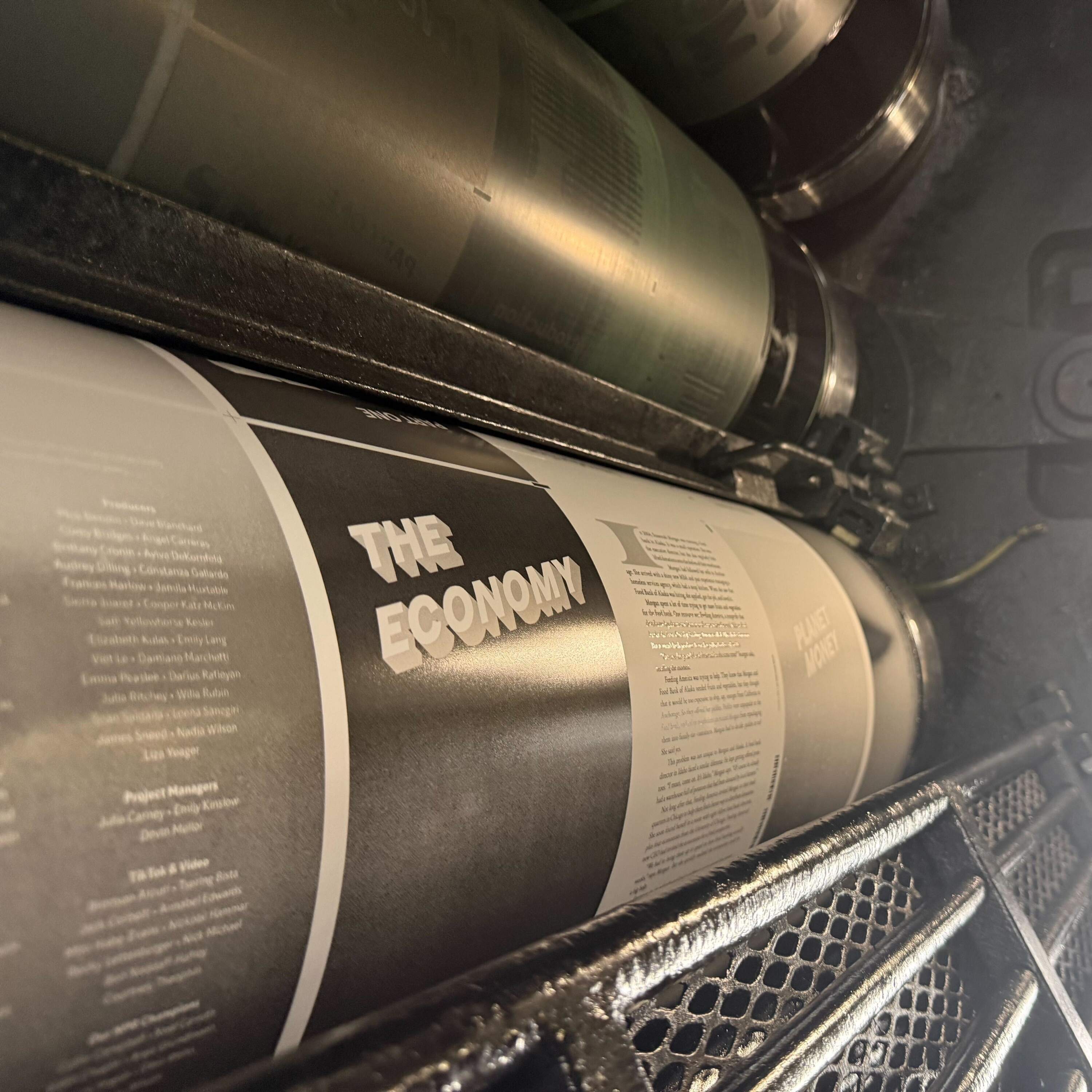
Next we walk over to the actual printing press. It's two stories tall, constantly in motion. We watch as the images engraved on the plates are transferred one color at a time onto a seemingly endless roll of giant paper. The paper is then cut into sections containing 16 pages each, and those are folded into page sized booklets. So each book is printed in little batches like this. They'll print thousands of copies of pages one through 16, then move on to pages 17, 32, and on and on until the last page. Those booklets are then stacked sequentially on top of each other to build the whole book. And those stacks are then glued and bound together and sealed in a Hardcover. But beyond all the Willy Wonka wonder I witnessed at the Lakeside Book Factory, it also became clear just how big of an advantage printing domestically can be if your books start flying off the shelves. During my visit, Julia told me about how one of Norton's New Year New youw titles, a book called Eat yout Ice Cream, seemed to have made even more of a media splash than they'd expected over the holidays, climbing its way onto the bestseller list.
- [40:59]
A
Then we came back in January and needed a lot of books and the whole team got them done in two weeks.
- [41:06]
B
Because Norton had chosen to print this book domestically, all they had to do was call up Lakeside to tell them to fire up the presses, rushing new copies out to bookstores across the country to respond to the snowballing demand from ending up on the bestsellers list. Now, the whole reason that I'd come to Crawfordsville was to tag along with Julia for one of the final steps. Before the Planet Money book could roar into full on production. Julia had schlepped all the way from New York to do one final quality control check to make sure that all of the many complicated color illustrations in the book were ending up on the page exactly as intended. Julia's job now is to manually inspect each 16 page signature each section of the book one at a time, right before they hit print on each batch. She does this over and over every few hours, around the clock, over the course of three days. I meet up with Julia for one of these checks at the printing press late one night. It's almost midnight, huh?
- [42:05]
A
Yes.
- [42:07]
B
This is when the magic happens.
- [42:10]
A
Hopefully.
- [42:11]
B
The printing technicians start printing the off test copies for Julia to inspect. She pulls out a special magnifying glass that looks a little bit like a jeweler's loop.
- [42:20]
A
I'm just checking the cropping, that's what I'm checking.
- [42:24]
B
And she starts to meticulously pour over every pop of color in this section of the book. She's looking for fuzzy edges or smears
- [42:32]
A
and also just the overall saturation, like the ink being solid on the page. No streaks, no white spots, no hickeys. There were a few hickeys on the first form. It looked like a little circle.
- [42:46]
B
They actually call them hickeys?
- [42:47]
A
Yes, they actually call them hickeys.
- [42:49]
B
That's kind of cute.
- [42:49]
A
Yes.
- [42:50]
B
Then Julia notices a problem.
- [42:53]
A
What I'm seeing here is a little black.
- [42:55]
B
I think I can move the black
- [42:56]
C
just a little bit.
- [42:57]
A
Thank you.
- [42:58]
B
She tells Trevor Simpson, one of the people overseeing the printing, what she would like changed. So what have you Noticed a tiny kind of out outline of black around this red circle.
- [43:07]
A
Yeah. A little bit of black and it's making it look a little bit jagged right here.
- [43:12]
B
It's like it's got a little bit of eyeliner on maybe. I have to say, a lot of these are levels of detail. I'm not sure I would spy in the wild.
- [43:20]
A
No, I know. Not at all. Most people wouldn't notice this.
- [43:23]
B
We just want it as close to perfection as humanly possible.
- [43:26]
A
Start there.
- [43:28]
B
After tweaking a few settings on the printer press and waiting for new copies to pop out, Trevor brings the fresh test run to Julia.
- [43:35]
C
I think it looks better.
- [43:36]
B
Is it dead on?
- [43:37]
C
We're not going to get much closer than that. You can see the black.
- [43:41]
A
I think that looks better.
- [43:42]
D
I think it's cleaned up the type,
- [43:43]
A
so I think it looks better.
- [43:44]
B
All right. So that one just got approved. Yeah, she likes it. And those are as well. This is kind of like locking it in for. For its ride.
- [43:51]
F
Yeah, for the whole run.
- [43:53]
B
Exactly. Finally, around 30 minutes after midnight, Trevor gets Julia's final approvals for this 16 page section of the book so they can start printing those hundred thousand or so copies. Then at 4 in the morning, Julia will come back to the factory and do it all over again for the next section of the book. I take that as my cue to bid farewell to Julia and Trevor and Chris and all the other fine folks I met in Crawfordsville.
- [44:19]
A
Safe travels.
- [44:20]
C
Thank you.
- [44:21]
A
Good luck putting the all this together.
- [44:23]
B
Likewise. Since going down this rabbit hole into the world of publishing, I think I've gained a new appreciation for the monumental effort that goes into making even one little book. All of the people and countless decisions and sleepless nights that you are holding in your hands every time you pick one up. That feeling really hit me. One afternoon a few months back, I was walking with my grand boss, Alex Goldmark, through the streets of midtown Manhattan. Okay, and today is kind of an exciting day. What are we here to do?
- [44:55]
F
Today is a big day that we've been waiting like years for. We're gonna get to look at our book. We're going to unbox the very first physical copies that have existed, and we're gonna get to look at them and see what they look like as an actual book. Hold it in our hands at the pages and maybe it'll feel a little more real right now.
- [45:13]
B
You ready to go see the Planet Money book?
- [45:15]
F
I am ready to go see the Planet Money book. Yeah.
- [45:17]
B
Let's do it. We head up to Tom out The window, you can see the two stone lions guarding the entrance to the New York Public Library. And on the shelves of his office, you can see a smattering of the nearly 200 books that Thomas helped shepherd into the world over his career.
- [45:34]
D
Yeah. And on my desk is the first box of the Planet Money book.
- [45:38]
B
They have arrived.
- [45:40]
D
They are right here. Do you guys want to open them?
- [45:42]
B
We desperately do.
- [45:46]
D
You know, there's something about this part of the process that never gets old. For me, it's like the thing that was in your mind, this thing that was just an idea in an author's head, goes from this, like, document on your computer to piles of paper that you've been scribbling on to hours, long phone calls with the author about arguing over this paragraph or whatever. And then all of a sudden, there's an actual book in your hand and it just feels magical.
- [46:08]
F
Yeah, I'm getting anxious here and antsy.
- [46:10]
D
Do you want to do the honors?
- [46:12]
B
After nearly three years since sealing the deal with Norton, Alex is eager to finally see the Planet Money book.
- [46:18]
D
You want to wield the Ceremon Blue Scissors special?
- [46:21]
F
Blue scissors. Yes. Yes, I do.
- [46:23]
D
All right.
- [46:24]
B
Feels like Christmas.
- [46:27]
F
Okay,
- [46:36]
B
There we go.
- [46:37]
F
I see the logo.
- [46:38]
C
There it is.
- [46:40]
B
At long last, the Planet Money book was finally here. We handle it delicate, Kitley, almost like a freshly delivered newborn. We flip through the pages, checking to make sure they're all there, that there are no signs of eyeliner marks or smudges. We give the book a little sniff, and while it doesn't exactly smell like money yet. Do you think we have a bestseller on our hands?
- [47:03]
D
I think this book should be a bestseller, but we don't know what the outcome is going to be.
- [47:08]
B
Tom says the answer to that question will actually come down to a final series of gatekeepers. Bookstores and booksellers get to decide whether it ends up on some obscure shelf in a back corner or stacked in a big pile prominently displayed at the front of the store, or whether it's even stocked at all.
- [47:27]
D
How do you get someone who's being pitched hundreds and hundreds and hundreds of new titles every week to say this book and not that one?
- [47:36]
B
There's now an even bigger question for us to answer. Once you have gone to the trouble of making a book, how do you actually sell it? That's coming up in a couple weeks on Planet Money. If you want to hear the story of how Planet Money got a book deal in the first place, listen to the episode in our feed called Inside Inside A Book Auction. If you want to see video of the Planet Money book rolling hot off the presses? Check out Planet Money's Instagram and TikTok. And if you want to help us sell out that initial print run, you can pre order the book right now. And remember that poster we wanted to make about the laws of the office but was too expensive? We actually did end up making it, but it is only available to people who pre order the book before April 7th. For the details, go to planetmoney moneybook.com this episode was produced by Willa Rubin with help from Emma Peaslee. It was edited by Jess Jiang, Fact Checked by Sierra Juarez and engineered by Robert Rodriguez. Alex Goldmark, My grand boss is also our Executive producer. I'm Alexi Horowitz Ghazi. This is npr. Thanks for listening.
- [49:00]
H
This message comes from Northwestern Mutual. One of the biggest money mistakes people make is putting off working with a financial professional. Northwestern Mutual will match you with a financial professional to build a plan based on what's important to you, finding new opportunities to help grow your wealth and protect what you've worked so hard for. Find a better way to money@nm.com the Northwestern Mutual Life Insurance Company, Milwaukee, Wisconsin and Northwestern Mutual Wealth Management Company. This message comes from Alexa. The all new Alexa will do more so you don't have to chat naturally while Alexa learns your style, anticipates what's next, and makes it happen free with prime on your Amazon devices. Learn more@Amazon.com Alexaplus this message comes from
- [49:47]
E
Capital Group what does Leadership really look like? On the Power of Advice, a new podcast series from Capital Group. You'll hear from athletes, entrepreneurs and executives who've led on the field, in the boardroom and in their communities. It's not about titles, it's about impact. Discover what drives them and the advice they carry forward. Subscribe and start listening today. Published by Capital Group, Inc.