Loading summary
Transcript177 lines
- [00:00]
Commercial Announcer
This message comes from US Bank Simplify how you do business with business essentials. A powerful combination of no monthly maintenance fee checking and card payment processing. Deposit products are offered by U.S. bank National association member FDIC.
- [00:17]
Kenny Malone
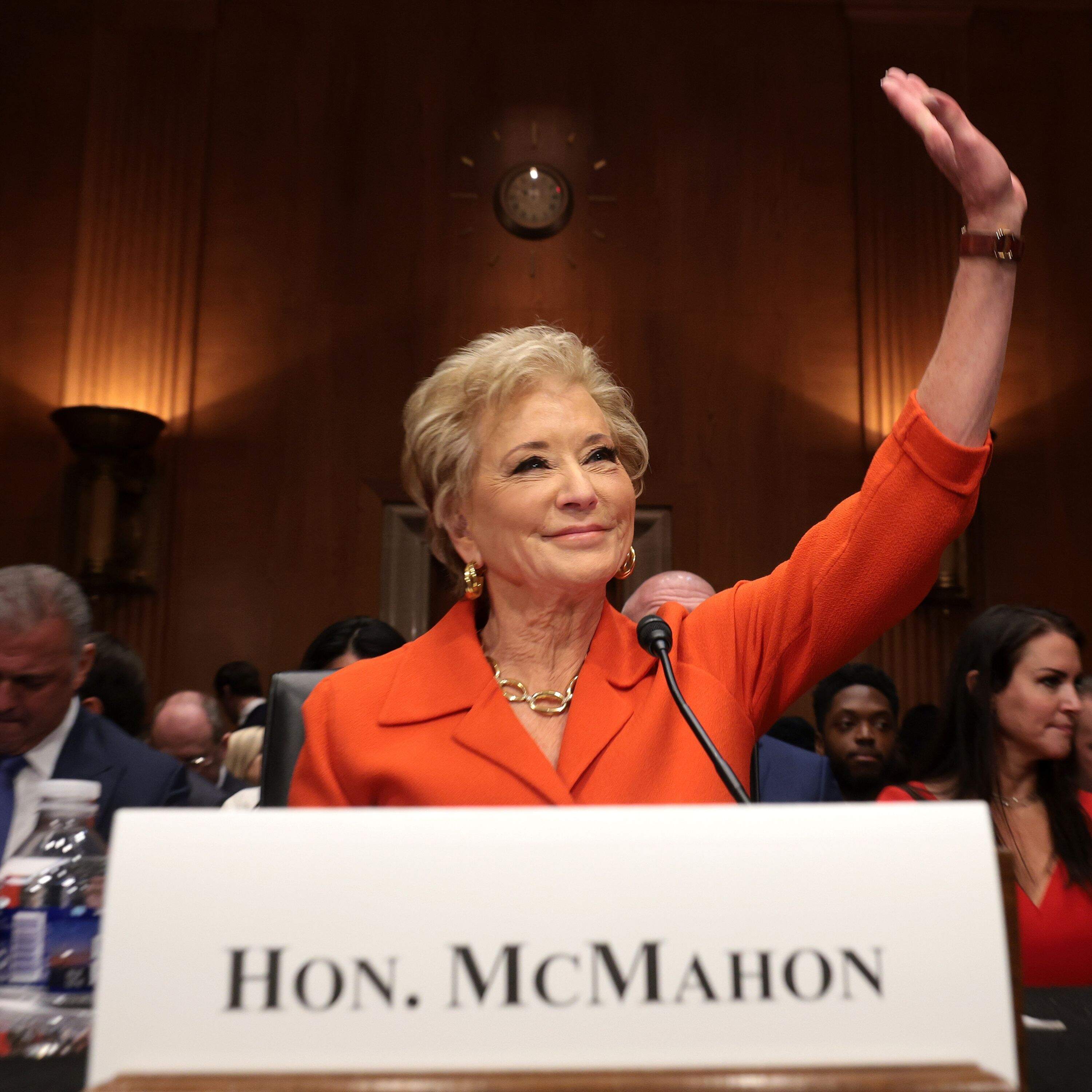
This is Planet Money from NPR. The Trump administration is taking a new approach to a very sticky problem in the United States, that of student loan debt, all nearly 1 point trillion of it. The Department of Education has a plan to bring down tuition costs beginning today, July 1st. What is that plan? Well, Education Secretary Linda McMahon recently described it to lawmakers at a committee hearing on Capitol Hill. We want to bring down the cost of education. Yeah, so far so good. Following that. Then she describes this big change to the federal program that loans students money for school.
- [00:59]
Cory Turner
We've put in caps on programs for graduate students and undergraduate students to make sure that we can help reduce the
- [01:08]
Preston Cooper
cost and the burden of college.
- [01:10]
Kenny Malone
Yeah, actually hold there for a second because that, that is the confusing bit for me. I believe she said to quote, help reduce the burden of college. The plan is to give less money to student borrowers.
- [01:26]
Cory Turner
And that's where I, I was really intrigued by their logic.
- [01:30]
Kenny Malone
This is Cory Turner, covers education for npr. Every time I run into Corey at the like NPR coffee machine, he will tell me something about some new thing happening in education and then months later the thing has exploded into a front page story. And that is why I listened to Corey recently when he told me to go check out Secretary McMahon's tuition fighting plan. So that plan basically is starting July 1st if you want get a graduate degree in most fields. The Department of Education, the biggest lender for student loans is saying that they're only going to give you about $21,000 a year. That is the cap if your tuition costs more than that. Well, sorry, the ed department is not lending extra to cover it.
- [02:15]
Cory Turner
The administration's logic is based on this sort of old idea and that is that if there's a lot of federal student aid floating around in the higher education marketpl colleges have no incentive to lower their prices. And so if they cap federal student loans specifically for graduate students, then the hope is colleges and universities all over the country will have no choice but to then lower their prices.
- [02:50]
Kenny Malone
I have many follow up questions.
- [02:54]
Cory Turner
Yeah, so it sounds logical. The question is, is it actually tr
- [03:02]
Kenny Malone
hello and welcome to Planet Money. I'm Kenny Malone.
- [03:03]
Cory Turner
And I'm Cory Turner.
- [03:05]
Kenny Malone
And Cory, I believe you have now called basically anyone who has had a hand in trying to study whether or not this proposal stands a chance to work.
- [03:12]
Cory Turner
That's right.
- [03:13]
Kenny Malone
Today on the show, Corey tells us what he's found and tells us the roots of this. Less money, less tuition problems? Is that what they're calling it?
- [03:22]
Cory Turner
Lower loans, lower prices? I don't know.
- [03:25]
Kenny Malone
It might need workshops. Whatever the name of this is, the roots of this particular solution.
- [03:36]
Commercial Announcer
This message comes from Capital One. Capital One offers checking accounts with no fees or minimums. What's in your Wallet, terms apply. SeeCapital1.com BankGuy for details. Capital One NA member, FDIC support for NPR and the following message come from Rippling. These days you can chat with AI about almost any business problem, but rippling AI is designed to actually solve them. That's because rippling AI is built on your live global workforce data. So it doesn't just uncover insights into your business, it uses them to take complex actions across your departments. Ready for AI that isn't all talk. Head to rippling AI, slash money and get AI that turns insight into action. That's R I P P L I N G A money sign up today.
- [04:30]
Kenny Malone
So we're gonna bring college prices down. That's what we're about to do today.
- [04:33]
Cory Turner
Yeah, I'm excited. College prices, look out. You're going down.
- [04:37]
Kenny Malone
Today we have invited NPR's Cory Turner over to our Planet Money House because big things that may affect you, that may affect your kids, your higher ed dreams, they are happening.
- [04:48]
Cory Turner
There's a consensus that there's a problem with the size of federal student loan debt in America. The question is, how do we fix the problem moving forward?
- [04:59]
Kenny Malone
Give less money, Give less money out.
- [05:01]
Cory Turner
That is their proposal. And so I may I ask, before
- [05:04]
Kenny Malone
we address that, is the problem that the money is being given out or that the money is needed that college is so expensive?
- [05:15]
Cory Turner
Why would you ask such a Gordian knot of a question?
- [05:20]
Kenny Malone
I see. Okay. For the rest of the episode, we will try to untie that knot to understand what problem the Trump Department of Education is trying to fix, specifically why they think less money is the right approach and simply will it all work. But first, something we must address, the administration's plan.
- [05:40]
Cory Turner
The changes going into place today, I mean, they will affect some loans for undergrads through a program that lets parents borrow for their kids. But really what we're talking about here, the huge change is not about undergrad. It's all about grad school.
- [05:58]
Kenny Malone
And like what? Well, prepare to have your mind blown.
- [06:04]
Cory Turner
So here's the weird thing. So the cost of undergraduate college is not rising.
- [06:10]
Kenny Malone
What?
- [06:11]
Cory Turner
The net price of undergraduate four year programs has been stagnant for roughly 10 years.
- [06:19]
Kenny Malone
Why? Cory, Then whenever I run like calculations for how much I'm supposed to save for my very young children for college, it's like, oh, you might need millions of dollars. Why are people telling me that?
- [06:31]
Cory Turner
Well, so there is a chasmic difference between sticker price and net price.
- [06:39]
Kenny Malone
Ah, got it, got it. Sticker price is what people actually pay.
- [06:42]
Cory Turner
Exactly. Sticker price has been rising steadily for a long time.
- [06:48]
Kenny Malone
Okay, send all your emails to Corey. But college net cost has not risen nearly as much as you may think.
- [06:55]
Cory Turner
Undergraduate college net cost, net net, not sticker net. Has not budged much.
- [07:02]
Kenny Malone
Corey says schools advertise eye popping tuition rates, but after financial aid and scholarships, the amount that families actually end up paying for undergraduate really has not been changing. That may be different if you're wealthy and you're not getting financial aid, but generally, yeah, grad school is the place where net tuition has really ballooned out of control.
- [07:24]
Cory Turner
That's exactly right. Whenever people like me talk about the $1.7 trillion federal student loan portfolio, a huge chunk of that is actually grad school debt.
- [07:38]
Commercial Announcer
Wow.
- [07:39]
Cory Turner
It's fewer borrowers than undergraduate borrowers. But the debt itself, so much of it is actually graduate school debt.
- [07:46]
Kenny Malone
Okay, well, let's fix that problem then, shall we?
- [07:51]
Cory Turner
Here we go.
- [07:51]
Kenny Malone
All right, so the Trump administration's fix for this problem of ballooning grad school tuition. Their idea of capping how much students can borrow. It's important to understand that it is just the latest move in what's been a decades long back and forth over how much to loan students. So caps on on how much grad students could borrow from the government were first imposed back in the late 60s. Then 20 years ago, in 2006, the Department of Education swung the other way and started offering unlimited loans, which lasted until today. And now the Department of Ed is dismantling that unlimited loan program and we're going back to caps. These new caps are just shy of $21,000 per year for most kinds of grad programs.
- [08:38]
Preston Cooper
For.
- [08:38]
Kenny Malone
For more expensive programs like medicine and law school, there is a higher cap. And this idea that caps on student borrowing could actually bring down the cost of tuition, it's been around for a long time. Corey told me at the old coffee machine. I believe that Linda McMahon's Department of Ed, they did not invent this theory, this idea. Where does the story of this idea begin?
- [09:01]
Cory Turner
Funny you should ask, Kenny. It begins on February 18, 1987.
- [09:08]
Kenny Malone
I didn't expect a specific date. I will say.
- [09:10]
Cory Turner
Okay, go on stormy night.
- [09:12]
Kenny Malone
I'm checking.
- [09:13]
Cory Turner
No, actually, I don't know what the weather was on February 18, 1987.
- [09:16]
Kenny Malone
But in what city?
- [09:18]
Cory Turner
New York. Because here, let me look at it.
- [09:21]
Kenny Malone
I will say, generally drizzly and hazy in New York City on that day. Yes.
- [09:27]
Commercial Announcer
Okay.
- [09:27]
Cory Turner
On that date was published an opinion piece by the New York Times written by Linda McMahon's equivalent, the education Secretary under then President Ronald Reagan. All right, and this opinion.
- [09:44]
Kenny Malone
Ronald Reagan's Linda McMahon.
- [09:46]
Cory Turner
Yes, exactly. William Bennett. Bill Bennett. And the opinion piece, the title says it all. He called it Our Greedy Colleges. All right.
- [09:55]
Kenny Malone
Oh, okay. Do we have this op Ed?
- [09:59]
Cory Turner
Yeah, we do.
- [10:00]
Kenny Malone
Okay, let's hear. Let's pull this up and just see.
- [10:02]
Cory Turner
Okay. Quote, many of our colleges are at it again. They have begun to unveil tuition increases that far outstrip the inflation rate. Next year, tuition is expected to rise 6% to 8%. He argued that increases in federal student aid, quote, have enabled colleges and universities blithely to raise their tuitions, confident that federal loan subsidies would help cushion the increase.
- [10:36]
Kenny Malone
Okay, we should pause there. So that's. That's the whole argument.
- [10:40]
Cory Turner
Yeah. And in fact, this idea really took hold, and economists dubbed it the Bennett Hypothesis.
- [10:47]
Kenny Malone
Okay, now, I will say this does not sound, on its face, preposterous to me.
- [10:53]
Cory Turner
No, no, I don't think it does either.
- [10:55]
Kenny Malone
Yeah. So where my brain goes immediately is we cover the Federal Reserve. They are responsible for keeping inflation at around 2%. And when they are worried about prices increasing across the economy, what do they do? Well, they make it harder to borrow money. And so, I don't know, is the DOE, to some degree, not sort of running monetary policy for one product, essentially, which is college? And so if they make it harder to borrow money, would that not be the way to fight inflation?
- [11:28]
Cory Turner
Well, Kenny, I will leave the monetary policy to you, but I will say it sounds logical. And I think that's why the Bennett Hypothesis persists to this day as a. As a kind of popular idea. The question is, is it actually true?
- [11:47]
Kenny Malone
Right. When the Bennett Hypothesis was hypothesized, it was exactly that. An untested assumption.
- [11:54]
Cory Turner
Yeah. There was no real way to test it until 2006, because that's when lawmakers decided to, I mean, really kind of do the opposite of what Bennett was saying. They decided grad students needed more money, you know, not just for tuition, but for things like rent and food and books, a laptop, while they pursued their. So it was exactly 20 years ago today that they enacted the Grad plus loan program. Which was the program that allowed unlimited borrowing for tuition, plus all that other stuff. And that move, even though it was, again, likely the opposite of what Bennett had in mind, it allowed us to test the Bennett hypothesis.
- [12:40]
Kenny Malone
Right. It provided exactly the kind of data that you would need to study whether easy access to unprecedented amounts of student loans would indeed result in. How did Bennett put it? Yes, quote, colleges and universities blithely raising tuitions to sop up more and more of the money.
- [12:59]
Cory Turner
Which is why I ended up calling about half a dozen economists and higher education experts.
- [13:05]
Kenny Malone
Corey had a simple question for all these experts. Is that theory bunk or not? I mean, what do we know for sure at this point about the Bennett hypothesis?
- [13:17]
Cory Turner
So I pored over these studies by lots of different researchers over the past 20 years about how grad plus affected students. And I'm gonna start with the study that everybody I talked to told me I needed to start with. That is most often cited by Republicans when they say, no, really, this will work.
- [13:39]
Kenny Malone
Okay.
- [13:40]
Cory Turner
Research was done in Texas, and it was specifically focused on the creation of the Grad plus program in 2006, where graduate school borrowers suddenly went from having capped loans to essentially being able to borrow as much money to cover tuition and fees as they needed.
- [14:03]
Kenny Malone
So what was the effect of that easy federal money? Well, Corey got on Zoom and chatted with one of the authors of that study.
- [14:10]
Cory Turner
His name is Jeff Denning.
- [14:11]
Jeff Denning
I am an economist and a professor at the University of Texas at Austin.
- [14:15]
Cory Turner
So what Denning said was they specifically wanted to look at when borrowers were suddenly able to take out a lot more in loans from the federal government. What effect did that have on colleges prices in Texas?
- [14:32]
Jeff Denning
Did it increase the price that colleges were charging for their graduate programs?
- [14:38]
Kenny Malone
It's like the perfect natural experiment if you want to test the Bennett hypothesis.
- [14:42]
Cory Turner
It is the perfect natural experiment. So Denning and his colleagues poured through tons of administrative data from graduate programs all over Texas, and they looked at student level details like enrollment, graduation rates, financial aid. And what they found is really interesting.
- [15:01]
Jeff Denning
And the short answer is that we found that the price did go up.
- [15:05]
Cory Turner
Was it. Was it, like, meaningfully up a little bit up? Like, how would you characterize it
- [15:15]
Jeff Denning
meaningfully up? I would say a meaningful increase in the price.
- [15:20]
Cory Turner
Denning told me that for every additional dollar that students received overall in loans, graduate schools increase their prices by 64
- [15:32]
Jeff Denning
cents, 2 thirds of a dollar, something like that.
- [15:35]
Cory Turner
And Denning and his colleagues say that this is a causal relationship that their study found because the students could borrow More. Many schools were indeed charging more.
- [15:45]
Preston Cooper
Hmm.
- [15:46]
Kenny Malone
That's what that study found. So just in Texas.
- [15:49]
Cory Turner
Just in Texas, but meaningfully meaningful.
- [15:54]
Kenny Malone
Okay, so great Bennett hypothesis, true. Problem, problem solved.
- [16:00]
Cory Turner
Not so fast, Kenny.
- [16:02]
Kenny Malone
Yes, yes, I suspect there's more.
- [16:04]
Cory Turner
So I also reached out to another researcher that lots of folks told me I need to talk to if I'm digging into the Bennett Hypothesis. And his name is Robert Kelchen.
- [16:15]
Robert Kelchen
I'm a professor of higher education at the University of Tennessee, Knoxville.
- [16:19]
Cory Turner
So unlike Denning and his colleagues on the Texas study, Kelchin, rather than studying a state or an area, he focused in specifically on different fields of study.
- [16:30]
Robert Kelchen
I did research looking at business, medical, and law schools across the country.
- [16:34]
Cory Turner
So what was the impact of limitless borrowing on traditionally pretty expensive graduate school programs? And what he found?
- [16:43]
Robert Kelchen
I did not find evidence, quote, I
- [16:46]
Cory Turner
did not find evidence of the Bennett Hypothesis, meaning no evidence that there's a direct connection between student loans and tuition prices.
- [16:55]
Robert Kelchen
There's some evidence in favor, particularly at
- [16:58]
Cory Turner
for profit colleges, but he says it's based on a kind of cynical understanding of graduate school. Basically that the Bennett Hypothesis is a logical conclusion if you're only looking at at certain types of schools.
- [17:12]
Robert Kelchen
It's a logical conclusion if you think that these graduate programs are massive profit centers. And some programs, fields like business, can be quite profitable, but other fields, for example, medical school, is wildly unprofitable.
- [17:29]
Cory Turner
And Kelchin's point is there are a lot of graduate fields of study that aren't that profitable because they are so expensive for the schools to offer.
- [17:38]
Robert Kelchen
It can take a million dollars of resources to produce one medical degree. So limiting borrowing is not going to reduce that cost.
- [17:47]
Cory Turner
You know, the labs, all of the different services they have to provide to students, and you can imagine the schools are operating on a relatively thin margin.
- [17:57]
Robert Kelchen
Even if we assume that institutions raised prices when loans became available, it doesn't mean that they have the space to move in the opposite direction.
- [18:05]
Cory Turner
But part of what Kelchin is saying is the reason these programs are expensive for students is they're expensive for the schools. So it's not so easy for them to cut prices. It's not that they're hugely inflated. I mean, some are, but not all of them.
- [18:28]
Kenny Malone
So we've got some serious mixed evidence about whether the Bennett Hypothesis could work. Nevertheless, this massive and sudden experiment is going forward today, the day we are publishing this episode. And so the people going to grad school this fall are already scrambling to make it work. We've got more on what the research says about how they're most likely to react after the break.
- [18:59]
Commercial Announcer
This message comes from Capital One. Capital One offers checking accounts with no fees or minimums. What's in your wal terms apply? Seecapitalone.com bankguy for details. Capital One NA member FDIC this message comes from BetterHelp.
- [19:16]
Narrator/Reporter
People talk about mental health more openly now, but asking for help can still feel hard. BetterHelp's 2026 State of Stigma report surveyed 2,000Americans and found that 85% believe getting support is wise, yet 74% say society discourages people from doing so. Don't let stigma stand in the way of support. Start therapy with BetterHelp. Visit betterhelp.com NPR this message comes from American Home Shield. It's not a matter of if an appliance or system like your H Vac will break, but when. Without a home warranty, these repairs or replacements can cost thousands. But with an AHS home warranty, they will fix covered breakdowns, helping protect your wallet. Get 20% off all plans@ahs.com NPR and see promo details. See ahs.com contracts for coverage details, including service fees, limitations and exclusions.
- [20:15]
Kenny Malone
Okay, so mixed conclusions on whether and when the Bennett hypothesis is correct, meaning the evidence linking how much people can borrow to how much grad schools charge for tuition depends on lots of things. But Corey also talked to some other researchers about this new Trump administration plan, which restores the idea of loan caps from 20 years ago. And actually the loans end up being even more limited than before because they don't take 20 years of inflation into account. So, so we asked Corey, like, how do the people you talked to think this move is gonna play out?
- [20:53]
Cory Turner
So I talked to Preston Cooper at the conservative leaning American Enterprise Institute.
- [20:59]
Preston Cooper
So I think, you know, going forward, it's important to remember that the new loan limits are still relatively high and that actually most students are already borrowing within the new loan limits.
- [21:11]
Cory Turner
These new loan caps are probably only going to affect about 30% of grad school borrowers because the vast majority of folks, Cooper says are right now borrowing within the new loan limits.
- [21:23]
Kenny Malone
Oh, that's interesting.
- [21:24]
Cory Turner
Yeah. And, and his point is that the point of these new loan caps is basically to put downward tuition pressure on some of the most expensive schools out there, including, by the way, some pretty elite name brand schools. One analysis from the peer center found that the two schools at the top of this list with the most affected borrowers are NYU and usc.
- [21:50]
Preston Cooper
If students don't go to that absurdly priced university and instead choose a more reasonably priced institution for the same basic degree path. That creates a lot of pressure on the high priced institutions to actually do something to lower their prices.
- [22:05]
Cory Turner
He's put together some fascinating scatter plots that show say, like a master's in social work and all of the programs in the United States that offer a master's in social work. And you can see he maps where the new loan limits are and the vast majority of programs fall within the limits. But then there are some quite well known and respected schools who for one reason or another are charging two or three times as much for the same degree that you could get at a public university next door.
- [22:39]
Commercial Announcer
Huh.
- [22:40]
Preston Cooper
So, yes, I don't want to promise that in the first year where everybody's going to slash their costs and you know, it's going to, it's going to be great. But I do think that this is going to create, you know, some pressure over time, whether that's through students choosing cheaper institutions or through institutions realizing that they can't just raise their the price every year and pass it along to students through the federal loan program. This is going to create some real pressure for cost control in the medium run.
- [23:07]
Cory Turner
So in the next couple of years, the Bennett hypothesis could maybe lower tuition sometimes at some places. The experts I talked to pretty much agreed on that. Robert Kelchin at the University of Tennessee, he told me he expects to see at most a small decrease in tuition.
- [23:28]
Robert Kelchen
Students may become a bit more price sensitive, shop institutions a little bit more.
- [23:32]
Cory Turner
And then Jeff Denning, who was one of the researchers on that Texas study, again, that is most often used by Republicans to justify this move, he told me it's possible we'll see price cuts.
- [23:46]
Jeff Denning
It's not out of the realm of possibilities that prices would reduce.
- [23:50]
Cory Turner
And a handful of schools have already said in response to this new program they're going to lower their prices because they know students can't borrow as much.
- [23:59]
Jeff Denning
There will be less federal aid available. But the question is how will the private market respond? How will students respond? You know, I don't have a crystal ball. I wish I did.
- [24:11]
Kenny Malone
So no one has a true crystal ball as to how much, if at all, these caps will bring down the price of grad school. But Corey, how do we think students will respond to this? Do we know that?
- [24:23]
Cory Turner
So, Kenny, one of the folks I talked to is another friend of the
- [24:28]
Kenny Malone
show, friend of my beat, a regular Cory Turner contributor.
- [24:31]
Cory Turner
A regular Cory Turner contributor. Her name is Dominique Baker. She's an associate professor of education and public policy at the University of Delaware. And she told me that there's really robust evidence around what happens when you cut financial aid for students. And she said one of the things that most often happens is people just stop enrolling when you cap financial aid
- [24:56]
Preston Cooper
like a student loan, but don't provide some commensurate type of grant or scholarship to help. The number one thing that happens is
- [25:04]
Cory Turner
that students stop going to college.
- [25:06]
Preston Cooper
And that is consistent across the research literature.
- [25:10]
Cory Turner
And Baker says, though we're not sure that's likely going to be true for grad students too. They're either going to leave school or turn to a private lender to try to get a loan. And Robert Kelchin was also telling me students are scrambling right now to figure out how to pay for school this year.
- [25:28]
Robert Kelchen
Can they find money of their own? Can they go to the private market and find a loan? Universities are trying to figure out how many students are willing to attend if they have to find money from a source other than the federal government.
- [25:39]
Cory Turner
So you've got lower income borrowers. What are they going to do? I mean, you could say, well, they'll go to the private student loan market, but the private student loan market is not what it used to be. And that's because it used to be a key source of borrowing for students. Lots of people leaned on it. But when federal grad loans became unlimited 20 years ago, there was this mass exodus out of private loans into the federal system. So there was little reason for students to take take out private loans. And so the private industry shrank. And now it could be way harder to get a private loan. If you're a lower income borrower with, you know, let's just say a short credit history or maybe a suboptimal credit history, you might not be able to get a private loan.
- [26:24]
Kenny Malone
Well, let me, if I put my sort of ruthless economic theory hat on
- [26:29]
Commercial Announcer
here,
- [26:31]
Kenny Malone
that is what it looks like when demand for a product drops, right? It's fewer people enrolling means fewer people are asking for a college degree, or in this case, a graduate degree. And in theory, is that not the signal that is meant to be sent to these grad programs? You're too expensive. People are not going to enroll.
- [26:53]
Cory Turner
Yeah, I think there's some truth to that, Kenny. And I also think that's not a bad message to send to some of these schools. I, I think it's reasonable to tell those schools we're going to make this money harder to come by for borrowers because we don't think you're giving them a Good return on their investment.
- [27:12]
Kenny Malone
Right.
- [27:12]
Cory Turner
And since they're borrowing taxpayer dollars, you know, the message to these schools is we're done. We're not going to lend unlimited money.
- [27:21]
Kenny Malone
I guess the cruel thing about this particular message to send is that you must use people who want a degree as the messenger. Not that I have a better way to send the message.
- [27:32]
Cory Turner
Well, I don't.
- [27:33]
Narrator/Reporter
Yeah.
- [27:33]
Cory Turner
I don't know if this metaphor is apt. But the way I, my brain keeps thinking of it is as a game of chicken. I feel like the Trump administration is playing chicken with schools.
- [27:46]
Kenny Malone
The game of chicken is the administration saying, get your prices down or else. We're not going to use taxpayer backed loans to send people to your program.
- [28:00]
Cory Turner
Get your prices down or we're going to make it so that you have a hard time filling your enrollment. And the trick there is that it's really the borrowers who are the ones having to make those hard choices.
- [28:11]
Kenny Malone
Does anybody have a better idea for how to get grad school costs down?
- [28:19]
Robert Kelchen
No.
- [28:22]
Cory Turner
Yeah, I mean, well, one proposal I've heard from folks is like, make the lending program more supple. You know, lend borrowers what is appropriate for their field of study.
- [28:37]
Kenny Malone
Okay.
- [28:38]
Cory Turner
And one of the things the department is also doing, which Republicans created in their one big beautiful bill, is they're implementing a brand new, what's called a do no harm provision, where all college programs are going to be evaluated on the return on investment to their borrowers. So, like, if a college program, if its graduates don't end up earning more than a high school graduate who didn't go to college, that college program is going to lose access to federal loans entirely.
- [29:11]
Kenny Malone
Entirely.
- [29:12]
Cory Turner
Entirely.
- [29:13]
Kenny Malone
So just, I don't know, would you even call that a cap?
- [29:16]
Cory Turner
No, I call it a death sentence.
- [29:20]
Kenny Malone
Right, right. Well, I suppose some might say that that is a pretty severe incentive to make sure there's a return on your degree.
- [29:28]
Cory Turner
Yeah.
- [29:29]
Kenny Malone
All right, Cory Turner, thank you very much.
- [29:32]
Cory Turner
Kenny Malone, I appreciate you asking me on.
- [29:46]
Kenny Malone
By the way, there are a bunch of student loan changes happening today, July 1st. It's not just this big giant one. Corey has a big digital story on the NPR website with a choose your own adventure component. So I recommend playing it through multiple times. Choose all of the adventures. Corey is also over on our sibling podcast, the Indicator, talking about all of those changes.
- [30:08]
Cory Turner
And. But while you're at it, help us put the planet in Planet Money summer school. Please give us a tip of some economic success from somewhere outside the USA that the rest of the world should know. About. Maybe it's a different way to do home loans or a story about job creation that actually worked. Email us@planetmoneypr.org and put Summer school in the subject line. This episode was produced by Willa Rubin and edited by Marianne McCune. You it was fact checked by Charlotte Isidore and engineered by Robert Rodriguez. Alex Goldmark is our executive producer. Special hat tip to friend of the show, Corinne I'm Cory Turner.
- [30:47]
Kenny Malone
I'm Kenny malone. This is NPR.
- [30:50]
Cory Turner
Thanks for listening.
- [31:04]
Kenny Malone
You know, every day on Up First, NPR's Golden Globe nominated morning news podcast. We bring you three essential stories. the heart of each story are questions what really happened? What really mattered? What happens next? At npr, we stand for your right to be curious and to follow the facts. Follow up first wherever you get your podcasts and start your day knowing what matters and why.
- [31:29]
Cory Turner
The fatal shooting of a teenager at
- [31:31]
Narrator/Reporter
a protest in Seattle has gone unsolved for six years.
- [31:34]
Kenny Malone
This is open in your face. How are there no answers?
- [31:38]
Narrator/Reporter
Our investigation has uncovered new evidence and witnesses who say they've never talked to police.
- [31:43]
Kenny Malone
Did police ever call you?
- [31:45]
Cory Turner
Not once.
- [31:46]
Narrator/Reporter
Listen to We Keep Us Safe, a new true crime series on the embedded podcast from N.