Loading summary
Transcript56 lines
- [00:01]
Narrator/Reporter
This message comes from Instacart. Let's talk groceries. Specifically your groceries. With Instacart, you want your groceries just the way you like them, right? Well, the Instacart app lets you do just that. They have a new preference picker that lets you pick how ripe or unripe you want your bananas. Shoppers can see your preferences up front, helping guide their choices. Instacart get groceries just how you like.
- [00:25]
Jeff Guo (Planet Money Host)
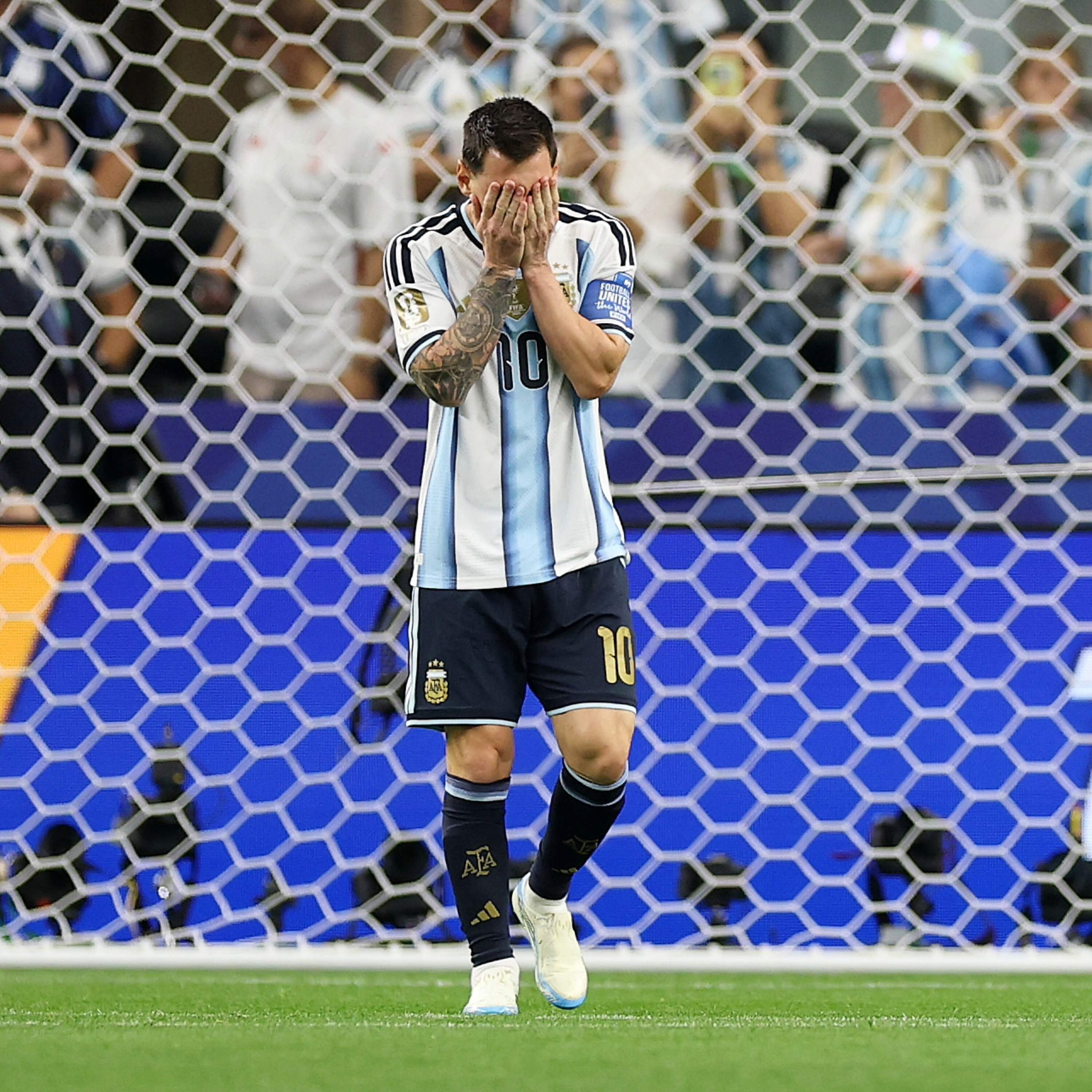
This is Planet Money from npr. Last week, one of the best soccer players of all time did something kind of shocking. Lionel Messi missed a penalty kick. The top World cup scorer of all time is actually a slightly below average penalty kicker. He's in the running for missing the most penalties of any player in World cup history. Somehow, Messi is worse at scoring when he's just 12 yards from the goal with no one but the goalie between him and the back of the net. And that might be because there's another skill at play when it comes to penalty kicks. It's not just about how good you are at kicking the ball. It's about something we here at Planet Money love. Game theory. Hello and welcome to Planet Money. I'm Jeff Guo. The use of game theory in soccer penalties might be one of the most interesting applications of economic theory, like, ever. Today on the show, we hear from the folks at the Soccer Nomics podcast about the art and strategy of the penalty kick. In a World cup year where there might be more games going to penalties than ever before, we're going to learn how game theory has changed the sport.
- [01:40]
Sponsor/Advertisement Voice
Support for NPR and the following message come from Rippling these days you can chat with AI about almost any business problem, but rippling AI is designed to actually solve them. That's because rippling AI is built on your live global workforce data. So it doesn't just uncover insights into your business, it uses them to take complex actions across your departments. Ready for AI that isn't all talk? Head to rippling AI Money and get AI that turns insight into action. That's rippling. Sign up today. This message comes from Capital One. Capital One offers checking accounts with no fees or minimums. What's in your wallet? Terms apply. Seecapital1.com BankGuy for details Capital One NA Member FDIC okay, so the whole point
- [02:35]
Jeff Guo (Planet Money Host)
of game theory is to come up with and analyze winning strategies. And where it gets fun is that in any game, your opponent, of course, is trying to anticipate your strategy and vice versa. So your strategy depends on what you think they think you think they Think you think they think they're gonna do, right? Like game theory is probably the best subject to study if you are an overthinker. And nowhere are these mind games more cinematically laid than on the soccer field when it's time for a penalty kick. Stefan Schmejsky is one of the hosts of the podcast Soccernomics. He's a retired professor at the University of Michigan and an expert in the economics of sports. And he says if you watch elite penalty kickers, they are not always taking the shots that they are the best at.
- [03:24]
Stefan Schmejsky (Soccernomics Host)
Everyone who takes a penalty has a good side and a bad side. Almost everybody. And you might think that you'd always shoot to your best side, but if you do that, you're predictable. And so what you have to do is sometimes, even though your chances of scoring are lower, you actually want to shoot to your worst side. And what you have to do is do this in a way that's unpredictable. And that's what's called in game theory, a mixed strategy. Now, picking a sequence of random numbers is quite a difficult thing to do. To choose at random, left or right in a sequence, left, right, right, right, left, right, left, so on. That's actually very hard to do. Most people aren't very good at it. And that's what you have to do with penalty taking. Sometimes you have to go one way, sometimes you have to go the other way, but you have to do so in a way that's completely unpredictable. And footballers turn out, professional footballers turn out to be very good at picking those random sequences.
- [04:18]
Jeff Guo (Planet Money Host)
Now, in this game, of course, it's not just the penalty kicker who's trying to be unpredictable. Another host of the Soconomics podcast, Ashish Malhotra, points out that the goalie is also thinking about how to be unpredictable.
- [04:30]
Stefan Schmejsky (Soccernomics Host)
So it's two simultaneous people sort of thinking about this in this way and also sort of knowing. If I know that he knows what my tendencies are, then that's going to complicate it further. That's exactly right. What's happening here is that both sides are in a mirror image situation. The penalty taker's trying to choose whether to go left or right. And the goalkeeper, if the penalty is well taken, that doesn't have time to react to the direction, has to choose before the ball is hit which way to dive. And they're then choosing what is their best strategy. Dive left or dive right. And they have the same problem because goalkeepers are often better going one way or going the other. And so what it turns out is the goalkeepers are also good at constructing these sequences as well.
- [05:16]
Jeff Guo (Planet Money Host)
By the way, in economics, these random mixed strategies, they actually used to be fairly controversial. There were economists who didn't think that people used mixed strategies in real life, partly because most people are just really, really bad at being truly random.
- [05:32]
Stefan Schmejsky (Soccernomics Host)
People tested this in laboratories with very simple experiments, offering students a few dollars to try and choose between alternatives and see if they could construct these random sequences of choices, and they couldn't. They weren't very good at it. So people started to say, oh, this mixed strategy theory is not up to much. And then what happened was a few economists came up, including Ignacio Clasio Swerter, who we're going to talk about a lot of, actually studied penalty shooting and found out that the choices of penalty takers in practice almost exactly match the theory. So this was the sort of a breakthrough in game theory to be able to demonstrate that this concept of the mixed strategy, which many academics have been quite skeptical about as a practical strategy, that kind of showed that this really did work and that people could do it if it was important enough. And, of course, in professional football, penalty taking is pretty important.
- [06:29]
Jeff Guo (Planet Money Host)
Now, just as an aside, for those of us who aren't elite soccer players, this research into mixed strategies is still really important. They show up in everyday life like, this could help you win your next game of rock paper, scissors. You see, according to game theory, the best possible strategy in rock paper, scissors is a mixed strategy. You want to be perfectly random, so your opponent can't predict whether you're gonna go rock or paper or scissors. But in real life, people are never perfectly random, right? Say you go rock, like, three times in a row, there's this big psychological temptation to go scissors or paper next time. And your opponent knows that. This is where the mind games come in. There's actually an entire world of competitive rock, paper, scissors players. Back in 2007, they even aired the championships on ESPN.
- [07:19]
Peter Sagal (Wait Wait, Don't Tell Me Host)
And.
- [07:19]
Jeff Guo (Planet Money Host)
And the entire basis of this competition is that at the elite level, you're trying to exploit your opponent's tiny little deviations from that perfect random strategy. Now, in professional soccer, once people started to realize that there was this optimal mixed strategy for penalty kicks, you started to see teams collecting data on their opponents to see who was good at being unpredictable and who. Who wasn't. Simon Cooper is another one of the hosts of the Soccer Nomics podcast. He's a journalist and a soccer commentator, and he explains how one economist led a kind of data revolution in penalty shootouts.
- [07:57]
Simon Cooper (Soccernomics Host)
Well, for a long Time. Almost nobody is tracking how people take penalties. And of course, there isn't much TV footage in the 80s and 90s of many leagues. So it's hard to know, you know, what the guy's penalties have been really until into the 2000s. Almost no teams are using records of how people have taken penalties. But the one guy who has this is an economist, a friend of ours, Ignacio Palacio Suerta. And he, from the 90s, is mapping. He's collecting this database of thousands of penalties. His wife and his mother are sending him videos of penalties from Spain and elsewhere. And he is creating the best database in the world of how footballers are taking penalties. And so you got this weird situation that this guy who's a graduate student at Chicago, he knows more about the habits of penalty takers than any club, even though he doesn't need the knowledge. And they desperately do. So when does this come to the fore? 2008 Champions League final. Chelsea. Manchester United.
- [09:00]
Jeff Guo (Planet Money Host)
So dramatic. The Champions League. This tournament features the top club teams in Europe. And ahead of the 2008 championship match, the manager of one of the teams in the final, Chelsea, had heard about Ignacio's database and asked him for his help.
- [09:17]
Simon Cooper (Soccernomics Host)
So Ignacio ends up writing a penalty report on Manchester United for Chelsea. And then, of course, the game goes to a penalty shootout. I'm in the stands in Moscow. It's about one in the morning when the shootout starts, because it has to be prime time in Western Europe. And what does Ignacio's crib sheet say? It has some amazing advice. So, for example, Ronaldo, the young Cristiano Ronaldo, when he pauses in his run up, the keeper should never move because Ronaldo watches what the keeper does. And when he pauses in his run up, he usually shoots. Right. If you watch the penalty shootout, knowing Ignacio's advice is absolutely thrilling. Cristiano Ronaldo, the world is watching. So Peter Cech, the Chelsea goalkeeper, follows this advice.
- [10:02]
Sponsor/Advertisement Voice
Big step.
- [10:03]
Simon Cooper (Soccernomics Host)
And he waits and he looks. And Cech stands big. And Cech dives right, stops Ronaldo's penalty. And Cech has saved from Ronaldo, of all people.
- [10:12]
Jeff Guo (Planet Money Host)
Yeah, it seems like the Chelsea goalie is following the economist's advice to a te. But the most important advice that Ignacio has for the team might involve what Chelsea's penalty kickers should do, how they can outsmart the opposing goalkeeper. Manchester United's Edwin van der Sar.
- [10:28]
Simon Cooper (Soccernomics Host)
And Ignacio, says Fondassara, the United keeper doesn't really follow a mixed strategy of randomizing. He dives too often to his right. And so clearly, the Chelsea Players got the note.
- [10:40]
Jeff Guo (Planet Money Host)
Yeah. There are clips of this all over the Internet. We'll link to one of them in our show notes where you can see player after player shoot to the Manchester United keepers left.
- [10:49]
Simon Cooper (Soccernomics Host)
He's taken some pressure penalties before. Ancid and scored. And he drills this one in.
- [10:55]
Jeff Guo (Planet Money Host)
Chelsea's second penalty kick also goes in. And the third, the fourth sneaks in too, just barely.
- [11:02]
Simon Cooper (Soccernomics Host)
Oh, it got in just, just.
- [11:06]
Jeff Guo (Planet Money Host)
Then comes Chelsea's fifth penalty kicker, John Terry. He slips because it's raining. So he misses his goal. And now it is tied 4 all this whole time the teams have been going back and forth and now they go to a sixth round and then a seventh. Manchester United's kicker goes first. He scores. And that's when the Chelsea player Nicolas Anelka steps up to the penalty spot to face off against the Manchester United goalie Edwin van der Sar. And Anelka has to get this one in.
- [11:35]
Simon Cooper (Soccernomics Host)
And just when Anelka is about to kick, Fondassa has figured it out. He's worked out they're all kicking to his left. And I was in the stadium, nobody noticed. I think this gesture in the stadium, it wasn't in newspaper reports afterwards. I didn't see it, didn't write about it. But watching the penalty shoes has on YouTube, you see very clearly Von the Sar standing on his goal line like this massive figure. And before Arnelka runs up, Von the Saar points left to his left. And he's saying to Anelka, I know what you guys are doing. You're all going left. And Anelka probably meant to go left like all the other Chelsea kickers, but now he knows that. Fondassaer knows that. He knows that Fondassa dived off from right. So what does he do? Fondassaer said, I think you're going to kick it left. Anelka is probably very shaken. He didn't look happy coming forward. Anelka and he kicks exactly the kick Ignacio said never take against Fondassa. He said against Fondassa either go over the ground or high in the top corner, but do not hit it mid height. So Anelka hits the ball mid heights to Fondassar is right. He's not happy now because it's red in Russia. Von Desara saves it quite easily. In Europe is Manchester United's night. United win the Champions League. So this brilliant data penalty report for Chelsea ends up backfiring.
- [12:57]
Jeff Guo (Planet Money Host)
Okay, okay. I don't know if backfiring is the right word. Like, yeah, Ignacio's report didn't end up working for Chelsea. But I would say that game theory still prevailed. Right, because even though United's keeper was too predictable, in the end, so was Chelsea. They did the most obvious thing. They shot to the keeper's left every single time. So Chelsea themselves didn't quite employ that unpredictable mixed strategy. And that, and maybe the wet field is what ultimately cost them the victory. After the break, we're going to learn a couple more tips about how game theory has changed the game of soccer.
- [13:40]
Sponsor/Advertisement Voice
This message comes from Capital One. Capital One offers checking accounts with no fees or minimums. What's in your wallet? Terms apply. See capital1.com bankguy for details. Capital One NA Member FDIC
- [13:56]
Peter Sagal (Wait Wait, Don't Tell Me Host)
this week on Wait, Wait, Don't Tell Me we talked to best selling author Carol Claire Burke about how it feels to write the hit book of the summer.
- [14:02]
Narrator/Reporter
I've been very dissociative, so that's a
- [14:04]
Jeff Guo (Planet Money Host)
problem for my future therapist.
- [14:05]
Peter Sagal (Wait Wait, Don't Tell Me Host)
Yeah, I see it. Let's talk about the fact you're not in therapy.
- [14:08]
Stefan Schmejsky (Soccernomics Host)
That's fascinating.
- [14:11]
Peter Sagal (Wait Wait, Don't Tell Me Host)
Don't miss our full conversation and the rest of our games. Listen to the Wait Wait, Don't Tell Me podcast in the NPR app or wherever you get your podcasts. Hi, it's me, Peter Sagal, host of Wait, Wait, Don't Tell Me. It's summer and if you want to turn your pool party into a nerd fest, check out our news quiz. We got comedians, we got celebrities, we got games to help you. You laugh about the week's news. Yeah, that news. It'll be just like we're all hanging out at your backyard barbecue. Listen every week to Wait Wait, Don't Tell Me on the NPR app or wherever you get your podcasts
- [14:42]
Narrator/Reporter
for three weeks in 2020, part of my Seattle neighborhood was taken over by a protest occupation.
- [14:48]
Sponsor/Advertisement Voice
We were here to protest police brutality,
- [14:51]
Narrator/Reporter
but it ended in tragedy.
- [14:53]
Sponsor/Advertisement Voice
The whole space felt darker and angrier.
- [14:57]
Narrator/Reporter
Join me as I investigate the unsolved killing of 16 year old Antonio Mays Jr. Listen to we Keep Us Safe on the embedded podcast from NPR.
- [15:07]
Jeff Guo (Planet Money Host)
Since 2008, a lot of teams have used Ignacio's data strategy to prepare for penalty shootouts. Ignacio has worked with the English national team. He's worked for Athletic Bilbao in the Spanish league, and goalies now often even have their crib sheets taped onto their water bottles. And the opposing kickers know that the goalies have these crib sheets taped onto bottles. So how do things change now that everyone is trying to play their optimal strategy, which is based on what they think their opponent's optimal strategy is.
- [15:38]
Stefan Schmejsky (Soccernomics Host)
There is a bit of a debate going on in the football world about whether really there's the better approach is the psychological approach or the sort of pure statistical approach. So I think the interesting thing is this. What Ignacio did is he brought data and quantification to penalty taking. And that's just about the analysis of numbers. But the world doesn't quite fit perfectly with the theory in the sense that the theory is based on. There are two choices, left or right. Well, there aren't really two choices. There's obviously up top, left, bottom right. And so there are different options. And so I think the issue is how far does pure number crunching get you? And then how much is additional psychology? And then what's interesting about Ignacio is he's clearly good at both. He does all the numbers, but then he sort of sits back and says, well, you know, what can we surmise from what we know? He sort of develops a feel for it.
- [16:41]
Jeff Guo (Planet Money Host)
So over the past two decades, between the research into game theory and the research into soccer psychology, most teams have started to treat penalty kicks in a totally different way.
- [16:52]
Simon Cooper (Soccernomics Host)
I mean, there are some findings from broader penalty research about things that are good to do. So, for example, take your time before your shot. Take a few seconds. England players, Jamie Carrah in 2006 famous example, would often rush in and shoot, which is a bad way of doing it. And then you want to practice under kind of shootout conditions. So I think they pipe in noise of the crowd, even in training sessions, and you actually recreate the shootout in a training session. You make everybody practice.
- [17:21]
Jeff Guo (Planet Money Host)
And there's even a strategy for the order in which you want to take your penalty kicks.
- [17:27]
Simon Cooper (Soccernomics Host)
You should always shoot first because the team shooting second is often in the psychological position of having to score just to stay in the game. So there's higher stress on the team shooting second. Which probably explains why, certainly in the past, in the era before penalty reports, the chances of winning if you shot first was 60%. I have said going first has lost some of its value now that pretty much every top team has penalty reports. Now every top team will go into a game with a report for the shootout. And that makes it a slightly more skill based and less about psychological pressure, I guess, on the team going second.
- [18:05]
Jeff Guo (Planet Money Host)
Yeah, the game is changing. We've even seen studies that say the advantage of going first might not even exist anymore now that penalty reports have become so common. It used to be that teams treated penalty kicks as basically a lottery, a game of chance, something you couldn't really prepare for. But nowadays you see a lot of teams commissioning these strategy reports. They take time to practice penalty kicking, piping in, you know, that fake crowd noise so that players can learn how to perform unpredictability under pressure. And we might see the product of all that over the next couple weeks. At the World Cup, 32 teams moved on to the knockout rounds, which means there could be more penalty shootouts than ever before. So we'll get to see how this data analysis and psychology works out on the world's biggest stage. Hey, I need your help for an upcoming episode. Are you a beverage goblin? We are looking into the economic forces behind why there are so many new types of drinks and drink flavors and we want to hear is this something that's affecting your life? Also, if Planet Money were a flavor, what flavor would we be? I think maybe salty. Send us your ideas. Record a voice memo. Email us planetmoneypr.org Also, we loved seeing all of you Planet Money plus subscribers at our virtual live event. You had awesome, awesome questions and we want to do more of these events in person and virtually. So let us know what you're interested in. Email us again@planetmoneypr.org this episode of Planet Money was produced by Emma Peasley with help from James Sneed. It was edited by Jess Jiang, fact checked by Sarah Juarez and engineered by An Li Huang. Alex Goldmark is our executive producer. The Socranomics episode was originally hosted by Ashish Simon and Stefan and sound designed by Alex Roldan. They have great episodes about the World cup, including one on whether soccer managers actually make a difference. Their podcast is based on Simon and Stefan's book, also called Soccernomics. And if you want to learn more about soccer and game theory, specifically Ignacios Palacios Huerta has also written a book. It's called Beautiful Game How Soccer Can Help Economics. I'm Jeff Guo. This is npr. Thanks for listening.
- [20:42]
Narrator/Reporter
The fatal shooting of a teenager at a protest in Seattle has gone unsolved for six years.
- [20:47]
Simon Cooper (Soccernomics Host)
This is open in your face. How are there no answers?
- [20:51]
Narrator/Reporter
Our investigation has uncovered new evidence and witnesses who say they've never talked to police.
- [20:56]
Stefan Schmejsky (Soccernomics Host)
Did police ever call you?
- [20:58]
Jeff Guo (Planet Money Host)
Not once?
- [20:59]
Narrator/Reporter
Listen to We Keep Us Safe a new true crime series on the embedded podcast from NPR.
- [21:05]
Jeff Guo (Planet Money Host)
Of all the protests in the summer of 2020.
- [21:08]
Stefan Schmejsky (Soccernomics Host)
For a moment there it was Utopia
- [21:11]
Jeff Guo (Planet Money Host)
one took a unique turn.
- [21:13]
Simon Cooper (Soccernomics Host)
Somebody over the age of 18 know how to use a gun.
- [21:15]
Jeff Guo (Planet Money Host)
This is the story of how violence came to occupy an anti violence occupation in Seattle. Listen to We Keep Us Safe, a new true crime series on the Embedded podcast from npr.