Loading summary
Transcript122 lines
- [00:02]
Becky Sullivan
This is Planet Money from npr.
- [00:07]
Kenny Malone
A few weeks ago, we accidentally recorded world history. I was calling up my friend for an interview.
- [00:16]
Becky Sullivan
Jenny.
- [00:16]
Kenny Malone
Hi, Becky, how are you? NPR sports correspondent there, Becky Sullivan. Becky had found the oddest watch party for the World Cup.
- [00:26]
Becky Sullivan
Hi, Kenny. I'm. I'm on a barge.
- [00:29]
Kenny Malone
You're on a barge in Seattle?
- [00:32]
Camilo Durana
Boat.
- [00:32]
Kenny Malone
Like a, really, like a, like a working boat.
- [00:36]
Becky Sullivan
It is even more working than I could have ever dreamed.
- [00:42]
Kenny Malone
Becky is at a World cup watch party in Seattle. In fact, this is the official watch party hosted by Seattle's Major League Soccer team, their MLS team. Now mls, as many of you know, is the top men's professional soccer league in the United States and Canada. But also maybe many of you don't know that. Which I suppose is why a team like the Seattle Sounders have decided to convert a commercial shipping container barge into a welcoming space where people can watch World cup matches. So you're on a boat, A really big boat.
- [01:16]
Becky Sullivan
I'm on a boat.
- [01:16]
Kenny Malone
Now you want to set the scene? Just describe it a little bit for me.
- [01:18]
Becky Sullivan
This is a boat. This is an actual barge. The interior of the barge has been transformed into this like beer garden watch party situation. Like down on the deck of the barge is like turf. There are like families. I'm like watching a toddler kick around a soccer ball. And then at the end of it is a gigantic screen set up with big, gigantic speakers. Surely you can hear behind me and
- [01:44]
Kenny Malone
on that gigantic screen and through those speakers is Uruguay versus Cape Verde. It's in fact Cape Verde's first ever, ever World cup.
- [01:52]
Becky Sullivan
And Uruguay is the big, big, big favorite. But the game has just started. Uruguay has a corner kick, it looks like, and we'll see.
- [02:03]
Kenny Malone
Now, even if you've never watched a soccer match in your life, this whole scene, it is part of one of the most fascinating real time business case studies you are going to find. Because Major League Soccer, MLS is facing what we here at Planet Money have come to call a real big problem. Tunity. The problem part of this is that in most countries, soccer is the number one sport. It's not really even a competition. But in the US it is so far from being most people's favorite sport to watch. And even if it is your favorite sport, like is MLS your favorite version of soccer that you love to watch, but the opportunity right now is that Major League Soccer has the World cup in town. It's happening and the US is one of the hosts. And that seems like a once in a generation chance. If all these MLS Teams can somehow find a way to capture all of this World cup attention for their local MLS clubs.
- [03:03]
Becky Sullivan
Yes, there's a lot of different ways that MLS teams are thinking about capitalizing on this World Cup. And so
- [03:10]
Brian Bolello
we have.
- [03:11]
Becky Sullivan
We have a Cabo Verde goal. We got a Cape Verde goal. They are up one to zero on Uruguay. Okay.
- [03:19]
Kenny Malone
Cape Verde scored their first ever World cup goal in history. Oh, my goodness. Becky, is the boat shaking? Are you near a life preserver?
- [03:29]
Becky Sullivan
There might be a little movement, but that could also just be the wind.
- [03:31]
Kenny Malone
Oh, my goodness. There is nothing like that World cup feeling. Now the question is, can Major League Soccer in the US Find a way to bottle that up and hold on to some of that very profitable glow? Hello and welcome to Planet Money. I'm Kenny Malone. And joining us for this episode, she has disembarked the soccer barge. She has her land legs back. It is NPR's Becky Sullivan.
- [03:59]
Becky Sullivan
Wow, it's so nice to be here. Hello, Kenny. What's going on?
- [04:03]
Kenny Malone
Becky has been zigzagging the country, covering the World cup for npr. How many cities have you been to at this point?
- [04:10]
Becky Sullivan
5? 7.
- [04:11]
Kenny Malone
7. And along the way, Becky noticed something and got in touch with us at Planet Money.
- [04:18]
Becky Sullivan
Yeah, you know, basically, as I was going all over the place, you know, even before the World cup, but certainly now that it's going on, I kept seeing all of these MLS teams sort of scrambling to find a way basically to take advantage of it. I mean, it just seemed so clearly like this real time experiment happening just off screen on the edges of this huge thing that everybody's paying attention to. And so I thought it was the perfect Planet Money story.
- [04:40]
Kenny Malone
And so today on the show, Becky has brought us pretty unusual access to this real time experiment as all these MLS teams see if they can find a way to turn World cup fever into obsession for their own local American soccer teams. And Canadian, there are a few of those in MLS too.
- [05:03]
Sponsor/Advertisement Voice
This message comes from CookUnity, the first chef led meal delivery service where every meal is handcrafted in local micro kitchens, not mass produced in large facilities. With hundreds of dishes to choose from and over 10 different dietary preferences like high protein, low sodium, GLP1 and more taste. What happens when real award winning chefs make fresh, small batched meals just for you? Go to cookunity.com money or enter code money before checkout to get 50% off your first order.
- [05:36]
Kenny Malone
The only other time the US has hosted a Men's World cup was in 1994, and it is widely credited for giving soccer in the United States, a huge bump.
- [05:47]
Becky Sullivan
And actually, notably, I mean, one of the conditions of the US even being awarded the 94 World cup in the first place was that it had to use the momentum from the event to launch a top tier men's professional outdoor soccer league in the United States. And so, two years after the World cup and we are underway, Major League Soccer has begun. MLS launched with no shortage of dramatic proclamations of that first broadcast. There are very few times where you
- [06:13]
Camilo Durana
feel the chill go up your spine. This is perhaps the biggest day in the history of U.S. soccer.
- [06:20]
Becky Sullivan
Still looking for our first shot on.
- [06:21]
Kenny Malone
Whoa. Can you feel it, Becky?
- [06:24]
Becky Sullivan
I can feel it.
- [06:25]
Kenny Malone
Spoiler. It's like 88 minutes before someone scores a goal in that match. It takes a long time.
- [06:30]
Becky Sullivan
Welcome to soccer, baby.
- [06:31]
Kenny Malone
Yeah.
- [06:32]
Becky Sullivan
And since then, MLS has done a lot of obvious things to grow the sport and compete with the other major professional sports leagues here in the United States. I mean, the league itself has grown a lot. They've gone from 10 teams back in 96. They now have 30, which is the same number as baseball and basketball. And they've also gone from just actually a few dozen games on TV each season to now, of course, every game is televised. And so everybody's talking about this World cup here in 2026 as another opportunity to. For that kind of transformation. But it seemed to me that these sort of relatively obvious things that MLS could do to try to bring itself on the same level as the other big sports leagues, those are already done. It's already on TV. They already have 30 teams. And so my question was, what do they do now?
- [07:12]
Kenny Malone
Score more, is the answer. No, just kidding. Just kidding. And so that is, is why Becky has been talking to all kinds of really high level soccer executives about their strategies to capitalize on the World Cup. And so let's start with the first strategy here. What I have come to call the field of dreams, the if we build it, they will come strategy.
- [07:36]
Brian Bolello
One of the most important fans that we need to be is actually that core sport fan, that sort of soccer loose fan. Like, yeah, I'm interested in soccer. Show me it's better than these other things.
- [07:48]
Becky Sullivan
This is Brian Bolello. He is the president of the MLS team in the Boston area. They're called the New England Revolution, and the team is owned by the Kraft family, who also owned the New England Patriots.
- [07:59]
Brian Bolello
We have to win that experience versus football versus baseball, versus hockey, versus basketball. Right. And I think the World cup actually is a great way of doing that.
- [08:07]
Kenny Malone
And actually, quick, quick Funny story that Brian's been thinking about lately because it has to do with his strategy for how to capture the energy of the World cup and show people that it maybe can compete with their favorite sport.
- [08:20]
Becky Sullivan
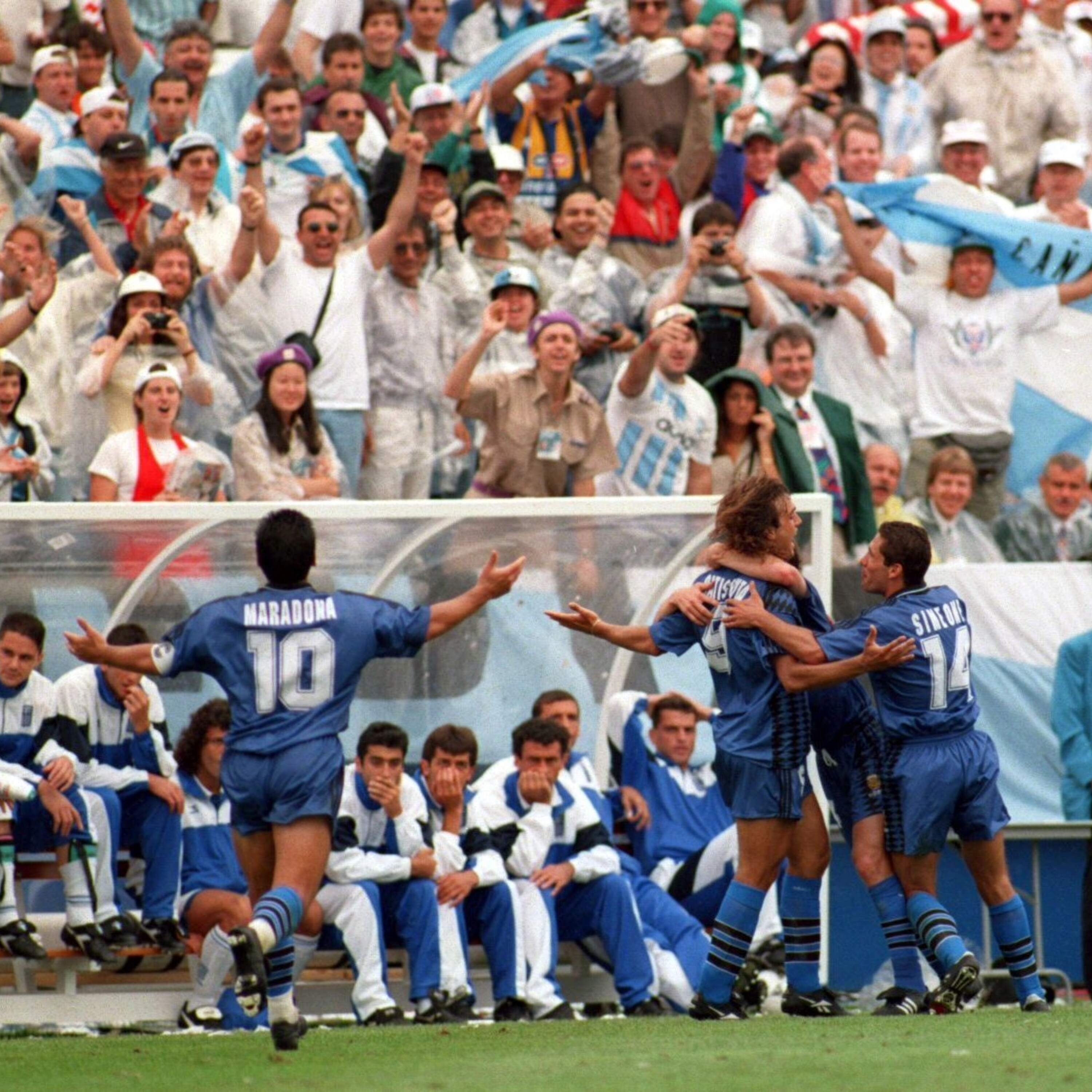
Yeah. So you should know that the New England Stadium has a bunch of photos on the wall in the office area of famous events that have been held at their stadium. And so Brian remembers on one of his first days on his job, he noticed that one of those photos was from the 1994 World cup, specifically from this match between Greece and Argentina.
- [08:39]
Brian Bolello
And there's a picture of Simeone Batestuta and Maradona celebrating a goal. And I'm looking at it and I was like, are you kidding me? That's me.
- [08:50]
Kenny Malone
Yeah, yeah. In the background of the photo is a very young Brian. As an MIT undergrad, he had volunteered to work at the 1994 World cup, where apparently the uniform was some weird military beret situation. But, yeah, there he was in that photo.
- [09:06]
Brian Bolello
19 year old me in the first row in my full brown uniform with my purple beret leaning over the side, like, am I going like this?
- [09:16]
Becky Sullivan
Like, he's just fully celebrating the goal along with Maradona and all the fans, and absolutely not doing whatever job he was supposed to be doing.
- [09:25]
Brian Bolello
Probably wasn't doing a great job back
- [09:26]
Kenny Malone
then, but, you know, yeah, this photo, it is a kind of aspiration, I would say. You know, back in 1994, Brian was a kid who liked playing soccer, but. But he had not fully realized what watching soccer in person at a World cup with all those international fans would be like.
- [09:45]
Brian Bolello
This is the level of passion that exists for this sport around the world. And it is. Sorry, but it is a higher level of passion than we see from our domestic sports here.
- [09:55]
Kenny Malone
And so Brian's strategy boils down to this. He thinks the World cup could unlock an unfathomable reservoir of passion for American sports fans. But they need to witness the game in person like he did and get a chance to literally celebrate a goal with Diego Maradona or Lionel Messi or whoever it is they might see this time.
- [10:20]
Becky Sullivan
And this is why the key to Brian's strategy in terms of the New England Revolution is to have the World cup specifically come to his town. He was super active in lobbying to get the Revolution Stadium selected as a World cup venue. Like, I mean, years of meetings, slide decks, press interviews, tours of the stadium, that kind of thing. And it all paid off because the Boston area got to host seven matches, including a quarterfinal.
- [10:44]
Brian Bolello
So I do think the World cup will really open up, you know, that. That sort of soccer. Curious sports fan in a way that in 94, I don't think those fans were open to that. There's like, ah, soccer sucks. I don't like soccer. You know, that doesn't really exist as much anymore. We're now sort of like, yeah, I'm interested in soccer. Show me it's better than these other things. And I think the World cup can highlight that passion, that energy.
- [11:09]
Kenny Malone
And sure, an MLS match is definitely not a World cup match. It's true. But Brian feels like the MLS atmosphere can have some of that passion, that energy.
- [11:21]
Becky Sullivan
Plus, the tickets are a lot less expensive than the World Cup.
- [11:24]
Kenny Malone
They. That is definitely true.
- [11:26]
Becky Sullivan
Yes. So Brian is betting that if people get hooked on live soccer from the World cup, his MLS product can scratch that itch.
- [11:33]
Kenny Malone
And, yeah, this is the most direct strategy. It is very Field of Dreams. Like, if we build it, they will come. Or I suppose more accurately, it is if we bring the FIFA World cup to the greater Boston area, general sports fans may decide they actually do like soccer. But, you know, that's a little less pithy. If we build it, they will come. We're going with that.
- [11:54]
Becky Sullivan
But here's the thing, Kenny. What do you do if your city did not get any World cup matches?
- [11:59]
Kenny Malone
Hmm, good question, Becky. At the end of the day, this is the biggest sporting event in the world that takes place once every four years, and it's not happening in Chicago.
- [12:10]
Becky Sullivan
This is Dave Baldwin. He is the president of Chicago's MLS team, the Chicago Fire.
- [12:16]
Kenny Malone
So the city of Chicago eight years ago, under Mayor Rahm Emanuel, decided very intentionally it was not worth it to be a host city. So the MLS club there, the Chicago Fire, could not just do what the New England revolution did and just use the momentum from a local World cup match to sell soccer. And we had a decision to make just kind of to bury our head in the sand and just watch on TV like everyone else, or the other one was to really rally behind it, put some dollars behind it.
- [12:45]
Becky Sullivan
The Chicago Fire, I think, actually pretty quickly came to the conclusion that they should not bury their head in the sand. But this question of what they should do, some of that became Dan Moriarty's problem to figure out.
- [12:56]
Kenny Malone
Dan is the chief marketing officer for the Chicago Fire. Internally, we use the line, give Chicago the World cup summer it deserves. And so we. We started looking at all of our options and all of the crazy things
- [13:06]
Camilo Durana
that we could do.
- [13:07]
Kenny Malone
We will get to the reason. Dan is speaking from a kind of loud place. But first, some of those crazy ideas that they could do because they're, they're interesting because of the puzzle that Dan and the Chicago Fire had to deal with. So they decided to spend about two or three million dollars to do something during the World Cup. But. But to decide what that something should be, they first had to decide, like who is the most valuable customer to target with all of this money.
- [13:33]
Becky Sullivan
Right. Because in professional sports, financially at least, not all fans are created equal. A disproportionate chunk of revenue often comes from rich companies because teams can sell them sponsorship opportunities in corporate suites that are worth a lot more than an everyday fan like you, Kenny, or me coming to one game. So one idea Dan and his staff batted around was maybe put all the chips in on big executives in Chicago.
- [13:57]
Kenny Malone
Like flying the 25 biggest CEOs in the. In the city out to the World cup final on a private jet. Very fun. But that is a strategy that would be sort of like use the money to target just a couple dozen very wealthy potential customers. Now, on the total opposite end of the spectrum was a purely populist approach. Like what if the Chicago Fire used their money to generate as much attention from regular Chicago people as humanly possible, like running our own World cup fantasy in Chicago only and putting $1 million prize on it.
- [14:32]
Becky Sullivan
And basically that idea was give away a million bucks, like March Madness brackets, but for the World cup. And I think credit where credit sued, that would get a lot of people's attention.
- [14:42]
Kenny Malone
Yes. The possible problem there is whose attention are you getting? Exactly right. It would be anyone interested in. In winning a million dollars, which is everyone, not just people who might be good soccer fans in the long term.
- [14:56]
Becky Sullivan
So ultimately the Chicago Fire decided that the best thing to do was neither of those things, but instead to spend over $2 million to throw basically one of the biggest World cup watch parties in a non host city. And so Dan, to come back to why he is talking to us from somewhere a little noisy, he gave me a tour of that party space.
- [15:16]
Kenny Malone
So, yeah. So where we are right now, this will be the watch party area. So you can see you've got bars in here, bars outside, probably 30 TVs.
- [15:24]
Becky Sullivan
So they have rented out this entire bar that is way more than just a normal bar. It essentially takes up an entire city block in Chicago. The inside alone would already be just a gigantic sports bar, one of the biggest you've ever seen. There's also this huge outdoor area. It's essentially this giant beer garden centered around what essentially looks like they've taken the Jumbotron from the arena where the Chicago Bulls play and just set it on the ground in the middle, showing games on all four sides. It is so much bigger than the Watch party that was on the barge.
- [15:52]
Kenny Malone
It would sink a barge, that Jumbotron. So I'm glad that's not what's happening there. And when we talked to the president of the Chicago Fire, Dave Baldwin, about this strategy, throwing a giant party, he had a delightful and perhaps surprising comparison. I sort of compare converting non soccer fans to soccer fans to my experience when I go shopping at Costco, which is I never knew that I needed 800 teriyaki meatballs, but I was walking through the line, I had a chance to sample it and I said, oh my gosh, this is amazing. And I go buy one of those giant boxes, right?
- [16:24]
Becky Sullivan
And so we are going to call the Chicago Fires World cup strategy the Costco sampling strategy.
- [16:30]
Kenny Malone
Yes, we were going to call it the teriyaki meatball strategy and we still might. We reserve the right. But yes, that gigantic party that is all about the samples. You get people to come to, I mean, of course share their email address and phone number with the team, but also to let those people know things like, hey, here's some Chicago Fire players that are in the World Cup. Here are some local collaborations with artists making killer merch.
- [16:53]
Becky Sullivan
And ideally for the Fire, they are selling soccer to people kind of like a bulk product. I mean, they're hoping to convince people to, you know, not just come to one game, but to eventually become season ticket holders, buy merch for years to come, that kind of thing.
- [17:07]
Kenny Malone
And I mean, look, it is true that a lot of the MLS teams around the country, they are doing smaller versions of this, you know, big old watch parties. And on the face, okay, kind of obvious, but I will say it does take advantage of something a tad more advanced, which is harnessing what we would call the network effects of sports fandom. You know, some products become more valuable as more and more people buy into them. Sports, I would argue, is is one of these. It is simply more fun to live and die with a team when you're doing it with other fans. And holding a big old watch party shows potential new fans, potential new customers for your soccer team that there is a network that they get to join. So will any of this work? Will any of these MLS clubs using their Costco strategy, their build it and they will come strategy, will any of this actually work? Well, people have actually studied what happens to domestic soccer leagues in a country after it hosts a World cup or a big tournament.
- [18:05]
Becky Sullivan
And the answer is, Becky, it's mixed, honestly. I mean, here's the thing. This study found that sometimes domestic leagues did see a bump in attendance, but sometimes the bump went away after a little while. Like it disappeared. And in some countries somehow, like Italy in 1990, they somehow saw a negative effect.
- [18:22]
Kenny Malone
Less attendance.
- [18:23]
Becky Sullivan
People came in the years after. Yeah, and so maybe people had used up all of their soccer energy and money on the big tournament matches. I don't know. But the point is, there is actually no guarantee at all that just having the World cup in your country will help you as the domestic soccer league. And so I think you can argue that that's why these teams are spending so much money to do whatever they can to try to bring in new fans.
- [18:47]
Kenny Malone
Yes. But may we pose what if the best way, the most valuable way to use this 2026 World cup has nothing to do with converting new fans? Nothing to do with with fans at all. Arguably the most important World cup audience after the break.
- [19:13]
Sponsor/Advertisement Voice
This message comes from Workday, the enterprise AI platform for HR finance and IT when it comes to your company's finance and HR functions, you can't afford to get it almost right. Workday's AI platform empowers agents to work securely and accurately, following your organization's unique context and guardrails. Agents operate within predefined permissions to complete tasks, and they log every action to guarantee auditability. From automating routine data entry to flagging financial anomalies, every workflow runs within enterprise controls, so it does the work to drive real outcomes you can trust. This is the world Workday is creating, where the limitless potential of AI is combined with the certainty and predictability your enterprise needs. It's a new Workday. Learn more@workday.com this message comes from Mint Mobile. If you're tired of spending hundreds on big wireless bills, bogus fees, and free perks, Mint Mobile is for you. Shop plans@mintmobile.com Switch taxes and fees extra. See Mint Mobile for details. This message comes from Rosetta Stone Rosetta Stone is designed to make language learning intuitive. It mimics how people naturally acquire speech as children, helping users read, write, and think in a second language. More@Rosetta Stone.com
- [20:38]
Kenny Malone
so far, we've talked to specific MLS clubs about how they're trying to use the World cup, but our final stop is mls. Like the actual organization headquartered in New
- [20:49]
Becky Sullivan
York City, we called up MLS's chief business officer, Camilo Durana.
- [20:53]
Camilo Durana
I think in North America in particular, we have the sense that the super bowl is sort of this. This enormous event that does about 200 million viewers worldwide. The World cup final in Qatar alone did 1.5 billion viewers. And so we knew that for our sport, this was a unique opportunity.
- [21:09]
Kenny Malone
Camilo told us that MLS is spending the most they've ever spent on marketing in the entire history of their league, tens of millions of dollars to try and take advantage of the World Cup.
- [21:20]
Becky Sullivan
And the centerpiece of the campaign that they're running is to buy some very, very, very expensive commercial spots during the World cup semifinals and final.
- [21:30]
Camilo Durana
And what I love is, is the campaign and the statement we're making. It is, thanks, World. We'll take it from here. And it is a bold statement of the confidence that we have in our league and our product.
- [21:42]
Kenny Malone
Thanks, World. We'll take it from here. I do think is fun, but I will say, if they had tried to pull this 20 years ago, it would have been laughable for MLS to be like, thanks, World Cup. We've got it from here. MLS will handle things.
- [21:55]
Sponsor/Advertisement Voice
Yeah.
- [21:56]
Becky Sullivan
And to explain that, I mean, it's because MLS is still very much not given the same sort of respect. It's not viewed in the same way as the sort of older, more established, more popular leagues in countries like England or Spain or Italy or Germany. I mean, maybe also Brazil and Argentina, depending on who you ask, who knows? But you get the point. Basically, it's newer, it's younger, it's not there yet.
- [22:17]
Kenny Malone
Yeah, the reputation is very much. Europe is where the world's best players play, but when big stars are past their prime, still want to make a little money, then they join Major League Soccer teams where they can, you know, play on easy mode.
- [22:30]
Becky Sullivan
And.
- [22:30]
Kenny Malone
And because of this reputation, I think there are lots of potential fans who are choosing to spend their sports time and money elsewhere.
- [22:38]
Becky Sullivan
Now, that said, there has been one very enormous consequential development that seems to be starting to change that reputation here for mls. Three years ago, a guy named Lionel Messi signed with an MLS team. He's a little old, but still very, very good. And here he was coming to Florida to play in Major League Soccer.
- [22:57]
Camilo Durana
I think few people, I'd say, have the ability to change the trajectory of a league, and Lionel Messi is one of them, right up there with Michael Jordan or Tiger Woods. What Messi's arrival did and what this World cup we believe will do is, uh, it'll encourage more players to come.
- [23:12]
Becky Sullivan
And this. This gets us to maybe the most important Potential audience for MLS during the World Cup. MLS has a once in a lifetime chance to show the world's biggest stars what life could be like in this league.
- [23:25]
Kenny Malone
Of course there is still the question like, how do you use the World cup to do that? And we asked Camilo, what, what's the plan exactly? Are you going to like slip MLS flyers into players lockers or something like that?
- [23:35]
Becky Sullivan
And honestly I think the answer is not that far off. Actually it's pretty close. Yeah, there are a ton of top level training facilities in the US that these international teams could have chosen to use. But MLS worked really hard to pitch their fancy new training facilities in their nice stadiums as places for the World cup teams to go.
- [23:51]
Kenny Malone
And sure enough, about a dozen national teams chose to use MLS training facilities as their base camps. Uh, Argentina's team was based out of the Kansas City MLS team's facilities. Uh, Brazilian players had been training before Erling Holland destroyed their souls from the newest fanciest facility, which is in New Jersey.
- [24:10]
Camilo Durana
They see our stadiums, they see the facilities.
- [24:12]
Kenny Malone
Are you hoping that, I don't know, Killian Mbappe happens past your finest training facility during his visit here, for example?
- [24:21]
Camilo Durana
Killian would be great if he sees it. Whether it influences his future decisions, fantastic. But it could also have an impact on, on the decisions of his teammates. And the people that players talk and they ask about experiences and what they think of certain places and often before players transfer, they ask around and ask people what they think. So it's really important for us that players have great experiences as they experience the World Cup.
- [24:45]
Kenny Malone
There is probably a cap on how popular your league can be when the best players in the world are all playing somewhere else. So really maybe the best way to grow American men's professional soccer during the World cup is to convince even more Lionel Messi level players to come. And then that that grows men's professional soccer in the US and in terms
- [25:08]
Becky Sullivan
of convincing those players, maybe the most important thing that's happened for MLS during this World cup is this.
- [25:15]
Kenny Malone
Lotaro sends it across, it's swept in.
- [25:19]
Becky Sullivan
And of course it's Lionel Messi.
- [25:21]
Kenny Malone
Messi saves the day for Argentina. And this Julian Alvarez running outside. Lionel Messi. Lionel Messi first career World cup hat trick ties the all time goal scoring record. Yes, that by the way, is us. We can't use broadcast of the World cup so we're reenacting them by watching Messi World cup highlights. Whatever, you get it.
- [25:44]
Becky Sullivan
Anyway, the point is that Lionel Messi has played out of his mind at this World Cup. And so to some degree, this whole thing has kind of been proof that coming and playing in Major League Soccer in the United States did not cause Messi to lose a step. This was not some kind of retirement home for him.
- [26:01]
Camilo Durana
When he chose to continue his career in Major League Soccer, there was a lot of people that thought he was coming here to retire, and it's been the opposite. Rarely do you see him getting subbed off. He wants to play the 90 minutes. He's intense. He wants to win. And I think that's carried into the World Cup.
- [26:17]
Kenny Malone
I mean, and the fact that he's like in shape for the World Cup, I think is probably one of the greatest pieces of advertising you could have ever hoped for. Not sure you intentionally did that, but that is what's happened, not just for
- [26:30]
Camilo Durana
him, but other players. I think Major League soccer players scored 10 goals in the group stage. So I think that validates everything that we're doing and it shows the quality that we have on the MLS pitch.
- [26:41]
Kenny Malone
Yeah, maybe that's the note you slip into everybody's locker. Hey, didn't score any goals. Well, maybe try leaving La Liga. Try coming to mls.
- [26:49]
Becky Sullivan
Yeah.
- [26:55]
Kenny Malone
Oh, before we go, real quick, plug for a virtual event, a special event that we have coming up next week for our NPR+ supporters, the indicators. Adrian Ma and Waylon Wong are going to be talking about the US Housing market with REDFIN Chief economist Darrell Fairweather. It's a live Q and A where Darrell's gonna be taking your questions. This is going to be on Thursday, July 23rd at 3pm Eastern, noon Pacific. It's over. Zoom. And if you're already a part of npr, check out our latest bonus episode for details. And if you haven't joined yet, there's plenty of time. Just go to plus.npr.org again. That is plus.npr.org it's a great way to support our work and support npr.
- [27:41]
Becky Sullivan
This episode was produced by James Sneed with an assist from Sam Yellowhorse Kessler and edited by Jess Jiang. It was fact checked by Sierra Juarez and engineered by Jimmy Keeley and Anlee Huang. Alex Goldmark is Planet Money's executive producer. I'm Becky Sullivan.
- [27:55]
Kenny Malone
I'm Kenny Malone. This is npr. Thanks for listening.
- [28:05]
Sponsor/Advertisement Voice
This message comes from Capella University. That spark you feel, that's your drive. For more. Capella University's flexpath learning format lets you earn your degree at your pace without putting life on pause. Learn more@capella.edu. this message comes from Mint Mobile. If you're tired of spending hundreds on big wireless bills, bogus fees and free perks. Mint Mobile is for you. Shop plans@mintmobile.com Switch taxes and fees extra. See Mint Mobile for details.
- [28:36]
This message comes from the International Animal Rescue. Every year, wild bears are illegally caught or trapped by poachers. Kept in small, barren cages and public entertainment venues, including restaurants, hotels and roadside zoos, they are used as a tourist attraction and to make money out of captive breeding. The International Animal Rescue helps rescue them with sanctuaries to receive urgent veterinary treatment, nutritious food and space to roam. Search the Great Bear Rescue to learn more.