Loading summary
Transcript66 lines
- [00:02]
A
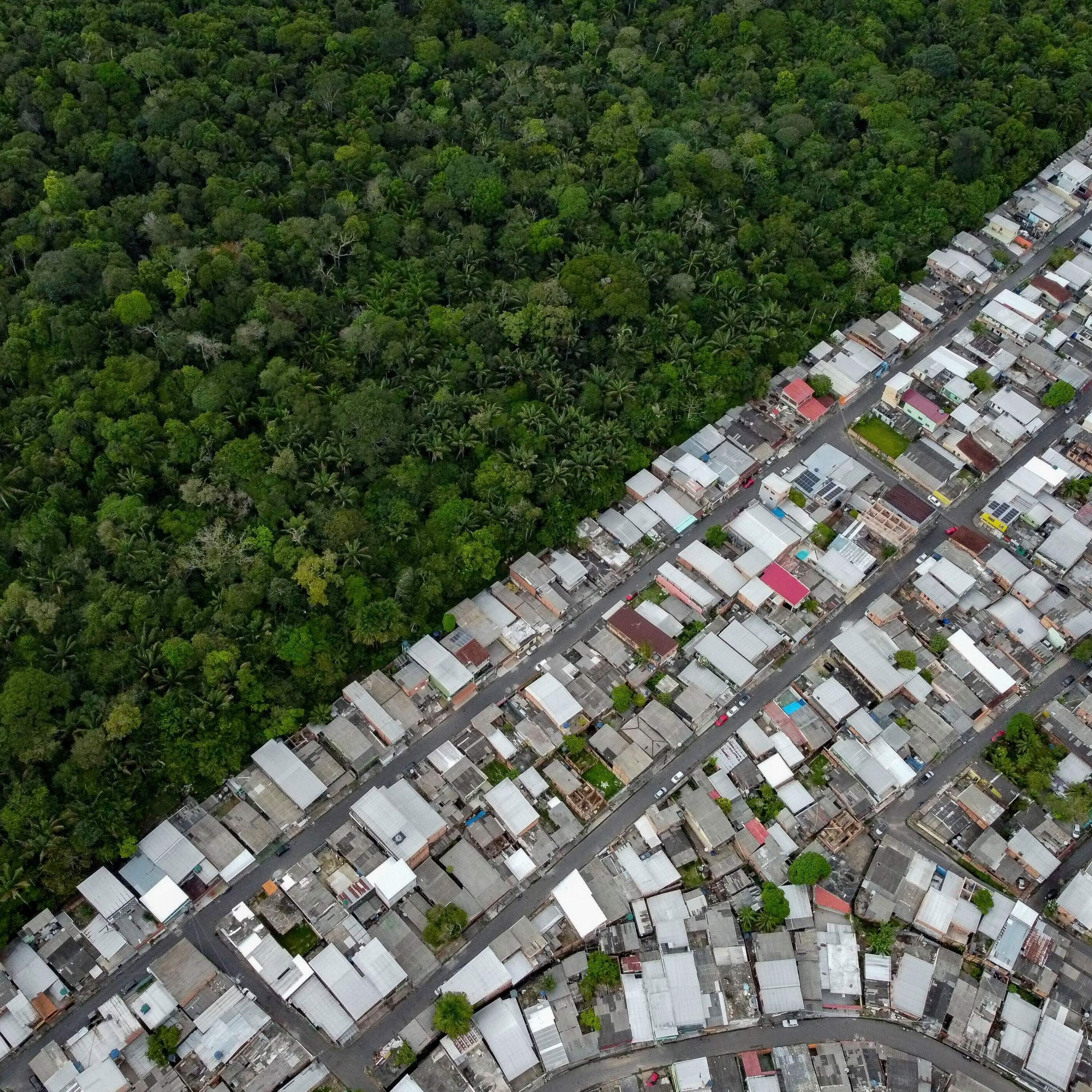
This is Planet Money from npr. A couple hundred years ago, some countries suddenly got rich quick. They started growing at rates never before seen in history. Countries like England, Germany, the United States. What these countries had in common were smokestacks, were steam engines and factories. They had all industrialized. And for a long time, a lot of other countries thought, okay, that is how you get rich. There's the blueprint. Some of them went to extraordinary lengths to follow that blueprint. A couple of months ago, Planet Money producer Luis Gaio and I went to get a better look at what one of those countries tried. We started down a dark jungle path. Do you like snakes? I don't love them, but what about spiders? I don't love them either. I like dogs. There were no dogs in the rainforest. But our destination was a big steel observation tower. Is there an elevator? And after climbing 10 flights of stairs, we reached the top, where we saw rainforest stretching all the way to the horizon. Except I hear it. I hear buses. Yeah, just to the south, through those streets, there was this bright line running through the jungle. So on one side we have the vast Amazon forest, and then on the other side, it's a bustling metropolis. Everything turned into squares and right angles and dark roads and white concrete high rises. We were looking at the city of Manaus, one of the biggest cities in Brazil. Over 2 million people live here. That is like San Francisco, Seattle, and Boston combined. The city is a manufacturing powerhouse. Nearly every TV that is sold in Brazil, every microwave, every motorcycle is built right here, right in the middle of the Amazon rainforest. And that is because 60 years ago, the military dictators of Brazil embarked on an ambitious economic experiment to get Manaus to grow as quickly as possible at nearly any cost. It was part of a bigger plan to get Brazil to grow as quickly as possible by following that blueprint, by industrializing. And for a long time, this worked. Until it didn't. Hello, and welcome to Planet Money. I'm Jeff Guo. Once upon a time, many economists believed that poor countries could very quickly catch up to rich countries simply by following in their footsteps, by building schools and roads and factories, lots and lots of factories. Nowadays, economists are a lot less optimistic, and if you ask them why, a lot of them will point to Brazil. Today on the show, how do poor countries become rich countries? And what went wrong with that original blueprint?
- [03:10]
B
This message comes from Superhuman, the AI productivity suite that gives you superpowers everywhere you work, AI that works alongside you, understanding where you're at, and proactively offers suggestions when you're building ideas Drafting emails, collaborating, and so much more. Superhuman helps you go from to do to done faster. Get time back you didn't know you had. Unleash your superhuman potential with AI that meets you where you work. Learn more@superhuman.com when you first get to
- [03:41]
A
Manaus, the city looks like an economic success story. Hola, poor Jeffy. There's the old town center with cobblestone streets from when this was a big rubber town. Now there are stores selling cell phones and soccer cleats. Ooh, 80% discount the outlet. There are high rise office buildings and gated communities. And then you cross the little bridge and all of a sudden you are in the industrial zone. There are rows of corrugated tin workshops, shipping containers stacked behind barbed wire. Smells like fried fish and diesel. Hundreds of companies from all over the world have set up factories here. Our Uber driver Claudio told us he is always driving foreigners around. Americano, Japonese, Coriano. Some of the companies have set up these huge walled campuses. Lg. Oh my God. Lg. There's also Honda, BMW, Whirlpool, Yamaha, Foxconn. He says Samsung is bigger. You think that's big? Samsung is bigger. Every year, these factories produce millions of cell phones and motorcycles and microwaves and computer monitors. The story of how all this arrived in the Amazon goes back to the 1960s, when Brazil's military dictatorship was following what most countries thought was the blueprint for getting industrialization manufacturing. And they wanted to bring manufacturing to the Amazon as well. So in 1967, they turned Manaus into this special economic zone where companies could get a lot of tax breaks. It's called the free zone, the Zona Franca of Manaus. All right, this looks very official. Shall we? Obrigado. The Zona Franca is run by this government agency. Their headquarters are in a swooping concrete modernist building at the edge of town. In the lobby, there is a wall with 27 framed portraits showing every past head of the Zona Franca, including the one we were about to meet. Look, there he is. His portrait right there. Bosco. Wow. It's the only one in color. Bosco Saraiva talked to us in his office with his colleague interpreting. He told us he actually grew up in Manaus. He watched all the factories come in, got some of his first jobs in those factories. What kind of products were you making?
- [06:13]
C
Television and vigil cassette. I don't know how they call the old.
- [06:18]
A
Bosco said all those factories came to Manaus for one big the tax breaks. Those tax incentives for the free zone. They brought thousands and thousands of new opportunities to Manaus. Over the next decade, the population doubled. From the point of view of the residents, the Zona Franca has been a huge success. It took a fading rubber town in one of the poorest parts of Brazil and gave it a whole new economy. And Bosco is like the number one hype man for the Zona Franca. It changed his life, it changed his family's life. And he's seen it change so many other people's lives.
- [07:10]
C
He's so happy to be a part of it because he saw the Manas retreat zone like born to get started and now he lead it. He says it's better than hope. It's certainty of development.
- [07:33]
A
And Manaus was just one example of Brazil's original mission at the time, which was to use the power of the government to follow that blueprint to quickly kickstart industrialization and economic development. This approach has a name. Economists call it dark developmentalism. Back in the 60s and 70s, other countries with authoritarian governments were trying this too, like South Korea and Singapore and Taiwan. They were like, bam, we're going to put a school here. Bam. We're going to put some roads there. Bam, bam, bam, bam, bam, bam. We're going to put a bunch of factories here, there and everywhere. And the dream was that those factories that came for the tax breaks would stick around and eventually start to level up to make more advanced products. So eventually they wouldn't need so many tax breaks. But in Manaus, that hasn't quite happened. Bosco told us that still today the companies in Manaus depend heavily on government subsidies, the tax breaks. Without the incentives, what would happen to Manaus?
- [08:40]
C
Well, we would be broken.
- [08:48]
A
In Viavo.
- [08:50]
C
It's not economically possible to do this stuff here. Without the incentives, all the industry would go away.
- [08:57]
A
And one way to understand why Manaus still can't live without its subsidies is to look at what comes into the city versus what goes out. Because what you want for economic growth is for the factories to import low tech components and turn them into high tech components. After our meeting with Bosco, we headed to the port to look at the reality. Going through some security doors, some X rays, metal detector, some metal detectors. Pretty much everything in Manaus arrives on big container ships. They travel almost 1,000 miles up the Amazon River. Most of them unload here at a terminal called Port Shibatao. When we got through security, we saw this huge floating pier with more than a dozen red and orange cranes. The guy in charge of all of this is Johnny Fidelis Santos. Johnny told us these days, like 70% of the cargo arriving in Manaus comes from Asia. We were standing in his office looking at hundreds of shipping containers stacked in the yard. Yes, if I just like picked a container like that one, probably what is in it? Yeah, these high tech electronic components, they get unloaded here in the terminal and whisked to the local factories in Manaus, in the Zona Franca, where the workers are mostly just assembling all this stuff, assembling them into TVs and air conditioners and notebook computers. So on the surface, Manaus is a tremendous economic success story. It's what a lot of countries dream of, a magnet for foreign investment, a manufacturing hub filled with high tech companies creating jobs for hundreds of thousands of workers. But underneath all of that, a lot of the manufacturing is not actually very advanced or globally competitive. Now, in recent decades, the government has been trying to upgrade the factories here. Bosco's agency has negotiated these complicated deals where if companies want to qualify for the tax breaks, they have to do some of the higher tech work here in Brazil. Take TVs for instance. These days in the Zona Franca, workers are soldering components onto circuit boards. They are making the power supplies. But when we went to see these TVs on the shelves of the department stores, yeah, I want to see the TVs. Are the TVs. Even the salespeople knew that the most important, important components, the actual fancy OLED or LCD panels, those are from somewhere else. Those are mostly coming over on the container ships from Asia. He says they are assembled here to be sold in Brazil, in the us. So despite all the government's efforts, the factories in Manaus, they've had a hard time leveling up and creating better jobs. And you could say maybe this is just a Manaus problem, that it's not a good idea to try to manufacture stuff in the Amazon. But this problem is not isolated to Manaus. It's happening all over Brazil. Starting in the 1980s, Brazil's strategy of rapid industrialization kind of hit a wall. Brazil went from one of the fastest growing countries in the world to one of the slowest. And you could also say that maybe this is just a Brazil problem. But in fact, a lot of countries that rapidly grew and industrialized in recent decades, countries that achieved what the World bank calls middle income status. They have also found that their economies just aren't growing like they used to. These middle income countries seem stuck. The name for this phenomenon is the middle income trap. It was coined by two economists at the World bank, one of them was Homi Karas.
- [12:45]
D
Even though neither of us are golfers, we kind of thought of the middle income trap with a golfing analogy.
- [12:55]
A
Oh, like a sand trap.
- [12:57]
D
There are these sand traps, and if you're not a very good golfer and you go into one of these sand traps, it takes you a lot of time to actually get your way out.
- [13:09]
A
Yeah, it can be pretty hard. Homi, who now works at the Brookings Institution, the think tank in dc, has basically spent his entire career studying if and when and how poor countries can become richer.
- [13:21]
D
Well, I come originally from a developing country, so that had always been one of my interests.
- [13:27]
A
Homi was born in Pakistan, and by the time he got to grad school at Harvard in the 1970s, economists were talking about this kind of utopian sounding idea. It was a theory called convergence, which said that in the long run, if they made the right decisions, poorer parts of the world should be able to catch up to the richer parts of the world or at least get pretty
- [13:49]
D
close, because there's a blueprint in front of you.
- [13:51]
A
Yeah. Step one, build roads and schools and infrastructure. Step two, industrialize. You know, get workers out of the fields and into factories where they would start out by making simple stuff like T shirts.
- [14:06]
D
The essence of the low income country strategy is to take advantage of low wages. By having low wages, you can be very competitive.
- [14:17]
A
And from there, once you've built up that manufacturing base, steps 3, 4, 5, 11, 22 is you start upgrading those factories, teaching workers more and more advanced skills. The economy grows, people start earning more money. And, you know, like, this was the blueprint for countries.
- [14:35]
D
And then as they developed even further, they would move into services like, you know, banking and finance and insurance.
- [14:43]
A
Because as an economy gets richer, more people need those things. The United States and the UK and Germany all followed this path where more and more people went from farms to factories to eventually where some were enjoying, you know, desk jobs and three martini lunches. In the 80s and 90s, a lot of countries had managed to accomplish just those first couple steps. They built a manufacturing base that got them from low income to what the World bank calls middle income, which is based on per capita national income. And in the late 80s and 90s, some of those middle income countries broke through again. South Korea and Singapore and Taiwan officially became high income countries. Some people called it the Asian miracle. But Homi, he writes this paper that's like, countries like South Korea might actually be the exception to all of this, not the rule.
- [15:38]
D
There have been lots of Countries that thought this is going to be their century and that they've had a history of decades of rapid economic growth that they thought would automatically translate into decades of future economic growth. But history teaches us otherwise.
- [15:56]
A
So you were kind of, you know, just kind of a wet blanket. It sounds like I was a bit
- [16:01]
D
of a wet blanket.
- [16:03]
A
And this wet blanket idea, the middle income trap, it has now become a big deal in economics. Homi's co author is actually now the chief economist at the World bank now. And a couple years ago, the World bank published this big important report all about the middle income trap. Literally the title was the Middle Income Trap. And the basic gist of it is that this blueprint for going from poor to rich seems to have a big hole right in the middle. Most economists now pretty much agree on those first couple of steps, you know, to get countries from low to middle income.
- [16:37]
D
What I would call get the basics right. That does really well for a pretty long period of time.
- [16:47]
A
They also agree on how rich countries like the US are supposed to grow. It's through inventing stuff, developing new technologies.
- [16:55]
D
Once you're high income, there's close to one path again to continue to push the frontier. And that path is called innovation.
- [17:05]
A
But for middle income countries, there doesn't seem to be just one path. Like South Korea went big on heavy industry and high tech electronics like microchips in Poland. The economy got a big boost from joining the eu. It got a lot of investment from Western Europe and became a manufacturing hub for a lot of European supply chains. Homi says middle income countries are caught in this weird situation where there are actually a lot of different ways to grow your economy, but you don't know which is going to be a good fit for you. I guess it's like, what sport do you want to play?
- [17:40]
D
Yeah.
- [17:40]
A
Are you going to be good at volleyball or soccer or basketball?
- [17:44]
D
Yeah. You're unlikely to innovate the frontier because you don't have the, let's say, the quality of universities and other kinds of things. And you can't compete in garments because you've got Bangladesh. You don't want to have low wages because the whole idea is how do we raise wages so that people are better off? So you need to move to a different strategy.
- [18:09]
A
And what is that strategy?
- [18:12]
D
That's to be figured out after the break.
- [18:16]
A
How does a country find its way without a blueprint? Foreign.
- [18:28]
B
This message comes from Superhuman, the AI productivity suite that gives you superpowers everywhere you work. AI that works alongside you, understanding where you're at and proactively offers suggestions when you're building ideas, drafting emails, collaborating, and so much more. Superhuman helps you go from to do to done faster. Get time back you didn't know you had. Unleash your superhuman potential with AI that meets you where you work. Learn more@superhuman.com As a kid growing up
- [18:59]
A
in Brazil in the 90s, Mayara Felix remembers this phrase that she would always
- [19:04]
C
hear people say Brazil is the country of the future. That's what we say.
- [19:08]
A
It's something people in Brazil have been saying for a long time, for decades and decades.
- [19:13]
C
There are songs because it seems like we have it all, man. And of course it becomes the joke because the future never comes.
- [19:24]
A
Growing up, Mayara did not have it all. Far from it. She was raised in a poor community in northeast Brazil.
- [19:29]
C
There was lots of chickens on the streets, and I remember a very vivid afternoon. My sister and I are in our living room, just like I think, watching TV in an afternoon, and then the neighbor's gigantic pig runs in front of us, and this is like a surreal moment, mayur says.
- [19:46]
A
As a kid, she didn't really know
- [19:47]
C
she was poor until, like, you know, you get to go on the bus to the city next door and then realize that the streets are paved and there's buildings and things like that.
- [19:56]
A
But there was a path for her to follow to get her out of that poor neighborhood. She did well on her tests, got selected for a special public school farther from home. Eventually she made it to college, then grad school, and now she's an economics professor at Yale, where she teaches about the different paths that developing countries have followed and why some of those paths might not work anymore. For countries like Brazil, I think the
- [20:21]
C
remarkable successes we can count in our fingers. It's Singapore, China, South Korea, Taiwan.
- [20:28]
A
That's it, man, mayra says. What those countries did, that worked was to manufacture stuff for wealthier countries.
- [20:35]
C
We experienced Post World War II, this remarkable opportunity for developing countries to grow by accessing rich people demand from rich people in rich countries. And East Asia has been able to really do this brilliantly. But somehow Latin America, Africa didn't quite manage to do that.
- [20:55]
A
And okay, there are all these different theories and explanations for why a country like Brazil couldn't quite make that path work. For one, Brazil is a tough place to do business. There's tons of government bureaucracy. The country is still struggling with a lot of crime and corruption and political turmoil, with the legacy of colonialism and
- [21:14]
C
slavery, especially in countries with history like ours. In Brazil and Latin America, where there's so much baggage that we carry, I don't think we can ignore that baggage.
- [21:25]
A
Also in Brazil, you had factories that mostly focused on making stuff for Brazilians. You know, like in Manaus, where the government used big tariffs to protect companies from competition. Whereas in places like South Korea, the government really pressured companies to export, forcing them to compete in the global marketplace. But Mayar says at this point, studying what countries like South Korea did in the past, that will only get you so far, because of course, the world is a lot different now, especially when it comes to manufacturing. These days, a lot of economists aren't so sure about where manufacturing fits into the blueprint anymore. Manufacturing technology looks a lot different than it used to. It's higher tech and fewer people. And also there's just a lot more competition now.
- [22:11]
C
It's very hard to compete on anything. Manufacturing with China, it's very hard. Nowadays, like the global competitive world is very, very intense. And so you need to play to your advantages.
- [22:23]
A
In fact, in recent years, Brazil and many middle income countries around the world have gone from industrializing to de industrializing before they really got a chance to get rich. They some economists call this premature deindustrialization. Companies are closing down factories because they can't figure out a way to compete. But Mayara says that doesn't mean that all hope is lost. It just means that countries like Brazil, they need to find something else for people to do.
- [22:52]
C
The key thing is, are you doing something more productive? And that doesn't necessarily have to be manufacturing sectors. Can we accomplish this with anything other than manufacturing?
- [23:03]
A
Yeah. Like in Brazil, factory workers there are less productive than they were five years ago. But Mayara says there are places where the Brazilian economy has been getting more productive. One of those bright spots where Brazil is leading the world in productivity is actually agriculture, just a more advanced kind of agriculture.
- [23:23]
C
No one expected in the 80s that Brazil would have become the world's biggest soy producer, orange producer, coffee producer. And we say that, oh, these are just commodities, man. Like, I think we need to update what our understanding of technology and agriculture is.
- [23:37]
A
Yeah. In recent decades, farmers in Brazil have invested hundreds of millions of dollars researching how to grow more food on the same amount of land, how to make farming more sustainable.
- [23:47]
C
The research it takes to actually adapt seeds, adapt varieties to Brazil's, you know, local environment, all of that is like really sophisticated things.
- [23:58]
A
Another potential bright spot, Maillar says, might be the beauty industry. Brazil has one of the biggest markets in the world for beauty products and cosmetic surgery. There is intense competition and that competition has driven Brazilian companies to develop, you know, new types of skincare, even new types of liposuction. And, you know, even in Manaus, we ended up finding people experimenting with what might be the next big industry. It's actually in a surprising place. Luis, nice you to meet. Great to meet you. Are these snacks for us? We were at this local company that made injection molded plastic parts. They were called Tutti Plast. When we walked through the plant, there were rows and rows of these big white pods with Chinese lettering on them. Okay, there's like a robot arm that goes in and like takes out the thinnest piece. Yeah, it's more than 95% of our property is automated. Automated. And I have to say this was kind of depressing watching these mostly automated machines pump out cheap plastic motorcycle bumpers and air ducts. Is it still warm? Oh, it's still hot. But then our tour guide, Gabriel Santos, told us, oh, let me show you the research lab. And it turned out that Gabriel had a PhD in material science. How many PhD material scientists work here?
- [25:27]
C
Only me.
- [25:29]
A
Only a PhD in the fabricate. She said. Yeah, this is actually a new direction the company's going in. Gabrielle is from Manaus and she told us her team's big project is to figure out how to take nutshells and turn them into biodegradable plastics. She showed us one of her prototypes. So is this made with Brazil nuts? Yes. Really? Plastic made from Brazil nuts. The Brazil nut, Shel?
- [25:55]
C
Yes.
- [25:55]
A
Wow. Wait, can we get a sound of that? It feels like plastic. Yeah, it's seems like normal plastic, but I can't eat it. And okay, they haven't perfected this plastic yet, but this is what economists like Mayara and Homi are talking about. This is something that is unique to Brazil, something that the South Koreas and Chinas of the world don't yet have. Brazil and Manau specifically might one day, I don't know, dominate the market of biodegradable plastics made from plant trash from the Amazon. And then maybe Gabriela's bosses at Tuttiplast will hire more PhDs and so on and so forth. This is how an economy might eventually grow out of the middle income trap. Through thousands and thousands of little examples like this. Guess what? We have a new newsletter. It's from our sister's show, the Indicator. And just like the indicator, it is short, it is sweet, it's to the point, it's smart, it's filled with links to the big economic stories of the day, plus our commentary on why they matter. My favorite part There's a listener mailbag section where we get to read the emails that you send us and answer your questions. You can sign up@npr.org Indicator Newsletter this episode of Planet Money was produced by James Sneed and Luis Gaio. It was edited by Marianne McCune, fact checked by Sierra Juarez with some translation help from Sarah Robbins. It was engineered by Robert Rodriguez and Jimmy Keeley. Alex Goldmark is our executive producer. A very, very special thanks to Carrie Kahn and Valdemar Gio from NPR's Rio Bureau and also to Ottaviano Canuto and Dennis Minev. I'm Jeff Guo. This is npr. Thanks for listening.
- [27:59]
E
Support comes from our 2026 lead sponsor of Planet Money, Amazon Business. You can't rely on guesswork to run your business with smart business. Buying innovative AI tools optimize your purchasing experience paired with delivery options. Empower your team today. More@AmazonBusiness.com this message comes from Edward Jones where they believe rich is about taking care of what gives your life meaning. That's why your financial advisor personalizes your plan to help you preserve your progress and create something that lasts. Lets find your rich Edward Jones Member, SIPC this message comes from American Home Shield. An AHS home warranty helps protect your major systems and appliances, no matter how old. Do you have an unreliable AC or a leaky water heater? AHS understands the headache and financial burden of surprise breakdowns. With an AHS home warranty, they'll fix a covered item when it breaks, and if they can't repair it, they'll replace it. Plus, as a benefit to select plans, you can even video chat with a repair expert to help troubleshoot home hassles over the phone. American Home Shield don't worry, be warranty. Get 20% off all plans@ahs.com NPR and see promo details. See ahs.com contracts for coverage details, including service fees, limitations and exclusions.