Loading summary
Transcript280 lines
- [00:01]
A
Sarah. Sarah Gonzalez, my longest colleague. Do you remember, a long time ago, an episode that you and I did together where I confessed to a minor?
- [00:11]
B
A crime. Confessed to a crime.
- [00:13]
A
I would say malfeasance. I confessed to some malfeasance. Whatever.
- [00:18]
B
You broke a rule.
- [00:19]
A
I definitely broke a rule. And slash law. You know, potato, potato.
- [00:24]
B
I knew exactly where you were going.
- [00:25]
A
Do you remember that episode?
- [00:26]
B
Of course. You were, like, not scanning groceries.
- [00:31]
A
Well, we don't have to get into the specifics. Cause we're about to run the episode.
- [00:34]
B
Okay, okay, okay, okay.
- [00:34]
A
What that is about. Okay, okay, okay.
- [00:36]
B
Yeah, yeah, yeah, yeah, yeah.
- [00:37]
C
I remember.
- [00:37]
B
It's like the one and only time Kenny broke a rule.
- [00:40]
A
I think certainly the only one I've confessed to on tape. And then do you remember what that episode was about? Overall?
- [00:46]
D
No.
- [00:46]
B
What is it?
- [00:47]
A
Well, so the episode was about my crime. I contend and will contend in this episode we're about to run was about incentives and incentives going rogue.
- [00:56]
B
Perverse incentives.
- [00:57]
A
Yeah, y. This episode was a bunch of those. And it was from a long time ago. But may I share the very exciting news?
- [01:06]
E
All right, ready?
- [01:06]
A
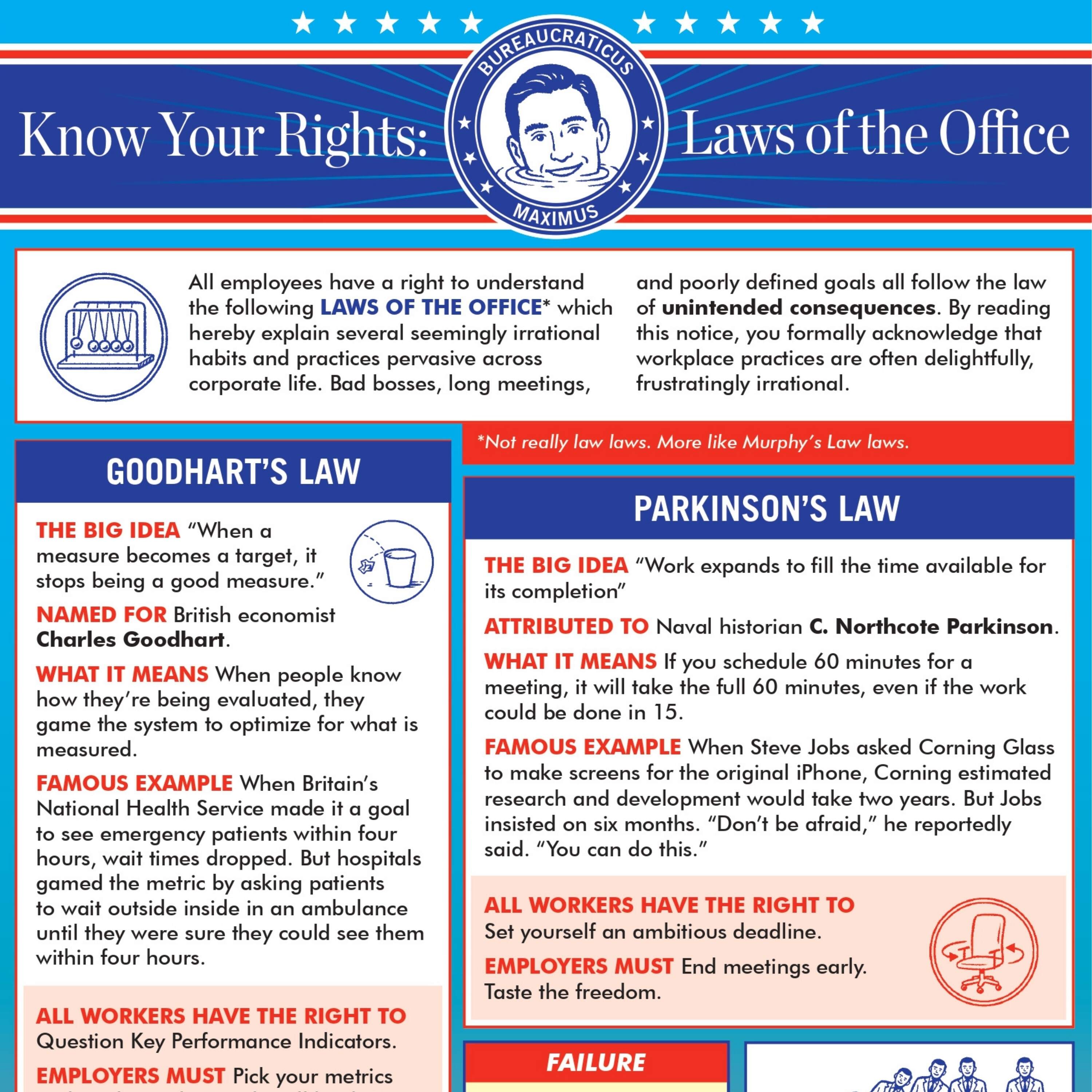
I'm gonna show you. I'm gonna show you something because this relates to the new Planet Money book. Are you ready? Look at this.
- [01:13]
B
Oh, the laws of the Office episode.
- [01:16]
A
This is a poster, like an industrial safety poster that you would.
- [01:21]
B
This looks like.
- [01:22]
A
See next to a watercolor.
- [01:23]
B
It's something like a federal agency would have 100%.
- [01:25]
A
But this is custom made for only very special Planet Money book buyers. And it is the laws of the office. It's the laws that you're about to hear in this episode. But put into a useful water cooler, like safety poster, and you can point to your colleagues obnoxiously when you're like, you know, you're really, really doing Parkinson's law right now, or really good arts law going on over there. What do you think?
- [01:47]
B
Yeah, yeah, yeah, yeah, yeah. So this is like wash the dishes in the communal sink post sticky note version. Yes, it's like a version of that. So, like, don't. Don't be that employee. Don't be that co worker.
- [02:00]
A
Yes. And all of these particular laws, as you will hear, have some kind of economic backing to them. That's what today's episode is about. But the important information here is this is a special edition poster only available limited edition only, for people who pre order the Planet Money book. And the way that you do that is you go to planetmoneybook.com and if you missed the link, don't worry, we will say it plenty more times. Okay, so here's the episode that inspired the poster that you can get when you pre order the Planet money book.
- [02:30]
B
I'm excited to hear it.
- [02:32]
A
It's good. It was good. It was very fun. Here you go. Here's the episode.
- [02:36]
B
This is Planet money from npr.
- [02:41]
A
Sarah, did you look up the thing?
- [02:44]
B
I looked up the thing. The statute of limitations in Pennsylvania for misdemeanors is two years.
- [02:52]
A
Two years? That's it?
- [02:53]
B
Yeah. So can you tell us the story?
- [02:55]
A
Okay, yeah, but let us not do it here. Let us do it here.
- [02:59]
B
Kenny Malone has brought us to a drugstore that has a self checkout.
- [03:03]
A
I used to be a cashier at a grocery store when I was about 16 years old.
- [03:07]
B
Aw, baby.
- [03:08]
A
Kenny, you have no idea. Dude, I looked like I was 11 years old at that age.
- [03:12]
B
Aw, I can see that. I can picture it.
- [03:14]
A
It was bad. So one day I learned that my managers have started to keep track of the performance of all of the cashiers.
- [03:20]
B
Like how friendly you are to the customers.
- [03:22]
A
No, no, no, no. They were measuring our, like, items scanned per minute. And then I believe they were posting those for the other cashiers to see. Okay, so I'm a little competitive. I'm also a goody two shoes. And I'm like, I gotta be faster. I gotta be faster. I gotta get my bosses these numbers. And then I get this item that won't scan.
- [03:40]
B
Oh, like cilantro. Cilantro never scans at the grocery store.
- [03:43]
A
There wasn't a ton of cilantro in rural Pennsylvania. I think it probably was like cat food. Cat food was weir. The label got all torn up and crap. Anyway, I'm trying to scan this thing and all I can think is like, oh, my God, my items per minute is plummeting, plummeting. And then finally I just let it go down the register unscanned, and I grab the next item and I move on.
- [04:04]
B
So you gave the cat food away for free?
- [04:07]
A
Yes. Technically, I suppose we would have to say I stole the cat food. But to be a good employee.
- [04:11]
B
That's why you asked me to check the petty theft laws in Pennsylvania.
- [04:14]
A
I was just trying to be a employee. I was trying to get good numbers, and I got good numbers. My items per minute were, I believe, the best in the entire grocery store. So.
- [04:24]
B
Okay, but when your bosses said speed things up, I'm sure that they didn't mean break the law in the process.
- [04:31]
A
Yes, yes. And that is the point of this story. I may have been breaking the Normal law. But I have since learned that I was simply following a different law known as Goodhart's Law.
- [04:43]
B
Goodhart's Law.
- [04:44]
A
Goodhart's Law. It essentially states that if a company decides to measure something, the employees are gonna find a way to give you good numbers. You just may not like how they do it.
- [04:59]
B
Hello, and welcome to Planet Money. I'm Sarah Gonzalez.
- [05:01]
A
And I'm Kenny Malone. And there are dozens of these laws or rules or principles or whatever you
- [05:07]
B
want to call it, like Goodhart's Law. Also the Peter Principle, Parkinson's Law. Today on the show, we take a look at these laws that claim to explain just about everything that can go wrong in an office, from bad managers to terrible procrastination.
- [05:22]
A
So, yeah, this episode originally ran in 2018. And we do. We just love this episode. It is one of those where once you hear these laws, you are gonna. You're gonna see them everywhere. You can't, cannot help it.
- [05:33]
B
And so that's how we thought we'd turn these Laws of the Office into like a real poster that you can hang in your office for your manager to see.
- [05:41]
A
And again, the way to get that is to pre order the Planet money book@planetmoneybook.com so today on the show, we'll
- [05:49]
B
hear the laws of the office along with a new one we found. And we hear from 2018 Kenny and 2018 Sarah, along with Alexi Horwas Ghazi back when he was just a baby producer at Planet Money.
- [06:00]
A
Oh, we were all babies, Sarah. We had so much energy.
- [06:03]
E
So much energy. This message comes from Capital One. Capital One offers checking accounts with no fees or minimums. What's in your wallet terms apply. See capitalone.combank for details. Capital One NA Member, FDIC. This message comes from Serval AI. Save your IT team time on repetitive ticket requests. The more your business grows, the more requests pile up. Password resets, access requests, onboarding all pulling them away from meaningful work. With Servil, you can cut 80% of your help desk tickets. Servl powers some of the fastest growing companies in the world. Get your team out of the help desk and back to the work they enjoy. Book your free pilot@servl.com money.
- [07:02]
F
Hello?
- [07:02]
A
Hi, Is this Professor Goodart?
- [07:04]
F
Yep, speaking.
- [07:05]
A
And you are Professor Goodhart of Goodhart's Law?
- [07:09]
F
I am indeed.
- [07:10]
A
Do you proudly wear that moniker?
- [07:12]
F
Um, slightly mixed feelings.
- [07:15]
A
Mm.
- [07:16]
B
This is Charles Goodheart, economist, former advisor to England Central bank, professor emeritus at London School of economics.
- [07:24]
A
And about 50 years ago, Charles Goodhart wrote a paper about monetary policy that included in the introduction a fateful little
- [07:32]
F
line it says ignoring in Goodhart's Law that any observed statistical regularity will tend to collapse once pressure is placed upon it for control purposes.
- [07:45]
A
Okay, hard to understand, but he was making a very narrow point about how measuring one tiny slice of the economy seems to mess up that slice of the economy.
- [07:55]
F
Goodhart's Law was actually a rather joking side comment. It was not intended at that time to be taken all that seriously, but
- [08:08]
B
over time it was. People took Goodhart's Law out of the world of monetary policy and came up with new formulations of the law.
- [08:16]
A
For example, once you target a measure, it ceases to be a good measure. I think is one of them.
- [08:21]
F
That's correct. The point is really fairly simple. Let's say that one of the measures of a hospital is that the waiting time is kept short.
- [08:32]
B
This is a real example. The British government started pressuring its hospitals to see emergency patients faster within four hours. And sure enough, wait times dropped, just not always for the right reasons.
- [08:47]
A
Hospitals started kind of gaming the statistics. And one of the most outrageous examples was this practice where patients would be asked to wait inside an ambulance until the hospital was absolutely sure that patient could be seen within the four hour time limit. Then the patient came.
- [09:03]
B
In another way of stating Goodhart's Law, be careful what you measure because your employees are going to make it happen.
- [09:12]
F
Indeed. And they will do it by reallocating resources to achieve that one measure and fail to meet non targeted measures because the resources will have been allocated away from them.
- [09:26]
A
When you first introduced Goodhart's Law, you had a very specific application.
- [09:30]
F
That's correct.
- [09:30]
A
This is not exactly the same. How do you feel about these broader formulations?
- [09:36]
F
Well, I'm perfectly happy with them. I mean all publicity is good.
- [09:41]
A
That's right.
- [09:41]
F
But I, in some ways it's a bit disappointing that I am probably best known for what is a jocular comment after some 60 years of doing more considered academic detailed work for which I am less known.
- [09:58]
A
And so, Sarah, I feel like we should introduce a corollary to Goodhart's Law here. If you decide to name a law, it will become a law. And you may not like what it does to your legacy. Hello? Hello. Check one, two. Kenny Malone here walking up to the desk of Sarah Gonzalez.
- [10:22]
G
Hey.
- [10:23]
A
Okay, so it's like what? 9, 30 in the morning? Thursday, November 8th, and we are supposed to be working on the next segment
- [10:31]
B
of this episode and we're not even close to finished.
- [10:34]
A
No, we're supposed to tell you about the so called Parkinson's Law, which states essentially that work expands to the time allotted.
- [10:42]
B
So, for example, Kenny and I have an entire week to finish this Parkinson's Law segment.
- [10:47]
A
And if we're being honest, that should really only take, like, one day's worth of work.
- [10:52]
B
Probably.
- [10:53]
F
Yeah.
- [10:53]
B
But we have a whole week, so that means we're probably gonna spend time, like, looking for archival tape that we're probably not gonna use.
- [11:02]
A
We are gonna do extra interviews that, if we're being honest, there's not room for in this piece.
- [11:06]
B
I always do that.
- [11:08]
A
We have a week. And so the work will expand to fill the week.
- [11:11]
B
But today, we're going to try to use Parkinson's Law to help get this done.
- [11:15]
A
And the reporter for this segment, though he does not know it yet, is Planet Money's newest producer, Alexi Horowitz Ghazi. And we are waiting for him to get into the office right now. Alexi.
- [11:27]
C
Yes. Hey, man.
- [11:28]
B
Hey.
- [11:29]
A
So, Alexa, you just got into work.
- [11:30]
C
Yes.
- [11:32]
A
So you're coming to the studio with me.
- [11:34]
C
Coming, coming.
- [11:35]
E
Okay.
- [11:36]
F
All right.
- [11:39]
A
So we have a professor on the line right now who's an expert in Parkinson's law.
- [11:46]
C
Hello, Professor.
- [11:47]
H
Hi.
- [11:48]
A
And I told you that I was gonna do the interview. We want you to do the interview.
- [11:51]
C
What?
- [11:52]
A
And furthermore, we want you to do the whole segment. There's one catch. The time allotted for you to finish this work is one day. You have to finish this by the end of the day.
- [12:01]
C
All right, let's. Let's do it.
- [12:03]
A
He's literally rolling up his sleeves.
- [12:04]
C
That's right. That's good. It's the only way to get anything done.
- [12:07]
A
All right, you can throw. You can throw the headphones on.
- [12:08]
C
Professor, can you hear me?
- [12:10]
H
Yes.
- [12:10]
C
Great. Okay, so maybe just to start out with, if you could introduce.
- [12:16]
A
Well, we are back in the studio. You've had a day. Your sleeves are still rolled up. Actually, you interviewed the professor. Do you have a story for us?
- [12:23]
C
That's the key to my success, and, yes, I do.
- [12:25]
A
All right, let's do it.
- [12:27]
C
So the first thing she told me was that Parkinson's Law started out as a joke.
- [12:33]
H
Yes. So it all started with a humorous essay published in the Economist in 1955. The author was C. Noscote Parkinson, who was a British naval historian.
- [12:49]
C
That's Meng Xu of the Johns Hopkins business school. In 1955, the Economist published Parkinson's essay as a kind of facetious argument. In it, he talked about why bureaucracies almost always grow no matter how Much work they're really doing. I actually found some archival tape of the now deceased Professor Parkinson talking about the essay.
- [13:10]
A
Archival tape.
- [13:11]
B
Oh, you actually brought us archival tape.
- [13:14]
A
Nice, man.
- [13:15]
F
It was unserious in form and it might have been sent to a humorous magazine instead, and I think more wisely, I sent it to the London Economist.
- [13:27]
A
Somehow you found someone that is more British than Professor Charles Goodheart. This is very impressive.
- [13:32]
C
That actually came off a 1960 vinyl album called Professor C. Northcote. Parkinson Explains Parkinson's Law. The blurb on the COVID calls it, quote, delightfully unprofessorial.
- [13:44]
B
That should be Planet Money's slogan. I feel like that's what we're going for.
- [13:48]
C
Meng says that Parkinson's article was mostly about why bureaucracies grow. But the thing that really stuck with people, that really made it a big deal was the opening line.
- [13:57]
H
So he summarized the law in the first sentence of his essay. That basically says, work expands so as to fill the time available for its completion.
- [14:08]
C
Mang says that even though it started as a joke, by the 1960s, people were actually treating this like a real law. So you had psychologists and economists coming up with experiments in the laboratory to try and figure out if people would expand their work to fit changing deadlines. It seemed like they actually did. And then you had other people going out and trying to find Parkinson's Law in the wild.
- [14:30]
H
Field tests across a variety of contexts, such as wood harvesters, steel industry, school system.
- [14:39]
C
Meng and her colleagues have actually studied this, and sure enough, they found that when they gave their subjects longer deadlines, they expanded the work to fit those deadlines. And she says that by now, Parkinson's Law has become a storied part of cubicle lore.
- [14:55]
H
It has been a main topic for management training. How do you fight Parkinson's Law?
- [15:02]
A
How do you fight Parkinson's Law?
- [15:03]
C
Well, she says there are a few ways. First, you could shorten your deadlines. Know something about that? Second, you could offer a reward for fast task completion.
- [15:14]
A
Are you asking us for a reward right now?
- [15:16]
C
This is a hold up.
- [15:17]
A
Like a stick up.
- [15:17]
C
Like a stick up.
- [15:18]
B
Like, how much money do we have in our pockets?
- [15:20]
C
Empty your pockets. Turn them out.
- [15:22]
A
I don't have any money. Oh, I do.
- [15:23]
B
I don't even have my wallet with me.
- [15:25]
A
I'll give you all the money in my wallet.
- [15:26]
C
Oh, my God, a whole dollar. Thanks.
- [15:28]
A
Good work, man.
- [15:29]
C
Made it rain. This is backed up by science. Meng says that even though Parkinson's Law started as a joke, it's been documented through a lot of different studies. But more importantly, she says it just makes intuitive sense.
- [15:44]
H
Yeah, that's the thing. I think people intuitively agree with his logic arguments.
- [15:50]
C
Oh, Meng. Meng. I think we just got cut off. I think that means that our interview expanded to the time we had allotted for it.
- [16:02]
A
Did your studio time actually cut out?
- [16:04]
C
It did.
- [16:07]
B
Alexi, you did it. You finished the task at hand in one day instead of a week.
- [16:12]
A
It was exactly as good as if we had done it in a week, too.
- [16:15]
D
Better.
- [16:16]
A
Hooray. Thank you, Alexi.
- [16:18]
C
Thanks, Kenny. Thanks, Sarah.
- [16:19]
A
Okay, this is 2026. Kenny popping in now because obviously we heard this segment and Alexi Horowitz Ghazi is now one of the co hosts of Planet Money. So graduated from producer to coast. And Alexi, obviously we needed to bring you back into the studio to debrief on this eight years later, but debrief, yes.
- [16:38]
C
Very happy to be here, Kenny. It's like a. It's like a therapy session.
- [16:41]
A
All right, so eight years on, what do you think about being pulled in to prove Parkinson's law Point. How was that?
- [16:49]
C
On the one hand, I still get, like night sweats about that level of in the moment stress. But, you know, on the other hand, I think it really. It really taught me you just got to get out there and talk to people and make it make sense. So on the whole, feel pretty good about it.
- [17:07]
A
Okay. Okay. That's a very positive review. We obviously, we give you a little bit more time on episodes these days, and I do feel like I haven't seen you in months because we've given you a lot of time on a very specific project. Alexi's working on a series based on. Wait for it. Listeners. The Planet Money book. Yes, it is. It is a little bit coincidence that Alexi's here, but it does work out great.
- [17:28]
C
Not spawncon.
- [17:29]
A
Can you tell us a little bit about the book?
- [17:32]
C
Yeah. So the book basically does a version of what we do here on the show. It applies an economics lens and a playful, whimsical sensibility to looking at everything in the economic world. Everything from tiny choices you make every day, like what to eat for breakfast to who you pick for your life partner to what do you do with your free time. So there's a lot of great stories Planet Money listeners will recognize and a ton of new reporting and new stories they're gonna love.
- [17:59]
A
Okay, so April 7th book. It is a deadline. Also, if you want to get the poster inspired by this episode that you're listening to right now, you do need to Pre order the book by April 7th. All right, Alexei, thank you for joining us again. For like the second or third time, I've lost track.
- [18:13]
C
Thank you, Kenny. I'll come back every time.
- [18:15]
A
Okay, so back eight years to our next law.
- [18:20]
B
Okay. The next law is called the Peter Principle. This one says that in a hierarchy, every employee tends to rise to their level of incompetence. If you're good at your job, your boss notices, promotes you. And then if you're good at that job, it happens again and you keep getting promoted until you get promoted to a job that you are not good at. To find out what that feels like, we asked our boss.
- [18:44]
G
Ooh, okay. I'm gonna remember this. Annual reviews, just a few weeks.
- [18:50]
B
Just kidding. We all think Alex is really good at his job. But Alex, we asked you to find someone who had the self awareness to realize that they were falling victim to the Peter Principle.
- [19:01]
G
Yes. And I found Stephanie Byrne.
- [19:03]
I
This story starts almost two years ago. I was doing a job that I love and never felt like I was even working. I loved it so much.
- [19:14]
G
Stephanie was a social media specialist for a large university. And this is a kind of behind the scenes job, which she liked. She got to find good stories about people around campus and then figure out how to share them on social media. It took creativity. She had a lot of freedom. She got to work independently, and these were the things she was looking for in a job.
- [19:33]
I
I just felt it was somewhere where I was really comfortable. I really felt that that brought out a lot of strengths that I have.
- [19:40]
G
Phase one of the Peter Principle right here. She is doing great. She knows that she's good at some things and not others.
- [19:46]
I
And then I was asked if I would be interested in this bigger role.
- [19:50]
B
Right. Promotion, totally normal. This is how jobs work.
- [19:53]
G
Now she's in charge of web content for the university, spends a lot of time in meetings. And part of her job is to tell other people how to do that, their jobs. So this is not behind the scenes anymore.
- [20:04]
I
I'm an introvert, so having to like stand up in a group of people was super uncomfortable for me. Like from the start, I had to do monthly trainings and I just felt sick before that every time.
- [20:18]
G
And she becomes the person who everyone brings their problems to, asking her to find a solution.
- [20:22]
I
I remember one time having someone confront me in the cafeteria about something they didn't like. Being put on the spot and, you know, holding my lunch and standing there, not sure what to do or how to handle it. I thought, I am terrible at this. Job.
- [20:40]
G
There are millions of Stephanie's everywhere in every industry.
- [20:45]
B
Right. Just because you're a good teacher doesn't mean you're going to be a good principal. And just because you're a good lawyer doesn't mean you're going to be good at bringing in new clients to the law firm.
- [20:54]
G
This is the Peter Principle. It comes from a best selling book back in the early 70s by a professor Lawrence J. Peter. And it was actually Sarah kind of a joke.
- [21:03]
B
Of course, all of our laws are jokes.
- [21:05]
G
This one was satire. And the point that Dr. Peter was trying to make was look around. This is the explanation for why so many people are bad at their jobs. Why so many mistakes just happen over and over again. And why so many people hate their
- [21:20]
B
jobs like Stephanie Byrne.
- [21:22]
G
And Stephanie is rare in that she is self aware enough to know it and admit it and also to do something about it. Stephanie is fighting the Peter Principle by stepping down from her new bigger job.
- [21:34]
I
Today is actually my very last day in it.
- [21:38]
G
She isn't going to quit, she's going to demote herself. She went and talked to her boss and she said, hey, I want a job like my old one, the one that I loved, the one that I was good at.
- [21:48]
I
Yeah, you know, I don't know that a lot of people will admit that they should be demoted, but I think for me it makes me happier and it makes me feel like I can do a better job and I feel smarter at what I do because I know my job so well.
- [22:06]
G
Now self demotion, that is one way to beat the Peter Principle.
- [22:10]
B
Okay, nice job, Alex. Good job reporting, but don't get any ideas. And I think there are some important meetings you have to go to. I think it's payroll day today.
- [22:18]
G
All right, I'm gonna go find Kenny, tell him to come on back in here. Thanks a lot Sarah.
- [22:22]
B
Thanks Alex. After the break we go searching for a law that did not start as a joke.
- [22:28]
E
This message comes from wix. Nothing beats seeing your ideas turn into cold hard cash. Well, if you use Wix Harmony, you better get used to it. Wix Harmony makes it unbelievably easy to create a fancy new website that's built to sell. Get the perfect blend of AI and drag and drop tools that puts you in control of every detail. Plus an AI agent to help you every step of the way. Try it for free@wix.com Harmony this message comes from Dell. Dell PCs with Intel inside are built for the moments that matter. Like a big project that can't be Interrupted by an update with long lasting battery life, you can stay focused on what matters. Built for Dell.com XPS this message comes from BetterHelp International Women's Day is this March. Time to celebrate all women. The leaders, the caregivers, the hype friends, the how do you do it? All types. Women deserve to be reminded how much they matter and that therapy offers a space to care for themselves. BetterHelp makes it simple by matching you with a qualified therapist based on your needs and preferences. Visit betterhelp.com NPR for 10% off.
- [23:41]
A
All right, for this last law, we figured we need something that did not just start out as a joke about crappy management or lousy procrastination.
- [23:50]
B
Our final law comes from Alice Evans.
- [23:53]
J
I know I've got a long boring title, but you should cut it. I'm a lecturer at King's College London. My title is a lecturer in the social what?
- [24:01]
A
She told us we could cut it. What you really need to know about Alice is that she is the kind of professor who when a brand new World bank report comes out, she live tweets her reactions as if she is watching Game of Thrones.
- [24:15]
B
And the law that Alice told us about is pretty well documented, but as far as we know, it doesn't have a name. But here's how Alice explains Social change
- [24:24]
J
accelerates when we see that others are changing.
- [24:27]
A
In other words, people want to change. They just want to see other people do it first.
- [24:33]
J
So it's this process of a snowball. Yeah, but the tricky thing is how do you get that snowball to move in the first place? So let me give you four examples.
- [24:40]
A
Four examples. This is great.
- [24:42]
J
You can pick and choose which one you like. So there was this brilliant intervention in Uganda.
- [24:47]
A
This was an intervention by Innovations for Poverty Action ipa.
- [24:51]
B
Uganda was struggling with domestic violence. It was happening at alarming rates and people didn't seem to be reporting abuse. Something needed to change.
- [25:00]
A
But per this law with no name, you shouldn't just tell people to do something. You should show them that other people are doing it. And so IPA ran a video campaign doing essentially that.
- [25:12]
J
So the video did not tell people that gender based violence is wrong. All it showed is people going out, reporting it and being supported by their community. And what they found within six months is this led to a rapid increase in reporting, a big reduction in gender based violence.
- [25:30]
A
There are a bunch of examples of changing social norms this way. For example, college binge drinking.
- [25:35]
B
Instead of putting up posters that said binge drinking is bad, researchers put up signs that Essentially said, hey, actual statistics show that your classmates don't drink as much as you think they drink. And that approach seemed to work.
- [25:50]
A
So this approach, it occurred to me, I think I have a problem that this could help fix. So, Alice, I know that typically your job deals with very important global, political, high stakes issues, but would you mind talking to me about the fact that no one at my office washes dishes?
- [26:08]
E
Shoot.
- [26:08]
A
Is it okay? Yeah, let's go. People in our office are leaving dirty dishes in the sink all the time. And so my idea was like, what if we worked with the office manager to put up posters that didn't say, hey, you should do dishes? What if instead they said, hey, did you know everybody else does the dishes a bunch?
- [26:27]
B
And Alice was like, no, this approach only works if you are actually telling the truth.
- [26:33]
J
So I wouldn't run a fake campaign. I think that's really dangerous because if people realize that the office manager is putting up fake posters, then that could undermine trust in the office and affect
- [26:43]
A
all sorts of other things. Okay, that's a good point.
- [26:45]
J
So I wouldn't do that. Kenny, can I draw parallels with rural Zambia here, please?
- [26:52]
B
So, for example, in Alice says that in remote parts of Zambia, healthcare workers often feel like no one cares what they're doing. This curbs worker morale, makes it hard for them to show up and to do their best work.
- [27:05]
A
But one thing that really helped was when supervisors started awarding a trophy for people's work. There wasn't even money attached. It was just a trophy.
- [27:14]
J
Just that sense of being appreciated, people seeing that you're making an effort and people rewarding. And I think that's something that we could learn from. With regards to your dishes problem, Kenny,
- [27:24]
A
you're saying I should make an amazing dishwashing trophy? Is that what you're saying?
- [27:29]
J
I think that could be cool.
- [27:30]
A
Yeah. I 100% can expense a dishwashing trophy for this story. Yeah, those are your laws of the office, folks. And once more, we have turned them into a wonderful poster. If you Google OSHA safety poster, that's what it looks like. Because we don't have a place for you to google our poster, but you can see what it would look like. And again, this is part of our book, Planet Money, a guide to the hidden forces that shape your life. If you pre order the book before April 7, you get the poster as a free gift, as a thank you for pre ordering the book.
- [28:04]
B
And the whole book in general is just filled with these kinds of visual jokes. There's a chart on tooth fairy inflation. There's like a whole love advice column from real economists. It's, it's truly, it's like colorful and bright, the book and really it's just like a joy to read. So go to planetmoneybook.com for info about the poster and about our book tour in 12 cities because that's right, Planet Money is going on tour on a real book tour.
- [28:33]
A
The book tour is for real, everybody. It's like book talk meets live. Planet Money meets meet and greet. Like it, it's all of the things.
- [28:42]
B
I'm hosting one in LA with co host Nick Fountain. And you guys know this person, He's a celebrity. Jack Corbett, our famous TikTok guy. So you know, if you're in LA,
- [28:54]
A
that's the LA one.
- [28:55]
B
That's the LA one.
- [28:56]
A
I will be in San Francisco is gonna be very fun. I believe we have one of the co founders of Anthropic is going to be there. One of the most cutting edge AI companies. So we've got some questions for Anthropic. I'll also be in Portland, Seattle.
- [29:10]
B
Spend some time with us and you can find ticket information for these live events and a link to where to buy the book@planetmoneybook.com or you can click on the link in the show notes.
- [29:20]
A
This episode was produced by Alexi Horowitz Ghazi. It was edited by Bryant Urstadt and
- [29:26]
B
our competent supervising producer is Alex Goldmark.
- [29:29]
A
If you have a law that you think we should know about, you can email us. We are planetmoneypr.org and special thanks to
- [29:37]
B
former Planet Money intern Shane McKean. He handled the most important part of this episode.
- [29:43]
A
I forgot about this.
- [29:45]
C
So I have a weird request. I'm trying to make a trophy with
- [29:50]
A
a golden mug on top. Yeah, of course. We asked Shane, the Planet Money intern to to go and custom order a Congratulations the kitchen is clean trophy.
- [29:59]
C
Yeah, so all it needs to say is the dishes are all done.
- [30:03]
B
Shane bought a five foot tall trophy.
- [30:06]
A
And then let's throw an exclamation point on the end. It had a real mug spray painted gold on the very top.
- [30:12]
B
And when the dishes were clean, this giant trophy would show up. If they weren't, the trophy disappeared.
- [30:18]
A
We left a recorder out and we just let people figure it out.
- [30:24]
B
It's rolling here. So there's this giant ass trophy. It has fork and knife taped to it. So I imagine it's an award for eating of some kind.
- [30:34]
A
I feel like a psychological experiment is being conducted without my consent. Oh, I bet this is for the
- [30:40]
B
Planet Money podcast about office problems, don't you think? Yeah.
- [30:43]
E
Uh.
- [30:43]
C
Oh.
- [30:43]
G
There's no trophy.
- [30:44]
A
There's a dirty spot in the sink. It's not mine, but I will wash it so that we can get the trophy back.
- [30:49]
B
The dishes are all done. Yes, but because I see the trophy, I feel like I'm being tricked by a trophy. Just a trophy would make me want to do that.
- [30:58]
A
That's interesting.
- [30:58]
B
Maybe I'm not gonna wash any dishes.
- [30:59]
A
The trophy has disappeared again.
- [31:01]
B
There's some dishes in the sink. Supervising producer Alex Goldmark is doing them
- [31:05]
A
with a big smile.
- [31:06]
G
Cause I know I'm gonna get a trophy.
- [31:09]
F
Ah.
- [31:10]
A
This was quite unscientific, but I'm just gonna say it. I think there were way fewer unwashed dishes.
- [31:16]
B
Yeah, it seemed to work.
- [31:17]
A
I'm Kenny Malone.
- [31:18]
B
And I'm Sarah Gonzalez. Thanks for listening. This episode was all over the place. It's Kenny breaking a rule. It's Alexi, like crash coursing. It's making a trophy.
- [31:31]
A
Yeah, it was great. It's a great episode.
- [31:32]
B
I don't remember it at all.
- [31:35]
D
This message comes from Instacart. Everyone prefers things a certain way, like groceries. If you want groceries just how you like them, you gotta try Instacart. They have a new preference picker that lets you pick how ripe or unripe you want your bananas. Shoppers can see your preferences upfront, helping guide their choices. Because when it comes to groceries, the details matter. Instacart get groceries just how you like.
- [32:00]
E
This message comes from Insperity. Excellence takes drive, work, perseverance. Tiger woods brings it to the course. Insperity brings it to your business. Want to be the best? Work with the best. Insperity. How you HR matters. Learn more@insperity.com Tiger.