Loading summary
Transcript146 lines
- [00:02]
A
This is Planet Money from npr. A few weeks ago, reporter Alex Mayasi and I headed to Canada to meet a leader of a small nation.
- [00:18]
B
There's dinner.
- [00:19]
C
The geese.
- [00:20]
B
Yeah, that's dark meat, man.
- [00:24]
C
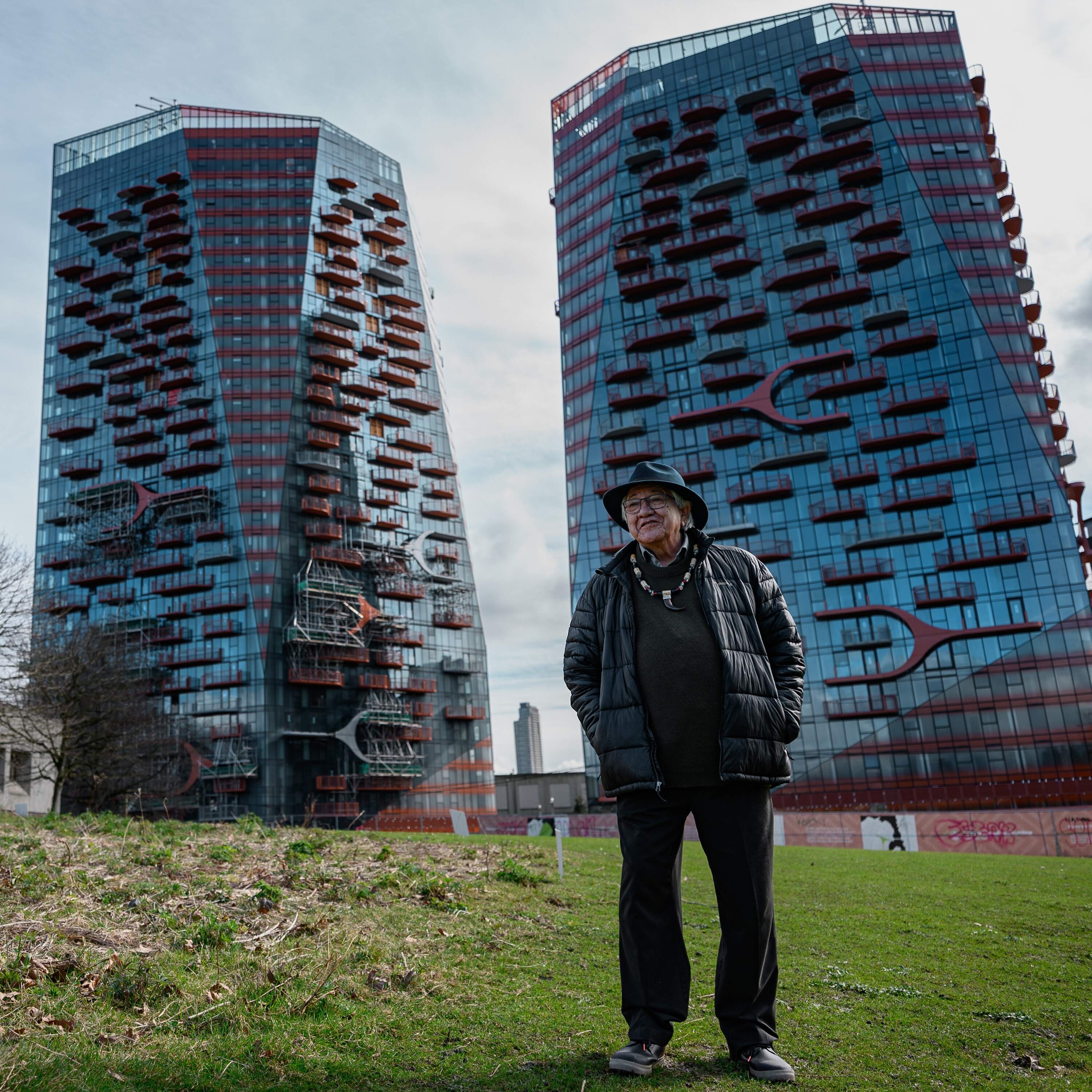
This is Gilbert Jacob. Everyone calls him Chief Gibby. He used to be one of the leaders of the Squamish Nation, a nation of around 5,000 indigenous people living in the Pacific Northwest. We met him in this charming little neighborhood full of single family homes. There was a big open park nearby.
- [00:40]
A
Now, the land that we were standing on used to be a Squamish village. It was called Sinach. Chief Gibbe's ancestors once lived here. Back in the 1800s.
- [00:49]
B
This was one of the most bountiful areas in all of the coast. We had elk, we had moose. You know, we had killer whales, we had seals, sea lions. You know, we had catch lots of different fish out here.
- [01:03]
C
And then what happened?
- [01:06]
B
Then the white people came.
- [01:08]
C
Government officials from British Columbia in 1913 came and took the land. They forced the Squamish to leave and destroyed the village.
- [01:15]
B
They didn't even give them time to go and take their belongings. They put our people on a barge, and when they were going out there, they turned around and they'd set this whole place ablaze. They burned everything, all our people's belongings, the whole village. They didn't want us to come back
- [01:33]
A
because the land that Sanhak was sitting on, it was right next to a fast growing seaport, a seaport that would eventually become a major city, Vancouver.
- [01:43]
C
Over the decades, the land where Chief Gibby's great grandparents used to hunt and fish was turned into streets, houses and apartments, government buildings, a park, a wharf, a marina.
- [01:52]
A
But the Squamish kept fighting for Sanhak. In 1977, the Squamish Nation sued the Canadian government. The legal battle took decades. And in 2003, they were able to get some of this land back, about 10 and a half acres.
- [02:05]
B
I was ecstatic. This place, we never doubted it belonged to our people.
- [02:12]
C
The location of those 10 and a half acres was incredible. We were standing right next to it. It's so close to downtown Vancouver. This was the biggest economic opportunity in the history of the Squamish Nation.
- [02:25]
B
When we got it back, I brought my whole team together. I said, we got a plan.
- [02:30]
C
The land they got back was a prime piece of real estate in one of the most expensive cities in the world. But now they had to decide, what were they going to do with it? Hello and welcome to Planet Money. I'm Alex Maassi.
- [02:44]
A
And I'm Jeff Guo. In most cities in North Americ, regulations put limits on how high or how quickly you can build. But Sanak is the sovereign territory of the Squamish Nation. They are not bound by these regulations. They can build in a way that almost no one else can.
- [03:03]
C
Today on the show, we follow the Squamish Nation as they live a kind of economic experiment. What would you build on a piece of land when all the normal rules go out the window?
- [03:18]
D
Support for this podcast and the following message come from Square. Whether you're selling lattes, cutting hair, detailing cars, or running a design studio, Square helps you run your business without running yourself into the ground. With Square, you get all the tools to run your business with none of the contracts or complexity. And why wait? Right now, you can get up to $200 off Square Hardware at square.com go money. That's sq U-A-R-E.com go money. Run your business smarter with Square. Get started today.
- [03:53]
C
Chief Gibby and the Squamish Nation had this once in a generation opportunity. In 2003, they'd gotten back those 10 and a half acres of envelop land about the size of a large football stadium in the middle of Vancouver.
- [04:06]
A
And right away, Chief Gibby knew what he wanted.
- [04:09]
B
I sat down with the whole consulting team, I said, this is our first opportunity, my people's first opportunity to get into development. This has to be a signature project.
- [04:23]
C
And Chief Gibbe wanted their signature project to make money. After decades of being displaced, generations of Squamish had struggled growing up in the 1950s, when Chief Gibbe was a young kid, he didn't have plumbing, didn't have running water, and. And since then, it had been hard for many Squamish people to catch up economically.
- [04:42]
A
So Chief Gibby's dream was to turn these 10 and a half acres into a dependable money making machine.
- [04:48]
B
Thought I want to do an atm. That's what I call these. Plug the card in every end of the month, the money comes out, pay the bills, you know.
- [04:59]
C
In the US some native tribes might choose to build casinos. But in this case, Chief Gibbe and his team were looking at a piece of land in the middle of a major city. They realized the best use of land was rental apartments.
- [05:11]
B
A lot of young people like you guys, you know, they can't afford to buy anything around here too expensive. So my view is always, let's house them.
- [05:23]
A
So as Chief Gibby remembers it, this is the plan the team came up with. They would Build a few mid rise apartment buildings. They'd be like a dozen stories tall with a total of maybe 1500 units. So a fairly typical modest size development.
- [05:37]
C
And then Chief Gibbey and his team had to sell the idea to the entire Squamish Nation. They shared the proposal in bulletins and newsletters, and people debated the merits and drawbacks at family and community meetings.
- [05:50]
A
Wilson Williams remembers those conversations. He was in his early 20s at the time.
- [05:54]
E
Wilson Williams is my English name. Swelten is my ancestral name. I carry on behalf of my father's side of my Squamish Nation ancestry.
- [06:03]
C
Wilson's great grandfather lived in Sanhawk in the early 1900s. He was one of the people driven off the land. And at the time when they were discussing Chief Gibbe's plan, Wilson found himself thinking a lot about this one phrase, this saying that he'd often heard a Squamish elder about their responsibility to future generations.
- [06:22]
E
We gotta start planning seven generations ahead.
- [06:25]
C
Plan for seven generations. What did that mean to you when you heard it?
- [06:31]
E
I had to go ask my mom, honestly.
- [06:35]
A
So this is the idea that you should be stewards of the land so that it can keep providing for your children and your children's children and, you know, your children's children's children. It's a kind of popular idea in a lot of indigenous cultures.
- [06:47]
C
Wilson says he learned about it as a Squamish teaching to ensure the health and wealth of the next generations.
- [06:52]
E
We gotta be prepared for the unborn children that are coming and make sure their survival and that they don't have to deal with what we've had to.
- [07:02]
A
This idea about providing for the future made Wilson think twice about Chief Gibbe's proposal.
- [07:07]
E
I was like, okay, this is it. How is it gonna give us generations of wealth? And that wasn't justified enough to me, even as a young person.
- [07:17]
C
To Wilson, Chief Gibbe's plan had two problems. First, these buildings just felt like your standard generic apartment complex. They didn't really feel Squamish Sanhok was
- [07:27]
E
the place of beauty, and that beauty wasn't presented in this proposal.
- [07:35]
A
And the second problem was that the whole plan also seemed kind of small. Like a few mid rise buildings weren't going to bring in the kind of profit that would change the future of the Squamish Nation.
- [07:47]
C
And as a self governing nation, they were in this unique position to build kind of anything they wanted on this land, which is extremely unusual.
- [07:56]
A
Yeah. In Vancouver, like in most cities in North America, there are zoning laws that Limit what you're allowed to build on any given piece of land. At the time, more than half the land in Vancouver was restricted to single family homes. There were also laws regulating lot sizes and requiring a minimum number of parking spaces. All of which make it hard to build dense neighborhoods.
- [08:17]
C
But the Squamish Nation don't have to follow those laws. Vancouver's zoning laws do not apply on Squamish land.
- [08:25]
E
So according to the government, when you're on reserve, you're not obliged to follow all the same regulations. So we can do different things, build higher, build differently, not abiding by the same bylaws and stuff.
- [08:40]
A
Wilson felt that putting mid rise apartments on this land would be squandering a huge opportunity. And he was not alone. In the end, those initial plans never moved forward.
- [08:51]
C
So for many years, the land sits there vacant. Eventually, Chief Gibby retires and in 2013, Wilson Williams gets elected to the Squamish Council.
- [08:59]
E
When I got on council 12 years ago, my late father in law, Byron Joseph, he said, oh, we need to get you some silver. And I was, I was like, oh, okay. Like, just thinking that. Yeah, that's what I thought he meant. That's what I thought he meant. But it wasn't. He's like, no part of our teachings. When you wear silver, it deflects bad energy away from you.
- [09:24]
C
So Wilson got some silver jewelry and stepped into his role as one of the leaders of the Squamish Nation. He was part of a new generation trying to come up with a plan for this 10 and a half acres.
- [09:35]
A
By then, Vancouver had become one of the most expensive cities in the world. Rents had gone bonkers. And that's because Vancouver is surrounded by water. So to build more housing, the city had to build up. But they couldn't build up because of all the zoning laws.
- [09:51]
C
And this is not just a Vancouver problem. Economists almost universally agree that restrictive zoning laws are one of the main reason rents are so high in cities like New York, Los Angeles and San Francisco.
- [10:02]
A
In Vancouver, those laws were contributing to a housing crisis.
- [10:05]
C
Was the housing crisis and really high rents in Vancouver an opportunity in a way for the Squamish Nation?
- [10:12]
E
Yeah, it was a true opportunity.
- [10:16]
A
Wilson and the council worked with the developer on a new plan. Instead of a few mid rise apartment buildings, they would build skyscrapers, 11 of them. The tallest would be about 60 stories. This would be a mega project that would add around 6,000 new apartments to the city. Most of them would be available to anyone in the public. They'd be luxury units with market rate rents, but there would also be some subsidized apartments for members of the Squamish Nation.
- [10:42]
C
This new plan would make Sanhak one of the densest uses of land in Vancouver. It would also include shops, restaurants and parks, and there'd be artwork and design by Squamish artists. So the Squamish Nation put it to a vote in 2019. They set up two polling stations, one in the city of Vancouver and one just outside like an hour away. And when the ballots were counted, the
- [11:03]
A
Squamish Nation is very happy to announce
- [11:07]
F
that the Squamish people have given us a resounding mandate to move forward on the Sanhok development.
- [11:13]
E
So really, the evolution from that first proposal to now, that was music to the ears of our people.
- [11:23]
C
The announcement was big news in Vancouver. The Squamish were about to permanently make over the city skyline, and that is
- [11:30]
A
when the nasty letters started coming in. The rest of that story is after the break.
- [11:40]
D
This message comes from BetterHelp as a dad, BetterHelp President Fernando Madera relates to needing flexibility when it comes to scheduling therapy.
- [11:50]
F
I have kids under 18 so like
- [11:53]
C
time is very limited. That's why at BetterHelp our therapists try to have sessions, sometimes at night, depending on the therapist, or during the weekend. So I think that's what we need to tell the parents. You're not alone.
- [12:04]
F
We can help you out.
- [12:06]
D
If a flexible schedule would help you, visit betterhelp.com NPR for 10% off your first month of online therapy. This message comes From Dell Dell PCs with Intel inside are built for the moments that matter, like a big project that can't be interrupted by an update. With long lasting battery life, you can stay focused on what matters. Built for you Dell.com DellPCS this message
- [12:35]
G
comes from Northwestern Mutual. One of the biggest money mistakes people make is putting off working with a financial professional. Northwestern Mutual will match you with a financial professional to build a plan based on what's important to you. Finding new opportunities to help grow your wealth and protect what you've worked so hard for. Find a better way to money@nm.com the Northwestern Mutual Life Insurance Company, Milwaukee, Wisconsin and Northwestern Mutual Wealth Management Company.
- [13:02]
D
Support for this podcast and the following message come from Alexa. Say hello to Alexa and see how the experience is tailored to you. Planning a vacation? Ask Alexa to recommend a trip. Use Alexa to find the name of that song you love, Discover new favorite shows or recipes, and so much more. Ask Alexa anything and now Alexa is free with prime on your Amazon devices like echo and Fire TV. Get started at Amazon.com alexaplus the Squamish
- [13:34]
C
Nation had decided six years ago to build huge towers on their ten and a half acres of land near downtown Vancouver.
- [13:41]
A
Oh, it's the closest I've ever been to a forklift. Last month we went to visit the construction site. Hi there.
- [13:49]
F
How are you doing?
- [13:50]
C
I'm Alex.
- [13:50]
F
Alex, Jacob.
- [13:51]
C
Very nice to meet you, Jacob.
- [13:52]
F
Come on in.
- [13:53]
C
Thank you.
- [13:54]
A
Do we need hard hats for this?
- [13:56]
C
Jacob Lewis III has helped oversee the Sanhok development for years. Three of the 11 towers are almost done.
- [14:03]
F
So this is Tower 3.
- [14:05]
C
I'd been reading about Sanhak for years, but seeing these towers in person. They're sleek and modern. Huge floor to ceiling windows made of tinted glass. Story after story, standing just feet away and craning my neck to see the top, the towers felt massive. The word tower feels appropriate when we're at the base of it where they are towering over us. It's an impressive thing to be standing here.
- [14:27]
F
It's got that mountain topology designed into it so, you know, you feel like you're at the base of a mountain.
- [14:31]
C
Right. Yet the towers do evoke mountains with a wide base, and they're a bit narrower at the top.
- [14:37]
A
They also have these orange accents. They've got orange balconies and giant orange panels of metalwork that kind of look like wishbones. Jacob says this shape is called a trigon. You see it in all kinds of squamish artwork.
- [14:49]
F
This represents us. We've experienced so many years of erasure. It's very important for us, for people to understand whose land and territory they're
- [14:59]
C
visiting, to really understand this project they're building. Jacob took us up to the very top floor of the tallest tower so far.
- [15:07]
B
Hi.
- [15:07]
A
Hi. What floor are we going to? 38. 38, yeah. The doors open to an active construction site. We walk past bare concrete pillars, exposed pipes, wires dangling from the ceiling.
- [15:20]
C
We walk up one more flight of stairs.
- [15:22]
A
And this is the roof.
- [15:24]
C
And it is spectacular.
- [15:28]
A
Oh, there's the bay.
- [15:29]
C
Straight ahead are the blue waters of English Bay. To our right, just across a narrow inlet, is downtown Vancouver with all those skyscrapers. But here, around the towers themselves, it's all parks and a leafy neighborhood with cute houses.
- [15:44]
A
What's that?
- [15:46]
F
This is this little section here. That's the Nimby area.
- [15:51]
C
From 38 stories up, it was easy to see the collision of the free market and the city zoning laws.
- [15:57]
A
Jacob was pointing out a charming little neighborhood right Next to the towers, it's called Kitt's Point. And when the Squamish first announced their plans to cram 11 huge towers onto this land, some of those neighbors were not happy. They were like, not in my backyard. You know, nimby.
- [16:14]
F
There's some definite resistance. And, you know, it was made loud and clear. And I think they'd put signs in their yards, and then there's online social media activity, like, it's not what their view of their neighborhood should look like.
- [16:30]
C
Some people in Kitt's Point had real rational concerns. They worried that the towers would bring lots of traffic, that the parks would be overrun. And some said that the high rises would disrupt the migratory birds.
- [16:42]
A
This is why, even when cities know that zoning is making it harder to build housing, they still have all of these very restrictive zoning laws, because zoning laws give people a say in what happens in their own neighborhoods, which sounds really great in theory, and. But in practice, most people generally don't want big, new, disruptive construction projects in their own neighborhood. And so they complain about it to planning boards and city politicians. They complain very loudly.
- [17:12]
C
And meanwhile, the people who'd potentially benefit from high rises like Sanhak, they probably don't live in that neighborhood yet. They might not even live in Vancouver yet. So they're not around to vote for pro housing politicians or advocate for the project.
- [17:25]
A
This all leads to a classic problem in politics, one that a lot of economists have studied, where a project that might benefit lots of people gets stalled because it would hurt a small minority of extremely vocal, extremely motivated people. There's an asymmetry here. Economists call it the problem of concentrated costs versus diffuse benefits.
- [17:45]
C
Jacob says in the early stages of the Sanhak project, they heard a lot from this very vocal minority. But some of the complaints, he says, seem to have this other undercurrent. It seemed like people were calling the Squamish greedy. Some even questioned why indigenous people were trying to build tall, modern high rises at all. A former city councilor told a reporter that there was a, quote, big gap between these big, concrete high rises and, quote, an indigenous way of building.
- [18:11]
F
A lot of people look at us as, you know, we're an indigenous developer. So they're expecting long houses, and they're expecting, you know what I mean? Like, things like, we used to live in. No, like, we're. We're gonna. We're creating something new, right?
- [18:23]
A
Jacob says these critiques were kind of offensive.
- [18:26]
F
I mean, it's frustrating. I know what it is, and I call it out. What it is it's, you know, there's levels, just levels of racism.
- [18:32]
C
Normally, developers have to be very careful about not offending the neighbors, even if the neighbors are saying kind of offensive things. But in this case, Jacob and the Squamish nation could more or less ignore the critics because this was their land. The Squamish got to make their own zoning laws. But they did listen to the criticism. They agreed to fund upgrades to help with traffic, like maybe a new transit hub for buses or adding bike lanes to the area.
- [18:56]
A
And as this project moved forward, the Squamish eventually started to find allies. Like when they approached the city of Vancouver about connecting the towers to the local roads and sewage system and power grid. The city was supportive. They signed an agreement.
- [19:10]
C
And when they were looking for funding, the Canadian government gave them a huge $1.4 billion low interest loan. That's Canadian dollars, so about a billion in US dollars. And this loan was a big show of support. Canada wanted to support the building of more rental housing.
- [19:26]
A
And sure, most of these Sanhak apartments are going to be expensive and high end, but when there's a housing shortage, every additional Unit helps.
- [19:35]
C
In 2022, the Squamish started construction. They held a groundbreaking ceremony. Squamish elders were there, the mayor was there, and so was Justin Trudeau, the Prime Minister.
- [19:44]
A
You had the Prime Minister of Canada come to the groundbreaking. What does that mean?
- [19:50]
F
I mean, that means this project's pretty damn special.
- [19:53]
C
Right after the ceremony, the towers started rising fast.
- [19:57]
F
We're three years in and we have three towers up. I mean, it says something, right? Yeah, I'd say it's fast.
- [20:04]
A
Like crazy fast.
- [20:05]
F
I'd say crazy fast.
- [20:06]
B
Yeah.
- [20:08]
A
Okay. This is another thing that makes Senaq unique. It's not just the size of the towers, it's the speed at which they're getting built.
- [20:16]
C
Because when neighbors can block projects and take real estate developers to court, that slows everything down. It creates delays and uncertainty that cost developers real money. These are hidden costs that are usually pretty hard to quantify.
- [20:29]
A
But recently, economists at MIT in Princeton came out with a clever new working paper that tried to do just that. We'll put a link to it in our show. Notes. The economists looked at the housing market in Los Angeles where developers can buy land that is pre approved for new construction, where someone's already gone out and gotten all the right permits. And they found that on average, developers are willing to pay 50% more for land with all the right permits attached.
- [20:53]
C
Basically, developers are willing to pay big money, hundreds of thousands to avoid battles with NIMBYs. The paper estimates that in LA, the slow and messy permitting process is responsible for about a third of the construction costs of a project.
- [21:06]
A
Over the years, more and more voters and politicians in Vancouver and in other cities and have started to recognize the costs of zoning laws.
- [21:16]
C
In fact, in 2019, Vancouver got rid of almost all single family zoning. The city allowed duplexes, and in 2023, they allowed multiplexes.
- [21:25]
A
There was a moment recently when Jacob realized that maybe more Vancouver residents were on his side than he thought. He was looking at this news report about the towers on his phone.
- [21:35]
F
It was posted through, like a TikTok, right? And then you see it in the comment section. You see people like, oh, you know, like saying, like, oh, it's so ugly. Like, it's just shouldn't be in this neighborhood.
- [21:43]
C
They were the same complaints he'd heard before. But then he scrolled down and saw something new.
- [21:48]
F
You had people jumping in now and saying, like, opposing those naysayers. And they were standing up for the project. And you're starting to see people like, no, this is great. You know, housing's being provided the way they're doing. It's being provided.
- [22:00]
C
Yeah. Now people on the Internet were defending the Sanhak project. They were saying yimby, like, yes, in my backyard.
- [22:08]
A
In the next three months or so, Sanhak will open its doors to the public. The first phase of the project will add about 1,400 new apartments. For context, that's about a third of the number of new rental units built in Vancouver last year. The Squamish expect that the full project, all 11 towers and 6,000 apartments, will finish by 2033.
- [22:27]
C
When we talked to Chief Gibbey, who helped lead the fight to get this land back in the first place, we were standing in a park right next to the construction site. It was afternoon, and the towers cast these long shadows.
- [22:40]
A
What do you think the story of this village and now these towers means?
- [22:47]
B
We're back. We're back. It's just placing our footprint back on our land again. To me, that's important.
- [23:00]
C
These towers, they are a case study in what's possible, how big you can build and how quickly if you don't have to follow the regular rules. And look, the Squamish are very clear about their main goal for this project. Their goal is to make money, to provide for the next seven generations. But these towers are also providing something to the rest of Vancouver. They're providing housing in the middle of a housing crisis.
- [23:32]
A
Alex, I think it is time to put you on the spot because this entire episode was based on one of the chapters that you wrote for the Planet Money book.
- [23:41]
C
Yes, that. That's right. It was one of my favorites to work on. But there are lots of other great stories in the book that I hope people will read and enjoy. There is a story about a corporate lawyer who kind of accidentally became a referee of global business.
- [23:56]
A
Guys, I read that chapter. It's amazing.
- [23:58]
C
A very Jeff chapter. There's a story about a bank teller who helped install a machine meant to replace her, and a college dropout who won a competition meant to identify the next Warren Buffet. You can find the book@planetmoneybook.com please read it. Enjoy it. We're so excited to share it with you.
- [24:17]
A
This episode was produced by Sam Yellow Horse Kessler with an assist from Emma Peaslee. It was edited by Jess Jiang, Fact Checked by Sierra Juarez, and engineered by Sina Lofredo. Alex Goldmark is Planet Money's Executive producer.
- [24:28]
C
Special thanks to Petsamuk and to Daryl Fairweather, who, by the way, is an amazing housing economist and will be at our Seattle Book Tour event. I'm Alex Mayassi.
- [24:38]
A
And I'm Jeff Guo. This is npr. Thanks for listening.
- [24:52]
G
This message comes from Northwestern Mutual One of the biggest money mistakes people make is putting off working with a financial professional. Northwestern Mutual will match you with a financial professional to build a plan based on what's important to you, finding new opportunities to help grow your wealth and protect what you've worked so hard for. Find a better way to money@nm.com the Northwestern Mutual Life Insurance Company, Milwaukee, Wisconsin and Northwestern Mutual Wealth Management Company. This message comes from Alexa. Say hello to Alexa and see how Alexa can do more for you craving your favorite restaurant. Alexa's on it free with prime on your Amazon devices. Learn more@Amazon.com Alexaplus this message comes from Capital Group.
- [25:39]
D
Some of the best lessons don't come from a classroom. They come from experience on the Power of Advice, a new podcast series from Capital Group. You'll hear from CEOs, investors and founders about how they built careers, took risks, and reinvented themselves. If you're starting your own journey, this is the kind of advice you won't want to miss. Available wherever you get your podcasts. Published by Capital Group Inc.