Loading summary
Transcript166 lines
- [00:00]
Sponsor/Advertiser
This message comes from NPR sponsor Charles Schwab. Financial decisions can be tricky. Your biases can lead you astray. Financial Decoder, an original podcast from Charles Schwab, can help. Download the latest episode and subscribe@schwab.com FinancialDecoder.
- [00:19]
Donna Shalala
This is Planet Money from NPR.
- [00:26]
Keith Romer
Every Tuesday morning, this very easy to overlook but incredibly important thing happens, happens on the street. Where I live in Brooklyn. Three employees of the city of New York roll up in a giant truck and take away all the garbage for the people in my apartment building. Those guys in their stained dayglo green T shirts, they are just one part of this vast army of workers who make a city like New York even possible to live in. An hour or so after these sanitation guys roll through, my daughter packs up her bag. Am I gonna need a raincoat today? I really like the weather. And heads out to her public middle school. Bye, sweetie, bye. Where she will be educated by yet more city employees. Those sirens you are hearing, those are because just down the street from where my daughter catches her bus each morning, there is a fire station manned by, you guessed it, city employees.
- [01:30]
Nick Bowset
Altogether, more than 300,000 people work for the city of New York. 300,000 people who make it possible for the city to function. And this marvel of social coordination, like so many things in our world, is made possible by money.
- [01:47]
Keith Romer
Yeah, my family pays city income tax and property tax and sales tax, and because my wife is self employed, something called the Metropolitan Community Transportation Mobility Tax. And all of those taxes pay for the sanitation workers and the teachers and the firefighters.
- [02:03]
Nick Bowset
Those city employees mostly get paid every two weeks. But the taxes and the big chunks of money that come from the state of New York or the federal government, those come on a completely different timeline. Income taxes are due in April. A lot of property taxes are due in July and January.
- [02:21]
Keith Romer
Lots of cities like Chicago, L.A. houston, Philadelphia, San Francisco, they deal with this with a little financial magic trick. They move money from the future when the taxes come in to the present when they need to pay their workers. The cities pull off this trick by selling short term debt, little IOUs that only last for a few months.
- [02:43]
Nick Bowset
Now, New York has generally had enough cash on hand that it hasn't had to use this short term debt debt trick for a while. Partly this is because New York is just very, very careful about this stuff because 50 years ago it was very, very not careful about it. And the city stopped functioning in some of the basic ways a city needs to function to survive.
- [03:09]
Keith Romer
Hello and welcome to Planet Money.
- [03:10]
Nick Bowset
I'm Keith Romer and I'm Nick Bowset. Sometimes to understand how things work, it can help to look at a moment when they stopped working altogether. So today's show is gonna be about New York City. Fifty years ago in 1975, a year when the city ran out of money and couldn't find anybody willing to give it to them.
- [03:31]
Keith Romer
What it takes when no one trusts you enough to loan you the several billion dollars you need to get by and just how hard it can be to re earn that tr.
- [03:48]
Sponsor/Advertiser
This message comes from Vanguard. Capturing value in the bond market is not easy. That's why Vanguard offers a suite of over 80 institutional quality bond funds actively managed by a 200 person global team of sector specialists, analysts and traders. They're designed for financial advisors looking to give their clients consistent results year in and year out. See the record@vanguard.com audio that's vanguard.com audio all investing is subject to risk. Vanguard Marketing Corporation Distributor this message comes from insperity. Excellence takes drive, work, perseverance. Tiger woods brings it to the course. Insperity brings it to your business. Want to be the best? Work with the best. Insperity how you HR matters. Learn more@insperity.com Tiger the 1970s were a.
- [04:44]
Keith Romer
Tough time for the government of New York City. White flight and the loss of manufacturing in the city had taken a big chunk out of the city's tax base. At the same time, there was a big surge in demand for the city's really quite generous social services. Big influxes of lower income folks had moved to New York. There was a nationwide recession.
- [05:04]
Nick Bowset
Steve Clifford remembers the city back then as an exciting place to live, but but also a pretty dysfunctional place to live.
- [05:11]
Steve Clifford
Everybody thought New York City was going to hell. Nothing seemed to work. The subways were, you know, 120 degrees in the summer. There was crime. There was dirt. There was just dirt everywhere.
- [05:28]
Keith Romer
Back then. Steve had two jobs. He ran a business with a friend of his making fiberglass furniture for interior designers. And he had started working part time as a consultant for the city controller. For one of his first projects, he spent a lot of time digging through the city's books.
- [05:44]
Nick Bowset
Steve had worked on city finances before and he did have an MBA from Harvard. But otherwise, he says, he was not your typical City hall employee.
- [05:53]
Steve Clifford
I was late to start as a hippie, but you know, I had long hair and I wore jeans and shiki and whatnot. Had a loft in soho. I was taking lots of dope.
- [06:10]
Keith Romer
Money was tight for the city back then, so Steve says New York made extensive use of that financial magic trick we mentioned earlier, where it took the money it was going to get in the future and transported it to the present.
- [06:21]
Nick Bowset
Yeah, the city would sell IOUs for lots of things for the real estate taxes it expected to receive for the state and federal aid it was counting on later in the year.
- [06:31]
Keith Romer
And banks were plenty happy to buy up all of these IOUs. They paid a pretty good interest rate. Lots of individual investors, big insurance companies, other banks were happy to take those IOUs off the bank's hands. And rating agencies said New York City debt was pretty safe.
- [06:48]
Steve Clifford
You could look at Park Avenue and you can say, these guys can't go broke. I mean, you want to talk about, you know, real property? I mean, these things are worth billions. The city can't go broke.
- [07:01]
Nick Bowset
Now, Steve's small part in this whole drama had to do with what he found when he poked around in the city's books.
- [07:09]
Keith Romer
How would you describe the financial record keeping of New York City?
- [07:13]
Steve Clifford
Well, there was no record keeping. I mean, there was a balance sheet. There was an income statement, and, you know, there were the computers whirring in the background. And, you know, what was going on.
- [07:29]
Keith Romer
With.
- [07:31]
Steve Clifford
The wizard of Oz.
- [07:33]
Keith Romer
See, Steve had gotten his hands on all this different information about all the different funds and accounts and sub budgets that had anything to do with the city's finances.
- [07:44]
Steve Clifford
And I started to, you know, just almost for the fun of it, started adding these things up.
- [07:51]
Keith Romer
And what he discovered was a very, very big problem.
- [07:56]
Steve Clifford
What had happened was, for the. At least for 10 years, there was a totally uncoordinated charade of different people devising different gimmicks that produced accounting revenue but didn't produce cash.
- [08:13]
Nick Bowset
Steve says for about a decade, New York City made moves that appeared to balance the city's budget, but. But very much did not.
- [08:22]
Steve Clifford
The city would, in various places, just delay an expense, like a payment for the pension funds. It's supposed to be paid in June 30, but we'll pay it in July, and then it'll go into the next year's budget. Give us more for this year.
- [08:41]
Nick Bowset
Or the city would pretend that its estimate at the beginning of the year for how much tax it would take in was the final number that went on its balance sheet, regardless of how much money it actually took in. And in a narrow sense, all of this was legal. But these kinds of financial shenanigans didn't exactly accord with generally accepted accounting principles.
- [09:05]
Keith Romer
And if you squint just right, you can maybe even feel A kind of sympathy for the politicians who were doing this stuff. All of the things they were elected to do to launch new government initiatives or provide the generous social services New York City was famous for back then to, you know, to help people, to make the world a better place. All of that takes money. Moving some things around on the balance sheet made it possible.
- [09:31]
Nick Bowset
Also, it let them add jobs and raise wages and make nice with powerful unions whose votes they were gonna need in that next election.
- [09:38]
Keith Romer
Yes, also that. But once you stop squinting, what you see is that all of this budgetary sleight of hand, it was funded by debt by those IOUs the city kept selling year after year.
- [09:53]
Steve Clifford
Nobody understood the cumulative effect of all these things. Absolutely no one.
- [10:00]
Nick Bowset
So Steve wrote up everything he found and took it to his boss, the city controller, Jay Golden.
- [10:06]
Steve Clifford
I started explaining all these gimmicks to him and said, look, we got $3 billion in debt and no way to pay it, because it's all been created by these gimmicks. Now, Jay didn't know what to make of me because I was still this hippie guy who wore jeans to work and sandals to work. And so I go in and tell him, look, the city's bankrupt. I mean, his reaction was, that can't be.
- [10:37]
Keith Romer
Steve did manage to pretty quickly convince his boss that, yes, the city was, in fact, in a rough spot. But even if the city completely swore off the budget shenanigans that had created that $3 billion deficit, it still owed billions of dollars more because of the shenanigans it had already done.
- [10:55]
Nick Bowset
And in the meantime, for the city to avoid default and keep functioning, it had to keep borrowing. When it came time to pay off, One of those IOUs, kind of their only move was to issue more IOUs.
- [11:10]
Steve Clifford
The only thing they could do was roll it over, roll it over, roll it over.
- [11:15]
Nick Bowset
Towards the end of 1974 and into 1975, the. The trust that the banks had that New York City would make good on its debts and avoid default slowly started to erode. And the interest rates that the banks demanded on those IOUs drifted higher and higher.
- [11:31]
Steve Clifford
The banks started saying, wait a minute. What's behind this rolling over? And they say, well, the faith and credit of New York City. And the bank said, well, that's great. Now, how much money does the faith and credit have? And that's when it all went nuts.
- [11:47]
Keith Romer
It all came to a head one day in February of 1975. The moment was actually included in a film by the BBC.
- [11:55]
Steve Clifford
Morning, ladies and gentlemen.
- [11:56]
Keith Romer
Today, the City of New York is offering for competitive bidding sale 260 million tax anticipation notes, of which 100 million will mature.
- [12:05]
Nick Bowset
That morning, the city tried to hold an auction of IOUs where syndicates of banks would come in and put their bids into a little tin box. But that day there were precisely zero bids.
- [12:18]
Steve Clifford
The announcement on behalf of the comptroller.
- [12:20]
Keith Romer
Is that the offer which we had expected to receive and announce at 2 o' clock this afternoon is now expected at 4 o'. Clock.
- [12:31]
Nick Bowset
Paul, does this mean that you have.
- [12:32]
Keith Romer
Not been able to sell them so far today? We will have a further announcement at 4.
- [12:39]
Steve Clifford
Yeah.
- [12:39]
Nick Bowset
That day nobody thought it was worth lending the city any more money. A couple weeks later, the city was able to sell some new short term debt. But that was the end of the line.
- [12:49]
Keith Romer
And without being able to roll over its debts, New York City only had enough cash on hand to get through a month or two.
- [12:56]
Steve Clifford
So having the city run out of cash, I mean, what you would have is the welfare checks don't go out and you don't pay the cops on the same day. And I mean, you can imagine what I mean, total chaos.
- [13:11]
Nick Bowset
The person presiding over this fiscal debacle was the city's mayor, Abe Beam. When journalists demanded to know what was going on, he put the blame on the State of New York and the federal government for not sending more money to help the city fund its social services.
- [13:28]
Felix Roedin
The basic cause of our crisis, among other things, is the fact that the City of New York is carrying costs.
- [13:37]
Keith Romer
Which are not appropriately New York City costs. One of the people watching this drama unfold was Donna Shalala. She was not a big fan of Abe Beam.
- [13:47]
Donna Shalala
He was short, inarticulate, bumbling.
- [13:52]
Nick Bowset
Donna would later become the Secretary of Health and Human Services and a congressperson. But back in the 70s, she was a politics professor with an expertise in the relationship between city and state governments.
- [14:03]
Donna Shalala
The mayor, the Mayor Abeam was totally over his head. He couldn't even explain, even though he had been the comptroller of the city, he couldn't even explain how many employees they had.
- [14:15]
Keith Romer
Donna lived in New York City, so she was paying attention to what was happening. But her main focus at the time was a book she had started writing.
- [14:22]
Nick Bowset
And then history came knocking on Donna's door.
- [14:26]
Donna Shalala
I got a phone call from the Governor of New York, Hugh Carey, just beginning the summer, it must have been June of 1975. He called and said, what are you doing for the summer?
- [14:39]
Keith Romer
By then, the state had already prepaid $800 million in aid to Try to keep the city from defaulting on its debts. But Governor Kerry wanted a longer term solution and he had a new plan which he proceeded to explain to Donna over the phone.
- [14:54]
Nick Bowset
Yeah, he had helped to create a brand new government entity to help fix New York City's debt problems. And he wanted to know if she was willing to be a part of it.
- [15:03]
Donna Shalala
He made it sound like it was going to be a quick in and.
- [15:05]
Keith Romer
Out, just a little. A little summer project for you and then go back to your book. Yeah. How did, how did that work out?
- [15:12]
Donna Shalala
Well, I never did finish the book, but I had a life changing experience.
- [15:19]
Keith Romer
Governor Carey's new government entity was called the Municipal Assistance Corporation, or the Mac. It was created as a way for New York City to get its hands on the money it needed without anyone having to lend directly to the city itself.
- [15:32]
Nick Bowset
Like, look, we get it. You don't trust the city government to pay you back. So forget about the city government. Lend Mac the money instead and let them worry about the city.
- [15:44]
Keith Romer
And Mac did have a couple of things going for it. It got first dibs on sales tax collected in the city. So it definitely had money coming in. And it was backed not by the credibility of New York City, but. But by the credibility of New York State.
- [15:59]
Donna Shalala
It was originally set up to issue bonds to stretch out the debt of New York City to give them some time to get their house in order. I think that's the simplest way to explain it.
- [16:13]
Nick Bowset
Donna was 34 years old and the only woman on the Mac board. The rest of the board was made up of the heads of big companies, a senior partner at a powerful law firm, and. And this famously charming investment banker named Felix Roedin.
- [16:28]
Donna Shalala
He had an instinct not for politics, but how to pull people together to get decisions. I think I was a pain in his butt initially, but he coached me along and we became very good friends. And I learned a lot from him about leadership.
- [16:46]
Keith Romer
Rohidhan was really good in front of TV cameras. He had this great overbite smile, these two big bushy eyebrows, and he was just so fundamentally calm. It was almost like he was wryly amused by everything that was happening.
- [17:00]
Felix Roedin
I really never knew how really fraudulent the accounting was. I mean, they did things with numbers here that they're just absolutely unbelievable. They would estimate revenues, you know, going ahead one century and estimate their expenses as of yesterday. But this is this kind of a way of life.
- [17:18]
Nick Bowset
Roden was known as a deal maker, but his main thing was mergers and acquisitions, not getting people to buy New York City's Debt.
- [17:26]
Donna Shalala
He just assumed because he didn't know a lot about municipal finance, that we could go into the market with bonds that were backed by the full faith and credit of the state, that had first dibs on New York City government money that were at 8 or 9% and that the market would just absorb those bonds.
- [17:49]
Keith Romer
And how did that turn out?
- [17:52]
Donna Shalala
It was much more difficult. No one believed in the credibility of New York City government.
- [18:00]
Nick Bowset
Donna and Felix and everyone else on the board worked hard to get people to believe the Mac bonds were credible. To get people to buy all this new debt.
- [18:09]
Donna Shalala
We had to peddle the bonds, the Mac bonds, all over the country. And so we all got on airplanes.
- [18:17]
Keith Romer
You personally, you were like flying around the country. David Rockefeller, as in one of the Rockefellers. At the time, David Rockefeller was the head of Chase Manhattan Bank.
- [18:27]
Donna Shalala
We landed in Dallas private plane, went to the Dallas Athletic Club to meet with the bankers, the great Texas bankers. And when we pulled up, one of his staff members came and said, Donna can't go in the front door because they don't allow women in the front door. And he said, so we'll take her around and she can go in the back door to meet with you. And David Rockefeller turned to me and he said, Donna, he said, I've never gone in a back door in my life. He said, follow me. And he walked me right through the front door of the Dallas Athletic Club.
- [19:02]
Keith Romer
Were you able to convince any Dallas bankers to purchase maps?
- [19:04]
Sponsor/Advertiser
No.
- [19:05]
Donna Shalala
Someone stood up and said, why should we invest in a place in which the Mayor doesn't know how many employees he has? David Rockefeller couldn't answer that question. So I don't think we sold many bonds that day.
- [19:15]
Nick Bowset
And Mac had trouble selling bonds kinda everywhere. Legally, Mac was a completely separate entity from the city of New York. But potential bond buyers still had a hard time totally trusting them.
- [19:28]
Keith Romer
Which meant the city was getting closer and closer to running out of money altogether. Mayor Beam announced a series of spending cuts. The city would pull back on social services and eliminate jobs. The very large and very powerful city workers unions were understandably not real happy with the Mayor's plans.
- [19:53]
Nick Bowset
The sounds of people striking and protesting.
- [19:56]
Sponsor/Advertiser
Layoffs in New York, a large group.
- [19:57]
Keith Romer
Of laid off policemen and their supporters gathered in protest near City Hall.
- [20:04]
Nick Bowset
At airports and hotels, members of the police union handed out brochures to tourists titled welcome to Fear City. The brochures warned how dangerous the city would be when police were laid off and offered tips for how to survive a visit. Don't take the subway, stay off the streets after 6pm do not walk anywhere.
- [20:25]
Keith Romer
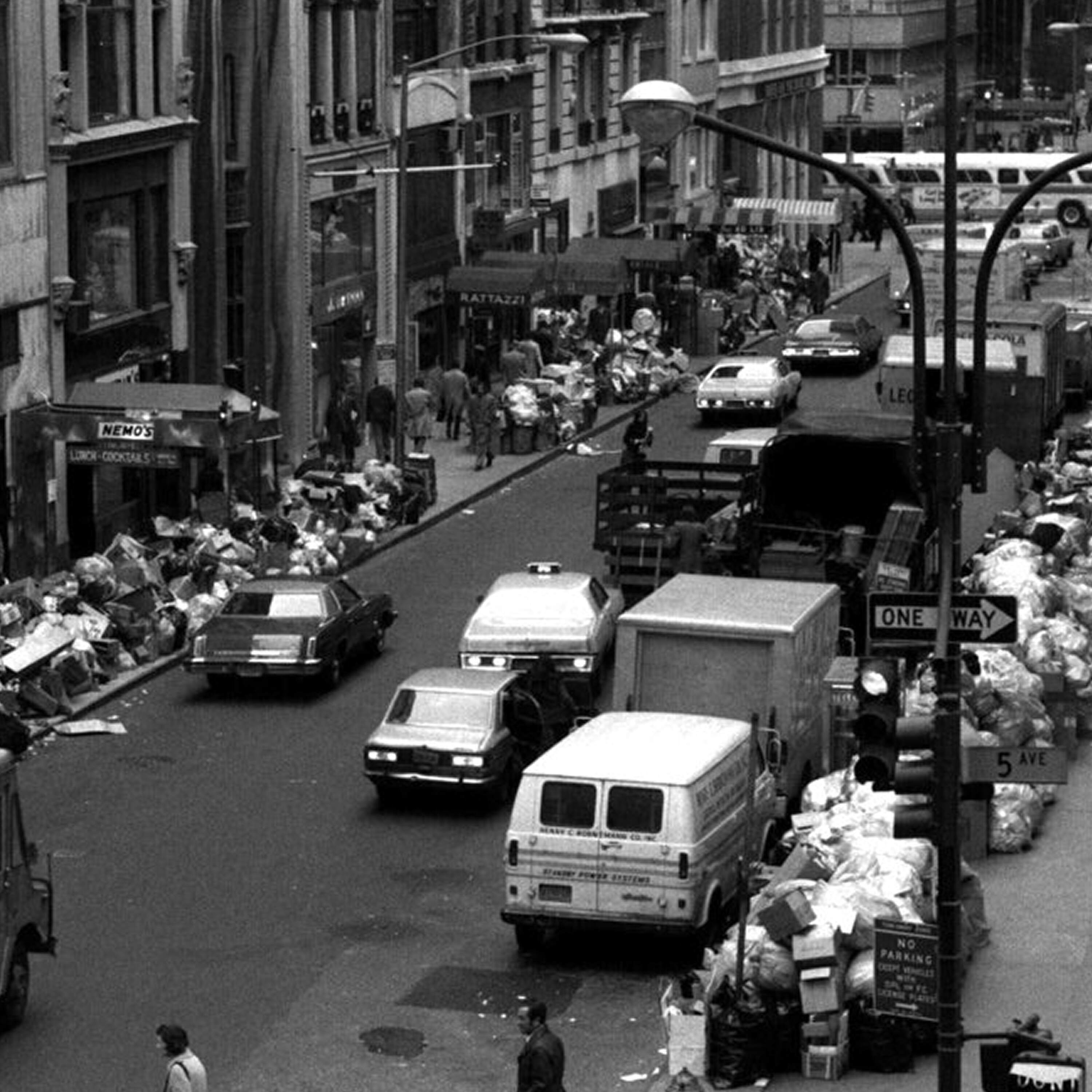
In early July in 90 degree heat, sanitation workers staged an unofficial but very comprehensive strike. No garbage has been picked up in the city since the weekend. The refuse piles up at the rate of 28,000 tons a day. The woman from Manhattan thought the layoffs could have been avoided.
- [20:42]
Steve Clifford
I think it's a terrible, terrible thing. I think Beam and all his other people should take $2,000 off their salary.
- [20:48]
Keith Romer
How do you feel about having 5,000 less cops on the street and 28,000 tons of garbage on the sidewalk?
- [20:53]
Steve Clifford
Terrible.
- [20:54]
Nick Bowset
I'm frightened stiff.
- [20:56]
Steve Clifford
I was afraid to ride the trains before I walk the streets. You can be sure I'll be locked in the house.
- [21:00]
Keith Romer
For Donna. The sanitation workers strike was sort of the worst thing that could have happened.
- [21:06]
Donna Shalala
It was a disaster. Right in the middle of what we were trying to do, we had garbage all over the streets.
- [21:12]
Keith Romer
Do you remember sort of like walking down the streets of New York?
- [21:15]
Donna Shalala
Yes. Smelling trash all over the place.
- [21:18]
Nick Bowset
In some parts of the city, people threw the piled up garbage into the middle of the street and lit it on fire.
- [21:26]
Keith Romer
Meanwhile, Felix Rohedin, the public face of the Mac board, was everywhere. On tv, in the newspapers, doing everything he could to get the bankers and the union leaders and the state and city officials to get on the same page and find a way to stave off default.
- [21:43]
Felix Roedin
I still cannot believe that these men, who are very decent men, aren't going to come to the conclusion that their future, along with everybody else's in the city is in their hands, that they're not going to do something about it.
- [21:55]
Nick Bowset
After the break, Mayor A. Beam takes a little trip down to Washington, D.C. and President Gerald Ford inspires one of the most famous headlines in New York City history.
- [22:11]
Sponsor/Advertiser
This message comes from BetterHelp. As a dad, BetterHelp President Fernando Madera relates to needing flexibility when it comes to scheduling therapy.
- [22:20]
Keith Romer
They have kids under 18, so, like.
- [22:23]
Nick Bowset
Time is very limited.
- [22:25]
Keith Romer
That's why at BetterHelp, our therapists try.
- [22:27]
Felix Roedin
To have sessions, sometimes at night, depending.
- [22:29]
Keith Romer
On the therapist, or during the weekend. So I think that's what we need to tell the parents. You're not alone.
- [22:35]
Felix Roedin
We can help you out.
- [22:36]
Sponsor/Advertiser
If a flexible schedule would help you, visit betterhelp.com NPR for 10% off your first month of online therapy. This message comes from Square. Every business has different goals. Square banking can help achieve your goals with more control over your cash flow and access to capital built into the same square system where you run your business. Go to square.com money to learn more about how your business can grow with Square Block Inc. Is not a bank. Banking services provided by Square Financial Services Inc. Member FDIC Square Checking provided by Sutton Bank Member FDIC Loans are subject to credit approval.
- [23:17]
Keith Romer
Okay, so here was the problem facing New York in the summer of 1975. The city owed billions of dollars in short term debt that it did not have the money to pay for. It also needed to pay the salaries of all its teachers and police officers and sanitation workers. And it didn't have the money for that either. And no one would lend it any more money to get out of this mess.
- [23:39]
Nick Bowset
Even Mac, the municipal Assistance Corporation that had been created to be this safer proxy to lend to because it was backed by the State of New York. Even Mac was having a hard time selling its bonds on its own. Mac couldn't solve the city's gargantuan debt problems.
- [23:56]
Keith Romer
Nana Shalala says nobody really knew just how bad things would get if the city defaulted on its loans and ran its reserves down to zero. But they knew it would be bad.
- [24:06]
Donna Shalala
It would have been the end of the growth of New York City. The school system would have been totally underfunded. Municipal jobs would have shrunk. It would destroy one of the great economic engines of the world.
- [24:21]
Keith Romer
A default would have been bad for the investors who held the IOUs from the city and would have to take a loss. Bad for New York real estate developers who would have had a harder time getting loans themselves, for the city workers unions whose members would face layoffs and wage cuts. For the state of New York who would have its biggest city basically stop functioning. And last but not least, bad for the federal government which would have the country's financial capital in full on meltdown.
- [24:49]
Nick Bowset
But at the same time, bad as it would be. No one really wanted to be on the hook for bailing New York City out of its multi billion dollar hole. And Donna says this is where Felix Roatan really shined.
- [25:03]
Donna Shalala
He just had confidence in his ability to do the grand deal, a deal.
- [25:09]
Nick Bowset
That would require buy in from everyone.
- [25:12]
Donna Shalala
People had to take cuts. Everybody had to give something up if they wanted to keep New York City solvent.
- [25:19]
Keith Romer
Whenever you turned on the news, there would be Felix Rodin warning about the possible consequences of New York City defaulting. How a lot of big companies that were headquartered in the city might just pick up and leave.
- [25:32]
Felix Roedin
And once that starts, then you've created a situation where in 10 years you'd have a city where you have more and more services required and less and less people Paying for the services, and you might end up with a gigantic slum.
- [25:46]
Nick Bowset
And away from the cameras, Riordan was constantly trying to convince all the big players in the city to do their part.
- [25:53]
Donna Shalala
It was his effort to get the unions and the real estate industry and the businesses all to share the pain, as he would say it. And the only way he could do that was to make sure that they understood the implications of bankruptcy. Here are the advantages to you, and guess what the disadvantages are.
- [26:17]
Nick Bowset
And slowly but surely, Roden helped broker these pretty astounding seeming deals. Like some of the city's biggest property owners agreed to pay hundreds of millions of dollars in real estate taxes months before those taxes were due.
- [26:32]
Keith Romer
After months of haggling, the city employees unions signed up to take billions of dollars from their own pension funds and use that to purchase the bonds that Mac was having such a hard time selling on the open market.
- [26:44]
Donna Shalala
Everybody was concerned about their own jobs, whether they were in the private or public sector.
- [26:48]
Keith Romer
It sounds almost like the commonality of purpose that comes in a war or something where if this goes down, we're all going down with it.
- [26:55]
Donna Shalala
Well, that was exactly the feeling. Why would the real estate guys have paid their taxes in advance? Out of loyalty to New York City. Yes. But at the deeper sense, they and Felix understood that this great city on its knees, that the country couldn't survive without New York.
- [27:19]
Keith Romer
I mean, there is also in that story, as I understand it, they also got a discount, right?
- [27:25]
Donna Shalala
Absolutely. But we got the cash.
- [27:28]
Nick Bowset
And Donna says that same Big Apple mix of public spiritedness and naked self interest kind of drove all of these deals.
- [27:36]
Donna Shalala
Well, it's transactional. It's a New York. Transactional.
- [27:39]
Keith Romer
Yeah, right. Like I'm gonna do the right thing, but I'm also gonna get a little piece of the deal for myself.
- [27:45]
Donna Shalala
Yep.
- [27:46]
Nick Bowset
When it came to the state of New York, the things it wanted the most from the city, where were assurances that the debt problem would not get any worse and that none of this would ever happen again.
- [27:56]
Keith Romer
Creating the Mac was just the first part of a plan that developed over months. The second part of the plan went like this. In exchange for funding a $2 billion aid package to the city, the state legislature forced the city's elected officials to give up a lot of their power over their own budget. New York City politicians would no longer be able to just fund every exciting new initiative or genuinely important service by fiddling with a balance sheet.
- [28:24]
Nick Bowset
A presumably more responsible but less democratic entity was created to watch over the city budget. The emergency financial Control Board. The Control Board got the final say over basically every last financial move the city made and made sure that the city was making the deep cuts it had to to actually balance its budget.
- [28:44]
Donna Shalala
The state essentially took away home rule from the city for the financial part of the city.
- [28:52]
Keith Romer
But even with the real estate folks paying their taxes early and the unions using their own pension funds to prop up Mac bonds and the state throwing in billions more, there was still one big piece missing. One institution whose involvement would do more than just fill the hole in the budget. One that hopefully would signal to markets that New York City wasn't going to be allowed to fail that institution. The federal government.
- [29:19]
Nick Bowset
Yeah. In the fall of 1975, Mayor Abe Beam traveled to Washington D.C. to plead his city's case.
- [29:26]
Keith Romer
What we want is the use of.
- [29:28]
Felix Roedin
The federal government's credit through guarantees on.
- [29:32]
Keith Romer
Our securities until we are able to re enter the credit markets on our own.
- [29:38]
Nick Bowset
In other words, Beam was asking the federal government to bail out New York City. But the President Gerald Ford, was not having it.
- [29:47]
Keith Romer
Responsibility for New York City's financial problems is being left on the front doorstep of the federal government, unwanted and abandoned by its real parents. In a speech at the National Press Club, Ford made all the usual arguments you hear made against any bailout. Why should taxpayers make investors whole on a bad bet they made? What kind of example would bailing out New York give to other cities who might be tempted to cut corners with their budgets? I am prepared to veto any bill that has as its purpose a federal bailout of New York City to prevent a default. I am fundamentally opposed to to this so called solution.
- [30:35]
Nick Bowset
The next day the New York Daily News busted out a headline for the ages. Ford to City, Drop Dead.
- [30:43]
Keith Romer
Do you remember seeing that headline?
- [30:47]
Donna Shalala
Of course. I had it for a long time framed.
- [30:50]
Keith Romer
But despite what Ford said in his speech, the federal government and Gerald Ford in particular were caught in the same incentive trap as everybody else. The country couldn't afford to have New York City actually descend into bankruptcy. And Ford had a presidential election coming up and New York had a lot of electoral votes.
- [31:11]
Nick Bowset
So In December of 1975, the United States itself was finally pulled into Felix Rhoden's grand bargain. The government ponied up more than $2 billion in short term loans to New York City.
- [31:23]
Donna Shalala
I talked to Jerry Ford about it years later. He used to have a conference in Vail and I used to sit next to him at dinner because he told his wife I was the only one that knew anything about football. But I talked to him about that, did he regret it? No, because he said from his point of view, it forced the city to pull itself together and to get it done.
- [31:48]
Keith Romer
And that's where the story usually ends. Grand bargain achieved. Fiscal crisis averted. But in reality, it wasn't quite that neat. It took years of raising taxes, slashing public services and cutting back the number of police officers and teachers and sanitation workers to get the budget to balance. And the city became a harder place to live, especially if you were poor.
- [32:11]
Nick Bowset
But the math, the actual numbers in the city budget did start to reflect reality. How much the city took in and how much it sent out. And eventually the markets finally started to believe what the city was saying about those numbers. In 1979, for the first time in four years, New York City was once again able to sell its short term debt.
- [32:35]
Keith Romer
It's worth noting New York City not the last place in the country to be completely overwhelmed by its debt. Philadelphia and Washington D.C. in the 90s, Detroit and Puerto Rico in the 2010s, each one had a similar debt crisis. But because of New York City, they also had a playbook to follow. A series of difficult and painful moves that could eventually lead them back out of that crisis. The New York City debt crisis was not the only economic debacle of the 1970s, if that happens to be your thing. We've also got an episode about the 1970s out of control inflation and one about Richard Nixon trying to manipulate the Fed. You can find links in our show notes. Also we here at Planet Money we have made a book. If you'd like to pre order it, you can go to planetmoneybook.com Today's episode.
- [33:35]
Nick Bowset
Of Planet Money was produced by Sam Yellow, Horst Kessler and James Sneed with help from Julia Ricci. It was edited by Jess Chang.
- [33:42]
Keith Romer
The show was fact checked by Cierra Juarez, engineered by Debbie Daughtry and Sina Lofredo. And we had research help from Will Chase and Jane Gilben. Our executive producer is Alex Goldmark. Special thanks today to Dennis Coleman, David Schleicher, Lyle Clark, Kevin Hennigan and everyone at Classical King FM in Seattle. Your Kings. I'm Keith Romer.
- [34:03]
Nick Bowset
I'm Nick Fountain. This is npr. Thank you for listening.
- [34:08]
Keith Romer
Sat.