← Pod Save America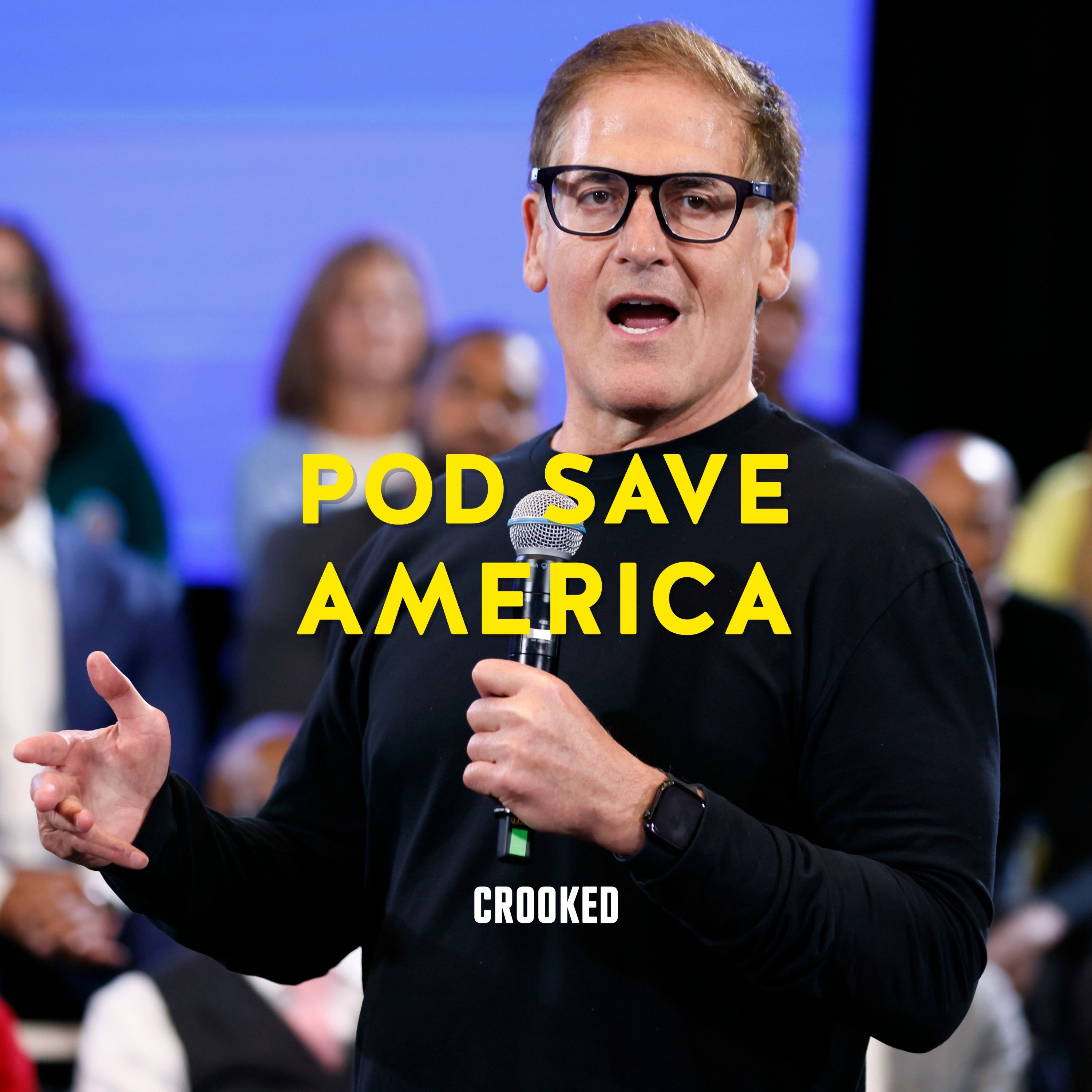
Pod Save America
Mark Cuban Wants Democrats to Stop Whining and Do Something
01:24:56
Mark Cuban may be a billionaire, but he's not your typical tech bro. The celebrity businessman and former Dallas Mavericks owner campaigned for Kamala Harris in the 2024 election and is a fierce critic of Donald Trump—and an outspoken advocate for affordable healthcare and medication. Dan and Mark discuss Trump's approach to the economy, whether Elon Musk's third party plans could actually change American politics, and why Democrats need to think bigger than just being anti-Trump. Then, Dan gets down to business with a list of his most pressing NBA questions.
Loading summary
Transcript232 lines
- [00:00]
Jon Favreau
Pod Save America is brought to you by Rocket Money. Everybody knows there are things they can do to reduce monthly costs and improve their finances, but who has time to go through all of their expenses and decide what to trim? With Rocket Money Crunching the numbers for you, Leveling up your money game gets way easier. Rocket Money is a personal finance app that helps find and cancel your unwanted subscriptions, monitors your spending, and helps lower your bills so you can grow your savings. Their dashboard lays out your total financial picture, including bill due dates and paydays, in a way that's easy to digest. You can even automatically create custom budgets based on your past spending. If you've got a goal you'd like to save for, Rocket Money can analyze your accounts to find the best time each month to put extra money aside. Rocket Money will even try to negotiate lower bills for you. The app automatically scans your bills to find opportunities to save and then goes to work to get you better deals. They'll even talk to customer service so you don't have to Rocket Money's 5 million members have saved a total of $500 million in canceled subscriptions, with members saving up to $740 a year when they use all of the app's premium features. Cancel your unwanted subscriptions and reach your financial goals faster with Rocket Money. Go to RocketMoney.comCrooked today. That's RocketMoney.comCrooked RocketMoney.comCrooked Imagine relying on a.
- [01:10]
Dan Pfeiffer
Dozen different software programs to run your business, none of which are connected, and.
- [01:14]
Mark Cuban
Each one more expensive and more complicated than the last. It can be pretty stressful.
- [01:19]
Dan Pfeiffer
Now imagine Odoo. Odoo has all the programs you'll ever need and are all connected on one platform. Doesn't Odoo sound amazing? Let Odoo harmonize your business with simple, efficient software that can handle everything for a fraction of the price. Sign up today@odoo.com that's o d o.
- [01:38]
Mark Cuban
O.Com.
- [02:01]
Dan Pfeiffer
Welcome to Pot Save America. I'm Dan Pfeiffer, back hosting another Sunday show because I simply couldn't pass up the chance to talk to our guest today, businessman, reality TV star and former Dallas Mavericks owner Mark Cuban. Mark may be a billionaire, but he's not the typical tech pro. He was a spokesman for former Vice President Kamala Harris campaign in 2024, a fierce critic of Donald Trump, and is an outspoken advocate for affordable health care and medication. I wanted to talk to Mark about Trump's approach to the economy, how Democrats can do a better job selling our policy, how and how we get attention in this broken media environment. Plus, I had to get his take on some pressing MBA questions. Mark Cuban, welcome to Pod Save America. How are you?
- [02:36]
Mark Cuban
I'm great. Thanks for having me on.
- [02:38]
Dan Pfeiffer
I know that's a loaded question in this day and age for a lot of people. How are you feeling? But are you legitimately great?
- [02:43]
Mark Cuban
I'm a little bit sore from working out today, but other than that, I have the same concerns that everybody else has, just about the uncertainty in the world, in the country. But I still, you know, think there's hope.
- [02:56]
Dan Pfeiffer
All right, that's good. Well, we'll get into all of that, but I want to just start by maybe with some table sticks here. You were out on the campaign trail for Kamala Harris. You were hitting the battleground states. You were one of our most vocal spokespeople. You were omnipresident in the media and on podcasts. From what you saw on the front lines, why do you think Trump won this election?
- [03:15]
Mark Cuban
A couple reasons. One, Democrats try to extrapolate, and everything that Democrats talk about is an extrapolation. If Trump did this, and in their mind they're extrapolating, then the normal conclusion is hell's freezing over. At some level or another, Republicans deal with the here and now. They're eating cats and dogs. They're coming to your neighborhood to eat your cats and dogs. There's no question mark about whether or not there's going to be, whether or not they want you to have a visceral experience. Democrats want you to think, they want you to understand what they envision and get you there. Republicans, they're taking your jobs. That's what immigrants do. DEI is keeping your husband, your son, your wife, your daughter from getting a promotion. Those are here and now things that people can, whether it's true or not, assign to themselves and say, this really could impact me.
- [04:17]
Dan Pfeiffer
I mean, Democrats, we are probably overly professorial. We, like, we're nerds. Maybe that's our problem. But like, like, I think in this one, like the extrapolation, right, the idea is like, Trump is going to do these things. He's not ended up doing a whole bunch of these things. Like, maybe it sounded hyperbolic when people were saying it, that he's going to deport all these people.
- [04:36]
Mark Cuban
It's not just about what he does, Right? It's the conclusion. Like you said, you're professorial, right? The conclusion is always the end of the world, Right? The conclusion is always. It's the end of the country. The conclusion is this demographic is done. They're over with people when they live their lives day to day, they don't. You know, we watch movies to see the end of the world. Right. They don't think about end of the world consequences. They think about what's happening to them today. And often it's just an excuse. Often it's not real, but it's visceral to them, you know? And thinking about the end of the world is not visceral. You know, it is to Democrats, but not to the Republicans. I know.
- [05:25]
Dan Pfeiffer
Do you think we oversold the case in that sense, that it was not believable?
- [05:30]
Mark Cuban
Absolutely. And I think that's the lesson that Democrats have to learn going forward. You can't project. And I think the guy in New York, I always get his name wrong, right?
- [05:38]
Dan Pfeiffer
Mandani.
- [05:39]
Mark Cuban
Yeah. Mandani, yeah. We're cutting rents, right? We're changing grocery stores. None of that shit has a chance. Doesn't matter. No one did an evaluation and did a risk assessment to say, well, there's, you know, a 50% chance that he could extend rent control so that another, you know, 50,000 people could benefit from it. No, not a single person does that. They're like, okay, this could impact me. I mean, what's the difference? It's like what a Trump guy told me in 2016. He said, I'm like, I know this guy, Dan, why are you voting? Mid-50s, right? Lifetime Republican? He goes, mark, I've been voting for politicians my entire life, and you know what they've done for me? Nothing. You know the definition of insanity. And the same thing applies here. You know, in New York, I've been voting for traditional mayoral candidates for a long time. You know, what they've done for me. And this guy is walking in telling me he's gonna walk on water, he's gonna make me more money, he's gonna save me money, he's gonna make my life better. Is it true? Does it matter? Because what's the option? And that's Trump 101. Is it true? Does it matter? If you say it enough times, people believe it.
- [06:51]
Dan Pfeiffer
I think in the Mandani case, and this is maybe. I think this is probably true of Trump, too, is maybe I give voters too much credit, which is that I think they know how hard it is going to do some of these things. But the policies that people say show who they're going to fight for, right? Like, I think most voters probably thought building a wall and having Mexico pay for it was stupid and probably is never going to happen. But it said to them, like, he really cares about immigration in a way in which I care about immigration.
- [07:16]
Mark Cuban
Mandani matter. Right, Right. Because it impacts my job or it impacts the jobs available to me. It impacts what I earn. It impacts my pocketbook in the here and now. Kamala and I tried to tell him to talk. Kamala talked about price gouging. How often do you get hit by price gouging? And she was very specific that 37 states already had price gouging laws. And nobody ever knew that those 37 states had those laws or what the impact would be on them. Yet that was her pricing mechanism like that. When I would go out there, I would say, look, your price of Gatorade might go up 9%, your price of bread eggs might go up 9%. But under Trump, your price of health care is going to skyrocket. Your Christmas presents are going to skyrocket because of tariffs. I couldn't get them to focus on the impact on voters in their lives today. And I think that's why they use me so much, because I didn't care what they told me to say because I told them not to tell me. I just try to make it pertain to people's lives in the immediate. Right. Or businesses in the immediate time frame. That's what Madani has done. That's what Trump does better than anybody. That's what the Democrats suck at.
- [08:32]
Dan Pfeiffer
And why do you think we suck at it?
- [08:34]
Mark Cuban
Because we want to think. Democrats want to think. They want to engage, they want to have conversations, they want to feel smart, they want to look smart. They go to college. These are college graduates. That's what college graduates do. Everything's like a dorm room discussion. And I think that's, that's a big difference. Not most people just want to live their lives and hope things get better. And if, you know, both sides are saying things are bad for their own reason, give me the short term hit that's going to benefit me as opposed to the long term possibilities that maybe a little bit too esoteric for me to even, you know, put any brain cells towards.
- [09:13]
Dan Pfeiffer
I assume you think that Bill Clinton and Barack Obama sort of avoided that trap. Did they do things differently or politics just changed different world.
- [09:20]
Mark Cuban
Politics didn't change the world, changed social media changed everything. Social media. Every single social media user on each individual platform that supports algorithms has their own unique feed that's night and day different from the Barack Obama, Bill Clinton world.
- [09:39]
Dan Pfeiffer
Yeah.
- [09:39]
Mark Cuban
You know, and look at how Donald Trump, what helped him win when Brad Parscale took, you know, Facebook and did micro targeting. You know, he created the algorithm for Facebook because Facebook wasn't as good at it back then, I guess is the best way to say it. Now you, you know, I would talk all the time, gotta reverse engineer. You gotta do what Mr. Beast does. He reverse engineers the algorithms to know what's going to sell best and get the most engagement. Go talk to him. Right? That's probably your best, you know, best person to educate you on all of this. But in a world where everybody has their own unique feed, you have to flood the zone. You have to say things that are going to be fed to each individual person in a way that may connect to them. That's like when Kamala first got picked and the brat summer thing hit. Everything was about algorithms and social media. And that's when all the momentum hit. The minute they started doing testing in a traditional political basis, right? Where it's just like, test this word, test that word. They would tell me all the time, yeah, we tested that. This is what works best. I'm like, fuck that. I'm not going to say that shit right. You've got to. It's like selling. I said it all the time. When Biden was in the White House, he couldn't, you know, he couldn't sell anything. He couldn't sell dollar bills for 50 cents. Kamala, when you sit down, have you ever sat down and just spent one on one time with her?
- [11:02]
Dan Pfeiffer
I have, I have, yeah.
- [11:03]
Mark Cuban
She'll start saying, you fuck this, da, da, da, da. She's a normal human being that's smart, that is, you know, has some charisma to her, but they don't let any of that come out, you know, And I think that really held everything back.
- [11:17]
Dan Pfeiffer
Yeah. It's interesting what you said about the traditional testing, because one of the things that I've taken from this last election, looking back on it, is that Republic and I would. I get all this testing, right? There's always, you know, they send it all to me and it says this exact phrasing of this word. These issues are the ones that will. They're 99% more effective than any other message we ever tested. But if you say it, the question is, who can. Who's actually going to hear it? Right? Which is, I think, a change in, like, how campaigns work is in the old days, you could just pay to show that to people on linear television. Now you do, kid. Doesn't work.
- [11:50]
Mark Cuban
Yeah, it doesn't work. And you've got to be able to connect Personally, you've got to be able to listen and you've got to be able to put yourself in the shoes of every demographic that you're trying to reach and ask yourself, what is it that's important to that person, that demographic, and what is it that reduces their stress? Like the IRA for drugs. Great. But that's big picture. You take, you know, a 35 year old, you know, non college graduate that's working on a construction site. They're more concerned with immigration and whether or not, and actually they could have used immigration against Trump because you could have said you're not going to have enough people to even have a job at a construction site. You know, there's ways to play it, to make it personalized to individuals, but they don't have. There was not a single salesperson in, in that campaign. There is nobody that ever, you know, that ever sold magazines door to door or, you know, sold construction equipment or sold whatever. You know, they were lifers in politics. And it was just so obvious where Trump was the exact opposite. He could sell. That's, that's the skill.
- [13:02]
Dan Pfeiffer
Yeah. I mean, going back to the messaging thing, what I think is interesting is the thinking of is, I guess Trump really does follow what you say about Mr. Beast, which he reverse engineers from what goes viral, not what it's natural to him.
- [13:15]
Mark Cuban
Like he says, you know, you say it enough times. Look, his mentor was Roy Cohn. Just read up about Roy Cohn and his playbook is obvious. Doesn't matter if it's true or not. You say it enough times, people will believe it. You get it places where it's going to get coverage enough so that, you know, it feel in this day and age fills those algorithms and so you would always see Trump in your algorithm no matter what. Right. And they're eating cats and dogs. Was so stupid. It was brilliant because everybody had to cover it and deal with it. And he knows as a candidate, everybody's got to cover him and deal with it. There's no, you know, it's not like he was looking to govern. He's looking to sell. He wants, he wants his, whatever he's saying, he wants it to be ubiquitous. He wants to flood the zone a hundred times over so there's no room for everybody else. He crowds everybody else out and we, you know, Kamala's group was more interested in test, test, test, test, test. How does this work? Traditional advertising go out and you know, knock on doors is great. That's face to face. Not, you know, nothing wrong with that. But Anything else was like, come on.
- [14:24]
Dan Pfeiffer
We'Re now seven months or whatever it is into this, the Trump presidency, is it worse than you thought it was going to be? Basically what you expected?
- [14:35]
Mark Cuban
Some things are worse, some things are better. Some things are what I expected.
- [14:38]
Dan Pfeiffer
Yeah. Say more. What do you mean?
- [14:41]
Mark Cuban
You know, I expected him to always flood the zone every day. And that's what he does. There's always something. And tariffs is his fallback. He doesn't want to solve terrorists. Right. He wants them to be something he can talk about every day. I was surprised that, you know, dei, immigration, he did it so quickly. I thought he would drag it out to try to use it to his benefit. But, you know, he was smart. And again, this is gonna sound counterintuitive, Democrats and a lot of progressives will hate me for it, but it was direct to the heart of what he said during the campaign. And so by dealing directly and immediately with dei, even to an extreme, cut out Jackie Robinson, we'll put him back if too many people complain. Right. Shut down the border completely. Those two things gave him, in his voters, minds, carte blanche to do everything else. You came in. The things that impact me the most directly, short term, you know, for so many of those voters. I'm not saying it's right or wrong. Right. You can say it's wrong in a lot of cases. Right. But he did what he said. So when it comes to tariffs and even to a certain extent, you know, guys putting on hoods to go just grab people off the street, the most un American thing that anybody could ask for, his supporters are like, well, he's batting.100 on the first two things, you know, yeah, maybe he's taken some folks that weren't criminals off the streets, but let's just see what happens. And tariffs, look, all the numbers say prices aren't going up. He ain't lying. Right. Well, tariffs are going to do this, this and this. And I've, including me, I've said it and I think it's still, well, it ain't hitting me yet, son. So if it ain't hitting me yet, you know, so he's, you know, batting.500. And if that's your candidate, you're going to give him every, you know, benefit of the doubt.
- [16:35]
Dan Pfeiffer
Like I get that he has, you know, to his supporters, he has delivered on the things he said he was going to deliver to them or at least seems to be trying to do them. Right. Like shutting down the border exceptions, Right?
- [16:46]
Mark Cuban
Yeah, yeah. If you were tps. Right. If you Were, you know, and now you're getting kicked out and you believed, you know, your family wasn't going to be deported. There's a whole big growing group of people who have every right to be pissed at him, right? But he avoids it like a champ.
- [17:02]
Dan Pfeiffer
And there are other people who, you know, there are people who even who were supporters of his who like, they. And if you listen, if you read the fine print of all those, they said he had policy papers and you listened to the entire two hour rally, you would know that mass deportation was coming. But if you just watched the ads and read the news signs right behind.
- [17:20]
Mark Cuban
Him saying mass deportation.
- [17:23]
Dan Pfeiffer
But I think people's general impression, and this showed up in like polling and focus groups was they thought he's coping for criminals and gang members. People just got here. It's when the person who's been in.
- [17:31]
Mark Cuban
Your community was, they're sending their worst right? From day one, they're sending their worst to now they're opening up their prisons and da, da, da, da, da, Right. But the Democrats aren't responding in a way that has a visceral impact.
- [17:44]
Dan Pfeiffer
What would that look like?
- [17:46]
Mark Cuban
So what that looks like is showing the families of every single person who's not a criminal has been deported. Instead, we had the one guy from Maryland. One guy from Maryland is big the first week, but when there's just a nonstop progression and we see the videos of people getting pulled off the streets, it's horrific. Every single one of those families should be in front of a camera and we should be working to say what's going on. They should be putting Tom Homan on blast saying, okay, the FBI has their top 10 most wanted list, right? Let's just get this right. Homan, don't, you know, do it right. List the top 100, let's go after them. List the top 1000 criminals that are here that need to be deported. We'll all help you. But the Democrats would never say something to the fact, we'll help you. They only have to do something that's the antithesis of what Trump says and does. You've never heard a Democrat say in the past seven months, yeah, okay, I don't like it, but this is a step in the right direction. We're going to help. Because I think the better path is for the Democrats to bring attention to the bad things and the good things and say, on the good things, we'll help you. Right. Which they would never say because that disarms whenever you're in a sales environment and you say Something positive about your competition. It's disarming. Yeah, we're better. But these guys, you know, that's not so bad. They're trying really hard. Okay, Tom Holman. We don't want criminals. If, you know, Venezuela and Colombia opened up their jails and sent all their worst criminals to us, we don't want them here either. If MS.13 has 173 gang members here from wherever, we don't want them here either. Post that list. And you know what? Chuck Schumer. I'm Chuck Schumer. I'm going to help you get rid of them. I'm going to post all those lists everywhere. We're all going to go after those bad guys together because they shouldn't be here. Now you disarm him. Now you disarm the Republicans who, you know, think that you guys, that the Democrats can't get anything right. You know, you do things that you, you can undermine. Undermining in the Democrats perspective is always, you're wrong. You're wrong. It's Trump. It's Trump. You're wrong. The T word, Trump is a trigger word, you know, and you can't just always use that in a negative line. The best way to convince people to reconsider is to say, okay, they're doing this. Okay, we'll help them, but let's go. You know, what about these people they're pulling off the streets in black hoodies, right? Post all the bad guys. We'll use our resources. Every single sanctuary city is going to, you know, I'm going to make sure that they all allocate resources to go after the Tom Homan 100. And when one of them's off, you put another one on, we'll go after that one. Let's get those criminals out of here like they deserve to be. Now all of a sudden, what, you know, it's a different conversation. We agree on that part. But why, you know, you've listed the criminals. Why are you taking this mom, this grandmom, you know, this kid. Why, why are you doing this? When they're not criminals? Let's get the criminals. Because now if nobody knows which ones are criminals, everyone that's taken off the street could be a criminal.
- [21:12]
Dan Pfeiffer
I get like, I can understand the, you know, like that would definitely get attention if Democrats were to do that. Because it, you're right, it's unexpected. Which I guess is part of like a good sales technique or a good media techni. This environment is do something that's unexpected because that draws more attention than just doing the same thing.
- [21:27]
Mark Cuban
Right. And it's effective, you know, and I.
- [21:28]
Dan Pfeiffer
Can imagine that just for people who don't pay a ton of attention to politics, just Trump Bad, Trump bad, Trump bad can sound monotonous enough to the point that you miss what's really, really fucking bad.
- [21:36]
Mark Cuban
Turn it off.
- [21:37]
Dan Pfeiffer
But I, but I guess my, here's my question on that though, is in the last four years, probably have won the House, the Senate and the White House. At no point has any Republican been like, you know, here's the good things Joe Biden's doing. Right? Like, they. Yeah, but I'm just saying, like, just as a, as a measure of political messaging, Right?
- [21:52]
Mark Cuban
Yes.
- [21:53]
Dan Pfeiffer
Like, why would it work for. Why, why can they get away? But if we can't, it's not us.
- [21:57]
Mark Cuban
Versus them, it's what works and what doesn't work. Right. That's part of the problem. It's like, it's my side versus your side. This isn't a basketball game. You know, Trump is really good at half court shots. He sucks at layups. He makes the easy things difficult. And the difficult things may not be difficult. Maybe he makes them more difficult. But some of them, like some of the international things, Iran, etc. Okay, you can make an argument that it's not the worst thing that happened. Some of them are bad. But, you know, you get my point, right? These are things that you, that, if you would have told me this would happen seven months in, I would not have believed you. He hit the half course shot. Maybe it was luck, maybe it wasn't. Maybe it was, you know, maybe it's not real and what we're seeing isn't real. We don't know, but that's what it is. But the easy stuff, like tariffs, like having guys in hoodies pulling people off the street that are not criminals, that's easy stuff. But how you, you know, and it's horrific pulling people off. I can't say it enough times. And the tariffs are not good for anybody. And it's obvious, you know, everybody around him is just placating him and he's just using it as a media tool rather than an economic tool. Well, you've got to come in and do something that people feel, not just talk about how awful he is.
- [23:16]
Dan Pfeiffer
So let's talk about the tariffs for a second. Right? They're on, they're off. There's a lot of uncertainty.
- [23:21]
Mark Cuban
The whole taco thing.
- [23:22]
Dan Pfeiffer
Yeah, the whole taco thing. Right. Like, what are you, like, what's your view of how the tariff policy is going. What are you hearing from other CEOs about this? Because whether the price increases are as bad as we said they would be a few months ago or not, there's just like a massive injection of uncertainty into time. We're recording this on Monday, July 7, and Trump has already extended the reciprocal deadline another month. He's threatened a bunch of countries with tariffs that maybe they'll get, maybe they'll not. It's like, how do business people like yourself plan in this environment?
- [23:50]
Mark Cuban
It's not business people like me, it's the little businesses, right? They're the ones that are screwed over because they don't have the capital to absorb uncertainty. Maybe they used up all the capital. You know, they have X amount of dollars, and maybe they were trying to hire somebody, maybe they were trying to, you know, open up a new office. Maybe they were doing. Trying to use that capital for raises, whatever it may be. But now they're trying to get ahead of the tariffs, so they have to take all that money and put it in. And then he comes back and says, well, okay, we're going to delay them. So they just overpaid for shipping and overpaid for a product to try to get ahead of the tariffs. Now it's costing them money. You know, you see the stock market go up, but you don't see the smaller companies in the stock market go up, just the s and P500 in the Dow. Right? Smaller companies are being debilitated by the on off tariffs. And wherever they come out, it's not going to be a positive for them. Big companies, they'll game it, right? They can borrow the money. You know, interest rates aren't so high that they don't have access to capital. They. There's just all kinds of ways they can play with it. So you don't see it in the stock market, and you don't even see it in a lot of the inflation numbers yet. But at the same time, if he goes down the path that he said he would, and on August 9th, we get 20, 30, 40% tariffs, the shit's gonna hit the fan. And like I said during the campaign, he'll be the Grinch that killed Christmas.
- [25:21]
Dan Pfeiffer
So during the campaign, like, Trump had more business support in 2024 than, than he did in 2016 or 2020 or throughout his presidency. And one of the things you heard a lot like, if you ever turn on CNBC, these CEOs who were like, pro Trump or like, were going to support Trump really seemed to believe that Tariffs were not going to happen. Right. Even Scott Besson, his Secretary of treasury, suggests the tariffs would never happen before he got appointed administration. Like in your conversations with other CEO business leader types, are they sort of shocked by what's happening here? Do they feel like they made a mistake?
- [25:52]
Mark Cuban
Yes. I mean, there were two things, two reasons why they went along. One, because they thought he learned his lesson from Trump. 1.0 tariffs went up. Price of washing machines, dryers went up. You know, they had to reduce interest rates because the economy slowed down. He's not going to do that again. That's one reason why they went along with him. Two, and possibly the more important reason is Biden didn't give any CEO leader the time of day. Not at all. When tech guy, he kept Elon out of the EV meeting. Right. You know, that's just dumb. That is just self inflicted pain. So one guy won't talk to you. Floated a net worth tax effectively. Right. And untaxed capital gains tax. There ain't no business person in the history of business persons who are going to accept that and think that's good for their business or the economy. Half of the conversations I had with business people after Kamala came in was explaining to them that the tax on unrealized capital gains was part of a budget just to fill a number and there was no chance it was going to happen. And they were like, you promised me, Mark, you promised me because it would kill me if it happened. It would kill the economy, it would kill the stock market. Who would you vote for if that's what you thought?
- [27:09]
Dan Pfeiffer
And there also seemed to be a lot of concern among business folks about the ftc. Right. And that it would stop. It couldn't do, couldn't do mergers. You know, I think it's particularly true around the tech people. But then now you have, Trump has come in and you have.
- [27:23]
Mark Cuban
Right?
- [27:24]
Dan Pfeiffer
Yes. Well, you thought, you thought. And they sort of thought everyone's gonna get the merge. And still you have, you know, Paramount's trying to buy cbs. So Paramount's trying to end this acquisition. They have to like pay tribute to Trump to get it. So it's like this is not the environment they thought they were getting, right?
- [27:38]
Mark Cuban
Not at all. Not at all. You know, Lina Kahn, I agree with everything she did, actually, except for her attitude on AI, that breaking up some of these big technology companies would hurt our. I felt it would hurt our ability to compete globally. And artificial intelligence. We had this conversation directly with. I had it with her directly. She disagreed. So I didn't see her as a threat to business in general or to mergers and acquisitions. But a lot of people did. And you know, be careful what you ask for sometimes because it's worse.
- [28:23]
Jon Favreau
Pod Save America is brought to you by Haya. Typical children's vitamins are often packed with sugar, unhealthy chemicals and unnecessary additives. Haya offers a super powered chewable vitamin with zero sugar and gummy additives that still tastes great even for picky eaters. It's designed to fill common nutritional gaps in children's diets, providing the full body nourishment they need. Formulated with the help of pediatricians and nutritional experts, Hayya is pressed with a blend of 12 organic fruits and veggies, then supercharged with 15 essential vitamins and minerals. It's non GMO, vegan, dairy free, allergy free, gelatin free, nut free and everything else you can imagine. Every single batch is third party tested for heavy metals so you know the product is safe and nutritious. Hi is designed for kids two and up and sent straight to your door so parents have one less thing to worry about. We've had in our family for a couple years now. Charlie takes Chaya vitamins and he likes them but they don't have a lot of sugar like regular vitamins. So it's great if you're tired of battling with your kids to eat their greens. Yes, Haya now has Kids Daily Greens and Superfoods, a chocolate flavored greens powder designed specifically for kids packed with 55 plus whole food ingredients to support brain power development and digestion. Just scoop, shake and sip with milk or any non dairy beverage for a delicious and nutritious boost. Your kids will actually enjoy the same multivitamin that more than a million kids and parents love. Are now available with Disney's the Lion King with a new Lion King unboxing experience including a Lion King bottle and Lion King stickers. Tommy's actually going to do the unboxing when we get shipment here. I'd love to do that.
- [29:48]
Tommy Vietor
Can we sing the song?
- [29:49]
Jon Favreau
We sure can Lion King and we've worked out a special deal with Haya for their best selling children's vitamin. Receive 50% off your first order to claim this deal you must go to hyahealth.com crooked. This deal is not available on their regular website. Go to H I Y A H E a l t h.com crook and get your kids the full body nourishment they need to grow into healthy adults.
- [30:10]
Mark Cuban
The McDonald's Snack Wrap is back. You brought it Back ranch snack wrap. Spicy snack wrap.
- [30:17]
Dan Pfeiffer
You broke the Internet for a snack? Snack wrap is back. Last week, President Trump signed the quote, unquote, big beautiful bill. Tax cuts for a lot of people, a bunch of tax breaks, 700, you know, nearly a trillion dollars in Medicaid cuts, $3 trillion in debt. What's your, what's your take on the bill?
- [30:42]
Mark Cuban
I think you can't generalize. I think the Democrats are generalizing too much on it. You know, like Medicaid is a perfect example. It's more about the provider taxes than actual cut to Medicaid. And each state is absolutely different and you have to go talk to each state to see what the impact is. I think, you know, a couple states, it's a 9% cost. Well, where do you make that up elsewhere so that you have no results, you know, but the provider tax is just an arbitrage that hospitals use to try to gain money that was created during COVID And so, you know, from my perspective, I think, you know, it may not be as bad as people expect it to be, but I understand why. Just in terms of Medicaid only. Right. Specific to that. Right. You know, in terms of some of the other things, like you couldn't, you had to reinstate the tax cuts. You had to. Right. There's just no way that you couldn't do that. That would cost everybody too much money.
- [31:40]
Dan Pfeiffer
Could you have done it just for the, you do it like Obama did in 2012, where it's just where you. For everyone under a certain income threshold.
- [31:48]
Mark Cuban
Yeah, you could. Right. There's no reason to cut my taxes and I don't need my taxes cut. Right. You know, it was a non event for me. But at the same time, where were the Democrats saying, you know what, let's propose reinstating, put aside reducing, making the same adjustments you just referred to. The problem with the big bill is that it's too big and it hides a lot of shit that is hard to find, particularly things that give Trump more executive power. That's what I worry about more than anything. It didn't make it easier to pass cuz it was so enormous it made it easier to hide things. And that's the concern that I have because it's almost impossible to read it. You can plug it into ChatGPT, you know, Gemini, whatever you want and it's not going to catch everything. But where were the Democrats saying, okay, we're going to extend the Trump tax cuts, let's just do a bill just for that and we'll all vote for it. Because that preempts them on saying, we got to get this cut, you know, we got to get this passed rather, because we can't have taxes go up for everybody. They just, anything that would, they think would be even a marginal win for Trump, they just won't consider. And yet more often than not, when you're trying to get somebody that you know is doing the wrong thing to try to change, particularly when there's voters involved, you've got to give them some wins so that again, you can preempt them and say, we gave you what you needed. This is what you're saying you're needing, you need, you need to keep these, these, these tax cuts. Okay. Yes. Let's propose a bill. Yes. You want to adjust to some. Yes. We're not going to mess with it at all. No pork from the Democrats. Yes. Now what? Now all of a sudden that big beautiful bill is smaller and people can start paying more attention to the details.
- [33:36]
Dan Pfeiffer
This sort of warms my heart because this is one of my arguments was the Democrats should have done exactly that. And this is just me, like as an old retired political hack, just going back to the same old tricks. That's what, that's what Obama said when he was fighting with the Republicans about this. He said, I want to extend all the tax cuts up to, he said 250 originally and ended up in negotiation 500. And so we like. So the point is we agree on every, on all of, on all people who need the tax cuts, but we disagree. So you want to have this big fight and maybe raise everyone's taxes because you're so hell bent on raising taxes for the Mark Cubans of the world. Democrats did not do that. I think the reason, if I'm being fair, they didn't do this time is they wanted to focus attention on people getting kicked off their health care here.
- [34:12]
Mark Cuban
Yeah, but they're not. Okay, first, they're not. Some people are getting kicked off because the work requires. But what is it like 72% or more of people you know are already working and they're most likely going to qualify?
- [34:26]
Dan Pfeiffer
Well, the hard part here is most people, it's not that people who are not working are getting kicked off. It's that the requirements are so onerous, the people who are working are not going to meet them. Because this is what happened in. But it's still Arkansas. But it's still by the states. Yes, but in these red states, like this is what happened in Arkansas, where I think it was 94% of the people who got kicked off were working like they had jobs when they did that before.
- [34:49]
Mark Cuban
Right. But it's still controlled by the states. This bill really didn't change the control by the states. And so you didn't see any, you know, call out, you know, Huckabee, Sanders, what are you going to do? It's in your control. Call out Desantis, what are you going to do? It's in your control. Put the pressure on them. Right. The people who actually, you know, can make or break somebody. All right, you know, Desantis, you know, how are you going to deal with these people? Are you going to kick them off or. Because you can make the decision to retain them on Medicaid. We picked the wrong pressure points. It's just Trump sucks. That's the underlying thought of everything the Democrats do. Trump sucks. Trump says the sky is blue. Trump sucks. That's not the way to win. It's just not, because it's not about Trump. It's about the people of the United States of America and what's good for them and how do you get them to a place where they're in a better position and it's less stressful for them. And so you go to the points where, you know, they're impacted. For Medicaid, you go to the states. You know, I'm not a Medicaid expert. I got a general understanding. But you go to the states because that's who controls it. Maryland has something different than California that has something different. Now California comes back and says, well, we don't have enough money to do A, B and C. Okay, what do you have money to do? Let's work on that. For the people in your state, you know, Texas, who didn't, you know, expand Medicaid, what are you going to do? Kentucky, you know, bad example. What are you going to do? In each red state we could have gone where you could have put pressure on the governor and made them answer the question. I mean, it's just like the whole Doge thing. It's like, Doge sucks. Yeah, because they didn't plan it out. They just cut things. Right. And there was a whole lot of red states that in red communities that voted for them, that lost a lot of jobs, that lost a lot of funding. West Virginia got crushed, you know, funding for things that they expected in communities. Gone. I haven't seen anybody pulled up in front of a camera with, you know, a Democrat next to them maybe once or twice.
- [37:08]
Dan Pfeiffer
Yeah, there is there. I say a lot of times this stuff doesn't break through, which is the hard part, which is like, that is a. We're in a chicken or egg problem here. But I will say in defense, there are members of Congress who are doing this, particularly in, like, the Virginias of the world, where they're, like, especially hit by this.
- [37:23]
Mark Cuban
Right. In your local community. That's a great start. Right? But you gotta flood the zone. You just. That's Trump does, right? Flood. You've gotta flood the zone. If you see enough of these people that have lost their jobs that, you know that buildings are being shut down, that the person in charge of the mayor is saying, revenues are going to be down, you know, 20%, and we're going to have to cut this service, this service and this service because our tax base is declining, those people will do a better job communicating for the Democrats than the Democrats themselves. And even though somebody might not care about the mayor of Parkersburg, West Virginia, on cnn, like, I push that stuff to cnn, and they don't think it's big enough. MSNBC doesn't think it's big enough. Great. It doesn't matter. Put it out there continuously so those algorithms pick it up. Because if you say it enough and you post enough, then more and more people will see it, and that'll feed the algorithms, and the algorithms will do the work for you.
- [38:24]
Dan Pfeiffer
You also need people who can actually draw attention. Right? This was the blessing and the curse for Trump of Elon, which is Elon gets all the attention in the world. He's. Maybe he's as good at getting attention as anyone, maybe other than Donald Trump, other than Trump. And so, like, that was great for Trump in the campaign. When Elon was selling it, it was bad when he was in charge of making a whole bunch of really, really unpopular cuts. So it's like, you know, it's like having, you know, I joke, it's like having Kim Kardashian drive your getaway car when you're robbing a bank. Like, it's not what you want to do. Right. I like that. But, like, for Democrats, we just. This is part of, like, this is a problem that exists every time a party's out of power, but in this media environment, it's, like, massively magnified, which is who can actually get attention, right? Like, Trump can stand with any single person, get attention.
- [39:05]
Mark Cuban
Dumbest shit ever goes viral. The dumbest shit ever goes viral. But who's working on going viral in the Democrats? You know, you want to stand in front of an MSNBC camera, a CNN camera, Maybe Pete, you know, goes out on Fox and does a great job, and, you know, we see that and everybody cheers. But everybody's got a feed on their social media. Everybody. Everybody. That's the only feed that matters because we all see the same things, you know, in our feeds. Now we're seeing all this AI video. Why aren't they creating just. Just tons and tons and tons and tons of AI video? That's all prompt generated. The stuff makes us laugh, right? I mean, you know, you see the gorilla with Downsy and all this stuff. That's. You know what I'm talking about?
- [39:58]
Dan Pfeiffer
I don't know. Tell me.
- [39:59]
Mark Cuban
Okay. It has me because it's like. Maybe it's because I look at my son's stuff sometimes, but there's just like, there's stuff that becomes ubiquitous on social media and that. You've got to use it. You got to go, Mr. Beast. I mean, what percentage of the population isn't on Facebook or Instagram or TikTok or Twitter or Blue Sky?
- [40:25]
Dan Pfeiffer
Yeah.
- [40:26]
Mark Cuban
And how much? Like, you don't even see things promoted on any of them. You see. I mean, you see little things here and there, but when was the last time you thought to yourself, oh, my God, this is too much from the Democrats on social media in your feed?
- [40:43]
Dan Pfeiffer
Yeah, this is a problem with the part. I mean, I think I very. Like, sometimes I think the Democrats get too much shit because it's like they have limited power to stop some of the stuff Trump's doing. Right. And so it's like we don't have the votes. But I think that a fair critique, a very fair critique, is that the leadership of the Democratic Party has a very poor understanding of the modern media environment.
- [41:06]
Mark Cuban
Right.
- [41:07]
Dan Pfeiffer
It's like Chuck Schumer, who I like personally a lot, he always calls it the social media when he talks about it, which is a problem.
- [41:14]
Mark Cuban
Or it's like Trump not knowing how to spell AI. It's just that's. That's the tool. It costs nothing to post. You can reach hundreds of millions of people in a nanosecond if you get lucky. I mean, Brad Summer changed all the momentum of the election, and it's like nobody remembers it. Nobody learned anything from it.
- [41:37]
Dan Pfeiffer
But the thing is, I think the lesson from that also is that's not something anyone put on a whiteboard in the Kamala Harris headquarters. It's like something that just took off.
- [41:44]
Mark Cuban
Well, that's okay.
- [41:46]
Dan Pfeiffer
Yeah.
- [41:47]
Mark Cuban
It's not like there aren't millions of kids who aren't posting things like you go on TikTok and there's, you know, depending on what direction you want to go, there's all pro Trump stuff and there's pro, you know, Democrat stuff and there's anti Trump stuff. You get these feeds, but. And it's all coming from individuals. There's no support, no help, no innovation, no creators creations from Democrats themselves.
- [42:15]
Dan Pfeiffer
I mean, there are obviously. I think that's sort of why Zoran Mandani stands out because he was able to do this. Right. AOC stands out because she could do this. Like, what is unique about them? It's not just their populist liberal.
- [42:28]
Mark Cuban
No. They're authentic in using social media.
- [42:30]
Dan Pfeiffer
Yes. And they're digital natives. Right. They grew up using it. Right. No one had to teach them.
- [42:34]
Mark Cuban
Yeah. And look, it's all changed. We're in a unique inflection point right now. And this is another topic that Democrats need to get over. Right. There is like, if I talk about AI on Blue Sky, I am getting torched. Like I get torched about everything and anything on Blue sky now and Twitter. So it doesn't matter where I post. But AI is like the antichrist to a lot of progressives. They need to get over that. You know, it is here. It'll be the most impactful technology in our lifetimes. Whichever party, whether it's a new or existing party, makes best use of it will have a huge advantage. I mean, if you can find what AI does, is amplifies the skill set of anybody who uses it. If you're a great writer, it can make you a greater writer. If you're a great creator, it'll allow you to create 100 different versions of something in minutes and then pick out the best one as opposed to say, okay, I only have X amount of time. I've got to make a choice. It may or may not work. You know, there's just so many unique opportunities that it creates. Is there going to be job disruption? Yes.
- [43:47]
Dan Pfeiffer
But is there a lot of job disruption, at least for some industries? Right.
- [43:51]
Mark Cuban
It depends on where you're looking at and when. Right. Is there going to be job creation? Yes. I mean, it can take a 16 year old kid and make him or her as smart a business person as anybody on the planet. Because it's like having every professor, every research paper, et cetera, available to you if you ask the right questions and are willing to take the time to learn. And it's like, I used to love to sit in a library and just read, sit in bookstores and just read because I know nobody else would. AI is that ultimate tool so that the Democrats, whoever Americans, have this tool at their disposal that allows them to do things they otherwise never would have been able to do. And so, you know, when I go talk to, like, middle school kids, one of the things I always talk about, I always say, look around you. That chair you're sitting on, that desk in front of you, that projector there, that screen there, there was a point in time where it did not exist. And somebody said to themselves, I have this idea now. 99% of the time when people have an idea, they take one or two steps and they stop. Somebody took the initiative to go through and take it to a place where those products were created, however long it took them. Now, with AI, that time, from thought to, you know, creation and distribution and sale, it could be cut by 90% or more in some cases.
- [45:23]
Dan Pfeiffer
Like, I get. I get the power of it, right? And I use it and it helps me. But it has to be regulated, right? Like, it can't.
- [45:30]
Mark Cuban
Well, it depends on where, right? So there's two different pieces there. Like this stuff about the states being able to regulate or not regulate for 10 years, that's shuffling deck chairs on the Titanic, right? Because there's nobody who's innovative and creating new, you know, AI models who's going to give a shit about any of that. And if you come after them, they'll just move somewhere. That lets you know, they'll drive to Mexico and it'll be a Mexican product because it's just so much, so rapidly. And so. And it doesn't take a lot of, you know, you can do it, you know, with a laptop anywhere. And so in terms of regulating, you can regulate it early, before something gets created, thinking you're going to be able to stop it, which you won't, or you can regulate it after it's created and somebody tries to implement it, which is where I think the regulation should be. Because you're trying to regulate ideas, you're trying to regulate concepts, you're trying to regulate computing power, algorithms. Ain't nobody in government going to be able to cover that. But if somebody releases, if Nvidia releases a toolkit that does A, B and C, and you say, no, you can't have something that automates the creation of, of a molotov cocktail to 16 seconds and buys everything and, you know, finds the robot that will assemble it for you. No, that's where we're drawing the line. So that's an implementation issue. You know, we're regulating that, and I, and I think do it at a state level. It's got to be federal.
- [46:59]
Dan Pfeiffer
Yeah, I agree with this, the state level thing, like in the absence of any federal regulation, if you can do things that will at least prevent some of the, some of the more manageable harms, like some of the deep fake stuff, the stuff in politics like that, like, I think that's on your.
- [47:12]
Mark Cuban
To me, it feels like you're regulating the output, but it does feel like.
- [47:18]
Dan Pfeiffer
You need a holistic policy here. Right. Which seems so far above and beyond what the government can manage. Like, you need regulation at whatever point makes sense. You need something for all the people who are going to lose their jobs. Right. Because if you are someone who works in, there's a whole generation of people whose job was to write SEO copy and that those jobs are gone.
- [47:41]
Mark Cuban
Like when I was, when I was a kid, like, I knew, I knew parents of friends that were, you know, the moms, not to be too sexist, but the moms took dictation. There were secretaries that took dictation. Gone. I went to school in Indiana. Terre Haute, Indiana was the record capital of the world. Right. They, they, they created more, you know, albums and then CDs gone. You are going to have creative destruction now. Can you find ways to create more revenue from all of this to deal with whatever comes along in case it's worse than we expect? Absolutely. You can put, you know, small taxes per hour taxes on robots. You know, you could say, you know, 25 cents an hour for every robot. Like we have robots@costplusdrugs.com. right. And we're making, you know, drugs, pediatric cancer drugs that are in short supply, and it only takes us four hours to shift, you know, from one line to another from a pediatric cancer drug to Pitocin to whatever it is, and we get it to hospitals and, you know, we can move faster and cheaper because of all the robotics and the AI we use. If it was another 25 cents per hour per robot. Okay. I could make the argument if I was that type of person, well, that'll increase the cost of pediatric cancer drugs. But I wouldn't because it'd be fair to do that. And collecting that money would make us more effective. And if you took some of that money and let's just say you take 20% of that collected and reinvest it so that we can become a global leader in robotics and not just software, the software side of it. Yes, because China is eating our lunch on that stuff. And we have to learn how to do it so, you know, you can't just dispel it and say, no, you know, they can't.
- [49:27]
Dan Pfeiffer
And the other thing, just last thing I'd say on a holistic policy is you need an environmental policy that has the clean energy. You need to actually power this. Right.
- [49:35]
Mark Cuban
Well, for sure. Right. But go to nepa. Right. You know, if I were involved in the political side, you know, in the White House or wherever, I would say as support side of the White House, I would say we're going to use AI and we're going to take a time, the time it takes to approve an application under nepa. We're going to cut the non environmental study side to three weeks. Right. Using AI, we're going to feed every application that's ever been, you know, we're going to put it into a model, we're going to train the model on all those applications and then we're going to spit out a response to each application and put it in front of a committee to evaluate and we're going to help people that are doing the environmental impact studies that go into an NEPA and say, look, we're going to cut that time down as well, because.
- [50:25]
Dan Pfeiffer
Which would help us get more green energy product. Ultimately. We need more clean power to power.
- [50:29]
Mark Cuban
This because it's a huge time it takes.
- [50:31]
Dan Pfeiffer
Yes. Yeah, you can use AI to make it so you have more power for AI.
- [50:35]
Mark Cuban
It's the whole abundance thing. Right. Abundance is the whole is innovator's dilemma for government. That's effectively what it is. We can't get out of our own way. So we do legislation, particularly when it comes to the bullet train example, et cetera, where it's like, this project is never going to change. It's always going to apply the same way it did when the legislation was originated. That's fantasy land. Particularly now. It's all going to evolve. And so using AI, we can become a lot more productive. And that's an opportunity that Democrats have because I know one thing about Donald Trump, he doesn't understand AI models, as.
- [51:14]
Dan Pfeiffer
You said, he can't spell it. So.
- [51:16]
Mark Cuban
And you know, historically, even like Obama, even though it wasn't his strong suit, he sure made us a big effort to learn and understand and bring in great people where Trump is bringing in loyalists. And so, you know, we have an opportunity to do something incredible there, but we fight it as if, you know, it's the end of the world again. And that is just counterproductive and it's not good for anybody. You want, you know, here's Trump, the big beautiful bill and the deficit. Okay, well, the only way, now that it's passed, the only way to overcome that deficit is through productivity and through innovation. And we have a chance because we still are, at least for the moment, the leaders in AI. So how are we going to overcome that deficit? Through productivity and innovation. And what's going to be a huge part of that? Artificial intelligence. Nvidia is probably the most powerful company in the world right now, followed by tsmc. We ain't doing shit to try to push that through. Okay? Trump has no idea what he's doing with the big beautiful bill. Put aside the things that give him more executive power, but all these things that put us in this bad spot. We're going to come up with solutions because that's what we do. We're going to stop bitching and start solving. Then the perspective of the Democratic Party changes people if they start to feel those solutions because obviously they're going to be afraid of AI. Everybody is. But you start feeling those solutions and seeing how there could be some upside to it and it could create jobs and enable things to happen and, you know, reduce your taxes or reduce, you know, the debt. In this particular case, where are the Democrats in any of this?
- [53:01]
Dan Pfeiffer
More of my conversation with Mark Cuban when we come back. But first, from the Big ugly Bill passing to the lessons progressives can draw from Zoran Mandani's campaign, my message Block newsletter breaks down what's happening in the media, why it matters, and helps each and every one of us figure out what we can do to defeat the MAGA movement. So if you want to follow along and join the conversation, head to the absolutely cringeworthy website crooked.com yeswedan to unlock a 30 day free trial of message box. If you like Pod Save America, I promise you you will love this newsletter.
- [53:33]
Mark Cuban
Foreign.
- [53:42]
Tommy Vietor
Is brought to you by Sundays. Sundays is fresh dog food made from a short list of human grade ingredients. Sundays was co founded by Dr. Tori Waxman, a practicing veterinarian who tests and formulates every version of each recipe. Sundaes contains 100% all natural meat and superfoods and 0% synthetic nutrient or artificial ingredients. Dog parents report noticeable health improvements in their pups including softer fur, fresher breath, better poops and more energy. After switching to Sundays, I got a. I got a pup who likes Sundays right next to me here. There's Leo.
- [54:10]
Jon Favreau
He's looking at us right now.
- [54:11]
Tommy Vietor
Leo's up in the studio.
- [54:12]
Jon Favreau
Leo, can you tell us how have your Poop Spin better.
- [54:14]
Tommy Vietor
He looks happy.
- [54:16]
Mark Cuban
Yeah.
- [54:16]
Tommy Vietor
I can tell Leo loves his food. I can tell you my dog loves his food. Because the minute Luca goes over to the Favro house, she sprints to Leo's food and tries to steal it. That's true, because she is a chowhound. But unlike other fresh dog food, Sundays does not require refrigeration or preparation because of their air drying process. Just pour and serve. Cancel or pause your subscription anytime. With our 14 day money back guarantee, every order ships right to your door. So you'll never worry about running out of dog food again.
- [54:41]
Jon Favreau
The reason we like it is dry dog food is so much better than, than the wet dog food.
- [54:46]
Mark Cuban
Yeah.
- [54:46]
Jon Favreau
Which always kind of smells. But with Sundays for dog, we just, you know, close it up, put it in the cabinet.
- [54:50]
Mark Cuban
There you go.
- [54:51]
Tommy Vietor
Get 40% off your first order of Sundays. Go to sundays4dogs.com crooked or use code crooked at checkout. That's sundaysfordogs.com crooked code crooked.
- [55:02]
Jason Kander
Every bold journey starts with a decision to go. And if you're ready, the Defender is too. This is a vehicle built for more. Whether you're heading off the grid or just getting out of town for the weekend, Defender is a true icon reimagined for a new generation. Its rugged exterior is built from durable materials and tested in the toughest conditions. Inside, it's modern, functional and refined, with smart storage and premium touches that keep you comfortable wherever the road leads. It's packed with tech like 3D surround cameras, ClearSight, ground and rear views, driver assist features, and an intuitive infotainment system. With three models, the Defender 90, 110 and 130, there's a Defender for every kind of adventure. From city streets to remote trails, this is a vehicle that, like you, is capable of great things. Explore the full Defender lineup@land roverusa.com.
- [56:00]
Mark Cuban
Let.
- [56:01]
Dan Pfeiffer
Me, I want to ask you about Elon Musk who announced us the other day. He's forming a new political party called the America Party. You were on Blue Sky, I believe, where you suggested that an organization that you, that you work with would help get them on the ballot.
- [56:15]
Mark Cuban
Yeah, that.
- [56:16]
Dan Pfeiffer
I saw that. That did not go over well on Blue Sky.
- [56:19]
Mark Cuban
It's not a surprise.
- [56:20]
Dan Pfeiffer
Not a surprise. No, but.
- [56:22]
Mark Cuban
Or, but.
- [56:22]
Dan Pfeiffer
So just help me understand what's your reaction to the new party and why would you help Elon Musk's party get on the ballot?
- [56:29]
Mark Cuban
So a couple things there. One, what's a, what's a party? What's a political party? Right. We see it as, okay, we're gonna, we're gonna run somebody for every position. We want to have a full slate. We're going to run somebody for president. I don't know, Elon, right. Other than just fucking with each other on Twitter. But that's not as best as I can tell. That's not how he thinks. And I think he came out today or yesterday saying there's only going to be six or seven spots that he's trying to fill. Which is smart, because that's how Elon thinks he looks for leverage. And there's absolute leverage in making sure that the two incumbent parties have enough power to pass anything. And so that's smart. That is really smart. And the way the parties are right now, where it's my team versus your team and people do things that are counterproductive and create all these self inflicted wounds for the American people all the time, I think that's a positive. Everybody wants the Democrats to win or the Republicans to stay in control. No, I want us to get to the point where we have to actually evaluate bills and do things for the American people. Now, do I trust Elon to just do all these things? Because I think he's a good guy. Fuck no. Right? But whatever he does, we're going to be able to evaluate and that creates a new opportunity. And, you know, that is something that I think this country needs. Could it be just dismissed because he's doing it all wrong? Of course. Does it mean just because it's Elon it must be wrong or right? No. But until we find out details, why are we jumping to conclusions?
- [58:09]
Dan Pfeiffer
I mean, yes, we don't have details. He has even formed a party, recruited a candidate. Like, then this may all just be something he does on Twitter and talks about it. Whether he actually executes, who knows? It is an either or choice, right? One of two parties is going to be in charge of Congress. It's either going to be the party that's going to greenlight all of the terrible things Trump is doing, or one party, as flawed as it may be in people's eyes, will actually try to stop him from doing those things, or may investigate all of the stuff that's happening. And so we do, like, I would love a large menu, but at the end of the day, there's only two. We only get in one of two dishes, right? One of them is Trump, one of them is us.
- [58:39]
Mark Cuban
But at the same time, you know, you can still have control of Congress and have six or seven seats in this new party, you know, or maybe or not.
- [58:47]
Dan Pfeiffer
Or it could hand it back to the Republicans.
- [58:49]
Mark Cuban
Not. But you'll know by the candidates that they run because it may well be that they are better Democratic leaning candidates than the others. And look, the presumption is Elon will just pay them to say whatever and do whatever he wants. Right. So we'll have to see if that's actually the case. Obviously, he'll influence them like any party. But I'm just not going to say no to change when we have a set of circumstances where it's not good for anybody. This bifurcation of the country into red and blue is not good for anybody short term, medium term or long term. And even just saying, okay, we're going to stop Trump, well, we don't know what he's going to try to do next. But just to say we're going to stop Trump and we're going to have the leverage to do that, okay, but that doesn't necessarily change our fundamental problems either. And it's not going to change Donald Trump because he's just given himself a bunch of executive power anyways and he's, you know, and so I don't, unless the Democrats come out with a plan that says here's how we're going to do things, you know, and here's why we're going to be able to bring the country together or here's, you know, where we see these problems and here's the bills we're going to introduce. It's just us versus them.
- [60:07]
Dan Pfeiffer
Look, I don't, I think this is going to move in a couple directions, right. One is Democrats will, they will have an agenda of some kind of things they're going to do. We understand, right, that Trump will still be president. Right. And so it's like if they come out and say here's our plan to make health care more affordable. We know Trump is not signing that plan. We, that's the plan hoping to make a lot of this.
- [60:25]
Mark Cuban
You don't know that. You don't know that.
- [60:27]
Dan Pfeiffer
I do. I do. That I do know. I feel like I can know that.
- [60:29]
Mark Cuban
Well, let's talk about that. Right. I know, Right. His MFN for most favored nation for drugs could really change the game. It could cut the cost of drugs. Now, he may not know it, but I'm trying to educate some of the people that work with them could literally cut the cost of medications because he's already come out and said effectively he's against the middlemen. And by the way, everything I'm telling you right now I've said to Joe Biden's camp, I said to Kamala's camp, Joe Biden had a chance to do something they didn't do. Right. And so if we can change how PBMs work, how insurance companies work, I'd rather see it come from the Democrats. But all the Democrats talk about is Medicare for All.
- [61:11]
Dan Pfeiffer
And well, that's, that's not true because, I mean, some, there are some Democrats.
- [61:14]
Mark Cuban
Talk about that April 25, Bernie and Jai Paul, and they came out with a whole nother presentation, whole nother proposal. Right. They didn't come out with Here's a better way. And all I have to tell you on that is read it like I did two days ago. And every single single payer system, Medicare for All introduced in this country always effectively starts out with the secretary of hhs, runs the show, which makes it like, you know, something that could be used and abused in any way, shape or form. You've got to deal with the fundamental problems of health care and the fundamental problems of healthcare are effectively the middlemen. There's these things called pharmacy benefit managers. And when you say why are for generic Drugs, which are 91% of scripts cost plus drugs that when we sell almost all of those, we're cheaper than almost every other country except for China and India. So for 91% of prescriptions, the United States is already cheaper. Now the other 9% are the more, more expensive and cover more dollars. Right. And so what he's trying to do, the reason that they're more expensive is because of these middlemen called pharmacy benefit managers. And he has said, let's get rid of them. I have, and I've sold every single part of this to Democrat after Democrat after Democrat and said, come up with something, I'll help you. Nothing, Nothing. And so you can't just say he'll say no to health care now, you know, maybe he'll be the same way in response. You know, if Chuck Schumer and AOC and Bernie got their shit together instead of just, you know, doing it the way they've always done it and came up with something that's more nuanced. Maybe he'll just say no because. But at least they'll be offering something. And you know, people who are in the industry could come out and say, no, this is good.
- [63:08]
Dan Pfeiffer
Yeah, I think, look, I think the way I think this is going to move in cycles is that Democrat, the Democrats running for the House, we'll have a set of things therefore, then we're going to have A group of, I don't know, two dozen Democrats. You have told me you're not going to be one of those Dem. You've told people you're not going to be one of those Democrats. I won't bother you with that right now. You've said there was zero percent chance, so I will take you at your word. There's zero percent chance. Heard, my friends. We were all going to have ideas, right? And then we're going to have a marketplace of ideas and they're going to have to have a health care plan. Some of them will be Medicare for All or a version of what Brony have done. Some of them will be something else. Just as There was in 2019, 2020, when Democrats were running. And so. And then the people are going to get a look at it and see what that looks like. That to me is when we're going to have.
- [63:51]
Mark Cuban
I'll just tell you up front, it won't work.
- [63:53]
Dan Pfeiffer
Why not?
- [63:54]
Mark Cuban
It can't work because there's no transparency in the system.
- [63:57]
Dan Pfeiffer
But can there be a plan to add more transparency to the system?
- [64:00]
Mark Cuban
You've got to do it up front, right? It's got to be more like Canada. Like Canada. Their health care system was built one province at a time, started in 1947 and didn't really click until 1965 for the whole country. And effectively each province makes a decision, you know, what they're going to include or not include and what the budget is, and they make it so it's all transparent. We don't have that transparency. And so even, even in the bills that say they'll determine the budget and figure out what they're going to pay, they don't know what they can and can't pay because there's no transparency. What I was going to say is three cost plus drugs. The smartest thing we did was we issued our. We released our entire price list. It shows our cost, shows our 15% markup, shows exactly what you're going to pay. If you go to costplusdrugs.com three plus years, January of 2022, we're still the only company who does that. Now you've got hospitals who have to publish their. A lot of their procedures, not all, but a lot of them. And when you look at their procedures, there's a price that they negotiated with United Healthcare, there's a price they negotiated with Aetna for, let's say, a hip replacement. And then there's the cash price. The cash price is always cheaper. Right. So we created an organization at Cost plus called Cost Plus Wellness that hasn't launched yet where we're negotiating all the cash prices with all these different providers and then we'll publish those contracts once all this stuff is published so there's no question about what it costs. Then a state, a city for that matter can say a company, you know, like for my companies if the drug comes from, there's no premiums. If the drug comes from Cost plus drugs or one of the providers we have an agreement with, there's no out of pocket for the employee or their family member because we've got the prices low enough to be able to afford to do that. And there's no reason why once there's transparency to the price and contract level and maybe even to the general ledger transaction level for providers, then city, states, federal government can negotiate all these things. And it's, and because it's already out there, it's not going to be a battle. It's just like okay, here's the prices. We think we deserve better for A, B and C reasons. And as technology moves on and there's more solutions and there's more, you know, gene and cell and gene therapies that are curative. We need more transparency to be able to negotiate.
- [66:27]
Dan Pfeiffer
Could you just require that, could that be, that'd be like going to be page one of Democrat access.
- [66:33]
Mark Cuban
But they're going to lie because the way the system is set up right now, it's so opaque that and vertically integrated you couldn't disassociate all the different pieces to know what it is. And so you know, you've got to be able to show now so that you know what it's going to cost because just to try to transition like when you look, you know it's going to take two years to try to do that. Every bit of self interest that providers have that insurance companies have. Look, over 150 million people in this country are provided their health care by companies that self insure. And what that means is they don't use the insurance companies for insurance. They take on all that risk with maybe reinsurance from a company for big expenses. And so for 150 million people we don't need insurance companies already. And so by making all this stuff transparent because those, those 150, the companies that cover those 150 million people, they are getting ripped off. They are getting ripped off and they just don't know how. And it's just a whole big game that's going on. If these companies are, you know, and this transparency will save them money, will allow them to do better, allow you to disaggregate it from employers. There's so many things that you can do, but you gotta take these first steps first.
- [67:55]
Dan Pfeiffer
Once you've taken those first steps, can we just. Like this would be at the core of every. Like there'll be different ways to get there. But can we have the core principle at the heart of what it will be any Democrats health care plan that everyone has a right. Oh, I believe quality, affordable health care. Right.
- [68:10]
Mark Cuban
Everybody has a right to health care. Right. And for some like. But you can means test at all.
- [68:16]
Dan Pfeiffer
Yeah, yeah, of course, of course. Right, right.
- [68:18]
Mark Cuban
And so there's no reason why anybody should ever pay more than 10% of their paycheck and for care. And if you're making, you know, at Medicaid levels, you know, 138% or poverty should be free. Yeah. You know, if you're making 200% of that, depending on the family size, should be close to free. If you're making $100,000 a year as a single person, let's just say it's 5 or 6% is the most you'll pay with no premiums, right? No premiums out of pocket. There's so many ways to get there. You can cut. I don't think I'd be out of school saying if our spending on healthcare is 4.9 trillion now you could cut it 3.5 trillion like that. It's just nobody thinks of it like. Let's get into the details like a real entrepreneur would look at it. It's like the ACA did a lot of brilliant amazing things, but they set this thing called up medical loss ratio which is 80 to 85% of the premiums collected. Well, if you only get to keep 15 or 20% of what's collected, what's the one thing you're gonna wanna do? Increase the collections and not care about what you spend. You've gotta get into the details and the Democrats are really, really bad at that. Particularly with healthcare.
- [69:33]
Dan Pfeiffer
I think, well, we can have this conversation again a couple years in this primary sense. But I think there will be very detailed plans from a bunch of Democrats. You may not like the plans, some of them may be good, but I think the wild will play.
- [69:41]
Mark Cuban
You know, I've read the proposals. Right. I've read the single payer plans, you know, and just they won't work.
- [69:49]
Dan Pfeiffer
Well, let's put healthcare for us every second. I have one last 2024 question and then I have a couple of basketball questions for you that will not be about the Luca trade. I promise.
- [69:56]
Mark Cuban
Thank you.
- [69:56]
Dan Pfeiffer
The last 2024 question is, one of your main jobs on the Harris campaign was they said you went on all the quote, unquote, bro podcasts. Right. You were on Theo Vaughn. You were on Flagrant. You went on all in with all the tech guys and all of that. And I heard you tell Tim Miller of the Bulwark that you told the Harris campaign they should go do those things. Why did that not happen? Like, what was the response when you said that?
- [70:22]
Mark Cuban
They were afraid. They were afraid. Right.
- [70:26]
Dan Pfeiffer
They didn't trust her that she would make a mistake.
- [70:28]
Mark Cuban
Yeah. And because they had her so wrapped, so wound tight, like, if the cursing Kamala would have gone on the broadcast, she would have killed it, which she.
- [70:41]
Dan Pfeiffer
Did do with Shannon Sharp. Right. When she went on Club Sh. Shay.
- [70:44]
Mark Cuban
Yeah. And you could see some of her personality come out.
- [70:46]
Dan Pfeiffer
Yeah. She was more relaxed there. Yeah.
- [70:47]
Mark Cuban
Right. You could see some of her personality. But even, like, Alex Cooper, that was so, you know, just preset. Right. That. That was so overly organized that it made it tough. But, like, flagrant. Andrew Schultz is a Democrat, you know, votes Democrat mostly.
- [71:04]
Dan Pfeiffer
You know, not this time, but most. But yeah, yeah, not this time.
- [71:07]
Mark Cuban
Right. But he was trying. He was really trying. But he said, Bernie on. He's had Pete on. He's had all these Democrats on, and he understands, you know, his. His impact that he could have the ov. He doesn't give a shit. He'll have anybody on. Right. He just wants to have fun. And I remember asking him, like, why do you vote for Trump? Why are you supporting Trump? Why are people voting for him? And I gave him all these characters destiny. Da, da, da. You're like, dude, he's gangsta. He's gangster. I like that boy. That boy's gangsta, Right? He don't give a shit. It's not hard to go on there and just have a real honest conversation where you can, you know, have some fun with it. And they just did not want Kamala to do that.
- [71:56]
Jon Favreau
Pod Save America is brought to you by the NPR Politics podcast. Obviously, politics can be a lot to consume, as we know here.
- [72:05]
Mark Cuban
Yeah.
- [72:05]
Tommy Vietor
A lot going on these days.
- [72:06]
Dan Pfeiffer
Hard to plan.
- [72:07]
Jon Favreau
Yeah. And it's hard to. It's hard to wrap your head around sometimes. But that's why NPR Politics Podcast is where you should go to decode what goes down in Washington and what every decision out there might mean for you. Every day, the NPR Politics Podcast team will focus on one thing and boil it down to 15 minutes or less. Think of it as your political multivitamin. You got 15 minutes to drive. You're doing a commute. You just have time to hear about one issue. It's perfect for that. Listen now to the NPR Politics Podcast, only from npr. Wherever you get your podcasts, do you.
- [72:37]
Jason Kander
Ever look at political headlines and go, huh? Well, that's exactly why the NPR Politics Podcast exists. We're experts not just on politics, but in making politics make sense. Every episode, we decode everything that happened in Washington and help you figure out what it all means. Give politics a chance with the NPR Politics Podcast, available wherever you get your podcasts. Every bold journey starts with a decision to go. And if you're ready, the Defender is too. This is a vehicle built for more. Whether you're heading off the grid or just getting out of town for the weekend, Defender is a true icon reimagined for a new generation. Its rugged exterior is built from durable materials and tested in the toughest conditions. Inside, it's modern, functional and refined with smart storage and premium touches that keep you comfortable wherever the road leads. It's packed with tech like 3D surround cameras, ClearSight, ground and rear views, driver assist features, and an intuitive infotainment system. With three models, the Defender 90, 110 and 130, there's a Defender for every kind of adventure. From city streets to remote trails, this is a vehicle that, like you, is capable of great things. Explore the full Defender lineup@land roverusa.com.
- [73:59]
Dan Pfeiffer
Okay, couple of NBA questions here. All right. I want to start with the health of the game. You were in a, you were in a big debate during the finals on various social media platforms with Clay Travis, the conservative Fox outkick the coverage sports guy. He's he to every time the ratings are down. He blames the NBA for being too woke, which is a pretty stupid argument for all kinds of reasons. But ratings have been down. What's your take on the health of the game these days?
- [74:25]
Mark Cuban
I think the game's in great, you know, great situation economically and with fans, I mean, and all television ratings are down except for the NFL. You know, it's not like you can look at every the NHL was down, but you know, like game seven of the Pacers Thunder for 18 to 34 of every 18 to 34 year old with a television turned on during the game, 71% of them were watching the game. That's an insane number. You know, we set records and share of people watching television so the people who could, you know, viably watch the game, we set records and share. Now the problem is fewer people are watching television, which is why we went in a big chunk to streaming. So we'll be on Amazon and we'll have other ways to get the games. Now that could work against us because we'll be on too many platforms. But at least it gives an opportunity to people who can't afford cable, traditional linear television cable, to watch games.
- [75:26]
Dan Pfeiffer
It does seem that there is this. I think there's a point you might have made in this argument, but like the cultural imprint of the NBA is as big as it's been in a while. Maybe not as big as the Jordan years, but no, probably it's huge. But it's happening at a time when like particularly young people are not watching the games at the same way because they don't have TVs. Right. But they may be following the game on less monetizable formats, like social media.
- [75:50]
Mark Cuban
Right, right. Yeah. So we dominate in social media.
- [75:53]
Dan Pfeiffer
Yeah.
- [75:53]
Mark Cuban
You know, our players are maybe, you know, Premier League Soccer, a little bit bigger globally, but after them, there's nobody Steph, LeBron, Luka, except Kyrie. They have huge social media platforms. You know, an NFL team walks through the door, maybe you know, the quarterback and a running back or wide receiver, and that's it. You're, you know, you know, almost every NBA player by sight, if you're in, if you're a kid. And so, you know, in terms of cultural impact, the NBA has never been stronger.
- [76:27]
Dan Pfeiffer
Do you think the season's too long?
- [76:29]
Mark Cuban
No.
- [76:29]
Dan Pfeiffer
Too many games?
- [76:30]
Mark Cuban
No, I think the game's just gotten faster, a lot faster. Guys are stronger, quicker, bigger. You know, the game is at a bigger pace. I saw somebody said that teams run more than 200 miles a year, more now than they did 10 years ago. You know, that's going to have an impact on your body. I think the biggest mistake we made was, you know, when we were talking about load management and resting players to be in a position to win and everybody gave a shit and we caved on that and the NBA caved on that. And now we had, you know, eight guys who had Achilles heel tears, I mean, which is brutal. And they were all almost the same move, right where the little step back move. And so, you know, it's just games evolve and the game just like football went from 250 pound linemen to 400 pound linemen. You know, now basketball players, they're bigger, they're stronger, they're more talented. They're more skilled and the game is just so much faster. And I think that's been the problem.
- [77:31]
Dan Pfeiffer
But does that. So. But you can't. We can't live in a world where the best players at age 27 are tearing their Achilles and they're out for a year. So it's like, what do you do to protect them against that? Because I think for listeners who may not follow this as closely as others, your point about the load management was then the NBA put in place a 65 game minimum where if you wanted to make all NBA, which is incredibly critical to how much money you can make because you make all NBA, you can get a super max deal. And so all these players in like most like, not the year he got hurt, but the year before, Tyrese Halliburton probably played when he shouldn't have played. So he could get to 65 games. But even. But it, you know, we've lost, you know, Halliburton, you've lost Dame, we've lost Tatum for. For a year.
- [78:12]
Mark Cuban
All number zeros too. Right, Right.
- [78:13]
Dan Pfeiffer
Yeah. Which is. I don't know what that has to do with that. But just what.
- [78:18]
Mark Cuban
So here's what I would do.
- [78:19]
Dan Pfeiffer
What can the. Yeah. What can the league do to protect these players?
- [78:21]
Mark Cuban
So I would cut the games to 40 minutes and for two reasons. So one is college games are 40 minutes. WNBA games are 40 minutes. Most international games are 40 minutes. So there's already precedent there. But in terms of TV ratings. And so back to that, there's precedent there. And I think that would reduce injuries, you know, and you could even set a cap on the number of minutes any one player could play so that, you know, the same guys aren't playing 40 minutes all the time. I don't think that would happen, but.
- [78:52]
Dan Pfeiffer
At least, you know, well, Tibbs is not coaching next year, so.
- [78:55]
Mark Cuban
Well, yeah, so that's happened. Right. Which is another thing. But so, so I think that starts to deal with the injury issues and wearing guys down over the course of the season. And just economically and for a lot of different reasons, that's better than cutting the number of games. But the other side of the equation is if you look at the highest rated sports, sports, there's an inverse TV ratings and even streaming numbers, there's an inverse relationship between the number, the number of minutes played of actual game minutes, action minutes in a game versus ratings. So football has the highest ratings. There's maybe 12 minutes of actual playing time in a football game. Basketball has the next highest ratings typically and. Or Actually college basketball during the NCAAs, you could say, and that's a 40 minute game. Then there's the NBA and we're a 48 minute game. It's hard in this day and age to get anybody under the age of 40 to commit to watching 48 minutes of anything, you know, and so I think by reducing the length of the game, it will screw up records, but so be it. But I think by reducing the length of the game, I think we would solve a lot of the injury problems and I think we'd also make the game more watchable whether it's streamed or television.
- [80:15]
Dan Pfeiffer
It would cost the NBA money though, because you obviously get fewer commercials.
- [80:18]
Mark Cuban
Yeah, but not that many. I think, you know, over eight minutes, over four quarters, two quarters. You know, you might lose two commercials.
- [80:25]
Dan Pfeiffer
And I guess you're making some of that money back with these new, with the much larger media package and Amazon and all of that.
- [80:30]
Mark Cuban
Right, exactly right.
- [80:31]
Dan Pfeiffer
Like money's not the problem here.
- [80:32]
Mark Cuban
Money's not the problem for the next 11 years.
- [80:36]
Dan Pfeiffer
What do you think about the, the NBA's and sports in general's relationship with gambling? Right. Like, are there dangers there? Yeah, I mean, you have, you have the actual case of Michael Porter's brother and been involved with prop bets. There's now an investigation into another player on that. How are you feeling about that? I know you have, you know, you worked, you have some gambling interests as well.
- [80:59]
Mark Cuban
Yeah, I mean, you know, if you were to ask me two months ago, my answer would have been different. I think two months ago I would have said, look, using sports radar and other and artificial intelligence and data tools, we can pretty much catch everything. And I think, you know, they're showing that we can catch them. That's how we're seeing, you know, that these guys are under investigation not just in the NBA, but other sports as well. But what I worry more about is younger kids because now that my son is 15, I just see more of it and we discuss it more and that worries me because it's still possible for underage kids to get in there. And I think we need a lot stricter controls to keep kids under the age of 18 and to keep people from gambling money they can't afford to gamble.
- [81:49]
Dan Pfeiffer
It just, it's become a part of the culture now. Like if you watch, not that people watch ESPN anymore, but if you were, it would be watching sports almost every show. It's all, it's all about the spread. The, you know, it used to be like very secretly referenced. If they you know, better.
- [82:07]
Mark Cuban
Yeah, yeah.
- [82:08]
Dan Pfeiffer
But now it's very. Now, like, it is a part of all of it. And it's part of like, people are looking for ways to make money in this economy. And so, like, there's dangers here.
- [82:17]
Mark Cuban
Yeah. And the funny part of the big, beautiful build. Did you see the thing on gambling?
- [82:22]
Dan Pfeiffer
Yeah. I've been following. I am not a gambler, but I am very interested in fantasy sports and gambles. I've been seeing some of the discourse about, and there seems to be some dispute about what it exactly means. So what's the mean?
- [82:31]
Mark Cuban
So the way I read it, right. Is that you can only write off up to 90% of your losses, as opposed to previously 100% of your losses. And so, you know, you can say that's positive in some respects, but if you're a gambler, you know, you play professional poker, whatever it may be, it's not just sports betting. You're not going to be happy.
- [82:50]
Dan Pfeiffer
Okay, last question for you. And I'm going to stipulate this as the former owner of the Mavs, that you're going to be very biased on this point. But what do you think about the lottery odds flattening, Right. Which has now led to multiple teams who are. I know you do, but imagine. And I say, and I'm a Sixers fan, so I benefited from this this year as well.
- [83:12]
Mark Cuban
Yeah.
- [83:13]
Dan Pfeiffer
Yes. And I bet we bet this, like, benefited from the flattening odds this year because we were the sixth worst team or the fifth worst team, we got the third pick. But if you are a fan of a. It used to be if you were a fan of a bad team and whether they tanked or they just sucked, Right. You had a chance to get a player and now your chances are reduced to the point where it's like the rich aren't getting richer.
- [83:35]
Mark Cuban
Right.
- [83:35]
Dan Pfeiffer
But the case of the Mavs. Yeah, they are. You have a. As they hilariously described the NBA draft coverage, they were like a tumultuous season. I was like, yes, a very tumultuous season. Yes. But, you know, you can have an injured player. Yeah, exactly. We won't get into the details of why they had the first pick, but they had the first pick. But like the Utahs, the Charlottes, the Wizards, there is just like, they are now stuck. It's very. It's much harder for a bad team or the fans of a bad team to have any hope.
- [84:04]
Mark Cuban
Right. It really. There's the luck of the draft. Right. Of the ping pong balls and you know, Right. Now, what is it, 14.3% or 13.4% for the top three teams. Right. So there's still an 87% chance that you're not getting it. And so it's never in your odds. And even before then, you know, from the time we went to the ping pong balls in 84 or whatever it was, you never had 100% chance like the NFL does. Right. You have the worst, worst record in the NFL. It's 100% chance you're getting the first pick. And so there's still the odds were against you. But the bigger problem is really the fact that you may have a bad draft class. Like, there are teams that, you know, got the number one pick and maybe, you know, the player that they got wasn't transformational, and the guy who got pick at 9 or 11 turns out to be the better player. And so it's really getting the right player and keeping them healthy and getting lucky with the quality of the draft.
- [85:05]
Dan Pfeiffer
And not trading them. Yes, right.
- [85:07]
Mark Cuban
Yeah. Not trading them. Right. The odds of getting the number one pick.
- [85:11]
Dan Pfeiffer
Yeah, yeah. The draft class thing is interesting because it's like if the spurs had won the draft lottery in 2024 instead of 2023. Right. And they'd ended up with Zachary Richache instead of Victor Wembanyama, a different French player, people would have felt very differently about how it went. And same thing with the maps. Right. If they'd won it in 23 or 24 instead of the Cooper flag year, than people. Very different.
- [85:32]
Mark Cuban
When I first came into the league, it was the Kenya Martin draft in 2000, and it was a different world back then, a lot of old school owners. So I was just buying up number one picks, and I'm thinking, you know, cost me $3 million a pick. I was trying to set a tone. The Mavs are no longer, you know, a trashy franchise. So I bought two. We had our own pick, and then I bought two more number one picks. Turns out to be the worst draft in the history of the NBA.
- [85:56]
Dan Pfeiffer
Right?
- [85:56]
Mark Cuban
Yes.
- [85:56]
Dan Pfeiffer
Yeah.
- [85:57]
Mark Cuban
And when you're scouting these kids, you know, particularly back then, it was harder to know who the great players were going to be. And while Kenyon Martin turned out to be a good player, you wouldn't say he's a Hall of Fame, you know, transitional player, that generational player. And so you got to get lucky on two fronts.
- [86:15]
Dan Pfeiffer
Yeah. Mark Cuban, this has been a lot of fun, interesting. We covered a lot of things. Great to talk to you. Thanks for being with us on Ponse America anytime.
- [86:23]
Mark Cuban
It was a lot of fun. Thank you.
- [86:25]
Jon Favreau
If you want to listen to Pod Save America ad free or get access to our subscriber discord and exclusive podcasts, consider joining our friends at the pod community@cricket.com friends or subscribe on Apple Podcasts directly from the Pod Save America feed. Also, please consider leaving us a review to help boost this episode and everything we do here at Crooked Pod Save America is a crooked Media production. Our producers are David Toledo, Emma Illustration and Saul Rubin. Our associate producer is Farah Safari. Austin Fisher is our Senior producer. Reed Churlin is our Executive editor. Adrian Hill is our head of news and politics. The show is mixed and edited by Andrew Chadwick. Jordan Kanter is our sound engineer with audio support from Kyle Seglin and Charlotte Landis. Matt de Groat is our Head of Production. Naomi Sengel is our Executive assistant. Thanks to our digital team, Elijah Cohn, Hayley Jones, Ben Hefcoat, Mia Kellman, Carol Pelaviev, David Toles and Ryan Young, our production staff is proudly unionized with the Writers Guild of America East.
- [87:32]
Dan Pfeiffer
Pandora makes it easy for you to.
- [87:34]
Mark Cuban
Find your favorite music.
- [87:35]
Dan Pfeiffer
Discover new artists and genres by selecting any song or album and we'll make you a personalized station for free.
- [87:41]
Mark Cuban
Download on the Apple App Store or.
- [87:42]
Dan Pfeiffer
Google Play and enjoy the soundtrack to your life.
- [87:46]
Mark Cuban
Tipping culture is out of control Yesterday I tipped someone just for handing me a napkin. So when hotels.com gives me up to 20% off for being a member, I finally get tipped. And you know what?
- [87:56]
Jason Kander
It feels good.
- [87:57]
Mark Cuban
Hotels.com, members save up to 20% off at hundreds of thousands of hotels.