← Pod Save the World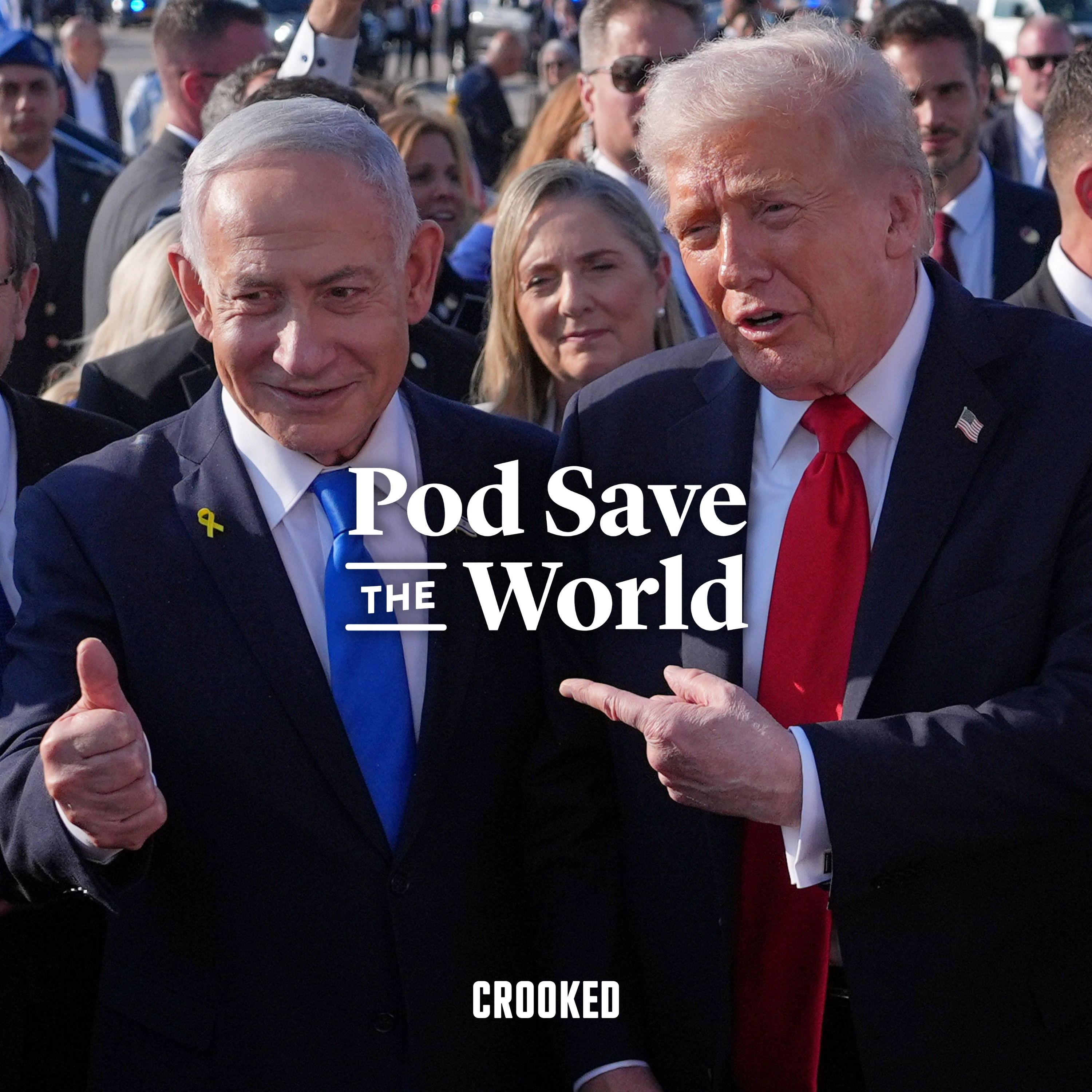
Pod Save the World
Breaking Down Trump's Gaza Deal
01:29:42
Tommy & Ben break down the deal between Israel and Hamas–how we got here, who deserves credit (and who doesn’t), why the hell it took so long, and then dig into the many questions still to be resolved: Will Hamas disarm? How will Gaza be run? And who might make up the proposed “International Stabilisation Force”? They also talk about Trump’s victory lap in Israel and Egypt (including a quick pit stop for some corruption with Indonesia’s president), the pervasive media narrative that Israel’s “victory” over Iran led to this deal, Benjamin Netanyahu’s political future, Drop Site News’s rebuttal to the Free Press’s vile “reporting” on starving Palestinian children with preexisting conditions, and whether Trump’s peacemaking is contagious and could spread to Ukraine. Also covered: how the US’s bailout of Argentina will benefit hedge funders in Treasury Secretary Scott Bessent’s circle, French President Emmanuel Macron’s surprising replacement for his short-lived Prime Minister, and why...
Loading summary
Transcript210 lines
- [00:00]
A
This podcast is sponsored by Squarespace. Squarespace provides all the necessary tools to claim your domain, build a professional website, expand your brand and facilitate payments, making it the ideal solution for businesses of all sizes. Squarespace gives you everything you need to offer services and get paid all in one place, from consultations to events and experiences. Showcase your offerings with a customizable website designed to attract clients and grow your business. With Squarespace's collection of cutting edge design tools, anyone can build a bespoke online presence that perfectly fits their brand or business. Start with Blueprint AI, Squarespace's AI Enhanced Website Builder to get a fully custom website in just a few steps, using basic information about your industry goals and personality to generate premium quality content and personalized design recommendations. Every dream deserves a domain. Squarespace Domains makes it easy to find the best name for your business at one fair, all inclusive price. No hidden fees or add ons required. Plus, Squarespace provides everything you need to bring more of your dream to life. Whether that means building a website or adding a professional email service, don't wait to claim your name. Invest in your dream domain today. Head to squarespace.com for a free trial and when you're ready to Launch, go to squarespace.comworld to save 10% off your first purchase of a website or domain. That's squarespace.com welcome back to Pod Save the World. I'm Tommy Vitor.
- [01:26]
B
I'm Ben Rhodes.
- [01:27]
A
Ben, did you notice today the birds were chirping? Everything feels a little easier, a little spring in your step. It's because peace has broken out everywhere. We have nothing but peace thanks to Mr. Trump.
- [01:38]
B
Just feel like the soft, warm embrace of autocratic peace all around us.
- [01:44]
A
Yes, Quiet, oppressive peace.
- [01:47]
B
Quiet, enforced peace at the point of a gun. Yeah, yeah.
- [01:51]
A
And a lot of money. Yes. And a lot of surveillance technology. We're obviously kidding. We are. We're going to spend a lot of time today digging into Trump's Gaza cease fire deal and the hostage release deal and just try to unpack it. We're going to tell you guys what was in the deal, how the implementation is going so far. We'll get into some of Trump's confusing and contradictory comments about what happens to Hamas now and what was accomplished at this big summit of world leaders in Egypt. We will try to assess who deserves credit for what, the backstory of how the deal came together, what work still has to get done, what comes next for Bibi Netanyahu, and a lot more. And then we're also going to highlight some new reporting about the much discussed article by the Free Press that suggested that starving kids in Gaza were really just suffering from pre existing conditions. We'll also look at whether success in Gaza might impact other peace efforts in Ukraine. You're hearing that narrative a lot from the Trump orbit. And then how Trump's $20 billion bailout for Argentina will benefit some hedge funds, why France can't catch a break or keep a Prime minister. And then the Nobel Peace Prize drama's latest. And then, Ben, you did our interview today. Who are we going to talk to?
- [02:58]
B
Yes, I talked to Michel VC Bachmann, who is an expert in maritime intelligence, which neither you nor I are, Tommy. And we've been talking a bit recently about this Russian shadow fleet that's been alleged to do everything from busting oil sanctions to creating platforms for drone incursions into Europe.
- [03:19]
A
Crazy.
- [03:19]
B
So I thought it was a good idea to kind of dig a little deeper. What is the shadow fleet? How big is it? How does it function? What is it up to? What can be done to try to stop it? It's pretty fascinating and also kind of doubles as a Netflix show pitch. You've got Chinese owned vessels registered in the Seychelles carrying Russian oil with Filipino crew and maybe drones. It's pretty cool stuff. I mean, it's concerning but also interesting.
- [03:50]
A
As you know, it's tough to get stuff greenlit in Hollywood these days. Could you and I just go in on a Shadow fleet tanker?
- [03:58]
B
We could. And just kind of do make one of those documentaries. That is also.
- [04:02]
A
No, no, no, just go on, start shipping stuff.
- [04:05]
B
Yeah, we probably could. Apparently. I didn't know this. Upwards of 20% of vessels on the high seas are. Yeah, Shadow.
- [04:13]
A
Is that why they're all like Panamanian flagged or something?
- [04:15]
B
Pretty astonishing number, actually, when you think about fifth.
- [04:17]
A
Yeah, fifth is a lot.
- [04:19]
B
Yeah. Given that it carries huge amounts of oil that could spill in the ocean. That's also not good.
- [04:24]
A
But it seems like a bad setup.
- [04:25]
B
Yeah, I guess I don't know much.
- [04:27]
A
About laws on the high seas.
- [04:29]
B
You know why? Because the United States did not come into the law of the sea. But that's, that's a whole other deep dive. Explainer.
- [04:35]
A
I was going to say I'm the captain now, but I guess I'm not. I'm an American. Okay, we'll stick around for that. That sounds fascinating. All right, Ben, should we talk about this Gaza deal?
- [04:44]
B
Yes. Spoiler alert. We will not be fluffing like the entire American mainstream media has been.
- [04:48]
A
No, we're going to try to stick to the facts. Okay, so let's talk about what was actually agreed to. So the 20 living Israeli hostages held by Hamas for over two years are now released. They are back in Israel. That is unequivocally a great thing for them, their families, really, for everyone in Israel who's kind of been holding their breath since they were taken. On October 7th, Israel has released 1700 detainees that they picked up in Gaza and held without charges. I've seen a lot of Palestinian voices argue that those people should be called hostages, too. I get where they're coming from. We also don't know all the specifics of all those cases. I don't think we can adjudicate that here, but noted. And then Israeli human rights groups also note that, like, there's thousands more Gazans being held by Israel, often without trial, all often in prisons where detainees have been allegedly tortured or killed. Or more so, just more context. But also, as part of this deal, Israel released 250 Palestinians serving prison terms in Israel, including many individuals who have hurt or killed Israeli citizens. And just remember, the Mastermind of the October 7 attacks, Yahya Sinwar, was released by Israel in a similar hostage deal back in 2011. So this is a big deal. It's politically explosive in Israel. It was like a challenging pill for them to swallow. As part of the deal, eight trucks are supposed to be surging into Gaza with at least 600 per day entering. But on Tuesday, Reuters reported that Israel is still restricting aid into Gaza to 300 trucks per day, half of what they agree to in the deal, and is preventing border crossings from opening. Israel says those restrictions are in response to Hamas being slow in turning over the bodies of 24 dead Israeli hostages who are still in Gaza. We've talked about the challenges of finding those bodies and getting them back, but apparently that's leading to aid restrictions. Already, the Israeli Defense Forces, or idf, has pulled back to the mutually agreed upon lines in the deal. The BBC reported the IDF is still in control of about 53% of the Gaza Strip. That is a lot. The fighting is supposed to have stopped, but Palestinian news sources say that six people were killed in an IDF drone strike east of Gaza City on Tuesday. And the BBC reported that hospitals in Gaza say at least seven people have been killed since the ceasefire went into effect. Hamas has reportedly deployed thousands of fighters to Gaza's urban areas to kind of reassert control. They've started fighting with other militia groups, including some backed by Israel. Hamas fighters publicly executed a bunch of guys in Gaza City on Monday. They filmed it. And they disseminated that video of the execution to kind of remind everyone they're there, I guess. And then oddly, Ben, a couple of days ago, Trump told reporters on Air Force One that the US had given Hamas some sort of tacit approval to kind of reassert authority and be in charge for a while in Gaza. Here are those comments because they do.
- [07:25]
C
Want to stop the problems and they've been open about it and we gave them approval for a period of time. You have to understand, they've lost probably 60,000 people. That's a lot of retribution. They've lost 60,000 people. And the ones that are living right now were in many cases very young when this all started. And we are having them watch that there's not going to be big crime or some of the problems that you have when you have areas like this that have been literally demolished.
- [07:58]
A
Weird. And then Tuesday, though, Ben Trump had this to say about Hamas disarming.
- [08:02]
C
They're going to disarm. And because they said they were going to disarm and if they don't disarm, we will disarm them. They misrepresent it because we were told they had 26, 24 of dead hostages, if we can use those terms. And it seems as though they don't have that because we're talking about a much lesser number. But that's a very tough subject. I want them back. You know, they did take out a couple of gangs that were very bad, very, very bad gangs. And they did take them out and they killed a number of gang members. And that didn't bother me much, to be honest with you. But we have told them we want disarm and they will disarm. And if they don't disarm, we will disarm them and it'll happen quickly and perhaps violently, but they will disarm. Do you understand me?
- [08:55]
A
Okay, so again, it's worth noting that the gang members Trump is cool with being dead or killed by Hamas were armed and backed by the Israelis. So, Ben, we'll get into the reconstruction talks in Egypt in a second. But like any initial thoughts from you on the deal, the kind of level of concern about this cease fire holding, given the kind of chipping away we're seeing here, and these confusing answers from Trump about what Hamas is allowed to do.
- [09:18]
B
Yeah, I share your relief. I don't want to say joy. I mean, let me just say that part of, I guess my meta concern about this whole last couple days is there was this outpouring of Adulation for Trump and all these guys, largely guys, many of them creepy, meeting at a peace summit. You know, at least 60,000, probably over 100,000 Palestinians are dead. More Israeli hostages are dead than needed to die. This is an important point I haven't seen made enough. I mean, if this deal, which is essentially the same deal that's been on the table for a very long time, had been reached earlier, we would have had more hostages back. And so it's not, yes, it's joyful for those hostages and their families to be reunited. For the Palestinians who are being reunited with people who've been released from prison, it's joyful that aid's getting. But this didn't need to happen. All this death and destruction I don't think was necessary for Israel's security concerns and certainly for the Palestinian people. So that's kind of my. You know, we all. It's important to note that this is a huge, like, positive step forward relative to where we were. But I think we also have to measure it against the fact that this didn't need to happen in the first place. And that's kind of a general discomfort I had with the kind of adulation that we've been experiencing in the coverage of this the last couple days now.
- [10:53]
A
It's like not joy. It's like relief, right?
- [10:55]
B
Relief is the word I felt more two years ago. Thank God, aids getting. Thank God these hostages are going home. And look, I think that the two biggest sticking points remain, and they were prominently featured in your windup there, which is, number one, what happens to Hamas? Are they going to truly demilitarize? And frankly, Trump, in a weird way, addressed complexity in his simple way. If Hamas just absented Gaza tomorrow, there actually is, then therefore no authority. And then the armed people are either Palestinian, Islamic Jihad, other militant groups like that, or it's weird, gangs created and armed by Israel. And that's not exactly a recipe for security. So there's this question about just what is the future of Hamas? And then there's the question of who's going to run Gaza and what is the Israeli government and Israeli military's intention there? Are they going to kind of resume some form of military operation once now the hostages are home? Are they going to permit aid to actually get in? Are they importantly going to permit international journalists to get in to see what happened there? And we still know as little about that today as we did like last week when we were talking about this, too. And so, again, I had that relief combined with some discomfort with the way in which this whole thing is being received, which we can unpack. Pos A lot of questions about how do we get over the main hurdles of essentially who's going to run Gaza.
- [12:30]
A
Yeah, and like, remember, you know, Netanyahu kept telling us the war can't end until Hamas is disarmed and basically eradicated and not in control, destroyed. Yeah, well, Hamas is still there. They haven't disarmed. I mean, I keep seeing reports that Hamas has agreed to give up their larger weapons, like rockets, but not small arms, in part because they're battling with these militia groups. I don't know, it seems like a big problem. And also we're going to get into the reconstruction issues in a minute. But like a key part of that 20 point plan that Trump laid out was this international kind of temporary peacekeeping force, often sourced from Muslim or Arab countries. These countries will never sign up to send in troops as peacekeepers if they are doing day to day fighting with Hamas. If Hamas is not disarmed, like that is going to be a non starter for these countries to like wage war with Hamas. But like how is this going to work if Hamas is not disarmed and if they're just sort of still there and they're still, you know, not only are they deploying fighters to the streets, they're also deploying its members like clear rubble and try to build and fix basic infrastructure. So they're kind of like reasserting control in civilian affairs too.
- [13:39]
B
Yeah. When Trump says we will disarm them if they don't disarm, I have a lot of questions about who the we is.
- [13:45]
A
Yeah.
- [13:45]
B
Is the weird. Well, it's certainly not him. And Jared, is the weird the US Military, Because I literally cannot imagine a scenario. But it's Trump. So, you know, who knows, everything's possible. But a scenario in which the US military is in Gaza, you know, fighting Hamas, that would be bad, beyond unprecedented and not good. Then is the we therefore this kind of group of countries that was meeting in Egypt? Because, you know, I do think the one way this would happen because people can say, well then what's your answer? I think it is if the Arab countries, Qatar, Saudi Arabia, Jordan, Egypt, probably Turkey as well, some collection of those types of countries, some of them are contributing significant amounts of money because they have significant amounts of money. And then some of them are contributing troops or peacekeeping force that could go in with an agreement with Hamas. I mean, this is the important thing that essentially they would have to negotiate. I don't think to your point, they wouldn't want to go in and fight Hamas. But. But particularly countries like Turkey and Qatar that have a lot of juice with Hamas. Could there be some way in which you essentially negotiate an Arab peacekeeping force taking the place of Hamas and kind of midwifing the emergence of a new Palestinian leadership? That is only possible if not only does Hamas agree to it, but if the IDF is not in Gaza, because similarly, those countries aren't gonna go in and fight the idf, you know.
- [15:16]
A
Yeah. Or be at risk of an airstrike.
- [15:18]
B
Or be at risk. Exactly. Of. So that, to me is the huge gap here. You kind of know what the only option is to an alternative Palestinian leadership that can govern Hamas. And so that gets to the Israeli political wills. Do they actually want that to happen, or do they essentially want this brief experiment to fail so they have a pretext to kind of resume control of Gaza? And the fact that they're still in like 50% of the Gaza Strip, just sitting there taking shots at things, you know, while some of the right wing ministers in the Netanyahu government are kind of beginning to say, oh, like, you know, we're never going to get past this phase, suggests that perhaps, you know, we still don't know whether the Israeli intention is to try to allow that success to happen or whether they're going to want to resume some form of direct control, if not resumption, of ethnic cleansing in Gaza. Yeah.
- [16:08]
A
And like Israel Katz, the Defense minister, a couple days ago was saying they need to take out all the rest of the tunnels in Gaza City. It's like that's, that's years of reoccupation.
- [16:16]
B
Yeah. Yeah.
- [16:16]
A
Okay. So, yeah, there's a ton of unanswered questions about Gaza's future. I mean, you mentioned a bunch of them. Who will govern it? Will Hamas disarm? What role, if any, will the Palestinian Authority play in governance? Who will provide security in the near term? Who will organize and fund that reconstruction effort? Like all couple of details, the summit of world leaders in Egypt Monday was supposed to begin to answer some of those questions, but it seems to have been more of a press event and more of just like a part two of the victory lap for Trump than a substantive meeting. So Trump was hours late because his previous events in Israel ran long. And I don't know if you saw this, but he actually was complaining about it during his speech to the Knesset, like bitching at bb pointing, Sarah Netanyahu being like, you talk for a while too. It was kind of funny. But when Trump finally got to Egypt.
- [16:59]
B
But to be clear, he kept, like, all these world leaders waiting, I think for like six hours.
- [17:03]
A
Hours, just sitting on their asses. Yeah. And then when he finally got there, like, he gave a speech, he took some pictures. The Economist story said he gave them like five minutes of time to talk, and then he signed this document and they left. Like that was it. Here's a bit of sound. He also had some bilateral meetings. Here's some sound from his time in Egypt.
- [17:21]
B
This is clearly in my mind, I.
- [17:22]
A
Think in the mind of everyone in this room. Probably one of the most important days for world peace in 50 years. That's not an exaggeration.
- [17:30]
C
Only 50, maybe 100. I don't know what it is. I like the tough people better than I like the soft, easy ones. I. I don't know what the hell that is. It's a personality problem, I suspect. We have Hungary. Oh, Victor. Where is Victor? Victor. Victor. We love Victor. Victor, I call him. You know, I put the little. The little accent on it. You are fantastic. All right. I know a lot of people don't agree with me, but I'm the only one that matters. I'm not allowed to say it because usually it's the end of your political career if you say it. She's a beautiful young woman. Where is she? There she is. You don't mind being called beautiful, right? Because you are. Thank you very much for coming. We appreciate it. Everybody's gonna join the Abraham Accord. I like to say the Avraham. I love Avraham.
- [18:21]
A
Okay, so that was that. The Wall Street Journal.
- [18:24]
B
That's peace. That's what peace sounds like.
- [18:26]
A
That was something the Wall Street Journal got ahold of. The document that they all signed. It was a bunch of, like, kind of gauzy, vague language, stuff like, quote, we seek tolerance, dignity and equal opportunity for every person, ensuring this region is a place where all can pursue their aspirations in peace, security and economic prosperity. We pledge to work collectively to implement, maintain this legacy, building inspirational foundations upon which future generations may thrive together in peace. Hopefully. There are more like kind of substantive working level meetings happening that got into the details, Ben, but we don't know. So look, the summit came together quickly, right? It would be unfair of us, I think, to suggest that these guys need to, like, hammer it all out in a day. But at the same time, like, you got all these heads of state in one place, that's a big deal. And you have all this momentum from getting this agreement. Like, you really want to use that meeting to get some commitments or make some progress or, like, get people to, like, publicly sign up for stuff. And it's just not clear that they did that. And I think, like, that speaks to what you were saying earlier, Ben, which is my biggest fear in this whole thing, is that Trump primarily only cared about getting the hostages home and how he's viewed in Israel, and that he will get distracted and he will kind of just turn a blind eye to what's happening in Gaza if the reconstruction doesn't happen or if the airstrikes continue and if Netanyahu just breaks this ceasefire deal like he does most deals.
- [19:46]
B
Yeah, I think it's interesting because I'm actually not opposed to the idea of getting a bunch of world leaders together to try to signal the importance of this, to try to create a sense of inevitability around it. Right.
- [20:02]
A
Oh, yes, it's smart.
- [20:04]
B
I actually thought, okay, that's smart. But the problem is, that's not what this felt like. This felt like a big commercial for Trump. I mean, if he achieved something, and we've said he achieved something that Joe Biden couldn't achieve, which he squeezed Netanyahu enough to get this ceasefire across the line, and I think Qatar and Turkey squeezed Hamas enough to get them there. Now, first of all, to the Rubio point, though, the biggest day for world peace. This is, as with the Abraham Accords. I mean, this is part of what was so frustrating to me is that the Abraham Accords was similarly framed as a peace deal. And look what happened.
- [20:42]
A
We did peace in the Middle East.
- [20:44]
B
October happened in part because Hamas felt like the Abraham Accords was cutting them out of the process. Right. Precisely because the Abraham Accords wasn't a peace deal. We had a much bigger war in Gaza. And I feel like we're seeing a repeat of this movie. We don't know the future of the West Bank. We don't know the future of Gaza. We don't know the future of the existence of the Palestinian people. And to get a bunch of world leaders together who primarily, and let's be clear, all of them failed. Everyone on that tableau in different ways failed, or else this wouldn't have happened the last two years. And to get them together, they looked relieved that just that maybe they'll have a little less pressure back home. Maybe I won't have protest, Maybe I won't have my kid ask me why I won't call this a genocide. And by the way, some of the same media outlets feel the same way. Like, maybe this is good. We don't have to look at this anymore. But just because you don't have to look at it doesn't mean that Gaza is still not destroyed. Doesn't mean that the west bank is still potentially going to be annexed. Right. And so I felt like some of Trump's again, so people don't just think I'm like trying to hate on Trump here. Like some of these instincts are not bad instincts, like get everybody together, like, make everybody accountable to be in Egypt and like, you know, try to get some momentum behind the ceasefire. But the point is, it's a ceasefire. Like you're trying to get momentum so that a ceasefire can over time become a peace agreement. And treating the ceasefire itself as like this world historic achievement. Not only does it plan put the cart before the horse, it diminishes the amount of work that has to be done to make this thing a reality.
- [22:19]
A
Yeah, I mean, they're just like, they're just spiking the football like the 50 yard line. You know, there's a lot more to do. I mean, I want to get to the backstory kind of the credit issues and what's going forward in a second. Just one quick aside before we leave Egypt. So Trump was busy in Egypt. He just did a couple events and he talked everywhere. But it was good to see he also carved out some time for himself. A little me time, a little self care, a little corruption time. Because while he was in Egypt, a hot mic caught Indonesian President Prabowa Sobianto asking Trump for a favor. And so the audio was crappy, so we couldn't play it for you guys. But what reporters could make out from the conversation was it went something like this. So Subianto refers to the region being, quote, not safe, security wise. And then he says, can I. Can I meet Eric? And Trump says, I'll have Eric call you. Should I do that, Subianto? Yeah, yeah, Trump, he's such a good boy. I'll have Eric call a moment later. Subianto says, Eric or Don Jr. Trump, I'll have one of them call you. The Guardian pointed out in its reporting that Trump's company opened its first golf resort in Indonesia in March. And the Trump org's website says another property in Indonesia and a resort in Bali are coming soon. So it's good to see that the firewall between official and personal business is holding up right there on the stage.
- [23:34]
B
And this is a really important point because essentially at a piece of summit, they're probably having under the table conversations about essentially the development of more Trump properties in Indonesia, which by the way, is how a lot of business gets done in Indonesia, which has huge corruption problems. There's protests across the country in part because of the corruption problems from Gen Z. And this is the last thing I want to say before we leave Egypt. Another thing that caught my eye, Tommy, is there were these gigantic. When the motorcade, the Trump motorcade was rolling down the street towards the Sharm El Sheikh peace venue, there were these huge billboards with a picture of Trump and Sisi, the president of Egypt, kind of superimposed over flags and then under the banner together in Peace. And I think in our dystopian reality, it's worth pausing on the fact that Sisi presides over a military dictatorship where there's something like 60,000 political prisoners who are regularly tortured. People disappear in prisons. Trump wants to deploy the troops in the streets of this country, which Sisi did.
- [24:40]
A
He rolled tanks into Tahrir Square.
- [24:42]
B
Yes. Even in the back end of this ceasefire agreement, Israel's still got the Palestinians living under permanent occupation. And what worries me is the definition of peace at the peace summit is literally like those autocrats controlling our lives with military in the streets and some corrupt deals about golf courses like that. Essentially, that's what peace is. It's not like the Palestinians actually achieving self determination and a better life. And it's not even like the rest of us living without, you know, being under the shadow of this kind of creeping dictatorial tendencies around the world.
- [25:16]
A
Yeah. Did you catch Trump, like praising Sisi for his like, tough on crime approach, being like, oh, there's no crime in Egypt, which, first of all, what are you talking about? Second of all, I mean, if you think, I mean, we know he thinks extrajudicial killings are okay when it comes to boats off the coast of Venezuela, but maybe coming to a city near you, but to the backstory. So let's talk about what we know of this backstory. I'll try to do a little TikTok and kind of like then we could suss out the credit. So we covered the initial Trump 20 point peace plan. When he laid it out a few weeks back, I think both of us were quite skeptical that they would get through all of it, and they have not done that yet. But basically, Trump kind of brought this plan in Netanyahu. He let him shape it behind the scenes before it was public, make it more advantageous to Israel, and then ultimately though, pushed Netanyahu really hard to say yes, and then just kind of ignored when Netanyahu was kind of Talking out of both sides of his mouth back in Israel and shitting on the plan and suggesting he'd never go through with it. That is the kind of pressure I think both of us always hoped that Biden would put on Netanyahu. Like, in fairness, right? Like, Trump was helped by the fact that it had been two years. He was helped by the fact that Netanyahu made this colossal mistake of firing missiles into Doha last month, and by Netanyahu ultimately knowing that he had lost the Democratic Party. And if Trump cuts him loose, he has nowhere to go politically in the United States. So there is context here. But regardless, Trump used his leverage and that was critical. And then a couple days later, Hamas responds with this partial yes to the Trump plan. They're like, okay, we're good with the hostage release. We're good with transferring governance to technocrats. They ignore the rest. They're like, we can talk about all the rest. This is the moment where I think Trump had some political genius because. Or genius or just the narcissism because he didn't call Netanyahu and say, what do you think? He didn't say, let's sync up, let's coordinate with Ron Dermer and get our teams together.
- [27:00]
B
It's Blinken out for some consultations in the region.
- [27:03]
A
He was just like, fuck it, we got a deal. Huge win. Truth. Social, historic moment like this is incredible. And that forced Netanyahu into these negotiations last week in Egypt, where, as you mentioned earlier, the Wall Street Journal had some great reporting about how Qatar, Turkey and Egypt push Hamas really, really hard to take the deal. Apparently the message was like, say yes to this deal or no more diplomatic cover from us. No more political office in our capitals. No more us fighting for you to be part of Gaza's future. And then Trump again, in a move I think he deserves credit for, allowed Steve Wyckoff, his golf buddy turned emissary, and Jared Kushner's son in law to speak directly with Hamas to reassure them that Trump would force Netanyahu to go through with the terms of the deal. They were concerned that if they gave up the hostages, they give up their leverage. I know that sounds gross, but that's what they were thinking. And this reassurance from Wyckoff and Jared directly apparently helped get the deal done. And that, you know, speaking directly to Hamas goes against traditional U.S. policy. We usually talk through intermediaries for rules that are stupid, but if a Democrat had done that, like if Joe Biden had had told Jake Sullivan to speak directly with Hamas, Lindy Graham would light himself on fire in front of the White House.
- [28:15]
B
Or Hunter Biden. Yeah, that's actually the closer analogy.
- [28:19]
A
That's, that's, that could have made it happen.
- [28:21]
B
Yeah, yeah.
- [28:22]
A
Being like the stockades in front of the White House right now. But so obviously it was the right move to do that because it helped get the deal done. So big picture, Ben, like, I think Trump gets a ton of credit for like getting the ceasefire deal done. Like you said earlier, I think he could have done it a long time ago. Right. Between. Between January of this year and March, whenever the ceasefire ended, they were supposed to be negotiating phase two of the ceasefire and an end to the war. If we pressured Netanyahu, then I think they could have gotten this deal done. And then like, just as a bit of a sidebar, there's all this sort of chatter and commentary. Like, keep seeing Politico playbook being like, and imagine if he hadn't bombed Iran, this never would have happened. It's like, couldn't be more unrelated.
- [29:01]
B
Yes.
- [29:02]
A
And then finally, like, I give Trump credit where credit is due. I'm so happy this happened. It's not a Middle east peace deal. And like the reporting shorthand, that's kind of taking that line. It's just you look like you look.
- [29:14]
B
Ridiculous and you're misinforming your public. Right. I mean, most Americans would wake up and literally think that there's a Middle east peace because that's what's been regurgitated to them by what is literally almost functioning like appliance state media. And it's not just Fox News. It's not with everybody.
- [29:29]
A
They're like, we owe him one on this one.
- [29:31]
B
We owe him one. You know, let's give him this one. Right? And yeah, I mean, look, Trump deserves credit for squeezing Bibi, which I think he did probably pretty hard. Like, we probably didn't even see this stuff in private. You know, it seems like he was fed up with this.
- [29:44]
A
Yeah, the humiliation ritual of calling the Qataris and saying sorry, like that was.
- [29:48]
B
Yeah, he did. You know, now you make an important point, which is from March, when the last ceasefire. Cuz there was a ceasefire, broke down to now, I don't think Israel accomplished a single legitimate military objective. Right. I mean, they had already taken out Sinwar. Like they, like, all they were doing is moving more people around Gaza, bombing more people, indiscriminately starving more people. And so I do think that's important because there wasn't the follow through done on the first ceasefire. We had kind of a pointless several months when, by the way, the Israelis seem to feel like they had a blank check because of the Gaza Riviera stuff. So this is a more complicated record. But at the end, Trump did squeeze Bibi. I agree. He was smart about kind of grabbing the Hamas. Yes. When he could, which is something Biden would never do. I think this Iran narrative, which is important because you hear it constantly now, I think what's happening there is the kind of more hawkish or kind of pro Israel parts of the Trump orbit and Republican Party, which, by the way, doesn't seem to include Trump. Don't want to say that this is because he squeezed Bibi. And so they've kind of seized on this narrative that like, well, because he bombed Iran like several months ago, that got us to the ceasefire, made Hamas say, you know, we give up like that. That couldn't be a crazier, less counterfactual narrative.
- [31:15]
A
Right.
- [31:15]
B
And, and to see, like American reporters, like, credulously repeating it over and over again is absurd to me. And if anything, what the Iran thing points to is, again, the lack of durability when you don't have a real peace agreement because we don't even know what's going on with the Iranian nuclear program right now. But it seemed like an effort to kind of impose a kind of hawkish pro Israel narrative on the reality, which is that Trump actually just squeezed Bibi into this ceasefire.
- [31:37]
A
Yeah. And so, like, the built out narrative about this you hear is like, oh, they've decimated Hezbollah and reduced that risk. Assad is now gone, the Iranian nuclear program is rolled back by Midnight Hammer. Okay, all true, but that did not change the security risk to Israel from Hamas. Right. It might have created political space for Netanyahu in Israel, but he still didn't want to take the deal. Like what, what changed things was the political pressure.
- [32:05]
B
Most of those things happened before March. Right. I mean, Operation, you know, Midnight Hammer or whatever was after. But yeah, you're right. I mean, the thing that changed here is that Trump was like, you know, we've had enough of this. I'm going to, I'm going to squeeze Bibi maybe because I want a Nobel Pe Peace Prize, whatever the instinct is here. I do think that there's another important point here, which is that you mentioned the kind of asymmetry of political space. Right. A Democratic president would feel like they couldn't necessarily engage Hamas directly or couldn't squeeze Bibi in that way. By the way, that may be true that the Republican Party would make a lot more noise and make that a lot more difficult. And the Democrats are more inclined to kind of defer to a president on this kind of stuff. But that still doesn't excuse it.
- [32:49]
A
I agree.
- [32:50]
B
I think the lesson for Democrats should be we can talk to Hamas if we think it's the right thing to do. We can squeeze Israel. Look, just cuz there's an asymmetry. We kind of psychologically allow the asymmetry to exist by being so defensive. So part of what Trump is doing that I think is useful is kind of blowing through all these, you know, weird kind of hawkish national security establishment slash media establishment guardrails around what you're allowed to do.
- [33:15]
A
Yeah, he invited the Taliban to Camp David, for God's sake.
- [33:18]
B
Not saying I would have done that, but hey, you know, there's another example. Yeah.
- [33:21]
A
Well, one thing I do want to know, Ben, and hopefully there'll be some more reporting on this, is like, I want to know if there are any secret deals between Trump and Egypt, Qatar and Turkey to get them to pressure Hamas. Like we probably know the Qatar one because Trump like tweeted that they got an Article 5 security commitment from the United States and we all assumed it was Hexath announced.
- [33:38]
B
Coincidentally, in between the announcement of the deal and the Egypt summit, he announced some Qatar air base in the United States.
- [33:45]
A
That was so strange. Then like walked it back. Bizarre. But I wonder if, you know, like Turkey, Egypt, they are friends, but they have at times been frenemies.
- [33:54]
B
Yes.
- [33:55]
A
They have grave human rights violations. There's some question about whether they might get more advanced military hardware or God knows what out of the deal. Maybe like F35s or who knows. But that watch that space, I'd say.
- [34:07]
B
Yeah. I mean, I had one theory, which is also that the Turkey and Qatar care a lot about Syria. And Israel was really going after Syria. They were bombing them regularly. They were threatening to annex southern Syria. And right around that Trump Netanyahu summit, you saw that kind of begin to dissipate and back off a little bit. So I almost wonder whether there was some kind of trade off where. Okay, we're going to lean on Bibi to stay out of Syria if you'll lean on Hamas. Interesting. I don't know. I mean, I'm speculating here, but there is clearly stuff under the table. And if you think that that is fanciful, just remember that it came out after the Abraham Accords. All of the things that the United States gave away to get the Abraham.
- [34:43]
A
Accords, big arms sale.
- [34:44]
B
We gave away Western Sahara, a piece of territory to Morocco, arms sales, you know, all these different things. So I do think in this kind of transactional approach to things, the US was probably spreading a bunch of goodies around the region to get that photo op in Egypt.
- [34:59]
A
Yeah, we'll learn what that is someday.
- [35:04]
C
Foreign.
- [35:08]
A
World is brought to you by Haya. Typical children's vitamins are basically candy in disguise. Filled with two teaspoons of sugar, unhealthy chemicals and other gummy additives growing kids should never eat. That's why Haya created a super powered chewable vitamin. HA fills in the most common gaps in modern children's diets to provide the full body nourishment our kids need with a yummy taste they love. Formulated with the help of pediatricians and nutritional experts, Haya is pressed with a blend of 12 organic fruits and veggies, then supercharged with 15 essential vitamins and minerals. It's non GMO, vegan, dairy free, allergy free, gelatin free, nut free, and everything else you can imagine. Free Haya is designed for kids two and up and sent straight to your door so parents have one less thing to worry about. I saw Charlie Favreau the other day. He just popped a high vitamin and he was explaining quantum superpositioning to me.
- [35:55]
B
Oh yeah.
- [35:56]
A
And now I finally get it. Oh, do you get it? Yeah, that's great. He had a Girdle's Lego. Oh, girdles. Lego. Yeah. So now makes sense. All because of Haya. And if you're tired of battling your kids to get them to eat their greens, Haya now has Kids Daily Greens plus Superfoods, a chocolate flavored greens powder designed specifically for kids. Packed with 55 whole food ingredients to support brain power development and digestion. Just scoop, shake and sip with milk or any non dairy beverage for a delicious and nutritious boost your kids will actually enjoy. We've worked out a special deal with Haya for their bestselling children's vitamin. Receive 50% off your first order. To claim this deal, you must go to hayahealth.com world. This deal is not available on their regular website. Go to H I Y-A H-E-A-L-T-.comWorld to get your kids the full body nourishment they need to grow into healthy adults.
- [36:43]
D
Hi, this is Kirsten Gillibrand, your DSCC chair. Donald Trump and his MAGA agenda are tearing this country apart from. But while Trump attacks our rights and our values, Americans are uniting. We're Making our voices heard. And in every single state, we are taking a stand. If you're ready to fight with us, sign my petition today to stand up against Donald Trump. Add your name@dscc.org fight paid for by.
- [37:10]
A
Dscc dscc.org, not authorized by any candidate or candidates committee. Okay, so during Trump's speech to the Knesset, he gave Steve Wyckoff a shout out. And then just to troll us, I think he gave Jared Kushner a bunch of love as well. Let's listen to a clip of that.
- [37:29]
C
You know, Steve was chosen by me. He never did this before, but he had tremendous negotiating skills. But I know a lot of people that negotiate pretty well, although it is an art. But most importantly with Steve, he's just a great guy. Everybody loved him. And then we called in Jared. We called, and we need that brain on occasion. We got to get Jared in here, we got to get his certain group of people. But Steve started this all by himself. I call him Henry Kissinger. Who doesn't? Like.
- [38:01]
B
Okay, I just want to say that, like, I'm on a spiritual journey here, Tommy. I'm trying to get to a good place, but if I don't, and I have been, hell, they're going to be basically playing that clip on a loop for me all day long.
- [38:11]
A
All day long, all day long. So, look, the Wyckoff piece, like, Wyckoff's been working this account since, like, before Trump took office. Obviously, he gets some credit for the outcome. The Kushner role, to me is just, look, I'm trying to be objective. It seems a lot thinner. And, like, the brazen spinning to get him credit is a little gross. Like, look, I don't think this deal got done because these guys formulated, like, the perfect plan and picked the lock with it. Like, no, the gist of the ceasefire, as you said, have been kind of out there for a long time, but on the table for a while. Nor do I think Jared, like, swept in and leverage his relationships with the Qataris to work some. No, it's like Trump forced Netanyahu to take the deal. Like, yes, Wyckoff and Kushner, like, I guess them going to the final days of the talks in Egypt signaled that Trump cared a lot, but that could have been Rubio or any government employee. And the upside of using Rubio in that case is you're not worried about whether Jared as a conflict of interest because he's sitting on billions of dollars from the people that he is then negotiating with.
- [39:18]
B
Yeah, I mean, we've Said many times, that seems like Trump squeezed Bibi. That's great. It also is the case that Israel was becoming an almost unsustainable pariah state, and the Europeans were starting to really break hard away from them. There were reasons why Bibi might have felt like he had to bend at this point in a way that he didn't feel six months ago or a year ago. And so to credit the kind of negotiating genius of Witkoffer, Jared Kushner, when the terms of this thing have always been pretty clear, like we've said a million times, this is the same kind of fucking ceasefire that we were hoping would be reached less than a year into this war after October 7th. And so if people are listening to us and thinking, oh, man, look, these guys don't give Trump credit, or these guys are pissed about the media coverage. No, the reason we're doing this is because I honestly think it's an important function of this podcast as we continue to descend further and further into kind of an authoritarian reality in which what we're learning is that everybody, from media outlets to whomever seems to be more inclined to capitulate. I don't know, I think some of those journalists, as I mentioned, not only is it like, let's give Trump this win, it's like, Jared's probably a pretty good source, you know, so let's just throw this chum. The reason we do this is cuz we want you to know, listener, that you're not crazy, because, I don't know, it was easy to think for more than a couple minutes the other day, like, am I crazy? Like, this is seems like way over the top for a ceasefire that is belated. That could have been in place in March. That was in place in March. So, yeah, I think we have to look under the hood of this stuff. I guess if I give Witkoff credit for anything, that guy will show up anywhere at any time.
- [41:05]
A
Yeah.
- [41:06]
B
Which again, this is the thing I like about. If there's one thing Trump, he will show up the next day in another country. He'll send somebody anywhere to talk to anybody. I like that. So let's be very clear. I do like that, but I just don't think that this was some ingenious formulation that was arrived at. Anybody who's looked at this problem since October 7th had pretty much the outlines of the exact same deal. And if anything, by the way, from everything I hear, feels like the Qataris were the ones that built that formulation. So if anything, Witkoff and Kushner were literally just Coming in behind what was probably a Doha produced ceasefire.
- [41:46]
A
And the Qataris helped pressure Hamas to get it over the finish line just a month after they had been bombed. So you should shout out to them for sticking with it.
- [41:54]
B
Now what Trump is revealing though, by the way, is that the United States, if it throws its weight around, none of these leaders are willing to, you know, they all fall in line. I mean, Keir Starmer looked like a busboy, like, waiting to be complimented by.
- [42:06]
A
Trump in that photo line. He got like, sort of summoned up and then dismissed.
- [42:10]
B
And instead of that, he's like, Victor, Victor.
- [42:12]
A
Victor loves his autocrats. Okay, so a few things we haven't talked about yet, Ben. So a two state solution, Palestinian state.
- [42:19]
B
Where did, where, where was that?
- [42:20]
A
And the settlement construction in the west bank or threats of annexation. We haven't talked about any sort of governance structure that could be an alternative to Hamas or a process to lead to Palestinian self determination. And so those are the big picture long term challenges. And unfortunately, like, inextricably linked to those questions is Bibi Netanyahu and his future. Trump all but endorsed Netanyahu during his speech in the Knesset. He also had this to say about Netanyahu's corruption trials. Let's listen.
- [42:50]
C
Mr. President, why don't you give him a pardon?
- [42:56]
B
Give him a pardon.
- [42:58]
C
I happen to like this gentleman right over here. And it just seems to make so much sense. Cigars and champagne. Who the hell cares about.
- [43:08]
A
Cool? So it's also clear that Trump is a lot more popular than Netanyahu in Israel itself. Check out this clip of Steve Witkoff addressing a big group of people assembled in Hostages Square in Tel Aviv over the weekend.
- [43:20]
C
To Prime Minister Benjamin Netanyahu. Okay.
- [43:40]
B
And to President Donald J. Trump.
- [43:47]
C
Thank you, Trump.
- [43:49]
B
Thank you, Trump.
- [43:51]
C
Thank you, Trump.
- [43:53]
A
The O in the long pot, like Wyckoff really, like, hung a lantern on those booze and just kind of let them ring out over the crowd.
- [43:58]
B
That guy's been on quite a psychedelic journey. Like a year ago he was a real estate developer in Florida. Now he's stuck in 100,000 Israelis. He's like, what?
- [44:06]
A
Shagging balls with Trump at the range? I was doing this. So the next Israeli election is supposed to be in about a year. They will likely call elections sooner. It's a little surprising to me, Ben, that like the right wing ministers in Netanyahu's coalition haven't gone further and toppled the government yet. Like we were told for years that Netanyahu could not take a deal because he'd get thrown out of power, and then he'd get prosecuted. But here we are. And maybe it's just a matter of time, right? Like, maybe, like it's Mar Ben GVIR will pull out tomorrow. But it could also be that, like, the extremist fringe didn't even. They didn't want to be seen as opposed to a hostage release. All that said, like, there was a recent poll that showed the, like, hood party has gotten a little bump from all of this, but not really that much. There are some rumors that Netanyahu could get presented a deal that's basically immunity from prosecution for all his corruption cases in exchange for leaving politics. We'll see. Do you want to bet on Netanyahu's future here?
- [45:01]
B
I never bet against that guy's capacity to, like, just survive some fashion. I mean, I think the one interesting thing here, and first of all, we should say there were a lot of boos, which are always good to hear after Netanyahu's name. But Tel Aviv is kind of like, you know, it's like someone praising Trump in New York or something, right? If there's anywhere and he's going to booze. But, yeah, he's objectively has a really low approval rating. The only thing I want to say is that what's interesting about the pardon idea is it might actually be one way to get Netanyahu out, you know, because the reason Netanyahu is clinging to power, one of them at least, is that he does want to go to prison. And there may actually be some weird deal that you could do behind the scenes in Israel where essentially Netanyahu gets pardoned and then can leave and they can have somebody else in there. And actually, that may be something that a bunch of Israeli politicians want, too, you know.
- [45:47]
A
Yeah, it does raise a lot of questions about accountability. Like, there's accountability for October 7th, remember, like, we don't need to relitigate all the ways the IDF and the military and intelligence infrastructure and the government failed to protect.
- [45:59]
B
And they've never done a real inquiry.
- [46:00]
A
No, Netanyahu has pushed out the generals, he's pushed out his intelligence chiefs. And then when it comes to his role, he says, oh, we'll get to that after the war. First, we have to win the war. He's never taken any accountability. And then second, like, Netanyahu has been indicted by the International Criminal Court. He's been accused of genocide. He has bombed, starved, and massacred entire population of people for two years.
- [46:23]
C
And.
- [46:23]
A
And if this ends with him kind of dancing off into the sunset or getting reelected. Like, I think that's bad. Like, it's bad for people seeking accountability who are wronged. I also think it's bad for the world and like the what's left of the systems and infrastructure we have in place to, to seek justice. I also think it could lead Israel to be even more isolated if people just feel like Netanyahu kind of like, acted in the worst way humanly possible and was rewarded for it.
- [46:52]
B
No, this is an incredibly important point because essentially there were committing war crimes again and again. And if there's no accountability for that whatsoever, and not just no accountability, but there's kind of like celebration here of the meta lesson beyond even the Middle east is that we're in a new age where laws of war kind of just don't matter. I mean, if you can essentially kind of be rewarded for doing what they just did in Gaza and face no accountability, and not only that, kind of get a blue ribbon, boy. We may look back on this as the moment when the Post World War II consensus against certain acts of war against civilians just collapsed. Essentially. That's not a small consideration.
- [47:44]
A
No, it's not.
- [47:46]
B
And again, I think the point when this is the rubber's gonna hit the road on this is if international journalists get into Gaza, and I don't want to diminish the fact that there are Palestinians who've been reporting. If you have international validation of what's under that rubble, of what the actual death count is, I actually think this is not going to go away. It's not just going to be memory hold. And there's going to be a lot of pressure to, like, here's a prediction. Trump will be calling for the ICC to pardon Netanyahu too. You know, there's going to be an effort to kind of whitewash this whole.
- [48:21]
A
Thing or to pressure them or to sanction them or attack them.
- [48:23]
B
Well, they're already doing that. Right. And so I don't know. This is not over yet. And, and again, like, what people see when they go into Gaza and whether they're allowed to is going to be very revealing.
- [48:35]
A
It is insane that Israel is not allowed in journalists yet. I mean, that has to happen.
- [48:39]
B
They're not. They're technically in a ceasefire and they're still not laying journalists.
- [48:42]
A
Yeah. One final thing, Ben, we wanted to talk about on this sort of topic before we move on is listeners probably remember the super viral report from the Free Press a few weeks back where they claim to have exposed like, media bias, I guess, because images of starving children featured in various news reports did not mention that some of those kids had pre existing conditions. The big gotcha, I guess, was that people with pre existing health conditions tend to die first or get sick first in a famine, and thus the libs were owned. So we kind of poked holes in that story from the first second it was released. One of the pre existing conditions was a kid who had a traumatic brain injury from an Israeli airstrike. But that was not seen as relevant or connected to the war. But dropsite news actually went even further. They had a journalist on the ground in Gaza look into these cases and try to report out and find these families. So she was able to report on three of them in depth before getting displaced from Gaza City because of the fighting and found that, quote, their underlying health conditions did not drive the deterioration of their health. Instead, it was the lack of access to food and medicine that drove their acute medical crisis. The piece then concludes, in all these cases, it could be said that the children and adults suffering from malnutrition and starvation had a universal complicating factor, Israel's attacks on their very way of life. I highly recommend reading the full story from Dropsite. They did a great job. And it was such a rejoinder to the kind of like sneering tone in that initial Free Press story, which was like, we found the names and we googled them and it was so fucking easy, right? And it's just awful. And it's also relevant given that the Free Press, which is purchased by Paramount for $150 million and Barry Weiss will now be running CBS News. Matthew Glaciers pointed out today also that, you know, when Biden was kind of in power and considering a ceasefire like the one Trump just brokered with, like a Hamas remaining in power, but the hostages are released, the Free Press and the kind of conservative right in the US acted like that was like an unconscionable betrayal, but now they're celebrating the same basic deal from Trump. So just worth pointing out the kind of fair and balance here.
- [50:47]
B
And that's, that's such a, like, relevant point that essentially what are these people really after here? Because part of what they're after is that they know, like, Trump is on a certain side in the world. It's a side in which you are aggrandized for being powerful and you don't have to feel bad about kids starving in Gaza. If that's happening, it's the fault of the people reporting it, right? Not the government that's doing it. And what was useful about the drop Side thing is it's actual journalism. You go out and actually try to talk to people. And part of what was so frustrating about the Free Press Report wasn't just the kind of horror of essentially diminishing the fact that these kids were starving because they had preexisting conditions. It was also what they said about journalism. Like, oh, we googled. And so our Google was more useful than your cameraman who's literally standing there in front of desperate people taking stringers on the ground. And the reason this is relevant is because this is all like the Free Press. And Barry Weiss now at CBS News. Journalism is not using your substack to try out warmed over, like pro Israel takes that. You can shop to Bill Maher, like on some appearance and then have Bill Ackman or David Sacks or Mark Andreessen, whoever, you know, give you a bunch of money. Like, that's not journalism. You know, journalism is actually going out and talking to people, you know, and God, I hope we, you know, don't lose that and everything else that we're losing.
- [52:11]
A
Yeah, it would be a real shame if CBS News got away from that. Yeah, Just became sort of an activist anti woke organization.
- [52:18]
B
Can you imagine like 60 minutes reports on DEI pronouns in emails or like one professor at one university who has like a weird view of Middle east studies. Like, that's the real problem in the world.
- [52:30]
A
Top issue. Finally, Ben. So there's this narrative out there that's again getting pushed by like Steve Wickoff and others in the administration that success in Gaza could spread and that like a peace in Ukraine could be next. I would obviously love for that to be true. The logic seems a touch flimsy, if not absurd, especially given that we know that Putin has been ramping up airstrikes lately. Not down, but Volodymyr Zelensky, the Ukrainian president, will be in Washington on Friday. So we will watch that one closely and also I guess get to see what kind of like, you know, humiliation, event, ritual, whatever you want to call it, the JD Vance kind of has set up for him.
- [53:07]
B
Yeah, I mean, I think the reason this doesn't correlate as much as, you know, it would be great if it did, is that Putin is not Netanyahu. You know, Putin, you know, the US doesn't have the leverage on Putin that it has on Netanyahu. Like, you don't make peace in Ukraine because of vibes. You know, Putin doesn't want to be at a peace summit with that cast of characters. Like he just had that meeting in China. And he felt pretty comfortable there. Right. So I think what remains in the question that remains for Ukraine is where is Trump going to find that leverage on Putin? Because it's not just going to be like him picking up the phone and telling him to cut it out, which is kind of what he did to Bibi. It's going to be, are we going to find ways to unlock Russia's frozen assets? Are we going to provide more offensive military assistance?
- [53:57]
A
They're talking about Tomahawk missiles. That's the kind of new ask.
- [53:59]
B
Well, and the Ukrainians are trying to show, I think they've been targeting Russian energy infrastructure, which is not nothing. I think they're kind of trying to show Trump like, hey, look, we could do a lot if you gave us some more and then you'd get some leverage on Putin. So I don't know, it'd be interesting to see where attention, all this stuff comes down also to Trump's attention span.
- [54:20]
A
Exactly.
- [54:20]
B
Like Gaza, is he going to stay on this thing for week after week, month after month? Ukraine, is he going to stay on this thing and not just do the kind of episodic engagement we saw in Alaska? Zelensky, it'd be interesting to see what his asks are when he comes. I think it's probably gonna be that offensive military assistance. It's going to be access to those Russian frozen assets. We'll see.
- [54:42]
A
Yeah, we'll see. We're gonna take a break. But quickly, Ben, before we go, I wanted to show you the COVID of Crooked Media Reads new book. It's coming out January 27, 2026. It's called Hated by All the Right People, Tucker Carlson and the Unraveling of the Conservative Mind. It's by Jason Zengerly, who I know, you know, great reporter. Yeah, truly one of the best reporters. Longtime New York Times Magazine and, you know, just a great feature reporter the title comes from. You'll like this. Tucker himself, because when he visited Hungary in 2021, he told Viktor Orban, you are hated by all the right people. And it became like a thing. Remember that? Like that Week of Tucker program.
- [55:20]
B
I fortunately remember it very well.
- [55:21]
A
I It's vividly documented in the book.
- [55:25]
B
It was good content on the pod.
- [55:26]
A
It was a good content in the pod. Bad for the world. So look, why Tucker Carlson? Because I think tracking his path from like one of the best magazine feature reporters in Washington, someone who was known by everybody, left, right, progressives, to today with the Trump administration and like this, turn away from reporting and facts towards outrage and the Rise of maga. It's just an essential story and I've read the book and it's excellent and I highly recommend it. So you can pre order it now@crooked.com books again, that's hated by all the right people. Crooked.com books highly recommend reading this also. You're a Californian, Ben I'm a Californian. On November 4th we get to vote on Prop 50. That is the ballot measure to combat Trump's, you know, power grabbing extra seats in the US Caucus and adding to a trifecta. Right. He started in in Texas where they're redistricting early. So this is Gavin Newsom's effort to fight back. The best way to make sure that Prop 50 passes is obviously to vote yes. If you live in California, vote yes on November 4th, but also to make sure everyone you know knows about the election. So Vote Save America is hosting an event today, Wednesday, October 15th at 8pm Eastern to help you kind of figure out how to take action that night. If you don't live in California, that's okay, you can still join. Go to votesaveamerica.com Prop 50 can learn you how to kind of get all the people out that you know in your life in California out to vote. VoteSave America.com Prop 50 paid for by vote Save America VoteSave America.com not authorized by any candidate or candidates committee. Today's episode is sponsored by Strawberry Me. We all know you've got to have a job, but what you really want is a career. Something that not only provides income, but also a sense of self worth and accomplishment. If you're feeling stuck in your job and want to level up your career, you should check out Strawberry Me. Strawberry Me is a career coaching service that will help you move up the ladder, negotiate better pay, and land a job you love in an industry that you're passionate about. You just take a quiz and then Strawberry Me will match you with a career coach who's best suited to help you achieve your goals. With the help of a coach, you'll gain clarity on your goals and ensuring that you're moving toward the career you actually want. Instead of working aimlessly and hoping for the best, you'll develop a plan designed to help you land better opportunities, negotiate higher pay, and position yourself for success. And because real progress doesn't happen without accountability, your coach will keep you on track so you actually follow through. Strawberry Me gives you the tools you need so that you're the one in control of your career. Head to Strawberry Me World to claim a special offer and get started. That's strawberry me, world. Stop settling and start building the career you actually want.
- [58:16]
D
Hi, this is Kirsten Gillibrand, your DSCC chair. Donald Trump and his MAGA agenda are tearing this country apart. But while Trump attacks our rights and our values, Americans are uniting. We're making our voices heard. And in every single state, we are taking a stand. If you're ready to fight with us, sign my petition today to stand, stand up against Donald Trump. Add your name@dscc.org fight paid for by.
- [58:43]
A
Dscc dscc.org not authorized by any candidate or candidates committee. Okay, we're going to switch gears a little bit at the end of the show. So also on Tuesday, Trump met with the President of Argentina, Javier Milei. So Malay, we've talked about him on the show a bunch. He's this self described anarcho capitalist. He ran on making dramatic cuts to government spending to tame inflation. He would even campaign with a chainsaw, which he later gifted to Elon Musk at CPAC because power tools go well with ketamine. So Milei is a big Trump fanboy. He's a right wing darling. The CPAC crowd loves him. So far, those cuts, those economic policies from Malay have made a lot of progress in cutting inflation. I think it's down from like 200% to 30%. But that happened because of these brutal austerity measures that have pushed a lot of people into poverty and are not popular. So fast forward to last month. Malay's party got crushed in Buenos Aires regional elections. That kind of panicked the stock market started a run on their currency up to the point where the US Stepped in to offer Argentina what is in essence a bank bailout. It is technically a currency swap. We give them access to US Dollars in exchange for Argentina's pesos. But if this goes badly and investors start dumping the peso and it's or if they devalue it, the US Taxpayer will be holding the bag and we will get royally screwed to the tune of $20 billion. So Milei was in D.C. on Tuesday. During that meeting, Trump was asked about how this idea is America first. He was asked if it comes with strings. Here's what he had to say.
- [60:17]
C
If the president doesn't win, I know the person that he'd be running against. I believe probably we probably have the person. A person is extremely far left and a philosophy that got Argentina into this problem in the first place. So we would not be generous with Argentina if that happened. If he loses, we are not going to be Generous with Argentina.
- [60:38]
A
So Argentina has midterm elections on October 26. No election interference there. Ben, The New York Times did some great reporting about who will actually benefit from this bailout for Argentina. Ben, you'll be shocked to learn that it's a bunch of hedge fund guys. It's a bunch of banks, it's a bunch of billionaires, most of whom are friends with Treasury Secretary Scott Bessant. It's names like BlackRock, Fidelity, Pimco. There's billionaires like Stanley Druckenmiller and Robert Citrone. Robert Citron once bragged on a Goldman Sachs podcast that he was responsible for Bessant getting a massive bonus when they both worked for George Soros. The Times reported that Citrone and this lobbying company that lobbies on behalf of CPAC lobbied both the IMF and Besant to bail out Argentina. And then, by the way, all of this is happening as farmers in Argentina are undercutting U.S. farmers by selling discounted soybeans to China. So, Ben, I'm mostly just bringing this up over and over again because I feel like it was designed in a lab to be like the most politically damaging thing Trump could possibly do, but it's not really getting that much coverage.
- [61:43]
B
I don't understand, you know, Democrats out there, Please, like, you don't have to agree with all the foreign policy takes, but this one is just like a giant softball that's being tossed at you. The American taxpayer is bailing out Argentina to take care of one of Trump's weird autocratic buddies and meddle in Argentine politics. I mean, we had a whole Tea Party in this country because they blamed Obama for George Bush bailing out the banks. But put that aside. This seems like the kind of thing that you could get political traction on. It seems absurd on its face. It's obvious cuz Trump said the quiet part out loud there. They were only doing this bailout because Milei's like a darling of the American right wing and all these kind of weird hedge fund libertarian type guys who like that he's an anarcho capitalist. I personally don't like the fact that we are leveraged to the tune of 20 billion bucks to a nutcase who sings like 80s rock anthems to a crowd of people so that he can.
- [62:40]
A
Feel says his dog is his advisor.
- [62:42]
B
Yeah, like corrupt sister running the whole thing. Please, like, just please do something with like, can someone else also take the baton on this one? And I mean, Elizabeth Warren's been good on this.
- [62:52]
A
Yeah, she's been great. Eight Democrats introduced a bill to prevent treasury from doing this, but, like, it's just, again, a bunch of hedge funds and banks they bought, they didn't. Like, they're not the original bondholders. They bought them at a discount from other people who have already lost money, and they're hoping that they get paid out because the US Steps in to rescue this fucking freak.
- [63:12]
B
And by the way, part of what's so dark about this, and we don't have the time to get into it, but if you want to go down a rabbit hole, basically, one of the reasons that Arch Argentina got into a financial crisis in the first place a bunch of years ago is that a bunch of, like, vulture funds and hedge funders in the United States, like, shorted the peso and, like, fucked them over, right? And so this also hits, like, deep chords in Argentina, and we don't have the time to get into this. But, like, earlier in the 21st century, one of the reasons that Argentina got into a gigantic debt crisis was it a bunch of US Hedge funds. They were called, like, vulture funds. Ultimately, they bought up a lot of Argentina's debt at, like, a basement rate, and then they came in to collect, and that put them in this giant hole. So this is something that is also like, you know, a bunch of hedge funds lurking around the Argentine pesos. Like, something that is probably not hitting the right chords down in that country either.
- [64:04]
A
Two more quick things before we get to Ben's interview. So, we've talked a bunch of times about French President Emmanuel Macron's unpopularity and the ways the snap election he called in 2024 has kind of rendered the country both hopelessly divided and basically ungovernable. That political disaster kind of manifests over and over again in Macron's total inability to keep a prime minister on the job. So in September, Macron appointed a centrist named Sebastian Lecournu as prime minister. And then last week, less than a month into the job, Lecornue resigned, meaning Macron had to pick a new candidate. So there's a bunch of speculation, like, is Macron going to pick someone from the left? Is he going to go for a centrist? Like, how's he going to play this? But amazingly, Macron, once again, he shocked the political world by selecting the same guy he reappointed Lecournu. So we will not bother you with all the details or bore you with all the details. They're going to try to survive this time by kind of delaying some pension reforms. But just big picture, it's like, it's hard to just watch this political dysfunction and imagine a better setup for Marine Le Pen and the far right National Rally Party as we barrel towards the French 2027 elections.
- [65:12]
B
Yeah, it doesn't. And it just doesn't feel like Macron has any plan to get out of this thing. And he's unwilling to tack off of his kind of radical centrism to use another Barry Wisest and I think, which is clearly not appealing to the French public. So, yeah, not an ideal situation.
- [65:28]
A
Bad news. And then finally, as I'm sure everyone has heard by now, Trump did not get the Nobel Peace Prize. He would like you to know that he's not mad about it. And if you suggest otherwise, he will drone you. The prize was awarded to Maria Machado. She is a conservative Venezuelan opposition leader. She was barred from running for the presidency last year. So she handed the baton to an ally named Edmundo Gonzalez, who by all accounts won that election and won it overwhelmingly. But Nicolas Maduro stole it. Which leads us to this moment of tension between the US And Venezuela. On Tuesday, the US Military blew up the fifth boat off the coast of Venezuela. We know this because Trump once again tweeted a snuff video. The White House is openly lusting for regime change. And here's what Machado told NPR about the Peace Prize I dedicated to the.
- [66:14]
E
People of Venezuela and President Trump because I think it's the correct thing to do, not only for what he has been doing in the last months to solve long and painful conflicts around the world, but precisely for what he's doing right now for the Americas. Because this is not only about Venezuela. Once Maduro goes, the Cuban regime will.
- [66:37]
A
Follow, the Nicaraguan regime will follow, and.
- [66:41]
E
For the first time in history, we will have the Americas free of communism and narco dictatorships.
- [66:49]
A
So, Ben, we're bringing back all the best U.S. foreign policy ideas. We had a reverse domino theory to combat communism like the Cold War. We got the war on terror meeting the war on drugs. We've got covert action and not so covert action in Latin America and fucking with their elections. What could go wrong?
- [67:08]
B
Yeah, when I saw this news, it was interesting. I feel like what the Nobel Committee did is they didn't want to give Trump the Peace Prize because that would make a farce out of the Nobel Peace Prize. But they wanted to pick someone that he couldn't be pissed that they gave it to.
- [67:22]
A
Yeah, seemed like that.
- [67:22]
B
It seemed literally like they had a meeting and were like, who out there can we give this award? To that won't piss Trump off, but is not Trump. Because Mitchell, I will say this person is braver than I am. This person has. She's undeniably courageous. Right. She's put herself at personal risk. There's no question that Maduro has been repressive. There's no question that she has taken extraordinary risks. She's also extraordinarily right wing, you know, and she wants a US Military intervention in Venezuela, like she said, as much like repeatedly. And she's expressed some admiration for people like Bukele who have obviously a different view of governance, not just from Maduro, but from a lot of people. And I saw it even recently she gave another interview where she said kind of promised that come and have a regime change operation here and all the American corporations can have the oil. She's speaking directly to Trump with this new platform she has. So I don't know. This feels kind of weird, too. This kind of feels like one more piece aligning because you hear her, that could have been Marco Rubio. Venezuela to Cuba to Nicaragua. And I'm not here carrying any water for any of those governments. I'm just here to say I don't think a US Regime change operation in Venezuela will end well.
- [68:44]
A
Well, if you take out Saddam in Iraq, then you're going to.
- [68:47]
B
That was going to be Iran. Yeah.
- [68:49]
A
Syria.
- [68:50]
B
It'll all go perfectly. We've heard this domino theories don't work in whatever direction the dominoes are falling. Positive dominoes or negative dominoes turns out.
- [68:56]
A
Like really simplistic metaphors don't always apply to foreign affairs.
- [69:00]
B
That's why dominoes. Yeah, it's like, you know, it's a game. Kids game.
- [69:03]
A
It's a kids game. Yeah. Okay, that's it for us for today on the news section. But stick around for Ben's interview about Russia's shadow fleet because you won't want to miss that pod. Save the World is brought to you by SimpliSafe. The political landscape is getting a little scary out there. Whether you're in politics or not, you probably want your home to be a place where you can have basic peace of mind. Ain't that right? Love it. You set up a Simplisafe system all by yourself? I believe I did. I set it up, I customized it to my home and then I installed all the sensors. The little button thing, whatever that's keypad is the word and works great. The app is really reliable and it's a great design and the customer support was really good. Highly recommend it. Simplisafe Smart cameras detect threats while they're still outside your home and alert real security agents. It's a game changer. The agents take action while the intruder is still outside. They confront the intruder, letting them know they're being watched on camera and that police are on their way and even sound a loud siren or trigger a spotlight if needed. That's how you stop a crime before it starts. That's real security. Other systems have cameras that let you talk to intruders, but they require you to see the alert yourself. Simplisafe's monitoring agents have your back and talk to the intruders even if you aren't home. There are no long term contracts or hidden fees. You can cancel anytime. Named Best home security system by U.S. news & World Report for five years running 60 day money back guarantee. So you can try it and see the difference for yourself. Right now my listeners can save 50% on a SimpliSafe home security system at SimpliSafe.com Crooked World that's SimpliSafe.com CrookedWorld there's no safe like SimpliSafe.
- [70:41]
D
Hi, this is Kirsten Gillibrand. Your DSCC chair. Donald Trump and his MAGA agenda are tearing this country apart. But while Trump attacks our rights and our values, Americans are uniting. We're making our voices heard. And in every single state, we are taking a stand. If you're ready to fight with us, sign my petition today to stand up against Donald Trump. Add your name@dscc.org fight paid for by.
- [71:08]
A
Dscc dscc.org not authorized by any candidate or candidates committee.
- [71:16]
B
Okay, so last week we touched on a story about French authorities who intercepted an oil tanker named the Borsa that was en route to Russia or from Russia to India. The ship is suspected of being the launch point for the drones that were flying over Denmark a few weeks ago. But the official reason France gave for stopping it was inconsistencies over its registration. Its captain and first mate were detained, but are now back on the ship and it has resumed its voyage. The Borsa is part of what's known as the Shadow Fleet, or a Dark Fleet fleet of ships that evade sanctions by obscuring their identities and registrations. This story has been hanging around for a while, and so we wanted to kind of just go deeper for people to understand what we're talking about, and we have the right person to help us do that. We're very pleased to be joined by Michelle VC Bachman. She's a senior Maritime Intelligence analyst at Windward, which is a maritime Intelligence firm. She is an expert on this subject. Michelle, thanks so much for joining us.
- [72:10]
E
Thank you very much for having me.
- [72:12]
B
Okay, I mean, let's just start with, like, very basic question for people. I talked a little bit about sanctions, invasion, but what are we talking about when we talk about a Shadow fleet, especially a Russian Shadow fleet?
- [72:25]
E
Okay, so there's lots of different ways. There's the Dark Fleet, the Shadow Fleet, the Ghost Fleet, the Parallel Fleet. There's lots of different names, but there's no defined methodology or marker for what a Shadow Fleet or Dark Fleet vessel is. However, there are some characteristics that are endemic, no matter what you call it. So a Shadow fleet is typically solely deployed in sanctioned oil trades. So it doesn't go from Saudi Arabia to China, then go to Iran and pick up a cargo. It's solely employed in, say, Russia trading, for example. It's normally the identity or the beneficial owner is obscured behind layers of byzantine corporate structures that range from the United Arab Emirates to India to Mauritius, Seychelles, Marshall Islands. And then also, they're usually elderly and poorly maintained because they exploit weaknesses in global shipping regulation to evade sanctions. And they also deploy a range of deceptive shipping, just deceptive practices. And that can range from switching off their vessel transponder, their automatic identification system, their AIs, to manipulating their position, saying they're in one place when they're really somewhere else to obfuscate the destination and the origin of their cargo. Those very dense layers of ownership, management, control. And typically they are also, as I said, elderly, very difficult to track, and their sole purpose is to evade sanctions. So that is a very long way of explaining what encompasses that term.
- [74:12]
B
No, that's great. And so to give people a sense of the scale, do we have any idea of the kind of number of ships that are out there being used in this kind of shadow fleet purpose? And how has that, as someone who tracks this, have you seen that dramatically increase since the sanctions were imposed on Russia after the invasion of Ukraine in 2022?
- [74:33]
E
Oh, absolutely. So at Wynwood, we've got our own Dark fleet list, and that starts at about 1900 vessels. However, when you sort of narrow that down for vessels over 20,000, deadweight, which is a measurement that typically implies that it's trading internationally, that number gets to about 1,000. That is probably where it's now. It's about 17% of the total internationally trading fleet. But before Russia invaded Ukraine, when there was still a dark fleet and it was mostly used for shipping sanctioned Venezuelan and Iranian oil, it was more or less about 300, 350 vessels that has more than tripled since Russia invaded Ukraine. Because obviously the imposition of sanctions meant that Russia had to spend and I think the UK government estimates about $14 billion in putting together a fleet, Russia trading fleet of maybe about450,500 tankers that are used to circumvent first of all the oil price cap, the G7 oil price cap that was imposed on Russia and to keep oil flowing with minimal Western involvement. So they kind of created a parallel fleet that's completely outside normal western jurisdiction.
- [75:53]
B
And when you so hearing that scale right, 17% of this kind of maritime trade, that doesn't feel like a bug. It feels like it's becoming kind of a feature of global commerce. I mean have we reached a point where sanctions are so I would say overused but so you utilized that not just Russia, but a whole bunch of other countries including purchasers of this oil are just kind of normalizing this comparallel trading system.
- [76:23]
E
Well that's for sure been an evolution of the imposition or the reimposition of sanctions on Iran that started back in 2018, implemented in 2019. And then of course the tactics were borrowed by Venezuela and embraced with gusto by Russia. So now when you look at the number of vessels that have been sanctioned by the EU, the UK and the US since the beginning of 2023, so that includes Iranian sanctions as vessels as well. This past quarter the number of sanctioned vessels exceeded 1,000 for the first time. So when you sort of step back and look at that, you have got about 20% of crude tankers are now sanctioned. So trade is now divided into compliant and to non compliant. And these vessels are really destroying the regulatory integrity of global trade. And they are also threatening international rules based order which is essential to have international shipping go safely, securely and you know, with, with without consequences for the environment because these tankers are carrying oil. So one Afromax tanker that's commonly used In Russia, that's 750,000 barrels of oil. These tankers are poorly maintained and they're using permissive flag states in order to avoid scrutiny if there is an accident. As it say, let's say an Afromax tanker sails from Russian, a Russian Baltic port to India through the Danish straits down through the English Channel which is the route the Boracay took. Marine insurers have said that is a billion dollar marine oil spill. That's what it's going to cost to clean up. So the stakes are really big when it comes to the shadow fleet.
- [78:24]
B
So it's not just the cost of sanctions evasion. Right. Making sanctions worth less. It's also potentially massive environmental risks. And then I want to ask about this emerging question of whether Russia is also shifting to use these ships for military purposes. We mentioned the Borisi potentially being used as a base for drone launches. There are other scenarios. We saw a shadow fleet tanker named Eagle S caught last year dragging its anchor to potentially destroy undersea cables which are obviously also critical to the global economy. What are the risks that you're seeing? You've got sanctions evasion, you've got environmental damage. What are the risks of potential military purposes to this growing shadow fleet out there?
- [79:18]
E
So when we come to the Boracay, the vessel was one of three that were listed as a possible staging point for drones. And none of the countries that have alleged the, have, have actually alleged the Boracay was involved. They've said that it was a vessel of interest and France didn't detain the vessel on that basis. However, over the weekend, Polish intelligence and also Ukraine's president have suggested that they have evidence and knowledge that these vessels are being used for drone attacks. I've personally seen no evidence or read any evidence, but do note that those reports have been said. There have also been reports that unauthorized personnel have been on this, this vessel, these vessels and that's from Danish pilots that have watched them go through the, the Danish straits. Again, if anybody would know who are those, who's on those vessels, the Danish pilots would know. I personally received reports from people in a position to know that they have seen unauthorized people on these vessels going back as long as 18 months ago. And of course the, the Eagles, this, the alleged sabotage of that vessel which cut the S link cable linking Finland and Estonia on Christmas Day. There has been no evidence offered even during a recent court case that this was done, this was sabotage. But definitely the, the, the evidence that came out in the court case suggested that crew incompetency and the vessel's very poor condition led to that anchor being dragged for I think it was 100 kilometers without anybody knowing.
- [81:04]
B
So that's interesting. So as with the environmental risks, in addition to there being potentially military uses, there's also just the risk that these are old ships that are not up to standard, that are not abiding by rules and so they could cause damage wittingly or unwittingly. So what are the tools available to deal with this challenge, this threat? And if they're not sufficient, what kind of new capabilities, policies, regulatory changes do you think are necessary to tackle what is clearly kind of a growing phenomenon out there?
- [81:47]
E
Well, I think shipping is at the front line of an unprecedented sanctions experiment and a foreign policy experiment because we have never seen, seen so many sanctioned vessels sanctioned so rapidly at such scale ever before. So there is no way of looking at precedent to say, well, this is what's happened before. What we do see now is that regulators are, because they have sanctioned so many vessels, they have fewer levers to pull. They are now targeting the enablers of sanctions evasion. So they're extending beyond vessels to flag registries, to marine insurers, to oil traders, directors of those companies that are oil traders, company formation agents, ship managers across many jurisdictions in order to frustrate and make shipping Russian oil more complicated, more expensive, more difficult for the Russians. And that certainly had that aim because of, obviously, we have to remember that the primary aim when sanctions on Russia were established wasn't to block the flow of oil. It was to diminish the flow of revenue to the Kremlin and certainly the oil price cap. Even though the UK and the EU have diverged from US policy, the price cap has definitely reduced income to the Kremlin because they have to accept a discount in order to sell their oil, whether or not they're price cap compliant. And they've also had to spend money in establishing this parallel fleet in order to avoid being compliant with the price cap. So are there policy solutions? You know, I've got a few ideas, but. But at the moment, I think it's all about making things as difficult as possible. And if you don't sanction these vessels, if you don't place impediments in the way of Russia in order to prevent them getting as much money and income for their energy sales, which of course, I think about 14 of Russia's GDP, then, you know, what other, what other consequences will they. They face for their, for their actions with Ukraine?
- [84:04]
B
So it feels like if, if sanctions are a tool here that can be expanded. It also feels like we're in kind of a cat and mouse game, right? Where, as you've described, it's relatively easy in global shipping to be kind of changing a ship's name, its owner, its flag, you know, pretty regularly to try to probably stay like half a step ahead of regulators or people enforcing sanctions. At the same time, we know that you know, and I know you're. Your firm is probably beginning to use AI to monitor the shipping data. So on the one hand, I can see how AI could be put to use kind of monitoring a challenge like this where you're trying to analyze behaviors and changes and registration and things like that. I also would expect that then they'll be using AI to try to stay ahead of that. How is technology going to begin to interact with this? How is artificial intelligence? I mean it's a good test case of how a new tool could be brought to bear on a kind of complex challenge like this.
- [85:09]
E
Well, I've actually got an excellent example from the weekend because we have at Windward, it's called early anomaly detection and we use AI to sort of use all these data points to find anomalies that can be significant. And I won't go into the where's and exactly how it works, but what it did find over the weekend is it pointed out that the Iranian flagged tankers suddenly began putting on their AIs. So that's the vessel transponder. Iranian flag tankers are owned by Iran's National Iranian Tanker Company, the state owned ship owner. And they are the darkest of the dark fleet. Their deceptive shipping practices are among the most difficult to track. So they very rarely have their vessel transponder on. They only have it on when they go through the Singapore Strait because they have to. You never track them loading at Iran because they spoof their location in order to hide the fact that they're loading. And they do lots of ship to ship transfers and you know, very complex logistics chain. And so AI for example picked up that behavior in the waters of Malaysia in the Malaysia's economic exclusive zone where a lot of them will an area used for floating storage and ship to ship transfers. That a lot of them simultaneously, I think there was about nine, maybe ten simultaneously began broadcasting their AIs. The reasons why, you know where I'm looking at that to, to find out why. But it's, I think it's related to the, the snapback sanctions that were reimposed by the the UN but that picked up a behavior that is very, very interesting for oil traders and for maritime intelligence and regulators all around the world.
- [87:03]
B
So one last question I just wanted to ask you. And back on the bore side where we began this, which is that I noticed that the captain and the ship's first mate and the captain is you do back in France to stand trial. They're both Chinese. Is there anything to be read into that geopolitically? Right. You know, kind of a Chinese collaboration or is there just like a common profile for these crews like who, who is, who is piloting these ships, who's working on these ships, who are the human Beings that, that are running the shadow fleet.
- [87:37]
E
Well, in terms of generally you will find Filipino, Indian, Chinese crew. That's certainly not unusual. And especially if there's some element of Chinese ownership or management of a ship, you will typically find Chinese crews. So I don't, I don't feel that that had any significance except it perhaps gives us a little, a few more clues about the beneficial owner or the, the, the management structure of the tanker which as I said, I can't recall exactly the details of the Boracay, but I believe it had Seychelles management structure which is something that's typically favored by Chinese linked dark fleet vessels. So that's probably my, my takeaway. I think with the Eagle S, for example, there was Georgian and Indian crew. The crew are probably the, the least guilty, you know, in terms of the, the dark, dark fleet management. You know, they're poorly paid, they usually don't have a choice of vessel. You know, they, you know, they need to feed their families. They'll take what they can get. So that's perhaps the, the most that you can gather from the, the Boracay and the cruise situation.
- [88:53]
B
Well, Michelle, potentially Chinese owned ship through hidden ownership through the Seychelles selling Russian oil with crew from all around the world. Sounds like a. And you could also write a Netflix show if you have the time.
- [89:07]
E
Yeah, but he has to forget. Yeah, but can I just add that that vessel was also falsely flagged, so it belonged to a fraudulent registry. So it was effectively lawless, flagless and stateless, which was the basis upon which the French interdicted it. Not because it was a shadow vessel, not because it was shipping Russian oil, but because it was potentially violating international maritime rules.
- [89:30]
B
Yeah, it's fascinating actually, and I think a challenge that's going to just continue to grow. Right. As sanctions are used and as geopolitical tensions increase. So thanks to you and the work that Windward your firm does. Thanks so much for coming on here to make us a little bit smarter about this.
- [89:46]
E
Thanks very much, Ben.
- [89:52]
A
Thanks again to Michelle VC Bachmann for joining the show and I don't know, talk to you next week. I guess maybe we might have to do a little bonus talk about all the other issues.
- [89:59]
B
It's not impossible that there's a bonus coming.
- [90:01]
A
Yeah, we'll watch. And if we regime change Venezuela, we'll let you know. We'll be on that too. Pod Save the World is a crooked media production. Our senior producer is Alona Minkowski. Our associate producer is Michael Goldsmith. Saul Rubin is helping out this summer. Our executive producers are me, Tommy Vitor and Ben Rhodes. The show is mixed and edited by Andrew Chadwick. Jordan Kanter is our audio engineer. Audio support by Kyle Seglin and Charlotte Landis. Thanks to our digital team, Ben Hefcote, Mia Kelman, William Jones, David Toles and Ryan Young. Matt de Groat is our head of production. Adrian Hill is our senior Vice president of news and politics. If you want to listen to Pod Save the World ad free and get access to exclusive podcasts, go to crooked.com friends to subscribe on Supercast, Substack, YouTube or Apple podcast guests. Don't forget to follow us at Crooked Media on Instagram, TikTok and Twitter for more original content, host takeovers and other community events. Plus, find Pod Save the world on YouTube for access to full episodes, bonus content and much more. And if, like us, you're opinionated, leave us a review. Our production staff is proudly unionized by the Writers Guild of America east.
- [91:12]
D
Oh.
- [91:13]
A
Hey, love your shoes. If you're hearing this, this is your sign to try those on. Trust us, you can totally pull them off. In fact, try on every shoe here if you want.
- [91:23]
B
We won't stop you in our house.
- [91:25]
A
You'Ve got unlimited freedom to play.
- [91:28]
B
And hey, fall is the perfect season to do wear.
- [91:31]
A
Be whatever you want.
- [91:33]
B
And with tons of shoes that get.
- [91:34]
A
You at prices that get your budget.
- [91:36]
B
We'Ll give you something to brag about. So go ahead, try them on.
- [91:40]
A
Let us surprise you.
- [91:44]
E
This Supreme Court term kicks off with no shortage of chaos on the docket. In October alone, the justices will weigh whether cops can break into your home without a warrant, whether bans on conversion therapy for LGBTQ kids count as censorship, and whether states can gerrymander or must gerrymander majority black districts. It's a term packed with questions that cut to the heart of free speech, voting rights, and the power of the police. And on strict scrutiny, we're here to cut through the noise with a carefully honed balance of legal expertise and plenty of smack talk. New episodes drop every Monday. Listen wherever you get your podcasts or watch on YouTube.