← PodBiz | Where's The Money In Podcasting? 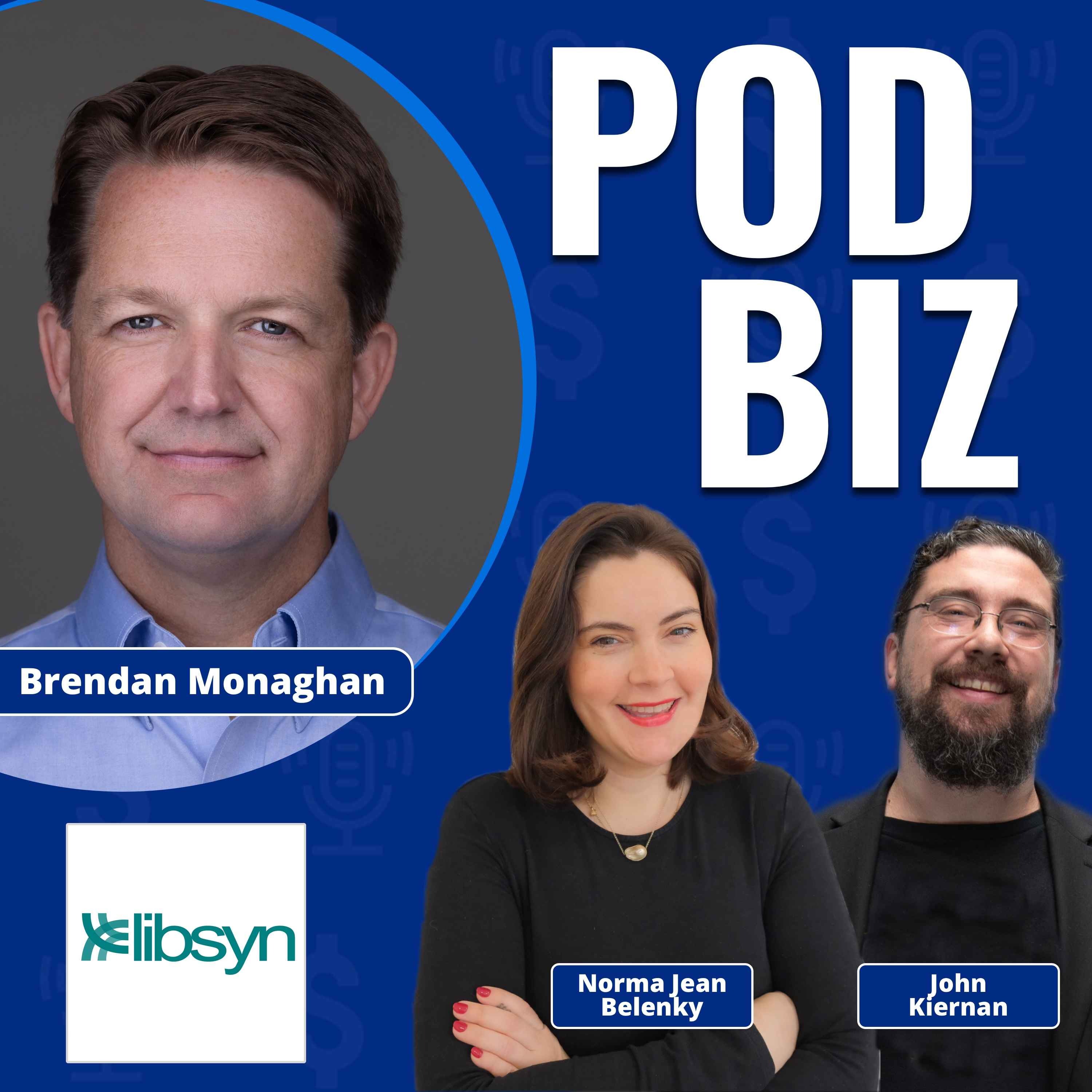
PodBiz | Where's The Money In Podcasting?
Podcast Infrastructure and Platform Economics with Brendan Monaghan
00:42:09
How Libsyn’s CEO thinks about scale, monetization, and where value is actually created in podcasting
Loading summary
Transcript67 lines
- [00:00]
A
We're constantly thinking about how do we build technology to maybe help facilitate more audience development for creators. So whether that's feed drops or guest appearances or things like that, it's. It's hard, right? It doesn't scale like plugging into an ad network and turning on a firehose. It's different.
- [00:19]
B
Hello and welcome to Pod Biz, the money behind the Mic, a podcast about the business of podcasting. I'm Norma Jean Balenke of NJB Media, podcast and media strategy, marketing and audience development. And I'm Joe Kiernan of podhouse Productions, your one stop shop for everything. Podcast production, from ideation to editing and recording, and so much more. We're your co hosts on this journey into this world of podcasting as a business tool. Whether you're launching your first show, scaling a podcast network, or building branded content for your company, Pod Biz breaks down the strategies, tech and mindset behind podcasting success. We're bringing you insider tips, real talk with industry professionals, marketing tactics that actually work, and all the lessons that we've learned in the trenches. Plus we'll tackle the big questions like where's the money in podcasting, monetization, growth, SEO, and of course, how to stay human in a data driven world. So if you're ready to go beyond the downloads and build real impact with your podcast, then hit subscribe and let's get down to Pod Biz. Welcome to Pod Biz. Today we're joined by Brendan Monaghan, CEO and president of Libsyn. Brendan, thanks for joining us.
- [01:28]
A
Great to be here. Thanks for having me.
- [01:30]
B
Absolutely. Such a treat. So let's get straight into it. Where's the money in podcasting?
- [01:35]
A
Well, such a, such a broad question. I love it. I think the money's in a lot of different places these days. Obviously, advertising is the most talked about and most well known, but there's also things like subscriptions, of course, other types of live events, et cetera. I mean, I like to think when you break down the advertising component, I like to think of it actually in three tiers. One is host red. So if you're, if you're large enough or have a compelling enough audience that advertisers want to directly engage with you as a host, that's the first place. The second is at Libsyn. How we think about it is audience targeted solutions. So if an advertiser wants to read a particular subset of your audience, say Starbucks wants to reach 18 to 30 year old coffee drinkers, they can do that. And that's another thing we offer here at Libsyn. And then the third is programmatic, providing a solution to try and fill every slot with a programmatic advertising unit. And so those are the three things we think about when it comes to monetization. Obviously, we drive all three of those for folks. And then of course, you have the patreons of the world as well as some other domains that people are doing in terms of live events, etc. So I'm excited about the outlook for creators and how they can monetize the labor of their love and hopefully finding more ways to do that for them.
- [02:56]
B
Absolutely. Yeah. It's so interesting in terms of the monetization model. Right. Because we have advertising and like you said, that is broken down into host thread, it's broken down into dai, it's broken down into programmatic. There's also a live event component and we'll talk about Libsyn in a second. But I think for the industry as a whole, we're definitely also seeing on the indie side, a lot of podcast move into a subscription monetization model as well as branded. So it's definitely been very fun. In terms of advertising and fill rates, what are some things that you've seen in terms of trends?
- [03:27]
A
Yeah, I mean, I think the, maybe the most notable trend I see is just the thirst for supply that large networks, including our own, have. There's a lot of demand as advertisers get more and more savvy with the space and comfortable investing in the podcasting medium. We're seeing a really high level of demand for a limited, a fairly limited amount of supply. And so I think it leads for me to a lot of conversations with creators about monetizing content and the opportunities to do so, even on the smaller side. Right. I mean, some folks that we have some fairly small shows that people think it's not worth it or it's, it's not necessary. And I think it's our job as the platforms to make it both compelling from a dollar amount perspective, but also easy to use from an implementation standpoint to make that process really slippery for them so that they can, they can opt in. And who knows, maybe it's just something as simple as paying for their hosting fees for a month or a quarter. But there are dollars to be allocated in the space. And of course, as shows grow, those opportunities get even better.
- [04:37]
B
Yeah, absolutely. We had Courtney o' Connor from Oxford Road, come on, speaking about that like, there's no podcast too small when the advertiser, you know, has a product that is a good fit. Right. And when, when you find the right niche. Absolutely. And it's very interesting in terms of indie creators, because this is what you guys really do at Libsyn. And, and we'll, we'll talk more about this in a little bit. But I do think that there's such a, like a mental barrier for a lot of independent creators because people don't get into podcasting to learn how to be in ad tech. Right. Like you and I like. Right. I have a platform background. I'm familiar. You know, we can talk about like programmatic and, you know, SSPs all day and at the same time, like somebody who created a podcast because they have a great community and they're funny and they love making a show. Yeah, they don't care. They don't care about that.
- [05:27]
A
Yeah, I think you're absolutely right. And I think it's our job to, for the folks that help engage the technology or the ad tech to make it really smooth and easy. I liken it sometimes to the old days of folks blogging and just, you know, opting into AdSense or something else, making it very smooth, very, very transparent and easy for folks to manage and kind of opt in and opt out. And I think that's something that we, as a community of technology and platform players could, could continue to improve upon for creators to just make it really easy and transparent and opt in if you like, opt out if you don't. And then also giving some more data about what's the appropriate amount of ads for a 30 minute podcast or an hour podcast.
- [06:10]
B
I mean, that's just the worst. Right. When you're listening to a show and then there's three minutes of ads, you know, your consumption rate is just going to, you know, drop off, right?
- [06:18]
A
Yeah, I mean, without question. But, you know, there's a sweet spot there and you can even be on the light end of that sweet spot and still, depending on the volume of your show, make decent amount of money.
- [06:28]
B
Yeah, absolutely. What would you say is the largest barrier to entry in terms of educating the creator population?
- [06:33]
A
Barrier to entry in terms of what part? Monetization itself.
- [06:36]
B
Yeah, yeah.
- [06:37]
A
I think it's just that that size doesn't matter how it works. Making it really clean to how, you know, for, for example, one thing that we've been thinking about is when someone onboards, how do we make it really clear and transparent what they're opting into, what kind of advertisers might they receive, what that translates to? I mean, you and I know this language But a cpm, what does that even mean? You know, when you translate that into actual. Actual dollars or actual pennies, you know, it doesn't seem all that appealing. But when you start to multiply that, of course, times thousands of downloads start to become meaningful. So I think it's a. It's a combination of, you know, where these ads live, how they go into the show, you know, who drives them, almost a quick tutorial on. On some of the vocabulary and language that you can make easy for independent creators. And then, of course, larger creators understand that. But even larger creators I talk to sometimes have questions about, okay, where are you driving your ad supply from? And is that just you guys selling it at Lipson, or is it coming from other places? And how do you draw those distinctions, et cetera? So I'm answering your question in a roundabout way to say that there's a lot of different ways to educate folks, but I think ultimately we've gotta do a job of making it really clear to creators and help them understand what the opportunities are.
- [07:57]
B
Yeah, absolutely. I think that educational piece is so important. You know, at Pod Biz, we also have a platform background, myself and John, my co host. So it's something where the educational component is so big because podcasting is an open medium. Right. Everybody out there is really their own media company in a way. Every independent creator has the opportunity to create their entire own community. And like you mentioned with Patreon, we're seeing it with Substack. You know, we're seeing this as well within the wider creator economy. Right. People are. We're in the age of kind of everyone building their own brand. Absolutely. Well, Brendan, I want to talk next about how you got into the podcasting industry, because it's a pretty interesting journey.
- [08:34]
A
Sure. Where do you want to start?
- [08:37]
B
Slate.
- [08:38]
A
Yeah. Yeah. Great. So, yeah, I was. I actually joined the Washington Post group of companies in mid, you know, call 2006, and ended up working with. They had a digital umbrella. Right. The. The Washington Post digital properties were separate from the newspaper. There are a variety of reasons why they did that, but Slate was purchased a couple years ago earlier from. From one of these executive deals where Warren Buffett put Bill Gates together with Don Graham and they end up buying Slate. So maybe more background than you need to know, but I ended up being the GM of Slate after a few years with the company, and we were looking for opportunities to expand Slate into other. Other realms of opportunity. My job as head of business development is to thinking about new realms of monetization and frankly, Just driving revenue for us as a company. And so Andy Bowers, who is the head of content and audio at Slate at the time, and I worked together to come up with the idea for what was at the time called Panoply.
- [09:42]
B
Before it became Panoply.
- [09:44]
A
Yeah, it was called Panoply. And the idea was to provide sales, something that we were doing a good job at Slate. We had a strong sales team led by Matt Turk, and we also had a really strong production capability. We had studios in New York, we had producers on tap. And so that was. The original model was to bring those two services to the table. Um, but frankly, we were looking around and we were actually lips in clients at the time. We were looking at platforms and felt like there was a little bit of different direction we wanted to go with the technology. And so we started to look around and we found these two brothers in Australia, the Cox Brothers, and we ended up buying their company, moving them to the United States, and they helped drive the Blackbone, sorry, the backbone for what became the platform that became known as Megaphone. And so that was the start of it. I'm happy to go further down the path, but that was the original kind of first, call it 18 months of the company going from content creation and monetization to adding a technology component, and then the journey goes on in other directions, which I'm happy to get into.
- [10:55]
B
Yeah, yeah, yeah, yeah, absolutely. And, you know, for everybody listening who's like, what are we talking about? We're actually talking about the Spotify acquisition of Megaphone for, I think it was $245 million. But it started out with Graham Holdings. I think making an INIT investment into
- [11:09]
A
a platform, it is reflective of Graham, you know, and for those who don't know, Graham owns a variety of business, including at the time, the Washington Post. When they sold that to Jeff Bezos, they renamed the company after the Graham family. And that's. They own a variety of businesses, from manufacturing to home healthcare to digital media, and at the time, podcasting.
- [11:30]
B
Yeah, absolutely. And you know, what's very interesting in the podcasting space is that there is, you know, obviously the creator economy, and there's all of us who work on the creative side, on the audience development side, on the marketing side. But on the platform side, there are a lot of people who really see the need for specific features and products and go out there and start their own hosting companies. It's. I mean, obviously this is like a. Like an ultimate example, right? But we see it in terms of the space, right? We've had a lot of other podcast hosting companies come on to Pod Biz. We had Alberto Botella from RSS.com right. And so it's definitely something where within the space there's still this like tech founder, you know, what can we build energy? Which is really fun because within a lot of other media industries, right, the established platforms are already there. And so within podcasting there's still a little bit of this wild west happening. It's very, very interesting. And you know, obviously there's, there's partnerships and you know, in terms of directories, right, we've got Spotify and Apple and that's a whole other thing. But in terms of the plat and hosting and features, it's been very interesting, right? How transcripts were rolled out, how videos rolling out. There's so much nuance there. And from a listener perspective, you may not always see it or hear it. And from an industry standpoint, it depends on kind of where your interest is. But if you are, you know, platform aware, it's something that's very interesting in terms of the ecosystem of podcasting and how these companies are coming up. And you know, I always talk to people about this kind of 18 month wave of, of trends that we see. You know, there was this huge wave of AI companies creating captions and then the hosting companies were like, we will just build in this feature. So I do think it's so interesting in terms of trends in overall and hosting what we're seeing. And at Slate you definitely saw the need for a specific kind of hosting. You created Megaphone from that and then the acquisition happened with Spotify. Now obviously, you know, this is coming from like a large company to a large company. But I think for everybody listening, you know, we all want to know kind of how that happens, right? Like, is Graham approached by a vc? You know, what do those conversations look like? And obviously, you know, a lot of that is subject to non disclosures and things built in around the process. I think it was public that Spotify acquired megaphone for $245 million. And so at that time it was a very large acquisition in the hosting space. And part of that was hosting, but the other part of it was the ad platform as well.
- [14:01]
A
Yeah, for sure. It was 235, just to be clear.
- [14:05]
B
Oh, sorry, okay, sorry. 235. I added an extra 10 million. Now with interest and inflation.
- [14:11]
A
Yeah, I would happily take it. No. So those kinds of conversations are really interesting, right? I think there's, there's a couple different ways you see them happening, and that is one. You see companies that approach the market, they'll hire a banker and they'll approach the market and say, hey, we think we're at an inflection point for a variety of reasons that we think it makes sense to bring this to market and sell this thing we've built. In other instances, you see where, of course, folks get excited, whether it's on the strategic side. When I say strategic, just to be clear, I mean like a Spotify buying a megaphone or we recently saw Red Sea Ventures out of Fox by superset. No, you know what I'm talking about.
- [14:54]
B
I know. I know exactly what you're talking about.
- [14:55]
A
I'm blanking on the name. Apologies for that. But anyway, those are strategic acquisitions. And then you see acquisitions that are more from an investment standpoint. Right. A private equity firm sees something that's profitable and valuable and sees that as being something they can grow and potentially sell again. So there's a variety of means that take place. Spotify was actually a customer of Megaphone, and so we worked with them in that regard as well. You know, the stars aligned for that acquisition. I think that was at a time, as you know, where Spotify was really acquisitive. They were buying, you know, content entities, including Gimlet, Pave. They were heavily investing in Alice Cooper, Joe Rogan. We, we're. When you see the, the, the, the mentions of Spotify's investment back at that time, we're not often mentioned, which I'm fine. I like to fly under the radar. But from a platform perspective, I think the folks at Spotify would tell you that was a transformative acquisition because at the time there was a lot of emphasis there on the advertising dollar and growing supply. And so what we had at Megaphone was we worked with a ton of large enterprise creators. And so we had a meaning amount of supply, available inventory to sell ads into. And Spotify had a global salesforce, not just in the US of course. And so there's a really strong marriage of our availability of supply, their need for supply and their strong demand and putting those two things together. So what was interesting about that too was, you know, Megaphone actually went into a different business unit than than Anchor, which is now called Spotify for creators.
- [16:30]
B
Yeah, I remember when the Anchor acquisition happened as well. So interesting. So if everybody who's listening and who's like, what, what are we talking about? Spotify actually acquired two different hosting companies. One was Megaphone, which is the enterprise solution that Spotify utilizes for Larger podcasts with larger ad inventory. And then there's Anchorage, which was a free podcast hosting platform that they acquired to funnel creators and creator dollars, I think, exclusively into Spotify for their walled garden strategy.
- [16:55]
A
Yeah. And that's now known as Spotify for creators, I think is what they call it. So.
- [17:00]
B
Yep, it's been rebranded. Exactly.
- [17:01]
A
Yeah. So it was an interesting time. There was a lot of acquisition. I went back and looked and I think four of the biggest players were taken off the board in 18 months. That was megaphone with Spotify Art 19 to Amazon. Yep. You had serious, and I heart making acquisitions as well and taking really large, generally enterprise or mid tier type players off the table. And so it's an interesting time for sure. And then of course, you had the wonders of the world and others. So that 2019-2020 was a really interesting time for this space.
- [17:37]
B
Absolutely. I mean, it really felt like the Wild west, right? It felt like that kind of when people talk about like Silicon Valley and, you know, coming in with an idea and getting VC funding, it really felt like that was that time for that in podcasting. For sure. I, you know, I refer to this a lot of. I Remember Podcast Movement 2022, which felt like the year of minimum guarantees, and it almost felt like someone was walking around with an invisible money gun and it was just like raining money. Like it was insane. Right. It was such a, such a wild time. I mean, I think it's very interesting in terms of also how the industry is evolving and you know, from your standpoint where you're sitting, it's very interesting because you sit it kind of in this almost Venn diagram. Right. At the intersection of creator and advertising and platform.
- [18:22]
A
Yeah.
- [18:22]
B
Right. So what do you see in terms of from that vantage point? Right. Because it's. That's a rare one. Most people are one.
- [18:30]
A
Yeah.
- [18:31]
B
So when we're talking about, you know, that, that vantage point of the intersection of creator and platform and monetization, what are some of the trends you're seeing?
- [18:38]
A
I mean, and the obvious one is the video side. I mean, it almost sounds like duh to say that, but I would be remiss if I didn't. I think that's. That's been something that's evolved slowly and then it kind of really accelerated this year, I think with Spotify's commitment and then of course Apple's announcement and then of course Netflix kind of, not unsurprisingly, but still kind of. It came out quickly in that late last year, early this year. So that's interesting. And then I think there are a lot of other players kind of interested in lurking, if you will, and you start to wonder about, you know, like I look at the Warner Brothers acquisition by Paramount, Skydance, like, are they going to be active in the space? They have such great digital products. And the Paramount platform is really compelling from a video perspective. So I think video is really interesting. The way I look at something like video is I look at the, to your, to use your example, the Venn diagram of those things and say, okay, how do we first of all think about the creator first? Right? Because without the creator, all of this other stuff is superfluous. Right? Is we've got to have the creator, we've got to have great tools for them, great compelling technology for them to publish, monetize, and measure all of their video consumption. So that's one piece of it. And then the platform part is, of course, building the technology and the tools and having those conversations with the Apples and the, and the Spotify's of the world to make sure we're in that mix and being part of those deals. And then the third piece is, of course, sharing that with the advertising community and bringing compelling opportunities, whether that's particular shows, particular audiences, or just frankly a big amount of scale that video advertisers are trying to reach and package that together in a way that makes sense for their buying, for the audiences they're trying to reach through these awesome creators. And so that's how we tend to think about those things. But you know, as you mentioned earlier, from a technology perspective, there is a very much of a platform focus. My time is, is all spent or largely spent thinking about how do I give the best technology and tools to creators and how do I connect advertisers with those awesome audiences those creators have developed. And so you think about it from that perspective, we sit in the middle of those things and how do we make it as easy as possible for all the parties involved? And if we do that well, we have an awesome platform that hopefully earns a lot of hosting business and by extension, audience inventory for the advertisers.
- [21:09]
B
Yeah, absolutely. And you know, Libsyn has a very interesting creator population. So tell us a little bit about that creator population and what differentiates it within the podcast hosting and monetization ecosystem. Because I feel like each host has almost their own, like, archetype of creators. It's very interesting.
- [21:25]
A
Yeah, no, I think you're right. I mean, I, I. So what's interesting about Libsyn is what people don't realize generally, is that Libsyn's been around for 20 years. Lipson is the original hosting platform, right?
- [21:35]
B
Liberated syndication. Yep, that's right.
- [21:38]
A
So if anyone was in podcasting over 10 years ago, they were likely hosted on Libsyn at one point in their career. Joe Rogan, Marc Maron, you know, you name these established and kind of Mount Rushmore, if you will, creators. They were at Libsyn at one, at one point. A variety of things have changed, including technology, monetization, et cetera. One thing Libsyn didn't do for the longest time was monetized creators. They didn't have that solution. And so I think that's one obvious reason why folks might look elsewhere. And I don't mind saying, I think at some point, you know, Libsyn lost its way in terms of being technically innovative. That was part of the reason why, you know, we looked elsewhere when we were launching Megaphone. And so part of my charge here, and not to make it too much about the current day, but it's been really about getting back to our technology roots and building that product so we can service every. All three tiers, right? I talked about three tiers of the advertising community. I think about three tiers of the creator community. You've got the enterprise creators, you've got what we might call a mid tier and then a long tail. And a mid tier can be someone like a Malcolm Gladwell or someone we work with, like a Nick Viall, really popular, has a handful of shows in a network, but isn't, isn't a, you know, isn't a CNN that has 10 or 15 shows, right, which might be considered enterprise, but these, these, these companies, like a Nick Vile, are growing dramatically and they're engaging with advertisers. And so all three of those community types really are who we aim to serve. I think what, what's happened in the past several years is we've kind of more focused on the mid tier and the long tail. But the technology we're working and building on is going to recapture a variety of enterprise customers. And as you pointed out earlier, that's my background is I started Megaphone at the enterprise level. So my aspirations are to say we want to build something for when you're just starting out, when you start to have some success and you grow and maybe you're, you need a host red or you need a salesforce, and then maybe, maybe you grow to be your own media entity and you've got your own sellers, but you need people to provide technology and additional ad inventory that your team isn't selling. So we want to provide that solution. And the way I say it to our team is at some point, Libsyn became a place you graduated from. Right. You got big enough, you moved on. No longer. That's not the type of company we're building that I was brought into to reestablish was we want a company that grows with you as that creator and helps, you know, generate meaningful revenue for you along the way.
- [24:16]
B
Absolutely. I mean, that's where the money is, Right. We've had, you know, I have a hosting background. We've had other, you know, creators of hosting companies come on and say, look, you know, you can only make so much from hosting, but advertising is a different ballgame. And so it's, it's very interesting. You know, some of the most monetized networks and hosting companies that are in one don't always have the most cutting edge tech, but they've got, you know, the most successful salesforce. It's a very interesting facet of the industry. Right. The independent creator is always going to need features. Right. The independent creator is going to go based on cost. Right. Why are you buying a podcasting host? Cost. And what features do you have built in on the enterprise side, it's who's selling it. Right, Right. So I do think that that's, I mean, yes, obviously those relationships and you know, when we're talking about big ad, it's inventory, right? Absolutely. It's based on that. But that independent creator, who's making a show that's enterprise level, that's monetized, they're not looking at the features of a hosting platform and comparing the monthly price of hosting. Right. They're thinking, who's going to get me the best, you know, ad deal on my show? Who's going to get me the best package, who's going to connect me with the best advertisers, both in terms of fit and in terms of fill rate. Right. I think it's so interesting, this conversation. Absolutely.
- [25:35]
A
You know, I think one thing I would say also on the enterprise side is we don't talk about it enough. But the enterprise also has some really complex needs from a roles perspective. And you know this from your background. But you know, if you're working with a CNN or New York Times or an ABC News like we do, you've got people that are strictly producers that are creating content, and then you've got dedicated people thinking about ad operations and smaller companies. One person might wear all those hats, but at larger companies, you've got dedicated roles. Right. And so they need permissioning. You know, if I've got 10 shows, do I want producer A being able to do anything with producer X's show? Maybe I don't. Maybe I want to keep those things separate. But as the parent company, I want to see all the stats and all the data across all 10 shows. So that's the complexity that those enterprise players bring in too, is they want best in class features, but they also need permissioning and data and monetization, all the things you mentioned, to really support their significant business. And so, yeah, it's an interesting way to look at it and how you think about building out features and functionality for those different constituents. And as you know, people are getting more and more sophisticated too. So what you might have thought, oh, that's only for a quote, long tail creator, they might start having needs of bigger and more demanding publishers because they're just sophisticated in how they create their shows.
- [27:02]
B
Absolutely. And on the independent creator side, right, you bring in an editor and you want to give them user access to upload the episode but not publish. Right, Exactly. So it's. Yeah, absolutely. It's definitely interesting in terms of some of those platform features that are built in. Well, Brennan, what would you say is something that people don't know about what you do?
- [27:20]
A
I think the degree to which you spend time thinking about people in your organization, anytime you're a CEO, I think there's a lot of. Certainly for me, there's a lot of misconception. It was board meetings, it was raising money, it was doing that kind of stuff. And that's all very important. But the amount of time I spend thinking about our people and creating a company culture, creating compensation and benefits and creating, creating opportunities for those people, whether they be really early in their career or really experienced in their career, developing a workplace that allows them to thrive is something that I spend a meaningful amount of time working on. I spend a lot of time with our HR person thinking about who are we hiring, who are we bringing into the company. And certainly when you join a company like I did that's been around for 20 years, there's a lot of different types of folks that are, that are working at a company and sometimes you have to make decisions and changes and those are always really, really hard. And I know sometimes that can seem not like a big deal, but those are not fun decisions to have to make. And something as a CEO, that weighs on you too.
- [28:23]
B
Yeah, no, absolutely. That's super interesting in terms of Corporate culture. And I think also with a company like Libsyn that's been around for so long, within the podcasting space, you have hires from different eras, right? And then you come in and you have a vision, and you're like, okay, I was brought in to do this, and we're here, and we're going to get here, and I'm going to get us here, and here's who I need to get us here, and it's people's livelihoods, right? So, yeah, absolutely. That makes a lot of sense. Well, what would you say is one key move or metric or even a mindset that's made the biggest impact on your career and the success of the companies that you've been with?
- [28:53]
A
I think the. The obvious thing is, well, one, I touched on the talent density of the organization. I think, two, is really putting ourselves in the minds of the creator. I think it's really tempting to be thinking, okay, I run this. I work on this technology company, and I've got to, you know, build this tech and advertisers and all this stuff, but at the end of the day, we're providing a medium for people to create and express their voice to the world. And it's. It's really simple. It's not easy, right? As one of these terms I always use is it's. It's a simple idea of providing tools and technology, but it's not easy. Right? How do we think about, you know, small versus enterprise creators? How do we put the things in their hands? How do we make it really easy for someone who's new to monetization, the things you brought up? But at the end of the day, I think sometimes we can get caught up in thinking about, you know, the bottom line or, you know, how many deals we're doing, et cetera, but it goes back to that kind of unit creator, whether that's one person in a closet trying to get their show off the ground, or it's a huge enterprise, it's putting our mindset in their shoes and building tools, technology, revenue data, audience development, which we didn't talk about those kinds of capabilities for them, is if we keep coming back to our why is what we talk a lot about at Libsyn, if we do that and we do that well, we create a lot of value in the space for people who want to share their voice with people.
- [30:23]
B
Yeah, absolutely. And you kind of read my mind in terms of audience development, that was going to be my next question. So in terms of supporting creators and when we say audience Development. Right. It's how to grow your audience. So in terms of supporting creators both large and small, what are some things that you've seen make a real difference?
- [30:40]
A
I think in the past, and you know this, there was something as simple as folks keeping a spreadsheet of how. Of swapping how many promotional slots I can have on your show and you can have on mine. Right. You know, we work with some former megaphone colleagues of mine on product called Pod Roll that's attempted to kind of automate some of that feed dropping capabilities. Yeah, but, but I think, I think the, the thing that we need to scale for is how big you are versus. Yeah. If you're Joe Rogan, you can call up anyone and they'll generally want to appear on your show. If you're a more junior person in the space, you're not going to have access to type of talent to help grow your audience by just saying, hey, I'm going to have Barack Obama on my show and I'm going to get a garner a bunch of listenership. So I think for us, thinking about the different stages folks are at and providing tools or capabilities or even just guidance about how you use those things to help garner broader listenership. One example is we think about technology from a transcript perspective or building out transcripts in a different way to try and help not just provide the spoken word on page, but also how do we translate that into AI capabilities that help develop monetization tools and other pieces of it. So audience development is the really the hardest piece, I think of the puzzle and I think of podcasting in really four key areas. Publishing, monetization, data and insights, and audience development. And that fourth leg doesn't get talked enough about, but talks so much about currency. And you'll hear me say that I think podcasting has two currencies. One, of course, is the revenue from podcasts from advertising or subscriptions. And then the second is actually audience, and that currency is a lot of ways harder to come by. And so we're constantly thinking about how do we build technology to maybe help facilitate more audience development for creators. So whether that's feed drops or guest appearances or things like that, it's. It's hard. Right. It doesn't scale like plugging into an ad network and turning on a firehose. It's different.
- [32:50]
B
Yeah. It's not turning on a light switch. I mean, I, I have my own independent company in terms of audience development. And so, you know, people ask me, how do I grow a podcast? I'm like, how Long is a piece of string. What's your podcast about? Right. And so we're still in this area where discoverability is this missing piece. Right. It's very directory dependent, it's very metadata dependent. It. There's so many different features. Right. And each creator has an opportunity to basically create their own playbook. Right. There's obviously best practices which we've gone into a little bit, like you mentioned, with feed drops and all of that, but it is something where in today's creator economy there is. It's really like a choose your own adventure in a lot of ways. And. And podcasting, for better or for worse, doesn't have a lot of the data that you're getting with YouTube. Right. And you know, I've heard actually some great anecdotal case studies about why that's great. Right. I've met some folks in London who had a podcast on domestic violence for a single specific cultural community that had a lot of listenership and not a lot of subscribers. So I do think that podcasting still has this, you know, it's still this bastion of audiences having the power instead of being a commodity in a lot of ways.
- [33:58]
A
Y.
- [33:58]
B
And there is that empowerment aspect of it, and I think that that also contributes to the audience trust in a lot of ways.
- [34:04]
A
I think it's an underexplored area of, you know, our space. None of them are easy, but that one might be the hardest of them all to help people find ways to grow their audience in meaningful, significant ways.
- [34:18]
B
You know, looking at the landscape today in terms of platform and monetization and the creator landscape, what would you say, you know, if. If somebody just came up to you and you were at a conference, is Libsyn's unique value proposition at this time and what are you working toward in terms of creating that unique offering for the industry?
- [34:37]
A
Yeah, I mean, I. I think I go back to. To three things. One is best in class technology. We're constantly working on that. I wouldn't say we've got that solved, but that's a huge priority for us. Two is monetization. We monetize all three of those buckets I talked about. Post read, audience targeted, programmatic. We offer all three of those. And. And the other which is. Goes unlooked a lot, especially for. For any type of creator, is the customer support and service you get. We have an active team that's very involved, that responds dramatically to or quickly to customers. We've got a couple of guys who do open office hours for our customers that can people can log on and ask them questions on a monthly basis. So we really try to go the extra mile to provide some clarity in what can be a confusing space for creators and just helping them get answers. So those are the three things that probably stand out the most to me. I'm sure there are others that I'm leaving off the table, but those come to mind as the ones that we tout in the market and we're constantly trying to get better at.
- [35:38]
B
Yeah, CS is a really big piece, Right. Because I think a lot of people give up when things get hard, right. In the age of reduced attention spans, it's like, just give up and have a snack. Right? Just give up and scroll to the next video. And I do think that specifically within technology, when people reach a roadblock, there's even more frustration that they face. So that CS piece tells me a lot. It's very, very interesting. Well, if you had to start over today, what would you do differently to grow faster or smarter?
- [36:05]
A
Yeah, I think I would continue to lean into artificial intelligence. I mean, I know, you know, and I don't mean that from the content creation standpoint, I mean that from enabling technology. And it's a, it's an important distinction, right? Because you know, well, as anyone that, like people have those conversations, we talk about AI generated content. Woo. Oh, yeah, that's a, that's a, you know, a thorny issue. But what I'm talking about is how you leverage technology in a way that allows you to get people to the end point quicker of what they're trying to do and support, and support the mundane things so they can focus on the things they really want to do, which is developing a great set of questions for their content, developing creators that they're going to have on their shows or other, sorry, other talent that might appear on their episodes. Those kinds of things are what people want to be spending their time on and not some of the nuts and bolts of blocking and tackling and creating shows. So I think that's one thing that you'll see us continue to lean into more to try and supercharge the access people have from time of idea to execution and providing a better set of capabilities for them. So I know that's a little bit of an easy answer in this day and age, but if you think about the degree to which you can build a company and make some significant changes, it's not to be overlooked.
- [37:28]
B
No, I think we're in this really interesting inflection point. Right. In terms of podcasting as an industry and in terms of just being in the world as a human. Right. Where are the inflection points of us using it ethically or using it creatively? And where are the inflection points of we're getting stupider or this isn't. Or like, I'm reading Someone's post on LinkedIn that's just very clearly written by AI to be thought leadership. Right. I started doing a LinkedIn post every Friday called It's My Face Friday, where I just do a live video of It's My Face because there's so much content out there that's literally just like, you know, Claude, thought leadership. You know, and we're seeing it in terms of content across the board. Right. Within podcasting, of course. Course. But also, you know, within social, within creator platforms like substack. It's really interesting. And the content that's written by humans algorithmically does better. It's so interesting.
- [38:21]
A
And I go back to also thinking about the market for. For these types of things. You know, everyone has a scale. It's. I think sometimes in the media, we try to make these conversations binary, right? Republican, Democrat, you know, black, white, all these, you know, rich, poor, all these distinctions. And the reality here is this isn't binary. This is business. And people are trying to make a distinction along the spectrum of how they want it to empower their work. Some people are comfortable using it extensively, but won't let it get into the creative side. Some people are comfortable, and ultimately, what's the market going to be comfortable? If you see these LinkedIn posts, you might skip right past them. Other folks might really be okay and be comfortable with them. And so I think the market decides these types of things, and we need to understand that perspective and provide people with the tools to do what they want. And, you know, their audience may reflect that. If folks don't like what they're doing, well, they might have to reassess. But I think it's to your point, it's a really interesting time and an interesting discussion to be had, particularly when you consider the overlap of technology and creativity. Right. This isn't. We're not just talking about pure technology. We're not just talking about pure creativity. We're talking about the intersection, which is why podcasting is actually such an interesting space.
- [39:38]
B
Absolutely. It's a very, very interesting time. Well, last question. What are you most excited about coming up within the industry?
- [39:45]
A
I'm excited about the intersection of all of these different things you talked about, like Patreon, you talked about Substack, Beehive, just announced or announcing they're getting into the space. I think you've got creative platforms in the audio space like Libsyn, and how are these companies coming together to provide creators with integrated solutions? Now, you may not be someone that wants to create a newsletter, but you may want to be able to distribute your video podcast to folks via newsletter or via social. You talked about. You know, I've been talking a lot about LinkedIn lately. I think any of us in the world are spending a lot more time there. And there's a. They tell you there's a gap between content that's available to consume and consumers looking for content there. And so I'm excited about what they're doing in this space. And so I'm constantly looking at not just audio and video, which is core, and we have to get that right. But then also, what are the other opportunities for us to provide tools for creators that make their lives easier? Obviously, I talked about a lot of monetization, but data, insights, people getting better perspective about who's listening and what. What common. There's this one podcast I listen to. It's called Lenny's Podcast. He's a. He's a product leader in the technology space, and he's actually created a bot to help surface the most popular recommendations of books or movies or the most common piece of advice that's coming out of his. Come out of his 300 guests. And so I think so much of that is. Is kind of coalescing around each other. And I'm excited for the next few years ahead. And I think video is the first extension of audio and where else that's going to go.
- [41:28]
B
Absolutely. I think the curation aspect of AI is going to be super interesting. Right. It definitely reminds me of that movie her, where the AI created a book of the guy's letters. I thought it was so interesting. And we do see that actually in terms of a lot of podcasting content. Right. In show notes, it's in terms of recommended episodes, it's quotes pulled from transcripts. We're already seeing it. And I do think in terms of the platform and hosting side, there's a lot of features that are going to come out in the next. Whatever this wave is that are going to improve the quality of life for creators, which I'm really excited about as well.
- [42:01]
A
Well, we hope to be at the forefront of that. Right. I mean, that's where we want to be. So I'm with you.
- [42:06]
B
Absolutely. Thanks for joining us.
- [42:07]
A
Thanks for having me. It's great to meet you.