← PodBiz | Where's The Money In Podcasting? 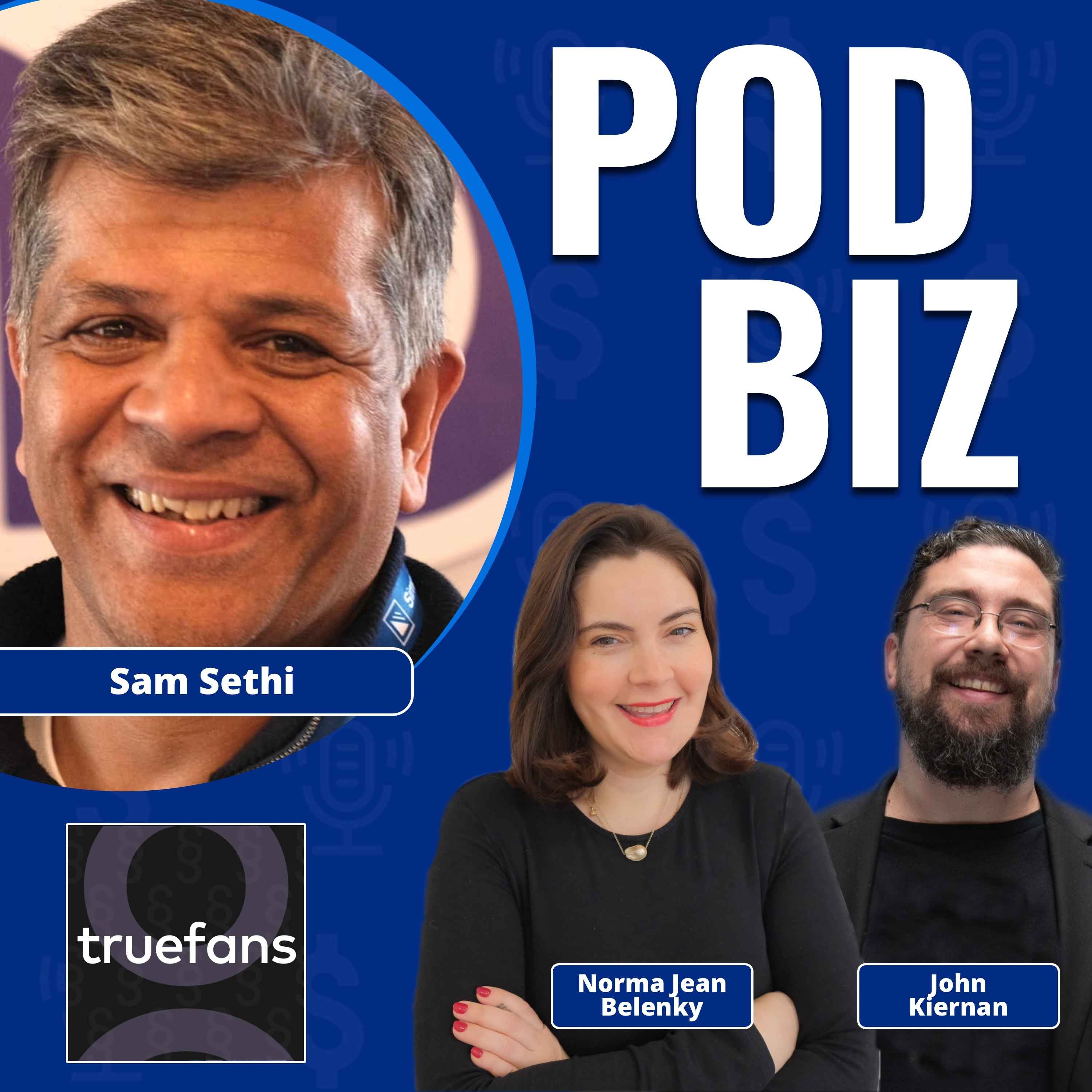
PodBiz | Where's The Money In Podcasting?
The Shift to Subscription Podcasting with Sam Sethi
01:02:05
True Fans CEO Sam Sethi on subscription podcasting, listener data, and monetizing fandom beyond ads
Loading summary
Transcript209 lines
- [00:00]
Sam Sethi
The word of the year is parasocial, right?
- [00:03]
Norma Jean Balenke
Absolutely.
- [00:05]
Sam Sethi
It's the one way deep relationship that fans have with creators. Jimmy Carr, a comedian in the uk, once said, was asked the question, what's it like to be famous? He said, it's like having Alzheimer's. What do you mean? He says, well, everyone knows who I am and no one knows. I don't know who anyone else is. Right. So they come up to me and say, hey, Jimmy. And I go, no, no idea who you are. I think in a parasocial relationship, we have that same thing. You know, James and I will have people come up to us and say, oh, I heard about your dog the other day, or your daughter's at this university. And I'm going, how do you know these things? And I go, well, I told you, right?
- [00:40]
Norma Jean Balenke
Hello and welcome to Pod Biz, the money behind the Mic, a podcast about the business of podcasting. I'm Norma Jean Balenke of NJB Media, podcast and media strategy, marketing and audience development. And I'm John Kiernan of podhouse Productions, your one stop shop for everything podcast productions. From ideation to editing and recording, and so much more. We're your co hosts on this journey into this world of podcasting as a business tool. Whether you're launching your first show, scaling a podcast network, or building branded content for your company, Pod Biz breaks down the strategies, tech and mindset behind podcasting success. We're bringing you insider tips, real talk with industry professionals, marketing tactics that actually work, and all the lessons that we've
- [01:23]
Sam Sethi
learned in the trenches.
- [01:24]
Norma Jean Balenke
Plus, we'll tackle the big questions like where's the money in podcasting, monetization, growth, SEO, and of course, how to stay human in a data driven world. So if you're ready to go beyond the downloads and build real impact with your podcast, then hit subscribe and let's get down to Pod Biz. Welcome to Pod Biz. Today we're joined by Sam Sethi, CEO of True Fans. Sam, thanks for joining us.
- [01:49]
Sam Sethi
Oh, thank you, Norma. Yes. Looking forward to this.
- [01:52]
Norma Jean Balenke
Absolutely. This interview has been a long time coming, so let's get straight into it. Sam, where's the money in podcasting?
- [02:00]
Sam Sethi
Ah, what a great question. That's the one that we have to answer. Okay. Most people would say advertising, right? I come from the other side of the fence, which is subscription based, premium content. And that's where I see the money for 2627 going. So why do I say that? Let's look at some of the companies in the market Space. There's Patreon, Substack, Supercast, now Beehive. Patreon paid out $2 billion in creator money last year. So that's bigger than the US Advertising market alone. You look at supercars who said they paid $26 million to their top 10 creators. We saw $40 million paid last year by substack to creators, and Beehives just kicked into that market. I think people have switched from wanting to have advertising driven podcasting in which they get interrupted, to accepting that podcasting is a subscription paid ad free platform. And again, we've just seen Apple with their new video platform, you know, again, in Apple channels, looking at subscriptions, looking at the way of not having to pay to listen to ads. So again, that's the market I'm in. I'm not saying that advertising isn't a market space, it's a massive place. But I see the drift going to premium content.
- [03:29]
Norma Jean Balenke
That's so interesting. You know, just the way that you describe that pipeline makes me think of television, right? I mean, I, I agree with you. I think there's three buckets, right? There's branded, which I love. I work with a lot of my clients and audience dev unbranded, right? It's where the brand really sponsors the show. So it's kind of best of both worlds. Then you have ads and that's bigger creators, free platforms, you can listen, but you know, obviously you're paying with your time and then you've got this giant subscription fan base model that is just taking off. Right. And, and I want to talk about that a little bit more, but what you just described sounds a little bit like in the 1980s, you know, cable television coming along. Are you going to pay extra for cable? Are you going to pay even extra for hbo? No. Commercials, Movies all the time, right? Then moving into, you know, the arts on Netflix. Are you going to pay a one time subscription? Then you get everything you want. It's very, very interesting and we're definitely seeing it on the creator side. It's this giant move. I mean, I love following creators that have built that platform just to see, you know, how they create that feeling of inclusion and community and value for the audience. I think that it's actually, it seems like something that's easy to do, but there's a real art to it, right? We've talked to a few people about this and you know, the people that do it, well, it's like they've created a whole new world, they've created a whole new industry because they have created this demand for the work that they make, right. The podcast they make, the personalities that they showcase, you know, the content that they're putting so much time and energy into making.
- [05:10]
Sam Sethi
And.
- [05:10]
Norma Jean Balenke
And you know, we say this on an anecdotal level, right? Of course, there's those independent creators that are like on a rocket ship, but then we see things like Gold Hanger and they've got a whole studio and they know what they're doing.
- [05:21]
Sam Sethi
Yeah. I mean, I think with the way that you described the 80s with cable, I mean, that, that sort of took off much later in Europe. Right. America led the charge.
- [05:31]
Norma Jean Balenke
Yeah, sorry, that is an American example.
- [05:34]
Sam Sethi
Yeah. You know, 20 years later, we sort of got a fourth channel, if we were lucky in Europe. You know, that was about it. But here's a question for everybody, right? You know, if you look at the subscriptions you pay today, I pay for Netflix, Spotify, YouTube Lite, I pay for Amazon through Prime, I pay for Paramount, occasionally, Apple. Right. But the one thing I don't get by paying is an advert. I never see an advert. I have an ad blocker on my Chrome. I do not see adverts. And so one of the challenges that I asked Rob Walsh this at Podcast Movement, you know, how many people in the audience skip ads? Hands went up everywhere, right? So we have this model in which we tell advertisers in podcasting that, yes, we're delivering your ad through dynamic ad insertion. And then we tell them, but we can't tell you how long the person listened, who listened when they listened. Right. We can put some metrics in, we can put in tags to tell you whether they clicked on a link and there was an actual purchase out at the end of it. I think the model that currently sits with advertising is one of trust and belief and that most people who can afford it pay for subscriptions to get ad free. So James Cridden, my co host on POD News, asked Maya Prohovnik on Spotify once, Spotify, you're launching this video model with no ads, right? And it's a subscription based revenue that you give to creators. And he said, so basically, people who don't pay for ads are your target audience. So really you don't want people who have a free subscription. And she was like very confused by, hang on a minute. So my market is non advertising based people. Yes, because you've decided to set subscription revenue as the way to pay your content creators. I think everyone's waking up to this. It's just slow burn that's all.
- [07:33]
Norma Jean Balenke
It's very interesting. You know, we just had Courtney o' Connor on from Oxford Road, who is fantastic. She's their, you know, director, podcast Media. And it's, it's interesting because even she said, and obviously, you know, they're one of the largest audio agencies in the world, but she said that, you know, Host Red is the way. And I think that, you know, you know, obviously they run lots of. Lots of different kinds of campaigns. And I don't want to say that's what she only said, listen to the episode for everybody out there. But, you know, I do think that podcast advertising has traditionally done well because you have the host trust. And, and it's been something where the host is like, hey, I'm outside of traditional media. I'm outside of the people trying to sell you things. And I like this product. It's very interesting. It's had almost kind of. And obviously we've come full circle and, you know, podcasting has entered the mainstream for sure. But I do think that there's something about, you know, the trust that you build with an audience as a podcaster, specifically. Right. And this, this translates into many different things. Right. Specifically in my audience development, brain consumption rates. Right. But I, I do think that Host Red, there is a place for that. But, you know, when you're listening to something and then a random programmatic pops on. Right. And. And I'm based in Europe, so sometimes it'll just be in a different language and I'm like, oh, okay, I know this isn't Host Read because it's just a totally different language and it's a different volume.
- [08:57]
Sam Sethi
Right?
- [08:57]
Norma Jean Balenke
Yeah, yeah.
- [09:00]
Sam Sethi
That doesn't help.
- [09:01]
Norma Jean Balenke
No, no. What are they saying? What are they selling me?
- [09:05]
Sam Sethi
So the word of the year is parasocial, right? We, we, we.
- [09:08]
Norma Jean Balenke
Absolutely.
- [09:10]
Sam Sethi
You know, it's the one way deep relationship that fans have with creators. Jimmy Carr, a comedian in the uk, once said was asked the question, what's it like to be famous? He said, it's like having Alzheimer's. What do you mean? He says, well, everyone knows who I am and no one knows. I don't know who anyone else is. Right. They come up to me and say, hey, Jimmy. And I go, no idea who you are. I think in a parasocial relationship, we have that same thing. You know, James and I will have people come up to us and say, oh, I heard about your dog the other day, or your daughter's at this university. And I'm going, how do you know these things? And I go, well, I told you.
- [09:45]
Norma Jean Balenke
Right.
- [09:46]
Sam Sethi
And so. But the host read ad, the thing that you mentioned then goes back to that trust. And I think Leo laporte on Twit was one of the first people who did brilliant host red ads. He was the godfather of it, I would say. And, you know, he'd say stop. And now in his own deep, rich radio voice, he would give you this heartfelt sales pitch about why you need to buy the product because he loves it and this is great and blah, blah, blah. And I think those, you know, again, if Oxford Road is suggesting that as well, it also means you're less likely to skip that type of content because it's.
- [10:23]
Norma Jean Balenke
Yeah, I also think that. Absolutely. I think that there's a night and not to. To jump in here, but I do think that, you know, nowadays, because content is so segmented based on, you know, outside of podcasting, algo, algorithm culture, all of that, you know, I think when you find content, you really feel like it's for you and these people are like you and it's your identity. Right. And so I think that because of that, because there's so much identity correlation between the host and the audience in this parasocial relationship, like you're talking about. It's not just that, like, you like the host content, you like the host ideas, you feel like you're the same kind of person as the host. You know it. There's all of these kind of psychological facets to it. Right. And so when the host says, hey, I know you're like me, I know you're in our community, I know you like our show. And also I like this product, you might like it. It's like a friend recommending something. The parasocial relationship is almost like a friendship psychologically. Yeah.
- [11:19]
Sam Sethi
I think we're extending that beyond the single podcast. So if you talk about Goal Hanger, the rest is politics, the rest is entertainment. Yeah, they do, you know, and I think it's common now amongst most people, they will bleed a new show into the feed of another show to give them awareness and. But you've bought into the brand of Goal Hanger now, right? You know what Goal Hanger is. You know that it's going to be two talking heads, it's going to be high quality recording, it's going to be entertaining. And so you tend to buy the stable or the slate of podcasts, not just the individual one. Right. And so they've done very well there. I think there are companies. You know, James and I again, have talked about it. Persephoneca who I love, Dino Sophos, does a great job, did the news agent and. But they don't have a brand extension between their podcasts. They're all named differently. They all have different looks and feels. They all. So I couldn't tell you which one is a Persephonica podcast and which one wasn't. Right.
- [12:23]
Norma Jean Balenke
Absolutely. Straight away, you know, yeah. You know, this is a Goal Hanger show. And I do have to say, you know, I. I talked to my clients about this, actually, on the branded side, because I have several clients, you know, that are larger companies that aren't necessarily in the podcasting biz. Right. They have a podcast to educate, you know, the population of people who may one day want to, you know, be interested in using their platform or product. Right. But they may have multiple shows, and I have to explain to them we have an opportunity to create a subconscious correlation between all of these shows to use them to build each other up. Right. To use them to have a correlation. Color, theme, sound, intro. Right. What is the cohesive overall experience that someone knows they're going to get when they listen to one of your shows? Absolutely.
- [13:07]
Sam Sethi
Yeah. And again, look, you know, not bigging up Goal Hanger for any particular reason. I do like them. But the.
- [13:13]
Norma Jean Balenke
They're getting it. They're getting a lot of free exposure on this episode of podviz Today.
- [13:19]
Sam Sethi
I think, you know, they'll take Auntie Scaramucci and they'll put him onto the rest is Politics uk or they'll. They'll take one of the other hosts and put him onto another podcast. And so you're building up the celebrity of the hosts as well.
- [13:33]
Norma Jean Balenke
100%. You're building a cast of characters. It's like Friends.
- [13:37]
Sam Sethi
Yeah.
- [13:37]
Norma Jean Balenke
Well, Sam, you've alluded a bit to James in your show, so we also didn't mention this in. In the intro, but Sam and James Kridland, the editor in chief of POD News, also host a podcast called Podcast Weekly Review, which we are very big fans of. I've been on the show a couple of times. It is the weekly roundup, I want to say, of all things podcast industry. Right. You guys have had everyone and anyone on the show. You always talk about the latest hot topics. I mean, here at Pod Biz, we're more of a deep dive. Right. We're more in depth on specifically monetization and some of the people behind that within the podcasting industry. But I am the biggest fan of Podcast Weekly Review.
- [14:13]
Sam Sethi
Thank you.
- [14:14]
Norma Jean Balenke
So that is the show that, that you were alluding to, you know, in terms of some of the conversations. And I want to talk a little bit next about how you got into the podcasting industry, because obviously you and James Kridland host Podcast Weekly Review. You're the CEO of True Fans. You've done quite a bit, but you also had a career beforehand and then you pivoted into podcasting. You've done a lot of really interesting things.
- [14:35]
Sam Sethi
I'm old, Fundamentally. Yeah. I mean, I started out a traditional corporate career. Microsoft, Netscape, Gateway Computer. I ran their online business, et cetera, et cetera. I then co host and founded TechCrunch with Mike Harrington. I then got a bit bored and Covid hit and I, with a couple of mates, decided to do an online conference. No one was doing them. And I pinged Cara Swisher on Hope and Prayer. Genuinely, Cara, do you want to do, do you want to be a guest on this conference that we're running? And she went, yes. And I went, oh, my God. And then it was Dan Snow and George the poet and all these great people, and James Cridlin was one of the people. So we did this online conference twice through Covid, went really well. And at the end of it, I said to James, you know, you do a three minute podcast every day. Do you want to do a half hour podcast with me? And he said, if it's only longer than half an hour, I'm not doing it.
- [15:36]
Norma Jean Balenke
Of course.
- [15:37]
Sam Sethi
Anyone who listens to PodMiz weekly review,
- [15:39]
Norma Jean Balenke
James has been on Pod Biz, so you can hear his episode. It's very early days. That's very on brand for James. Yeah, he does a lot.
- [15:47]
Sam Sethi
So sadly, I think we now close to an hour and a half to two hours.
- [15:51]
Norma Jean Balenke
It's quite long, I do have to say, you know, sometimes I'll even go on a very long walk and I'm still listening when I get home.
- [15:59]
Sam Sethi
We have chapters you can skip.
- [16:02]
Norma Jean Balenke
Oh, no, it's true.
- [16:03]
Sam Sethi
But yeah, so James and I do that and we've been doing that for nearly four or five years now, which is crazy.
- [16:10]
Norma Jean Balenke
Yeah.
- [16:10]
Sam Sethi
I mean, do not listen to episode one, whatever you do, because.
- [16:14]
Norma Jean Balenke
But, you know, every podcaster says that. I, I have to say, for, for everyone out there, you know, podbez, we're a bit of an industry show. But for everybody out there who's, you know, maybe on the, you know, not behind the mic or maybe is even thinking about starting a podcast and has found Pod Biz, if you ask any podcaster, we're talking like hundreds of millions of, of dollars and ad, you know, big deal contracts to, you know, your local, like hobby or podcast hobbyist who really has made, you know, 5,000 episodes but in their basement and they just do it for fun and they don't tell anybody about it. I got to tell you, nobody will want you to listen to their first episode. It is a universal truth. The universal truth of podcasting is. No, but don't listen to the first one.
- [17:00]
Sam Sethi
No. I mean, James is very good and he is. I think we've got it down to a fine pat between us. I mean, you know, we need to keep it fresh. But I think we've got a format that works pretty well. I think we do work really hard during the week to try and deliver what's going on within the industry and find the new voice that's currently topic of the day or week. And often, you know, we get them on the show as well. So yeah, that works really well. During COVID I also launched a radio station called river radio. I had 40 presenters. And in many ways we are doing what the industry is doing now, which is we did live shows, 40 live talk shows, which fundamentally were podcasts. And we then automatically turned those into podcasts straight after the show using a company down in Australia called Wooshka, which Spotify bought, but.
- [17:52]
Norma Jean Balenke
Oh, yep, I'm familiar. Yep.
- [17:55]
Sam Sethi
Yeah. And so it was great. So we would have the breakfast and drop. Lifetime shows would be music based, so they would never turn to podcasts. But every show after that was hyperlocal radio. So it was all about schooling in the area or be businesses in the area. And advertising would be local advertising, but all of those would then turn into a Spotify or Apple podcast straight away. And that worked really well. And you can see radio doing that now. They've only just started to do that, but we were doing that five, six years ago, but it. Maybe it was too early, I don't know.
- [18:28]
Norma Jean Balenke
I think everything has its time. I definitely have had. I mean, remember Clubhouse, right? Like, I think, I think we all love the idea of Live Stream, but also it's very interesting. I mean, I just came off of Radio Days Europe and just seeing how radio stations are starting to pivot into the model of exactly what you're saying. Right. How can we post package? How can we get this content out to people who really want it? How can we hyper segment out for different markets? I do think sometimes it takes a bigger player to make that adjustment for the collective audience and greater consciousness to really adopt a new consumption practice. For sure.
- [19:11]
Sam Sethi
Yeah. I mean, I think in the attention economy that we live in, where we're all attention deficient, I think, yeah, clip based content is working really well to drag people in. So I very rarely listen. I don't think I've ever heard a full Joe Rogan show. I don't think I've ever heard a full diary of a CEO show. Right. But I have picked out their clips. And you know, Stephen Barlow once said the way that they create their clips is a really interesting model. They've got a hundred people who pre listen to every episode and then they press the space bar at the point they find it interesting and then they aggregate the histogram of those hundred people and that's the clips they put out. It's really interesting.
- [19:53]
Norma Jean Balenke
Model Wild. Yeah, we've had rocks codes come on Pod biz. And he talked a little bit about that in terms of FlightCast and the hosting platform they're building and, you know, kind of putting a little bit of data behind that and being able to, to do that from a tech standpoint. But I do have to say, I think, you know, that technology didn't exist probably when Stephen Bartlett started to do that. And it takes that kind of mindset to create those practices, right. To be like, I'm gonna go the extra mile. You know, I once even heard like Will Smith in an interview talk about how he just wasn't gonna lose if there was a race, he was just gonna keep going until he won. Like, that's it. And I think you almost have to have this kind of like crazy mindset of like, no matter what, I'm gonna succeed and I'm not gonna stop. And I think that a few of those people have entered the podcasting space. And I mean, you know, just in general in terms of entrepreneurship, it takes that kind of mentality, which to be honest, sounds really aspirational, but the day to day of it is like, okay, are you mentally okay? You know,
- [21:00]
Sam Sethi
being an entrepreneur is just mental.
- [21:03]
Norma Jean Balenke
Oh my God. Right? It takes that kind of like determination, like you're just never off the clock. And so I do think it's interesting that, you know, some of the people who started out with that mentality, a lot of that thinking has translated into now how we market, how we test podcasts, how we're clipping, how we're bringing an audience, the strategy behind that. It's wild. Yeah, yeah.
- [21:26]
Sam Sethi
And I think in summary, I'd say video podcasting is today's TV democratized. And I think live podcasting audio will be democratized. Radio. I think we are beginning to see the cost model of traditional TV networks and the cost model of radio networks being too high. Licenses are all coming up for renewal. Local radio stations are being closed down. But the content is required. The people still want it. They just can't get the delivery cheap enough. And I think live podcasting will be the next thing that people will adopt. Again, going back to clubhouse, I think we will evolve that clubhouse model into a podcast model. So you will get not just a single person going, hey, I'm live for 10 minutes or an hour or whatever, but you'll get a slate of podcasts within a production, like a radio station. So I can tune in at 10 o' clock to hear Norma Jean, and then 11 o', clock, it's somebody else in the PodBiz network. And you could go through the whole day listening to podbiz. Right. And maybe some of the shows are repeats of earlier podcasts because, you know, the content's still fresh, it's new, it doesn't always have to be live. And if you listen to most radio stations, like BBC Radio 4, it's a combination of live shows and recorded shows.
- [22:49]
Norma Jean Balenke
Absolutely.
- [22:49]
Sam Sethi
But to the listener, it's live. Live at that moment. Right?
- [22:53]
Norma Jean Balenke
Yeah.
- [22:55]
Sam Sethi
So, again, I think we haven't evolved the model sufficiently yet, but I think when you look at people like, you know, again, Cara Swisher's leading the chase, I think, down in the U.S. you know, I can see her creating the brand of Swisher with 20 shows in it with, you know, advertising coming into that and repeating shows during the day or during the week because they haven't got the content.
- [23:22]
Norma Jean Balenke
Yeah, absolutely. Absolutely. I think it's something where we're seeing the model change as the industry develops. We're sailing the ship as we build it. We're building the ship as we sail it. We had Dane Cardio from Good Tape on, and he said, you know, we're all just growing old together, which I love. You know, I think as an industry, we're all kind of growing up together. We're all figuring out the playing field. I mean, we've got everybody from Apple to the New York Times to Spotify all being like, okay, we're doing some stuff with video. And I think the market's going to dictate how that goes. The audiences out there are going to dictate how that goes. Consumer behavior is going to dictate how that goes. And, you know, of course, there are ways to steer that technologically. And also it's a Brave new world it is.
- [24:16]
Sam Sethi
And I think talking of a brave new world, I mean, again, the way we metric the industry is changing dramatically, right?
- [24:23]
Norma Jean Balenke
Yeah, absolutely. I mean, Death of the Download. Absolutely, yeah.
- [24:29]
Sam Sethi
And you know, again, about three, four years ago, I was, you know, banging the drum about this. You know, a download is not what we need. And one of my favorite people in the industry is Dan Meisner from Bumper.
- [24:42]
Norma Jean Balenke
Yeah, we had him come on Death of the Download. And I've had probably four or five other guests on podviz Friends Dan on their episode. Dan, you're getting another plug. Death of the Download.
- [24:55]
Sam Sethi
And, and I think, you know, Dan was one of the first people to highlight that. And, and it's become so obvious. It became very obvious after the Apple apocalypse when they, they turned off some of the auto downloading. I think Apple could go much, much harder. I mean, I think, you know, I've said to James, I wish that the auto download was off by default, not on by default. Right. They still leave it on. If you put that off by the numbers would go through the floor. But I don't think they want to do that. And so one of the things. And I'm going to spin it back to Trufans. I'm sorry, but I am going to do this.
- [25:31]
Norma Jean Balenke
No, please. We haven't even talked about Trufans yet.
- [25:34]
Sam Sethi
So True Fans is a marketplace. It started out as a listening app and it involved from just being a podcast player to becoming a podcast portal. So we did blogs and newsletters and events and merch. So that's one area that. But I've always been talking and waiting for the podcast hosting industry to catch up with all of the new features and functions that were appearing. You know, pod roles, person tag, chapters,
- [26:03]
Norma Jean Balenke
transcripts, and they just weren't a lot of podcasting 2.0. Yeah, yeah.
- [26:08]
Sam Sethi
But it just wasn't happening fast enough. And I was like talking to friends in the industry who run the host companies and they are friends. Come on, when are you going to get that feature? When's that going to happen? No, we're not going to do that. We're not going to do that. When are you going to do video? When are you going to support the alternative enclosure? You're not going to do that. And I got to the point of frustration where I went, you know what? I'm just going to build my own hosting company. And in the last four months, that's what we did. We've just built our own hosting company. So now we are.
- [26:36]
Norma Jean Balenke
Congratulations.
- [26:37]
Sam Sethi
Thank you very much. But I think hosting, I often talk about something called the technology escalator. I think hosting 10 years ago was the top of the escalator. It was a hot new technology. Everyone wanted to get in on it and you could monetize that really well. And there was good profit margin in it. And through time, technology goes down that escalator and it becomes less and less revenue generating as in profit margin. It becomes a commodity. And I think hosting is now a commodity. We've seen Riverside launch hosting. We've seen Patreon launch hosting.
- [27:09]
Norma Jean Balenke
I was just thinking the same thing. Patreon and Riverside, these are companies that did not start out as podcast hosting platforms. They started out as recording platforms and a monetization membership platform. And hosting is something that, it's a value add. Right. And it reduces it, it reduces, you know, the time that their creators are outside their ecosystem. It reduces a lot of content creation fatigue for sure.
- [27:39]
Sam Sethi
Yeah.
- [27:39]
Norma Jean Balenke
And also it's a value add
- [27:43]
Sam Sethi
and I think that's where hosting's now fitting in. It's a need to have, not a nice to have. Right. As in the platforms have them. We saw Captivate bought by Global, we've seen Red Seat Ventures, the Fox Media Network by Speakeasy, and recently Supercast. So I think we're seeing a real big M and a moment.
- [28:05]
Norma Jean Balenke
Yeah, I do, I mean, I think it comes in waves though. I do also just want to jump in. Right. I do think when a company gets big enough, they're looking at, okay, where can we optimize? Optimize. And when they're building out ad tech, or they're building out subscription based modeling, or they're building out a giant recording platform, they're thinking, do I want to keep having to go, you know, you know, from my Michelin star kitchen down to the five and Dime to buy butter. It's like that's kind of, you know, and not that, not that hosting is the five and dime, but in terms of the revenue model, when you're looking at hundreds and hundreds of millions of dollars in advertising revenue, it can comparably possibly be like that.
- [28:42]
Sam Sethi
Yeah, yeah, yeah. And look, I think, you know, we, we are seeing what I call, I've called them the five P's Right. So pre production, production, post production, profitization and publication. Right. So the whole gamut. And up until now you've had different slithers done by different parts of the industry. And you know, I started to notice this when Descript started to. Not only were they doing the production after the recording, but then they bought Squadcast. Now they were doing production, pre production, post production, then they started creating clips. That's the promotion part of it. And would it be a surprise if Descript copied Riverside and became a host? Not at all. It wouldn't.
- [29:28]
Norma Jean Balenke
I wouldn't even bat nye. Yep.
- [29:31]
Sam Sethi
But then would that entity, and Riverside included, become part of someone else's bigger entity? Would they go into, you know, I want to have the whole recording part in my platform now because I've got hosting, I want recording. So I can see that happening.
- [29:46]
Norma Jean Balenke
And I think that's, well, it's, it's also interesting, right, Because I mean, what do they say? Build it, buy it, bury it. Right. And so you see, and this is kind of, you know, not a specifically podcasting term, but more of a big tech. Right. Like Spotify hasn't really bought a big recording platform. They had Green Room for a while in the pandemic. That didn't go that well. People didn't use it. It may have been the way it was positioned. It may have been the timing of the market. There's lots of things. Now, could I see Spotify buying a recording platform? A hundred percent. Right.
- [30:19]
Sam Sethi
Oh, the big rumor last year was Riverside was going to be bought. Right? That was everyone's chat.
- [30:24]
Norma Jean Balenke
Yeah, absolutely. And so I, I do think that, you know, as we see this consolidation within the industry and even within, you know, some of those mid tier players, like we're talking about the Descripts in the Riverside. Right. Like you're talking about Descript launch clips. For a while there, I want to say, like 2022, 2023, there were all these companies that came out that were like weak, provide you podcast clips. And that's what they did. That was their one thing. Right. And so you see all the mentor companies being like, okay, can we build it if we can. Yes, most of them did. To be honest, they didn't really acquire a lot of these smaller, you know, bootstrap startup clip companies. Or could they buy it? They didn't. Or, you know, if it's, it's something where you want to bury it. It's like you've just got to. And, and, and, and that's not a nice thing. But it happens in tech and it happens in M and A and, and in a lot of big industry.
- [31:15]
Sam Sethi
Yeah, Well, I think Green Room's a fascinating one. I mean, I've said before on numerous.
- [31:20]
Norma Jean Balenke
That's a throwback, isn't it?
- [31:21]
Sam Sethi
Yeah, but, but they have to bring that back. Right. I mean, I went to see a
- [31:26]
Norma Jean Balenke
boy or they'll buy something, you never know.
- [31:28]
Sam Sethi
I'm not quite sure who, but. Yeah, but, but I went to see an artist in London this week called Brooke Am, and you know, I got tickets but. But it was sold out pretty quickly after. Now would I have then gone on to Spotify, found Brookholme, who I actually follow as an artist and go, I can watch you live from home. I would have done it. Right. So why would they not provide extension to the concert tickets that they're already partnering with Ticketmaster on to allow you to have a virtual experience of it as well? Again?
- [32:01]
Norma Jean Balenke
Yeah, or a, or a Spotify Premium concert pass.
- [32:05]
Sam Sethi
Exactly, exactly. There's so much they could do. Who knows what they'll do? But, but I think when I, when I, when I looked at what we were doing at True Fans on, on the app side, it was creating that parasocial relationship by creating a portal, a multi touch point capability for creators. Okay, yes, you want to listen to my audio, yes, you want to view my video, but maybe you want to just read what I've said. Maybe you want to come to a live event. Right. And I don't want you to go to five different places to do that. Jason Hoi Su, who I interviewed recently from Supercast, said exactly the same. The idea of now going here, there and everywhere to get a creator. A good example is you look at Mehdi Hassan with his network. He's still on YouTube, of course, cause of the algorithm. He's still on Spotify, he's still on Apple, but his aggregated platform is substack. Because he wants to have a customized domain, he wants to have a place on the web where everything comes together
- [33:08]
Norma Jean Balenke
and he wants to have everybody's emails.
- [33:10]
Sam Sethi
Yeah. Scott Galloway again has done the same thing and you're seeing more and more creators do that. I think you can't build community on Spotify. You can't build community, I don't believe, on Apple and you can't build community on YouTube. So that is their weaknesses. Yes, there are massive platforms in their own rights and they are great algorithmically for discovery, but I don't think creators will want to create their home on the web and their business around those three platforms. They will go to the Patreons, the substacks, the Beehives, and hopefully the true fans. Right. That's what I'm hoping will happen. And as I said, we started hosting not because we thought we want to take on the world of Buzzsprout and Captivate. Right. We're not going to. They're better than us. But we had to change the model so we decided not to have downloads as a metric. Now we're the only company at the moment that can do real time streaming of audio and video and metric across all apps. So let me give you an example. When you, if you were hosted with us, have your audio, we break it down into six second packets and that means we can tell you exactly the consumption data of every user. So we can say, right, somebody was listening on Fountain, they listened to 12 minutes, somebody was listening on Apple and they listened to 18 minutes. Right, because we know exactly at the six second packet that you stop play. That's the point. We stop. Whereas traditional hosts download the full episode and can only give you a download metric. So the industry's been bound by downloads because the hosts can only give you a download metric. But now as a host we can give you listen time, watch time consumption data, number of plays, IP addresses, country locations and that changes the game.
- [35:05]
Norma Jean Balenke
And that's when people listen on Trufans,
- [35:08]
Sam Sethi
that's no, that's when they are hosted on True Fans. Right?
- [35:12]
Norma Jean Balenke
Okay.
- [35:13]
Sam Sethi
So if you listen on True Fans, True Fans will do any podcast host right in the background. What we've done is we've said as a host, if you come to us, we will basically do that. The other things we've done that make
- [35:27]
Norma Jean Balenke
there's certain data you can't pull though, right? I mean like Spotify isn't sharing certain stuff unless you go into there.
- [35:34]
Sam Sethi
We don't need. That's the critical part. Because in the past the first party data was locked by Apple, Spotify and YouTube that the traditional hosts had to go, please sir, can I have some data?
- [35:47]
Norma Jean Balenke
Could you tell me.
- [35:48]
Sam Sethi
Right, Whereas we don't need that because when we're streaming to Spotify, we know exactly when the Spotify user stops listening. So we don't have to ask Spotify. Could you tell me sir, the first
- [36:01]
Norma Jean Balenke
party consumption because you're delivering second by second, right? Exactly. You're timing it on the microsecond of consumption. Very interesting.
- [36:09]
Sam Sethi
So that's one thing. The second thing is we have a unique model where we refund you the amount of money you don't use. So we will charge you $15 a month. But if you don't consume your full $15 a month, guess what, you get a credit. So we are a variable pricing, not a fixed pricing. So not, not, not to pick on bus proud but they are friends, they will say $20 a month and let's say you get 25 listeners when you've still paid your $20.
- [36:40]
Norma Jean Balenke
Yeah, but that's the traditional model. Right. I think you're paying and we've changed it. You're paying for the platform. That's wild. I do have to ask though, you know, in terms of that like, you know, real time streaming, data aggregation on the hosting side, how does the Apple auto download factor into that?
- [36:58]
Sam Sethi
So that is the anomaly within that. That is the anomaly. That was my question again, you know, why did I say I wish Apple would not put auto downloads on earlier? Right. It is the anomaly.
- [37:10]
Norma Jean Balenke
Yeah.
- [37:11]
Sam Sethi
I mean, and all we can do is then record that as a full 100% consumption. Right?
- [37:16]
Norma Jean Balenke
Yeah.
- [37:16]
Sam Sethi
There are anomalies within it. Right. Not everybody has that turned on. Not everybody does that within.
- [37:21]
Norma Jean Balenke
And on Spotify you can also download episodes as well. It's not automatic, but it, you know, I, if I'm going on an airplane, I actually, and I know this is just anecdotal, but like I always forget. And then you know, right. When they're like, put your phone on airplane mode, I'm like auto download down. Not auto download, but like download all these episodes. And I know that it's not really helping the consumption data of all these people that I'm listening to. But like I don't want to be on a long flight and not have, you know, some great shows I could listen to, including podcast Weekly review. Thank you.
- [37:51]
Sam Sethi
But, but again, not, you know, these are Apple and Spotify. So for example, on True Fancy app, we have a download function.
- [38:00]
Norma Jean Balenke
Yeah.
- [38:00]
Sam Sethi
But what we do is we measure your listening of that download. So then when you come back on, we can sync that back up so we can actually look at your consumption data of the offline content you were listening to and bring that back. Right.
- [38:15]
Norma Jean Balenke
On the True Fans app. Yeah, yeah, yeah, yeah, for sure, for sure.
- [38:19]
Sam Sethi
And you know, the last thing I'll say, and you know, we can, we, we can look at other parts, but the one thing we are being very aggressive so we are refunding you the data you don't use. And the other thing is if your listeners listen via True Fans, we don't charge you at all. Zero cost.
- [38:34]
Norma Jean Balenke
Well, that's very cool. And True Fans has done some cool stuff. Right. Like you can get paid in crypto if people listen to your podcast on the, on the platform.
- [38:45]
Sam Sethi
Yeah. I mean, look, micropayments are something that I think is a very cool technology. It's just taking a long time to make it adopted because it's complex.
- [38:55]
Norma Jean Balenke
Yeah.
- [38:55]
Sam Sethi
You know, one of my favorite expression expressions is complexity is fail simplicity. Right. And I love that.
- [39:02]
Norma Jean Balenke
I'm going to use that, Sam. Complexity is failed simplicity.
- [39:07]
Sam Sethi
Yeah. And I think the industry has been pushing a rock up the hill. You know, micropayments. It's the way forward. It's the way forward now. It is the way forward, but I don't think we're there yet. So.
- [39:19]
Norma Jean Balenke
No, I don't think we're there yet. And, you know, when I see, you know, like, Adam Curry talking about value for value, I think it's great. But I also think it's, it's not industry wide at this point.
- [39:28]
Sam Sethi
Yeah, no, and look, let me go back a fraction. So you asked me where I started my career. One of the places I started was at Netscape. And I remember being, you know, the product manager over there and talking about, it's called the web. It starts HTTP, colon, forward, slash, forward, slash, www. Right. And people look to me, Sam, you're talking Swahili. That'll never catch on. No one understands what you're talking about. Yeah, give it a break. Anyway, and then we'd say, oh, yes. And you have to go and find off a magazine, you get a floppy disk with the browser, put it in your machine, because there was no download chicken.
- [40:06]
Norma Jean Balenke
Oh, I remember that.
- [40:07]
Sam Sethi
Oh, yeah. And then you had to get an IP address. So getting onto the web in the early days was just crazy. It was just.
- [40:15]
Norma Jean Balenke
Yeah. I mean, for everybody out there who's like, what's Netscape? Netscape is one of the very first web browsers that ever existed. It was created, I believe, as a graduate school project by some guys. And then it was acquired.
- [40:28]
Sam Sethi
It was Marc Andreessen, who runs a 16Z. I mean, Andreessen Horowitz, the biggest DC in the world, probably. Mark worked on Mosaic, which was the graduate project. And then he moved to start Netscape with a, a guy called Jim Clark. And it did become the, you know, the, the catalyst for creating what we see today as the Web.
- [40:49]
Norma Jean Balenke
Yeah, but also, I mean, those guys went from being like nerds that thought their whole lives they would be like academic nerds to being like rock stars, VC tech rock stars. You know, it's, it's, it's very anecdotal for everybody out there who' what it's like, you know, and this is very, very early days. This is decades ago. Right. But to imagine something like Mosaic, you know, that became Netscape, that was a graduate school project. I mean, I just think that's so fascinating. Right. For everybody out there in academia who's like, what am I going to do after I get my PhD? Right. I think it's a very interesting thing because it changed the entire zeitgeist of, you know, you can make it in tech. It created that archetype and that model and that dream for an entire generation of people.
- [41:37]
Sam Sethi
Yeah. And I think we can mirror that today, because with micropayments, if you ignore the technology for a minute, the concept is very solid. It's. I want to pay Norma Jean a small amount of money right now as a thank you for the content she's creating. How do I do it? I'll get my credit card out. Oh, well, you know, Visa and MasterCard, take half that. PayPal. No, that's a large chunk gone as well. Right. How can I do a peer to peer payment to Norma? Okay, so now I need a wallet. Okay. And she's got a wallet. Okay. Where do I get those wallets? That becomes a technical challenge. But I have a wallet. You have a wallet. Now I've got to get this digital funny money called a micropayment, which is based on bit. Oh, my God. This is getting complex now. Right. So how do I do that? But once I get over some hurdles. Okay. I've got some funny money, bitcoin in my wallet, and Norm Jean can accept it. Great. Okay. And I send it the first time, it's crazy. The first time everyone sends it, it's like one sat, which is the micropayment denomination. And you will always get a message. Did you get it? Right? And when someone goes, I got it. The amazing realization was, it's so funny. I mean, everyone does this when they do a video. Can you hear me?
- [42:49]
Norma Jean Balenke
Can you hear me?
- [42:50]
Sam Sethi
Are we live? Can you hear me? Right?
- [42:52]
Norma Jean Balenke
Yeah. It's like a seance. Are you in the room?
- [42:54]
Sam Sethi
Exactly. And so what we're seeing now, MasterCard, Visa Stripe, PayPal are bringing something in called stablecoin. And so you and I won't think about it. Be well, I have my MasterCard or my Visa and on it will be digital currency as well. And I'll just be able to pay in that digital currency. So give it another 612 months. And yes, micro payment denominations will be, I think, the standard deriga as a way of paying content creators from your fans.
- [43:26]
Norma Jean Balenke
Yeah, absolutely. I think it's, it's an interesting model and idea. And I think as crypto becomes more and more standard and familiar within the cultural zeitgeist, I think it, it Becomes more and more of something that people can acclimate to for everybody wondering, by the way, a SAT for. For all of the non tech, you know, everybody not in the. The. The. The, you know, tech nerd side of podcasting. A SAT is short for Satoshi, which is the somewhat anonymous founder of bitcoin. And it's 1/100 millionth of a bitcoin. It's the smallest nomination, so. Well, no, no, bitcoin's doing okay, but you know, it's it for everybody out there. It's. It's a tiny, tiny micro cent. But, you know, it's interesting and important to. To know. I always just like to know that. That kind of thing. You know, you guys are, from my knowledge, the first platform to do anything like that where you can really, you know, see that credit and that it's something where you can actually cash it in if you want. Right.
- [44:28]
Sam Sethi
And more importantly, cash it out.
- [44:31]
Norma Jean Balenke
Yeah, that's what I mean. Right. Yeah, exactly. Yeah. Well, what's one key move or metric or even a mindset that's made the biggest impact on, I want to say your podcasting career, but, you know, I think a lot of the things that you have done have led to each other. So what do you think is the thing that's made the biggest difference in your success and, and a lot of the things you've worked on?
- [44:57]
Sam Sethi
Curiosity, purely curiosity. I think if throughout my career that's the thing that's driven me and I think with tech and podcasting, it was Adam Curry Talking about podcasting 2.0 and telling me that there's a new namespace. What the hell's that? And then suddenly things called tags, which fundamentally are features. And it was like, okay, well, well, I'm going to build a little podcast app to see how this all works, which is how I started True Fans. And it sort of seemed to make sense and the bits were falling into place and then suddenly now we see Apple with transcripts and chapters, and now we see others getting involved. Curiosity would be the thing that was the thing. I love finding new tech. So some of the things I'm playing with now are AI characters. We've got two characters called Kevin and Kelly.
- [45:56]
Norma Jean Balenke
Okay.
- [45:56]
Sam Sethi
Kevin and Kelly comes from the person who has the underlying philosophy of what I believe in. So Kevin Kelly was the editor of Wired, and he said back in the late, early noughties, late nineties, that you just need a thousand true fans. You do not need a million likes or a million follows or a million this. He Said, get a thousand true fans to pay you $10 a month and you have the business.
- [46:23]
Norma Jean Balenke
Right.
- [46:24]
Sam Sethi
And it's that repeat customer coming back. And fast forward to today, which is why we called the platform True Fans. And I fundamentally believe monetizing fandom is the way to do it, with multi touch points around creator portals. And I think we're seeing that model occur now. And it goes back to what we said right at the beginning. I see the companies like Patreon and Substack giving creators direct payments from their families rather than ethereal money from an advertiser, which is fine and I don't have any issue with it. I think we will see the. Look, one of the interesting things is Spotify hasn't released their video numbers, they haven't released the revenue. I hope Apple will do the same, that they will release it because it'll be interesting to see where the balance is between.
- [47:13]
Norma Jean Balenke
I mean, is Netflix ever gonna release the revenue?
- [47:16]
Sam Sethi
No. Exactly. Exactly.
- [47:18]
Norma Jean Balenke
Okay, well, what's next? I mean, I don't wanna be like, negative, but like, you know, I'll add it to my list for Santa as a nice Jewish girl.
- [47:28]
Sam Sethi
It'll. Yeah, you're right. They may never do it, but I think, you know.
- [47:32]
Norma Jean Balenke
Sorry, sorry. Yeah.
- [47:33]
Sam Sethi
To answer your question, I think. I think there's always something new coming down the track in podcasting. That's what keeps me excited, that's what keeps me awake, that's what keeps me buzzing. You know, as an entrepreneur, you talked about, you know, the life of an entrepreneur.
- [47:47]
Norma Jean Balenke
Yeah.
- [47:47]
Sam Sethi
It is a slog because one, you've got to come up with a usp. Two, you've got to convince people that your USP is the one to follow and the one to get on board with. There's days when you're selling a concept, an idea, a vision that nobody believes in, and it takes time, it's a slow burn. And then suddenly pennies start to drop.
- [48:08]
Norma Jean Balenke
Yeah. And for everybody out there, just really quick, who's not into the entrepreneur speak, USP is unique selling proposition.
- [48:14]
Sam Sethi
Right. And so, you know, so I think Steve Jobs said, here's to the crazies. That is what the entrepreneurs are. We are the crazies. Right.
- [48:22]
Norma Jean Balenke
Yeah.
- [48:24]
Sam Sethi
You know, and many of us fail. And the ones you hear that succeed are the 1 in 100. I mean, there will be many that start something that fail. And that's the hard part.
- [48:34]
Norma Jean Balenke
Well, I think it takes a certain kind of person to, like, want to go on that journey. Right. And I think the journey ends up differently Right. You get to different destinations with different projects, meeting different people at different phases of your life. Right. And it's wild. I mean, in podcasting specifically, we're such a new industry. We have friends who are like bootstrapping it and we have friends who sold up.
- [48:55]
Sam Sethi
Yeah. And I think, you know, for those that make it, congratulations. I always hat tip them because they're probably burnt out, exhausted and tired.
- [49:07]
Norma Jean Balenke
They need a vacation.
- [49:08]
Sam Sethi
Yeah. But without those people, I think we wouldn't see the industry evolve as fast as it does. Right. It's an interesting thing. And not to bring it down to gender, but it's an interesting observation. Why is it there are more men that are entrepreneurs than women these days? And I think it's men have a natural tendency to take risk. I mean, we start when we're silly boys at five, jumping off roofs, climbing trees. And I'm not saying that girls don't. I have two girls who are amazing and I didn't discourage them from climbing trees and jumping, but so many girls are discouraged. They're told not to do that. Risk.
- [49:50]
Norma Jean Balenke
I think girls are told not to. I think girls maybe subconsciously and socially are taught to be more risk averse. But I also have seen a lot of entrepreneurs that have wives that really support them.
- [50:02]
Sam Sethi
Yeah. Oh, absolutely.
- [50:04]
Norma Jean Balenke
And it's interesting, right. As someone who's single, I'm not further behind. I just don't have someone on my team in my corner cheering me on, cooking all the dinners, doing all the laundry, making all the social connections. And so I think when you remove that labor, Right. And there's a lot of people, a lot of men in really a lot of tech, tech adjacent industries that have that support and then get to go off and be the, you know, bootstrap or did it on their own or kind of person. But I think that there's a lot of invisible labor that women do and, and, and also societally, not to go down the patriarchal track, but society's built, you know, has been built for the last thousand years for men to succeed. And so I've just seen, you know, anecdotally in many couples, when two people have, have great careers, if a woman's going to have kids, she's got to take herself out of the workforce. Right. Men sometimes get promoted a little bit earlier, a little bit faster. And so when you, when you. And I'm not, I'm not saying, you know, everybody's not equal or whatever, but it's just that like men can't physically give birth. Right. I think there are. There are sometimes real world hurdles to this kind of thing. And I've met a lot of amazing men in podcasting that are, like, building things and great. And I meet them and I'm like. And then they're like, oh, yeah, I have this amazing part partner that, like, you know, supports me.
- [51:36]
Sam Sethi
I'll give you a real world example. My wife used to run MSN for Microsoft. Right. And we have two girls, guess who had to take time off from work. It wasn't me, because fundamentally, as you said, I didn't give birth. Right?
- [51:49]
Norma Jean Balenke
Yeah.
- [51:49]
Sam Sethi
To all those men who said, we are giving birth, stop it. It's not you, it's them. Seriously, please, you have nothing to do with it. Well, you had a little bit, but that's about it. Now, the. The point being that Jill and I would often see women wait until they were overqualified to get a job, and men wait when they were under qualified.
- [52:11]
Norma Jean Balenke
This is also. This is also something that I. That I've said to several people. I get asked to speak a lot at conferences, but also, you know, I submit for stuff. And if I'm putting a panel together, whether it's for a conference or something, that I'm putting together my own or a program or a, you know, online platform or something like that, if I ask a. A man, usually the answer is yes. And if I ask a woman, she'll say, I don't know if I'm qualified to speak on that. And I have to say, I think you are. Yeah. That's why I asked you. You know, and they say that that data actually translates into applying for jobs. Women generally only apply for jobs that they're 100% qualified for, and men apply for jobs that they're a lower percent qualified for. Yeah, yeah.
- [52:52]
Sam Sethi
I mean, we were at a VC dinner once, me and Jill, and I was running TechCrunch and she was running MSN. Of the two, she was the more important person in the room than me, let's be clear. But she was heavily pregnant. And so all these VCs would come up to me, hey, Sam, how you doing? And ignore Jill. And it was. So I stopped one of them. I said, do you know who this is? Oh, it's your wife. No, I said, other than that, she's Gillian Kent. She runs msn. Oh, my God. And so Jill and I called them Willy Waggers. They basically have a card that says, I'm very important, and that's all they are. And I hear and see so many Willy Wagger men. At conferences and places. Let me tell you how amazing I am and what's brilliant about me and blah, blah, blah. And they never listen and they never learn and they never understand. And I only mentioned that men do this because again, what we're talking about is entrepreneurs was I wish more women would be entrepreneurs. I wish we had more women in the tech community. I wish we had more women in the podcasting 2.0 geek area that I live in most of my time. Right. Because I think they bring great insight. We've got Eddie Rubenstein from Pocketcast, who I love dearly. She's brilliant, right?
- [54:09]
Norma Jean Balenke
Brilliant.
- [54:10]
Sam Sethi
And I want more Eddie Rubenstein's. I want those people. They'll bring different perspective and industry thought. You know, know 10 white men in a room, think 10 white men ways. Right. That's not going to change. So diversity will help, but we don't get it, and I don't know why. And maybe it goes back to that little boy who climbs a tree and the little girl who gets told, don't do it, you'll fall off.
- [54:34]
Norma Jean Balenke
Yeah, possibly. Well, Sam, what's something that people don't know about what you do?
- [54:39]
Sam Sethi
I used to be a martial arts instructor.
- [54:42]
Norma Jean Balenke
Oh, yeah.
- [54:46]
Sam Sethi
Krav Maga, the Israeli hand to hand combat.
- [54:49]
Norma Jean Balenke
Wow. Okay. Don't mess with Sam, everybody. Yeah.
- [54:54]
Sam Sethi
I used to be in the parachute regiment, so I was an army officer.
- [54:57]
Norma Jean Balenke
Wow.
- [54:58]
Sam Sethi
And now I spend nearly every living, breathing moment when I'm not podcasting playing paddle. So I am a saddle paddle player.
- [55:06]
Norma Jean Balenke
Oh, you have joined the cult of Padel. Fantastic.
- [55:11]
Sam Sethi
Yeah, So I play every day, normally at 7 in the morning. I am a sad convert to paddle now. Yeah.
- [55:19]
Norma Jean Balenke
No, I have quite a few friends who play well, Sam, if you had to start over today, what would you do differently to grow faster or smarter?
- [55:26]
Sam Sethi
I don't know if I could do anything differently because the technology's evolved at a pace that we've evolved with. I think hindsight's wonderful. Everything's obvious in hindsight. Would I cut out some things that we've done? Maybe, yeah. Would I have invested less time in, say, certain tech that I thought was going to be more successful that hasn't? You know, maybe. You know, we talked about micropayments. We spent six months trying to get that stuff working. Could we have done that today or maybe in six months in the future? So there are things in hindsight that you would go, yeah, let's not do that again. Again. But no, the, the pace of the industry has evolved. Like this week, we're adding in more video, ui, UX controls.
- [56:15]
Norma Jean Balenke
Right.
- [56:17]
Sam Sethi
That would have made no sense six months ago.
- [56:19]
Norma Jean Balenke
No.
- [56:20]
Sam Sethi
So we couldn't have accelerated that. So, yeah, I think, you know, I, I talk about AI, I think, you know, you look at Spotify djx, that's a really interesting example of how an AI interface works. I think we'll see that in podcasts.
- [56:33]
Norma Jean Balenke
I've used djx. I think it's interesting. It doesn't always pull what I want, but it's, it's, you know, I love trying stuff out and I. Sometimes I'll use it, I'll be like, here's the vibe I want. And based on my listening experience, it'll, it'll pull stuff. It's interesting.
- [56:47]
Sam Sethi
And I think that's the thing, you know, if you were doing AI voice interfaces a year ago, it wouldn't have worked. They were, they were crappy and they, and they are tolerable right now. In six months time, I think they will be exciting, you know, so would I change anything? I think maybe trying to raise the funding that we got recently, raised that much earlier to take the pressure off me, that would have been a nice thing to do. But again, would we have been able to raise that funding at the level we did because we weren't far enough down the road with the technology?
- [57:22]
Norma Jean Balenke
Yeah.
- [57:23]
Sam Sethi
Bottom line, right?
- [57:24]
Norma Jean Balenke
It's the chicken and the egg, right?
- [57:27]
Sam Sethi
Yeah, it is. And, you know, when's the right time and, and there never is.
- [57:31]
Norma Jean Balenke
No, I think this is an entrepreneurial, I mean it. You definitely have, you know, lived the journey of an entrepreneur so many times. And I also, you know, I'm on that journey, have done that before, have had phases where I didn't. And it's something where it's like, there's no right answer, there's only choices.
- [57:49]
Sam Sethi
Yeah. And. And it's the Sliding Doors moment, that film.
- [57:53]
Norma Jean Balenke
Yeah. Right, yeah. Gwyneth Paltrow, fantastic film. Late 90s. Yeah, yeah.
- [57:59]
Sam Sethi
You know, and chance meetings. And I'm a firm believer in serendipity. Right. I think, you know, you meet people at the right time. Again, not to quote another film, but Jim Carrey and yes, man, that is one of my philosophies. Try and say yes to as many things as you can because you never know. So if you look at, you know, me reaching out to Chinese James Cridland saying, do you want to do Pod News Weekly Review? James could have said no and that would have been the end of it. We would not have that show today. Right. He said yes and I jumped on board and we got going. And I think you have to be open to things if you want to be in the entrepreneur space. You have to have, I think, an understanding of the market, but you haven't got foresight. I didn't know half the things that have happened in 24, 25 and that are happening now. I couldn't predict all of those things, even though James and I do a prediction show, which often means that we don't get it. Right. But.
- [58:57]
Norma Jean Balenke
Well, he is a radio futurologist. Okay.
- [58:59]
Sam Sethi
Yes.
- [59:00]
Norma Jean Balenke
So you're in good company.
- [59:02]
Sam Sethi
Yeah. But the point is that, you know, you have to be open to go Ying and yang when there's the opportunity. And so, yeah, finally, to answer your question, no, I couldn't change anything because I couldn't know what I would change.
- [59:17]
Norma Jean Balenke
No, no, you're sailing the ship as you built it.
- [59:20]
Sam Sethi
Exactly.
- [59:22]
Norma Jean Balenke
What are you excited about? Coming up within the podcasting industry?
- [59:26]
Sam Sethi
I think we are going to see more and more creators make money and a living from podcasting. Not just the head, but I think the long tail. I think, you know, a knitting podcast with 50 people should be able to make a living from that by having the right advertisers target it, having the right fans connect with it. Right. So they should make money from the one end of getting that wool company who wants to reach that audience that's very highly engaged. But equally, the parasocial fan who wants to support the creator should be able to pay the micropayment and support them or the subscription and the monthly amount. And I think those two things now are becoming much more available to the long tail and not just to the head. And that, I think, means that we will see more and more creators making a living from podcasting rather than having what we call pod fade, where seven episodes in, they have an audience.
- [60:28]
Norma Jean Balenke
It's just so heartbreaking. Just the. The graveyard of abandoned podcasts.
- [60:34]
Sam Sethi
I mean, I think the other thing that is difficult, though, is when you've got so much content out there, how can we find the next great show? It's been word of mouth.
- [60:45]
Norma Jean Balenke
Discoverability. Yep.
- [60:48]
Sam Sethi
So I think there are things that are happening that will make that better. I think one of the things that's really cool. Recently, Buzzsprout came out with a new voicemail interface for lead leaving comments. Right. An audio medium that has a voice interface that allows you to leave an audio comment. Who knew that would be successful? Right? Of course that would be successful.
- [61:09]
Norma Jean Balenke
Well, I gotta say, in the voice memo culture of today, like, if I can't type it out or I'm walking. I'm just gonna, I'm gonna just, hey, here's what's going on. Here's the voice text. Yeah, yeah.
- [61:18]
Sam Sethi
And so I think, you know, again, we will see a lot more tools that make it easier to interact with the creators so that parasocial relationship becomes a little bit deeper Y and more two way than one way. Yeah. So I have three pillars. Discovery, interactivity and monetization. I think all those three are going to get better. We'll get better discoverability. The interactivity is coming and the monetization tools are not just singular, but they are multiple. And therefore I think creators will be able to build a career around podcasting, not just have it as a hobby.
- [61:58]
Norma Jean Balenke
Absolutely. Well, Sam Sethi, CEO of True Fans, thank you for joining us here on Pod Biz.
- [62:04]
Sam Sethi
Thank you for having me.