← Power Hour Optometry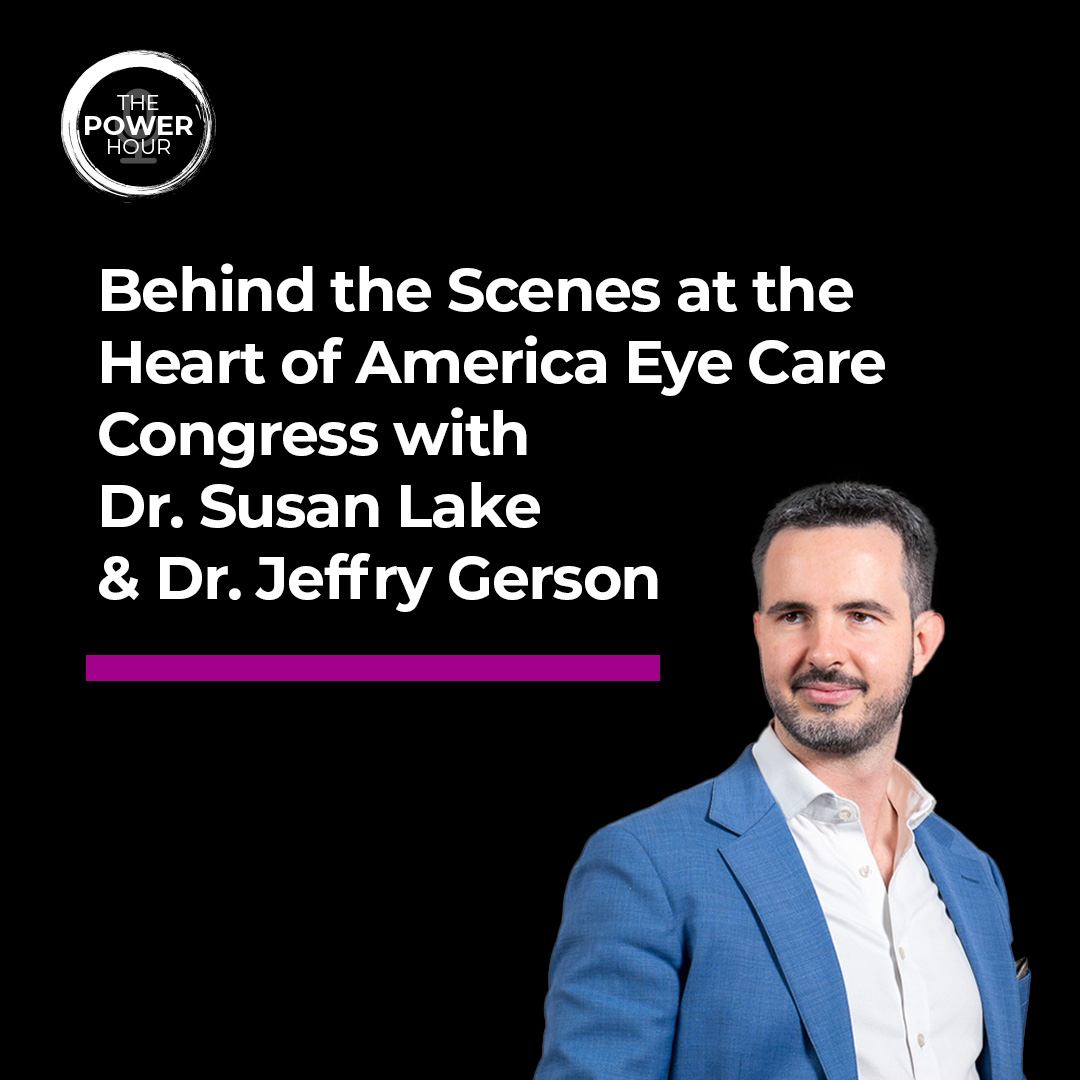
Power Hour Optometry
Behind the Scenes at the Heart of America Eye Care Congress with Dr. Suzy Lake & Dr. Jeff Gerson
00:36:43
What makes a conference more than just a meeting? For over six decades, the Heart of America Eye Care Congress has been one of optometry’s most enduring traditions — bringing together thousands of professionals, students, and industry...
Loading summary
Transcript135 lines
- [00:00]
Dr. Jeff Gerson
How do you run a practice? How do you grow your practice?
- [00:03]
Host / Interviewer
A lot of the things that resonate really well is strategies, ideas, tips, anything to do with increasing number of patients that walk in the door, increasing the number of dollars that those patients are spending, or increasing the frequency with which those patients come back. If you guys are going to put something like that together, I think that'll be awesome.
- [00:23]
Dr. Jeff Gerson
Yeah. So I think that's.
- [00:32]
Host / Interviewer
Welcome to the.
- [00:33]
Narrator / Podcast Host
Power Hour, optometry's biggest and longest running show. And today's episode is going to take us behind the scenes into another long running optometric tradition. It's a meeting in the Kansas City area and it's called the Heart of America Eye Care Congress. Now, I recorded this conversation back in February of 2025 with Dr. Susie Lake and Dr. Jeff Gerson. They're two of the doctors who help organize and lead the event. And if you've ever wondered what whether Hart is worth attending or what actually happens there, this episode should give you.
- [01:04]
Host / Interviewer
A lot of insight.
- [01:05]
Narrator / Podcast Host
So what we're going to cover during the show is also some elements that make the meeting unique. So they've got over a thousand attendees, over a hundred hours of ces. Then you'll hear a little bit more about how those CES are put together. They specifically balance sessions to include cutting edge topics, but then also a lot of clinical information, hand hands on workshops for paras, student doctor networking night, and something really cool that I got to witness firsthand, which was their massive poster session that kind of highlights the next generation of optometrists. You're also going to hear what organizers are planning for February of 2026. The meeting is on February 20th and 21st and 22nd of 2026. And so they're expanding content for office managers, but they're also including a diabetes symposium. I think there's some content on keratoconus and ocular pain. So a lot of clin. And of course, all in the same high engagement, super friendly Midwestern atmosphere that the meeting is really well known for. So if you're choosing where to spend your CE time and travel budget next year, hopefully this episode gives you a little bit of insight and helps you figure out whether Heart of America should be on your list. If you're new to the show, please make sure that you follow us on Apple podcasts, Spotify or YouTube. You can always write to me@eugene shotsman.com or on the Power Power Hour website. You can include things like your feedback for episodes, ideas for future episodes, just anytime you need help. Or if you want tools or practice growth insights, always available to help and.
- [02:37]
Host / Interviewer
Excited to do it.
- [02:38]
Narrator / Podcast Host
And now let's get into our conversation.
- [02:40]
Host / Interviewer
Welcome to the power hour. Dr. Jeffrey Gerson, Dr. Susie Lake. And we're here live at the Heart of America Eye Care Congress meeting. And for everybody who's listening, maybe some people don't know what this meeting's all about. So maybe you guys could describe it.
- [02:56]
Dr. Susie Lake
Yeah, absolutely. It's actually the 64th annual Heart of America Eye Care Congress. It is a premier education here in the middle of the country, in the heartland, which is where we get the name. We feature over 100 continuing education hours. We attract doctors and paraprofessionals from offices Midwest and across the country. And we just, you know, it's, it's Dr. Led and Dr. Run board that put on the education. So it's a very OD centric and focused.
- [03:31]
Host / Interviewer
All right, so we're going to get into that in just a moment. But just to give everybody a flavor, what I've seen from, I, I've gotten a chance to speak here and I've also gotten a chance to interact with some of the, some of the folks in other audiences. And really what I've seen is a super engaged group. So these people are really here. They're here to learn, they're here to network, they're here to view the exhibits. And you know, just again, for context, how many people are here? How many hours of education are happening? What's going on? Dr. Gershe?
- [04:03]
Dr. Jeff Gerson
Yeah, so great question. So we actually have over 1,000 people in attendance between the doctors and the paraprofessionals. We have over 100 hours of continuing education. And one of the things I think you hit on is the audience and the camaraderie that we have here, which is something I think that really kind of sets it apart from other meetings. It's not just the size, but it feels much smaller because of how much everybody connects with each other.
- [04:29]
Host / Interviewer
Got it. While it feels small, I think the topics are really big. So let's talk about how those topics. Before we even talk about the content, let's talk about how those topics were selected. And I want to go back to something else you said, Suzie, about the fact that this is a doctor led board. And explain that a little bit.
- [04:50]
Dr. Susie Lake
Correct. It's a volunteer board of optometrists. We have no staff that helped to run this conference. It's a group of 12 different doctors and their spouses who design everything from the spaces that we work in to the Education to the food that is served to.
- [05:09]
Dr. Jeff Gerson
I mean, really just every aspect of the meeting. Yeah.
- [05:13]
Host / Interviewer
Okay, but why is that relevant to the people attending the meeting? Why is that important?
- [05:16]
Dr. Susie Lake
Yeah, it's absolutely relevant because every single one of us has been either a private practice doctor or an employee in a, in an office. And we are very well aware of what everyday ODs need to fully function in their practices and to grow those practices.
- [05:32]
Host / Interviewer
Right. So when you're choosing the topics that are going to be presented for the continuing education, when you're deciding what the content is and what the meeting's going to be like, that's all designed with the private practice or the optometrist or the paraprofessional in mind.
- [05:50]
Dr. Jeff Gerson
Yeah, I think it's important because everyone that's part of the planning process is somebody that's a practicing or has been a practicing optometrist. And so we've been to not only this conference, but other conferences and talked with our staff to, to know what's really relevant and what people want.
- [06:07]
Host / Interviewer
Right. So what are the kinds of things you avoid at this meeting, specifically? I mean, there's a lot of really good things that you do, but what are the kinds of things that you avoid at this meeting?
- [06:16]
Dr. Jeff Gerson
That's kind of a loaded question. We avoid lousy education. I think that's really a big part of it is that we're really careful about who we invite to come and provide the education. And so we go to different meetings to seek out and vet the speakers that we get. So we can be very confident every year that the level of education will be really high. So I think that's one of the things that we really, really focus and avoid.
- [06:42]
Dr. Susie Lake
Totally agree. We want to be a cutting edge source of education for people from every subject from practice management. We had a wonderful talk about AI from Eugene Schatzman as well as we will dig into OCTS and amd and our para track is exceptional too.
- [07:01]
Host / Interviewer
Well, so let's actually zoom in because we're here kind of towards the tail end of the conference. And I think what we, what people want to know if they didn't attend is what did they miss? What are some of the things that, what are some of the big learnings and what are some of the big topics that are on people's minds? And really, what are some of the golden nuggets too?
- [07:20]
Dr. Susie Lake
I kind of want you to cover that because we are very lucky to have Dr. Jeff Gerson on the board and he's, you know, a very renowned Speaker?
- [07:27]
Narrator / Podcast Host
Yeah.
- [07:28]
Host / Interviewer
I mean, I think you've spoken in every state in the country, is that right?
- [07:31]
Dr. Jeff Gerson
I think I hit 50 this year. Yes, that's true. I did.
- [07:34]
Host / Interviewer
Incredible. It's. You've literally been on stage in 50 states. In all 50 states.
- [07:39]
Dr. Jeff Gerson
Yeah, yeah, yeah. No, but you know what I, what I've always said as a speaker is that Heart of America has always been my favorite conference to be able to come to as a speaker. So for me, it's kind of an interesting place where I get to experience it previously as a speaker, as an attendee, and now as part of the board to kind of see it from all the different perspectives. And so I think one of the unique things about the content here is it's very practical and that I think that if you look at the speakers that we choose and the topics that they talk on, one of the things that I would say is it's something that people can go to their practices on Monday and do something differently because of what they heard here. So I think that's one of the important takeaways or for people to know about our Congress is that it's really practical and it's something that can change the way you practice. Susie was mentioning some of the different topic areas, and again, if you look at the courses that we're offering, it's a really wide range of topics. So whatever somebody is into or what they want to learn about, you know, I found it interesting. Your talk on AI was an interesting panel from really four different perspectives on what AI is, how it's affecting us today and how it could be affecting us tomorrow. And I think that's a really important topic because it's one that two or three years ago, I think most of us would have just preferred to stick our head in the sand and pretend like it's not here or coming. And really what your course showed is it's here and it's going to be even more. And I think that's an incredibly practical takeaway.
- [09:06]
Host / Interviewer
And that one was really fun to do because I obviously have a technology based and marketing based perspective on AI. But being on that panel was really fun because I think the speakers brought a wide variety of perspectives. And, you know, somebody talked about the clinical side, you know, what are they doing from a very specific clinical approach on the, on the AI side and what are they using in clinic right now and what are they hoping to use in clinic this year? And then, you know, I talked a lot about, you know, what are the different tools, shortcuts, things that you can use in your practice to either drive revenue or cut costs with AI. And then one of the other speakers talked about this really interesting futuristic view which I think have no doubt we're going to hit, but where is AI going to be in two years? And really what is the transformative nature of it, which I think the crowd really jazzed and energized to be like, okay, I got to do something today because I don't want to be in that reality and I've done nothing today to prepare for it. So I thought that was a really, really interesting take.
- [10:10]
Dr. Susie Lake
And I think in addition to those forward thinking classes that we have, we also offer a really good amount of niche classes in pediatrics and specialty contact lenses that sometimes people have a harder time finding person classes to be able to attend.
- [10:25]
Host / Interviewer
So what are some of the examples of learnings that people had in both those classes and maybe some of the other ones?
- [10:31]
Dr. Jeff Gerson
So, you know, one example that it may be not quite as much of learning, but I was speaking when talking with one of the speakers before the class who was doing a talk on thyroid disease, and what he was saying is normally a lot of people say, well, I guess I'll go to that and I'll get emails done or I'll do something else. But that it's his favorite course to be able to give because he sees people writing down names of patients because of something they learned. So I know, I understand that's not a specific takeaway, but just to what Susie was saying, classes on topics that you may not think are interesting, but you really walk away with something to do. So, you know, one of the classes was talking about macular degeneration and really talking about what are the treatments that are available today to our patients, even if it's not you doing it, where can you send people to have something done and what's going to get done for them? Which I think is something that's really, really an important topic. We had some course or we had a speaker here talking a lot about aesthetics. And I think that that's a really important takeaway, that aesthetics is another thing that a couple years ago I think most people would have said, well, that's, I'm an optometrist. That doesn't really affect me or my business. And what we're seeing and learning here this weekend about is how much it is an optometric opportunity and how much it is a business opportunity.
- [11:48]
Host / Interviewer
Yeah, and I heard a lot about, I heard a lot of feedback about that particular class because I think the the premise, which I thought was an interesting take home moneymaker, is that we're already all in the esthetics business. Right. You think about whether we're selling contact lenses or glasses in addition to being a medical device that's also a fashion accessory or something designed to help the patient look better. So we're already there. We just have to learn to take that to the next level and have comfortable conversations with patients about it.
- [12:20]
Dr. Susie Lake
Agree. And I think the other thing in that track, and we have a few of them, where we have a lot of interaction between doctors and the paraprofessionals working together within a class. And I think that's fantastic because we all know that we can take anything back to our practices, but if we do not have buy in from our staff and an understanding of what they could do in practice on Monday as well, it doesn't go as quickly.
- [12:40]
Host / Interviewer
Yeah. I found that classes for the paraprofessionals to be super, super engaging. I think that the speakers that you selected for them super, super engaging because, you know, and they're really. It kind of seems like the people who are here are here to learn and the speakers who are here are really excited about being here. They're, they're really bought in.
- [13:03]
Dr. Susie Lake
Well, we have so many states this year that are going for scope expansion and we offered a surgical assisting for the per optometric at this, at this course with an on site laser. So it was a really fun class.
- [13:15]
Host / Interviewer
Yeah. Talk more about that.
- [13:19]
Dr. Jeff Gerson
Well, I think it's just again, looking at the landscape of optometry and I think going back a half a step is to say, I think that the paraprofessional courses that we offer are not an afterthought. It's not. Well, this is a doctor's conference and okay, we'll have a couple courses for the, for, for the Paris. It's really on the forefront. That's really a part of the planning process. And so when planning for this meeting, to have the course that Susie just mentioned was really something we thought was important because when looking at the landscape and seeing what offices in our member states will likely be doing in the relatively near future, it's important that it's not just the doctors that know what they're doing, but it's the staff as well. And so I went and observed and part of that class, and it was a hands on class and quite frankly, it was a hands on class at a level that many of the doctors here would be able to appreciate and take something away from. So it was really?
- [14:13]
Dr. Susie Lake
They were in full scrubs.
- [14:14]
Dr. Jeff Gerson
Yeah.
- [14:15]
Dr. Susie Lake
Hat scrubs, everything.
- [14:16]
Host / Interviewer
Yeah, yeah, that's cool. So I. And that's a good example of something that's really on the forefront of optometry. So many states going for scope expansion. So you put together that program. What else is kind of forefront or really kind of bleeding edge type of stuff that you covered. And again, let's give the audience some take homes as well.
- [14:37]
Dr. Jeff Gerson
I don't know if you would say this is leading edge forefront, but something that we've continued to do for the paras are workshops. And where that might seem pretty old school. And why would you do that? I think we would all agree that a lot of our staff is somewhat transient.
- [14:51]
Host / Interviewer
Right.
- [14:51]
Dr. Jeff Gerson
And we're getting new people into our offices that haven't been a part of the business. And so even though it sounds like something they would be. Well, why do you continue to do that? It's because it's something that for a lot of reasons, practically speaking and financially speaking are so important for offices that a new optician knows how to adjust glasses appropriately.
- [15:10]
Dr. Susie Lake
So at an advanced class and an advanced class. So if you come one year and go to the basic class, you could return the next year to do the advanced dispensing class.
- [15:19]
Host / Interviewer
And what, what I heard is that some of the doctors who are here are sending some members of their staff as a reward or as a, you know, kind of an earned benefit to get the additional training, but then also to attend a conference and to learn in both the doctor and the para tracks.
- [15:35]
Dr. Jeff Gerson
Yeah, I think that's an important thing you point up as a, as a reward to staff. So when we start talking about staff retention and what are things we can do, that's one of the things that we can offer. And so we think this is a great opportunity for staff to come and learn and quite frankly have, have a good time. The exhibit hall has over 80 booths in it. And so there's something there literally for everybody. There's camaraderie, events. Last night, part of it was a beer tasting. So different local beers that people were going around the exhibit hall and tasting different beers and interacting and it's just, it's kind of a unique opportunity to both learn and have fun.
- [16:12]
Dr. Susie Lake
And I think you should talk about our poster session because we do have an incredible.
- [16:16]
Host / Interviewer
That was super cool.
- [16:17]
Dr. Jeff Gerson
Yeah, yeah, it was amazing. I was totally blown away. It was the first time that I'd really walked through it at all. And you know, I've been lucky enough to go to most of the major meetings and where it's, you know, very scientific meetings where they have lots of posters. I've never seen anything that compared to what I saw last night. And it wasn't just the number of posters that there was 80 some posters that were there. It was the quality and it was how engaged people were. And so a lot of times at meetings, it's just students that kind of wander around and because they feel as though they have to. But there were so many attendees in there interacting, asking questions. It was amazing.
- [16:56]
Host / Interviewer
Yeah. And I think the poster session was really kind of a great way to bridge because I have met a number of students at this meeting as well. It's an interesting way to bridge kind of the current trends in optometry with what's going to be the future of optometry as well.
- [17:11]
Dr. Susie Lake
Yes. And Eric, he's in charge of our. Eric Polk. Dr. Eric Polk, he's in charge of our poster session. And you know, he was mentioning when we were talking about it today how prideful he is that we actually, you know, we select winners of our poster session and we fly them here, we pay for them to come and be able to, to, you know, talk about their posters. And we want that to continue to grow our support of, of young doctors and, you know, the educational aspects of our profession.
- [17:36]
Host / Interviewer
Yeah, and I thought that was, that was neat. So do you. I mean, are there a couple that you want to mention in terms of posters? That one or really, are there any major trends in terms of research or what students are really interested in that you identified during the poster session?
- [17:52]
Dr. Jeff Gerson
You know, I think so. When I was at registration and talking to students in residence, as I checked in, I was asking, what's your poster on? And tell me something about. And I was trying to almost not really harass them, but ask them a few questions. And one trend that I saw was amongst the students and residents we had that did the posters, they're really smart and man, they were on it and they really knew their stuff. And that's not a one specific poster, but that was something that was really proud and happy to see that. You know, sometimes you hear about optometry and, you know, board scores and who are the graduates, but it was a glimpse into maybe the cream of the crop of the graduates that are here at our meeting and presenting something.
- [18:37]
Host / Interviewer
Yeah, I thought it was really interesting to see how passionate the students were about their work, but also it's interesting to see how the students were interested in the. In the various, both practice management and clinical tracks. That you had going on.
- [18:55]
Dr. Susie Lake
Definitely. And we do have 25 students from that are actively in optometry school right now that come and help us run the meeting as well. So, you know, we're looking to the future, too, to let them know how important it is to stay involved in state organizations, local organizations, and then regional meetings, too, that, you know, we want to keep this live education alive and continuing far into the future.
- [19:17]
Host / Interviewer
Yeah. And I mean, it attracts a really. I think it's a well organized, large crowd of doctors who are all here and doctors and paraprofessionals and students who are all here to do a couple things. Number one is learn. Number two is to network. But the learning doesn't just happen in the classroom. It also happens in the exhibit hall, too. So talk a little bit more about how that's organized, because I noticed the vendors doing some interesting things as well.
- [19:45]
Dr. Jeff Gerson
Yeah. So one thing I would say is we have two people on the board that are in charge of the exhibit hall. And so a lot of time and energy is really put into really everything about the exhibit hall and how it runs and what people are doing. And I think over the years, one of the things that exhibitors have seen is if you just come and sit in your booth and hope that people come by, people will come by, but if you do something a little bit different, that more people are going to come by and it's more interactive. So I think we have a lot of great vendor partners that are here and doing fun things in their booth.
- [20:18]
Dr. Susie Lake
Popping popcorn.
- [20:19]
Dr. Jeff Gerson
Popping popcorn. Yeah. Just lots of great stuff that goes on. Yeah.
- [20:25]
Host / Interviewer
I felt that the interaction is a little bit more intimate and a little bit less, you know, salesy as you're walking through the exhibit hall. And it's. It's a little bit like, you know, everybody's kind of friends and they know each other. And even though you are not just for the Midwest. Right. You guys have. How many states here represent.
- [20:45]
Dr. Jeff Gerson
I believe we're at. We ended up at 41. 41 states represented, international speakers that are here. And so it really is. It's for sure, a national meeting. And with the international speakers, I guess you could almost say we're a global meeting.
- [20:57]
Host / Interviewer
Yeah. Well, so this is important because I think that. But the meeting is always in Kansas City, right?
- [21:02]
Dr. Jeff Gerson
Yeah, it's always in Kansas City. It's always right around Valentine's Day. Heart of America. So kind of two meetings. We're in the heart of America. In the heart for Valentine's Day.
- [21:12]
Host / Interviewer
Yeah. And this year, one of the things I'm super impressed with is that, you know, we're talking on Super Bowl Sunday and this year you are.
- [21:23]
Dr. Susie Lake
And last year and the year before.
- [21:25]
Host / Interviewer
Seriously, you guys compete with the Super Bowl?
- [21:27]
Dr. Susie Lake
This is our third year. Yeah.
- [21:28]
Host / Interviewer
Third year competing with the super bowl and you get a thousand people to show up.
- [21:31]
Dr. Susie Lake
Absolutely.
- [21:31]
Dr. Jeff Gerson
Pretty impressive, huh?
- [21:32]
Host / Interviewer
That is pretty impressive. So it must mean that the people who are here really enjoy their experience and really get a lot out of it.
- [21:40]
Dr. Susie Lake
Yeah.
- [21:41]
Host / Interviewer
So trends that. Let's go back kind of global trends as you think about, because obviously anybody who's listening to this either attended this meeting or didn't in 2025, but is probably thinking about, okay, do I, is this something that I consider in 2026? So what are some trends that you. I mean, right now it's probably is the case that the year that your planning season starts for next year to some extent. So what are some trends that you identified or what are some trends that you really think that you will focus on next year as you start thinking about what next year looks like?
- [22:17]
Dr. Susie Lake
Well, I'm going to let Jeff talk about the education, but one of the things that we recognized starting last year was that doctors were telling us they were really struggling to find associates and doctors to hire for their practices. That's a major issue. Right. So we decided to include. On Saturday night we had a reception for everyone to come with drinks and food and a live band. But we added into that a student doctor meet and greet. So if you are either looking for a doctor for your practice or you're someone who's looking for a new job, we have a, a reception where people can come and, and meet each other and set up perhaps future job opportunities.
- [22:54]
Host / Interviewer
Got it. So how does that work? Just explain that a little bit more.
- [22:58]
Dr. Susie Lake
So ahead of time, we ask anyone, you know, we send out a lot of information to social media, but as well as on our ask for doctors that are currently seeking employees and or, you know, people who are seeking positions to get a hold of us or to their state liaisons, their executive directors of their optometric associations, and we get gather some information about those practices that are seeking doctors. And then when they come, we just literally put them all together in a reception area. We separate it by the states. We have five states that participate in the Heart of America and we have 40 that attend. But we have five states that generally.
- [23:37]
Host / Interviewer
Participate in the recruiting.
- [23:39]
Dr. Susie Lake
Correct. So those states in particular will have a table in our reception and students go in there and it's packed with people just Looking for jobs and or associates.
- [23:48]
Host / Interviewer
So it's almost a mini job fair, but a very practical one because you're not necessarily going through recruiters or anything and you're getting to meet face to.
- [23:56]
Dr. Susie Lake
Face and in a real light, fun setting as well. Right. Like you're, you know, you're relaxed and you're just having good conversation versus a stiff job interview or an online ad.
- [24:05]
Host / Interviewer
Yeah, that's cool. That's super cool.
- [24:08]
Dr. Jeff Gerson
Yeah, no, it has been a really successful event. You were talking about planning for next year and you know, one of the things that we noticed, I mentioned this earlier, as far as sending staff and who comes, we want to make sure that we're meeting the needs not just of newer staff or people that haven't come, but maybe people that have been in office for a long time that take on different roles. So I would say historically we may not have had as many of the office managers come, but I think next year we'll probably have some interesting tracks, whether it's marketing and practice growth that will attract a whole different set of paraprofessionals that the doctors will likely attend as well. That are really practical as far as how do you grow your practice? A lot of times that's kind of an off limits topic because a lot of times states limit how much practice management you can get. But the reality is without it, how do you run a practice? How do you grow your practice? So we think it's important enough that that will likely be part of our program next year.
- [25:04]
Host / Interviewer
Yeah, and I, I agree with you 100% because I think that, and I'm sure the listeners will agree with you because what we hear in terms of feedback to the shows that we publish and I ask for feedback during, after every single show. But a lot of the things that resonate really well is strategies, ideas, tips, anything to do with increasing number of patients that walk in the door, increasing the number of dollars that those patients are spending or increasing the frequency with which those patients come back. And quite frankly there's, while there's a lot of they call like, you know, advice in the ethos fear about little, you know, little general things that you can do here and there, it's not really all that well organized into practical day to day money maker tracks. And so if you guys are going to put something like that together, I think that'll be awesome.
- [26:00]
Dr. Jeff Gerson
Yeah, so I think that's something that's kind of a different spin on how we're doing, you know. And I think as always an emphasis will be Put on the quality of education and to have a varied offering so that we know that there's something for everybody, including panels. Because I think a lot of times people agree that it's more interesting, it's more fun, it's more engaging to have a panel of speakers instead of just listening to any one person, but to do something more interactive. So I feel confident we'll see more of that as well.
- [26:35]
Host / Interviewer
Totally. I think, I think panels are a fun way to get people to engage. And it's also true that, you know, you've seen this, I'm sure, as you've, like, turned around, is that, you know, people. People come in the room and they hear the speaker talk for a little bit, and then they, you know, 10 minutes in, they're like, well, you know what? This isn't really resonating with me. And then they either disengage, whip out their laptop, or they, you know, or they walk out of the room. What's great with the panel is that you can get. See more people engaged because they know that, and even if they're not resonating with the current speaker, then, you know, 10, 20 minutes later, there's going to be somebody else with a different perspective. And I think it gets the audience really excited. So in terms of, you know, again, going, going to future meetings, what are the things. Let's. Let's summarize. What are the things that you're going to keep and do more of, and then what are the things you're going to try to avoid?
- [27:31]
Dr. Susie Lake
Well, I think Jeff talked earlier. You know, we really don't want people to ever leave a class and go, that was a wasted hour. You know, we really put a lot of conscious thought in making sure that the education that we offer to people, like he said, is applicable immediately upon them, you know, entering their practice the next week. So we don't want to just put a class in as a filler class. We want classes that are interesting and engaging for people. So, I mean, I think we'll definitely continue along that track.
- [27:57]
Dr. Jeff Gerson
Yeah, for sure.
- [27:58]
Host / Interviewer
Yeah.
- [27:59]
Dr. Jeff Gerson
I think that's, that's really the main point of what we'll continue to do, what we'll avoid. I think we'll. We'll likely continue to have a fun and engaging exhibit hall that has something for everybody. You know, we, we recognize that for some of our attendees, that this may be the only big meeting that they're going to, so it's really important that we offer some of everything. And so where we may not be incredibly deep in any one area, any one thing. I think there's some of everything for everybody.
- [28:29]
Narrator / Podcast Host
Yeah.
- [28:29]
Dr. Susie Lake
Emily, we were saying this is the 64th part of America Congress. That's a, that's a very long running start, Susie.
- [28:36]
Host / Interviewer
This is now, you know, like, I.
- [28:37]
Dr. Susie Lake
Think that's a great question. I don't know that I have the, the full answer for how we began, but I will tell you. In college, I went to, to the University of Nebraska at Lincoln and I worked for an optometrist and he would bring us every year to this conference.
- [28:49]
Dr. Jeff Gerson
That wasn't quite 64 years ago, though.
- [28:51]
Dr. Susie Lake
Almost just shy of 64 years. Yeah, that was one of the first years. But it was such a full circle moment to, to be come on this board because I vividly remember walking into that, that front door of this hotel. There used to be a phone bank of payphones. And I went over and called my parents collect and said, this is the fanciest hotel I've ever been in in my life.
- [29:15]
Dr. Jeff Gerson
That's great.
- [29:16]
Dr. Susie Lake
But it, you know, it, it really, it's. You were talking about the camaraderie in the exhibit hall. What I will tell you is it, it is the Midwest. It's Midwest. Nice. You come here and, you know, you'll see people sitting all around this hotel and chatting with people and connecting, you know, with people they haven't seen since the last year that they were here. It just has such an incredibly good feeling for this conference.
- [29:36]
Host / Interviewer
Yep. And I found, you know, so in, in speaking to the audiences as a presenter, I found the audiences to be incredibly engaged. I found that people are really here, they're not here to check a box. But, you know, there are so many CE options. You probably wouldn't travel to check a box. You would probably travel to get something out of it. And you would travel on super bowl weekend if you're really getting something out of it.
- [29:59]
Dr. Jeff Gerson
Yeah, it's true. But you know, the other thing that speaks to that is there are doctors that have been coming to this for literally over 40 years. And so we have a lot of attendees that have come 10, 20, 30, literally 40 times. And so it really is, it's something that once, once you come and it's almost like you're sucked in, that once you come and experience it, people keep coming back year after year after year. Which it also plays to your question about what are we going to do differently or the same. You won't see that. You know, when doctors come, they won't see the same speakers on the schedule. This year as last year. And so it's not the same program every year. It is completely different every year in really every, every respect.
- [30:41]
Host / Interviewer
Yeah. So what's interesting is that, you know, there are, as you were talking about, there are other options for, for practices. So now talking to the general audience who has not been to this conference, you know what, compare it to some of the major meetings that they may have attended, whether it's at their state association or maybe whether it's at the, at a national meeting like Vision Expo or something like that. And I don't necessarily, I think that there are some things that you do that are truly different, but the energy kind of feels a little bit different. It feels, while there's a thousand people around, it also feels super intimate.
- [31:17]
Dr. Jeff Gerson
Yeah. So I, I would say I, I don't know if I would call this conference the biggest small meeting or the smallest big meeting, but either way it's something right in between.
- [31:28]
Host / Interviewer
Yeah.
- [31:29]
Dr. Jeff Gerson
And so we have the advantage of being able to have multiple speaker tracks, huge exhibit hall, but small enough, as you mentioned, to feel intimate, to just hide in a corner and talk to talk to someone you saw last year, the year before. And so I think that's something that's a unique draw that we have all the benefits of the biggest of conferences and we have some of the unique benefits of the smallest of conferences. And that allows us to do, do things in a unique fashion.
- [31:57]
Host / Interviewer
Yeah, that makes perfect sense. And you've got this whole concept of, okay, we're going to take the students, we're going to take the, we're going to take the paraprofessionals, we're going to take the practice owners, we're going to take the people who work in a practice and we're going to try to make something work for everybody so that everybody feels like they got something out of it. The recruiting thing is pretty neat and is not something that I see at a lot of other meetings. And you know, again, I think one of the, one of the key parts of this is that I think you mentioned this, Susie. Is this how Midwest nice everybody is? So nobody feels like they're head down? You know, like everybody just wants to talk to everybody else.
- [32:37]
Dr. Susie Lake
Yeah. And I think that the heart of America at its core is dedicated to preserving the future of the profession of optometry. You know, we are dedicated to making sure that, that, you know, legislatively we're protected, educationally we're protected. And you know, we just really want to push that concept.
- [32:57]
Host / Interviewer
Yeah. So next year is it going to be on super bowl weekend again, of.
- [33:03]
Dr. Susie Lake
Course it will be.
- [33:03]
Dr. Jeff Gerson
Yeah, yeah, of course. Yeah. I mean, I mean, the Chiefs will be in, right.
- [33:07]
Dr. Susie Lake
But I actually don't know if it is actually super bowl weekend.
- [33:10]
Dr. Jeff Gerson
It might be the weekend.
- [33:10]
Dr. Susie Lake
It might be after. Yeah, but if it is super bowl weekend, of course.
- [33:14]
Host / Interviewer
Right.
- [33:14]
Dr. Susie Lake
The Chiefs will be in.
- [33:15]
Host / Interviewer
Right. So this is why the Chiefs in the super bowl is because the, the real thing is.
- [33:21]
Dr. Jeff Gerson
So we, as Susie mentioned, we have a band playing tonight at our, at our reception, and we had to go to second choice, who our entertainer was going to be, because Taylor's going to be at the super bowl, so she couldn't be with us here tonight.
- [33:32]
Host / Interviewer
I see. And I understand that is, yeah, but, but I, I, I can understand, you know, entertainment options and, but it's, it makes perfect sense.
- [33:42]
Dr. Jeff Gerson
Yeah, of course.
- [33:43]
Host / Interviewer
So again, if we're thinking about if somebody is trying to decide, do I attend Heart of America or not, especially if I'm on the coast and I'm not in the Midwest, what are the three questions I should probably ask myself to decide whether or not this is the right meeting for me?
- [34:05]
Dr. Jeff Gerson
I think at least two of them are, do I want to get really good education? Do I want to be able to meet some other really friendly colleagues from different parts of the country? And I think another one is, do I want to really be able to have an incredible, even almost academic experience because of the posters, which sounds like, again, it should be, or could be an afterthought. But it's such an amazing part of this meeting and what it brings to the meeting that's unique that there aren't many other places where you can get that level.
- [34:39]
Dr. Susie Lake
Yeah. And that much variety.
- [34:40]
Dr. Jeff Gerson
That much variety.
- [34:41]
Dr. Susie Lake
I totally agree. Yeah. And, you know, Kansas City in February is not exactly a, you know, weather mecca, but Kansas City is a great city. You could bring your family here. There's plenty of things that you could do. So it doesn't have to be something that you come to solo. You could bring your family.
- [34:56]
Host / Interviewer
The barbecue is amazing.
- [34:57]
Dr. Susie Lake
Fantastic.
- [34:58]
Dr. Jeff Gerson
Great restaurants. And, you know, Union Station right across the way, where a lot of, there's a lot of great stuff to see. There's a lot to your point, there's a lot of people that did bring their families and little kids, and it's, it, I think it's an underrated spot, for sure.
- [35:12]
Host / Interviewer
Well, so I think for the, for the audience, how do they learn more and if they're interested in exploring what next year looks like, how, how does the audience learn more about this meeting and all the things that you'll be doing at it. What's your announcement schedule?
- [35:29]
Dr. Jeff Gerson
Yeah, so I guess what I would say is, you know, you can go to our website and so you can just Google Heart of America Eye Care Conference next year. Schedule is not up yet. We're in the process of asking our speakers for next year right now. We've already have several confirmed and asking others. But I think within the next month or two that we'll have at least some tentative schedules and people will be able to see that. But if nothing else, you'll be able to see what we have done. And I think that what has been happening over the past few years is also a reflection of what we will be doing moving forward.
- [36:05]
Host / Interviewer
That's great. Well, Dr. Susie Lake, Dr. Jeff Gerson, thank you for joining me on the Power Hour. Thank you for sharing with our audience a little bit more detail about this. Really interesting and I think a little bit of a hidden gem of, as you kind of called it, the smallest big meeting or the biggest small meeting, whatever, however we classify it, I think it's a really important meeting, and that's why I really wanted to cover it. So thank you both for joining me and thank you both for educating the audience.
- [36:31]
Dr. Susie Lake
It was a pleasure to be here.
- [36:32]
Host / Interviewer
Yeah.
- [36:33]
Dr. Jeff Gerson
Thanks for having us.