← Power Hour Optometry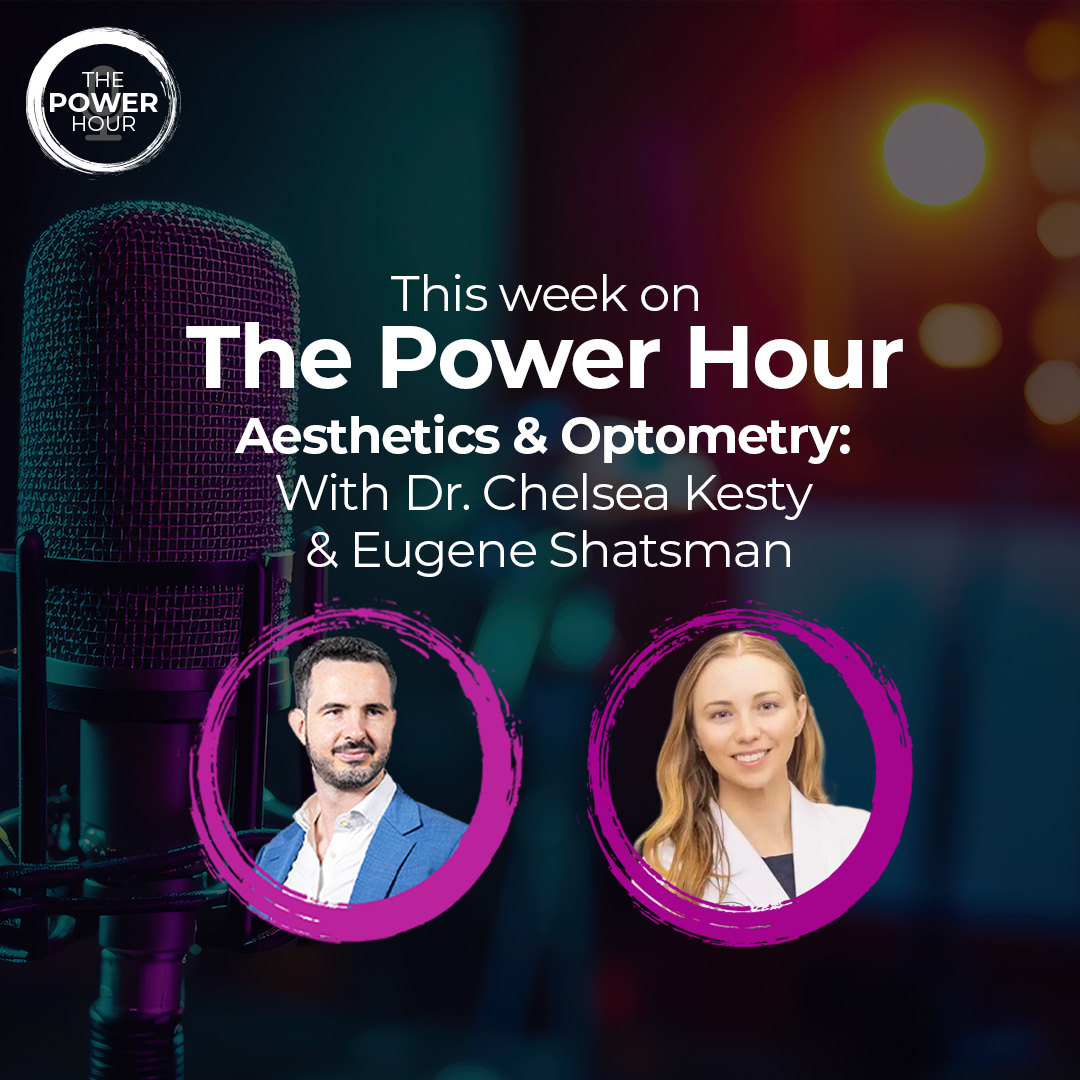
Power Hour Optometry
Bringing Aesthetics into Optometry: Dr. Chelsea Kesty on Lasers, Toxins & the $10K Patient Opportunity
00:53:08
Is optometry the next frontier for aesthetic medicine? In this insightful episode of Power Hour, host Eugene Shatsman welcomes double board-certified dermatologist Dr. Chelsea Kesty to explore a booming opportunity: aesthetic procedures in and around...
Loading summary
Transcript91 lines
- [00:00]
Dr. Chelsea Kesty
Foreign.
- [00:07]
Eugene Shotsman
Hello, everyone. Welcome to the Power Hour, Optometry's biggest and longest running show, celebrating our 13th season. I'm your host, Eugene Shotsman. And today's episode is a deep dive into an increasingly relevant and highly misunderstood adjacency, aesthetics. So I'm getting one perspective out of it today because I'm joined by Dr. Chelsea Kesty, who, who is a double board certified dermatologist who also happens to be the daughter of two ophthalmologists. So she's got the bloodline, she's got the training, and also the receipts. Her practice performs hundreds of advanced procedures every single year in the aesthetics field with a focus in and around the eyes. So this is why I think this episode matters for us. Whether we realize it or not, we're already in the aesthetics business. Your optical products are fashionable. Your patients, they care about how they look. And in this episode, we explore how optometrists can possibly and responsibly and profitably offer aesthetic services. And think about ipl. We talk about toxin, we talk about laser treatments, because there is a growing patient demand. And we talk about the science behind common procedures as well. Now, if you already know what the lasers do, Skip the first 15 to 20 minutes, because I spend a lot of time trying to go deep on that. So that, quite frankly, if you're just thinking about all these different procedures and you want a little bit of insight from a dermatologist as to how this stuff actually works, it was a really great tutorial. But if you're already familiar, Skip the first 15 minutes. Then we go straight to the economics of aesthetic patients, by the way, not small. Then we talk about the critical mindset shift that's necessary to compete with what we'll call the commodity injectors of the world. And we even get into Chelsea's laser blepharoplasty technique, which is something that she's helped pioneer and she's certainly published out in the past. So if you've ever wondered whether offering aesthetics could be a part of your growth strategy, or if you're just kind of curious about what those lasers do, this one is definitely worth your time. And I'm also going to offer that if this is a topic that's interesting for the audience, I can create a panel of optometrists who, who've actually implemented aesthetics in their practice and have adjacent practices that are thriving, that are aesthetic specific. And I can bring that panel onto the show. So before we dive in, make sure you're subscribed on Spotify, YouTube, Apple, Podcast or wherever you get your shows. And as always, I love hearing from you. If you want to see that panel come to life, just go to Eugene Shotsman.com or the power Hour website. Drop me a note with your face, with your feedback, with your ideas and anything else you'd like to learn. Again, that's Eugene Shotsman.com and now let's jump into today's episode with Dr. Chelsea Keste. All right, Dr. Chelsea Kesty, welcome to the Power Hour.
- [02:54]
Dr. Chelsea Kesty
Thank you so much. I'm so happy to be here.
- [02:57]
Eugene Shotsman
All right, so I think that it makes sense to start with a little bit of background because while we're certainly here to explore the adjacency aesthetic procedures and aesthetics in general has to offer to the optometric patient, I think it might make sense to start with your background because yours is relatively unique. You're a dermatologist, but you have a hand or I guess maybe a background in some cases in vision. So talk a little bit about that.
- [03:30]
Dr. Chelsea Kesty
Yes. So I am a double board certified dermatologist in general dermatology and in Mohs micrographic surgery. Surgery. However, as you were alluding to, both my parents are ophthalmologists. My father is an oculoplastic surgeon. My mother has a fellowship in cornea transplants. And so I kind of have merged the two board certifications basically, or part of my family with a special focus in and around the eyes. Although, you know, my background is in dermatology for sure.
- [04:01]
Eugene Shotsman
So talk a little bit about the dermatology practice that you have. Just again, from, from a context standpoint, how many patients do you tend to see? What are patients coming to you for? Just give me a overall viewpoint of your dermatology practice.
- [04:16]
Dr. Chelsea Kesty
Yes. So I am based in St. Petersburg, Florida. I practice with my sister, Dr. Kat Kesty. She's also a board certified dermatologist and we specialize in laser medicine. Specifically. We see about 15 to 35 patients a day, usually a variety of lasers, neurotoxins, dermal fillers, things like that on our cosmetic side.
- [04:42]
Eugene Shotsman
And when, when you're talking about patients who are coming to you because you said you practice with lasers and we're going to get into that momentarily. But are patients coming to you for traditional esthetic procedures like filler and Botox and those kinds of things?
- [04:59]
Dr. Chelsea Kesty
Correct? Yes, we see a variety. We basically, you know, what happens is that they come in for a consult, we kind of talk about overall assessment. And usually they're coming to me saying, you know, I'm noticing, I'M aging. You know, when I look in the mirror, I look like my mom or dad. And then we kind of do a general assessment as far as kind of what's going to be best, the best procedure, but also the best kind of going forward for that patient. And that can be a combination of dermal fillers, neurotoxins, and laser medicine, for sure.
- [05:30]
Eugene Shotsman
Got it. Okay. And when you're doing this assessment, ballpark, how many patients are you doing this assessment for? On a. Just to give the audience a little bit of scale. Over the course of the last year, for example, how many patients have you done these assessments on?
- [05:47]
Dr. Chelsea Kesty
Yeah, probably over, you know, 600.
- [05:51]
Eugene Shotsman
Got it. And I think it's really important for the audience to realize that that gives you an interesting perspective into the goals of these patients. And, you know, we as optometrists, when we. When we see a patient in our. They have visual goals, but at the end of the day, we're also selling much more than the ability to see clearly. We're also selling an aesthetic function. Right. Somebody has glasses on their face for a wide for 18 hours a day, you have an aesthetic function to that product. And so if you think about that aesthetic function, that's another patient goal. And the. And Chelsea is seeing patients with that same goal, which is the aesthetic function. Which is why I thought this would be an interesting crossover episode into an adjacency that I see some practices start to dabble in, develop in, and that kind of thing. So let's go a little bit deeper. So what are the. Let's talk about the procedures that. The aesthetic procedures. I'm not talking about functional, but the aesthetic procedures.
- [06:57]
Dr. Chelsea Kesty
The.
- [06:58]
Eugene Shotsman
That you tend to do as a dermatologist or that you tend to do a lot of in your practice. And we're gonna zoom in a little bit. So when you say lasers, like, zoom in and explain what the lasers are, and talk to me like, I don't know anything about them.
- [07:11]
Dr. Chelsea Kesty
Yeah, of course. So there's different categories as far as kind of what a patient's concerns are. But again, the most common thing is that people are coming in saying, I've noticed when I look in the mirror that I'm aging, and that can be different for different people. But most commonly, it's fine lines, deeper wrinkles in and around the mouth, in and around the eyes. Some of that hooding can happen. You know, the glabellar lines become prominent. As we age, we have lost kind of the fat pads that kind of protrude out through the Cheeks and jaw. So all of those are definitely concerns. And so the most common procedure that I'm doing is something called a fully ablative laser. And that can be done all across the face. And then of course, with my focus in and around the eyes, we're going up to the, the lash line on both sides. But basically that's the one procedure that's going to give a patient five to 10 years off their skin age and what they look in the mirror as far as their cosmetic concerns.
- [08:08]
Eugene Shotsman
So what does that laser do? Like explain the science behind it for sure.
- [08:13]
Dr. Chelsea Kesty
So it's usually a CO2 or an erbium based laser. So those wavelengths are 10,600 nanometers and then 2940, that's the erbium. And basically what it's doing is actually evaporating the tissue. So so we take it layer by layer as far as the skin is actually coming off and becoming smoke or plume. So that's how it actually creates the damage and the heat damage to the skin so that you create native collagen. And that's why it works so well especially. And I think we're going to go into this, but basically people are looking not for kind of that overdone look, but really that natural kind of native. And that's where lasers really excel.
- [08:58]
Eugene Shotsman
Okay, so once you essentially vaporize the skin at the top layer of someone's face, then what does the body do?
- [09:08]
Dr. Chelsea Kesty
So in response to that damage, what happens is it creates a cascade of inflammation and basically your body has to repair. It's almost like a wound, but it's a very deliberate wound. So we're using advanced technology. So I know exactly how many micrometers I'm taking off of the skin. But it creates a controlled wound that your body has to then repair. And that repair cascade is why you make that nice native new collagen. So without any sun damage, without any of the age that has happened. So it's not, you know, if Your age is 55, it's not 55 year old collagen. It is brand new, you know, zero years old.
- [09:51]
Eugene Shotsman
Right. And that doesn't naturally happen with skin overall. Right?
- [09:57]
Dr. Chelsea Kesty
Correct. Yes, there is some native kind of collagen turnover, but not to the degree that we're talking about with lasers.
- [10:04]
Eugene Shotsman
Got it. Okay, so that's what a laser does. And in what we'll get into that. Okay, so what else do you do?
- [10:13]
Dr. Chelsea Kesty
So other than that, you know, some people are just coming in for, oh, I don't like these freckles or Brown spots. And then we're using something like a broadband light or fraxel, which is another wavelength that basically can kind of use heat damage in and around that area to just target the melanin. So there's different targets of what lasers and each wavelength. So it depends on which laser you're using, what the target is. So we can switch technologies to then target something like melanin or the brown in that area.
- [10:46]
Eugene Shotsman
Okay, so I know that many providers are familiar with IPL for dry eye. So talk about that and also talk about why that works not just for dry eye, but also to make people's skin better.
- [10:59]
Dr. Chelsea Kesty
Right. So IPL or you know, intense pulsed light or broadband light, those are basically light based therapies. So they're not exactly a laser, but they are light based. And what they do is we use a certain filter. So that basically they are, they are targeting what we want it to target. So if we want to target redness or something like heat, then you're using a 560 nanometer wavelength and you're filtering from there and basically you're getting that whole spectrum up from 560nm, but you're targeting red in telangiectasias and kind of the demodex and the IPL that you're looking at and then it can heat it, use like photocoagulation and photothermal like, sorry, it causes thermal regulation and heats the meibomian glands. And that's how it was working for it in and around the eye area. But we use that Same filter, that 560 filter for something like broken blood vessels in and around the nose. We use it for background redness or rosacea in through the face and the chin. And then we can switch to a 515 filter which basically is just a little bit more coverage. And again it's switching that filter to target more melanin rather than hemoglobin, which is that 560 filter.
- [12:18]
Eugene Shotsman
And what it does again is. So I understand the heating, sure. But the filter in itself and that intense pulsed light, what does that do scientifically?
- [12:32]
Dr. Chelsea Kesty
Scientifically it basically just limits the range of where the nanometers that it's going to target. That's all it's doing. Okay, so if you think about light, it's the whole light spectrum and when you look at the certain targets, so you're looking at the red in that light spectrum. So that's that 560 and same thing with 515, you're getting that just a more specific target within that whole light.
- [12:55]
Eugene Shotsman
Spectrum and is the intent. Then again, we're heating the skin or we're heating the tissue so that what.
- [13:04]
Dr. Chelsea Kesty
Happens basically you're heating the specific target, so that's why the filters work so well. But you're heating that target and basically that light is traveling through the skin. So kind of hitting that target and using heat damage to then damage it. And then hopefully that gets relayed back to the skin so that your body can clear that basically.
- [13:27]
Eugene Shotsman
Got it. Okay, so we're still kind of the same process. We're causing or we're vaporizing or we're causing damage in some in a controlled way so that the body naturally repairs it because we know that the body will repair it with something brand new. And then at that point we have both younger looking appearance, but we also have a functional component of it. Sometimes when we're talking about dry eye or Demodex or whatever.
- [13:54]
Dr. Chelsea Kesty
Correct, exactly. So you're just using technology in different ways so that you can, you know, again, use some type of controlled wound or damage to the skin so that your skin can kind of naturally clear that. Correct.
- [14:06]
Eugene Shotsman
And why would you pick, for example, IPL versus RF or something like that? Because I've heard that radio frequency is also a technique for kind of the same thing, right?
- [14:19]
Dr. Chelsea Kesty
Yes. So radio frequency like microneedling, is that what you're talking about? Okay, so you know, radio frequency microneedling, you know, it depends on kind of the technology that you're using. But yes, radio frequency in general has the same type of, you know, goals. Right. But it's just using a little bit different technology. So instead of the light based spectrum, now you're in a radio frequency spectrum. So so they're kind of shooting those radiofrequency bands in through there again, trying to heat the tissue. It's really just. And why I don't specifically use radiofrequency is just because the target is not quite as defined as when we're talking about melanin, hemoglobin or water. So in the skin in general, those are the three targets that our lasers target or our light based therapies target. Whereas radio frequency, yes, it has really nice. You know, again, it's just in a different spectrum.
- [15:15]
Eugene Shotsman
Got it. Okay, so these are. This is great. Tell me more about the other popular procedures that you would do for aesthetic reasons.
- [15:28]
Dr. Chelsea Kesty
So, you know, a big thing is definitely vascular lesions. So obviously we can have a pulsed dye light, which is a 595 nanometer or a KTP, which is another Nanometer, where we're just targeting vessels and hemoglobin. So it's a little bit different than what we're talking about, the 560 nanometer. But you can kind of tell that anywhere in that wavelength, 595 or 532, they're going to get that hemoglobin. So it's. And it's a different target, but it is a different laser. But again, in and around the nose we get some vessels. You can get ocular rosacea. So we are treating up to the eye in that sense. And then, you know, rosacea throughout the cheeks as well. That's possible. And getting those broken blood vessels.
- [16:12]
Eugene Shotsman
And you said there are three things we can target. Why would you pick to target one or the other?
- [16:18]
Dr. Chelsea Kesty
Sure. It's basically how the lasers are working. So if you're targeting something red, usually you're going to target something in that 532 to 560 or 595 range.
- [16:31]
Eugene Shotsman
Meaning I want to get rid of redness, I want to get rid of rosacea in someone's skin. I would target.
- [16:38]
Dr. Chelsea Kesty
Correct. Those are the nanometers that you're looking for. Yes. And then if you're talking about melanin or something brown, then you're going to be in that 515 range. So a little bit lower on that light spectrum. And then if you're going after just normal rejuvenation, you're going to actually target water because that has the highest absorbency in the skin. And that's how we make the most damage and the most heat kind of related injury in the most controlled way. And that's going to be something like CO2 or an erpium based laser. And again, those are higher nanometers. So 10,600 or 2940.
- [17:20]
Eugene Shotsman
Okay. And I heard you say the word microneedling and I've heard of this procedure as well. So describe that for a moment. And because that sounds, you know, I've always thought it sounds painful.
- [17:32]
Dr. Chelsea Kesty
Yeah. So just for context, so when we talk about fully ablative lasers across the face, the depth that I'm going ranges between 100 to 600 micrometers. So that's the depth that I'm going as far as taking off that skin. And that is based on the thickness of the epidermis or the first layer of the skin. Because what I don't want to do is get into that skin second layer, because that's the dermis and that's where we actually create scar instead. So depending on kind of Where I am on the body. So this is relatively thin skin in and around the eye, whereas in and around the mouth, it tends to be a little bit thicker. So again, that the depth changes, but in that range, somewhere between 100 micrometers and, you know, 6 or 800 micrometers. Whereas microneedling, where they are actually using a pen, which you may have seen seen, where they have needles that go down in through the skin and that depth is 0.5 to 2 millimeters. So you can actually see that between your fingers. That's how deep those are going. But it's the same premise in the sense where you're creating an injury where your body has to heal from. So with microneedling, you're actually making small little holes, almost like venipuncture. If you've ever had your blood drawn, it's very similar. So you're going to heal up just fine from that. You're not going to notice where you got your blood drawn because it's such a small little needle that goes in there. And it's the same premise across the face. So they're trying to use, you know, a little bit of actual. Instead of heat damage, they're actually using a true wound in that area.
- [19:21]
Eugene Shotsman
Got it. And of course, there's the popular procedures like toxin filler that I'm sure you do plenty of as well.
- [19:28]
Dr. Chelsea Kesty
Yes, of course, yes. So there's a lot of, you know, newer toxins and there's the older toxins, but basically they're all targeting the neuromuscular junction. And, you know, you know, variety of FDA approvals for that, but yes, most commonly in through the gallbladder lines, up through the forehead, in and around the eyes. Very, very popular.
- [19:47]
Eugene Shotsman
Is there a big difference between kind of knowing the. And I know a little bit about this, but sure, you know, everyone always looks for Botox, at least as a marketer. I know that that's the really popular way patients look for to correct this issue. So they say things like Botox provider near me or Botox near me. But realistically, there's like Botox, zmn, others, right?
- [20:18]
Dr. Chelsea Kesty
Yes, yes, there's a variety. And to be honest with you, in my clinical practice, I really don't discern between any of them. And I haven't had a patient, you know, there are patients who, you know, would say, oh, I prefer this because, you know, xyz, it lasts longer. I've noticed better results. But again, I don't think in my clinical practice I would actually be able to tell You. Oh, you know, I've gotten better results with this brand versus this brand. So I don't discern between any of those.
- [20:48]
Eugene Shotsman
Okay, so there's tox, which I think is a really big entry point into the aesthetic side. And then there's filler, which you kind of alluded to earlier is that when people lose the fat pads in their face, so that's one of the easiest ways to repair it, right?
- [21:03]
Dr. Chelsea Kesty
Yes. I mean, so there's different types of filler. So there's, you know, your classic dermal filler, which is hyaluronic acid, and then there's bio stimulatory fillers, which, you know, could encompass, like, so Sculptra. So the difference between them, and I'm not sure, you know, this is a little bit nuanced, but it is more information. So hyaluronic acid is a normal molecule that is in the dermis or in that second layer of the skin that we usually have. And so it's basically manufactured hyaluronic acid that lasts longer. And that's what we're replacing that with. In through, you know, the fat pads, like we were talking about, up through here, in through the jawline, where you need that support for sure. Whereas other bio stimulatory things, something like a Sculptra would. Basically, you put it in the area where you're wanting it, but you're not getting full results at the day of that procedure. It takes about three to six months to kind of see your own body react to the stimulation that it's putting there, and then it creates more collagen in that area.
- [22:10]
Eugene Shotsman
Okay, so you've given me, I think, a phenomenal and really succinct lesson on all what these things are, what they do. And hopefully our audience appreciates that as well. If you didn't know, now you know. So the next question becomes, okay, so what's a patient worth? What's an aesthetic patient worth? What's the lifetime value of an aesthetic patient? And I'm thinking about it from a business perspective. If a person did, you know, 600 plans last year, what was the range of those plans, and what's the average that a patient will spend with you initially to get the first part of the plan done, and then we'll come back to how often they return?
- [22:52]
Dr. Chelsea Kesty
Sure. It depends on kind of how intensive, you know, we're going. But, you know, cosmetic procedures, I would say, range from $500 to, you know, 10 or $12,000. So if you're looking for kind of the all in one procedure where instead of getting a deep plane facelift and neck lift, we're doing a fully ablative face. I'm doing, you know, a blepharoplasty or I'm doing something in and around the eyes. Then you're looking at the higher end of that. If you're looking for full face, you know, you know, toxin or I'm just doing a certain laser, like a vascular laser, then it's more on that kind of 500 to 1,000. And then I would say, you know, usually I tell people that we make a treatment plan, right. So you're not going to be, we're not going to be kind of pigeonholed into doing one laser or two lasers or three lasers. We usually see how the progress is going and make a plan from there as far as kind of checking in. But you know, as far as a yearly, I would say somewhere in that range of, you know, 5,000 to 10,000 is probably in a yearly what you're, what your, each patient is bringing and.
- [24:08]
Eugene Shotsman
Then that patient comes back next year. Right. Like this is not, none of these things are permanent. You have to come back and get it done. Again, it just depends on the procedure, the frequency at which.
- [24:21]
Dr. Chelsea Kesty
Right, yes, and that's a good point because, you know, neurotoxin, you know, they're averaging three to, you know, if you're thinking about Daxify, then you're thinking about six months is kind of what you're looking at. As far as frequency of returning. The return on dermal fillers is usually between 6 to 12 months. Someone's coming back to get another round of dermal fillers. As far as lasers themselves, you are. We are always aging, unfortunately. Right. So every year we're getting more sun damage and more damage to our collagen that's there. So, so let's say I do, you know, one of those more intensive procedures where I'm taking 10 years off the skin. My patients are going to be very happy, however, in one year. Not that I have to do something as intensive, but we, I live in Florida. So, you know, you go outside to your car, you're getting ambient sun that's going to create and damage that collagen that's there. So there is going to have to be some type of keep up or maintenance is kind of what we're calling it. And that's true. Every one to two years people are at least returning once, you know, for a laser.
- [25:34]
Eugene Shotsman
Got it. So an aesthetic patient who is fully committed and it probably seems like Once you've committed once, you're probably going to get something done in the future because you've now invested and you gotta, you know, kind of keep your investment going.
- [25:48]
Dr. Chelsea Kesty
Right.
- [25:49]
Eugene Shotsman
It seems like they'll spend somewhere between five and $10,000 a year on the aesthetic procedures. So with that in mind, let me just ask. In that I understand the consultation, I understand all of the processes up front to get the, you know, to get the right treatment plan. Once the treatment plan is defined, your time as the. As the doctor, how much of your time is required to help facilitate that? Or is this all just like techs are doing the work? And I think the argument I want to make is that it's attractive once you've invested in the equipment and all that stuff. But I don't know if that. I don't know if your data supports that argument.
- [26:34]
Dr. Chelsea Kesty
Sorry, just to clarify, do you mean getting people scheduled and back on the kind of maintenance?
- [26:40]
Eugene Shotsman
No, just doing the procedures itself.
- [26:43]
Dr. Chelsea Kesty
Yes. So we have taken a different stance as far as my sister and I are the only ones who perform procedures in our practice. And I think in this aesthetic kind of industry, there is something to say about, you know, how to differentiate yourself. And, you know, in this, we, we carry experience, we carry, you know, knowing anatomy. We understand the safety concerns and we're doing more intensive procedures, but also we're choosing the right procedure for that person. And that's based on the fact that we have the lasers to support, you know, not just, you know, I'm not some standalone medical spa that has one laser, and I'm trying to use that on everyone. Does that make sense? Like, I'm trying to use the right technology for that patient and get their goals addressed in the safest way possible. And again, I think that in this space there's something where you have to differentiate yourself, that you have the education, you have the training, and this is kind of your not, not so much specialty, but this is your niche, this is your focus, this is your, you know, passion as far as that.
- [28:00]
Eugene Shotsman
Yeah. And I think that you make a really good point. Is that there. It does seem like there's a med spa on every corner. And that's why I wanted to go deeper into the actual procedures, because I think that there is a world in which, you know, you could hire an injector to work in an office. I mean, I don't know, it could be adjacent, could be not adjacent to an esthetic practice. But I think that what you're describing is a. An educated performance performing procedures that are leveraging the education that you have. So when we come back from the break, I heard you say the word blepharoplasty in your full treatment plan. And I know that you've developed a really interesting procedure, so I want to talk a little bit about that. But then I also want to get really practical for our audience and say, you know, how can optometrists get in on this game? You know, in all reality, there's an adjacent component to what we're doing. How do we actually take advantage of it? So we'll be right back on the Power Hour and continue the conversation. And we're back on the Power Hour. I'm here with Dr. Chelsea Keste, and I think we're having an interesting conversation about the world of aesthetics. And I want to try to make this super practical in the second half of the show where we zoom in on how can optometrists really help serve their patient population. But before we do that again, earlier in the show, you mentioned that your full treatment plan of up to $12,000 includes a blepharoplasty. And I want to talk to you about what that means. So you've got ophthalmology adjacent background right through your parents. Yeah. Right. You grew up with ophthalmology. You grew up with an oculficial plastic surgeon. So what that means is that you know the procedure well. So what did you do to adapt it and how are you doing it from a dermatologist point of view?
- [29:59]
Dr. Chelsea Kesty
Sure. So there's been a decision point and I have this with this conversation with my patients as well. So I offer two procedures, one of them being what we call a laser blepharoplasty, where I'm actually using the CO2 laser, but the 0.2 millimeter incisional part of it. So instead of a scalpel, I'm using a laser, which means that I'm using cut and coagulation at the same time. So I, I'm. It's a very clean field and it's again that 0.2 millimeter incision. So it's a really, really small line, but I'm able to cut that tissue out. And then I actually do something really cool where I raise the laser a little bit and almost take a zoom out picture of the, of the skin at the point where I've actually taken out that. So you can see kind of the underlying of that skin that I've taken out and I tighten from there. So that's the septum part of that, that I actually tighten. And so you can kind of see the two edges of the skin get closer together, and that helps with longevity of the results. I think, you know, as far as kind of not just I'm pulling two edges of the skin together, but I'm actually tightening that whole septum part of that underneath the skin. And that's really, really helpful. As far as, you know, we used to say blepharoplasty, so, you know, are lasting five to 10 years. I think with this newer procedure, we're going to see that kind of extended into that 10 or 20 years, to be honest with you. Then the next part of that is an option for people who may not have that kind of 10 millimeter. They may not have the laxity that you are, you know, that people are requiring to get a blepharoplasty, but they still have some mild hooding. They have, you know, a crease on their upper eyelid that they're not wanting to have, or on the lower eyelids, they're saying, oh, my eyes look tired. I have too many bags under there. What can I do? That's not a surgery that's not going to leave me with a scar. And that's something that, you know, my sister and I are completely comfortable with. And again, because of that kind of ophthalmology blood, but, you know, we use, you know, optical shields, we use metal shields in through the eye, and we're really comfortable with that. But we treat all the way up to the lash line on both the upper and lower lids. And we are combining a CO2 and an erbium laser to get that tightening. And that's something that we, you know, effectively call coagulation. But, you know, it's not the coagulation where we're thinking like blood clotting, but it's actually just that heat damage. And you may have seen a video of it, but basically it goes like this, and it kind of brings this skin together very, very satisfyingly on the upper and lower lids. So that's really nice.
- [32:55]
Eugene Shotsman
Are those procedures kind of, you know, when do. So a traditional blepharoplasty, you have some decent recovery time after a traditional blepharoplasty. What about what does the recovery time look like on the second option?
- [33:08]
Dr. Chelsea Kesty
So on the second option, that's not a, you know, that's a laser bleph, which is, you know, seven days with stitches in the upper eyelid. You're looking actually about one to two weeks of pink redness and maybe some, you know, oozing from the skin and then, you know, maybe a week longer of some pinkness of the skin. Now, obviously there's going to be candidates to that. Lighter skin tones tend to, you know, heal better and things like that. So that is something we're going to look at in our consultation. But that's generally what you're looking at is one to two weeks of maybe some, you know, redness, swelling oozing in that area.
- [33:44]
Eugene Shotsman
So you kind of invented this laser bleph thing, right? Or is that right?
- [33:49]
Dr. Chelsea Kesty
There are some providers in, in the United States, mainly in New York, Louisiana and in Utah. There's, there's other dermatologists who are doing this procedure. Yes, but I have combined it specifically with the full face and with the lower eyelid. That is relatively unique. Yes, got it.
- [34:10]
Eugene Shotsman
And you had a paper or something on this most recently?
- [34:13]
Dr. Chelsea Kesty
Yes, in the Journal of Cosmetic Dermatology we recently published. And we used actually like AI technology to basically kind of look at before and afters, which I think is, you know, a burgeoning part of, you know, dermatology, what we're actually going to be held to as a standard. However, they have, you know, they found that, you know, people look younger, they have felt better about themselves, they, you know, have less fine lines, wrinkles and all that kind of, you know, again, technology driven results for sure.
- [34:41]
Eugene Shotsman
Interesting. Okay, so I think if people wanted to refer to you for this procedure, it would probably take some travel, unless they're located in Florida. So I actually want to zoom back out and say, okay, well, an optometrist sees, I don't know, 2,000 patients annually. And those patients, many of them are coming to the optometrist to see better. Right. But then also the, the outcome is oftentimes they get a great fashion accessory in the form of glasses that they get to do that they get to use to improve their look, improve their confidence, that kind of thing. The adjacency obviously is they can potentially get esthetic procedures. And my question is, and I know there are some optometrists who have tried to do this in their practice. Some successfully, some not so successfully. And what do you think about that? Like, you know, you're a dermatologist, so what do you think about optometrists bringing aesthetic procedures right into their practice? Specifically?
- [35:44]
Dr. Chelsea Kesty
I think it's a great avenue and I think because sometimes the optometrists are the first touch of the patient who is coming in saying, hey, you know, I look tired or I don't like my wrinkles in and around There. And I think, you know, dabbling in that part of aesthetic medicine, as long as you have some, you know, training in it in which you, you do as far as the anatomy, you're very well aware of all that kind of thing and the function of that, I think it's a great first touch into that for the patient because they're kind of looking. And again, the lines between medicine, function and aesthetics are becoming increasingly blurred and patients don't really, you know, from a patient perspective, they're not going to understand, oh, this is from, you know, this is who I'm going for, my eyeglasses. This is who I'm going for, my spots around the eye. This is who I'm going for, my wrinkles around the eye. And, you know, it's to the advantage of the optometrist and also, you know, myself and people who are experts in the field to understand the options for each patient and if you can offer those options to them, I think that's a great foot in the door to that person with obviously the caveat of when it's not something that you can address, how to refer out. For sure, we have patients coming from all over the country to come and do this procedure with us for sure. So we have the infrastructure to do that. But again, I think that there's a role for that first touch patient and that education.
- [37:19]
Eugene Shotsman
So if you're an optometrist, what equipment should you invest in that would get you the most, call it business return on investment, but also allow you to help the highest number of patients? And I'm not going to ask you to because I think laws differ by state. Right. So what an optometrist is allowed to do in one state is it may vary from one state to another. So let's assume there's the adequate medical director supervision involved. But let's just start with a question of which piece of technology helps the most. Helps patients the most. And if you already own an ipl, is that one? Is that one of the pieces of technology?
- [38:04]
Dr. Chelsea Kesty
Yeah, I mean, definitely. I think that, you know, toxins are a great kind of entry point, which we kind of talked about, but I think that's a good entry point. I think you guys are very much aware in and around the eyes of all that anatomy. So I think that that's applicable. And then again, if you already have an ipl, you know, taking a course or, you know, you can take our course and how to apply that for the rest of the face, I think is completely within the, you know, this again, depends on state by state, but would be within the realm of what you can do and what you can offer patients. For sure.
- [38:41]
Eugene Shotsman
Yeah. What about the lasers? Because it sounds like that's a pretty, that that's a pretty common thing that you're doing.
- [38:50]
Dr. Chelsea Kesty
Yes, I mean, I think realistically that's a much deeper conversation because there's some considerations of what they would be comfortable with the most. And again, it depends. But the most kind of applicable laser would be something like an erbium or fractionated erbium. So nothing like fully ablative because I think there's a lot of risks and, you know, nuance to that. But probably something, what we call like a fractionated erbium would be my recommendation. And that's again, for like overall rejuvenation, you know, deeper, deeper lines and wrinkles. And that would probably be my recommendation.
- [39:33]
Eugene Shotsman
Yeah. And again, you know, there's state, state laws that you have to consider, but I think the. I've had trouble, and I don't know if you can speak to this or we can go on to the next topic, but I've had trouble understanding the business side of it as well because I think that, you know, tox, you've got a, it's a highly competitive thing that patients tend to price shop because, you know, they'll, they'll call a med spa and say, what's your cost for a unit of Botox or whatever? And usually it's a, it's a cost competitive thing that you have to offer, which many practices seem to offer a break even because you have to provide. You have to pay the provider who, you know, isn't the, I don't know what the. Yes, exact certifications are state by state, but I know that in many states you become a certified injector and then you get the certification to inject the patient. But that injector takes like up to 50% of whatever that patient's paying. And then you got to pay for your material cost of the actual tox. And then like you're left with like 20% of what the patient's paying, maybe if you're lucky for that tox procedure. But the idea would be that it's the entry point to the laser and the IPL and all of the other beauty kind of the, the other aesthetic sides of things.
- [40:58]
Dr. Chelsea Kesty
I think, I think that's an aspect of it. However, I would encourage, you know, optometrists to take the aspect of, I am not going to compete with the Groupon that you got next door do you know what I'm saying? Like, I'm not going to do that because I have confidence and the training and the degrees to say and knowledge to enhance the fact that I am going to do this better than the next door neighbor of a medical spa. Does that make sense? And that's how, that's how, you know, I'm not on Groupon, I'm not giving, you know, points per Botox, whatever it is. Like, it's just not something that, again, I'm gonna do the best for the patient. And I think that's an angle where it takes some time to build that confidence in this arena. However, once you have that, patients do respect that.
- [42:06]
Eugene Shotsman
Yeah. And you know what's interesting is that, which I think what you're saying from a marketing standpoint is don't use, don't go out to the marketplace and say, hey, I'm going to target Botox near me. Right? Because then it becomes a price competitive discussion with a patient. What you should do is you should leverage the relationship with the 2,000 patients you're already seeing and as, and you may be surprised if you're the typical optometrist as to the size of that population that would be interested in an aesthetic procedure. And then you leverage that and you leverage the goodwill you've already built up with the patient to say, and hey, I can do this for you while we're here, or I can do this for you because I'm already a provider who you trust and you're already comfortable here, so why do you need to go somewhere else?
- [42:56]
Dr. Chelsea Kesty
I completely agree because I think that there is again, because as those aesthetic and functional things get blurred, the patient is going to see the person that they are already seeing that they already like, that they already have a relationship with. And that happens to me on a daily basis, like, oh, you know, I didn't know you guys do Botox or filler. Like, I thought you guys just did lasers. Let me, you know, transfer my care into this, you know, perspective. And that relationship, I think is extremely important. And the second that you make that rapport with that patient, you know, yes, it's maybe $2 extra a unit to get it injected by somebody who has experience. But I think that that's. And who has that relationship with you. But I think in this ever changing, you know, medicine aspect, that's going to be minimal at best. You know, I think that. And I also think on the flip side of that, that, you know, the providers who are discounting Botox, who are not making money, they're going to have a higher dropout rate and your competition is then going to thin over time. And this is my prediction. This is, I think that's what's going to happen is because as you know, wrinkle relaxers or neurotoxins get more and more expensive, that bottom line is going to get ever more thin. So if you can market to people who are already in the practice, but not in the sense that you already have that relationship with them, you're going to build long term clients rather than people who are just shopping that Groupon.
- [44:41]
Eugene Shotsman
That makes sense. And I guess if a practice were to approach an aesthetic provider, a high quality aesthetic provider in their area and try to set up a relationship, what would a relationship look like? Have you ever, have you ever set this up with any providers in your area? And kind of, how does that, how does that work?
- [45:05]
Dr. Chelsea Kesty
Yeah, that's a great question. Because a lot of, you know, what we try and do is position yourself not to be competition with someone. And that's hard in the aesthetic business because you can always think about competition. I mean, I'm a dermatologist. Realistically, my competition spans from medical spas, nurse practitioners, all of the mid levels that are injectors, you know, plastic surgeons, vascular surgery, everybody's got their hand in this because, you know, there's a lot of cash to be made. And I think that is where you try and position yourself as a resource to other people rather than competition. And that's how we have set it up in our community. You know, when you have, let's say you've tried your lasers at your place and nothing has helped the patient, that's when we can step in and do that and, you know, take over the tougher cases. And I think as far as the application for optometrists to that again, there is a certain point where you're going to be above your head. But I also think that there's a certain angle where you are probably a more experienced provider and a safer provider than somebody who's just starting out of college who got a weekend degree. Does that make sense?
- [46:30]
Eugene Shotsman
Right. And that is actually that that's so true is that there are, I think most people don't realize this. Is that the certification that there's no like standard industry certification to become an injector or to operate a laser? Right?
- [46:47]
Dr. Chelsea Kesty
Yes.
- [46:49]
Eugene Shotsman
And so like you could just go and do a weekend seminar and then somehow you now claim that you're certified, Correct?
- [46:58]
Dr. Chelsea Kesty
That's completely true.
- [46:59]
Eugene Shotsman
You were working at McDonald's yesterday and now you're a certified injector today, completely.
- [47:06]
Dr. Chelsea Kesty
And again, I think that's where education plays into it. And I think patients are starting to catch on because complication rates are getting higher. You know, there are places where, you know, we are getting referred things that have happened, you know, burns and things like that, and there has to be some type of regulation. And again, this is not my forte, but there isn't. And so everybody is jumping into this space and you have to position yourself to say, I am more educated and I am a safer provider than the person next door. And you can guarantee your patients that. And I think optometrists, they have enough training, they have enough knowledge of anatomy in and around the eye, the gobel, like all those types of areas, 100% like, you are more well trained than the person who just did a weekend course and again worked at McDonald's yesterday. And I think that's exactly how you have to frame yourself.
- [48:08]
Eugene Shotsman
So let me ask you, in your opinion, if somebody is trying to get in on the business of esthetics and they're in the optometry space, is the right approach to do to set up a referral relationship with a high quality esthetic provider in their area, and then there can be some sort of economic benefit to that, or is the right approach to offer it in your practice, or both?
- [48:33]
Dr. Chelsea Kesty
I think it's both. I think it depends on the comfort level of the person who's providing the, you know, the laser, if we're talking about lasers. So when you, When I purchase a laser and if I was to advise somebody when they were going to purchase a laser, pick one that is not just applicable to multiple patients. You know, probably what you're looking at is, you know, again, we kind of hit the highlights, but probably one of these three lasers, right? So probably a vascular laser like PDL or ktp, probably a IPL or broadband light or a resurfacing laser, probably an erbium is probably going to be your safest bet. So out of those three, if you choose one of those, and I would choose start with one and learn it like the back of your hand. Be the best provider that you can be, you know, test, go to a course, you know, learn, have our course online, you know, be something that you are going to know the ins and outs of that laser. You're going to know how it works, how to repair it, how to use it correctly, what patients not to use it on the endpoints that you're looking for at the Laser. And at that point, you have become a much safer provider than most of your competition, or what you can kind of quote unquote, is your competition. So that's what I would say is if you're interested in doing one of those three, pick one and become very familiar with what the applications are and the realistic things that, of what that laser can treat, what it can't treat, and again, be a safe provider in that space. And I think that's entirely achievable with the information that again, with the training that optometrists have and with, you know, they have good heads on their shoulders, they can do it.
- [50:34]
Eugene Shotsman
Yeah. And I, and I guess, you know, comment a little bit on getting your staff trained on the technology as well.
- [50:41]
Dr. Chelsea Kesty
Honestly, it's safety. That's it. You know, the staff is there to help you, but it's going to be you at the end of the day. And the only thing that you have to you, the only thing that you have to worry about as a laser provider is safety of your staff and safety of the patient after that. You know, again, you don't want to, you don't want to be on the back end of that safety. So that's, you know, goggles, that's training them that, you know, things are flammable in and around the laser. But it's very practical things, you know.
- [51:12]
Eugene Shotsman
Yeah. This has been such a great. What I'd call like the immersion into the esthetic space. I'm going to do the call out to the audience and say, look, if we want to bring back Chelsea and, or some providers, because I've been thinking about doing a panel episode with some folks who have successful aesthetic practices inside of their optometric or adjacent right next to their optometric practices. But some optometrists that have done aesthetics and they can talk about the, the way that they run their aesthetic practices, I would love to do a panel episode of that sort if the audience wants it. So shoot me an email, let me know or just write in on the Power Hour website or@Eugene Schatzman.com Let me know if you want to focus a little bit more time on this topic. But I think that it's an interesting adjacency that some of our colleagues have already started exploring. Chelsea, thank you so much for being on the show today. Congratulations on your success and thank you for sharing. So I think willingly and transparently some of the things that you're working on with your patients. Is there anything else that you want to add? And how can people find you so.
- [52:29]
Dr. Chelsea Kesty
The clinic that we run is called St. Petersburg Skin and Laser. You can look up us, look us up online or our Instagram. We're happy to, you know, take any questions through our DMs or calling us at the office. And again, I'm happy to answer questions. I'd be happy to be on a panel. As long as that's helpful to your audience. I'd be more than willing to share my expertise and my 2 cents as far as that. For sure.
- [52:55]
Eugene Shotsman
Yeah. Thank you so much for being on the show today.
- [52:56]
Dr. Chelsea Kesty
Of course. Thank you.