Podcast
Project Joyful
Hosted by Tracy Tutty · EN
This podcast is dedicated to the art of joyful living. More than being happy, rediscover that soul filled joy moment by moment.
Fall back in love with your work or find work that feeds your soul.
24episodes
Episodes
Newest firstAll episodes
What Happens in the Body Before You Speak Up
3w ago00:13:35Tap to summarizeThere's a moment right before you speak in a meeting where you can feel it building, and then it doesn't come out. Or it comes out smaller than it was in your head.In this episode, Tracy explores what's actually happening underneath that half second, the gap between the impulse to speak and the decision not to. It's not confidence. It's not the room. It's an internal bar, built early and built well, that quietly decides whether a sentence is allowed to exist before you're even aware there was a decision to make.Tracy walks through the three ways this shows up (the gesture that never becomes a raised hand, the sentence rehearsed until the room's moved on, the sentence that gets rounded on its way out) and reveals the one mechanism underneath all three. She also names a cost that's easy to miss: the same bar that makes you exceptional in one room may be exactly what's keeping you at the next level, and quietly costing you at your own table too.This episode doesn't ask you to become louder, or more at ease. It's about noticing the impulse arrive, and getting to choose from inside it, rather than being overridden before you knew a choice existed.If this episode found you, I'd love to hear which part landed. DM me on Instagram @tracyctutty, or send me a message on LinkedIn (link below).If you're ready to explore this further, this is exactly the work we go deeper into inside Revitalise.Connect with TracyInstagram: @tracyctuttyLinkedIn: https://www.linkedin.com/in/tracytutty/
Transcribe →
How Herbal Medicine Supports Sustainable Leadership
4w ago00:19:24Tap to summarizeWhat if the missing layer in your leadership wasn’t a strategy, a skill, or a mindset shift, but something happening inside your body that no leadership programme has ever addressed?Most leadership development focuses on what you do and how you think. Very little of it considers the biological environment inside which all of that doing and thinking is actually happening. Your energy, your immunity, your sleep, your cognitive clarity, your capacity to remain present and resourced through sustained demand. And yet that biological layer is shaping the quality of your leadership every single day.In this episode Tracy explores:• Why the biology beneath your leadership shapes everything, including your thinking, your presence, your energy, and your immune resilience• How herbal medicine works with your body’s own intelligence across multiple body systems, not just stress and the nervous system• The difference between adaptogenic, nervine, and trophorestorative herbs and what each one does in your body• Why herbal medicine alone, as powerful as it is, addresses only part of the picture• How combining plant medicine with deep Neuro-Identity evolution creates change that is faster, easier, and more lasting because all parts are being supported simultaneously• Tracy’s own story of using herbal medicine to support her body through sustained corporate leadership pressure, and the missing piece she discovered that changed everythingEpisodes from the Herbal Ally Series• Episode 228 · Valerian Root: More Than a Sleep Herb• Episode 223 · Tulsi: The Adaptogen for Modern Stress• Episode 215 · Milk Thistle: Your Herbal Ally for the Season of More• Episode 206 · Schisandra: The Five Flavour Adaptogen for Aligned LeadershipLinks and ResourcesHerbs for Health · Monthly Email SeriesEach month Tracy showcases a different herb, its properties, its clinical relevance, and how it might support you.Sign up here: https://tracytutty.com/herbs4healthRevitalise · Private 1:1 Coaching with TracyFor high-achieving women ready to recalibrate the subconscious, identity, and nervous system patterns beneath overperformance.Learn more: tracytutty.co.nz/RevitaliseIf this episode resonated with you, Tracy would love to hear from you. And if you know another woman in leadership who deserves to hear this conversation, please share it with her.
Transcribe →
The Nervous System Side of Executive Presence
Jul 200:20:38Tap to summarizeMost conversations about executive presence focus on what you do. Speak with confidence. Hold eye contact. Command the room. Control your body language.This episode goes somewhere different.Tracy explores what is actually happening inside the leader while she is doing all of those things. Because two women can walk into the same boardroom and deliver the same presentation, and the room will respond to them differently. Not because of what they said. Not because of how prepared they were. Because of what their nervous system was doing underneath while they were saying it.In this episode, Tracy reframes executive presence not as a communication skill or a personality trait, but as a biological state. And she introduces a distinction that changes the conversation entirely.In This EpisodeTracy explores the nervous system side of executive presence through a layered, biology-informed lens, including:Why the word for word scripting, the room scanning, and the over-explanation of a decision you have already made are not confidence problems. They are biological information.What hypervigilance actually means in a leadership context, and why it shows up as thoroughness and high standards rather than anxiety.How the nervous system defines safe, and why that narrow definition keeps intelligent, high-achieving women in patterns that are exhausting but familiar.Why reading a room and tracking micro-expressions are genuine leadership skills, and the crucial difference between choosing to use them and having them running on by default.How a threat response draws on the same cognitive and physiological resources that produce clear thinking, decisive communication, and authentic authority.Why most executive presence training is reductionist, and what recalibration at the identity and nervous system level actually makes possible.And the science behind co-regulation: why the room's nervous system begins responding to hers the moment she walks through the door, before she has said a single word.The Central DistinctionExecutive presence is not the absence of nerves. It is the absence of self-protection running the meeting. It is what becomes visible when a woman's internal resources are no longer consumed by managing threat, and become available instead for thinking, connecting, deciding, and leading from the full depth of what she actually has.This Episode Is For You IfYou deliver excellent presentations and still leave the room feeling something closer to relief than satisfaction.You script out what you are going to say word for word, not because you don't know the material, but because something in you needs the words to already exist before you walk in.You find yourself over-explaining decisions you have already made and don't need permission for.About Tracy TuttyTracy Tutty is a Neuro-Identity Coach, Medical Herbalist, and leadership thought leader working at the intersection of subconscious transformation, nervous system coherence, and biology-informed leadership evolution for high-achieving women in corporate leadership. Through her private coaching experience Revitalise.Share This EpisodeI would love it if you could share this episode with a woman whose leadership you admire. Send it to her. Because this conversation belongs in more rooms than the one it is currently in. ✨Connect With TracyWebsite: www.projectjoyful.comInstagram: @tracyctuttyLinkedIn: https://www.linkedin.com/in/tracytutty
Transcribe →
What High Performers Misunderstand About Energy
Jun 2000:20:40Tap to summarizeYou're doing the things: yoga, meditation, maybe magnesium on the bedside table and a sleep-tracking app telling you you're getting enough rest. Yet there's still a low-level hum of anxiety that doesn't seem to shift.This episode explores why.The answer isn't in the practices themselves. It's in the physiological state you're bringing to them. The difference between a wellness practice and the nervous system baseline you keep returning to underneath it is the missing piece in most conversations about energy and restoration.We'll explore your autonomic nervous system, why a chronically activated baseline can override even the most consistent wellness habits, and what it takes to make those practices create lasting change.What We Cover in this episodeWhy the practices aren't the problemYoga works. Meditation works. Both are backed by solid physiological evidence. So why aren't you feeling different? We start by honouring what you're already doing before exploring what's happening beneath it.Your autonomic nervous system and the dance between the two branchesThe sympathetic nervous system governs activation, alertness, and stress response. The parasympathetic nervous system governs rest, recovery, and restoration. In a healthy system, these branches move fluidly according to life's demands. We explore what happens when that flexibility is lost.Why a chronically activated baseline overrides restorationWhen the sympathetic nervous system has been activated for years through high responsibility, visibility, and consequence, it can become the body's default setting. Even after a restorative practice, the system quickly returns to that familiar baseline.The heating and the fan A simple analogy that makes the relationship between wellness practices and nervous system baseline instantly clear.Why the email arrived in child's poseWhen your to-do list appears during meditation, it's not a failure. It's often evidence that your parasympathetic nervous system is finally creating enough space for unfinished thoughts to surface.The herbal medicine parallelConventional medicine often addresses symptoms. Herbal medicine looks for the underlying condition creating them. Energy restoration works the same way.A guided extended exhale to closeWe close with a simple practice that gives your nervous system a direct experience of the parasympathetic state—not another task to add to your list.The Practice from this episodeThe extended exhale stimulates the vagus nerve, a key pathway of the parasympathetic nervous system.Inhale for four counts. Exhale slowly for six to eight counts. Let the second exhale become a sigh. Notice what shifts.Work with TracyIf this episode has landed for you, the link to explore working with Tracy privately is below.https://www.tracytutty.co.nz/RevitaliseConnect with TracyWebsite: projectjoyful.comInstagram: @tracyctuttyLinkedIn: https://www.linkedin.com/in/tracytuttyAbout Project JoyfulProject Joyful is the podcast for high-achieving women in corporate leadership who want to understand the biology, subconscious patterns, and nervous system science shaping the way they lead, perform, and live.Hosted by Tracy Tutty, Neuro-Identity Coach and Medical Herbalist.#ProjectJoyful #BiologyOfLeadership #NervousSystemHealth #HighAchievingWomen #NeuroIdentityCoaching
Transcribe →
Why Your Body Knows You're Over Capacity Before You Do
Jun 1200:31:38Tap to summarizeHave you ever found yourself crying over a spreadsheet, snapping at an email, or feeling completely depleted by something that wouldn't normally bother you?What if the problem wasn't the spreadsheet?What if your body had been trying to get your attention long before that moment arrived?In this episode, Tracy explores why high-achieving women in leadership often miss the earliest signs that they're operating beyond their body's sustainable capacity. Drawing on neuroscience, physiology, nervous system regulation, and the science of allostatic load, she unpacks how your body continuously monitors your energy budget and often knows you're over capacity long before your conscious mind catches up.You'll discover why tears, irritability, sleep disruption, jaw tension, and emotional reactivity aren't signs that you're failing. They're physiological data. Intelligent signals from a highly adapted nervous system doing exactly what it was designed to do.This episode is for ambitious women in leadership, finance, and corporate environments who are carrying significant responsibility and want to understand how to lead sustainably without sacrificing their health, wellbeing, or sense of self in the process.In this episode, you'll learn:• What allostasis and allostatic load actually mean and why they matter for leadership• Why your body begins preparing for demand before the demand arrives• How a depleted energy budget affects emotional regulation, resilience, patience, and decision-making• Why crying is one of the body's most sophisticated self-regulation mechanisms• The difference between a demanding season and chronic physiological depletion• Two simple nervous system regulation techniques you can use in under a minute• Why awareness creates choice when it comes to sustainable leadership• How to recognise the signals your body is sending before they become symptomsResources MentionedJoin Biology of Leadership, Tracy's free three-day live online experience exploring the hidden biological factors influencing leadership, performance, resilience, and wellbeing:https://www.tracytutty.co.nz/LeadershipBiologyIf you'd like to join us, simply DM Tracy the word JOYFUL and she'll get everything set up for you.Connect with TracyWebsite:https://www.tracytutty.co.nzLinkedIn:https://www.linkedin.com/in/tracytutty#BiologyOfLeadership#NervousSystemRegulation#WomenInLeadership#ExecutiveWellbeing#LeadershipDevelopment
Transcribe →
The Hidden Difference Between Being Busy and Being Activated
Jun 600:23:57Tap to summarizeYou finish the meeting. The presentation went well. The emails are handled. And yet your brain is still moving.Still scanning.Still preparing.Still holding what has not happened yet.In this episode of Project Joyful, Tracy explores the hidden difference between external busyness and internal activation, and why so many high-achieving women in leadership struggle to truly switch off even when nothing urgent is actually happening.This conversation unpacks the Biology of Leadership beneath:• mentally rehearsing tomorrow’s conversations during the drive home• opening emails on Sunday “just to get ahead”• waking at 3am thinking about a meeting agenda• arriving on holiday while part of your nervous system is still at work• feeling tired in a way that rest alone does not fully resolveTracy explores how the brain’s default mode network, cortisol patterns, subconscious preparation loops, and nervous system conditioning shape the way high-performing women experience leadership, responsibility, and rest.You’ll also hear:• why your nervous system learned to stay in anticipatory readiness• the physiological difference between genuine demand and chronic activation• how high-functioning leadership patterns become identity-level adaptations• why nervous system coherence changes the way teams experience leadership• the hidden energetic cost of constantly staying “across everything”• how embodied leadership allows performance without self-abandonmentThis episode is not about becoming less ambitious, less prepared, or less capable.It is about what becomes available when your nervous system no longer needs to stay permanently braced for what might happen next.If you have ever felt physically exhausted despite “handling everything well,” this episode will likely feel deeply familiar.Connect with Project Joyful on LinkedIn for deeper conversations, leadership reflections, podcast clips, and Biology of Leadership insights.ABOUT TRACY TUTTYTracy Tutty is a Neuro-Identity Coach, Medical Herbalist, and leadership thought leader helping high-achieving women recalibrate the subconscious and nervous system patterns beneath overperformance, chronic stress, perfectionism, and emotional self-protection.Through the Biology of Leadership, Tracy bridges nervous system science, subconscious identity work, emotional regulation, and embodied leadership to help women succeed without chronic self-abandonment.#BiologyOfLeadership#NervousSystemRegulation#HighAchievingWomen#LeadershipDevelopment#CorporateLeadership
Transcribe →
Why Your Brain Keeps Solving Problems After Hours
May 3000:12:16Tap to summarizeYour body leaves work, but your mind never fully does.You finish the meeting, drive home, make dinner, and technically stop working… while part of your brain is still replaying conversations, mentally organising tomorrow, and anticipating what needs attention next.In this episode, Tracy explores the neuroscience behind why so many high-achieving women struggle to fully switch off after work, and why constant mental activation often becomes mistaken for professionalism, competence, and effective leadership.This conversation goes far deeper than “overthinking.”Because when women spend years being rewarded for anticipating problems, staying mentally prepared, and carrying responsibility exceptionally well, the nervous system can start associating ongoing cognitive readiness with safety, success, and identity itself.Inside this episode:• Why your brain keeps solving problems after work hours• The neuroscience of anticipatory thinking and cognitive readiness• How high performance conditions the nervous system to stay mentally “on”• Why mentally carrying leadership becomes exhausting over time• The hidden difference between strategic thinking and continuous subconscious preparation• How constant mental activation can quietly reduce clarity, presence, and restoration• Why coherence, not vigilance, creates more powerful leadershipThis episode is especially for women in leadership, finance, corporate environments, and high-responsibility roles who feel physically exhausted in ways rest alone does not fully resolve.You’ll also hear about the new Project Joyful LinkedIn page where Tracy is continuing deeper conversations inspired by these episodes around neuroscience, leadership, subconscious conditioning, and cognitive load.If this episode resonated, send Tracy the word PRECISION.CONNECT WITH TRACY:LinkedIn: https://www.linkedin.com/company/projectjoyful/ Podcast: www.ProjectJoyful.comNeuro-Identity Coaching™ | Leadership | Nervous System Leadership
Transcribe →
When Success Stops Feeling Like Success
May 2300:26:36Tap to summarizeThere comes a point for many high-performing people where success no longer feels the way they thought it would.The career is working.The mortgage gets paid.You’ve built a life younger you once dreamed about.And yet internally, something feels different.Not because you’re failing.Not because you hate your career.Not because you’ve lost your ambition.But because achievement can quietly become linked to safety, self-worth and identity in ways we rarely talk about out loud.In this episode of Project Joyful, Tracy explores the nervous system patterns, subconscious safety contracts and hyper-independence behaviours that often sit underneath high achievement, and why so many intelligent, capable people become exceptionally skilled at building successful lives they don’t fully have the capacity to experience while they’re living them.This conversation unpacks:• why success can start feeling emotionally flat over time• the hidden relationship between achievement and safety• hyper-independence as a nervous system strategy• why many high performers live “neck up” and disconnected from their body• Hans Selye’s stress physiology research and how the body adapts to chronic pressure and stimulation• the difference between accumulation and expansion• why spaciousness has become such a luxury• how to recalibrate without burning your life down• creating a version of success your nervous system can actually live inside of sustainablyThis episode is for anyone who has ever looked around at the life they built and quietly wondered:“Why doesn’t this feel the way I thought it would?”And more importantly:“What if success could feel different from here?”If you’re beginning to realise the version of success you built no longer matches the internal experience you want to live inside of, you can book a private Clarity Call with Tracy here:Book a Clarity Call with Tracy#ProjectJoyful #NervousSystemRegulation #HighPerformanceWomen #LeadershipDevelopment #NeuroIdentity
Transcribe →
Why High-Achieving Women Stop Responding to “Self-Care”
May 1400:22:14Tap to summarizeSometimes high-achieving women become incredibly good at doing restorative things… without actually feeling restored by them.The yoga classes.The supplements.The meditation apps.The herbal teas.The massages squeezed into lunch breaks while mentally rehearsing tomorrow.And somewhere underneath all of it, the shoulders are still tight. The jaw still aches. The mind keeps moving even in moments that are supposed to feel restorative.In this episode of Project Joyful, Tracy explores why self-care can quietly stop working when the nervous system experiences it as another performance metric. This is a sophisticated conversation about anticipation physiology, optimisation culture, leadership capacity, adaptogens, and the difference between forcing restoration versus allowing responsiveness.You’ll learn:• Why many high-achieving women unconsciously approach rest with achievement energy• The difference between optimisation and nervous system responsiveness• Why pressure and performance can become unconsciously linked• How anticipation physiology affects restoration, creativity, and decision making• Why adaptogens work differently from force-based wellness strategies• The subtle signs your system may be asking for responsiveness rather than more discipline• How coherent leadership begins changing in tiny everyday momentsThis episode is for the woman who is highly capable, deeply responsible, and quietly wondering why all the “right” self-care practices no longer seem to create the restoration they once did.Because sometimes the issue is not a lack of discipline.Sometimes the nervous system no longer responds well to being treated like another productivity project.And sometimes the smallest moments change everything.Connect with Tracy:Instagram: @tracyctuttyPodcast: Project JoyfulWebsite: projectjoyful.com#ProjectJoyfulPodcast#NervousSystemRegulation#HighAchievingWomen#LeadershipPhysiology#BiologicalCongruence
Transcribe →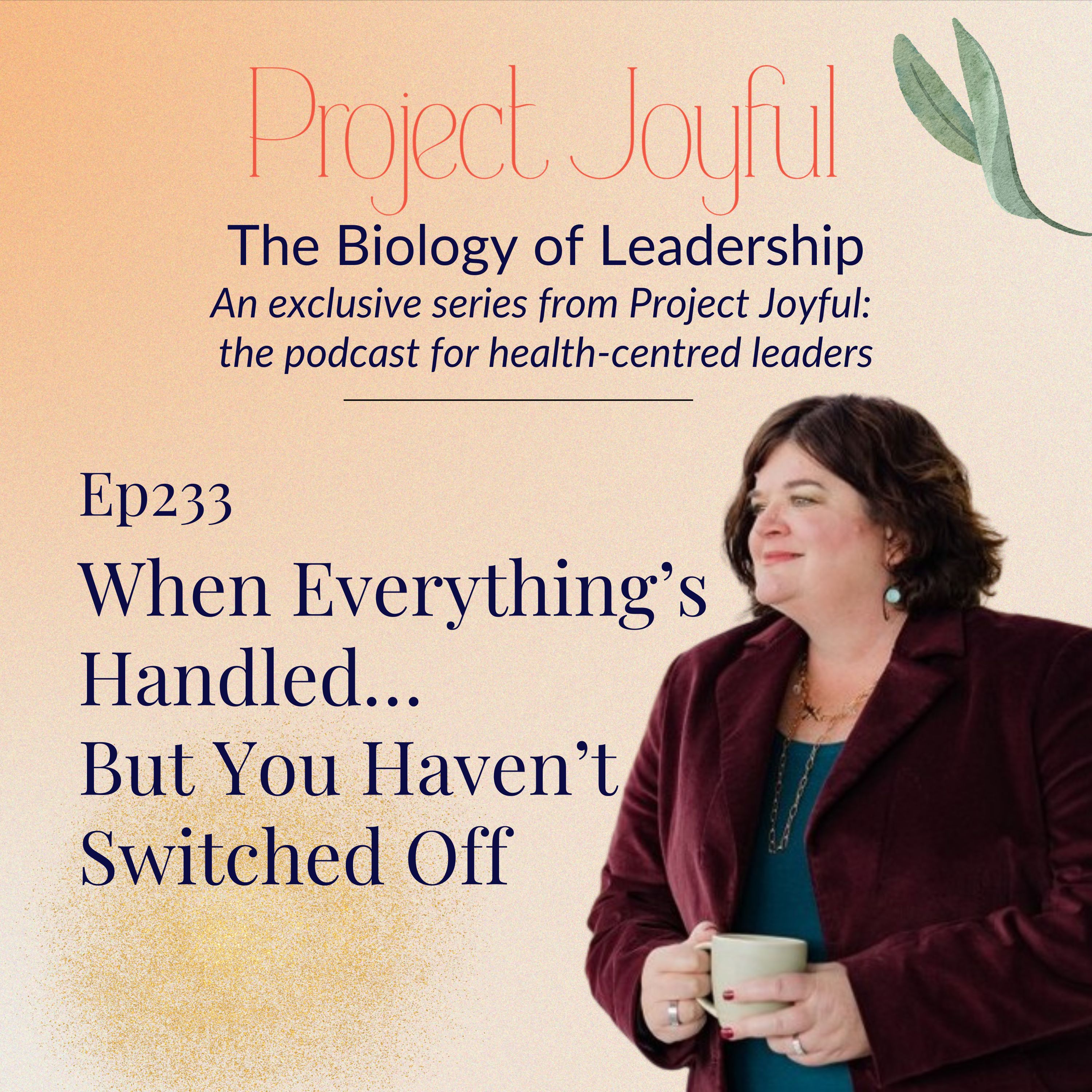
Why You Can’t Switch Off Anymore
May 900:14:16Tap to summarizeThere’s a point where the day is done… but your mind isn’t.Everything has been handled. Conversations have landed, decisions have been made, and on the surface there’s nothing left that requires your attention. And yet, something in you is still moving. Still replaying. Still stepping ahead into what’s coming next.In this episode, we explore why that happens.Not from the perspective of workload, time management, or needing to “switch off better”… but from the way your system has learned to operate beneath all of that.You’ll start to recognise:• Why your mind continues to loop, even when everything is complete• The anticipatory pattern running beneath your thinking and decision-making• The difference between your capability… and the constant background state that supports it• Why switching off isn’t the absence of work• What it actually feels like when that internal state begins to shiftThis isn’t about doing less, or managing your thoughts more effectively.It’s about understanding what’s happening at a biological level… and what becomes available when your system no longer needs to stay in that constant state of readiness.If you recognise yourself in this, you’ll understand why this work matters.Biology of Leadership26–28 MayYou can register here: https://www.tracytutty.co.nz/LeadershipBiology#BiologyOfLeadership #ExecutiveWomen #WomenInLeadership #NeuroLeadership #LeadershipDevelopment
Transcribe →