← Proof: A True Crime Podcast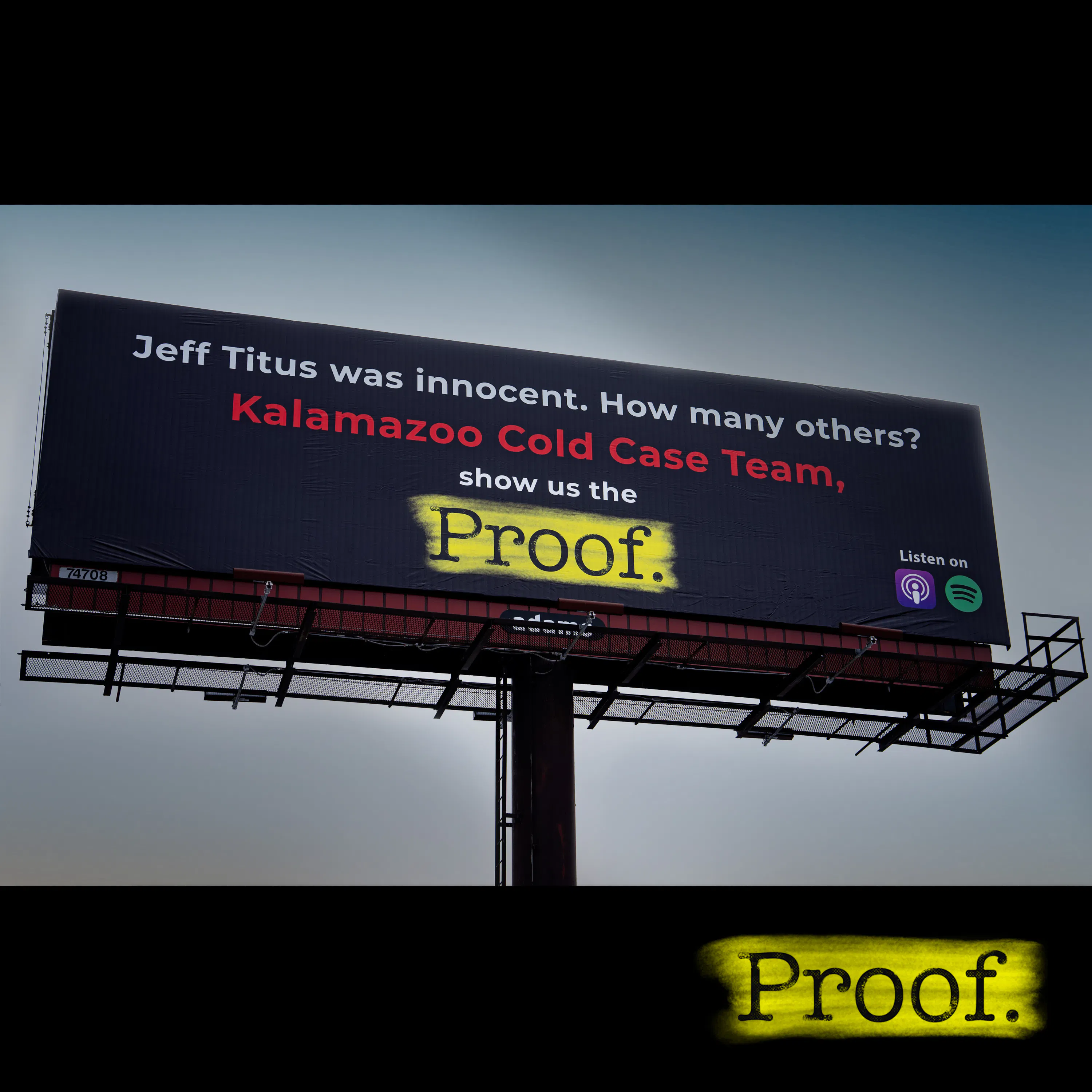
Proof: A True Crime Podcast
Murder at the Bike Shop | Ep. 12 – Hush Hush
01:02:14
For nearly two decades, letters between a Cold Case informant and Kalamazoo’s former police chief and prosecutor had been tucked away for safe keeping. Now uncovered, they point to a possible conspiracy to silence a key eyewitness in the Polderman murder trials.
Loading summary
Transcript274 lines
- [00:01]
Susan Simpson
I sold my car in Carvana last night.
- [00:02]
Jacinda Davis
Well, that's cool.
- [00:03]
Susan Simpson
No, you don't understand. It went perfectly.
- [00:06]
Jacinda Davis
Real offer down to the penny.
- [00:07]
Susan Simpson
They're picking it up tomorrow. Nothing went wrong.
- [00:09]
Jacinda Davis
So what's the problem?
- [00:11]
Richard Vendeville
That is the problem. Nothing in my life goes as smoothly. I'm waiting for the catch. Maybe there's no catch.
- [00:16]
Susan Simpson
That's exactly what a catch would want me to think.
- [00:18]
Shelly Nichols
Wow.
- [00:19]
Jacinda Davis
You need to relax.
- [00:20]
Susan Simpson
I need to knock on wood. Do we have wood?
- [00:21]
Richard Vendeville
Is this table wood? I think it's laminate.
- [00:23]
Susan Simpson
Okay.
- [00:23]
Richard Vendeville
Yeah.
- [00:24]
Jacinda Davis
That's good.
- [00:24]
Richard Vendeville
That's close enough.
- [00:25]
Jacinda Davis
Car selling without a catch Sell your car today on Carvana. Pick up fees may apply.
- [00:32]
Rich Madison
Is Daredevil.
- [00:33]
Susan Simpson
I'm right here.
- [00:35]
Richard Vendeville
Don't miss the return of Marvel Television's Daredevil Born Again.
- [00:39]
Jacinda Davis
So what's next?
- [00:40]
Susan Simpson
I feel liberated.
- [00:41]
Richard Vendeville
We're going to take this city back over medicated in an all new season now streaming only on Disney Plus.
- [00:48]
Jacinda Davis
They're hunting us. It's time we started hunting them. I can work with them. This should be tons of fun.
- [00:56]
Richard Vendeville
Marvel Television's Daredevil Born Again now streaming
- [00:59]
Susan Simpson
only on Disney Plus. There's all kinds of letters and stuff that he wrote. It might be in them. Letters? I'll look and see if I got more letters. When Virginia Bice handed us the stack of papers she'd collected over the years from her brother Richard Vindeville, she handed us a roadmap to something far bigger than we expected. Vendeville has claimed before to know about a conspiracy lurking in Kalamazoo. A conspiracy that reached far beyond the Cold Case team and covered up police and prosecutorial misconduct. A conspiracy that, if discovered, could overturn convictions. He told Jacinda and Kevin when they met with him that the conspiracy was real, but also that it would be no good for him to tell them about it. Knowing something happened doesn't change anything. What matters is having the pieces of paper that prove something happened. And now we did.
- [01:57]
Richard Vendeville
Sis. I never knew that them people killed the Poldermans. The Cold Case team was up to some sneaky shit.
- [02:07]
Susan Simpson
A strange thing about the Polderman trials is that Richard Vindeville, the state's eyewitness who told detectives he'd seen the five Polderman defendants go to the house to commit the murders, never testified in the case. Vindeville's documents offered a possible explanation as to why it appears there had been a conspiracy by the police and the prosecution to make sure that he did not appear at the trials. In one letter, Vindeville explained what Chief of Police James Mallory had said to him.
- [02:37]
Richard Vendeville
Mallory told me, Kalamazoo cannot have me testifying as I have a lot to show how the cops and prosecutor did a whole bunch of dirty shit that would make them lose the Polderman trials.
- [02:48]
Susan Simpson
There was a letter, too, from Kalamazoo Assistant Prosecutor Scott Brower, confirming an offer made by Chief Mallory.
- [02:55]
Richard Vendeville
I believe the concessions in this letter are consistent with the discussions you've had with Captain James Mallory.
- [03:04]
Susan Simpson
Virginia Vindeville's sister told us that she had firsthand knowledge of what had gone on when this deal was made. She told us how in the fall of 2007, she'd gotten a call from Chief Mallory asking if they could meet to talk about her brother Richie. He said Virginia said that right away something about the request hadn't seemed right. Something about it had seemed kind of shady. I'm sorry, because he met me in some strange places that I would think you would come to somebody's house and talk to you. So he wants to hide it? Yeah, he did. I mean, he wouldn't even come to my mom's house and she could hardly move and he'd say, oh, no, no, can't you just meet me down at this park right down the road from your mom's place? Vindeville's documents described how Chief Mallory had met with him and his family to propose a deal.
- [03:55]
Richard Vendeville
Mallory went on to explain that he had a deal to present me with. If I agreed not to testify on behalf of any of the Polderman defendants, then the prosecutor's office would allow me to have a sentencing reduction.
- [04:08]
Susan Simpson
But you can see in there where Mallory says they're going to help him with the lawyer. And they kept saying, you're going to get a 10 year flop. You're going to be out of there. You're not going to do that time, because we know you didn't do it. Oh, Gedding's right there. Yeah. Oh, this letter. It is in there. Is in there. So Getting was his attorney? Yeah, Getting is Jeffrey Gadding. In 2007, it was somehow arranged for him to be Vin Deville's defense attorney. He was supposed to help Vendeville get his sentence reduced. Today, though, he's the elected chief prosecutor of Kalamazoo. He's in charge of the prosecutor's office.
- [04:43]
Richard Vendeville
I understand your reluctance to trust me, to act in your best interest. I can only offer you my promise that I will do the best I can on your behalf.
- [04:57]
Susan Simpson
The Polderman triple homicide had gone unsolved for seven Years. It was a horrific case that shocked the community. People wanted answers. Finally, five people had been arrested. And shortly before the trials began, the key eyewitness in the case was given a secret deal not to testify. And no one was to know. That was supposed to be hush hush. I can see why it would be. Why had the chief of police and the prosecution gone to such extreme lengths to silence Vindeville? What was behind this conspiracy? How did it happen? And what did it all mean?
- [05:37]
Richard Vendeville
I have a lot to show. How the cops and prosecutor did a whole bunch of dirty shit things that would make them lose the trials against the Polderman defendants and they would walk free.
- [05:53]
Susan Simpson
I'm Susan Simpson.
- [05:55]
Jacinda Davis
And I'm Jacinda Davis.
- [05:56]
Susan Simpson
I'm an attorney and investigator and I'm
- [05:59]
Jacinda Davis
a true crime TV producer.
- [06:01]
Susan Simpson
And this is Proof Season three Murder at the Bike Shop. Proof is a Red Marble Media production in association with Glassbox Media. This is episode 12 Hush Hush.
- [06:21]
Jacinda Davis
In the Kalamazoo cold cases, there's a familiar pattern to how the investigations played out. The cold case team would come in, they'd identify a probable suspect, and then they'd go out and re interview witnesses. Remarkably, time and time again, these witnesses would change their statements. They'd tell the cold case team something different from what they told the original investigators, and their new statement would point directly at the suspect the cold case team was looking into. Based on these changed witness statements, the cold case team would make an arrest and get a conviction. The cold case team always got their man.
- [07:03]
Richard Vendeville
There's not one case that Cold case has done yet that we've picked up and investigated that we haven't solved or gotten convictions on. Not one.
- [07:16]
Jacinda Davis
The Polderman case started out like any other cold case. Six years after the Polderman murders, Kalamazoo City cold case detective Mike Werkema came in and took over the investigation. As you can hear in his interviews with witnesses, from the start, he already knew who he was going to charge in the case.
- [07:37]
Richard Vendeville
I'm a lieutenant now and I run the detective bureau, second command there. So I'm overseeing this. We're not going to give Richie that opportunity to get out of prison. That's our ultimate goal.
- [07:50]
Jacinda Davis
Richie is Richard Vendeville. Kalamazoo Cold case detective Rich Madison worked on the case as well.
- [07:58]
Susan Simpson
I seen your files in the Polderman case. You were gunning for him.
- [08:01]
Rich Madison
Yes, absolutely.
- [08:02]
Susan Simpson
I mean, you were, you were going hard at him.
- [08:05]
Rich Madison
He's a puke. Yeah, I. It wouldn't be a surprise to me to, you know, Find out definitively that he was there.
- [08:16]
Susan Simpson
The investigation into the Polderman case and Richard Bendeville began the same way as the other cold case investigations. The detectives went to re interview witness Brandy Miller, Bendaville's girlfriend at the time of the murders. Back in 2002, she'd actually accused him of committing the murders, but then she recanted. Then in 2007, when the cold case team goes to talk to her again, she changes her story once more. She hesitates at first, but goes on to tell them, you're right, Bendeville did kill them. From there, detectives went to a second witness, Ben Platt. And after a lengthy multi day interrogation, Ben changed his statement as well. He told them he'd gone to the Polderman house with Brandi and Vindeville and that Vindeville had killed the Poldermans. With two witnesses now willing to testify that they had first hand knowledge of Ven's guilt, a conviction should have been easy. But this is where the Polderman case stops being like all the other cold cases. Because Richard Vindeville is no ordinary cold case suspect. He was also a cold case team informant who had a history with Detective Mike Workema.
- [09:27]
Richard Vendeville
And I know we could have spent a whole lot of time with him. As you know, he's a very dangerous person.
- [09:37]
Susan Simpson
Vindeville had given Werkema information in a number of cold cases that had resulted in convictions. And when we spoke to Detective Rich Madison, we'd asked him how Vindeville came to be part of any cold case investigations at all. He told us Werkema had known Vendeville's sister, Rhonda.
- [09:54]
Jacinda Davis
You mentioned that Vendeville became Werkema's informant because of his relationship with Rhonda.
- [10:02]
Rich Madison
I think that's where it started.
- [10:03]
Jacinda Davis
So what was that relationship with Rhonda?
- [10:06]
Rich Madison
Mm, apparently a lot I didn't know about.
- [10:11]
Susan Simpson
Rhonda is not the sister that we got Vindeville's documents from. That's Virginia. Virginia does not think her brother Richie killed the Poldermans. But Rhonda absolutely does think he killed them. She's even said he confessed to her once. And as detectives Werkema and Madison explained in interviews with witnesses, Rhonda really wanted to see Vendeville go down for the Polderman murders, to the point that she'd threatened people who got in the way of that happening.
- [10:39]
Richard Vendeville
Langham in a worse way once her brother had spent the rest of his life in prison. She was kind of part of the pun, doing it her own hillbilly way. Being threatening and so forth to you.
- [10:48]
Rich Madison
She knows Richard did this and he's
- [10:51]
Richard Vendeville
worked hard to try to help prove it.
- [10:53]
Rich Madison
She's on our side.
- [10:59]
Susan Simpson
Rhonda was so certain that Richie had killed the Poldermans and so eager to see him charged for it that she'd even threatened to fight Brandi Miller when she'd recanted her 2002 statement accusing Vin Deville of the murders. Brandi's recantation had prevented him from being charged. Back then,
- [11:17]
Jacinda Davis
he just said that basically
- [11:19]
Richard Vendeville
that she wanted to fight me. Ronnie was on the other side trying to get you, though, and she was mad because you weren't.
- [11:25]
Susan Simpson
She.
- [11:26]
Richard Vendeville
She knew you knew something.
- [11:28]
Susan Simpson
That's probably just doing that because she wanted her to.
- [11:30]
Richard Vendeville
Yeah, she. Well, she wanted Brandy, though. Come forward.
- [11:37]
Susan Simpson
We asked Detective Workama for comment on the nature of his relationship with Rhonda, but he hasn't responded. I did speak to Rhonda once, back in 2020, and I asked her then about Workama. Mike's been a guardian to me, she said. He's always protected me and looked after my family. It's just too bad, she said, that my brother Richie's bullshit got Mike kicked off the cold case team. At the time, though, I hadn't known what she'd meant by that.
- [12:09]
Jacinda Davis
Brandi Miller wasn't the only witness in the Pullderman case who claimed that Rhonda threatened her. We also spoke to Shelly Nichols. She knows a lot of people connected to the Polderman case, including Rhonda. Shelley has even met Detective Mike Werkema.
- [12:25]
Susan Simpson
And you know Mike Werkema through her,
- [12:27]
Shelly Nichols
or Rhonda was a fellow stripper at Heartbeats. Rhonda introduced us first time was at Heartbeats on the side, because you walk in, there's a stage in the shape of dick and balls on your right, and then all around the dick and balls, there's different tables. And in the back, towards the left, there was like three or four tables in the dark over there. That's where they specifically wanted to sit.
- [12:47]
Susan Simpson
In the dark.
- [12:48]
Shelly Nichols
In the dark.
- [12:49]
Jacinda Davis
Of course, Shelly knew Rhonda because they were both dancers at the same strip club, but she also knew Richard Vendeville. They dated once, and even after they broke up, they'd stayed friendly. Shelly told us that she knew Vendeville had been accused of killing the Poldermans. But there's no way he did it, she said.
- [13:09]
Shelly Nichols
I mean, Richard didn't have it in him. Richard was a lot of things. He hustled a little bit. He was fucked up. In the soul, like he was broken. That still does not make me convinced that he had it in him.
- [13:26]
Jacinda Davis
Back in 2002, when Vendeville had been arrested for breaking into a garage and stealing a purse, he'd asked Shelley if she'd testify for his defense. She'd agreed. According to Shelly, Rhonda had not liked that she had threatened Shelley, telling her that Detective Workama would get her into legal trouble. So Shelly says she called Detective Werkema.
- [13:50]
Shelly Nichols
I got tired of Rhonda using him to threaten me. And I called him and talked to him on the phone and told him, call your dog Rhonda off and tell her to stop threatening people using you.
- [14:02]
Susan Simpson
What'd he say to that?
- [14:03]
Shelly Nichols
His remark was, well, you testified for Richard, and I don't care what I've got to do. One way or another, Richard Bendeville is going to go to prison for the rest of his life because I know he had something to do with that Polderman case. Them were his exact words. One way or another, I'm putting this man in prison. He knew he had something to do with it. He just couldn't prove it, basically, is the way he was coming across.
- [14:29]
Jacinda Davis
As Shelley sees it, that's, in fact, what Detective Workema did. In 2003, Richard Vendeville was convicted of committing home invasion for stealing a purse from a garage and sentenced to 20 to 40 years in prison.
- [14:45]
Shelly Nichols
You got to think about it. He ended up going to prison for 1B&E in Kalamazoo County. So the threats that Workama was giving him came true.
- [14:55]
Jacinda Davis
The cold case team always gets their man.
- [15:01]
Susan Simpson
But actually, though, in this case, the cold case team didn't get their man. Richard Vindeville was never charged for the Polderman murders. Something in the case went sideways. Detective Workman had been in charge of the investigation, but suddenly he no longer was. And just as suddenly, the case went in a whole new direction. And not long after that, Detective Mike Werkema announced his retirement and stepped away from the case. We don't know why detectives concluded that Vindeville had not killed the Poldermans. It is not addressed in a single police report. But this sudden realization that Vindeville was innocent caused a big problem for the remaining detectives, because, remember, they had just gotten two people to confess that they had gone to the Polderman house with Vindeville, where he'd committed the murders.
- [15:54]
Jacinda Davis
And then I came back. I had seen Rich. He was just covered in dust.
- [15:59]
Rich Madison
He helped rich Cook, carrying Mr. Boldeman out of that back bedroom. You had the feet, he was face down.
- [16:05]
Richard Vendeville
Rich had his arms or under the shoulders. Right.
- [16:11]
Susan Simpson
This put the cold case team in an awkward spot. They had two choices now. They could either acknowledge that the way two witnesses had been questioned had somehow led them to falsely implicate an innocent man, or they could conclude that those two witnesses were actually the murderers and they'd been trying to fool investigators by blaming Vindeville. Instead.
- [16:35]
Richard Vendeville
Birch was nowhere out there, was he?
- [16:36]
Rich Madison
Which made him a piece of garbage as he.
- [16:39]
Richard Vendeville
Is that right?
- [16:40]
Rich Madison
To get him caught up in this, Thomaski somebody responsible for some part of it.
- [16:46]
Jacinda Davis
Police concluded that Brandy and Ben were the killers. They had actually done the murders. They were just lying about Vendeville being involved. This created a second problem, though. Because Brandy Miller and Ben Platt don't really know each other, it makes zero sense that they'd commit a triple homicide together. So if Brandi and Ben killed the Poldermans, then there had to be others involved in this conspiracy as well. But who? In February of 2007, Chief Mallory, along with a couple detectives, made their first trip to see Vendeville in prison. They were hoping he could give them their answer. He knew both Ben and Brandy. Maybe he knew more about what they'd done. In a letter home, Vendeville talks about this visit.
- [17:39]
Richard Vendeville
The cold case team came to see me in prison. They had lied for so many years, calling me a killer, but the first words out of their mouth were, was, Richard, we want to prove that you're innocent.
- [17:50]
Jacinda Davis
Vendeville says they told him, rich, the only reason you got such a long sentence for breaking into that garage was because of the Polderman murders. But now we know you didn't do it. Tell us what you know, and maybe we can help you with your sentence.
- [18:06]
Susan Simpson
Mallory said, rich, you're not guilty. You're innocent. And they kept telling him, we're going to get you out. Don't worry, you're going to be out.
- [18:15]
Jacinda Davis
That's Vendeville's sister, Virginia Bice. In his letter home, Vendeville explained that he'd agreed to give a statement in the Poderman case, but only if he was given immunity. First.
- [18:27]
Richard Vendeville
I wanted to know all that they knew so I could even shit up. See, with the immunity, they couldn't use any of my lies against me. I mean, shit, they were lying to me. So tit for tat. I found out how it all happened.
- [18:45]
Jacinda Davis
In this letter. Vendeville says, with the immunity, they couldn't use any of my lies against me. With that, how can anyone be sure What Vendeville says is even true. We don't have the recording of Vendeville's immunity statement, but according to the police report, what Vendeville told them was that he was actually an eyewitness. He'd been there. He'd seen the killers drive to the Polderman house. The police were right. Ben and Brandy were part of it, but so too were Joe Williams, Andrew Miller, and Angela McConnell. When detectives went and interviewed their new suspects, they told them what they'd learned from Vendeville and how they'd caught him and his lies and made him tell the truth.
- [19:31]
Richard Vendeville
One thing I learned about Rich Maneville over the week that he was down here is that I know when he's lying, for one. And he's like you, when I call him on it. Chuckles a little bit. And he says, yeah, you know, and you're right, you're right. And then he comes off it.
- [19:54]
Jacinda Davis
That's how detectives claimed they'd finally solved the case, by outsmarting Richard Vendeville, by getting the truth from him. Only in his letters, Vendeville says he was the one who outsmarted the detectives.
- [20:10]
Richard Vendeville
When the cold case team came there to see me, it was time to play their game. So let the games begin. They were playing dirty, so I had to even the playing field with them.
- [20:26]
Jacinda Davis
Detectives now had a new theory. The five Polderman defendants had conspired to blame Richard Vendeville for a murder they had committed.
- [20:36]
Richard Vendeville
You have the concocted story of the Plain Ridge story, all right? The Blame Ridge story. And that has fucking fallen to pieces. And now we've got to all these people and said, hey, time to tell this right story. And each time somebody speaks, it's a
- [20:55]
Rich Madison
brushstroke on the picture.
- [20:57]
Richard Vendeville
Well, the brushstrokes are creating some kind
- [21:00]
Rich Madison
of a fucking picture right now we
- [21:02]
Richard Vendeville
got that one picture. It's all sort of fucked up and
- [21:05]
Rich Madison
squiggly lines on it.
- [21:10]
Jacinda Davis
That's right. Richard Renneville was no longer the killer. He was now the victim. When Detective Workima was in charge of the Polderman investigation, he worked to make a case against Richard Vendeville. Now he was the patsy. And after his statement to police, he was also a key witness.
- [21:31]
Richard Vendeville
Now we got this new painting that's. Holy fuck. Now we got the new story over here. This story over here is a fucking damn good painting that's gonna be at the Kalamazoo Art Museum. It's gonna be a beautiful painting. Everybody's gonna want to see it.
- [21:59]
Susan Simpson
You know, I think I'm not typically a picky person when it comes to food or things like that. There's one thing I am incredibly picky about.
- [22:07]
Jacinda Davis
What's that, Susan?
- [22:08]
Susan Simpson
That's how my water tastes.
- [22:10]
Jacinda Davis
You know, I'm the same way. My water tastes a lot like swamp.
- [22:14]
Susan Simpson
Some places just have really gross water. It's unfortunate, but when I'm somewhere that has swamp water, I'm definitely not drinking out of the tap.
- [22:20]
Jacinda Davis
Yeah, but you know, we're not alone. Did you know that three out of four US homes have toxic chemicals in their tap water?
- [22:26]
Susan Simpson
Yeah. Even though contaminated water can look clear, it can put you at risk for devastating health concerns including fatigue, hormone disruption, cognitive decline, even cancer. Surprisingly, standard fridge and pitcher filter do little to remove most contaminants and bottled water contains microplastics.
- [22:42]
Jacinda Davis
Introducing Aquatru, the countertop water purifier. Tested and certified to remove 84 contaminants including chlorine, lead, forever chemicals and microplastics. Its patented four stage reverse osmosis system goes way beyond ordinary filters for pure healthy water. You can trust. No plumbing, no installation.
- [23:02]
Susan Simpson
Aqua Truwater is the best. I used to use a fridge pitcher, which was okay. I guess I'm never going back. Aqua True is the best tasting water I've ever had.
- [23:11]
Jacinda Davis
So join 98% of customers who say their drinking water is cleaner, safer and healthier.
- [23:17]
Susan Simpson
Go to aquatrue.com now for 20% off your purifier using promo code proof. Aqua True even comes with a 30 day best tasting water guarantee.
- [23:26]
Jacinda Davis
Take the guesswork out of pure great tasting water with this extra exclusive podcast only offer now@aquatru.com a q u a t r u.com using promo code proof
- [23:38]
Susan Simpson
P R O O F It is really good water though.
- [23:48]
Jacinda Davis
I've been trying to do a little spring reset with my closet, packing up some of my winter stuff and bringing out my spring stuff. But I realized I, I need to freshen up my wardrobe a little bit.
- [23:59]
Susan Simpson
Always a great excuse to go to our favorite place for clothes.
- [24:01]
Jacinda Davis
Quince.com I 100% agree. Susan, have you got anything new recently?
- [24:07]
Susan Simpson
You know I have. My latest purchase from them was their waterproof rain trench coat which is super adorable and super useful with this rainy spring we've been having. Jacinda, can I buy you some stuff from Quints because you need some more color in your, in your wardrobe. Would you wear it?
- [24:21]
Jacinda Davis
Well, I'm going to say yes. So you pick out something for me and I will wear it and I will Love it.
- [24:26]
Susan Simpson
Luckily, Quince has a ton of great cute options of colorful clothing. So coming your way soon.
- [24:32]
Jacinda Davis
Did I tell you that I actually went outside the norm of clothes? And I bought some new earrings from Quince that I love. The mini U hoops.
- [24:40]
Susan Simpson
Cannot wait to see it. I'll believe it when I see it.
- [24:43]
Jacinda Davis
We're gonna look so styling next time we're out in the field.
- [24:46]
Susan Simpson
Do you think the witnesses we talk to you, like, recognize how stylish we are now? I hope so. So go ahead and refresh your spring wardrobe with quince. Go to quince.com proof for free shipping and 365 day returns. Now available in Canada too.
- [25:02]
Jacinda Davis
Go to Q-U-I-N-C-E.com proof for free shipping and 360 five day returns. Quince.com proof.
- [25:20]
Susan Simpson
All right, so to all the men listening to our show right now, go ahead and, like, press mute for the next 30 seconds or so. Okay. To all the ladies listening, we wanted to tell you about Honey Love.
- [25:31]
Jacinda Davis
Honey Love makes the best bras and shapewear out there.
- [25:35]
Susan Simpson
Do you need comfy, reliable support for your boobs? Try Honey Love.
- [25:41]
Jacinda Davis
No joke. It's really great. And, you know, if you don't like wearing Underwire, Honey Love is the solution.
- [25:47]
Susan Simpson
Their modern wireless T shirt bra. It's amazing for a lot of reasons, but probably the main one. Jacinda.
- [25:52]
Jacinda Davis
Well, a big bonus for us is because going into prisons having underwire makes the whole process much more difficult. Put on your Honey Love, walk right through the metal detector.
- [26:04]
Susan Simpson
Yeah, Comfy, stylish, and prison approved. What more can you need? So treat yourself to the most advanced bras and shapewear on the market. Use our exclusive link to save 20% off@honeylove.com proof that's honeylove.com proof.
- [26:18]
Jacinda Davis
After you check out, they'll ask where you heard about them. Please support our show and tell them we sent you experience for yourself. The new standard in comfort and support with Honeylove.
- [26:34]
Susan Simpson
The five people that Vendeville named in his immunity statement were charged with the murders, even though no physical evidence put them there. Vindeville says that when he made this statement, detectives told him they could help him get his sentence reduced. But months went by and he'd heard nothing more from them. That's when he realized he'd made a mistake. He hadn't gotten anything in writing. The promises of a new sentence were just empty air. So in August 2007, he wrote to his sister Virginia. It sounds like them police are fucking Me like I thought they would. Vindeville went to plan B. He wrote to defense attorneys in the Polderman case and told them that they needed to call him to testify at trial on behalf of the defense. He could help them win.
- [27:21]
Richard Vendeville
He said, that punk workama took me to some murder scenes and fed me some info on some murders I can show. There was a lot of dirty going on with that cold case team.
- [27:36]
Susan Simpson
Vendeville's plan did not work in the way he'd intended. His letters were intercepted. The prosecution found out his plan. Vendeville was the state's eyewitness. But with him threatening to take down the entire case, they obviously couldn't risk calling him to testify. And they couldn't risk having the defense call him either. After all, getting convictions in what was perhaps the biggest cold case in Kalamazoo history was on the line. That's when Chief Jim Mallory made his second trip to visit Vindeville in prison. When he made his first trip to talk to Vindeville about giving a statement in the Polderman case, he'd come with other investigators, but this time he came alone. In letters home, Vindeville wrote that Mallory had told him that he'd seen the letters where Vendeville had offered to testify for the defense and Mallory told him he wanted to make a deal.
- [28:31]
Richard Vendeville
Chief Mallory tells me that Kalamazoo cannot have me testifying against them. I have a lot to show how the cops and prosecutor did a whole bunch of dirty shit things that would make them lose the trials against the Polderman defendants and they would walk free. Chief Mallory tells me that if I keep my mouth shut that he will get me time soon served. He gives me a letter from the prosecutor.
- [29:00]
Susan Simpson
That letter from Assistant Prosecutor Scott Brower was also in the papers we'd gotten from Virginia. It read in part, dear Mr. Vendeville,
- [29:10]
Richard Vendeville
I'm writing this letter to document that the Kalamazoo County Prosecutor's Office will not file written procedural objections to a delayed motion seeking review of your sentence. I believe the concessions in this letter are consistent with the discussions you've had with Captain James Mallory. Sincerely, Scott W. Brower, Assistant Prosecuting Attorney.
- [29:30]
Susan Simpson
Vindeville was serving 20 to 40 years after being charged with home invasion for stealing a purse out of a garage. And although Prosecutor Brower's letter does not spell out the details of the agreement, it does confirm Mallory's offer that Vindeville's efforts to be re sentenced would not be opposed. But Mallory didn't stop there. As Vindeville explained in his 2011 affidavit, Mallory told him they'd get him a lawyer if he agreed not to testify.
- [29:57]
Richard Vendeville
Mallory stated that the police and prosecution's office would retain an attorney that would file a post conviction motion on my behalf, which would lead to my being re sentenced. Chief Mallory then went on to explain that the attorney was ready to go and as long as I promised not to testify, he would contact me in a couple of days.
- [30:18]
Susan Simpson
I feel the need to point out that none of this is normal. None of this is how things are supposed to work. Prosecutors are not supposed to have secret agreements with witnesses at all, let alone a secret agreement for a witness not to testify. All of this is truly extraordinary, even before you consider the fact that Vindeville had been the lead suspect in this murder for five years. And it had been Detective Workema's efforts to convict Vendeville that led to this situation to begin with. Because once Vindeville was deemed innocent, investigators were stuck with the narrative that Workama had begun and had somehow transformed it to build a case against the police Holderman defendants. Instead, if Vindeville were to testify, he could potentially have caused that entire narrative to unravel. Vindeville himself had recognized just how wrong all of this was. Though as he noted in the records he'd kept, that hadn't stopped him from going along with it.
- [31:19]
Richard Vendeville
Despite my concerns about the obvious misconduct by the prosecutor and Chief of police, I agreed to the terms of the deal.
- [31:28]
Susan Simpson
Vendeville accepted Mallory's offer. He promised not to testify at the Polderman trials. And just like Mallory had promised, a few days later, he got a letter in the mail from his new attorney, Jeffrey Getting, who at the time was a defense attorney, though now is Kalamazoo's chief prosecutor.
- [31:48]
Jacinda Davis
When we met with Detective Rich Madison, we wanted to know if he had known about this deal. After all, he'd been heavily involved in the Polderman case. So we told him about what happened when Vendeville had tried to write to the defense attorneys in the Polderman case to tell them they needed him to testify for the defense, that he thought he could help get their clients acquitted.
- [32:12]
Susan Simpson
Jim Mallory intercepts the letter. He goes to Bendelville and says, nice try. Almost got me there. Almost got it through. You're not going to do that. He then arranges for a deal with Brower and Vendeville, where Brower will agree not to oppose a re sentencing and they will hire him, his own private attorney, to ensure he gets re sentenced.
- [32:33]
Rich Madison
Gotta be kidding me.
- [32:35]
Susan Simpson
I'm not. This is the letter from Brower.
- [32:39]
Jacinda Davis
Detective Madison told us he had not known about the deal. And that makes sense. Actually. The deal appears to have been brokered by the Kalamazoo City Police. Madison was with the Kalamazoo County Sheriff's Office. And he says they never told him about it.
- [32:57]
Susan Simpson
I mean, it sounds unbelievable. I know. They hire him.
- [33:01]
Rich Madison
Jeff Gedding hired Jeff Gedding on his behalf.
- [33:06]
Susan Simpson
They did.
- [33:06]
Rich Madison
How could they do that?
- [33:07]
Susan Simpson
You can read this letter.
- [33:09]
Rich Madison
I believe you. I understand your reluctance to trust me in this act.
- [33:18]
Jacinda Davis
Vendeville's documents don't describe how exactly Jeffrey Gedding was hired to be his attorney. But Goetting had sent him a letter a few days after Mallory's visit to see him in prison.
- [33:30]
Richard Vendeville
At the request of your family, I've agreed to represent you in a post conviction motion for you to be re sentenced. You should also presume that any contacts you have with me regarding this issue are monitored by the Department of Corrections.
- [33:46]
Jacinda Davis
In the documents we got from his sister, Vendeville described how he'd written back to Getting. He told him, you know damn well my family never asked you to represent me. It was the prosecutor and chief of police that set this shit up. Here's what Getding wrote in his next letter to Vendeville.
- [34:04]
Richard Vendeville
I understand your reluctance to trust me to act in your best interest. I am preparing a motion on your behalf to address the sentencing issues in your case. The timing of the motion is important.
- [34:16]
Susan Simpson
It says the timing of this is important. That is delay. Then the trials happen. Have you ever heard of something like that happening? Does it seem right to you?
- [34:24]
Rich Madison
No, absolutely not.
- [34:27]
Susan Simpson
I've never seen such a someone go to the lengths of getting a murder suspect their own attorney to prevent them from giving.
- [34:34]
Rich Madison
See, Gideon had been a prose assistant prosecutor along with Stu. And it's when the prosecutor was Jim Gregart and he fired Stu and Getting. That's why Gettyon was in private practice.
- [34:53]
Susan Simpson
So he has ties to the prosecutor and they go to him. All the five get convicted and poof. Nothing ever happens. They play at Vendeville.
- [35:06]
Jacinda Davis
Vendeville carried through with his end of the deal. He did not contact the defense attorneys again and did not appear at any of the trials. But once the trials were over and he could no longer interfere in the Polderman case, nothing happened in his case case either. Jeffrey Getting never did file that promised motion for resentencing. We're not sure why, but four years later in 2011, Vendeville attempted to file a motion pro se without an attorney seeking reduction of his sentence, defendant Vendeville
- [35:40]
Richard Vendeville
decided to file his motion for relief of judgment himself, expecting the prosecution to honor their end of the agreement. As Defendant had honored his attorney, Jeffrey Getting failed to follow through on his obligation. So defendant decided against utilizing him for the filing of this post conviction motion.
- [35:59]
Jacinda Davis
Vendeville's motion was denied. He never did get his sentence reduced. He served his 20 year sentence for stealing a purse before being released.
- [36:11]
Susan Simpson
He didn't help him though. He didn't. So he double crossed and they never did anything for him.
- [36:18]
Jacinda Davis
Richard Vendeville had wanted to testify at the trials for the Polderman defendants, but he'd been persuaded not to by prosecutor Brower's and Chief Mallory's secret promises to have his 20 year sentence reduced if he did not appear at the trials. In doing so, they stopped a witness who could have damaged their case against the Polderman defendants from being heard by the jury. And they stopped the defendants from discovering just how flawed the case against them had been. It makes you wonder, what if Vendeville's letters from prison hadn't been intercepted? Would his testimony have prevented the Polderman defendants from being convicted? What if he had said he had made it all up and never saw them doing anything? And what else might he have said about the cold case team and Detective Werkema, whom he'd been an informant for in several other cold cases? We've reached out to Scott Brower, James Mallory, Mike Werkma and County Prosecutor Jeffrey Getding for comment. To date, we've heard back from none of them. But we wanted to hear from the attorneys for the Polderman defendants as well. Had they known anything about the secret deep deal with Richard Vendeville, about the steps taken to keep Vendeville from testifying?
- [37:35]
Rich Madison
This is just flat out bribery, obstruction of justice, trying to influence testimony, witness tampering.
- [37:45]
Susan Simpson
That's Michael Roby. He was one of the trial attorneys for Polderman defendant Joe Williams. And it turns out, no, he had not known about the deal with Vindeville and prosecutor Scott Brower's agreement to allow his resentencing get out of prison sooner.
- [38:02]
Rich Madison
Oh, that's really troubling. I wouldn't have thought that of Scott, but I wouldn't have thought he had tried this case with such shit evidence, let alone that he won.
- [38:21]
Susan Simpson
Are prosecutors allowed to make secret deals with witnesses so they don't testify?
- [38:29]
Rich Madison
No, that's not good form.
- [38:35]
Susan Simpson
Roby was a prosecutor for many years before he was a defense attorney. In fact, for eight Years, he was a prosecutor in Kalamazoo. Many of the police and prosecutors in the Polderman case were his former colleagues. Roby told me the Polderman case case had always bothered him, and he's never forgotten. Joe. They're still in contact today.
- [38:57]
Rich Madison
I couldn't believe they convicted him. I'm a pretty cynical guy, and I still can't believe they convicted him. The cold case team, I had some reservations about in that if they don't solve cold cases, there's no reason to have a cold case team. They were going to find somebody to hang this on.
- [39:26]
Susan Simpson
Well, what's interesting is they did find someone to hang it on. Richard Vendeville.
- [39:31]
Rich Madison
They did? Who?
- [39:33]
Susan Simpson
Richard Bendeville. The beginning. Well, they started off trying to convict him, and then, for reasons they never disclosed, they decided he was innocent. And then he'd switch over to the. The five Polderman defendants.
- [39:48]
Rich Madison
Wow. I don't know what to say about that.
- [39:52]
Susan Simpson
Because Vendeville never appeared at trial, his actual role in the Polderman case was never revealed. Roby didn't know, and the juries never heard that the cold case team had begun their investigation by trying hard to charge Vindeville for the murders. But for reasons never disclosed, investigators changed their minds. They decided he was innocent. And then Vendeville had claimed he was an eyewitness who saw the five Polderman defendants go commit the crime, and they were charged. Instead, Brower gives him immunity to accuse the five Polderman defendants. He tells them that he followed the five Polderman defendants on a dirt bike out to the Polderman house and saw them go inside.
- [40:36]
Rich Madison
Hmm.
- [40:37]
Susan Simpson
Did you know that?
- [40:38]
Rich Madison
No, I was not aware of that.
- [40:43]
Susan Simpson
So here's part of why. Looking at Vendeville, we know that he tried to smuggle letters out of prison to the defense attorneys.
- [40:51]
Rich Madison
I don't think we got anything from.
- [40:53]
Susan Simpson
Well, the letters were intercepted by Captain Mallory. I explained to Robey what had happened after Mallory intercepted those letters, the ones that told the defense attorneys that they needed to call Ventiville as a witness. And how Prosecutor Brower had promised not to oppose his resentencing and help him get out of prison. And how Mallory had arranged for attorney Jeffrey Gedding to file the motion for him if only he promised not to appear at the Polderman trials.
- [41:19]
Rich Madison
Man, is that dirty pool. Obstruction of justice. I mean, bribery. Take your pick.
- [41:32]
Susan Simpson
We don't know exactly why Prosecutor Brower and Chief Mallory went to such extraordinary lengths to stop Ville from testifying. We don't know what they were afraid would happen if Indville did testify. We don't even know why. Investigators thought the statement Vinville had given them was the truth, that these five people had, in fact, committed the murders. They did not respond to our request for comment, but from Vindeville's letters and affidavits, he seems to have thought they were concerned with what he knew about Detective Workama's investigation into the Polderman case. Vindeville believes that Workama's supervisors had discovered some kind of misconduct, something possibly involving his sister Rhonda, the dirty cop.
- [42:17]
Richard Vendeville
Detective Workama also tried to plant evidence against me using my own family, and he got caught. In 2007, his supervisors found this evidence that showed Werkema had planted, tampered with evidence. His supervisors approached me and committed some misconduct to keep me from coming forward and to keep this information from coming out.
- [42:39]
Susan Simpson
Actually, this is something that Ventoville mentioned to Jacinda and Kevin when he talked to them. He told them about how, when he'd been brought in for his immunity statement In February of 2007, Captain Mallory had brought up Detective Workema. And Vindeville said Mallory told him it was his sister Rhonda's fault for leading Detective Werkema astray. In his letters home, though, Vindeville noted that he disagreed with Mallory on this.
- [43:05]
Richard Vendeville
Captain Mallory tried to tell me that it was my sister Rhonda that made Detective Workma go bad. The truth to that is the cop was always dirty. He also destroyed a lot of lives with his corruption.
- [43:21]
Susan Simpson
So Vindeville believed that he knew a lot of things that the prosecution would probably prefer he stay quiet about. The thing is, though, I don't think that Vindeville himself necessarily understood all the ways in which he was a problem for the. The prosecutor's office, because Vendeville could have damaged the prosecution's case against the Polderman defendants in so many ways. All he had to do was mention his supposed role as an eyewitness or even admit, like he had in his letters, that he didn't know anything about who'd done the crime at all. Sis, I never knew that them people killed the Poldermans he'd written. Or Vindeville could even just mention how all of this began with a statement he'd made to Detective Werkema in 2002, when he'd lied about picking Joe Williams up near the Polderman house and then admitted he'd only said that because he wanted reward money and a break on his burglary charges. And what if Vindeville were to get up on the stand and say that none of it was true at all, that he'd made it all up after all, he'd changed his story before, and there was no physical evidence tying any of the defendants to the crime scene. We're still not even sure why the police believe him. And it was not just the Polderman case that was on the line here. The Polderman case was high profile. There were reporters in those courtrooms. If Vindeville had testified, and if he'd gotten on the witness stand and talked about his role in all the other cold cases he'd been an informant in and been paid for through Silent observer, the prosecution would have had problems way bigger than just the Polderman case. Many of the other cold cases could have been jeopardized, though they'd have had big problems in the Polderman case, too. If you had known about Vindeville being a secret informant for Werkama.
- [45:12]
Rich Madison
I know. I agree about that.
- [45:14]
Susan Simpson
And if Windeville was saying that workema falsified evidence, here's how I can prove it. Would you have used that?
- [45:19]
Rich Madison
Yeah, I would have used that.
- [45:24]
Susan Simpson
For the police and prosecution, Richard Mendeville must have seemed like some kind of ticking time bomb. If he talked publicly, who knows how much he could have blown up? So they found a way to make sure he stayed quiet.
- [45:38]
Richard Vendeville
They.
- [45:39]
Rich Madison
They must have really not wanted him to testify. I find all of this sort of shocking. It's just so disappointing, especially when
- [45:54]
Jacinda Davis
the
- [45:54]
Rich Madison
shit work, the shitty police and prosecutorial work were done by people I know.
- [46:05]
Susan Simpson
The police and prosecution went to extraordinary lengths to keep Richard Vendeville from testifying in the Polderman trials. What they did was also extremely unethical and potentially illegal. They consist of conspired to induce Vendeville not to testify by promising that he would be able to have his sentence reduced and get released from prison sooner. And by providing him with an attorney that he was told could take care of it all for him. Vendeville himself had known just how wrong this all was. As he explained in one of his
- [46:36]
Richard Vendeville
letters home, when the prosecutor sent Captain Mallory to quiet me, he committed prosecutorial misconduct, which is an issue for them killers, to get a new trial and even to be set free over this dumb shit that they did.
- [46:49]
Susan Simpson
All five Polderman defendants were convicted. We'll never know if Richard Bendeville's testimony would have changed that outcome.
- [47:02]
Jacinda Davis
In an earlier episode this season, Susan made a comment that she wondered if Richard Vendeville was the Forrest Gump or the Rasputin of the cold case team? Was he a bumbling figure who somehow just randomly appeared in so many cold cases just by chance? Or was he the evil mastermind behind the Polderman murders who used his connections to the cold case team to deflect blame away from himself and to the Polderman defendants instead? Richard Vendeville's documents suggest the answer is neither. Vendeville's connections to the cold cases wasn't random. It had to do with Detective Workma. And he wasn't a mastermind. It seemed like he may have been a useful tool, a tool that served as an informant, but somehow went from informant to becoming a suspect. Maybe because he really was a suspect, or maybe because he simply knew too much and had threatened to come forward with what he knew. And once that happened, it seems the work of the cold case team and their perfect record was at risk. But the deeper we dug into Scott Baldwin's case and the other cold cases we had questions about, the more Vendeville's name came up. Vendeville has long claimed that Detective Mike Werkema took him to crime scenes, gave him information about what had happened, and then had him call in tips and a silent observer using the same info Wergma had given to him to give the police leads on cases he knew nothing about. And Veniveville told Kevin and me when we met with him that one of the cases where this happened was with Corky Lard. Mike contaminated that whole case. He told us, listen, he took me to the fucking graveyard and told me this is where the body was at. Vendeville's documents had given us what he called the piece of paper that proves it. But we were also aware that Vendeville knew more, knew more about other cold cases, more about what he had done as an informant for Mike Werkema, more about the Polderman case. And what else did he know about then, Chief of Police James Mallory or about Jeffrey getting the current chief prosecutor in Kalamazoo? But back then, the man who had been hired to represent Vic Bendaville Gedding, it turns out, was also the defense attorney for Corky Lard, the man Rich Madison believes the cold case team wrongfully sent to prison. We were on our last trip to Kalamazoo to investigate Scott Baldwin's case. We had one last shot to talk to Vendeville. We were hoping he'd agree to meet and asked him to give us a call. We didn't hear anything for a little bit, but Vendeville has an Uncanny ability to only ever appear when you least expect it. Like when you're seconds away from walking into a witness interview.
- [49:58]
Susan Simpson
Because that would show. Why does Richard Bendeville always call at the worst time?
- [50:07]
Jacinda Davis
Hello? Bendeville was reluctant to meet, but I told him we found the proof he told us to look for.
- [50:16]
Susan Simpson
It would be good for you to
- [50:17]
Jacinda Davis
get some eyes on this stuff. Are you around if I come get you? Because I know you are interested and I. I want to get your comment on it. Vendeville agreed to meet with us later that night. All right, talk to you later. Bye.
- [50:32]
Richard Vendeville
Okay, so he's basically on for tonight?
- [50:34]
Jacinda Davis
Sounds like it. Richard Vendeville did not show up that night. We don't know exactly why. Maybe keeping these secrets buried was the only leverage he had left in all of this. But we were hopeful that perhaps we'd get a chance to talk to him when we came back to Kalamazoo again. Because by then it was clear there would be an again.
- [51:11]
Richard Vendeville
Life is full of choices. But the choice between getting crispy chicken nuggets or a Crunchwrap slider isn't one you'll have to make the new Crispy Chicken Crunchwrap slider at Taco Bell. All white meat chicken nuggets breaded in tortilla chips, wrapped up sauce and all inside a slider sized crunch wrap. Choose from creamy chipotle or jalapeno honey mustard. Well, here we go. Last life still full of choices. The new crispy Chicken Crunchwrap slider. A brand new classic only at Taco Bell. And participating in those Taco Bell locations for a limited time and while supplies last.
- [51:43]
Susan Simpson
And Doug, there's nowhere I wouldn't go to help someone customize and save on car insurance with Liberty Mutual. Even if it means sitting front row
- [51:51]
Rich Madison
at a comedy show.
- [51:52]
Susan Simpson
Hey, everyone. Check out this guy and his bird. What is this, your first date? Oh, no. We help people customize and save on car insurance with Liberty Mutual.
- [52:00]
Rich Madison
Together.
- [52:00]
Susan Simpson
We're married. Me to a human, him to a bird. Yeah, the bird looks out of your league anyways, Only pay for what you need@libertymutual.com Liberty. Liberty. Liberty. Liberty.
- [52:12]
Jacinda Davis
Hey, everyone. Before we continue with this episode, I want to tell you about another podcast. Have you ever wondered what it feels like to watch your house burn down? Or be attacked by an alligator? Or learn that your spouse hired someone to kill you? If you're dying to know, then what Was that Like? Is the podcast for you? What Was that Like? Is filled with real stories about the most surreal experiences of people's lives on the show. Host Scott Johnson dives deep with his guests into the unbelievable situations they found themselves in, like animal attacks, plane crashes, winning, the Price is Right, and more. The show brings you tons of completely surreal, completely true stories, all told through the lens of the person who actually experienced it.
- [52:52]
Susan Simpson
Check out some of these episodes about wild and gripping stories to gain some insight on what it was like to say be a professional bridesmaid or lose a leg in a shark attack.
- [53:01]
Jacinda Davis
Susan, I think you'd be a really
- [53:02]
Susan Simpson
good professional bridesmaid and you'd be really good at losing a leg in a shark attack.
- [53:05]
Jacinda Davis
Oh gee, thanks.
- [53:08]
Susan Simpson
So if you want to hear some disturbing and inspiring first hand stories, you need to check out what Was that Like. Every story is thoroughly researched and fact checked. So you know, even the most bizarre tales are someone's reality. Listen to what Was that like on Apple Podcasts, Spotify, or wherever you get your podcasts.
- [53:28]
Jacinda Davis
Detective Rich Madison spent more time on the cold Case team than any other detective. The work meant a lot to him and the information we shared with him from our investigation couldn't have been easy for him to hear.
- [53:42]
Richard Vendeville
You're proud of the stuff you guys did?
- [53:44]
Rich Madison
Absolutely.
- [53:44]
Richard Vendeville
You did really good stuff.
- [53:45]
Susan Simpson
Right.
- [53:46]
Richard Vendeville
You feel good about the work you were doing?
- [53:48]
Rich Madison
Yeah.
- [53:50]
Jacinda Davis
But Detective Madison has always known that the cold case team was far from perfect.
- [53:56]
Rich Madison
I've been openly critical about Werkema and the cases. I haven't kept quiet about it.
- [54:02]
Richard Vendeville
You weren't on the wrong side of the tightest thing.
- [54:05]
Rich Madison
Yeah. And I've been very vocal, you know, about, about Corky Large. You know, I haven't shut up about that.
- [54:14]
Jacinda Davis
Madison has always believed that the cold case team sent two innocent men to prison, Jeff Titus and Corky Laird. And that's before he found out the extraordinary lengths his colleagues had gone to with Richard Vendeville and the deal they made to keep him quiet. None of that should have ever happened, he said.
- [54:35]
Rich Madison
It's disheartening and embarrassing and it pisses me off.
- [54:39]
Richard Vendeville
Yeah, it's got to be. It's frustrating.
- [54:42]
Rich Madison
It is kind of scary that we've gone this far into it. My concern is that where it's going to go from here.
- [54:57]
Susan Simpson
Where is this going from here? Because it doesn't end here. It can't. The Kalamazoo Cold case team closed 15 cases and got 21 convictions over the roughly eight years they operated as cold case team. Detective Mike Brown said, that's a hell of a record. But of those 15 cases, there are at least nine where we believe the evidence, or lack thereof, should be serious cause for alarm where we believe there is a significant chance of a wrongful conviction. That's right. We believe that more than half of the cases solved by the cold case team could be wrong. To date, the 14 defendants in those cases have served a combined 250 years in prison and counting. 250 years of time served by people potentially wrongfully convicted by one cold case team. The numbers are absolutely staggering. So far, only one of those cold case defendants has been exonerated. Jeff Titus. His conviction was overturned, but without any official recognition of the wrongdoing. That led to him being sent to prison for a crime he did not commit. And Scott Baldwin died before his innocence could be recognized by the courts. You've heard about many of the other cold case defendants in this season already, whose cases we think should be looked at again. There's Corky Laird, the man convicted of killing his ex brother in law, even though his ex brother in law was last seen with a suspected serial killer. Corky pled guilty, and we firmly believe that was the right call for him. He served only seven years, the shortest term by far of any of the cold case defendants. But after he got out cold, cold case detective Rich Madison even tracked Corky down to apologize.
- [56:52]
Rich Madison
And I said something like, I know you didn't do it. And he swears at me again, gets in his car and leaves. He didn't want anything to do with me.
- [57:00]
Jacinda Davis
You wanted to let him know.
- [57:02]
Rich Madison
Yeah, I believed you didn't do it. And you got railroad it.
- [57:07]
Susan Simpson
There's also the case of Hyland Sterling, convicted of murdering his best friend, Robert o', Keefe, and what prosecutors said was a business deal gone wrong. A conviction that only became possible after the key eyewitness more than a decade later changed the story. The eyewitness initially said the man he saw at the victim's house that day had not looked like Hyland Sterling. But after repeated interviews with the cold case team, he said the man looked like Sterling, only with longer hair.
- [57:36]
Rich Madison
He looked similar to the gentleman that was there in the morning earlier, but his hair looked like it was shorter,
- [57:42]
Jacinda Davis
like he just got a haircut.
- [57:44]
Susan Simpson
The fact is, Hyland Sterling always kept his head shaved bald. He couldn't have been the man the eyewitness saw who had longer hair. And there's Roberto Davanzo, the man convicted of hiring a hitman to murder his girlfriend while he was in prison. Except nobody could ever prove there was ever even a hitman, much less that Roberto had Hired them. So Roberto gets convicted of hiring a hitman to kill his girlfriend. What happened to the hitman?
- [58:14]
Rich Madison
Yeah, there's no.
- [58:14]
Susan Simpson
I mean, it ends there. Who is the hitman? Correct. Nobody ever looks into that. There's also the case of Patrick Mitchell. He was convicted of murdering his girlfriend and making it look like a convenience store robbery.
- [58:29]
Jacinda Davis
What makes you think that you can stand and accused me of murder?
- [58:34]
Richard Vendeville
Because we're the cold case team, and that's what we do, and we're good at it.
- [58:38]
Susan Simpson
Witness Debbie Brown alleged that Patrick had confessed to her. And even though she claimed they were having an affair, Debbie couldn't even identify Patrick in court. I've done 23 years now, and I haven't killed anyone.
- [58:54]
Richard Vendeville
I never even thought about doing.
- [58:55]
Susan Simpson
I'm such a terrible thing that happened to her.
- [58:59]
Richard Vendeville
I broke down and cried. I had to go out of the courtroom when they were showing the pictures
- [59:03]
Shelly Nichols
I. I couldn't take.
- [59:06]
Susan Simpson
Was horrible. And finally, there's the Polderman case. This would end up being the final investigation handled by members of the Kalamazoo cold case team. It's hard to explain everything that went wrong here, but ultimately, five people went to prison. There's no physical evidence, but there is evidence of serious misconduct by the police and prosecutors involved.
- [59:31]
Jacinda Davis
So where does this leave the cold case defendants, the ones who may also be innocent? Only a few of them currently have attorneys, though. Scott's attorney, Olivia Vigiletti, with the Michigan Innocence Clinic, is becoming very familiar with the Kalamazoo cold case convictions. In such a small community, I would not have expected to hear about so many shady convictions as I have. I don't think it's a coincidence that 10% of my caseload right now is investigating the Kalamazoo cold case team. I do statewide work. You know, I don't think they were just magically so much better at solving murder. One of Olivia's current Kalamazoo clients is Polderman defendant Joe Biden Williams. She, along with attorneys for Andrew Miller at the Exoneration Project in Chicago, are hoping new DNA testing may finally bring answers to what happened to the Poldermans. And our investigation into the Polderman case has uncovered significant issues, even beyond what happened with Richard Vendeville, that we believe may help those still serving time in the Polderman case. Though, sadly, it all comes too late for Angela McConnell, who took her own life in 2023. But frankly, there are not enough innocence attorneys out there to address a problem like Kalamazoo. Take the Polderman case, for example. Ben Platt, the third Polderman defendant, who is still in prison today, has no attorney, not because his case is any less worthy, but because there just isn't anyone available to take it on. So for the other Kalamazoo cold case defendants, their best hope is for there to be public recognition that something went horribly wrong here. Yes, I mean, I think attention on this cold case team would be enormous. I'll say. Say, I think public perception tends to catch on quicker than the courts. So if the public can kind of start to see these issues and start to demand transparency around these issues, I have to hope the courts will follow. It's hard to get people to believe wrongful convictions happen. We all want to believe the system works, that by the time a case reaches a jury, the checks and balances have worked, that a guilty verdict is the just verdict, and nobody wants to risk releasing a person a jury has found guilty of a heinous crime. But consider this. Mistakes get made in all areas of our lives. On the news, we constantly hear stories of corrupt politicians or incompetent teachers. The fact is, all areas of our lives have certain individuals occupying a job that for various reasons, they probably shouldn't have. What if a group of doctors had killed or harmed the people convicted by the Kalamazoo cold case team? Would people have such a hard time then believing they should see justice? Because the fact is, ending up being charged with a crime is no different than ending up in a hospital. The expectation is that you should have faith in the system. How is that different than what happened to these cold case defendants? Society's expectation is the same, that you can trust the people in charge, the people who have been sworn under oath to protect and serve, to behave ethically and make extraordinary efforts to render justice. Something went terribly wrong with the Kalamazoo cold case team. They used aggressive tactics aimed more at closing cases than finding the truth and questioned witnesses in ways that seem almost designed to change their statements, to lead them in a way that investigators wanted to go. All of that is already cause for concern, but it's made so much worse when combined with detectives and prosecutors who are willing to take things further, to hide evidence, to conspire to keep witnesses from coming forward or from telling everything they knew. In this season, you've heard about some of the other cases we have serious concerns about, but they are far from the only Kalamazoo cold cases that we believe warrant reconsideration. And we hope to be back in future episodes to tell you more about those cases.
- [64:14]
Susan Simpson
So this is the last regular weekly episode of season three. But it is not the end of season three. In fact, I suspect that it will be a very long time before we can say that season three is truly at an end. Because what we're saying here is that all the cold cases should be re examined. But this is an ending of sorts for now. And since Scott Baldwin is the one who brought us all here, we'll give him the final word. I believe they're afraid of what they're
- [64:44]
Richard Vendeville
about to open up.
- [64:46]
Susan Simpson
It's going to cause a flood effect.
- [64:48]
Richard Vendeville
Look how many cases they solved in that shorter period of time. And how many have questions. How many more do we have?
- [65:08]
Jacinda Davis
That's it for now of this season of Murder at the Bike Shop. We'll be back though, with updates as they unfold. And we'll be back on Thursday with a sidebar episode. A special thank you to all our listeners and to all the people we've met along the way in Kalamazoo and to our families who sacrificed so much so we can do what we do. And to Scott Baldwin's family, we hope, like you, that his name will be officially cleared. Thank you for opening your hearts to us. Proof is a podcast by Red Marble Media made in association with Glassbox Media. Send us your questions and comments@proofcrimepodmail.com and if you have any information about Scott's case or any of the cases we've covered this season, please reach out. Kevin Fitzpatrick is our executive producer. Our theme music is by Ramiro Marquez. Audio production for this episode is by Michael Ulatowski, Michael Alfano, Karen Incarnation, and Jesus Urbaez. Our social media manager is Leanne Cook. And thank you to all of our sponsors who make this podcast possible. Follow us everywhere with the handle at Proof crimepod and on our website, proofcrimepod. Com. That's all for now. Thanks so much for listening.