← Proof: A True Crime Podcast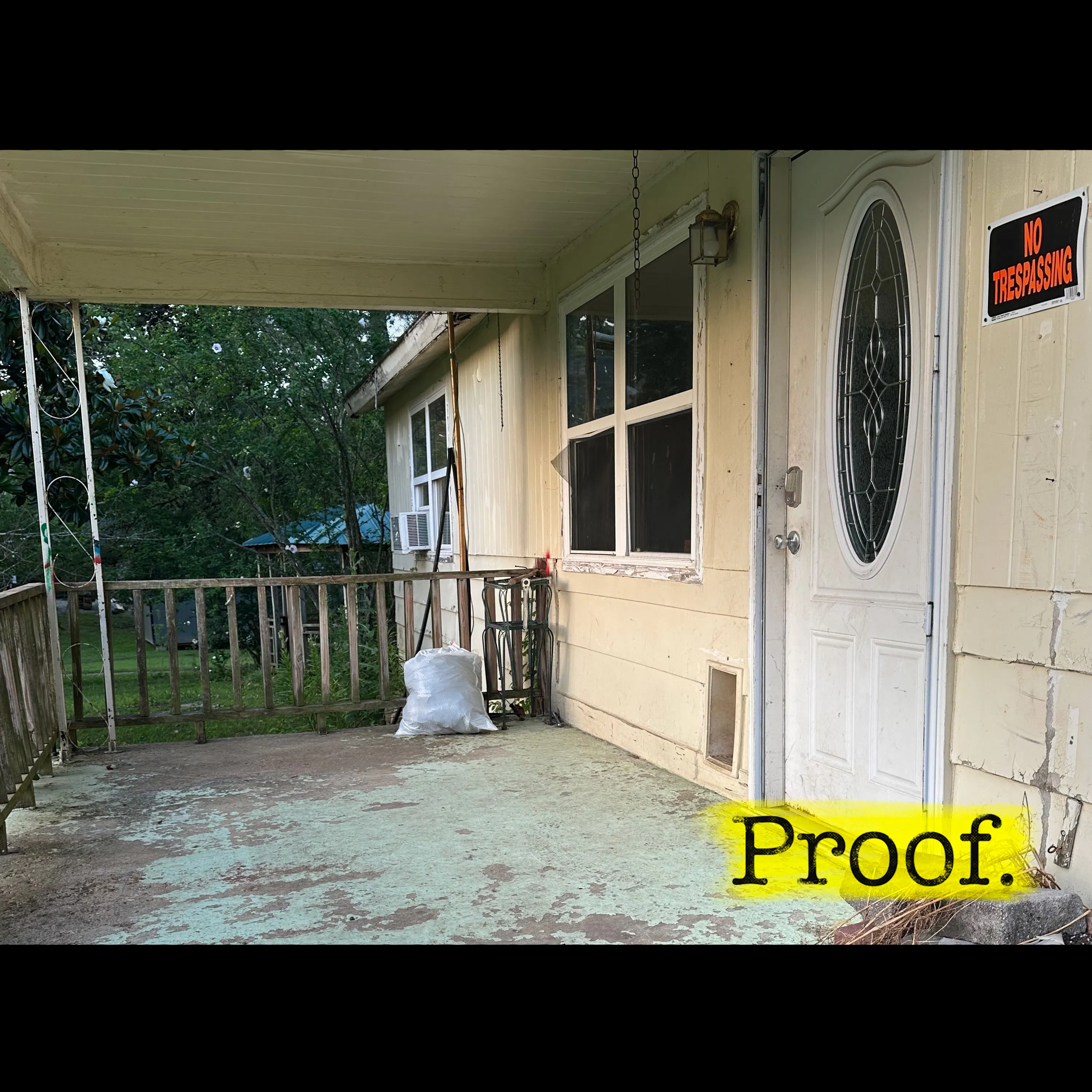
Proof: A True Crime Podcast
Murder at the Bike Shop | Ep. 8 – Watch Out for Snakes
00:56:23
New leads send Jacinda and Kevin back to Alabama to re-interview Scott Baldwin’s ex-girlfriend and track down James Long, a former bike shop employee who investigators never fully questioned.
Loading summary
Transcript305 lines
- [00:01]
A
Hey, Sal.
- [00:02]
B
Hank.
- [00:03]
A
What's going on? We haven't worked a case in years. I just bought my car at Carvana and it was so easy.
- [00:08]
C
Too easy.
- [00:09]
D
Think something's up?
- [00:10]
A
You tell me. They got thousands of options, found a
- [00:14]
D
great car at a great price, and
- [00:16]
A
it got delivered the next day.
- [00:18]
D
It sounds like Carvana just makes it easy to buy your car, Hank. Yeah, you're right.
- [00:23]
A
Case closed.
- [00:25]
B
Buy your car today on Carvana.
- [00:29]
E
Delivery fees may apply.
- [00:31]
C
When beloved family patriarch Gary Ferris went missing, his family looked everywhere on their property until they came across something horrifying. It's a homicide.
- [00:40]
A
Absolutely.
- [00:41]
C
The blame game in this family went round and round. This is Blood is Thicker, the Ferris Wheel. I don't see how anyone can look
- [00:50]
A
at this story and think they were happy. Follow and listen to Blood is the
- [00:54]
C
Ferris Wheel on the Free Odyssey app or wherever you get your podcasts.
- [01:03]
B
Okay, so now we are in Alabama, and we're going to talk to a employee of the bike shop named James Long.
- [01:12]
C
And a potential suspect.
- [01:14]
B
And a potential suspect. He was the last one that we know of to see Earl alive.
- [01:24]
A
After Earl o' Byrne was murdered, James Long never returned to the bike shop. He and his long term partner, Jimmy Connell, ended up leaving Michigan altogether and by chance moved to a small town in Alabama, not far from where Scott's girlfriend Stacy had ended up moving. So Kevin and Jacinda were in Alabama hoping to talk to both of them. Stacey is an important figure in this case for obvious reasons, but we had started to think James Long might be important too. Detectives had never considered him to be a suspect, but we knew that two of his co workers had thought from the very beginning that he could have been the one to kill Earl. James had not been interviewed in person in this case since 1988. Police reports from the cold case team note that they'd struggled to make contact with him at all, though they'd finally spoken to him on the phone. And although he'd testified at Scott's trial, he'd done that over the phone as well from his home in Alabama. So I was hoping that Kevin and Jacinda were going to be the first investigators to speak to James Long face to face in a very long time. They had let me know they were on their way to his house, so I waited for them to call with an update.
- [02:35]
F
Hey.
- [02:36]
C
Hey. I don't think we're gonna be able to talk to James Long.
- [02:42]
A
Why not?
- [02:43]
C
Cause he's dead.
- [02:44]
A
Oh, no.
- [02:47]
C
Yeah.
- [02:48]
E
When?
- [02:50]
C
It seems like as long as five or six years ago,
- [02:54]
A
that's crazy. He'd alive. In all the databases, James Long would have been 80 years old at that time. But there was no obituary, no record of death. So I'd allowed myself to hope that he was still alive. Though I knew his long term partner, Jimmy, had recently died. Jimmy did have an obituary. It mentioned all his family had died before him and that he never married. The house where James and Jimmy had lived together was now empty.
- [03:23]
C
Yeah, I mean, clearly it's some kind of abandon or just nobody's been in it since. The other James, Jimmy Connell, died, you know, five, six months ago.
- [03:33]
A
Kevin and Jacinda spoke to several of James and Jimmy's neighbors, hoping to learn anything about them that they could. We knew almost nothing about their lives, but the neighbors hadn't known much either. Not even the couple who lived next door and who'd been given James and Jimmy's house.
- [03:51]
C
And it seems to be that they were deeded the house simply because he had nobody else to leave it to. They didn't even know James Long's name.
- [03:58]
A
Did they know they were gay?
- [04:01]
C
No. No, they didn't. Like it had never been confirmed for them. The other neighbor that said that had been described to him that they were friends. But the wife of the neighbors that got the house, she said that there had actually been a domestic dispute.
- [04:17]
A
That was pretty much all they knew about James Long. He'd always just kept to himself.
- [04:23]
C
They said that James Long, who they'd never spoken to, basically he just sat on the porch smoking cigarettes all the time.
- [04:30]
A
He lived there for two decades.
- [04:32]
B
Yep, yep. But he didn't talk to his neighbors ever. It's like he's a ghost.
- [04:36]
C
At no point did we suggest to them that James Long could be the killer or that Jimmy could be the killer.
- [04:43]
B
I think they had their suspicions. Cause the mom was like, when my kids were little, James would sit there and watch them play. And it creeped me out. I was really scared.
- [04:55]
E
Oh,
- [04:58]
A
that could just be normal southern stuff, though.
- [05:00]
C
That's just an old guy sitting on a porch smoking cigarettes, staring at kids.
- [05:06]
A
We were a few years too late to speak to James Long and a few months too late to speak to his partner, Jimmy. Kevin and Jacinda had asked if they could go into the house to look around, but the neighbors who owned it now told them they were concerned the flooring might fall through. So that was the end of that. They had to leave without getting any real answers. A disappointing result. But the trip was not over yet because they still had to go back and Speak to Stacy. There were some unanswered questions we still had for her. I'm Susan Simpson.
- [05:43]
B
And I'm Jacinda Davis.
- [05:45]
A
I'm an attorney and investigator, and I'm
- [05:47]
B
a true crime TV producer.
- [05:49]
A
And this is Proof, season three, Murder at the Bike Shop. Proof is a red marble media production in association with Glassbox Media.
- [05:58]
B
New episodes are released on Mondays and on Thursdays. You can catch our sidebar episodes where we talk about the case, talk to guests, and tell you more about what's going on behind the scenes.
- [06:14]
A
This is episode eight. Watch out for snakes.
- [06:22]
B
Kevin and I spoke to Stacy twice. She was the first witness we spoke to when we began investigating Scott's case. And we went back to speak to her again months later, shortly after Scott had died. Stacey had already heard about it. She'd seen his online obituary.
- [06:41]
E
Yeah, I mean, I hate to hear anybody pass away, honestly, you know, I feel like Scott did what he did. I can't change it. I just know what he told me. I know what I went through and what I witnessed. That's all. I don't. You know, yeah, because the only thing I was trying to do was the right thing, what I felt like I should do, you know, it just. It sucked that his whole life was wasted like that.
- [07:06]
B
By the time of our second interview with Stacy, we had been to Kalamazoo, had talked to more witnesses, and gone through many more case files. There were a lot of inconsistencies in Stacy's story, but she has always been adamant that she is telling the truth.
- [07:24]
E
When I went to court, you know, they asked about what I was dealing with, the drugs. They asked about my lifestyle. I never lied to them. I told. I said, fine, you want to know everything? Here it is. Because the whole thing is I'm just trying to do the right thing, and I get slammed left and right. Oh, you did this and you lied on that. And you. And I'm like, well, here I still stand, you know?
- [07:53]
B
But even if she is telling some version of the truth, Stacy's story has changed over time, like when and where Scott confessed, when she went to the police, what Scott brought in through the window that night. These crucial details have changed. It's a pattern we've seen in so many of the Kalamazoo cold case witness testimonies. Timelines shift. Important details change, always in a way that hurts the defendant. Is that what happened here? After repeated conversations, did Stacy's memory somehow, as Detective Workama once put it, awaken?
- [08:34]
E
I don't think I was led in that way, you know, I was convinced anyway that he did it. They definitely weren't showing me things to say. He didn't.
- [08:45]
B
But
- [08:47]
E
I didn't feel like they were trying to change my. Or change me. I mean, because I had told them from the beginning, I'm gonna stick with the truth.
- [08:58]
B
One of the major inconsistencies in Stacey's story we want to ask her about was her testimony under oath that Scott Baldwin had not confessed to her until one year after Earl o' Byrne's murder. I pulled up her transcripts to show her what she had said before. It was a year later.
- [09:17]
E
No, it was not a year later. It was, like, shortly after.
- [09:21]
B
So your Polygraph was on June 23rd of 89?
- [09:26]
E
89. That was the polygraph. Oh, that's what. Yeah, that's what they did that day.
- [09:31]
F
Yeah.
- [09:31]
B
And the murder was June of 88.
- [09:34]
E
No way. I didn't wait a year. There's no way I waited a year. It was right after. That doesn't make sense to me.
- [09:44]
B
So this is the statement you sent to the cold case team, right.
- [09:47]
C
And it's 43, 44 pages.
- [09:49]
E
Yes.
- [09:53]
B
This 40 plus page statement was written by Stacy at the request of the cold case team in December of 2000. She started off by writing down all her memories of Scottish and the night she says, he came home covered in blood with money he'd gotten from somewhere. So around page 17, you stop and you say, I'm tired. I'll finish this tomorrow. And then you say, well, it's later. I talked to the detective on the phone. I told him about writing this last night and this morning and about the things I remembered. So we know you talked to the detectives halfway through the statement.
- [10:32]
E
The statement, yeah. Yeah.
- [10:34]
B
So this is after you've talked to Rich Madison, you said. I realize now that it was almost a year after the man was killed that Scott actually told me he had done it. I'm glad I finally got that straight in my mind. It was really bothering me.
- [10:48]
E
See, that sounds like. That part sounds like they were manipulating me because I knew it wasn't no year I was saying it in that paper. But then I talked to them, and it's like they. They rearranged my timeline or something. I'm not saying they did. It seems like they might have been able to subtly change things or something or, like, nudge me in some way, because it seemed to me like I was convinced the same way I was now that it was a few days. And then they called, and then I was like, well, they clarified that it was a year later. I don't know if that was something that fed me or if that's. Was it really a year later? And time just went by in a blur because it was just crazy during that time, I was sure, just like I am now. And then all of a sudden, it says, I talked to Rich, and he clarifies all these dates.
- [11:40]
C
I do think that the cold case team had a problem with the jury, and I think the problem was the following. And this is just my speculation. Everyone is saying, well, this woman is trying to do the right thing, but why is it that she's waited a year before she's come forward?
- [11:55]
E
Yeah. And I never knew they thought that.
- [11:57]
C
And so the cold case team have their solution right here. The solution is.
- [12:02]
E
Yeah, it's very tidy.
- [12:03]
C
The solution is that he doesn't confess
- [12:05]
B
to you until a year later.
- [12:07]
C
Until a year later.
- [12:08]
E
Yeah. Which just isn't true. I could definitely see where that would, you know, where it would help them, you know, if they just were trying to get somebody.
- [12:18]
C
You know, what you were just saying there, that it feels like there are moments where maybe they were manipulating your timeline. Do you feel that that happened during other times during your discussions with them?
- [12:29]
E
Honestly, I never thought about it until listening to you read that. How was I not clear? And then suddenly I talked to them, and then I was like, oh, that's. You know, I never felt like they pushed me, but maybe I was just so naive. They didn't have to really push me.
- [12:46]
B
I think Werkema called it a technique called awakening a memory.
- [12:50]
E
Yeah, well, it's a little different reawakening than to plant a memory. That might not be the right word, but just by reading that statement, it does feel like that there was some sort of manipulation.
- [13:06]
B
But it's not just the timeline of Stacy's story that changes after her conversation with the cold case team. In the first part of the statement, you talk about a bank bag. In the second part, now you remember the color of the bank bag.
- [13:23]
E
Yeah. It's fascinating from somebody that's never looked at the possibility that he didn't do it.
- [13:30]
C
But the idea that 13 years later, after you talk to the detective, suddenly you remember the color of the bank bag and what's written on it.
- [13:39]
E
And honestly, I can't say that they might have subtly put it in my head. You know, those are my words. I'm listening to the statement, and now it's like, oh, I talked to them, and this is. And now all of a sudden, you know, and I hear that and I'm like, what was I a bit manipulated and didn't even know.
- [14:04]
A
Is so easy to end up influencing a witness when you speak to them. It's unavoidable, really. And most of the time, it's not anything intentional. It's not something the interviewer is trying to achieve. It's just how human memory works. Best you can do as an interviewer is to be aware of it and try to minimize it. That's why the first time we spoke to Stacey, we hadn't shown her any records or told her anything we knew about the case, so we could try and hear her story while influencing her as little as possible. What you've heard from Stacey on this season so far actually comes from two separate interviews we did with her. The first at the very start of our investigation and the second towards the end and after we'd made several trips to Kalamazoo to speak to witnesses there. And the second time Kevin and Jacinda spoke to her, they asked her about some of the records in the case, like the polygraph she took in 1989 when she'd been asked what kind of person would make up a story like the one she'd told about Scott. And she told them probably someone who was angry with their boyfriend or somebody who wanted the reward money.
- [15:12]
E
That's when I thought. They thought I was just after money. That and I was a dancer, you know.
- [15:16]
A
Yeah.
- [15:16]
B
Because the reward had reached a high
- [15:18]
E
amount, I couldn't convince them. Anything else?
- [15:21]
C
You told us last time that we met, that both your brother in law and yourself were given Silent observer money, is that right?
- [15:28]
E
I wasn't given Silent observer money. He was.
- [15:35]
A
Stacy told us her brother in law, who had called in that Silent observer tip was given reward money for Scott's conviction. There is no publicly available record of where Silent observer funds go. So we don't know if Stacy is right about this, but if he did get a reward, then he wasn't the only one.
- [15:54]
E
I got money from Rich and Mike Workima personally, they said. They came at me like, we felt like you deserved it.
- [16:02]
C
They paid you after you testified?
- [16:04]
E
Yeah, it was after. I never knew anything about it until after everything was over. And they just came and gave me a check. And so we pulled this together and thought you could use it. And I was like, okay. And I did feel like it came from their heart, so I did take it.
- [16:18]
B
Do you recall how much it was?
- [16:19]
E
It was 5,000.
- [16:22]
A
At trial, prosecutor Stuart Fenton had stressed to the jury that Stacy had no financial incentive to testify the way she did. That's why they could believe her. She had no personal interest in the outcome of Scott's trial. But Stacey was paid after the trial, so the jury never heard about the $5,000. That wasn't known until 2009, when a private investigator working for Scott's attorney went to talk to Stacy. The PI recorded that conversation. Here's what Stacy said back then,
- [16:56]
B
but
- [16:57]
E
it's just mass confusion.
- [16:58]
A
It's like, you know, there was some reward money.
- [17:01]
E
You call it reward money, I call it work money. Yeah. But I felt like I deserved.
- [17:07]
D
Yeah, whatever.
- [17:09]
E
I don't want to do what I did, anything. But you know what I'm saying, Like, if you didn't do it, I wish
- [17:15]
A
him the best of luck.
- [17:16]
E
Yeah, if you did do it, I wish him the best of luck, maybe even more so. The only thing I came came from Silent observer, and that's all I'm going to tell you. It came from Silent observer, and so you should be able to figure it out from there.
- [17:32]
A
But, you know, figuring out if, you
- [17:35]
E
know, cash or check and when you were paid would be, you know, kind of helpful. That's, I guess, your job to figure it out. But I feel like it's my job to help you. So I'm trying to think, maybe I need a lawyer. Why are you even asking about this money? That wasn't even that much money, and I don't even know what difference that would make.
- [18:00]
A
There's reason to think, though, that a key witness getting paid money in Scott's case would have made a big difference had the jury known about it. Because we talked to a juror at Scott's trial and asked him what he thought. But we, the first jury found by chance, we get the jury foreman. Did you hear about Stacy getting the reward? Would that have made a difference if he had known? He was like, yeah, it might have.
- [18:24]
B
He actually. Not only did he say it, he. He. It might have. He said it probably would have. Yeah, probably would have changed things.
- [18:31]
A
That wording was like, that would give you a reason to lie. He very quickly said it wasn't like he had to think about it. He's like, well, no. Yeah, that would definitely. He said, if we.
- [18:40]
B
If I had known, that could have changed things.
- [18:41]
A
He was like, how much did you get? 5,000. He kind of nodded. He was like, well, yeah, that would change things, wouldn't it? If the jury had known at Scott's trial that Stacy stood to gain $5,000 if Scott was convicted that might have made a difference back then. Anyway, this guy criminally loves Scott, was guilty, but had no doubts. It was like me and one other guy were instantly, of course he's guilty. No doubt whatsoever.
- [19:07]
B
The jury foreman told us that when the jurors began their deliberations, he'd already been certain of Scott's guilt. He saw no reason to doubt Stacey's story. Other jurors had not been quite as certain, but it hadn't taken long before everyone was convinced of Scott's guilt. The foreman said.
- [19:30]
A
He said initially there were quite a few hold like, you know, four, maybe four jurors that weren't buying it. And eventually all they all came over.
- [19:38]
B
The jury foreman told us a few other things, too, one of which, in a different case, would have been a bombshell. It would have had strong potential to overturn Scott's conviction all by itself. Because the jury foreman told us he'd been a bike shop customer decades before and had seen where Earl and Johnny had kept some of their money. Money that Scott could have easily stolen if he'd been inside. And the jury foreman shared that knowledge with other jurors to convince them of Scott's guilt.
- [20:11]
A
So, yeah, anyway, that's a big deal if Scott had enough time for an actual legal claim.
- [20:16]
B
In what sentence? Explain.
- [20:19]
A
Jurors can't take outside knowledge and bring it to deliberations. That's a big no. No, like they just cannot do that.
- [20:25]
B
But the judge knew about it.
- [20:27]
A
Judge didn't know about the money.
- [20:28]
B
He said he told the judge.
- [20:29]
A
He said he'd been there as a customer a few times. He meant he didn't tell the judge about the jar. The.
- [20:39]
B
Under different circumstances, what we'd learned from the jury foreman would have made for a strong post conviction claim. Jurors cannot bring outside knowledge into deliberations. It violates the Constitution's requirement that a defendant be able to confront all the evidence used against them. And in this case, the evidence the jury foreman had shared with other jurors was factually wrong. It was about money he'd seen when Earl's brother Johnny was still alive. But that money was no longer there after Johnny's death. What the juror told us he had done could have been enough by itself to overturn Scott's conviction. It could have brought Scott home. But resolving such a claim would have taken many months and more likely years.
- [21:33]
A
So, yeah, good work, Jacinda. We just found some important evidence that doesn't matter at all.
- [21:38]
B
Don't say that we don't know Scott
- [21:40]
A
will not live long enough.
- [21:41]
B
We don't know we don't have our son Scott yet. It was in fact too late for this new information to matter at all. The day we interviewed the jury foreman was the day before Scott's release from prison. We had no idea then he'd be dead before the week was over.
- [22:16]
A
These days, when it comes to clothes, I am all about quality over quantity. I want my closet to have great, comfortable clothes that I love wearing. They're easy to find and I'm not just digging through piles of laundry every single week.
- [22:27]
B
Is that why you love Quince so much?
- [22:29]
A
That is why I love Quince so much.
- [22:31]
B
If you don't know Quince, check it out. Quince makes high quality wardrobe staples using premium fabrics like 100% European linen, 100% silk and organic cotton poplin lightweight cotton cashmere sweaters. Perfect for the changing seasons and can't miss seasonal colors and prints from spring. Versatile, well made pieces that make getting dressed simple. But even with so many colors to choose from, there's nothing wrong with sticking with the basics. Like the heather charcoal lightweight cotton cashmere V neck sweater I just ordered.
- [23:03]
A
So stop waiting to build the wardrobe you actually want. You don't need a closet full of options. You just need pieces that work.
- [23:09]
B
Right now. Go to quince.com proof for free shipping and 365 days return. That's a full year to wear it and love it. And you will now available in Canada too. Don't keep settling. For clothes that don't last, go to Q U I n c e.com proof for free shipping and 365 days returns.
- [23:30]
A
That's quince.com proof. Jacinda what's the one thing we need the most during the podcast season?
- [23:41]
B
Anything that helps make our lives easier and more simple.
- [23:45]
F
And.
- [23:46]
B
And that includes food and meal prep.
- [23:48]
A
Yeah, the only reason I'm not eating just like instant noodles the entire podcast season is thanks to Green Chef.
- [23:53]
B
Yeah, same here. It's the only reason I'm eating healthy. Green Chef Box delivers certified organic produce and responsibly source proteins and seafood. That means avoiding ultra processed fillers, which would be my go to if I didn't have Green Chef.
- [24:08]
A
Green Chef cuts through the noise as the trusted authority in clean eating, delivering only real farm sourced ingredients. Green Chef is convenience made simple. Take control of your health without the
- [24:18]
B
stress and you can trust every bite with over 40 clean, customizable weekly recipes designed to give you peace of mind.
- [24:26]
A
So head to greenchef.com 50Proof and use code 50Proof to get 50% off your first month, then 20% off for two months with free shipping. That's code 50Proof@greenchef.com 50Proof. One of the reasons jurors had been certain of Scott's guilt was because they believe Scott's friend Lloyd magruder and his girlfriend Melissa Missy jarsma corroborated Stacy's story. According to Stacy, they, too, had seen Scott painting his jeep while he was burning his bloody clothes and tossing around a bloody stick. So while we were in Kalamazoo, we had wanted to speak to Lloyd and Missy for ourselves. We wanted to know what had they actually seen that day over at Scott's house. What we'd learned from them is one of the reasons we knew we needed to speak to Stacey again and to hear what she would have to say about it. So we just spoke to Lloyd magruder. He didn't want to record, but he talked to us for a while, answered all the questions.
- [25:34]
B
He seemed like a nice guy. Like, I was like, maybe he'd invite us on the deck for a beer.
- [25:39]
A
Yeah, he basically is this guy who, like, once saw his friend spray paint his truck and for the next almost 40 years, has randomly had people come to his door and ask him about it.
- [25:48]
B
I know we were not the first. He's like, I just thought this would go away.
- [25:53]
A
Let it go away.
- [25:54]
E
He's like, why won't it go away?
- [25:55]
A
Why is this still important? Lloyd didn't want to record his interview with us, but he has talked to other investigators in the past, and some of those interviews were recorded. It's November 3, 2009. I am going in to see Lloyd mcgruder.
- [26:16]
D
Oh, God, why does this keep haunting me?
- [26:21]
A
Seventeen years ago, an investigator for Scott's defense talked to Lloyd Magruder and asked him what he'd seen at Scott's house that day.
- [26:28]
D
You know, I saw him spray paint his jeep. Black gold rims.
- [26:34]
A
Did he seem like he was acting weird? Aside from just spray painting his jeep, he didn't. He did not seem like another day. Hey, man, what's up?
- [26:40]
D
Yeah, Like, I even told the prosecutor it wasn't unusual for Scott to do things like that. Nice guy. He'd do anything for you. But he was just that guy. I mean, he. My kids do often, of all things at times. And I know Scott stole. He admitted in court that he done some stuff. I knew it. He knew it. But as for a violent person, he wouldn't.
- [27:07]
A
Lloyd told the investigator that to him, Scott painting His Jeep, black with gold rims, hadn't seemed like evidence of anything. That was just the kind of thing Scott did, and nothing else had seemed unusual to him. Lloyd did not see any bloody clothes or a burn barrel or a bloody stick or any of the things that Stacy describes. In fact, he didn't see Stacy either.
- [27:31]
D
Stacy was nowhere to be found. When I saw him painting his Jeep, she was nowhere to be found. It was Scott and I.
- [27:41]
A
It's not just Stacy who wasn't there when Scott was painting his Jeep. Lloyd said his girlfriend Missy also wasn't there.
- [27:48]
D
I never saw him. I never saw anything except the Jeep
- [27:53]
A
being painted, which, according to Stacy's testimony, very vividly gone over carefully with the detectives. All happened the same day at trial when Lloyd testified he'd seen Scott spray painting his Jeep. That had seemed to corroborate Stacy's testimony because no one thought to ask Lloyd the next logical question, which is, were Stacy and Missy there, too? Because if Lloyd had been asked that, what the jury would have heard was, no, they weren't. Lloyd did not see them or any of the other things Stacey testified about.
- [28:30]
D
I went over there on my own because my girlfriend. I mean, she worked. I worked well, went to school, but went over there sawing spray paint his Jeep. If Scott's innocent, he definitely doesn't need to be in there. You don't. I mean, obviously, if he's guilty, he needs to. And that was the hardest thing I had to do in my life, go up there and testify in court on a murder trial of somebody I hung out with for years, who I grew close to.
- [29:07]
A
At trial, Stacy testified that both Lloyd and Missy came over together that day. Missy had even come inside to talk to her before they'd both gone out again to hang out with Scott and Lloyd. While all four of them were there. Stacey said Scott had begun burning his bloody clothes in the burn barrel. Missy Jarzma testified at Scott's trial, too. She said she'd been over at Scott's house on the day he painted his Jeep and that she had seen remnants of burned clothes in a burn barrel and a stick with a red substance on it that looked like blood. So who's right here, Lloyd or Missy? Scott's defense investigators had tried to figure this out. They talked to Missy as well back in 2009. And I don't know how much you know about her current situation, but apparently she has no memory.
- [29:55]
D
Really?
- [29:56]
A
Yeah. She's had a couple brain aneurysms.
- [29:59]
D
Oh, my God.
- [30:01]
A
This is what Missy told Us, too. When we tried to speak to her, she'd sent an email saying, I am unable to help on this. I have cognitive issues due to two strokes and a brain aneurysm. My memory has been affected the most. Best of luck.
- [30:18]
D
Maybe I'm going out of bounds. I'm on Facebook with Missy's brother, and I never heard of anything of her having an aneurysm or anything like that.
- [30:32]
B
Do you remember Lloyd McGruder?
- [30:34]
E
Yes, I know. I remember Lloyd.
- [30:37]
A
When Kevin and Jacinda spoke to Stacey for the second time, they told her about what Lloyd had said both to us and to the earlier defense investigators.
- [30:47]
B
My understanding is that it was Lloyd and Missy.
- [30:51]
E
Missy came over that day because I called Missy. I asked her to come over because I was freaking out about what Scott was doing. I didn't understand. I told her, I said, he's done something bad. I don't know what it is.
- [31:03]
B
When we talked to Lloyd, he remembered being over at Scott's mom's house, and Scott was spray painting the Jeep black. But he says, I know it was just me there that day. Missy wasn't there. Stacey wasn't there.
- [31:18]
E
No, we were. I was in the basement. He wouldn't let me come up. But now it's possible Lloyd didn't see me. And I'm trying to think because I didn't go up. Maybe I knew Lloyd was out there with him. I could have just thought Missy was with him because I was talking to her that day. I don't know, because, like I said, I was afraid to come up.
- [31:38]
B
Right.
- [31:39]
E
And so I don't know if it was after Lloyd left, when he was burning that stuff or what time, you know, when he had the burn barrel and he was throwing the stick and all that in there. I can't. I don't know. It was sometime that day, that morning. Have you talked to Missy? Because I wondered if she said she was there. I knew he wasn't letting me out of the basement.
- [31:59]
C
We were unable to speak to Missy, and she sent a statement that said that she had suffered a stroke and no longer had any memory of any of the events.
- [32:09]
E
Oh, wow. Bless her. Hurt. Even to this day. I guess some people just choose to. They don't want to deal with it.
- [32:17]
B
Well, we appreciate you doing it.
- [32:20]
E
I want to know, after all this time, because of everything, it's definitely got me going, Dang, what is going on? Is it possible? I mean, because this is stuff that, like I said, I've never really seen this. And if he didn't do it. I hope they find who did, even if it's too late or if that person's past. But, you know, I. It's hard to feel bad about knowing you did your best. Like, I know what I did.
- [32:56]
A
When we spoke to Cold Case detective Rich Madison, he told us that before Stacy testified at Scott's trial, the reward money had never been discussed.
- [33:06]
F
There was never any talk about money, reward money, or anything else. Never from us. Never mentioned it, never suggested.
- [33:17]
A
But yes, Detective Madison said they had given Stacey a reward.
- [33:24]
F
Mike and I wanted to do something for her. I mean, she lived, like, under not a good circumstance in that trailer. And so when it was all done, we contacted.
- [33:37]
A
What the heck, they call it Silent Observer.
- [33:40]
F
Yep, Silent Observer. But that's when we approached Silent Observer. Trial was over. She was home. And we said, hey, you know, maybe we should do something. And that's when that happened. I mean, never, never, never was mentioned.
- [33:56]
A
I don't agree with all the investigative methods that Detective Madison used on the cold cases. I don't agree with many of his conclusions. But as far as I can tell, he's never bullshitted me about anything. He's never lied to me about something that happened in an investigation. And when we talked to him about Scott Baldwin's case, we definitely wanted to ask him about the reward money, but we didn't have to. He brought it up himself. He defended their decision to give Stacy the money. He was adamant that there was no quid pro quo with her, that she was not expecting to receive the funds. And I believe him, actually. But at the same time, I also believe this is something the jury should have known. Stacy's knowledge of the reward money and her intentions are a credibility determination for the jury to have made. She never asked for it.
- [34:45]
F
Nope. Nope.
- [34:58]
C
If you work in university maintenance, Grainger
- [35:01]
F
considers you an MVP because your playbook ensures your arena is always ready for tip off. And Grainger is your trusted partner, offering
- [35:09]
A
the products you need all in one
- [35:11]
F
place, from H vac and plumbing supplies to lighting and more. And all delivered with plenty of time left on the clock. So your team always gets the win. Call 1-800-GRAINGER visit grainger.com or just stop by Granger for the ones who get it done.
- [35:30]
A
Whether or not Stacy knew in advance about the reward money, what was going on with Silent observer and the reward money is a huge problem in general. Silent observer is, on paper anyway, a civilian organization, a private nonprofit that collects and passes information on to law enforcement agencies and provides reward money to tipsters. In practice, though, there is little daylight between Silent observer and law enforcement. After all, the president of Silent observer was the Kalamazoo Sheriff's secretary. And there are other cases where it's been suggested that Detective Mike Werkema had the ability to use Silent observer as a sort of discretionary slush fund to assist in investigations. Richard Vendeville says he was one of the beneficiaries of workman's payouts from Silent Observer. He talked about it at a sentencing hearing in 2003 after he was convicted of committing a home invasion by breaking into a garage and stealing a purse. Here's Kevin reading from the transcript.
- [36:35]
C
Your Honor, I would just like to say some things on my behalf. I am the reason for area cold case crimes being solved. And without that, my knowledge and help, these crimes would not have been solved. I can prove that the clues and information that I have to give to these Kalamazoo area cold case homicides were the reasons they were being solved. There are a few issues, though. I can also prove that the detectives kind of used illegal tactics to solve these other crimes. Cold case detective Mike Werkema took me to various murder scenes and gave me information. I met secretly with Cold case detective Mike Werkema. He gave me information of crimes that no one knew but police investigators and the killers. Actually, I had turned some information into Silent Observer. Workama kind of told me by what information I turned into how the reward would sum in a case and all of that.
- [37:33]
A
This is a startling claim. What Richard Vendeville told the court at this sentencing hearing was that Cold case detective Mike Werkema had given him confidential information about cold case murders so that Vendeville could call in anonymous tips that would point investigations in a certain direction. In exchange, Werkema would pay Vindeville with reward money from Silent Observer. If what Vindeville said was true, then in his role as an informant, he. He wasn't even really providing the cold case team with new information. He was just parroting the information Werkema had given him. Vindeville is claiming that Werkema was essentially paying him to plant leads in the case. And because Silent observer is anonymous, there'd be no way for anyone to trace what was going on. Vendeville said all of this back in 2003, in court and under oath, but there's no indication that anyone ever looked into it further. How did Werkama and Vindeville connect?
- [38:34]
F
Werkma knew his sister, who can't think of her name right now.
- [38:41]
A
Rhonda.
- [38:42]
F
Rhonda.
- [38:43]
A
But through her, Workma starts talking to Bendeville and gets info about cold cases. Do you think he was giving good info?
- [38:53]
F
Where's this? What's going to go? Just curiosity or what?
- [38:57]
A
Vindeville seems to have been involved in several of the cold cases giving info. And I don't trust the info he was giving.
- [39:03]
F
Yeah, me either.
- [39:06]
A
Richard Vindeville wasn't just a cold case informant either. In May of 2002, he became a cold case suspect. So he's, you know, apparently allegedly maybe involved in this triple homicide.
- [39:20]
F
He was. The Polderman case. That's for your people.
- [39:24]
A
So after the Polderman murders, before he gets officially implicated, he's talking to Mike Workama about several cold cases and giving him info?
- [39:32]
F
That's right.
- [39:33]
A
Like for Corky Lard.
- [39:35]
F
I'll tell you what happened with Corky Lard.
- [39:38]
B
Corky Lard is, along with Jeff Titus, one of the two cold case defendants that Detective Madison believes were actually innocent. In March of 2003, Corky pled guilty to killing his former brother in law,
- [39:56]
F
Wally Gould. Yep, and just a little mouse of a guy.
- [40:04]
B
Wally Gould worked third shift at a factory. And one day after the shift was over, he spent the morning hanging out with some co workers. They were all drinking. Wally drank quite a lot. He ended up giving his co worker, Tim Kissinger, a ride home. Kissinger's wife saw him walk up alone to their home a little after noon that day. And Kissinger said Wally had just dropped him off, then done a quick U turn and driven away. Wally was never seen again.
- [40:38]
F
Anyway, he gets dead. He's found in the cemetery. Dumbbells, school craft. The guy that actually found him, he and his wife, they were out on a Sunday bike ride and they went in, made the loop in the graveyard and, you know, saw the body over there. So he goes over and there's this sundress, little girl sundress wrapped around the head. But when they unwrapped the dress, just part of his head is gone and it's not there. So obviously he got dumped, you know. So it goes on unresolved until Bendeville
- [41:20]
A
comes forward, until Ben Deville. As far as I understand, Venable's the one who.
- [41:29]
F
How the hell did that start?
- [41:31]
A
So the report I've seen from Mike Workma is that Vindeville came to him and said Corkulard confessed to me.
- [41:37]
F
Okay, could be.
- [41:42]
B
Several of cold case detective Mike Workema's reports describe how it was Richard Vendeville who cracked the cold case wide open for him by telling him that Wally Gould's brother in law, Corky Lard, had confessed to him that he had committed the murder. But the timeline of how Corky would have even had a chance to kill Wally had seemed odd to us.
- [42:07]
A
And how would Corky even get involved? Like, how does Corky even get him? He and Wally, he was an ex brother in law.
- [42:14]
F
Ex brother in law.
- [42:14]
A
But how would he intercept him in the story? Like, there's no room for Corky to swoop in there.
- [42:19]
F
And I don't know if these were so tips or Silent observer tips, but people were saying that Corky used to go up to the cemetery where the body was and drink and get drunk and cry. That was a bit of information.
- [42:41]
B
The official story, the one Madison remembered and that was reported in the newspapers, is that the cold case murder of Wally Gould was solved by a tip to Silent observer in August of 2001. Initially, investigators had believed that Wally Gould was killed somewhere else and later dumped in the cemetery. That's why part of his head was missing. But the cold case team's theory was that after dropping off Kissinger at noon, Wally had gone to drink in the cemetery with Corky. They'd had a fight, and Corky had killed him. In September of 2002, eight years after Wally's murder, Corky Laird was arrested.
- [43:27]
F
Corky's story was that on that day, he would have been working for. Was it Kalamazoo Catering and vending. And, you know, the whole thing could have been resolved if they had had the time cards, because Lance Hanlogan went over there and said, hey, do you keep your time cards? And they thought they had him, but they had cleaned something out and destroyed them. It would have cleared Corky in a heartbeat.
- [43:56]
A
Too late.
- [43:57]
F
Would have cleared, yeah, it was gone.
- [44:01]
B
Madison told us that when cold case detectives were driving Corky to the Kalamazoo jail, he'd made a curious comment.
- [44:10]
F
He said to him, after I get sentenced, there's something I want to tell you. Where does that affect. They said, okay. So we talked about that. And they kind of thought he was going to say, yeah, I did it, you know.
- [44:24]
B
Facing a life sentence for murder and a cold case team that touted its perfect conviction record, Corky made the decision to plead guilty to manslaughter instead of going to trial. After he was sentenced to seven years, the cold case team went back to speak to him again to find out what he'd wanted to tell them.
- [44:44]
F
They had to bring it up to him. Say, corky, there was something you want to tell us, huh? There was something you wanted to tell us Kind of a thing. And he goes, yeah. He says, I didn't do this. Don't ever stop looking for the person that did it. But it wasn't me. But the guy who's dead now too.
- [45:05]
A
Tim Kissinger.
- [45:06]
F
Tim Kissinger.
- [45:07]
A
How was he cleared? I've been wondering that.
- [45:09]
D
He was.
- [45:10]
A
How was.
- [45:11]
F
He wasn't.
- [45:11]
A
Then why is he not the one in the charge?
- [45:16]
C
Because Vendeville told Workimo that it was Corky Large. Is that why?
- [45:19]
F
Yeah, it kind of started that way.
- [45:21]
A
But Tim Kissinger, like he's. He's a violent murderer. Serial murderer. He says Wally drove home, but Wally didn't get home. Timothy Kissinger was Wally Gould's co worker and the last known person to see him alive. And he was also a suspected serial killer. He was the prime suspect in several cold case homicides, including the murder of Wally Gould. But he primarily targeted elderly victims, breaking into their homes and beating them viciously. In case you're wondering, yes, this does sound a lot like the Polderman murders and the bike shop murder. But no, Kissinger could not have committed those crimes. He was in prison when both happened. It certainly seems plausible though that he could have killed Wally Gould. He drove him home, he didn't get home. I never understood what happened to make Tim Kissinger a very obvious suspect. Not the suspect.
- [46:16]
F
Yeah. And Kissinger said they went to supposed to meet somebody at a gun range, shoot some trap skeet and they didn't. They didn't show up. So he just had Wally take him home. The damn car was found about 300 yards if that from Kissinger's trailer where he lived.
- [46:37]
A
Right. Okay, thank you. Because this was.
- [46:39]
F
That's a clue me going through.
- [46:40]
A
I'm like last guy scene with him.
- [46:42]
F
He lives right there.
- [46:43]
A
Car is next to his house. Like no one sees Wally after he's with Kissinger. Kissinger's history after this, although not admissible evidence, is a pretty good indication of the kind of guy he is. Kissinger was never charged for Gould's murder. He was arrested in 1997 for other crimes. But he said then that he'd been cleared as a suspect in the Wally Gould case after he passed a polygraph. So instead, when the cold case team reopened the investigation, they got a conviction against Corky Lard. It all began with a tip. Someone called in to Silent Observer. Do you know who called those tips in?
- [47:22]
F
I don't now. I don't know if I did.
- [47:24]
A
Do you know who got paid Silent observer money for The.
- [47:26]
F
I don't.
- [47:27]
A
Richard Benille. Does that surprise you?
- [47:35]
F
No. No, it doesn't.
- [47:39]
A
Would it surprise you he may have gotten paid in other cases, too?
- [47:44]
F
No. I know he did.
- [47:46]
A
Which ones?
- [47:46]
F
Polderman's.
- [47:47]
A
He got paid in the Polems case.
- [47:48]
F
He got.
- [47:50]
A
He gave info.
- [47:51]
F
I can't. I guess I can't say that for sure.
- [47:56]
A
There's no way to track Silent observer money. So there's no way to confirm for sure that Vendeville received Silent observer funds for the Wally Gould case or any of the other cases. But over the years, Vendeville has claimed that Workama paid the Silent observer money to him. And in the Polderman case, where a reward of $20,000 was being offered, we know several witnesses told detectives back in 2002 that Vendeville told them he'd had a plan to get that money for himself. If Madison is right, then the plan worked. Which would mean that the reward money in the Polderman murders ultimately went to the man that many investigators believed was the prime suspect. By design. What Silent observer does is kept secret. Which is why Corky Lard never knew who it was that had first accused him of killing Wally Gould. He never knew it was Vindeville that got the case against him started. When I told him, he was like, fucking Rich Vindeville. Like, I knew that guy, kind of. The defense never knew that's what the case had started with. So why did Vindeville accuse Corky Laird of killing Wally Gould? We may never know for sure. But when we spoke to Virginia Bice, Richard Bendeville's sister, she told us that over the years, her brother had mentioned a couple of things to her about his role as an informant. The only thing I know is he
- [49:32]
E
told me that he told them about that case there in Fulton. That's the only case I know about that Rich said that he gave, and they didn't follow through with it.
- [49:39]
A
His story is they tried to get him to claim that Titus confessed to him.
- [49:42]
E
Oh, wait a second. There is another one on a graveyard.
- [49:46]
A
That's Corky Lard. What'd he tell you?
- [49:48]
E
Ruth said the guy wasn't guilty.
- [49:50]
A
He said Corky wasn't guilty?
- [49:51]
E
I think so.
- [49:52]
A
That would make sense.
- [49:54]
E
I'm pretty sure he did. He said he did tell Werkema that guy was not guilty, and Werkema didn't believe him.
- [50:00]
A
He helped Workama arrest him, though.
- [50:02]
E
Ah, go figure.
- [50:09]
A
The trip to Alabama had been a partial success. We'd gotten to hear from Stacy, but we were still disappointed that we Would never be able to speak to James Long. On their way back to the airport, Kevin and Jacinda called to give me an update on what Stacy had said. The brother in law got paid too, though.
- [50:28]
B
That's what she said.
- [50:28]
E
Yeah,
- [50:31]
A
that was not disclosed.
- [50:33]
B
Let me call you back because this is an Alabama number.
- [50:36]
A
All right, bye. The call was from James Long's neighbor. What she told them made Kevin and Jacinda turn around and head back.
- [50:49]
B
Yeah, we're on our way back to James Long's house where the neighbors have bagged up some stuff for us. It sounds like they don't go in there a lot and the house is dangerous. According to the wife, what her husband said was that there are two rooms and one was James and one was Jimmy's. James being James Long. So he went in there and there was a closet, and so he went ahead and opened the closet and just grabbed stuff that was in there.
- [51:18]
C
I think she said like a jacket and a hat, maybe a comb, maybe a toothbrush and that he'd used gloves and bagged it up.
- [51:28]
A
I mean, forensically, that should be enough.
- [51:31]
E
It's not ideal, but enough.
- [51:32]
A
And legally, I'm hoping it's enough too. I was being generous here. Not ideal is an understatement. Forensically, this is kinda iffy as a method of evidence collection, but it was also probably the only chance anyone would ever have to potentially maybe get a sample of James Long's DNA. And a kinda iffy chance is better than no chance at all.
- [52:03]
C
They left it on the porch for us, so we're kind of rapidly going out there. I'll preface this by saying that when we were out there just yesterday, a huge snake went under the car. So
- [52:15]
B
there better not be a snake in that bag. And also, if it's a rat snake, don't hurt it.
- [52:24]
A
She.
- [52:24]
B
Thanks for your concern. Okay, here's the driveway.
- [52:32]
F
Yeah.
- [52:35]
B
Said they were going to leave it on the porch for us. Watch out for snakes.
- [52:48]
D
Yeah, watch out for snakes is right.
- [52:56]
B
I see a bag on the porch. So there's a plastic bag, garbage bag full of stuff. Yeah. Operation bag pickup complete.
- [53:16]
A
Kevin and Jacinda bought a suitcase, put the bag of maybe James Long's belongings inside and flipped it back home with them. We would have preferred the chance to speak to James Long for ourselves, to ask him questions about the bike shop murder that he should have been asked long ago, but never was. Maybe it's still possible, though, for him to give us some answers from beyond the grave. Because in theory, James Long's DNA probably is inside that plastic bag inside the suitcase. And maybe his part partner Jimmy Connells is too. The neighbors had never known James long at all, but they'd known his partner Jimmy a little after James died. They had helped Jimmy out sometimes as neighbors as he grew older and could do less for himself. That's why he had deeded them the house. If Scott Baldwin was still alive. I'm not sure if anything could be done with this bag of belongings. It's not the sort of DNA testing you'd typically see being used in a court proceeding. For good reason. But Scott is dead. This is never going to court. And maybe there are no answers inside that plastic bag. But maybe there are. Maybe there's a lab out there that would agree to test it to find out. Because what if the DNA inside that plastic bag matches the DNA found underneath Earl o' Byrne's fingernails? We don't know if any answers are inside that bag. So for now we have to keep looking for answers in other places. And the next time we went to Kalamazoo, it wasn't just for Scott's case that we were hoping to find answers. We were hoping to find them in the Polderman case, too.
- [55:00]
B
Next time on Proof.
- [55:04]
F
He was there. He admitted that he had ridden out there on a dirt bike and watched from a distance and had turned them onto it.
- [55:17]
D
I would die for people to believe me and to understand, to take an innocent person, anybody in the whole entire world. I would give my life up for them to live in my shoes for
- [55:28]
A
10 minutes inside here. No one what I know about my
- [55:32]
D
innocence, you know, just so they could see and feel the agony. I'd give my life to prove my innocence.
- [55:41]
C
We're on.
- [55:42]
D
This is Lieutenant Werkema, Detective Sergeant Rich Madison.
- [55:45]
A
It's January 12th of 2007, 10:40 in the morning. We're about to make contact with Brandy
- [55:51]
E
Miller regarding the Polderman homicide.
- [55:56]
F
Foreign
- [56:00]
B
you've been listening to Proof, a podcast by Red Marble Media in association with Glassbox Media. We'll be back next week with episode nine. Send us your questions and comments@proof crimepodmail.com we'll respond during our bonus episodes. Proof Sidebar on Thursdays. Kevin Fitzpatrick is our executive producer. Our theme music is by Ramiro Marquez. Audio production for this episode is by Michael Ulatowski, Michael Alfano and Jesus Orbaez. Our social media manager is Leanne Cook. And thank you to our sponsors who make this podcast possible. Follow us everywhere with the handle proofcrimepod and on our website, proofcrimepod.com that's all for this week. Thanks so much for listening. Listening.