Podcast
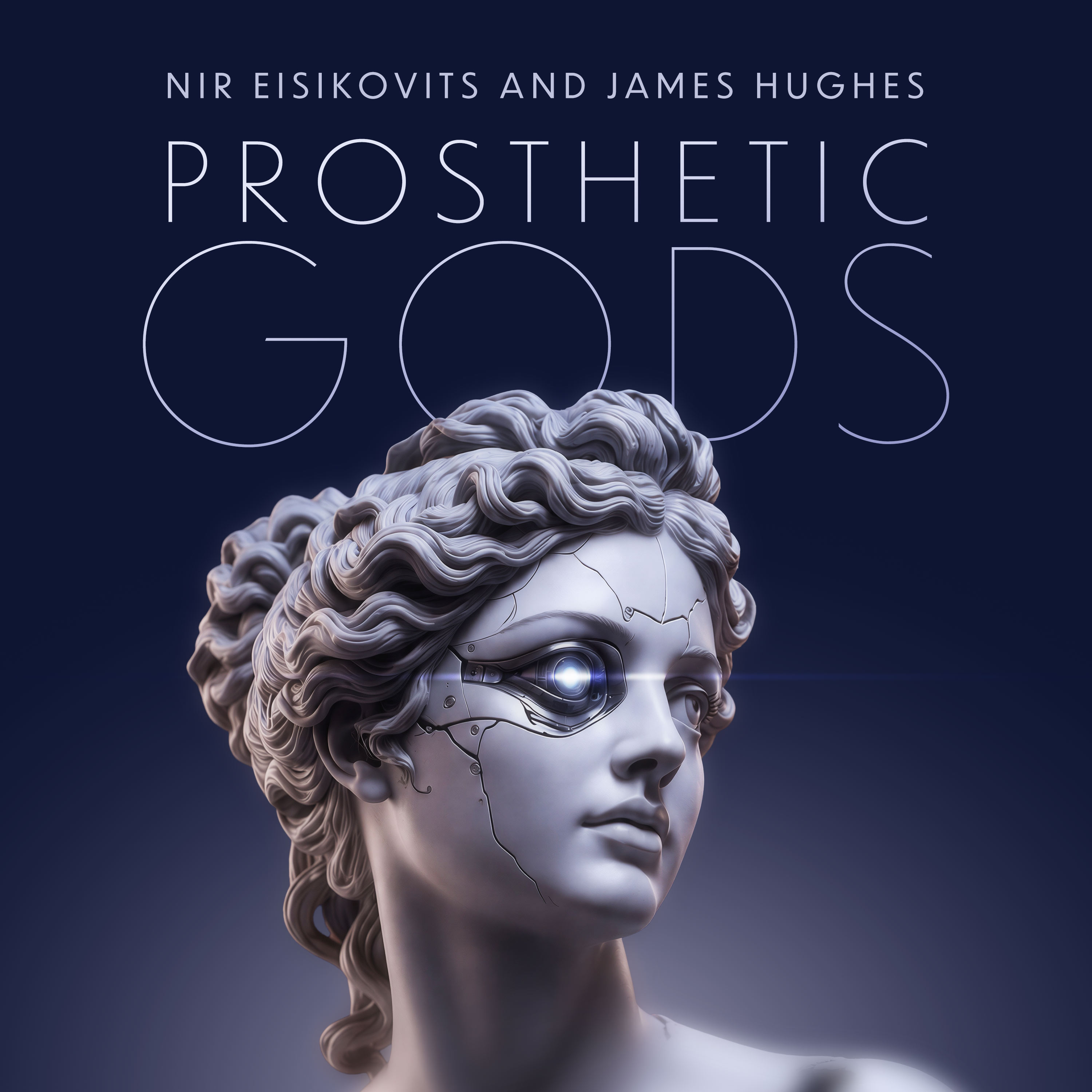
Prosthetic Gods
Hosted by James Hughes and Nir Eisikovits · EN
Welcome to “Prosthetic Gods,” the podcast where bioethicist James Hughes and philosopher Nir Eisikovits engage in spirited debates on the ethics and politics of emerging technologies. Hughes, a pro-technology transhumanist, and Eisikovits, with his Luddite stance, explore topics from brain-computer interfaces to artificial intelligence. Tune in and explore the promise and perils of technological advancements with us!
15episodes
Episodes
Newest firstAll episodes
Right to Try
2w ago01:01:16Tap to summarizeEpisode 45 - Right to Try This week on Prosthetic Gods, Nir and J discuss patient autonomy and the "right to try". The debate surrounding medical autonomy is intensifying as desperate patients use federal "Right-to-Try" laws and amateur biohackers bypass traditional regulations to create and access unapproved treatments. A booming gray market has emerged for unproven, compounded peptide shots, and RFK’s FDA wants to protect that access. These trends highlight a profound ethical tension between a patient's fundamental right to medical self-determination and the state's paternalistic duty to protect the clinical trial regime - which gives us the data necessary for informed consent - and to guard citizens from harm. Ultimately, regulators and bioethicists argue that without rigorous oversight, vulnerable individuals may fall victim to "snake oil" because true informed consent is impossible when a treatment's risks and efficacy remain largely unknown Show Notes: “No Evidence for Trump’s Right to Try Claim” Eugene Kiely “Right–to-Try Does Not Undermine Clinical Trials” Niklas Anzinger “Survey: Americans Overwhelmingly Back the Right to Try for Individualized Treatments” Goldwater Institute “Final wish denied as Colorado ALS patient's access to experimental drug stalls” Brian Maass, Colin McIntyre “Peptides, Patient Autonomy, and the Limits of Medical Freedom” Chuck Dinerstein “Survey Shows Peptide Misinformation, Misuse Rising in US” Ashish Rana “What's behind the push to make peptide therapies more readily available” Will Stone As always, listeners can contact us at prostheticgods@gmail.com with questions, comments, and suggestions for future topics. Credits: Hosted by James Hughes and Nir Eisikovits Music & Production by Jake Burley
Transcribe →Magnificent Humanity: A Conversation with Father Michael Baggot
Jul 801:08:11Tap to summarizeEpisode 44 - Magnificent Humanity This week, J and Nir talk to Father Michael Baggot about Pope Leo XIV’s recent encyclical, Magnifica Humanitas, which outlines Catholic positions on AI and other emerging technologies. Father Michael Baggot is an Associate Professor of Bioethics at the Vatican’s Pontifical Athenaeum Regina Apostolorum in Rome, a member of the Scholarly Advisory Board for Magisterium AI, and the chief editor of Enhancement Fit for Humanity: Perspectives on Emerging Technologies. Show Notes: MAGNIFICA HUMANITAS “Pope Leo’s First Encyclical Is a Game Changer,” The Nation “Pope Leo XIV Against the Market’s Techno-Dehumanization,” Jacobin “Pope Leo Isn’t Standing Athwart the Singularity” New York Times As always, listeners can contact us at prostheticgods@gmail.com with questions, comments, and suggestions for future topics. Credits: Hosted by James Hughes and Nir Eisikovits Music & Production by Jake Burley
Transcribe →Brain-Computer Interfaces
Jun 2401:11:44Tap to summarizeEpisode 43 - Brain-Computer Interfaces This week on Prosthetic Gods, Nir and J discuss the ethics of brain-computer interfaces. What role do they play in the futurist imagination, and what is the reality of their current use? How quickly will they be available for consumer use, and what ethical issues do they pose? Show Notes: The Philosophy of Brain-Computer Interfaces Conference - UMass Boston - June 5-6, 2026 “Long-term independent use of an intracortical brain–computer interface for speech and cursor control” Nature Medicine “Brain-computer interface trials are taking off” MIT Technology Review “Brain Implant Lets Man With Severe Paralysis Speak in His Own Voice Again” ScienceAlert “How Scientists Are Growing Computers From Human Brain Cells” SingularityHub “China Prepares Tianjin as a Center for Brain-Computer Technology” VOI An introduction to Neal Asher's Polity Universe books As always, listeners can contact us at prostheticgods@gmail.com with questions, comments, and suggestions for future topics. Credits: Hosted by James Hughes and Nir Eisikovits Music & Production by Jake Burley
Transcribe →Live from Cambridge: Existential Risk
Jun 301:13:14Tap to summarizeLive from Cambridge: Existential Risk In this special live episode, recorded before an audience at Long Now Boston, Nir and J dig into existential risk. J takes seriously the prospect of catastrophic AI outcomes even absent consciousness or agency in any rich sense, while Nir worries less about civilization-ending scenarios than about a quieter, lowercase existential threat: the erosion of what makes us distinctively human. Show Notes: Find out more about our hosts, Long Now Boston, here! The Hollow Men by T.S. Elliot Enshitification by Cory Doctorow The Apology by Plato Cyborgs and Space by Manfred E. Clynes and Nathan S. Kline As always, listeners can contact us at prostheticgods@gmail.com with questions, comments, and suggestions for future topics. Credits: Hosted by James Hughes and Nir Eisikovits Music & Production by Jake Burley
Transcribe →Who Really Needs Ozempic Anyway?
May 2000:59:26Tap to summarizeEpisode 42 - Who Really Needs Ozempic Anyway? This week on Prosthetic Gods, Nir and J discuss the tradeoffs of GLP1 drugs. Their use has reversed the obesity epidemic and has proven to have myriad medical and psychological benefits. But they also come with risks, and are seen as a technofix replacing the need for diets. Are GLP1s another step to the posthuman body, and is that a good or bad thing? Errata: The first GLP1s were approved by the FDA in 2005, semaglutide/Ozempic in 2017, and oral orforglipron/Foundayo was approved in April 2026. More than two thirds of American adults are overweight or obese by BMI, and 40% are obese. Show Notes: GLP-1s Are a Lot Weirder Than Anyone Thought | The Ezra Klein Show Ethical Considerations in the Use of Weight Loss Medications The Ethics of Ozempic and Wegovy WHO issues global guideline on the use of GLP-1 medicines in treating obesity Review of 64 studies finds GLP1s effective for weight loss for almost all groups Obesity rate declining in US Hard Fork Podcast Rest is History Podcast As always, listeners can contact us at prostheticgods@gmail.com with questions, comments, and suggestions for future topics. Credits: Hosted by James Hughes and Nir Eisikovits Music & Production by Jake Burley
Transcribe →Disgust
May 600:52:27Tap to summarizeEpisode 41 - Disgust This week on Prosthetic Gods, Nir and J discuss the role of disgust in morality. Neuroscience suggests that feelings of disgust underlie many moral judgments, especially in the treatment of sexuality. Conservatives have long defended disgust as a source of moral intuition, while liberals seek to minimize it. Can we suppress disgust? Should we? Show Notes: Hiding from Humanity: Disgust, Shame, and the Law by Martha Nussbaum “The Wisdom of Repugnance,” by Leon Kass The Righteous Mind by Jonathan Haidt “Daedalus, or, Science and the Future,” JBS Haldane What We Are Seeking, Cameron Reed Wolfendon Report of the Committee on Homosexual Offenses and Prostitution Jeremy Bentham’s Auto-Icon As always, listeners can contact us at prostheticgods@gmail.com with questions, comments, and suggestions for future topics. Credits: Hosted by James Hughes and Nir Eisikovits Music & Production by Jake Burley
Transcribe →Nicholas Christakis - Technology and Contagion
Apr 2200:56:32Tap to summarizeEpisode 40 - Nicholas Christakis - Technology and Contagion Dr. Nicholas Christakis is the Sterling Professor of Social and Natural Science at Yale University and the Director of the Human Nature Lab. His research sits at the intersection of the social, biological, and computational sciences, exploring how our evolutionary biology and social network structures shape human behavior, health, and society. His groundbreaking work on "social contagion," demonstrates how everything from obesity and smoking to happiness and cooperative behavior spreads through human networks. Most recently, his work has focused on the emergence of "hybrid systems" of humans and machines, examining both the Burkean risks of how AI might degrade our interpersonal social graces and the technoprogressive potential of using "dumb bots" to optimize human coordination. Show Notes: The Human Nature Lab at Yale University An overview of Dr. Christakis's current research on social networks, computational social science, and the biology of social interactions. Blueprint: The Evolutionary Origins of a Good Society, by Nicholas Christakis. His 2019 book detailing how evolution has biologically pre-wired humans for a "good society" based on love, friendship, and cooperation. Connected: The Surprising Power of Our Social Networks and How They Shape Our Lives, by Nicholas Christakis His 2009 book exploring the "three degrees of influence" rule and how social contagion dictates our behavior. Dr. Christakis on Bluesky - @nachristakis.bsky.social For the Love of Science Vlog As always, listeners can contact us at prostheticgods@gmail.com with questions, comments, and suggestions for future topics. Credits: Hosted by James Hughes and Nir Eisikovits Music & Production by Jake Burley
Transcribe →Live from Portsmouth: Artificial Intelligence and Human Values
Apr 1702:13:21Tap to summarizeLive from Portsmouth: Artificial Intelligence and Human Values In this special live episode of Prosthetic Gods, we bring you a night of big ideas recorded on April 2nd at the Music Hall in Portsmouth, New Hampshire. Presented as part of the University of New Hampshire's Sidore Lecture Series, "Artificial Intelligence and Human Values" gathered three leading thinkers to explore what AI means for how we live, think, and relate to one another. The evening opens with short, TED-style talks from Kay Mathieson (Northeastern University), Henry Shevlin (Cambridge University), and Harvey Lederman (UT Austin), each offering a distinct lens on the philosophical, ethical, and cognitive stakes of AI. Nir and J then take the stage to lead a wide-ranging live discussion with all three speakers and with questions and reflections from the Portsmouth audience. Show Notes: Artificial Intelligence and Human Values: A Public Conversation As always, listeners can contact us at prostheticgods@gmail.com with questions, comments, and suggestions for future topics. Credits: Hosted by James Hughes and Nir Eisikovits Music & Production by Jake Burley
Transcribe →Sven Nyholm on Ethics of AI
Apr 901:09:27Tap to summarizeEpisode 39 - Sven Nyholm on the Ethics of AI This week on Prosthetic Gods we are talking to Sven Nyholm about his new book The Ethics of Artificial Intelligence. If our thinking relies on external media, where do we stop and the AIs start? What is the moral status of LLMs? Are they sentient? Are AI relationships any good? And should we raise robots like children? Sven Nyholm is Professor of the Ethics of Artificial Intelligence at LMU Munich and a Principal Investigator for AI Ethics at the Munich Center for Machine Learning. His books include Humans and Robots: Ethics, Agency, and Anthropomorphism and This Is Technology Ethics: An Introduction, and his latest, The Ethics of Artificial Intelligence, ranges from alignment and moral responsibility to artificial consciousness and the existential stakes of humanity's wager on AI. Show Notes: Sven Nyholm at Researchgate and PhilPapers “How AI Robs Us of Meaning” Sven Nyholm The Ethics of Artificial Intelligence by Sven Nyholm As always, listeners can contact us at prostheticgods@gmail.com with questions, comments, and suggestions for future topics. Credits: Hosted by James Hughes and Nir Eisikovits Music & Production by Jake Burley
Transcribe →Humanoid Robots
Mar 2501:02:00Tap to summarizeEpisode 38 - Humanoid Robots This week on Prosthetic Gods, Nir and J talk about the distinctive ethical issues raised by the humanoid robots coming to homes and workplaces. Their presence and human-like form elicit unique responses compared to those of non-embodied AI. The appearance of a robot can manipulate human empathy and consent; robotic caregiving could be used as a pretext to dismantle the social safety net, and robot lovers could deepen loneliness. Show Notes: Moravec’s paradox “Can AI Robots Help Older Adults Live in Their Homes Longer?” By Lee Pruitt “China Could Dominate the Physical AI Future” by Eric Schmidt and Selina Xu “Humanoid Robots to Reach Nearly US$30 Billion by 2036” by Shihao Fu Humans (2015-2018, 3 seasons) Battlestar Gallactica (2004-2009, 5 seasons) As always, listeners can contact us at prostheticgods@gmail.com with questions, comments, and suggestions for future topics. Credits: Hosted by James Hughes and Nir Eisikovits Music & Production by Jake Burley
Transcribe →