
Podcast
Public Lectures from the Faculty of Law, University of Cambridge
Hosted by Faculty of Law, University of Cambridge · EN
The Faculty of Law has a thriving calendar of lectures and seminars spanning the entire gamut of legal, political and philosophical topics. Regular programmes are run by many of the Faculty's Research Centres, and a number of high-profile speakers who are leaders in their fields often speak at the Faculty on other occasions as well.
Audio recordings from such events are published in our various podcast collections. Video recordings are available via YouTube.
18episodes
Episodes
Newest firstAll episodes
The Death Penalty in the Commonwealth - A Complex Landscape: Cambridge Pro Bono Project Annual Lecture 2026
May 800:44:30Tap to summarizeThe Cambridge Pro Bono Project (CPP) hosted the annual lecture featuring Saul Lehrfreund MBE on Thursday 7th May 2026. Saul is Co-Founder and Co-Executive Director of The Death Penalty Project, an international legal action charity based at Simons Muirhead & Burton LLP in London.The Cambridge Pro Bono Project is a research centre that draws on the subject-matter expertise of graduate researchers and Faculty experts to produce reports on a wide range of public interest matters. Every year, we invite distinguished speakers to address our researchers, staff, and students at the University of Cambridge. For more information about the Cambridge Pro Bono Project, see https://www.cpp.law.cam.ac.uk/ Twitter (https://twitter.com/Cam_ProBono) or Facebook (https://www.facebook.com/CamProBono).
Transcribe →'Implications of U.S. Foreign Aid Cuts and Reciprocal Tariffs for African Countries - A View from the Global South' - Prof Olabisi D Akinkugbe, University of Dalhousie
May 100:38:15Tap to summarizeLecture summary: President Trump’s decisive attack on foreign aid and USAID, leading to the restructuring of the latter and the closure of ongoing and future development aid work across the world, has left many vulnerable regions of the world in potential crisis. With some of the funds hitherto allocated to development aid in vulnerable Global South countries reallocated to national economic projects or redirected to support programs that deepen U.S. foreign policy objectives of America First abroad, one thing is clear: economic nationalism, power-based relations, and opposition to the rules-based order is back.Calculated, unfair, and transactional politics is the name of the game for President Trump’s return to office so far. Whether it is in relation to a developed, developing, or least-developed country, the Trump administration has unapologetically proven that it does not care whose ox is gored. Despite the US Supreme Court ruling, the “Reciprocal Tariff Policy” has disrupted and entrenched the uncertainty in the multilateral trading system that was already confronted with crisis about its own existence, especially the World Trade Organization, and the resulting fragmentation in international trade has further exacerbated the socio-economic and fragile status of developing countries.Olabisi Delebayo Akinkugbe is the Purdy Crawford Chair in Business Law and Associate Professor at the Schulich School of Law, Dalhousie University. Prof Akinkugbe obtained a Ph.D. in law from the University of Ottawa, an LL.M. from the University of Toronto, and an LL.B. from the University of Lagos, Nigeria. He previously served as the Viscount Bennett Professor of Law at the Schulich School of Law and was convenor of the annual Viscount Bennett Roundtable on International Economic Law.In 2024, he was the recipient of the Hannah and Harold Barnett Excellence in Teaching Award.In this paper, I analyse the multiple implications for developing countries in the African continent.Chair: Prof Lorand BartelsThis lecture was delivered on 1 May 2026 and is part of the Friday Lunchtime Lecture series.
Transcribe →Child Contact Arrangements in the Context of Gender-Based Violence. A look at the Spanish no-contact rule: Family Law Seminar
Apr 3000:28:18Tap to summarizeSpeaker: Dr Maitena Arakistain Arriola (Assistant Professor in Civil Law, University of the Basque Country; Visiting Fellow CFL; Bye Fellow, Robinson College)Can the pro-contact culture that prevails in the justice system in child arrangement cases be changed through legislative reform? This is exactly what the Spanish legislator tried to do in 2021 when he amended the Civil Code to introduce a no-contact rule in cases of gendered-based violence. Now the presumption is that there will be no contact unless proven to be in the child’s best interests. Has it worked? The number of cases where unsafe contact is still awarded by the courts suggests that it has not, or, at least, not yet. In this seminar we will look at the position under Spanish Law and we will examine some of the arguments used to avoid the new no-contact rule.For more information about the Faculty Family Law Centre (CFL), see:https://www.family.law.cam.ac.uk/
Transcribe →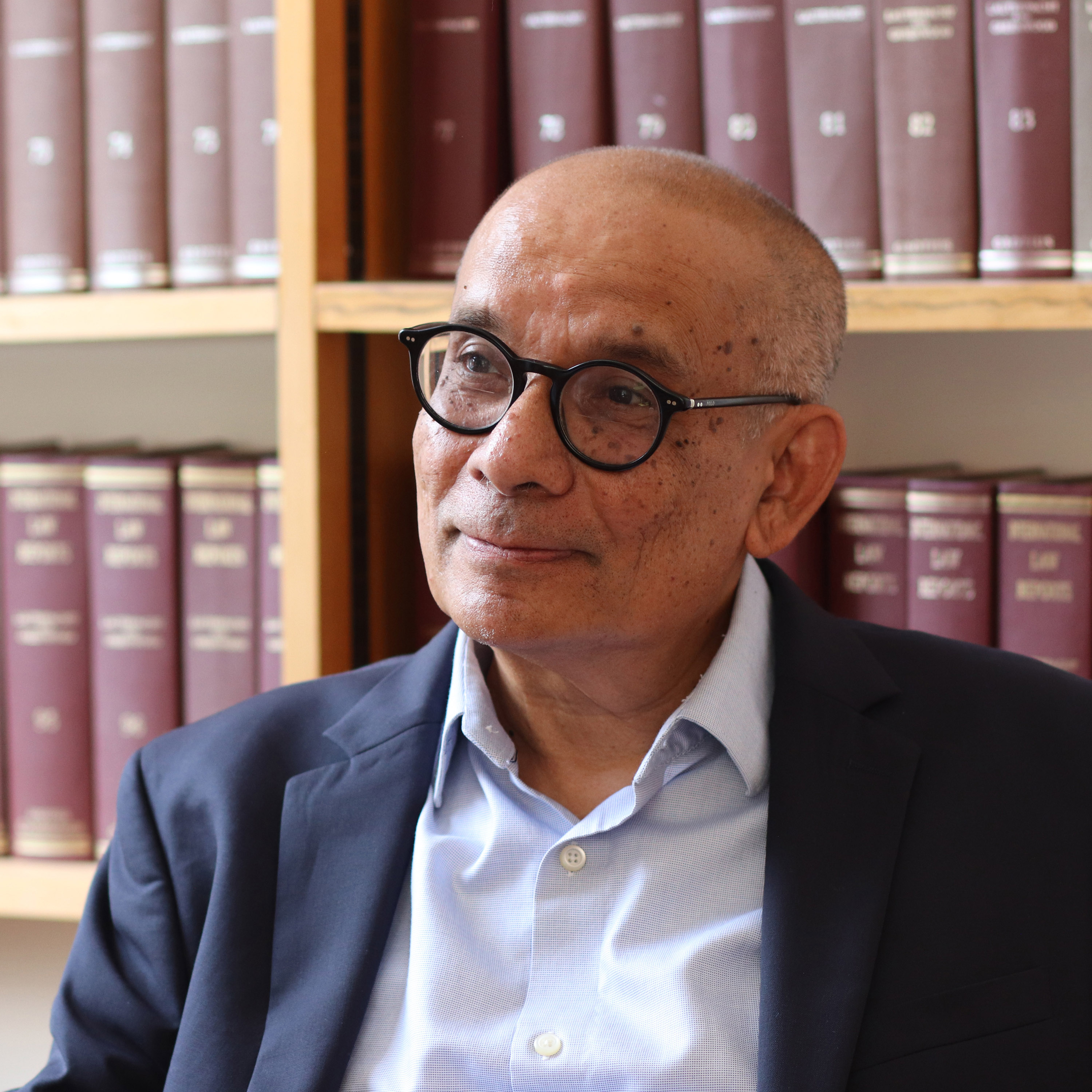
Conversation with Professor Anthony Anghie
Apr 2300:54:42Tap to summarizeProfessor Anthony Anghie was the Arthur Goodhart Visiting Professor of Legal Science for the academic years 2024-25. He was interviewed at the Lauterpacht Centre for International Law in Cambridge on 16 June 2025.For more information, see the Squire website at:http://www.squire.law.cam.ac.uk/eminent_scholars/
Transcribe →Panel 2: Is the Architecture of International Justice under threat?
Apr 1400:37:59Tap to summarizeThe Sixth Annual Wolfson Sir David Williams Law Society Event was held on 7 March 2026.This Wolfson College Cambridge event featured two insightful panel discussions with distinguished law professionals; an afternoon tea and a formal dinner to conclude the day.The event was primarily aimed at Wolfson Law and Criminology alumni, current students, and individuals working in the legal field.Panel One: Environmental Regulation in the Era of Climate Change Chair: Tugba Basaran (Wolfson College)Speakers: Prof Surabhi Ranganathan (Lauterpacht Centre for International Law), Prof Avidan Kent (University of East Anglia), Róisín Finnegan (Barrister, Six Pump Court)Panel Two: Is the Architecture of International Justice under threat? Chair: Thomas Grant (Wolfson College)Speakers: Prof Nicola Padfield (Emeritus Professor of Criminal and Penal Justice; Former Director, Cambridge Centre for Criminal Justice), Isuru Devendra (Barrister, 36 Stone), Marie-Anne Coninsx (first EU Ambassador to the Arctic 2017-2019)For more information see: https://www.wolfson.cam.ac.uk/about/events/sixth-annual-wolfson-sir-david-williams-law-society-event
Transcribe →Panel 1: Environmental Regulation in the Era of Climate Change
Apr 1401:01:34Tap to summarizeThe Sixth Annual Wolfson Sir David Williams Law Society Event was held on 7 March 2026. This Wolfson College Cambridge event featured two insightful panel discussions with distinguished law professionals; an afternoon tea and a formal dinner to conclude the day. The event was primarily aimed at Wolfson Law and Criminology alumni, current students, and individuals working in the legal field. Panel One: Environmental Regulation in the Era of Climate Change Chair: Tugba Basaran (Wolfson College) Speakers: Prof Surabhi Ranganathan (Lauterpacht Centre for International Law), Prof Avidan Kent (University of East Anglia), Róisín Finnegan (Barrister, Six Pump Court) Panel Two: Is the Architecture of International Justice under threat? Chair: Thomas Grant (Wolfson College) Speakers: Prof Nicola Padfield (Emeritus Professor of Criminal and Penal Justice; Former Director, Cambridge Centre for Criminal Justice), Isuru Devendra (Barrister, 36 Stone), Marie-Anne Coninsx (first EU Ambassador to the Arctic 2017-2019) For more information see: https://www.wolfson.cam.ac.uk/about/events/sixth-annual-wolfson-sir-david-williams-law-society-event
Transcribe →The Rt. Hon. Lord Lloyd-Jones addresses the Exploring Law Conference
Apr 100:44:05Tap to summarizeIn this lecture, delivered at the 51st iteration of the Exploring Law Conference (ELC) at Cambridge, Lord Lloyd-Jones provides an expert overview of the United Kingdom's highest appellate bodies: the Supreme Court of the United Kingdom and the Judicial Committee of the Privy Council.Key themes from the address include:Constitutional Evolution: The 2005 transition from the "Law Lords" in the House of Lords to an independent Supreme Court, emphasising the separation of powers and increased transparency.The Supreme Court's Mandate: The court acts as a final arbiter for "points of law of general public importance," deciding cases that shape the development of the law across the UK.The Value of Dissent: A rigorous defence of the right to issue dissenting judgments, which Lord Lloyd-Jones argues enhances intellectual rigour and signals that the law is a living debate.The Global Reach of the Privy Council: An exploration of its role as the final court of appeal for 29 overseas jurisdictions, highlighting its unique ability to apply local laws - from common law to the Napoleonic Code.Constitutional Boundaries: A comparison between the UK’s principle of parliamentary sovereignty - where courts cannot strike down primary legislation - and other jurisdictions where the Privy Council may invalidate unconstitutional laws.Lord Lloyd-Jones concludes by encouraging the next generation of "high fliers" to pursue careers in the law, promising a rewarding and intellectually stimulating path.For more information about the Conference, see:https://www.law.cam.ac.uk/access-outreach/exploring-law-conference
Transcribe →Privacy International (Yorke Distinguished Visiting Fellows Seminars)
Nov 17, 2022Tap to summarizeThe Faculty of Law is organising in the 2022-23 academic years three seminars on key public law cases, given by three Yorke Distinguished Visiting Fellows – Lord Carnwath, Lady Hale, and Lord Lloyd-Jones.The first of these seminars took place on Wednesday 16 November and was given by Lord Carnwath, looking at the Privacy International case. Lord Carnwath gave the leading judgment of the majority in the case. Lord Carnwath and Professor Alison Young talked about the impact of the new ouster clause found in section 2 of the Judicial Review and Courts Act 2022. Lord Carnwath talked about his judgment in this case and the new legislation, with a brief response from Alison Young.The talk was sponsored by the Centre for Public Law.
Transcribe →