← Question Everything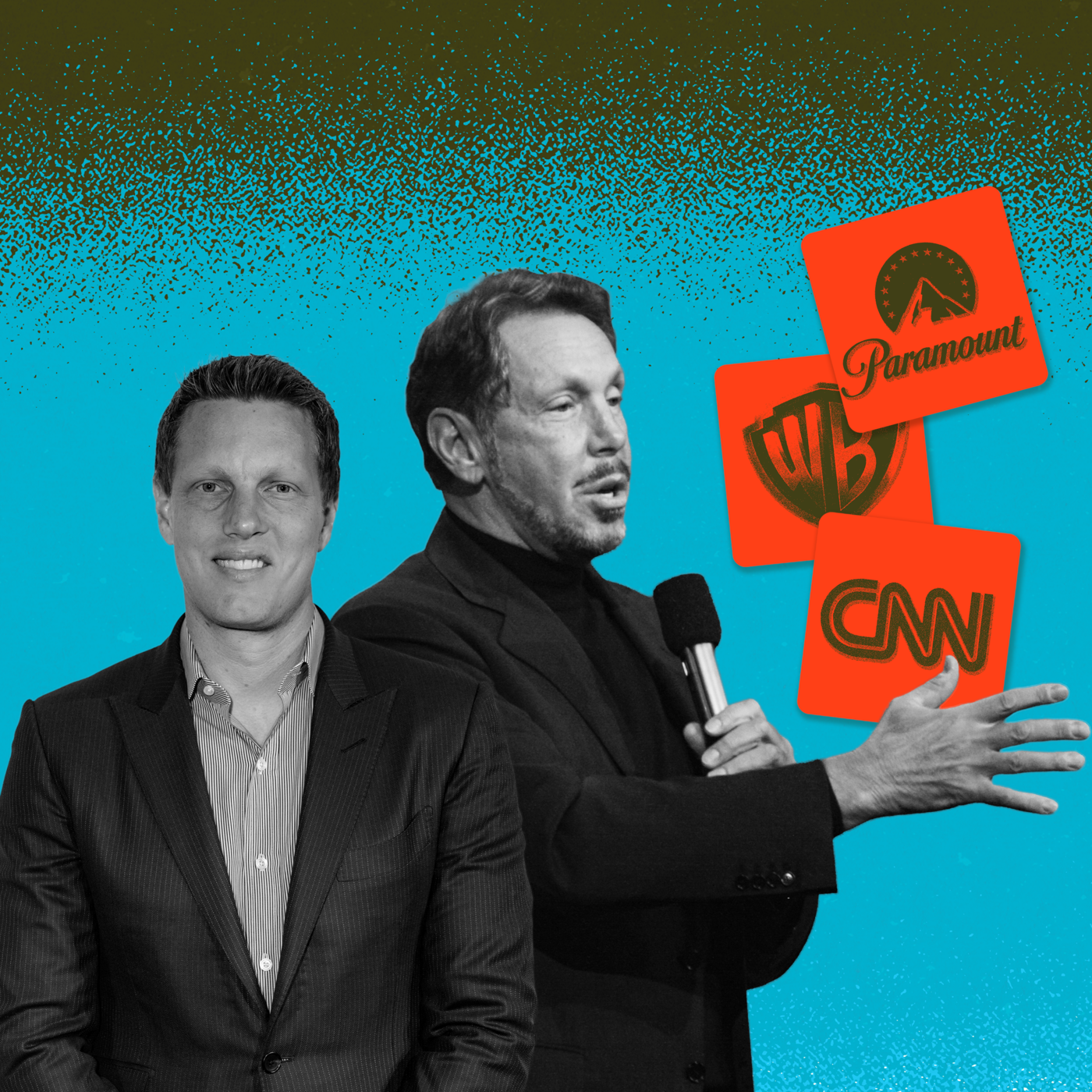
Question Everything
Are We Captured Yet? Now Trump’s Pals Are Taking Over CNN
00:39:51
What it means that the American media is being gobbled up by friends of the president.
Loading summary
Transcript76 lines
- [00:01]
Brian Reed
A few months ago I told you I was absolutely freaking out after Skydance Media took over Paramount. The reason the owners are buddy buddy with Donald Trump. Larry Ellison is great and his son David is great. They're friends of mine, they're big supporters of mine and they'll do the right thing. Now those same friends of Trump's are buying another media empire, Warner Bros. Discovery, which includes the iconic Movie Studio Warner Bros. 8 HBO and the News network that Donald Trump just can't stand, CNN. We've got a Brian Reed freakout 2.0. So in the last couple months, there's been this dramatic bidding war going on between Netflix and Paramount to gain control of Warner Brothers Discovery. For a while, it looked like Netflix was going to come out on top of Warner Bros. Accepted their offer. But then Paramount kept throwing more money at Warner Bros. Until finally a couple weeks ago, Netflix backed out and Paramount won. Economic reporter Robin Farzad told PBS NewsHour it wasn't even necessarily the cash that sealed the deal for the owner of Paramount, David Ellison and his dad, Larry Ellison. Netflix just came to realize it probably couldn't win no matter how high it bidden. Netflix got every signal from this White House and the fcc and Donald Trump being explicit and both with kind of background suasion that by far he prefers Paramount and the Ellisons taking this over. He'd like to see CNN under new ownership, ideally friendly to the persuasions of Donald Trump. Larry Ellison, one of the richest men in the world, founder of Oracle, is a big donor of Donald Trump's. We've already seen what happened after the Ellisons took control of CBS News. One of David Ellison's first moves was to install a new editor in chief. Bari Weiss, who before this had never worked in broadcast news or even been a news reporter. She's an opinion journalist with very clear political alignments and views that often skew rightward. In her first months on the job, she caused a huge controversy when she pulled a 60 minute story that was critical of the Trump administration. It was about immigrants being sent to El Salvador and she claimed it needed an interview with a member of the administration before it could run. The reporter on the story accused the network of pulling her piece for political reasons. Then there was a whole scandal when Bari Weiss reportedly kissed Donald Trump on the cheek after an interview. And then just a few weeks ago, a CBS News producer quit, saying journalists are being forced to self censor and claiming their stories are being evaluated on a shifting set of ideological expectations. So what can we expect when the Ellisons take over Warner Brothers and cnn. Just the latest of many threats against the media since Trump took office. The Pentagon's press office trying to bring in MAGA media influencers of election deniers
- [02:56]
Natalia Antelova
and pro Trump propagandists handpicked to ample
- [02:59]
Brian Reed
for a second day, the White House has marked the Associated Press today, the corporation. There's a name for what's happening. It's called media capture. It's when a government or authoritarian leader effectively controls the media and gets it to serve as a megaphone for their agenda. For a long time, US journalists have looked to other countries to try and measure are we there yet? Is the American media captured? Are we as bad as Hungary, as Russia, as Turkey? Researchers have come up with models for media capture. Some break it down into four. Stage one, taking over the broadcast regulator here, that's the fcc. Stage two, going after public media. Stage three, using government money to influence the press in other ways. And then stage four, having rich allies of the leader buy up private media companies. This is normally the hardest and most complicated step. But the fact that it's already happening pretty rapidly. This is why I'm freaking the fuck out over the Ellisons taking over all of these media companies and news organizations now CBS and cnn. And it's why we're gonna bring you this episode that first ran back in October about media capture. Because back then I was trying to figure out, are we there yet? Are we in media capture? And how. And again, back in October, I got a pretty unsettling answer.
- [04:34]
Natalia Antelova
It creeps up on you. And I have watched it creep up on people, brave, principled people, because you slowly make choices that you can live with.
- [04:46]
Brian Reed
From KCRW emplacement theory, I'm Brian Reed. This is Question Everything Today, my conversation with someone who's reported in countries around the world whose media has been captured. She's actually from one and now she's here in the US she's come here to cover this topic. And I was surprised, though I guess I shouldn't have been, that the place she wanted to station herself to understand media capture wasn't Washington, wasn't New York, but Silicon Valley. Stick around. Can you list all the countries that you've worked in whose media was captured?
- [05:25]
Natalia Antelova
Russia, Georgia, Syria, Lebanon. Thinking whether Iraq fits the bill, like Kyrgyzstan, Uzbekistan, Burma. I can keep going, actually.
- [05:39]
Brian Reed
Natalia Antilova has spent 15 plus years as a foreign correspondent. She's reported for the BBC, CNN, the New Yorker from all the countries she listed and more. She's from Georgia, the country as she's constantly clarifying, which was part of the Soviet Union when she was growing up. Now Natalia runs a newsroom called Coda Story, which covers the erosion of democracy around the world and the corruption of the free press. This is Natalia's beat, which is why I went to her to find out, has it happened yet? Is the US Captured? How would we know if the US Media is captured?
- [06:14]
Natalia Antelova
I think one of the signs is self censorship.
- [06:18]
Brian Reed
But from the start, Natalia didn't talk about it that way. She kept gently but firmly trying to redirect my framing. She was describing something slipperier and frankly scarier than that.
- [06:29]
Natalia Antelova
I think when you find yourself in a situation when journalists question themselves and what they're willing and not willing to say, where your editorial decisions become part of the bigger calculation of, like, how is that going to affect my life? Am I going to get fired or am I going to get deported or am I going to go to prison? And the stakes get higher and higher, higher. But it can start with a very simple, am I going to get in trouble? Like, is this a story that's worth doing? And I think that's part of the reason why the threshold is so difficult to identify, because I think it happens on individual level for many, many people in silence. It's almost internal. I mean, then there are like, much more obvious signs. Takeovers of businesses, suspicious mergers, departures of big stars, television shows that sort of like silencing of voices, that has business excuse that looks completely legitimate on CBS is interesting. We genuinely don't know what's gonna happen with the CBS takeover. But the ducks align, right?
- [07:44]
Brian Reed
This is what's so tricky and insidious about media capture. There always seems to be an excuse or a reason to explain something away. Like when CBS canceled Stephen Colbert as they were trying to get the Trump administration to approve their merger with David Ellison's company. Did that mean we're captured or did it just mean late night shows are losing money? Probably both. But the money thing muddies the claim of capture. How about Jeff Bezos overhauling his Washington Post's opinion section to be more conservative? Is that capture creeping in? Or just the personal political preferences of a billionaire businessman? How about the editor at a national magazine I was chatting with telling me he's noticed them assigning fewer stories about people of color or about women or conservation, how they're reorganizing their story list to delay pieces that deal with identity capture or just a publication reflecting the Zeitgeist.
- [08:39]
Natalia Antelova
It's subtle shifts in the environment that are very Easy to justify as the water in which you're boiling gets hotter and hotter.
- [08:50]
Brian Reed
But do you feel there is a threshold when a country goes from the media is not captured to we are in capture?
- [08:58]
Natalia Antelova
I think it's very easy to see it in hindsight rather than when it's happening in real life. I remember in 2014 covering the annexation of Crimea and we were seeing all this Russian troops coming in and taking over.
- [09:17]
Brian Reed
This was in February of 2014. Russia invaded this part of Ukraine, Crimea, and ultimately annexed it, made it part of Russia. Natalia was there on the ground watching as troops streamed in, trapped in the
- [09:29]
Natalia Antelova
middle of a battle between Kremlin backed rebels and Ukrainian troops. I was doing a live for the BBC and next to me was a Russian television correspondent who was going on air. And the dynamic on the ground was that there were all these Russian troops, but they had no insignia. So you kind of couldn't tell whose troops they were. And Putin kept insisting day after day after day that there were no Russian troops in Crimea.
- [10:01]
Brian Reed
Putin was insisting these soldiers were local Ukrainian militias. Not true. They were Russian troops, as the Ukrainians were claiming from the start.
- [10:10]
Natalia Antelova
And I'm standing on the ground in Crimea. I'm about to do a live hit. I'm standing next to the, and we had like a little patch and a Russian television correspondent was next to me and I'm listening in and he talks about the fact that these troops are self defense battalions who are, you know, in Crimea and they're like local Ukrainian Crimeans who are defending. And then the line cuts like he's done and then he starts shouting and screaming into the microphone because he's gone back to his producer swearing and saying like, I can't do this anymore. This is a total lie. You know it's a lie. You're making me say these things. This is such bullshit. They're our boys. They're our boys. When are we gonna say that they're our boys? And I remember going up to him later that night. We were in the same hotel and we ended up, you know, chatting for quite a while. He was, you know, a nice, intelligent man who was basically saying, I don't know what to do, I can't quit. I have no other skill. I have a family to support. I can't get out of Russia. I've spent my whole career working for this station, like, what do I do? But I also can't do that anymore, you know, and he was dealing with this like enormous like personal dilemma. But everyone working for Russian TV knew that the official line was, these are self defense battalions indigenous to Crimea. These are not Russian troops. And this is what we're doubling down on. And that's what he had. He knew he had to double down. And.
- [11:54]
Brian Reed
Or what had he not?
- [11:55]
Natalia Antelova
Oh, he'd be fired. He said he'd be fired. He was told that he'd be fired. We know that the core messaging is decided in the Kremlin and then passed out to the editors in chief of the main stations in Russia. And then things can be massaged around the core messaging. But there are some messages that they have to stick to that they absolutely have to stick to. And the order was to stick to the line that this were not Russian troops.
- [12:24]
Brian Reed
Stick to it or what? And I understand the consequence for that individual journalist, if he had on live TV said the truth, said something different, he would have been fired. But in terms of the kind of top down chain of command you're describing
- [12:35]
Natalia Antelova
in Putin's Russia, stick to it or you're going to fall out of a window. Because that's the kind of regime it is. Right. They kill you.
- [12:44]
Brian Reed
Right. I'm generally wary of comparing Russia's treatment of the press to the us. I've always worried about overblowing it. The real threat of violence seemed to put Russia in another category. But it is true that more and more journalists in America are getting tear gassed by law enforcement, assaulted, locked up. One was just deported after covering ice. And Natalia, who has reported in Russia, who grew up in the Soviet Union, she is not hesitant to compare there to here.
- [13:16]
Natalia Antelova
I don't know how helpful it is to make a distinction between capture and repression, because repression is capture. Obviously. It's a completely different environment. The power dynamics are different. I see the pattern that is the same. One of the things that I've noticed is the centralization of the message. I think this administration is very disciplined and very good at putting certain messages out and making sure that they're widely picked up in slightly different iterations by so many actors. That just becomes the narrative. When it comes to narratives, I think there's so many that have become embraced in the U.S. i mean, something as simple as librarians are the enemy, like the war on librarians in the U.S.
- [14:08]
Brian Reed
the president fired the Librarian of Congress. Why did he choose to do that?
- [14:12]
Natalia Antelova
We felt she did not fit the needs of the American people. There were quite concerning things that she had done at the Library of Congress in the pursuit of dei and, well, like slavery wasn't really a thing in the US that backtracking like that. It happens in a very similar way in other authoritarian environments as well.
- [14:34]
Brian Reed
Listening to Natalia, I started thinking about Donald Trump's big lie. The lie about him having won the 2020 election and how that proliferated, how an autocrat doesn't need to use actual state violence against journalists to get what he wants. The big guy starts shouting the message from the top. This is a fraud on the American public.
- [14:55]
Natalia Antelova
This is an embarrassment to our country. We were getting ready to win this election. Frankly, we did win this election.
- [15:08]
Brian Reed
That message shoots out like from a splatter gun into the media ecosystem, boosted along by podcasters and weird fake news Facebook pages and memes. Audiences start buying it. The big right wing broadcasters take it up. Talk radio, Fox News, we don't know how many votes were stolen on Tuesday night. We don't know anything about the software
- [15:29]
Natalia Antelova
that many say was rigged.
- [15:31]
Brian Reed
We don't know. We ought to find out. I love these legal challenges because we
- [15:34]
Natalia Antelova
have to get to the bottom of
- [15:35]
Brian Reed
all this and expose fraud where it occurred. They concoct all sorts of tall tales that support this fake narrative about phony ballots on planes and corrupted voting machines. Right now, Joe Biden is pretending to be the President elect. They know they haven't won this thing fair and square. A third of the country comes to believe this damaging fake story that the election wasn't legitimate. The lie inspires an insurrection attempt. And when Trump comes back into office, he makes denying the results of the 2020 election a cornerstone of his administration. It becomes a loyalty test for people in the MAGA world. Here's Democratic Senator Elizabeth Warren last month trying to get Trump's nominee for the Federal Reserve Board, Stephen Myron, to crack and simply state the truth. Easy. Yes or no, did Donald Trump lose the 2020 presidential election? Joe Biden was certified by Congress as the President of the United States. Right.
- [16:33]
Natalia Antelova
So did Donald Trump lose that election?
- [16:36]
Brian Reed
As I just said, Joe Biden was certified. Donald Trump lose state election. Can you say the words Donald Trump? Donald Trump lost that election. Are you independent enough to say that the Congress certified Joe Biden as President? All right, so that was one. Let's try another.
- [16:49]
Natalia Antelova
Obviously, the White House is not sending directives to, you know, heads of ABC and so on, but yet, do we now live in the world where they don't need to? Because they create the mood music so effectively with that, like centralized messaging, they push it out to their sympathizers in the movement. So they just create this mood music. And that mood music is very much part of and that's what creates the narrative. And then with just a little bit of fear and a little bit of self censorship, it's easier and it's safer in the time of great uncertainty just to be on the safe side, to just follow the mood music. And that's how everyone gets co opted into it. Capture works in much more subtle ways than we imagine. It creeps up on you. And I have watched it creep up on people, brave, principled people, because you slowly make choices that you can live with.
- [17:54]
Brian Reed
After a quick break, Natalia explains a grand unified theory she's come up with for how censorship works in the modern age. And she points at an important culprit. What's up, la? This is Roy Choi, honored to be among fellow chefs, bakers and food folks judging KCRW's pie fest and contest. Back this pie day, Saturday, March 14th. We're tasting your pies, man, baked with love amor flavor, everything you got in just four categories, apple, other fruits, cream, custard, and pies by junior bakers. Final judging happens live on stage, so be there. RSVP now@kcrw.com Pie. Welcome back. If you've been listening to our show recently, you know I'm wrestling with the question of what can be done about lies that are overwhelming us online and how to hold tech companies more accountable for their role in this. I've honed in on this policy change, reforming a law called Section 230 to allow people to sue Internet companies when they algorithmically boost posts that are defamatory. As Natalia has studied the way that repressive regimes are operating in recent years, including regimes she's reported under, as she's documented the methods they've devised to stamp out narratives they don't like. She's come up with a theory, one that's specifically about what I've gotten focused on, too, the Internet and social media and the way strongmen leaders are using it.
- [19:29]
Natalia Antelova
Instead of censorship, what authoritarian regimes use the world over is noise. And I think noise has become the new censorship. As a child, I was born in the Soviet Union, and I remember my early childhood memories as, you know, my mom listening to shortwave radio to the Voice of America or the BBC, because she knew that all the information we got at home was fake. And you had to find a signal that came from the outside to give yourself understanding of what really was happening, Right? And you had to like interpret it. And that's how you try to make sense of the world and figured out how to navigate it. I think what has happened since is that we don't. We no longer have censorship the way we had it. Like that doesn't exist anymore. And I don't think it's coming back on a big scale. I don't think it's going to come to America in the way that it happened in the Soviet Union. You no longer need to censor a single voice. You put out so much noise that truth gets lost and it becomes impossible to figure out who is saying what. Endless theories and rumors and fake news and pieces of information, you know, and some of it is truthful information, too. Yeah, but it's. If it's all going into the same pipe, and if that pipe is full of sewage, you know, a little bit of clean drinking water is not going to make any difference. And that artificial.
- [21:09]
Brian Reed
I'm not drinking that water.
- [21:10]
Natalia Antelova
Yeah, you're right, but. No, you. But you are. We're all drinking that water. That's the thing. We're all drinking that water.
- [21:20]
Brian Reed
This made me think back to my trip this summer to the Iowa State Fair, where I asked people how they were feeling about the state of things in the country and with the media and just the exhaustion they expressed. Personally, I feel like it's hard to know who to trust in the press to get a straight answer on things. It's exhausting. Every time you turn around, nobody knows what's true. Nobody knows what to believe. How do you know what's real and what's fake? Sometimes you know, because sometimes you get these fake news articles that'll report this and people will go, oh, yep, that's real. So let's all believe it and spread it out there. Natalia says, what I was hearing people say in Iowa, that's evidence of media capture.
- [22:02]
Natalia Antelova
I think that's the big picture to media capture, because media capture is happening in that bigger environment that is so noisy, that is so overwhelming, that is so hard to punch through that it becomes much easier for those with resources and power to manipulate certain narratives and to make sure that they go the way they want. Silicon Valley has become the perfect accomplice to people like Vladimir Putin because they're the ones who created the information architecture that allows for this. The zone is being flooded constantly, all the time.
- [22:50]
Brian Reed
Flood the zone is the Trump team's actual strategy. Trump advisor Steve Bannon brags about it. Keep driving it.
- [22:57]
Natalia Antelova
Flood the zone.
- [22:57]
Brian Reed
Overwhelm them. It gets to be a psychological thing. They're overwhelmed. They don't know where to turn. But Bannon and Trump, they copied this from Putin.
- [23:07]
Natalia Antelova
You know, he was really Good at putting out another scandal. He puts out Kremlin, puts out like hundred conflicting, contradictory theories. You know when I covered the downing of MH17, the Boeing over Ukraine, that was shut down by the Russian troops, the Malaysian flight, the Malaysian flight, it was shot down by the Russian missile over Ukraine. And it was incredible to see, like you were standing there in those fields surrounded by bodies that have fallen out from this plane. Everyone had died, 298 passengers. You were in the field, 80 children. I was there, yeah. And I arrived early. And Moscow pumping the propaganda and conflicting theories on contradictory hypothesis on who shut down the plane. And you could see them spreading across the Internet. It was the Ukrainian jet, It was a Western conspiracy. It was the CIA, it was this, it was that. It was like endless, endless conspiracy theories
- [24:15]
Brian Reed
that were scrolling on Twitter online, seeing this.
- [24:18]
Natalia Antelova
And then the local people right in those fields are repeating these things back to you. And that's, you know, that environment is created where people like the agency is taken away because it feels like it's impossible to find the truth.
- [24:36]
Brian Reed
What I hear you saying is that I kind of maybe came to this conversation with like a more simplistic view of capture or a cruder view of it, like why capture matters is that the public can't access reliable information to stay informed and to connect with what's happening. And so whether it's happening through this process of the government co opting the independent press or some other more diffuse means in our information ecosystem, it doesn't matter.
- [25:01]
Natalia Antelova
That's right, yeah. Ultimately the result of media capture is people not getting the information they need or the understanding that they need to navigate the world. Instead they're getting the narrative that serves someone else's agenda. People are being cope have elected governments that are taking over things that people value like their independent media. And all of that happens through manipulation of narratives basically. And the Silicon Valley has built a business model on, you know, they essentially profit from the abundance of information. And I think the news industry in particular is very guilty and has a lot of responsibility for the world that we live in. Because I think we failed at our pretty basic function, which is to hold powerful to account when it comes to Silicon Valley and when it comes to tech bros who are now pretty much running the world and are shaping the world to their liking.
- [26:13]
Brian Reed
Natalia moved to Silicon Valley for a year to do a fellowship at Stanford where she worked on this theory about noise being the new censorship, largely because she wanted to be in that world developing sources, seeing how people who work
- [26:26]
Natalia Antelova
in tech think you know, these are a handful of men whose fortunes make them bigger than sovereign nation states. And there are a handful of men who don't believe in sovereignty of nation states.
- [26:40]
Brian Reed
It was all there for reporters to cover and raise the alarm on for years.
- [26:45]
Natalia Antelova
And we failed to tell the story. And I think part of the reason we failed to tell the story is because we drank the Kool Aid, because Silicon Valley was very good. They made fantastic shiny products that made our lives easier. And they were also kind of cool. You know, everyone wanted to be part of it. And I think when it comes to just pure accountability reporting, you know, it didn't happen. I went to my first journalist conference, I don't know, 2016, 2015 maybe, when I was setting up Coda. And I remember Facebook was like a tiny booth right on the vendor floor. Within two years, Facebook was the keynote speech. Facebook was a keynote speaker at all journalism conferences. They bankrolled journalist conferences along with Google, along with other tech companies. They ran labs and gave out grants. And then they told the newsrooms that they everyone should pivot to doing instant articles. Facebook would pivot to doing more video and then all the newsrooms would be like, now we need to do more video. We kind of adopted as the industry, we adopted their business model which is all around clicks and traffic. And in that adoption and in taking money from them and building our distribution
- [28:08]
Brian Reed
to be so very reliant on them.
- [28:11]
Natalia Antelova
That's right. And in just simply in drinking their Kool Aid, we kind of forgot what we are for. We got ourselves into a giant mess. Sadly, I see the pattern totally repeating itself now with AI. You know, Facebook has long pulled out. Google is not that interested anymore. But you know, Microsoft is now at the journalism conferences serving champagne at receptions. Absolutely, champagne.
- [28:35]
Brian Reed
What conferences are you going to?
- [28:36]
Natalia Antelova
I remember having a conversation with a guy at Google. It was just like friendly drinks. And we were talking about some of these things and I was talking to him about, you know, trying to connect this dots between some of the decisions made in the valley and how they play out like in faraway places and of how a certain like tweak to an algorithm enables Russians to go down and hunt down a Ukrainian or makes it impossible for an Afghan exiled journalist to reach his community back in Afghanistan. And his reaction was basically, it's collateral damage. He's like, yeah, we know this happens. It's not that we don't know, but it's collateral damage that they are going.
- [29:23]
Brian Reed
Collateral damage in service of what?
- [29:25]
Natalia Antelova
In service of the bright, beautiful future that Many of us, the people I met, really believe in, and everything that happens in the meantime, you know, like, that stands in the way. Will, you know, that's too bad. But, like, the cause is fantastic and great, and that's where we're headed. And we just have to put up. To me, that's how, like, Joseph Stalin treated, you know, people he sent to the Gulags.
- [29:53]
Brian Reed
Or Machiavelli.
- [29:53]
Natalia Antelova
Or Machiavelli. Or any tyrant, you know. And that's why I think of the Valley as, like, a place of this, like, authoritarian kind of ethos in some way, because they are so sure in what they're building and what they're creating is there.
- [30:06]
Brian Reed
When you think back to the last 10, 15 years, is there a story or a moment where you're like, oh, that's where we as reporters and journalists should have done something different, covered it differently, positioned ourselves differently, you know, like,
- [30:21]
Natalia Antelova
for example, like, we. One of the most underreported stories in the West. The West. There was plenty of coverage of Alexei Navalny, the Russian opposition leader who was killed in prison by Putin. But what didn't get any coverage was that Navalny came up with an absolutely fascinating way of going around really, really harsh restrictions around elections in Russia. And if it had worked, and we're talking 2018, 2019, if it had worked, it could have become a really interesting blueprint for any opposition party fighting in elections anywhere in the world. So he comes up with a way of participating in the democratic process, even though he's technically banned from it. And it's basically an app where any Russian using their zip equivalent of a zip code can look up Navalny's recommendation for who to vote for. Super simple, but could have been incredibly effective and brought about the upset of Putin's party. What happened was that the Russian government requested that Apple Google take down the app from their stores, take down the instructions that were on Google Docs, and take down all the videos about it from YouTube. And they obliged.
- [31:45]
Brian Reed
And that killed it, basically.
- [31:46]
Natalia Antelova
It killed it. It killed it. And I think eventually it killed Navalny. Well, Putin killed Navalny, but, you know, he didn't have a fair chance of a fight to begin with. And Silicon Valley very much aligned itself with the Russian government in that case, as they have with many others. These dots all connect.
- [32:12]
Brian Reed
In the last few weeks, the Trump administration told Apple to take down apps from its store that allow people to document and share videos of ICE doing public raids. Apple did it. The administration asked Meta to get rid of a Facebook group used by nearly 80,000 people to track ICE agents in Chicago. Meta did it also, Donald Trump sued YouTube for suspending his account after the January 6 riot. And instead of using Section 230, the special immunity Internet platforms get to block the lawsuit, which YouTube totally could have used. And they have used in many other cases where non presidents were suing them. YouTube instead settled with Donald Trump, agreeing to pay the president $22 million, which will go towards building the new White House ballroom. The company also reinstated Trump's account and a bunch of other accounts supporting the president that they had previously deemed harmful enough to ban. Now the President's buddy Larry Ellison is about to add Warner Bros. And CNN to his portfolio, which already includes Paramount and CBS News. Through his son, not to mention, Larry Ellison led a group of investors in buying TikTok, which means that the news you hear on broadcast and cable, the TV shows and movies you stream, and also the content you watch on TikTok, so much of it is now under control of this one incredibly powerful and wealthy family, the Ellisons, because of deals that were anointed by Donald Trump. Before I left Natalia, she had one more turn of the screw for me, one more facet of media capture that I had truly never considered. Something she says has taken place in my own mind. Natalia was talking about how she thinks we need more straight up regulation of social media and tech companies. These platforms are products, she says, like cars or planes or cement. We require safety measures for those and we need the same for social media. The idea of active regulation, that's not something I've been so into. My knee jerk reaction is that's the government regulating speech and I feel allergic to that. But Natalia believes I only feel that way because the tech industry has exploited my and other journalists weakness, our love of the First Amendment.
- [34:29]
Natalia Antelova
I mean, I always think of the way that the big tech weaponized the first amendment is very similar to the way the gun lobby weaponized the second Amendment.
- [34:41]
Brian Reed
Yeah, like all the, all the industries you're mentioning where they have been subjected over time to regulations and safety measures to rein in the harms of their products. So auto industry with seat belts, cement with certain regulations, they're not tied up with a constitutional amendment. It does feel like social media is a speech product in a lot of ways. And so it's been tied up in the First Amendment and why it's avoided.
- [35:08]
Natalia Antelova
But broadcasters are regulated and publishers are regulated. That's also tied with the First Amendment. So there are ways there hasn't been a political will and the tech Lobby has very successfully made sure that through incredible lobbying efforts to contain all the conversations about regulation around publication, free speech arguments, conversations that we aren't having are
- [35:39]
Brian Reed
the safety conversations to reframe it around. This is a product and it's dangerous and it's harming people to reframe the counter narrative to these products, to not make it about whether or not you're regulating speech.
- [35:53]
Natalia Antelova
Yeah, absolutely. That's absolutely. Because it suits them just fine for us to be engaged in the endless debate on whether or not we're regulating speech.
- [36:04]
Brian Reed
So I think, I know it makes me tough. It's made it tough for me to engage in it just as a journalist because, you know, like, if you're, if you're. It's interesting for you to put it this way. I never thought that I. That they were setting the terms of that debate in such a way that it made it hard for me and other journalists, I think, to come out on an adversarial side.
- [36:22]
Natalia Antelova
That's part of the capture.
- [36:23]
Brian Reed
That's part of the capture, yeah. I don't know. I gotta sit with this one. I think social media regulations are tricky in practice, but also politically tricky. They're divisive. That's why I like reforming section 230, making it so people can sue tech companies and hold them accountable. In at least certain cases, there's bipartisan political will to do it. And the way I look at it, it's the opposite of regulation. We would be rolling back a law about speech rather than adding in a bunch more. But there are lots of people who hate that idea too. People who I respect and have been yelling at me online since I came out as an advocate for it. So the next time we pick up this thread, that's what we'll get into. The reason Section 230 exists and the bad things that could happen if we change or get rid of it. Though I still think we should. Seems like a good time to point out that Question Everything. We are independent media. We're funded by listener supported public radio. We are not trying to do a big merger, not donating money to anyone's ballroom project. We call things like we see them. And right now, if you're looking for that kind of voice, a great way to support us is just by sharing the show with a friend or with five friends. Text this episode along. Spread the word. Today's episode was produced by our managing editor, Kevin Sullivan, with help from associate producer Kevin Shepard. Robin Semion and I are the executive producers of Question Everything. Our team includes producers Sophie Kazis and Zach St. Louis and contributing editors Neil Drumming and Jen Kinney. This episode was fact checked by Annika Robbins and mixed and sound designed by Brendan Baker. Our music is by Matt McGinley. Our partners at KCRW include Arnie Seiple, Tejal Jumeirah, Natalie Hill, and Jennifer Farrow. We'll see you next time.
- [38:23]
Natalia Antelova
I just got my new phone and the KCRW app is the best way to get the music and shows you love from kcrw. And it's been totally redone to be cleaner, faster and more reliable. And there's two new music Dance 24 and Vintage 24 and they're only in the app plus real time now playing so you never miss a track ID. Look up KCRW in the App Store and be sure to make a free account to use all the new features.