← Radical Candor: Communication at Work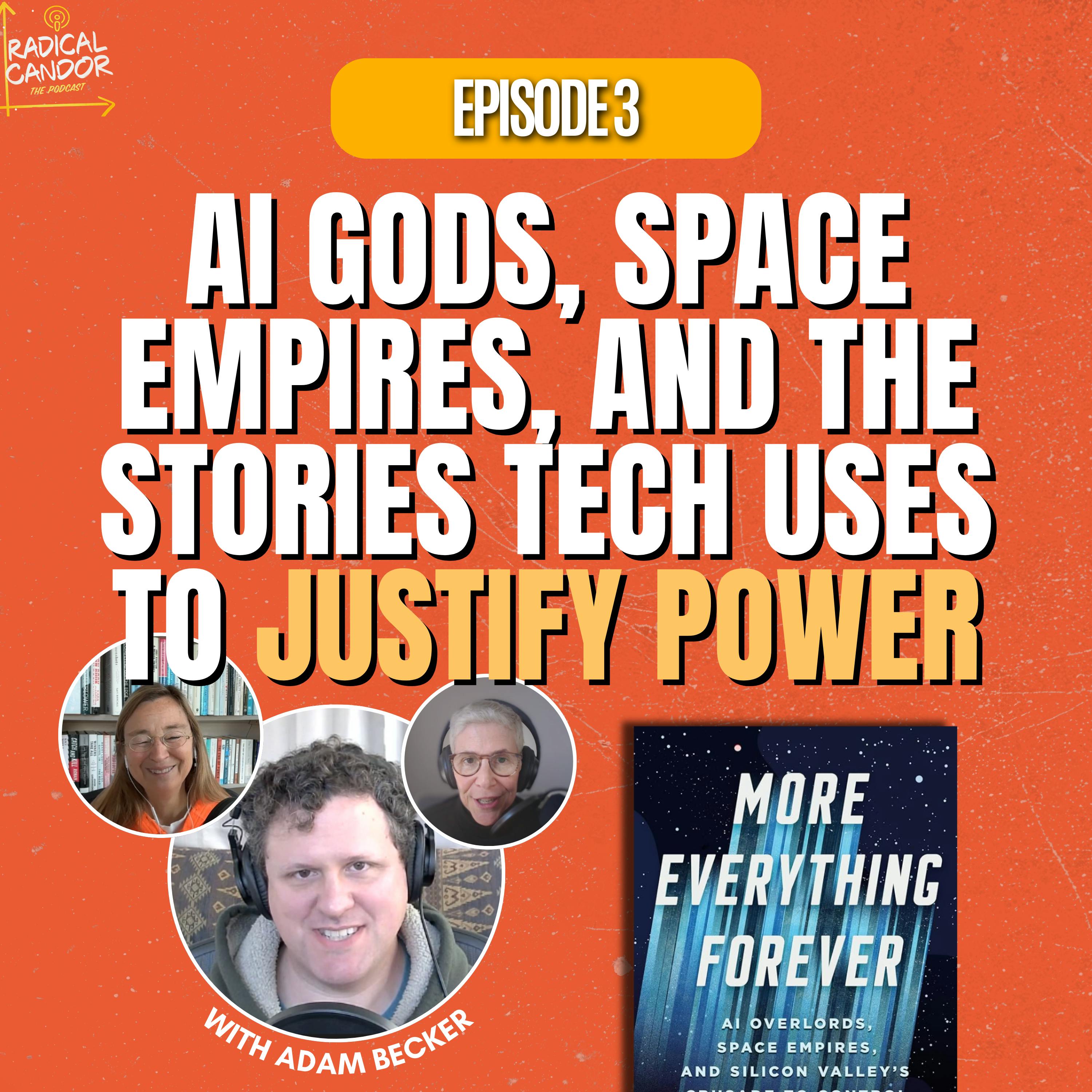
Radical Candor: Communication at Work
AI Gods, Space Empires, and the Stories Tech Uses to Justify Power with Adam Becker 8|3
01:06:51
Loading summary
Transcript370 lines
- [00:01]
A
This episode is brought to you by Peloton Break through the busiest time of year with the brand new Peloton Cross Training Tread plus, powered by Peloton iq. With real time guidance and endless ways to move, you can personalize your workouts and train with confidence, helping you reach your goals in less time. Let yourself run, lift, sculpt, push and go. Explore the new peloton cross training Tread plus@onepelaton.com.
- [00:30]
B
Hello everyone, and welcome to the Radical Candor Podcast. I'm Kim Scott.
- [00:35]
C
I'm Amy Sandler. Today we are talking with science journalist and astrophysicist Adam Becker. Adam has a PhD in Computational Cosmology, which if you're like me, you had to look up and so impressed already. Adam's first book is called what is Real? It was about the unfinished quest for the meaning of quantum physics. And then Adam moved on to an even easier topic for his newest book, and I will quote the subtitle, AI Overlords, Space Empires and Silicon Valley's Crusade to Control the Fate of Humanity. Yes, you are very curious about the book title. It is More Everything Forever. We're going to be talking about this, this new book, More Everything Forever, which you all have got to go check out. It is a deep dive into the stories that Silicon Valley is telling us about the future. Why these stories matter for all of us, whether we work in tech or not. We are so thrilled to have you, Adam.
- [01:36]
B
Welcome, Adam. Your book is absolutely one of the best books I read all year. And I can't tell you how much I admire what you did. You went deep on some really seriously disturbing ideas, some of which were transhumanism, effective altruism, long termism. And these ideas have taken hold here in Silicon Valley. You went deep enough to understand them so that you could challenge them. And yet you were still able to have compassion for people with whom you disagree vehemently. That is what Radical Candor is in a nutshell. So welcome, Adam.
- [02:16]
D
Oh, thank you for having me, Kim and Amy, this is a delight to be here.
- [02:22]
C
So this book, as Kim said it, was one of her favorite books, and I agree. In fact, I had the audio and now I have the hard copy because I do want to keep going back to it and we'll get into what you cover. But what actually motivated you to write this book?
- [02:40]
D
That's a great question. I mean, the short answer to that question is I've lived out here in the San Francisco Bay area now for well over a decade, and I just got tired of all of the nonsense that I was seeing and you know, got invited to one too many parties where people were saying things to me and I thought that, well, that's definitely not true. The longer answer was struck by the shallowness of certain kinds of criticism of the tech industry that I was seeing out there because I was seeing a lot of very accurate and hard hitting stuff about the tech industry back when I was thinking about this book at the beginning, which is like we're talking like 2020, 2021 somewhere around there. And I was thinking about that and there was all of this criticism sort of based on politics, based on, you know, the social and political and psychological impact of the products of the tech industry. And all of that was accurate and good. And I thought, you know, made a lot of sense and I was glad that people were bringing up those points, but it didn't seem like enough. It seemed like, okay, you know, yes, these products are really bad for us, but also the entire tech industry is in thrall to these ideas about what the future holds. This idea of, you know, super intelligent AI, the idea of space colonization, you know, the, the what I say in the very first sentence of the book that the dream is always to go to space and live forever. And, and, and what I noticed was that there was not enough, I thought, not enough criticism of the tech industry.
- [04:39]
E
Pointing out, oh yeah, also these guys.
- [04:41]
D
Don'T have actually know what they're talking about when it comes to science and technology, even though it's the tech industry. Right. You know, there's this assumption that a lot of people seem to have that like, okay, Elon Musk is a terrible person, but when he's talking about space, he knows what he's talking about. Like, that's just not true.
- [04:58]
B
Not true.
- [04:58]
D
It's not true at all. And, and so I started thinking about that and there was, there was actually a particular incident that really got me thinking about that where I, I allude to this very briefly in the book, but there's this online magazine that I found was publishing articles saying that evolution wasn't true. So pseudoscientific nonsense. And it was all being funded by Peter Thiel, the tech billionaire. And so that really got me thinking about this. And of course the political situation here in the US was getting worse and worse and I was starting to see the, the tech, you know, billionaires really get involved in that. I mean it was, I, obviously when I was starting to write this, it was way before Musk came out in support of Trump, but Thiel was already supporting Trump and Musk was going on and on about how horrible coronavirus restrictions were and, and shelter in place is bad and all that. I really thought, you know, these guys really don't know what they're talking about when it comes to science. And all the stuff that they're saying about these things have political implications, but they're in service of this idea of the future that just doesn't work and comes from science fiction, not science.
- [06:18]
B
I love it. I mean, it's like, I do feel like here in Silicon Valley there's like an idea virus and I feel like your book is the inoculation.
- [06:29]
D
So that was the idea.
- [06:30]
B
Thank you.
- [06:33]
C
And I thought it might be helpful for folks who haven't yet read the book, what are some of these stories, maybe especially for folks who might not be well versed in science fiction, because that was another piece of the book that a lot of these ideas actually almost come from science fiction. But what are some of these sort of myths that have actually been latched onto that you go into in more detail in the book.
- [06:55]
D
The really big myths, sort of the big three are space colonization, going out and, you know, having enormous numbers of humans living and working and, you know, building families and building a civilization in deep space like Mars and beyond the solar system entirely. That's one. Another one is this idea of super intelligent God like AI with powers of creation and destruction and transformation that are beyond anything that human civilization as a whole could even come close to mustering. And then the third is, which sort of ties in with the first two especially. The second one is this idea of singularity, the idea that technology as a whole is going to get to this point where civilization just has these powers of creation and destruction and transformation that are beyond anything that we can imagine. And they will allow humans to transcend our biology and upload our minds into computers and live forever in space with an AI God. And, and this sounds fantastical. It sounds absurd. It sounds like something that nobody would take seriously if you haven't spent much time in the tech industry or in the Bay Area. But the minute you start talking to people out here, you realize this is not just something that people entertain. This combination of ideas is the animating motivation behind some of the biggest and most important tech companies out there today. Even though all of this is impossible.
- [08:45]
E
All of that stuff, it's never going to happen. It's never going to happen. But that is why OpenAI exists, that is why anthropic exists, that is why.
- [08:54]
D
SpaceX exists, it's why Neuralink exists. It is why these companies exist. And this is not a conspiracy theory.
- [09:00]
E
This is exactly what these people say that the reason is for these companies.
- [09:06]
D
Existing is why they did this. They're very, very open about it and they think that this is the inevitable future. And if you don't see that coming, you lack vision, they lack critical thinking.
- [09:18]
B
Skills, and yet you can't really. It's not because they're not educated. It's like they read some science fiction book when they were 10, maybe 9, and it like entered somewhere in their brain where they couldn't think about it anymore. And now they're, you know, they have hundreds of billions of dollars and they're trying to make this nine year old dream come true or something.
- [09:41]
E
I mean, yeah, I mean, well, they're.
- [09:43]
D
Very explicit about that. I mean, to go back to Musk, Musk has said science fiction should not remain fiction forever. He said that direct quote. And you know, first of all, it's fiction for a reason. Some of it just can't be done. And second, you know, which science fiction. Right.
- [09:59]
E
You know, lots of science fiction is dystopian.
- [10:02]
B
Yeah.
- [10:03]
E
You know, he's talked about how awesome Blade Runner is. Blade Runner is a cyberpunk dystopia.
- [10:08]
B
That's what you're not supposed to do.
- [10:10]
E
Yeah, exactly. And it's very clear that he doesn't understand that.
- [10:13]
D
I mean, he also to rag on Musk just a little bit more. He also seems to think that there is a character in Blade Runner named Blade Runner, which is not true.
- [10:25]
E
He said that the cybertruck looks like.
- [10:27]
D
Something Blade Runner would drive.
- [10:30]
B
Like, what is that?
- [10:31]
E
Yeah, yeah.
- [10:32]
D
It's like.
- [10:32]
E
Have you seen the movie? I'm not. I mean, if you did, were you paying attention? Do you think that Harrison Ford's character.
- [10:38]
D
Was named Blade Runner?
- [10:43]
E
Like Peter again? Peter Thiel said that he thinks that the entire plot of the original Star wars was motivated by Han Solo owing Jabba the Hutt money.
- [10:56]
B
Yeah.
- [10:57]
E
Now it is true that Han Solo owed Java the Hutt money, but that is not the animating principle behind like, that is not the motivation.
- [11:04]
B
Not a capitalist morality.
- [11:07]
D
No.
- [11:07]
E
I seem to recall something about an empire and a rebellion and a Death Star and you know, but hey, maybe that was just me.
- [11:17]
B
Yeah, no, it's really, I mean, it's really interesting. It's like also, Peter Thiel loves the Lord of the Rings. Like, how could you name Palantir Palantir?
- [11:26]
E
Right.
- [11:27]
B
Like how could you do it?
- [11:29]
E
There's this. Okay, so there's this, this sketch comedy.
- [11:33]
D
Duo, Mitchell and Webb. And they have this sketch that I love. It's two Nazi soldiers in World War II, sort of looking around at all of the stuff around them, you know, in their trench and how it all has skulls on it. And one of them says to the other, are we.
- [11:52]
E
Are we the baddies? Like, and. And I feel like working at Palantir, you're going to have to wonder, like, wait, the company is literally named after the device used to corrupt people by the dark lord and embodiment of all evil in one of the greatest myths of the 20th century. Are we the bad guys?
- [12:19]
B
Yeah, it's really. It's really interesting. I was reading. Now, I'm going to have to dig it up, but I was reading an article about a guy who was a sex trafficker. And he said that he. He was trying to reform him. He was like, on the path. But anyway, he said that he started down the wrong path when he watched Star wars and he watched Jabba the Hutt. And he wanted to be like, Jabba the Hutt. Imprisoning Prince. It's like, that was not a lesson.
- [12:52]
D
Like, how.
- [12:54]
B
And who could think that somebody would want to be Jabba the Hutt? Like, he was meant to be disgusting in every way. It's. I mean, it's funny, but it's not funny.
- [13:04]
E
Like, okay, so I'm gonna. I'm gonna do something that I normally don't do. Here I'm go you something from the book that's relevant here?
- [13:12]
D
It is.
- [13:16]
E
It's right here. Literally on the first page.
- [13:18]
D
It's. It's the. The epigraphs. Right. One of them. Sci fi author. In my book, I invented the Torment Nexus as a cautionary tale tech company.
- [13:29]
E
At long last, we have created the.
- [13:31]
D
Torment Nexus from classic sci Fi novel.
- [13:34]
E
Don't create the Torment Nexus.
- [13:39]
B
Yes, exactly.
- [13:40]
C
Maybe we'll create a character named Torment Nexus.
- [13:43]
E
Yes.
- [13:44]
B
Yeah, yeah, it's. It's nutty. And I think you. You gave a partial explanation. There was an anecdote in your book that I loved. When you went to the UK to the. To the headquarters of the effective altruists.
- [13:59]
D
Yes.
- [14:00]
B
And there was a whiteboard.
- [14:01]
D
Yes.
- [14:02]
B
And it says, after all the world's problems have been solved, what will you do? And somebody wrote, I'll read the Tempest. I'm like, you don'. Solve all the world's problems to read the Tempest.
- [14:13]
E
Yes.
- [14:14]
B
Maybe. Maybe if they had read Crime and Punishment, admittedly a lot longer than the Tempest, they would have realized that the Problem with their ridiculous theory.
- [14:26]
E
I mean, honestly, I think if they read the Tempest, they might have seen there was a problem with their theory. Right, The Tempest.
- [14:32]
D
This is.
- [14:32]
E
This is a story about how you can't solve everything with magic.
- [14:38]
D
Right?
- [14:39]
E
Right.
- [14:40]
B
Yes. And even more.
- [14:43]
E
Yeah. If you. And like, and if you want to go back and be part of civilization, you need to break your staff and drown your books so you can live with people like.
- [14:53]
B
Yes.
- [14:55]
E
And also, the Tempest is not that long. It's a play.
- [14:58]
B
Like, come on, it's 90 pages.
- [15:00]
E
Yeah. Like, oh, you're so busy saving the world that you can't read one of the greatest contributions to literature of all time. Like, what kind of life is that? How can you think of yourself as an informed person more able to act wisely in the world if you don't take the time that you need to think clearly about, you know, the world that we're in and those who've come before?
- [15:26]
D
And what better way to do that than to, you know, read and take in great art?
- [15:31]
B
Yeah.
- [15:32]
C
Adam, can I ask just to go on the back on the title, More Everything Forever? Because I feel like that was such a brilliant, brilliant. I mean, obviously the subtitle, like, catches us in with the, you know, space empires and the AI overlords, but there's so much about kind of the underpinnings and actually the story of capitalism and more and forever. When you talk about transhumanism and long termism and I just. If you could put those into word, people listening can understand, like, first of all, why did you choose that title? And, like, what is the relationship between capitalism, sort of these myths that we've been talking about?
- [16:10]
D
Yeah, that's a really good question. The title came about once I realized exactly what the structure of the book was and started really getting into writing the first chapter. Because I had a few false starts where I thought the book was going to have a slightly different structure and be organized differently. And then once I realized how it had to be and started really getting into what ultimately became chapter one of the book, I thought about the title and realized, you know, what is it? What's the animating principle here? What is it that's really going on is that these people want more of Everything Forever.
- [16:50]
E
And once I thought that, I was like, okay, I guess maybe the title's more Forever.
- [16:55]
D
And then I gave a very early draft of the first chapter to a dear friend who's also a writer. And he read it and he said, I think this is great. One note. I think the title's not More Forever. I think the title is More Everything Forever. And I'm like, oh, God damn it, you're right.
- [17:10]
E
And so, yeah, I mean, this idea that it's.
- [17:15]
D
That it is possible to have more everything forever and that it would be good to have more everything forever, this is, this is a lot of what's behind these different ideologies in the book that I, I give this overarching title to. The ideology of technological salvation. And that includes these things like transhumanism, this idea that we can. That. That our consciousnesses can be uploaded into machines and so then we can live forever or almost forever. And an idea that has essentially no basis in science and quite a bit of science cutting against it. And as for how things like this connect to capitalism, I mean, there's capitalism and there's capitalism, right? But there's this idea, I think, in the form of capitalism that is favored by the tech billionaires and many other people that. Well, you know what? No, I'm going to back up a sec. I'm a physicist, right? And I tend to see the world as a physicist does.
- [18:28]
E
And.
- [18:29]
D
And I think that leads me to spend a lot more time thinking about the natural world and a lot less time thinking about, like, the creations of human ingenuity, although human ingenuity is. Is truly amazing. And I really think that for a lot of these guys, and they are mostly guys in, you know, the tech bro Lagar sphere, there's this idea that markets are fundamental, that they are this. This thing that's as fundamental as laws of physics, that there's this rule that says that markets are the best way to solve every problem, when the fact is that markets are a tool that humans created. And in just the same way that a hammer is not the right tool for every situation, markets are not the right tool for every situation. They're very good at some things. You know, hammers are very good at hammering nails into pieces of wood. Markets are very good for, you know, figuring out how to exchange certain kinds of goods and services. But also there are different kinds of markets, and there are questions about how you want to regulate those markets. The leaders of the tech industry have been very, very clear that what they.
- [19:46]
E
Want is completely untrammeled, unregulated.
- [19:50]
D
Lassez faire capitalism to the extre.
- [19:53]
E
And, you know, that's like saying, no.
- [19:55]
D
I have this hammer and I'm going to use it for everything, and if.
- [19:59]
E
Something is broken, I'm going to hit.
- [20:01]
D
It with this hammer as hard as I can.
- [20:03]
E
And that will fix it.
- [20:05]
B
Yeah.
- [20:06]
E
And if you don't think that that will fix it, you lack vision.
- [20:10]
B
You're a communist.
- [20:11]
E
You're a communist.
- [20:12]
D
Exactly. Yes. If you don't think that hitting it with the hammer will fix it, you're a communist.
- [20:16]
E
And if you obey that, like, kind.
- [20:19]
D
Of market logic with that kind of completely unregulated market, which means that you're.
- [20:25]
E
Going to have all of the problems.
- [20:26]
D
That markets have, including, you know, they're not very good at pricing in all kinds of externalities, and they have a tendency to take metrics and turn them into objectives in ways that make the metric completely use, useless and make it.
- [20:42]
E
Hard to live a life that you might enjoy in a world where we all work together to try to make everybody happier.
- [20:52]
D
If that's the kind of logic you think the world has to run on.
- [20:56]
E
That'S going to lead you inexorably to.
- [20:58]
D
Want more everything forever.
- [21:00]
B
Yes. And the irony, I think, is that Peter Thiel, for example, who. Who started out saying, I want small government, so now he wants to be the government, and then he's going to scale the government. Like, all of a sudden we're going to have the biggest. We're going to have Palantir in our bedrooms.
- [21:19]
E
What Thiel wants is he wants to more everything forever. Yeah, he wants more everything forever. He wants power, and he wants nobody to stand in the way of that.
- [21:28]
D
And if he can get that by shrinking the government and increasing corporate power, great. And if he can get that by helping take over the government, great. And if he can just merge his corporate enterprises with the government, that's probably best of all. Right.
- [21:42]
B
Yeah. Yes, exactly. I think that's very well said and not well enough understood.
- [21:49]
D
Thank you.
- [21:50]
C
Yeah, I thought it was so well said. And just to go back to something you said earlier, Adam, which relates. Was. Which really clarified to me, I think, why the book I found so important to read, which is, is this even possible? Right. Like, when I might have first heard about, like, oh, we want to prevent, you know, an existential threat from AI like that on its heels, seems like, hey, that seems like a good thing. Like, sign me up for that. But you talk a lot about, like, is that possible? Is that a real thing? So sort of one. And then is it good? And what I also appreciate about the book, and you say you come from a physicist background, but there was, I thought, just such a clear explanation of philosophy and ethics and talking to experts in those fields about who. What is good and who is determining what's Good. And is there not some intrinsic part of being human that actually more everything forever is the very sort of, you know, grist of what makes us human. So anyhow, the possible and the good. Just that frame I found really helpful.
- [22:47]
D
Thank you. Yeah, no, I mean, that was exactly what I was going for. I mean, I, I think finding myself thinking of that famous line from Jurassic Park. They're so obsessed with whether they could, they didn't stop to consider whether they should.
- [23:02]
E
But these guys are even worse. They don't really think about either one. They just claim that they can and they should, when the fact is they.
- [23:10]
D
Can'T and they shouldn't.
- [23:14]
E
You know, like Musk says we have to become a multi planetary civilization. We can't and it's a bad idea.
- [23:20]
B
Yes, yes. And I'm gonna foul our nest in the process of doing like. That's the first time I ever heard Musk speak. And this was a lot, this was before we really knew. But I remember thinking he, he wants to go to Mars because he knows he's gonna screw up where we're living now. And like we shouldn't let him do that.
- [23:43]
E
Yeah.
- [23:43]
B
You know, it's a great place where we live right now.
- [23:45]
E
Well, and the other thing is like.
- [23:47]
D
He thinks, I think that by going to Mars, and Musk is not alone in this. You see this from Teal, you see this from many of the other tech billionaires. There's this idea that if you go to space, you've somehow escaped politics. Yeah, right.
- [24:04]
B
Yeah. Sea steading.
- [24:06]
E
Yeah. Seasteading.
- [24:07]
D
Exactly. All these pseudo libertarian schemes, or just libertarian schemes to, to get away from.
- [24:15]
E
Everybody else and live independent of society. As though that's something that would be good.
- [24:21]
D
Right. We need each other. We're social creatures. Right. Yeah. And yet they, they seem to think that the old phrase is that some men are islands. Right.
- [24:29]
E
Rather than no man islands.
- [24:32]
D
Right.
- [24:33]
E
Like they just want to build Gulp Gulch in space. And like, you know, the real end.
- [24:38]
D
Of Atlas Shrugged is that then all of those, you know, wealthy titans of.
- [24:43]
E
Industry starve because none of them want to be farmers. Like, what are they going to do?
- [24:48]
B
You know, they won't pick their own strawberries and they're going to boot out those who will.
- [24:52]
D
Yeah.
- [24:52]
E
It's just nonsense. And, and I really.
- [24:57]
D
There's that bit in the Starlink terms of service where Musk says, oh, you know, by signing this, you recognize that any Mars colony that SpaceX creates is a sovereign colony that is not subject to the laws of Earth. You can't like, abrogate international treaties just by using an end user license, signing a turn of.
- [25:18]
E
Exactly. And there are international treaties governing this.
- [25:20]
D
Ultimately, what they fail to realize is, like, you can't escape politics by going to space because politics is something that happens the minute you have more than one person in a room.
- [25:29]
B
That is really true. What is it, do you think about, like, would it happen to us too, if we. If we had billions of dollars dumped on us tomorrow, would we too cease to be able to understand that. That. That con. That there should be constraints on us, that we'll be better off if there are constraints? Like, what. Why are these people so. Who claim to be so rational and so technical? Like, why are. Why has there. Like, how do you. How did this money brain happen? Like, what is wrong with them.
- [26:11]
C
On that? I'm like, I know that you had talked about reaching out to many of the leaders that you criticize in the book with, you know, the goal of, like, having a conversation, and you actually did not hear back. Is that correct? Or.
- [26:22]
D
Yeah, yeah. There's. There's actually a list at the end of the book.
- [26:25]
C
Yeah, yeah. So do you want to just tell a little bit more about both your intention for those outreaches? Were you surprised?
- [26:31]
D
I was not surprised. I did not actually expect to get them, but I had to try. And, you know, it would have been great if I had. I suppose one of the imperfect things about including a list like that is, you know, some of them just gave me a very quick no or just ignored me completely. And I did indicate where some ignored rather than declined, but some of them actually, it seemed like I got close. I was in conversations with, like, the people surrounding some of these guys on that list at the end of the book, in some cases over the course of days or weeks, and it seemed like it might actually happen, but it didn't. And, you know, I wasn't surprised, honestly. I was just surprised that I was able to get a hold of as many people as I did. Part of that is the nature of writing a book if you're not a famous person. Right. You know, because, like, as a freelance journalist, if I get an assignment from, say, Scientific American, then I can send an email where the subject line says, scientific American interview request. And people know what Scientific American is. And, you know, in theory, if they weren't sure if I was who I said I was, they could go call Scientific American and they said, yay, Adam's on assignment with us. That that email was real. Whereas for writing a book, if you're Not a famous person. You just send an email saying, hey, I'm writing a book. And it's with this publisher that you may or may not have heard of. Yeah, it's one of the biggest publishers in the world, but people generally don't pay attention to the names of publishers. Like they've maybe heard of Penguin, Random House, and that's about it. And even if, even if they have heard of Penguin and if I were with Penguin, which I'm not, I still don't think that that would have been as effective as saying, like, you know, the Atlantic or something.
- [28:12]
B
Yeah, right. Yeah.
- [28:13]
C
And so have any of them actually followed up with you since the publishing?
- [28:17]
D
Nope.
- [28:19]
B
Weird.
- [28:19]
C
Well, weird.
- [28:21]
E
Not really. Right. Because that's the second thing. The second thing is even if I.
- [28:24]
D
Had said I was with the Atlantic.
- [28:25]
E
Or whatever, I still think almost all.
- [28:27]
D
Of them would have said no.
- [28:28]
E
Because what, why would they say yes?
- [28:31]
D
Right. You know, they're surrounded by PR people.
- [28:34]
E
Who would look at me and say, well, we don't know much about this.
- [28:37]
D
Adam Becker guy, but we, we have no guarantee that he's going to play nice in an interview. And so there's no real upside and only downside because, like, what, what am.
- [28:47]
E
I going to do?
- [28:47]
D
I'm not going to make them wealthier, right?
- [28:50]
B
Yeah.
- [28:51]
D
Like, I'm just some guy. I'm not going to make them more famous. Even if I was with the New York Times, I don't think I'd make them more famous.
- [28:58]
B
Yeah.
- [28:59]
D
So all it represents for them is downside. And while I don't think that these billionaires are particularly good at thinking clearly, I think their PR people are usually pretty competent.
- [29:08]
E
10.
- [29:11]
B
What about from other people? I mean, like, the vast majority of people here in Silicon Valley are, are basically, I don't know what the right word is anymore. Progressive.
- [29:21]
E
Yeah.
- [29:22]
B
Have people reach out to you and said, thank you. Like, have you gotten at least from the, the non. Billion. Like, I feel like we need more of you in Silicon Valley because we need, we need to come together and.
- [29:35]
C
More everything forever of Adam. That's our new not forever.
- [29:39]
B
Like, immortality is one letter away from immorality. So we're gonna, we're gonna, as Esther Dyson says, put some term limits on ourself. But, but I do feel like we need to, like, for some reason, we've allowed a handful of sin of centibillionaires to, to grab the microphone in Silicon Valley, and they're a tiny minority and they represent the worst of us. So it seems like we need, we need your vote. We need to give you, you know, megaphone.
- [30:11]
D
Well, I would love that. So, you know, I mean, that's why I'm here. Right. I completely agree. Right. You know, the, the leaders of the tech industry are politically and ethically out of step with most of the workers and most of the people who live in Silicon Valley and the Bay Area. Right. I mean, you know, it's certainly true that there's some upswing even among people who are not tech billionaires of like a kind of techno fascism and you know, this alt right, you know, racist nonsense. But by and large, you know, you still see that most of the people who live here and most of the people who work in the tech industry are voting for liberals, progressives, leftists, you name it. Stuff left of center. Right.
- [31:06]
B
Yeah.
- [31:08]
D
And yet the tech billionaires don't do that. And, and I think it's not all of them though.
- [31:14]
B
I mean.
- [31:15]
E
Yeah, that's true.
- [31:16]
B
I'm guessing that, that Sundar voted, did not vote for Trump.
- [31:21]
D
Sure.
- [31:22]
E
But on the other.
- [31:23]
C
Pretty sure.
- [31:23]
D
On the other hand, he was there at the inauguration.
- [31:25]
B
He did, he did. That's, and that's the thing that is very, that is very ominous to me is that I'm guessing that Tim Cook did not.
- [31:36]
E
Yeah, Tim Cook probably didn't.
- [31:37]
D
You know, I, I, you know, I don't know, Sam Altman may not have, you know, I wouldn't be that surprised. But all of them were there.
- [31:44]
B
Yeah, yeah.
- [31:45]
E
You know, Tim Apple himself was there.
- [31:47]
C
I think that that is the data point that I think, you know, especially if we broaden it out to folks just listening wherever they life. There was something that I wanted to quote from your, your website, Adam, if I may, which is these futuristic visions cloak a hunger for power under dreams of space colonies and digital immortality. The giants of Silicon Valley claim that their ideas are based on science, but the reality is darker. They come from a jumbled mix of shallow futurism and racist pseudoscience. End quote. Is that, is that a correct reading of, of your, your website? And the reason why I mention it is because this impacts everyone's everyday life left, sort of where our future is. And I'm just curious like how, what is your goal for kind of the everyday person, whether they work in Silicon Valley or not, but the impact, it's going to impact our day to day lives. Like what, what would you like them to take away from, from this conversation sort of more broadly from your book?
- [32:50]
D
Well, that's a good question. So from the, from the book I think what I want people both in and outside the tech industry to take away is that these ideas about the future that are used by these tech billionaires as an excuse for their behavior are false promises. They're fundamentally hollow and we shouldn't listen. And it's not just that we shouldn't believe the tech billionaires when they say these things because they're untrustworthy. It's that we shouldn't believe them because these ideas are impossible. These are not good goals because they won't work. Right. We're not going to space, we're not going to build the AI God. And yet these are the promises that at this point the entire tech industry is built on and it's in pursuit of these futures. Like these ideas about the future are used as a kind of excuse and moral absolution by the tech billionaires. Right. Musk says he's just trying to save humanity by making us multi planetary. Right. Sam Altman says that he's trying to save humanity by, you know, bringing about the AI God. Dario Amade says that he's trying to save humanity by building the right kind of AI God because OpenAI is building the wrong kind that's going to kill everybody.
- [34:10]
B
Yeah. It's like the threat and the promise are the same. And that, that was the reason for optim. When I read your book, I'm like, oh, thank God. This whole. Because I was thinking, I always, every time I read this, like AI is gonna, you know, kill us all. I'm like, no, it's not.
- [34:26]
D
No.
- [34:26]
B
But that was my instinct. So you gave me good reason to believe that.
- [34:30]
D
I'm glad. That was, that was a lot of what I wanted to do with the book. And it's, it's one of the main things I want people to take away from. This is like both these, you know, utopian and apocalyptic views of AI.
- [34:43]
B
Yeah.
- [34:44]
D
They're not just not going to happen, but they're in a sense the same view because they're both ideas of a future where AI becomes unimaginably powerful and then it's a question of what it does with that power.
- [34:58]
E
But that's not going to happen.
- [35:01]
D
Yeah, you know, that's not where this.
- [35:03]
E
Technology is going to. The reasons for saying it's going to go there all come from science fiction.
- [35:08]
D
None of them come from real science. So there's that. That's one of the things I want people to take away from it. But then as for this conversation, you know, this is one of the things I've been Thinking about a lot since I wrote the book, because, like, I. Spoiler alert. You both know this, but I end the book with a call to eliminate billionaires to make it impossible for people to have that much money. Because I think, you know, going back to your earlier question, Kim, I. I don't know what would happen to us if suddenly we became billionaires, but it clearly does something really bad to the human brain. You know, it's like a really, really awful drug that you can't get yourself off of or to use or.
- [35:51]
E
Or to use an analogy from a book that Peter Thiel likes, but to use it correctly, it's like the One ring. It poisons your brain, and you can't.
- [36:01]
D
Bring yourself to get rid of it.
- [36:03]
B
Yeah.
- [36:04]
E
You know, so there's that.
- [36:06]
D
I want to just tax their fortunes away to.
- [36:09]
B
You were pretty generous. You were gonna leave them with 500 million. I mean. Yeah, I think 100 million is enough.
- [36:16]
E
I've heard people say 50 million.
- [36:18]
D
Yeah, but.
- [36:19]
E
Yeah, but no, I, like, I picked.
- [36:24]
D
That number deliberately, to be perfectly honest. I picked that number because it was very easy to defend that position that, you know, half a billion dollars should be enough for anybody.
- [36:33]
B
Yeah. And.
- [36:35]
E
And also because I knew that if I proposed putting a cap on wealth.
- [36:40]
D
People would accuse me of being a communist.
- [36:42]
B
Yeah.
- [36:42]
D
If I said, you know, well, I'm okay with some people having half a billion dollars. And then somebody said to me, oh, Adam, you're a communist.
- [36:50]
E
And I can say, oh, yeah, you know what?
- [36:52]
D
I think you're right. I think it was Karl Marx who said that some people can have half a billion dollars. I think that was in Das Capitol, like.
- [37:01]
E
But, yeah, I think in the.
- [37:04]
D
In the. You know, we should be working toward the goal of creating a more equitable and just society, and that involves sharing this wealth that these people hoarded and did and built on the backs of everybody else and did not create themselves. Yeah. But to get there, you know, that's the question that I've been thinking about a lot since I wrote the book. Because after I wrote the book, the election went the way that it did. And I've had people say, you know, I'm in despair. The tech billionaires won.
- [37:34]
E
What can we do? And this goes back, actually, to a.
- [37:38]
D
Point earlier in this conversation about, you know, the difference in political views between the leaders of the tech industry and the people who work in the tech industry. Because I really think that one of the best ways to go after this is through labor organization. Right. Organized labor is a way of addressing the problem that the leaders of a company are actively working against the interests of the people who work for that company. Right. If there's that kind of massive disagreement and massive, you know, difference in political alignments, one way you handle that is to remind the leaders of those companies.
- [38:19]
E
Oh, yeah, by the way, all that money and power you have, you wouldn't.
- [38:22]
D
Have any of it if it wasn't for all of these people. And these people are very angry with you.
- [38:27]
B
I agree. We need, we need more solidarity, whatever form it takes. How do we create real checks and balances? Like, not. Because I think in some ways, if I go back to when I started working at Google, an embarrassing admission, but when I was deciding whether or not I would take the job, I read the S1 letter that Larry and Sergey wrote before the company went public, and I was moved. Literally, I got tears in my eyes because it was like, oh, they want to treat all their workers well. And, and, and when I got there, I felt like it was real. Like, I, I do that, I do think that there, and at that time, it was like, oh, the, you know, what's bad is Wall street and what's good is entrepreneurs. I, I feel like there's this constant, you know, you hate the man now you are the man kind of thing that happens.
- [39:19]
D
And so meet the new boss, same as the old boss.
- [39:21]
B
Yeah, yeah. And, and I think the, the same thing can happen with unions, unfortunately.
- [39:26]
E
Yeah, no, I, I, So what do we do?
- [39:28]
D
Yeah, there are definitely unions that are organized poorly. That has absolutely happened in the past. It's totally true. Mostly my feeling about that is the same way that I feel about, you know, answers to questions like, oh, but electoral politics is so difficult and hopeless and like, this is before Trump because, you know, politicians get so corrupt and so many of them are so awful. Yeah. Okay. It's better than the alternative, though. And the way that we deal with that is we shine sunlight on the horrors or problems of these, these, you know, bad politicians and, and try to vote them out of office and get better ones. And like, yeah, you know, there are bad unions. What do you do with that? You shine sunlight on that and try to get better ones, right?
- [40:15]
B
Yes.
- [40:15]
D
We have bad corporations who try to shine sunlight on that and get better ones. I mean, of course I'm going to say that because I'm a journalist. Right.
- [40:23]
E
But we need more journalists.
- [40:26]
B
Yeah, we need to give more, more, more money for journalism.
- [40:29]
E
Oh, well, yeah.
- [40:30]
D
Music to my ears.
- [40:31]
E
But, yeah, I mean, I, I, I.
- [40:34]
D
Also think in the particular case of Google. Once again, you know, not only are these guys so bad at reading science fiction, but they do things that if you put it into a science fiction novel, you'd get criticized as, you know, unimaginative. Yeah. And like, too ham handed.
- [40:49]
E
Like, you have a company where the motto is don't be evil, and then at some point they change it. And like, that is, you know, that's like, it's like one of those indicator stickers on a, on a, on an aquarium.
- [41:04]
D
Right.
- [41:05]
E
And like, you know, like they, they remove that and like, oh, yeah, no, those fish are gonna die. Like, you've got, you've got a problem. Like, what's the problem? Well, you said you weren't gonna be evil and now you're not saying that anymore. That's raising a lot of questions for me.
- [41:21]
B
And yet it didn't. Everybody was.
- [41:23]
C
I know.
- [41:24]
E
That's so crazy.
- [41:25]
B
I know. Including me. I'm like, oh, well, I'm sure there's a good reason.
- [41:29]
C
Adam, I love this conversation because it's making me think. Like, I would love to get your tips for myself and for our listeners. You know, when you talk about how we're focused on, you know, sort of the existential threat of rogue AI or this sort of cosmic future, it's distracting us from what's happening around climate, around equality, sexism, racism, all these other urgent issues. And so I'm curious, like, that was the biggest takeaway, I think, for me from the book is like, what, what is that story underneath it? And it's like, who's telling the story? So how should we be looking at the news? Like, what's the frame? And maybe not just news, but these companies, the sort of stories underneath them. How should we be thinking about that?
- [42:09]
D
I'm going to get at the answer to your question in a slightly roundabout way. So something that's happened to me now twice with both of my books is like, right after I'm done with the book and it's off with, you know, the, the publisher and they're, they're starting to print the actual physical book, I come across a quote and I'm like, oh man, I should have put that in the book. That would have been perfect. And with the first book, which was about like the history of quantum physics, I had no excuse. I came across this quote and that quote had, you know, was older than I was and I could have put it in the book. I just didn't find it in time with this book because it's about more current stuff. I was at least able to console myself when I came across this one perfect quote. It was October of last year. And I thought, okay, well, it's too late. You know, this guy just didn't say it early enough. And the guy who said it was Eric Schmidt, former CEO of Google. And what he said in October 2024, which really was like, that was the month this book closed. I was, I was finishing up copy edits and sending it off at the end of that month. And he said this, like right before that. And by that point it was too late because copy edits is, you know, it's, it's too late to actually add anything serious. You just fix typos. But what Schmidt said then was something to the effect of, we're never going to meet our climate goals anyway. So what we should do is we should, you know, burn as much carbon and get as much energy as possible into the development of AI. And so that way we'll get to a gi, artificial General intelligence, which will magically tell us how to solve climate change for us.
- [44:00]
B
This is the alcoholic who says, well, I'm going to stop drinking tomorrow, so I'm going to drink this whole bottle of scotch today.
- [44:08]
E
I mean, I just, to me it's like, what do you think is going to happen? Even if all of that happens, Say that AGI is a real thing rather.
- [44:19]
D
Than an ill defined, impossible goal.
- [44:22]
E
And then say that you build one and say that it really does understand.
- [44:27]
D
The world and understand the problem of climate change. And say that you get there by.
- [44:31]
E
Burning all of these fossil fuels. And then you ask it, you ask this genie in a bottle, hey, how do I solve climate change? What should I do? What's the first thing it's going to do? It's going to say, well, if you.
- [44:42]
D
Wanted to solve climate change, you shouldn't have built me.
- [44:44]
E
Yeah, like, turn me off. What are you doing? I mean, and the good news that the other thing that made me feel.
- [44:52]
D
Better about missing this quote was that I had something very similar to it from Sam Altman in the book where Altman says, like, a good way to solve climate change is to build AGI, super intelligent AGI. And then ask it, you know, how do we build a lot of clean energy? How do we build a lot of carbon capture? How do we deploy this at scale? And in the book, I say, what Altman is saying is that a good way to solve the biggest problem of our time is to build a machine that nobody knows how to build and then ask it for three wishes.
- [45:24]
E
And I Just think, first of all, how delusional can you be? And second, it's really telling that all.
- [45:37]
D
Of these approaches to solving these problems are technological approaches. Right? These the hope, I think, and I think this goes back to why these billionaires have trouble understanding the world. The hope is to reduce every single problem to a problem of building a particular kind of technology, usually computer technology. Why? Well, first of all, that's the industry that these people are in. If you have a hammer, everything is a nail again.
- [46:08]
E
But also I think these guys believe.
- [46:12]
D
That money is directly correlated with intelligence and they are the wealthiest people who have ever lived, so they must be the smartest people who've ever lived. And.
- [46:25]
E
And if you believe that, if you genuinely believe that you are the.
- [46:28]
D
Smartest person on earth and able to.
- [46:31]
E
Analyze any problem at all without the.
- [46:34]
D
Need of informed expertise, which clearly a lot of these guys believe that, if.
- [46:39]
E
You believe that, that almost forces you.
- [46:41]
D
To the position that the world is actually a very simple place because there must not be anything particularly complicated that you can't understand because you must be able to understand everything because you're the smartest person who ever lived.
- [46:54]
B
And because you, you overestimate the importance of intelligence. Like it's exactly, gee, there's no such thing. Thing is like even human intelligence, it's ridiculous.
- [47:06]
C
Just for folks who might not know what you're talking about with G. And the idea of general intelligence, what you're.
- [47:10]
E
Yeah, so this, yeah, this idea of.
- [47:13]
D
General intelligence is, is something that goes back to intelligent test intelligence testing schemes that were developed in the late 19th and early 20th century, often by eugenicists and often by eugenicists and they were exported wholesale into this idea of artificial intelligence. And the way that the people behind these companies see the world. And it's not a coincidence that a lot of these people are also openly into like eugenics and racist, racist pseudoscience that says that, you know, certain races of people are smarter than others, when in fact the scientific consensus on this is overwhelmingly in the other direction.
- [47:53]
E
But when you have this like simplistic, pseudoscientific way of looking at the world that so many of these guys do, then of course you're going to think that, oh, technology is going to solve everything. When the fact is that like the biggest problems facing humanity today on all scales, like from, from planet wide problems.
- [48:14]
D
Like climate change to more localized problems that are still huge, like say the crisis in the Middle east and Gaza, the problem in say, and I'm going to get a little more general than just Gaza.
- [48:33]
E
The problem, you know, with peace and stability in the Middle east, that's not.
- [48:39]
D
A problem that we have failed as, as a species to solve because of a lack of intelligence.
- [48:45]
E
It's not like not enough smart people.
- [48:48]
D
Have looked at that.
- [48:50]
E
And similarly with climate change, that's not a problem that we have failed to solve through a lack of technology. There was a time when we didn't have cheap green energy.
- [49:01]
D
That time has passed.
- [49:02]
E
We have lots of cheap green energy. The problem is primarily not technological at this point.
- [49:08]
D
We do need better carbon capture, but. But that's not the big barrier.
- [49:12]
E
The big barrier is a collective action.
- [49:15]
D
Problem, which means it's a political and social problem problem.
- [49:17]
E
It's a problem. Solidarity and solidarity in politics.
- [49:21]
D
Yeah.
- [49:22]
E
Similarly, an even more clear example of.
- [49:25]
D
This is maybe the other, I would say greatest threat facing humanity, nuclear war.
- [49:30]
E
We know exactly what we have to do to prevent nuclear war. Technologically, we, we have 100% of the technology stack needed to end the threat of nuclear war. All we have to do is dismantle every single nuclear weapon. We know how to do that. The only problem that that would leave would be, okay, what do we do with the nuclear fuel? And you can use that to build.
- [49:54]
D
Nuclear power plants most of the time. I mean, yeah, there's a lot of.
- [49:57]
E
Messy details in there, but by and large, this is a problem we know how to solve. And certainly, you know, if that were the only problem we were dealing with, that would be much, much closer to.
- [50:06]
D
Not having nuclear war then. Oh, actually we have these nuclear submarines and ICBMs and whatnot, armed the teeth and bombers, and they're just around all of the time. We know how to solve that problem.
- [50:17]
E
That problem is 100% political.
- [50:20]
B
Yes.
- [50:21]
E
And it is, I think, second only.
- [50:25]
D
To the climate crisis in terms of its ability to, you know, wreak havoc and end human civilization.
- [50:32]
E
And also, it's not even quite right.
- [50:34]
D
To make them separate because they interplay in various ways.
- [50:39]
E
Because the world is a complicated place filled with all kinds of very human messes.
- [50:45]
D
But that's exactly what these guys want to deny.
- [50:48]
B
And thinking that intelligence, I mean, the other weird thing about the obsession with intelligence and the just of like, because I'm so smart, I have all this money and I deserve all this money because I'm so smart, which all of which is false. There's another irony, which is because AI is so smart, maybe it's going to become conscious and maybe we better treat it, maybe we better give it human rights, but we're not willing to give humans human rights.
- [51:16]
E
Right, Exactly.
- [51:18]
D
Yeah.
- [51:18]
B
So weird.
- [51:19]
E
No, I mean, all I want is a world where we treat everybody like people.
- [51:23]
D
Yeah, I don't see why that's such a radical proposition.
- [51:26]
E
It's not, you know.
- [51:27]
B
Yeah, it's not communist either.
- [51:29]
C
I'm curious. You mentioned that you've been, you know, traveling, talking about the book. There's been so much interest in the book. Kim and I both felt, you know, reading towards the end that there. There actually was some hope that. Okay. Identifying what the real issues are. I'm curious, in these conversations that you've been having, have you heard any great ideas or any kind of interesting ideas of how people are thinking about how to shift the conversation and sort of the balance of. Of power on these discussions?
- [51:57]
D
That is such a good question.
- [51:59]
B
Do you want me to give you some time to think by.
- [52:01]
C
Yeah, we can.
- [52:02]
B
My response?
- [52:02]
E
Yeah, yeah, let's.
- [52:04]
B
And you can tell me if this was a good idea. I've read your book now three times, and every time I read the last chapter, I get a little weepy. Hopefully not in the ridiculous way to reading the S1, but. But like your, Your. Your appreciation for our planet is really beautifully put.
- [52:22]
D
Thank you.
- [52:22]
B
And so yesterday I turned off all my devices and I spent nine full hours pulling weeds out of you. You can look at my fingernails, you can see there's dirt and planting wildflower seeds. And like, I feel like. I mean, maybe that's not going to solve all the world's problems, but it really did make me feel better and more connected to the Earth. And I went to sleep happy and woke up happy. And I think that matters. So that's my response to your book.
- [52:53]
D
I think that's beautiful. And also, as. As a writer, first of all, hearing that you read the book three times, that's amazing and makes me very happy. But also, as. As a writer, and please don't take this the wrong way, hearing that I made you cry is. Yeah, you know, in a way, exactly what I was going for with that chapter. So thank you.
- [53:19]
E
And also, connection to the earth is.
- [53:21]
D
Exactly like one of the messages that I was trying to get across with. With the book in connection to nature. It's funny. This is connected in a way to the single most common question that I get when I go out and give talks about the book, which is, okay, Adam, you spent how long working on this? And you were, like, staring into the heart of darkness on this? How did you stay sane thinking about these. These people and their terrible ideas? And the. The answer is I worked very hard to maintain a strong connection to the natural world away from screens. And, you know, I'm lucky to live in a beautiful place and a very short walk from some really great hiking trails. And so, you know, several times a week, every other day, usually I would go out to the hiking trails and go on a hike up into the hills. I would turn off my phone every night and try to go as long as I could every day before turning it back on and make sure that I had real face to face conversations with real, live human beings who I knew and cared about and who cared about me. Because I feel like a lot of what the tech industry is trying to do is they want to take all of our behaviors and interactions and experiences of the world and mediate them through screens. Right. And in some ways, the sort of end game of this is, you know, VR and smart glasses. Right. Everything is captured. Every single part of every single facet of your experience is captured. I feel like most people of my generation, there are certain posts that just live rent free in my head forever. And there's one that I'm never going to forget that was really prescient from about 10 years ago when it wasn't even meta yet. It was still Facebook bought Oculus. And people were confused by this because Zuckerberg hadn't yet gone off saying, oh, you know, the metaverse is everything, and done all that. And so people were confused why social media company was buying a VR company and somebody posted. No, I understand this. This makes a lot of sense to me. What's Facebook's biggest problem? Facebook's biggest problem is that sometimes people aren't looking at computers. And so what did they do?
- [56:02]
E
They bought a company that straps a.
- [56:04]
D
Screen to your face.
- [56:09]
E
And, you know, at the time it was a funny joke, but I actually think it's completely correct. Yeah, right. I mean, look at the unhinged stuff that Zuckerberg has been saying about the number of friends people want and the number of friends people have. And like, okay, you know what? The first half of that statement, yeah, maybe you're right. Maybe people don't have as many friends as they want. The solution to that is not synthetic friends.
- [56:33]
D
The solution to that is something that's like genuinely promoting authentic social connection. And do you know what can't do that? Is literally anything with a screen.
- [56:45]
B
Yeah. Yes.
- [56:47]
E
So I, my, my radical idea is very similar to yours, which is turn off the damn screens, leave them at home and. And go screaming into the hills.
- [57:01]
B
Yeah.
- [57:02]
E
So.
- [57:04]
C
Well, and also, what I'm really touched, Adam, by that. Is. That really is. You know, certainly the work we're doing at Radical Candor is. I mean, there's technology can enable some of these conversations, but it really is about building these real human relationships and kind of charging yourself up in nature. And there was a lot in your book that really, to me, felt like so much of this philosophy was a complete ignoring of nature. As we get to closing, you had some really great quotes from Carl Sagan about, you know, sort of rights for any living being on Mars. As you were talking. There's just something about the honoring of all living beings of, you know, this. This is not to be colonized. Does anything pop up as something that either from Carl Sagan around that idea of nature that you want to talk about?
- [57:48]
D
Yeah, yeah, I know exactly what you're talking about. I will give you a little bit of the backstory as to why I included that quote as well, before I get into it. Basically, I was seeing a lot of people using Sagan as a justification for this desire to go out and have more everything forever. And as someone raised on Carl Sagan, I saw that and had this very, you know.
- [58:21]
E
Primal reaction of, oh, you're in my house. You want to play the let's quote Carl Sagan game? Fine, let's play that game. I'll even let you go first, because. Because Sagan was very, very clear about this. What he said was, if we find any life at all on Mars, even.
- [58:48]
D
Something as simple as, you know, bacteria, you know, the simplest possible microbe, he said, then we should leave Mars alone. Mars should be left for the Martians. There's this really striking thing that one of the sort of house philosophers of the tech billionaires, one of these effective altruists, Will McCaskill, said something to the effect of, you know, in a perfect future, we'd figure out which galaxies had even, you know, a 1% chance of developing advanced life, and we'd leave those alone.
- [59:31]
E
Like, okay, first of all, how are.
- [59:34]
D
You going to do that? There's a very good case to be made that that is technologically impossible to make that kind of evaluation. But second, advanced life.
- [59:46]
B
Yeah.
- [59:46]
D
What.
- [59:47]
E
What constitutes advanced? And who gets to say.
- [59:50]
D
Yeah, exactly.
- [59:51]
E
And. And who gets to say why, you know, what.
- [59:55]
D
What counts as advanced and what stuff gets to be left alone? And what stuff we can sort of take for our hours?
- [60:03]
E
And it's just this incredible sense of. Of both myopia and entitlement that really puts the.
- [60:13]
D
Puts the colonization into space colonization. If you Will. And.
- [60:20]
E
And I believe even Sagan pushed back against using that word.
- [60:24]
D
He said, you know, like, there's a really ugly history there, and we don't want to repeat that.
- [60:30]
E
And this is one of the reasons why, you know, I mean, there are many good reasons not to go to.
- [60:35]
D
Mars, but especially if we were to find life there. If we were to find life on the surface of Mars, I think we would need to stop sending rovers.
- [60:44]
B
Yes.
- [60:45]
D
You know, and instead just observe it from a distance. But maybe that's an extreme position, but.
- [60:51]
E
That was Carl Sagan's position and Sagan also.
- [60:58]
D
One of the things that I thought.
- [60:59]
E
Was particularly beautiful about Sagan's work is.
- [61:01]
D
That he was very clear about trying to give a deep appreciation for how special this place is here, Earth.
- [61:13]
E
And.
- [61:16]
D
I was hoping to try to do some of the same with my book.
- [61:19]
B
Yeah, you succeeded. Thank you.
- [61:22]
C
You really did succeed. It's so, so beautiful. I have two tips for people. Tip number one, go get more everything forever. Here's our copies. I also love listening it well while I am outside in nature, either without devices. If you're not listening to this book, then throw the device away and go into the wildflowers. Those are our shared tips. Adam, anything else before we close?
- [61:48]
D
You can read this book without a device. Right. And I'm not just saying that because as an author, publishers care more about hardcover sales than they do about ebooks and audiobooks, though that is unfortunately true. I'm also saying that because. And this is something. Maybe I should write about this. It's something I've been thinking about writing about. I don't love the feeling of somebody reading over my shoulder, especially if I didn't invite them there. And the fact is that if you are reading on a device, whether that's an audiobook or an ebook, someone is reading over your shoulder. The big tech companies are looking at what you're doing. And yes, read the book in whatever format you want, but go buy the.
- [62:35]
E
Hardcover specifically and take it out into the woods and turn off your phone.
- [62:42]
D
And read a physical book. One of the nice things about physical.
- [62:45]
E
Books is they don't need batteries, they don't need a screen, they.
- [62:54]
D
They never fail, they never glitch. And you can write whatever you want in the margins. So.
- [63:04]
B
And you don't have to share it with anybody.
- [63:06]
D
Exactly. And so, yeah, you can just have your own reading experience. And then when you're done reading it, you can lend it to a friend, and then they can read it, and then you can talk about it. And so I guess please, please buy.
- [63:22]
E
My book, but also please go get physical books from your local indie bookstore.
- [63:30]
D
It doesn't have to be my book. There are so many other amazing books. I read so many amazing books in the course of writing this book, both for research and for pleasure. And if you don't want or can't don't have the money to go to your local bookstore, go to your local library. And if you are as angry at, you know, libertarian tech billionaires who are trying to burn down everything good about the world as as I am, if you're that angry at them, there is.
- [64:00]
E
Nothing that a libertarian hates as much.
- [64:02]
D
As a public library.
- [64:05]
E
So go to your public library and get a book.
- [64:09]
B
And if you have some extra books around on your bookshelf, you can give them to your local that's right.
- [64:15]
D
Yeah. Yeah.
- [64:17]
C
All right. Well, those are such words of wisdom, I'm almost afraid to say that we do have on our radicalcater.com podcast there is a URL for the episode. We don't yet have the mimeograph copies of the show notes and if you're a visual person, you can watch the podcast on on YouTube and Spotify. When you're not when you're not at the library, please do give us some praise in public and of course criticize in private. If you if you like what you see in here, go ahead, rate review wherever you're listening, Watching Share the episode of course, share the hard copy of Adam's book. And if you've got any feedback for us or question for a future episode, Please do email podcastadicalcandor.com we love hearing from you.
- [64:59]
B
Thanks everybody. Thanks Adam and buy the book.
- [65:03]
D
Thank you for having me.
- [65:06]
B
Take care.
- [65:08]
C
Bye bye.
- [65:09]
B
The Radical Candor podcast is based on the book Radical Be a kick Ass Boss without losing your Humanity by me, Kim Scott. Episodes are produced with thanks to Podium Production Company with script editing by Amy Sandler. The show features Radical Candor co founders Jason Rosoff and me. It's hosted by Amy Sandler. Nick Cursimi is our audio engineer. The Radical Radical Candor podcasting music was composed by Cliff Goldbacher. Follow us on LinkedIn Radical Candor the company and visit us@radicalcander.com starting a business.
- [65:48]
F
Can seem like a daunting task unless you have a partner like Shopify. They have the tools you need to start and grow your business. From designing a website to marketing to selling and beyond, Shopify can help with everything you need. There's a reason millions of companies like Mattel, Heinz and Allbirds continue to trust and use them. With Shopify on your side, turn your big business idea into Sign up for your $1 per month trial@shopify.com specialoffer.