← Radio Atlantic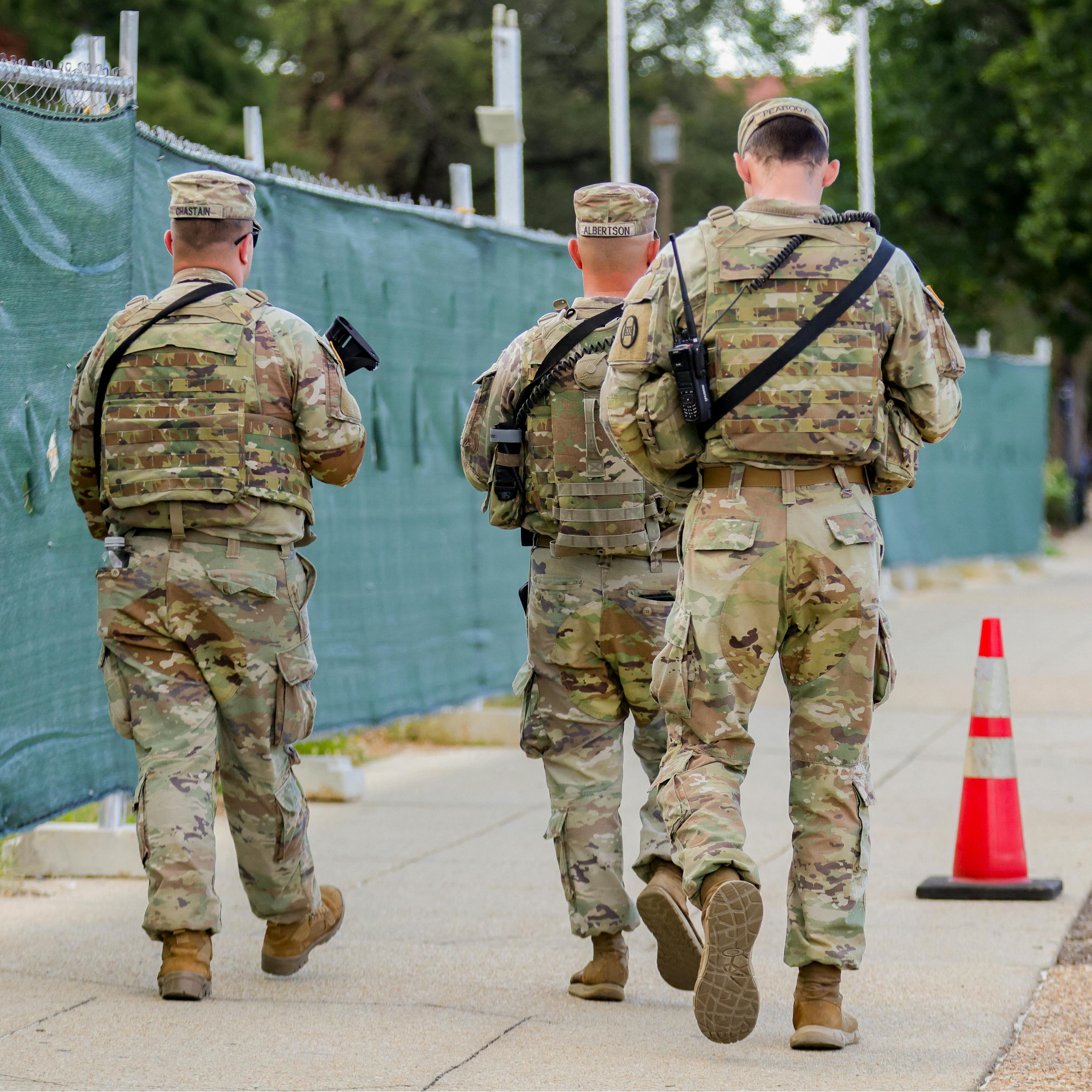
Radio Atlantic
A Blueprint for Military Takeovers
00:35:48
How the president could normalize military presence in American cities.
Loading summary
Transcript85 lines
- [00:00]
A
Hey, it's Ryan Reynolds here for Mint Mobile. Now, I was looking for fun ways to tell you that Mint's offer of unlimited Premium Wireless for $15 a month is back.
- [00:09]
B
So I thought it would be fun.
- [00:11]
A
If we made $15 bills, but it turns out that's very illegal. So there goes my big idea for the commercial. Give it a try@mintmobile.com Switch upfront payment.
- [00:22]
C
Of $45 for a three month plan equivalent to $15 per month. Required new customer offer for first three months only. Speed slow after 35 gigabytes of networks busy. Taxes and fees extra.
- [00:29]
B
See mintmobile.com Labor Day savings are happening right now at the Home Depot. So what are you working on? Prep for fall with our wide selection of cordless power tools that make it easy to clear your lawn starting at $79. And once the leaves are clear, keep your yard looking fresh with colorful mums that bloom all season long. Shop Labor Day savings now through September 3rd, only at the Home Depot. See select stores for details. You look at Chicago, how bad it is. You look at Los Angeles, how bad it is.
- [01:14]
C
We have other cities that are very bad.
- [01:16]
B
New York has a problem. And then you have, of course, Baltimore and Oakland.
- [01:22]
C
This is, of course, President Donald Trump announcing the short list of cities that he's considering sending federal troops to to help with their very bad problems. Actually, the verb the press tends to use in relation to Trump is not announce, but muse, as in this week, Trump mused that Chicago was, quote, a killing field. Then he mused that he wasn't going to do anything about it unless Illinois Governor J.B. pritzker asked him to send in the troops. And then moments later, we may just.
- [01:53]
B
Go in and do it, which is probably what we should do.
- [01:57]
C
This is Radio Atlantic. I'm Hanna Rosen coming to you from Washington, D.C. where federal officers and armed national guards have been patrolling our streets to help us with what Trump has declared our city's crime emergency. Now, D.C. is a special case. We'll get into that. But there is no real precedent in American history for what Trump is musing about now, which is routinely using the military for local law enforcement whenever he wants to in whatever city catches his fancy. This week, Trump signed a handful of executive orders trying to formalize that plan. One, for example, directed Defense Secretary Pete Hegseth to create a specialized unit trained to quell civil disturbances and ensure safety and public order, quote, whenever the circumstances necessitate. Now, there's always been a healthy skepticism in a democracy for a president who liberally uses military force and the American Constitution and various legal precedents guard against it. So what does stand between the president and troops showing up in your city, as they did in mine? Also, what's the subtext of these city takeovers? What is the administration actually trying to accomplish? We talked to Quinta Jurassic, who covers legal issues for the Atlantic, and Nick Miroff, who covers immigration. Quinta, welcome to the show.
- [03:28]
A
Thanks for having me.
- [03:29]
C
Nick, welcome.
- [03:30]
B
Thank you. Good to be here.
- [03:32]
C
So, Quinta, like me, you live in dc. Walking around your neighborhood these last couple weeks with your brain full of legal expertise, what is the thing that struck you the most about what you've seen?
- [03:43]
A
What's interesting to me is the way that law enforcement and the National Guard have spread out across the city. Down here by the Atlantic offices, by the Wharf, the National Guard has been really hanging out by the metro by the riverfront up where I live in Northwest, near Columbia Heights, which has a pretty significant Latino immigrant population. I have not seen any National Guardsmen, but there have been instances where people have been functionally grabbed off the street by federal law enforcement. And there are a lot of signs posted around on lamp posts, that kind of thing, saying in English and Spanish, don't talk to ice. Various invective directed at ice, posters of ice cubes melting. And recently I actually started seeing posters directing people in Spanish, Spanish not to talk to DC's Metropolitan Police Department MPD, and saying talking to MPD is the same as talking to ice. Do not speak to the cops. So it's very, very present, even when federal law enforcement and the Guard aren't actually themselves. Right there.
- [04:59]
C
Nick Trump talks about it in terms of crime, like the city's crime is out of control, but reports like the one Quinta just made are everywhere. And there's been reports of immigration checkpoints in dc. What have you heard? Can you tell how much this is about immigration, how systematic this effort is?
- [05:18]
B
Sure. Well, I mean, I think it's important to keep in mind that the Trump administration and the President in particular, have conflated crime and immigration for a long time. And so even though countless studies have shown that immigrants commit crimes at lower rates, we have the two things very much conflated by this administration. And the president and his team are using the National Guard deployment and the broader federal law enforcement deployment across the District to kind of get around the sanctuary policies that have been put in place basically to protect immigrants and to limit the cooperation between local, local police departments, in this case, D.C. police and ICE. And so under the guise of making the Streets safer. It's a way for the administration to have a more muscular ICE presence and a more aggressive ICE deployment in a sanctuary city. Now, whether they would be able to kind of replicate that model in other places, I think is still an open question. The DC deployment follows the administration's incursion into Los Angeles, where they very visibly deployed ICE officers and had a big kind of roundup operation to grab people on the streets. And so we're seeing similar tactics in the District. And I think if they move on to Chicago, as they've talked about, we can expect to see something like that there.
- [06:50]
C
Okay, so so far the examples we have are DC and Los Angeles, and they're quite different. Quinta. DC has its own special circumstances. We don't, for example, have a governor who can say, no, thank you, we don't want you here. So how does D.C. differ from, say, Chicago or LA?
- [07:07]
A
As you say, D.C. doesn't have a governor. We are technically a federal enclave. We don't have voting representation in Congress. And we also don't have control of our own National Guard or at the moment, our own police department. So precisely because D.C. is a federal enclave, the state self governing authority that it has is actually something established by Congress under something called the Home Rule act, which was passed in the 1970s. And there's a provision in the Home Rule act that says if there is an emergency, the President can essentially request the mayor's support in deploying the D.C. metropolitan Police Department as he likes for 30 days. Right.
- [07:53]
C
So that also has an emergency provision, but it only applies to the police. The National Guard, he can deploy at will.
- [07:59]
A
Exactly. So then the other component is that other places, including other territories, by the way, they have their own National Guard. The governors of those areas, they can deploy it in D.C. it goes directly to the President. And what that means is that Trump can basically call it up at will and make them do whatever he likes. And there are fewer restrictions on how he can use them. And so that's why you see guardsmen around, some of them standing around on their phones, some of them picking up trash, some of them helping with law.
- [08:32]
C
Enforcement and some carrying guns.
- [08:34]
A
Yes, by the way.
- [08:35]
C
Okay, so that's DC Very exceptional. He is talking about other cities now. So what happens in other cities? What are cards he can play?
- [08:45]
A
First off, obviously, he doesn't have control over the local police departments. And I think that is, you know, a huge distinction that is worth mentioning and can't.
- [08:53]
C
No emergency power can give you control over the local Chicago Police Department. Right.
- [08:58]
A
No, precisely, because, you know, Chicago is a city in a state and that state has sovereignty under the Constitution. And so, you know, just as he couldn't federalize the lapd, he can't do that with the Chicago Police Department. He can deploy the Guard, but it works differently because in states, the Guard don't report directly to the President. They report directly to the Governor. In order for the President to deploy them, you have to jump through some hoops. There are a couple different ways you can do it. What he did in California was he federalized the Guard. So he essentially moved them from their state status, where they report to Gavin Newsom, the Governor of California, into their federal status, where they then report directly to the Secretary of Defense and the President.
- [09:49]
C
Okay, quick question. So, yes, because we all know he sent in troops despite Gavin Newsom's very loud and sometimes very funny and sardonic objections lately. So how easy is it to federalize troops? I mean, as we all saw, it seemed to happen pretty quickly. So is that like a little thing to federalize the National Guard? Like, you can just easily do that in Chicago or wherever?
- [10:13]
A
It's a good question. You do have to jump through some bureaucratic hoops. You have to find a particular authority that you are deploying them under. So there are sort of legal boxes to tick.
- [10:27]
C
Okay.
- [10:27]
A
I think the main issue is just, you know, it takes work to tick those boxes. It takes work to move people around. Right. People in the National Guard are not full time soldiers. They have jobs. They, you know, in California, maybe someone lives in San Francisco, they have to schlep all the way down to la. Then once they're there, you go, got to figure out somewhere to put them. There were reports about National Guardsmen sleeping on the floors in auditoriums and that kind of thing. So it's a logistical challenge. And then there's the separate question of, okay, what are these people actually doing? And this is where it gets complicated, because when the National Guard is federalized, it's functionally acting as part of the US Military. And what that means is that there is a legal restriction on using the military for law enforcement. Law that's called the Posse Comitatus act.
- [11:23]
C
And by the way, very important. I feel like there's just a. There's reasons for this and a tremendous skepticism, for good reason for allowing a President to use troops in cities as they wish.
- [11:37]
A
Exactly. And so what that meant is that what you saw in la, when the Guard was deployed federally, they couldn't engage in law enforcement. So what they did instead Was there was a lot of standing around federal buildings because they're protecting federal property. And the government argues that that's a sort of acceptable use of the Guard in its federal capacity. And a lot of standing around ICE agents as those agents arrested people. And there's actually litigation going on right now. We're waiting for a judge to rule on whether some of the things that the Guard did, like, say, holding someone while they waited for ICE to show up, whether that actually constituted law enforcement, and whether it was impermissible. So essentially, you can use this power of federalization to deploy a state guard against the wishes of that state's governor, but once you do that, there are some real restrictions on how you can use them.
- [12:35]
C
Got it. Nick, you were in LA when the troops came in. What you witnessed, did the situation give ICE agents cover to do things or behave in ways that they wouldn't be able to otherwise, or did the situation seem more restrained than usual?
- [12:51]
B
The Guard was not, on the whole, deployed with the ICE teams. They had other federal agents with them from ATF or dea, that type of thing. And really the most kind of aggressive tactics we saw were the Border Patrol agents under the command of a Border Patrol chief who was really running all of the broader deportation and ICE enforcement operations in la. Most of the Guard troops that I witnessed were, as Quintus said, standing around federal buildings or in the main sort of downtown area that was the focus of the protests, where ICE has a kind of detention and processing center. That was the heaviest National Guard deployment. And they were just kind of standing stoically in the broiling sun and looking.
- [13:38]
C
Pretty miserable, as they do here. So is what you guys are describing, then? Is this just theater? Is this like Trump Theater as you're talking? I'm finding it hard to understand if I should take this seriously as a move towards dictatorship and the sort of fears we all have of a president, like manipulating troops in ways that he wants, or if this is just Trump theatrics, the equivalent of his parade.
- [14:05]
A
I think it is. And it isn't a move toward a more authoritarian model of the presidency, let's say, on the side of it isn't. As we've said, the Guard was mostly just standing around. They don't seem hugely happy about it. I know there was some reporting in the New York Times that I think it was 75% of the members of the California Guard whose commission was up after that deployment, who had been deployed, said that they were not going to rejoin. They weren't particularly happy about it. Neither were people in la. And I think that does matter. On the flip side, the argument that I have heard from people who study civil military relations and who study the deployment of the military domestically is that this is stepping over a sort of culturally and politically very important line where we don't, as you say, Hannah, we have kind of a bad response culturally to the idea of the military being deployed to American cities and say, why?
- [15:06]
C
Like, let's just articulate why. That's been a huge constitutional fear.
- [15:13]
A
It looks dictatorial, right? It looks like you suddenly have the military being deployed against American citizens, that the federal government is turning against its own people. And then in terms of the history, we have examples like the Kent State shooting, say, where college students were shot by National Guardsmen during a protest over the wars in Vietnam and Cambodia. So there's sort of a really ugly leg here. And what Trump is doing in all these deployments that are pretty silly looking so far, frankly, is kind of eroding that cultural prohibition against deploying the military in this way. We're sort of becoming used to the idea that you can have soldiers standing around in camo with a handgun on their hip and that that's something that is normal to that it's normal to be afraid of what the military might do to you.
- [16:18]
C
So that's what the average citizen has to fear. For immigrants, the dangers look more immediate. That's after the break. Class is now in session and the UPS store is here to help you Ace arriving on campus, our certified packing.
- [16:40]
A
Experts can pack everything you need, from desktops to decor.
- [16:45]
C
Plus, when you pack and ship with.
- [16:46]
A
Us, you get our exclusive pack and ship guarantee.
- [16:49]
C
Your items arrive safe or your money back. Restrictions and limitations apply. To get a 20% off packing coupon and for full details, visit theupsstore.com packing@blinds.com.
- [17:03]
A
It'S not just about window treatments. It's about you. Your style, your space, your way. Whether you DIY or wand the pros to handle it all, you'll have the confidence of knowing it's done right. From free expert design help to our 100% satisfaction guarantee, everything we do is made to fit your life and your windows. Because@blinds.com, the only thing we treat better than windows is you. Shop blinds.com Labor Day mega sale happening now. Save up to 50% site wide plus a free measure. Rules and restrictions may apply.
- [17:35]
C
Nick, it's easy for us to talk abstractly about the constitutional fear, but I think with the immigration subtext, the situation's A little different. Like Quinta said, people actually have been nabbed on the streets. A lot of delivery drivers. There's been tons of pictures on DC Social media about that. So I wonder if how much you think Trump has been using this. I don't know if we can call them city invasions to further the immigration agenda or create generalized fear around immigration.
- [18:07]
B
In this case, the Guard requires this emergency declaration, and then that emergency declaration creates the possibility to do more aggressive immigration enforcement, including the kinds of checkpoint style stops on city streets that allow ICE to be right there and to play a role in getting more people. I mean, on the one hand, I think it's hard to do long term systematic immigration enforcement in a big democratic run city like Chicago without cooperation from local authorities and the police. And so having Guard troops for weeks or months at a time, doing that kind of work is probably not feasible. But like when said, these are trial runs in a sense, and Trump can send the National Guard out for a limited amount of time, declare some sort of victory over crime, and highlight some of the most egregious immigration arrests. And then at some point down the line, if the administration determines that there's some other need to have another emergency deployment, maybe because of civil unrest, maybe because of some other immigration purpose. At least now they've had their practice run. And Trump advisor Stephen Miller has been kind of talking about and fantasizing about this type of military role on US Streets for a long time.
- [19:28]
C
Yeah, Quinta, you mentioned this. The situation in LA is being litigated right now. Where does that stand? And how could that affect Trump's ability to send National Guard into other states?
- [19:42]
A
This is a lawsuit that California filed just days after Trump announced the deployment into la. It's Newsom v. Trump. So very clear from the case caption, what's going on there. And essentially what California is arguing is, as I'd mentioned earlier, that in deploying the National Guard under federal authority, the Guard broke the prohibition against being engaged in law enforcement by helping out ICE in these various ways. We're waiting for the judge, Judge Charles Breyer, to rule on this issue. And I do think it is a question in my mind how this might affect any deployments going forward. There are a couple ways. One is, if Trump decides, okay, I want to federalize the Illinois National Guard and send them into Chicago, will that limit what the Guard does in Chicago? Will they maybe be more constrained in just standing around a courthouse or something like that? Now, on the other hand, I think what you will probably see if the judge comes out with a ruling that is not favorable to the government is that it will immediately be appealed. If the appeals court also rules in a way that is not favorable to the government, they will probably appeal to the Supreme Court. And then if they're able to get the Supreme Court to put that ruling on pause or throw it out, that then they would probably say, well, so much for that ruling, or this doesn't actually apply to the Illinois Guard. That was only regarding the California Guard. So we're going to go ahead and try it again. And we've seen a willingness on the part of the government to really push the line there.
- [21:29]
C
Push but not step over.
- [21:30]
A
Well, that's the interesting thing, right. Is that there is simultaneously a very sort of macho posturing of the courts can't tell us what to do. And yet at the same time, there is also clearly an awareness that they can't go too far.
- [21:45]
C
Right.
- [21:46]
A
I don't know what's causing that, but there's a hesitation there.
- [21:50]
C
Right.
- [21:50]
A
And so another possibility, what you might see is there is another authority that I haven't mentioned yet under which you can deploy the Guard. So I've talked about the Guard and the state status, the Guard and the federal status. There is something in the middle. It's called Title 32, where it is operating under state authority, but federal direction. And usually that's mostly useful because it means that the federal government can, like, foot the bill if you're using the Guard to clean up after a hurricane.
- [22:20]
C
Say it again. It's operating under state authority.
- [22:23]
A
Yes.
- [22:23]
C
But the federal government pays for it.
- [22:25]
A
Essentially. Yes. So it's a, it's state authority on a federal mission.
- [22:29]
C
And does the state have to agree? Like, does the governor have to say?
- [22:32]
A
Yeah, the governor has to agree. But what you can do is you can send in the Guard from amenable red states into a blue state. And so in D.C. actually, we have Guardsmen from a range of red states, South Carolina, for example, who have actually been sent here, and they are operating under this Title 32 status.
- [22:58]
C
Oh, confusing. So you can choose National Guard from Mississippi and South Carolina with the agreement of those governors to go into Chicago.
- [23:07]
A
That's where it gets hairy. So in D.C. again, we don't have these legal protections of state sovereignty. You can send them into D.C. yeah. If you tried to say, okay, well, I want to have the National Guard in Chicago. I don't want to be limited by this restriction on using the Guard for law enforcement. I'm going to say, let's send them in under Title 32 because a red state, Governor Greg Abbott in Texas, agrees to send in the Texas Guard, then what you would have is Illinois saying, wait a minute, we're being invaded by Texas. You can't do that. We're our own state. We get to decide whether or not somebody comes in. And so then there would be this freedom around the sort of issue of, okay, well, you can't engage in law enforcement. You wouldn't have to worry about that, but you would have to worry about a lawsuit, that this deployment would violate federalism protections on state sovereignty, the specific statute that you would use to send them in, maybe that doesn't stretch quite as far as the President would be arguing. So we might see that as well, and then there would be another lawsuit on those grounds.
- [24:19]
C
So it sounds like a lot of things have to be worked out in the courts, but does that mean the legal system's always gonna be playing catch up on Trump's actions? Like, his timeline is fast, their timeline is slow.
- [24:31]
A
I think that is a very real risk. That's something that we've seen over the last six months of this administration. Trump has kind of adopted this strategy of moving fast and breaking things and waiting for the courts to catch up. The district courts, I would say, have actually done a pretty impressive job of moving very, very quickly. This is not a branch of government that traditionally moves at this speed. But the problem is that even when district courts have stepped in, the administration has often been successful in its efforts to get those rulings paused by appeals courts and by the Supreme Court. And so what you see are these circumstances where a district court will say, please stop doing this while I figure out whether it's legal or not. That order will get paused. And then the administration is essentially able to keep on doing what it's doing while the legal issues are hashed out.
- [25:26]
C
So that's the legal side now, the logistical side, which you both have mentioned. Nick, you just attended a job fair for ICE agents. They've just been given a lot of funding, and they obviously need ICE agents for a bigger anti immigration push. What did you pick up there?
- [25:43]
B
Yeah, I mean, so one of the reasons that the Trump administration hasn't been able to do the kind of mass arrests that the President envisions is that the ICE workforce simply isn't large enough. That's why we've got other federal law enforcement agencies assisting ice, and they have these National Guard troops, in some cases, out trying to support the overall immigration enforcement mission. And so ICE has gotten about $75 billion through the president's big, beautiful bill. That's nearly 10 times the agency's annual budget. And a big chunk of that money is going to go toward massively increasing the size of the ICE workforce. There are about 5,700 ICE deportation officers nationwide right now, and the agency is trying to train and deploy 10,000 by the end of this year. Really just over the next four months, they're shortening the amount of time that they'll be trained at the academy. They're really fast tracking every part of the process in order to get as many people out there as possible. But it obviously comes with risks. Whenever you cut corners on the hiring and training process, it has, you know, increased. What we've seen historically is that it increases the risks of, you know, officers engaged in corruption or misbehavior.
- [27:03]
C
Okay, so from what both of you say, we have a lot more coming, potentially. There's a lot more ICE officers. Trump is trying new legal strategies. Quinta Trump began this week with a barrage of executive orders which seemed to signal, okay, I have more hands to play, and I want to understand those a little better. Formalizes the creation of this specialized National Guard unit to, quote, ensure public safety and order, and points to the Defense Department to create these. I mean, people have been calling them rapid reaction forces. What do you make of that?
- [27:35]
A
It does seem like, as you say, like an effort to formalize the idea that if there's something going on in a city that Trump doesn't like, he can send in the Guard and maybe in an effort to make the kind of logistical difficulties that we talked about, kind of smooth those over so it's even easier. Easier to send them in. So certainly I think he has the legal power to do that. But it is, again, another step in this direction of sort of normalizing the idea that sending in military troops to the streets of American cities is a typical thing to do.
- [28:12]
C
Then there's these other two executive orders which call for the removal of cashless bail, one in D.C. and one across the country. Can you explain cashless bail and how it fits into this bigger picture, which you called formalizing the idea?
- [28:27]
A
I am honestly kind of puzzled at how cashless bail got pulled into this whole thing. So as of just as a brief definition, I think most people are probably familiar with the idea of cash bail, where, you know, if you are arrested for something in order to get out of jail before your court date, you put up a certain amount of money, and the idea is if you don't show up, then you lose the money. So it's essentially a way to get people to come back to court. Recently there have been a number of reforms where states and local jurisdictions are moving away from cash bail on the grounds that it is basically just a penalty for not having money upfront and that that is not actually particularly connected to public safety. So in D.C. for example, there are restrictions on the use of cash bail in such a way that would prevent from actually walking free. And instead, what you see is judges will make a determination of, you know, is this person a danger to the community? Should, you know, are they a flight risk? Should we allow them to go? Interestingly, on the federal level, my understanding is that judges really don't particularly make use of cash bail. They make those separate determinations. So Trump, I don't know from where, seems to have gotten this idea that cashless bail is responsible for a surge in crime, which it's worth saying there is no surge in crime. Crime is falling across the country in a major metro areas. But he seems to have this idea that they're somehow linked and that as president, he has the ability to push back on that for the same reasons that I mentioned before about sort of state sovereignty. He doesn't have the ability. There's no authority that the president has to say, actually you have to use cash bail here. There's no. He likes to point to Article 2 of the Constitution, which gives the President his powers. There's no Article 2 power on cash bail or local law enforcement. That's explicitly left to the states and to local jurisdictions. And so while he seems to have a bee in his bonnet about this, it is not very clear to me what he actually thinks he can do here and whether any effort to try to reinstate cash bail would hold up in court.
- [30:53]
C
Right. And we should say he does threaten to cut federal funds in those executive orders. So whether he does or doesn't care about cashless bail, maybe he's using it as a way to gain leverage on states and cities, kind of like he's done with universities.
- [31:10]
A
Okay.
- [31:10]
C
Another point to bring up is how Democratic politicians in these states and cities are responding. You have the California and the Illinois governor getting a lot of attention for pushing back against Trump. I don't know. I mean, Quinta, how do you see this back and forth political bounce back effect happening? Because Newsom and Pritzker have been very clear. Like Pritzer's comments were like, no, no, thank you. Don't come to Chicago. No, thank you.
- [31:35]
A
It definitely seems like Democrats who are interested in positioning themselves as 20, 28 contenders are seizing the moment to respond here. So Newsom obviously has used this to kind of position himself nationally. Pritzker gave a sort of very stirring speech rallying the troops, metaphorically in Chicago, saying, as you say, Mr. President, don't come here. Wes Moore, the governor of Maryland, has been kind of egging on as maybe a bit strong, but sort of, you know, saying, you know, hey, you want to come walk the streets of Baltimore with me? There's definitely, it seems to me, an extent to which these leaders at the gubernatorial level are willing to kind of take this opportunity to position themselves against Trump.
- [32:27]
C
So this could go either way. It could strengthen certain Democratic candidates. It could lead to more legal barriers and sort of strengthen state sovereignty, or the opposite could happen. So let me ask you both this. What are you both watching as an important determination of what the future might look like? Like, is it a particular court case, is it a particular city, Is it a particular mayor or governor's response? I'll ask you first, Nick, in immigration, like, what's the important unfolding story for you to see how this works out, this crackdown? Whether it works results in a lot more sort of like loose and unruly immigration enforcement, or it's just a bunch of people standing around.
- [33:05]
B
I think it's yet to be seen whether this has any staying power, whether this is just going to be a temporary thing that the president does in D.C. and then moves on to somewhere else. And then what are the longer term local impacts? Are people driven out of D.C. in some kind of meaningful way? Is there a long tail of fear that this leaves is the city? Does it get more used to the presence of federal immigration enforcement in a place that is supposed to have sanctuary policies? And does that become a model? So that's what I'm watching for, particularly as ICE over the coming months starts to train and deploy thousands more deportation officers and is eager to send them out into blue cities.
- [33:53]
C
So it's like, what model solidifies? If we get a working model, they can repeat that working model in lots of cities.
- [33:59]
B
That's right.
- [34:00]
C
Quinta, what about you?
- [34:01]
A
Legally, I will be keeping a close eye on this court case in California, how the judge rules, what happens to it. I do think that I'm sure the administration will try to push ahead regardless, but it will nevertheless be an important marker as the first time that this has been seriously litigated in the second Trump term. And I do think that it might shape how he is as the National Guard going forward, even if it's just, you know, choosing to kind of divert his tactics around any legal minefields that this might open up.
- [34:38]
C
Right. Okay. Well, thank you both for joining me and helping to explain this.
- [34:43]
A
Thank you.
- [34:44]
B
Thank you.
- [34:49]
C
This episode of Radio Atlantic was produced by Kevin Townsend and Rosie Hughes. It was edited by Claudina Baid. Rob Smirciak engineered and provided original music, and Sam Fentress fact checked. Claudina Bade is the executive producer of Atlantic Audio. And Andrea Valdez is our managing editor. Listeners, if you like what you hear on Radio Atlantic, you can support our work and the work of all Atlantic journalists when you subscribe to The Atlantic. At theatlantic.com listener, I'm Hanna Rosen. Thanks for listening.