Loading summary
Transcript52 lines
- [00:07]
A
Over the weekend, President Trump announced that US Strikes on Iran killed the country's supreme leader, Ayatollah Ali Khamenei.
- [00:15]
B
This wretched and vile man had the blood of hundreds and even thousands of Americans on his hands and was responsible for the slaughter of countless thousands of innocent people all across many countries.
- [00:31]
A
There are reasons why previous American presidents haven't gone after Khamenei, even though he was always a brutal dictator and an infamous sponsor of terrorism all over the world. They feared that an attack on Iran would prompt a broader Middle east war. They feared that the theocrats and military hardliners in the country would not give up power so easily. All these fears are still very valid, and yet here we are with Khamenei dead and no real plan for a democratic transition.
- [01:01]
B
Combat operations continue at this time in full force, and they will continue until all of our objectives are achieved. We have very strong objectives.
- [01:14]
A
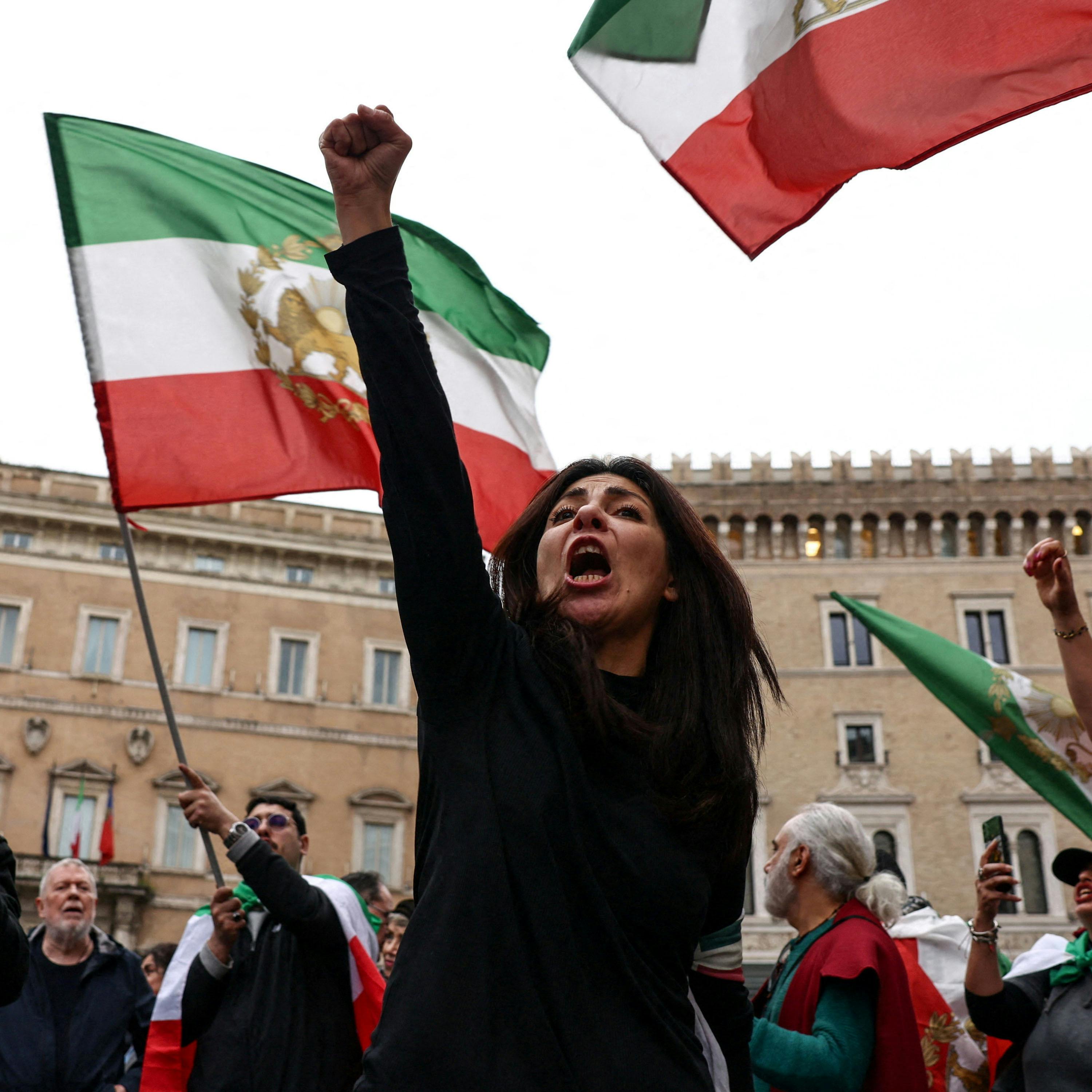
I'm Hanna Rosen. This is Radio Atlantic. What President Trump wants out of Iran has always been vague. Maybe regime change, maybe a nuclear deal. The strikes on Saturday gave him a clear victory in the killing of Khamenei. But the conflict has already escalated outside Iran, and Trump's endgame has remained vague since the strikes. He's brought up Venezuela as a model where the US Removed the leader, but the regime itself stayed in place. That might seem like the simple solution, but the factions inside Iran are already fighting for power. Trump keeps repeating that the people of Iran should rise up and take power.
- [01:57]
B
Now is the time to seize control of your destiny and to unleash the prosperous and glorious future that is close within your reach. This is the moment for action. Do not let it pass.
- [02:11]
A
There is, however, no obvious opposition leader. So what are the real possibilities for Iran's future and the U.S. s role in shaping it? Today, we're talking to Iranian writer and Atlanta contributor Arash Azizi, and to staff writer Anne Applebaum, who covers democracy around the world. Arash, welcome to the show.
- [02:32]
C
Great to be with you.
- [02:33]
A
Anne, welcome to the show.
- [02:35]
D
Thanks for having me.
- [02:36]
A
Arash, we spoke last summer after the US had bombed Iran's nuclear facilities. And one thing you told me was that you knew people were thinking, well, wouldn't it be great if Israel or the US Came out and took care of this regime and we could move on to a better life? Do you remember that?
- [02:53]
C
I sure do. Yes, indeed.
- [02:55]
A
And I'm wondering how they're feeling now that it actually happened.
- [02:59]
C
Well, many people were continuing to have the same hope that something like this could happen. And in the months after, actually, this hope was strengthened. People thought it was even more possible when the idea of killing Khamenei had already become pretty mainstream, both in the regime's security thinking, but amongst a lot of its opponents. So there was this exciting idea that this could happen. But now that it has happened, I think people are faced with the fact that, well, even if you kill Khamenei, you won't have the kind of change that you want necessarily overnight. And they're kind of facing with that
- [03:34]
A
reality, which means what sort of. What are they thinking? What are the questions in their head?
- [03:39]
C
I think the average Iranian citizen, frankly, in the past year or so, feels a lot powerless because they are looking at these big events that are happening. Of course, they also went through protests that led to the massacre of thousands of Iranians by the regime in January. And they look at these events and they know that the big decisions that affect their lives rest with the president of the United States, rests with Israel and rests with different factions, you know, in their own unrepresentative regime. And there is not a lot they can do about it. So I think some try to be hopeful. People are very fearful. Of course, they're living under this bombardment now, but I think they feel powerless and they know that they can't really influence the course of events.
- [04:20]
A
Well, that powerless is an important word because. And Trump, while he's given a few different scenarios about who might take over, one thing he keeps repeating is that the people will take over. Like yesterday, he suggested that the Islamic Revolutionary Guard Corps should surrender their weapons to the people. And when he announced the war, he said, now is time to seize control of your destiny. What do you make of all that?
- [04:45]
D
So the problem is that Iran has had coherent opposition movements over the decades that have managed to create nationwide movements and strikes. Almost all of them have been systematically destroyed, people arrested, people killed, people exiled. And on the ground in Iran, there isn't a single group or person or movement to whom these IRGC or other police or paramilitary could surrender. In fact, it's almost a very strange thing to be saying, he says you should surrender, but to whom should they surrender? There's no body to surrender, and why would they feel safe in surrendering? And it's the same question about the people should take over. I mean, okay, the people should take over, but what should they do? They're still facing more than a million people under arms who are defending the regime. There's still a part of the population. I heard an estimate of about 20%. Maybe it's lower who support the regime. And we saw some of them came out and demonstrated today as well. So the mechanisms by which this should be done aren't clear. I mean, there are people outside the country who have plans. There's the Crown Prince, Reza Pahlavi, who has described himself as a potential leader and a potential unifier. And that could be true. But he doesn't have boots on the ground, as we say in Iran. He doesn't have a movement ready to take over. And so the question is how all these things would happen in the face of violence, guns, bombardment is still pretty unclear right now, as far as I understand.
- [06:17]
A
Arash, is that your impression? Trump said yesterday he had three very good choices for who could run the government. Now, he didn't name them explicitly, but given what Ann just said, what are the realistic choices right now?
- [06:30]
C
I think Ann is exactly right. And that's really the key issue, the key issue that frankly, many Iranians have struggled to face. We Iranians who want democracy have failed to create a credible, ready alternative. This is what you could have done over the past few years. We haven't been able to. Of course, a big reason for this is regime's brutal repression of anytime anything tries to take shape inside Iran. And Mr. Pahlavi, outside Iran does have many supporters inside Iran, I would say, you know, a very considerable number of Iranians supported him at wary. But support doesn't translate into the kind of political part that you want automatically. And he does not have the underground game. And I want to actually further to what Ann says, not only we don't have it, we don't even have 2% of it. I mean, if you have, let's say 50% of the game, like if you look at Belarusia, Venezuela, you can argue how ready their opposition is from one to 100, you know, we are not even to five out of 100. That's just the truth of the matter. We don't even have like a basic organization. This is the reality that we are facing now. As for the president, you know, he has said very different things over the last 24 hours. So yes, he said he had three candidates. Then he said in another interview that he had a few candidates, but they had all been killed at some point. He said Venezuela start transition would be the best thing, which suggests he doesn't really want to change the regime. Senator Graham, who is close to him and who has been really, he met with Mr. Palavi several times. He seemed to be the regime change sort of quote unquote promoter. But now he says, oh, the goal is not actually regime change. So what the President had said in the last 48 hours has changed considerably. So it's not clear which version of it we should accept. I'm not sure. He also knows exactly.
- [08:22]
D
I would add to that, that in the weeks before this current bombardment, they also changed their tune several times. I mean, Trump did say during the demonstrations in January that the US Would come to your aid, that the people should rise up, and so on. And then almost immediately afterwards, Steve Witkoff started talking about welcoming Iran back into the League of Nations. He started talking about a nuclear deal. J.D. vance said something about, we don't want regime change in Iran. You know, we just want to negotiate away the nuclear weapons. And so the Trump administration itself has zigzagged back and forth as to whether it wants regime change or whether it wants to do a deal or whether it wants some insider regime person to emerge who they can deal with. I mean, that was actually the model in Venezuela. Venezuela did not have a regime change. You know, they removed one person, and then there are two people, Maduro and his wife, and then they essentially kept everything in place. Whether that will work in the long term, we don't know yet. But it's clearly not going to work in Iran, which is a much more complicated country, and where the regime has been much more aggressive over the years, has been entrenched, has been there since 1979. And it's not going to be possible to remove one person or two people and simply start dealing with their colleague. It's also a regime that has a. Not just a totalitarian ideology, but a theocratic religious belief in its own rightness and a kind of addiction to radicalism that it's had from the beginning. And that's not something you can just reform or change overnight. There's no moderate version of the Islamic Republic that could. You can imagine dealing with the United States as a partner. I mean, the United States is the Great Satan.
- [10:05]
A
Right?
- [10:05]
D
And so it's not like there's a kind of Gorbachev figure who could emerge that we would be able to be friends with.
- [10:11]
A
Right. Okay. So I'm picking up from both of you that Trump is all over the place, doesn't necessarily understand the details or the gravity of the situation. And I want to ask about the implications of that for the United States. But first, I need to understand a little better, Arash, what are the options? So, on the one hand, there's what Ann just mentioned. You know, there's a theocracy. It has an ideology and it has some number of supporters. On the other hand, there's what you said, the democratic opposition, which doesn't really have a leader, isn't organized. So what's in the middle? There must be pragmatic options. There are some names that have come up. Can you just put some concreteness to what are the actual choices here? Like names, people?
- [10:57]
C
Definitely. I would say this. First of all, it's interesting that, you know, on broad day comparison to Soviet Union, the Islamic Republic itself has really looked into Soviet Union. It makes sure it doesn't want to have a garbage chef because it sort of knows it led to the collapse of that system. So over the years it has looked at Soviet Union and China. And while I would say there is not really a garbage figure, there are Deng Xiaopings, if you will, to use the Chinese example, that is, there are figures, the most important of whom is Hassan Rouhani, the former president, who really have given up on the sort of theocratic vision and who are more technocratic. You know, they're not democrats by any means, but they're sort of thinking, you know, Deng Xiaoping's famous saying was, it doesn't matter if a cat is white or black, what matters if it can catch a mouse. But he basically meant, you know, what matters is efficacy if you're able to have economic development. So if you give long speeches about Islam, but your entire country is crumbling, that's no good. People like Rouhani, who was a president for eight years, really believe in that sort of vision. Now it just so happens that in the current constellation of power in Iran as vsp, Rouhani is totally out of the picture. But his ally, Ali Larijani, his national Security advisor, the speaker of the Parliament who is part of the national security, Councillor Baghar Ghalibov, has somewhat of a similar outlook. So I do believe this sort of cast of current characters, some amongst them are in this way technocratic. As a result, they're also west facing. They're very critical of ties with Russia and China. But they also contend with the fact that the Revolutionary Guards, this militia that controls much of the Iranian economy, is now led by a new hardline figure, Ahmad Zahidi. You know, they're also part of this system. So the question of how the relationship between them will work is what determines the next page, I guess.
- [12:45]
A
So what you're saying is that there's a sort of pragmatic ish political leadership and then a slightly more hardline military leadership. And that's where the tension is.
- [12:56]
C
That's exactly right. But what also matters is that even for the pragmatic ones, I mean they're sort of, they inherit these terrible policies of Khomeini after 36 years and the situation, the country finds itself in this war with US and Israel. The question is how can they manage this war? What can they do about it? But I would say this, it is entirely mainstream to them, for example, to say they need to give up the position of wanting to destroy Israel and they need to basically accept that Israel is gonna be there, have a position at least similar to Saudi Arabia's, that they would need diplomatic relations with the U.S. after all, President Rouhani negotiated for many years with the U.S. so you know, this idea is quite mainstream to them for self saving reasons, by the way. Right. But what has happened to them is that they understand if you wanna stay in power, if you don't wanna just get bombed to oblivion and also be facing our rebellion baron people every couple of years, there's a few things that we need to do. Now Khamenei would never do that because he was an ideologue trained in the 1960s and 70s who believed it's better for the whole country to burn down but for him not to give up his ideology. But I don't believe some of the other folks that I named, Lari, Jani, Khalibouff, Rouhani, I don't think they're like that.
- [14:12]
A
I see. So this vision that you outlined, this vision that you're outlining, which is between the two poles, looks like what? They have some relationship with the US politically, but it's unclear how the Revolutionary Guard treats its people or how open the country is.
- [14:34]
C
I think what it is going to look like is that they'll go towards some sort of a deal with Trump, they'll hope to get the sanctions lifted, they'll give up this belligerence against Israel, you know, in some sort of agreement at some point and they'll start sort of rebuilding the economy and they'll probably relax some of the social repressions, that is the sort of Islamist puritan repressions against the people, but never given up politically, so they wouldn't politically do. And you know, this used to be called the Chinese model in Iran. They basically want to do exactly what China decided to do after Tiananmen and they see China as a huge success. In my conversations with people who are sort of in the know in Iran, it's very clear to them that they have no other path forward. The country barely has any resources. It has a huge sort of economic crisis, environmental crisis is really crumbling in every way. So the alternative of sticking to your guns is going to be chaos, civil war, prolonged conflict. And I don't think they're ready, people who have sort of wealth and privileges and others in the regime itself, they're not ready to throw at all to the wind. And if I say one thing that really shows my point about them not having, not being ideological. I mean, if you look at these guys, very leadership figures, middling figures, all their sons and daughters are usually like partying, investing capital, studying in other places. And if you look at their life, you speak to them and all that, their focus is on technocratic elements. They kind of know that the ideology and the sort of anti American Islamist ideology of the revolution has failed.
- [16:10]
D
The only difficulty with that model is that it implies no democracy, it implies continued military control, it implies no rule of law, and therefore it also implies corruption. I mean, it implies a kind of Russian style or in the best case scenario, China, but in the more worst case scenario, Russia or Zimbabwe style regime, where the regime is still, you know, consists of people who rule by force and who are technocratically more competent, but who are extracting wealth from the society and staying in power that way. So there is a, it's not necessarily a recipe for long term stability.
- [16:55]
A
So Trump says he wants the Iranian people to take control of their own country after the break. The ways in which the Trump administration has already hindered that effort. Let's get back to Trump. Everything that you both have outlined is immensely complicated and unfolds over a long period of time. And what's your sense about the administration's commitment to overseeing everything you just described?
- [17:38]
D
So let's begin with the fact that over the past year, the Trump administration has withdrawn all of the admittedly very small amounts of support that the US Used to give to the Iranian democratic opposition. Quite a few, you know, human rights and other monitoring groups, for example, have lost their funding. The US has undermined and really blown up American broadcasting. There are two Farsi language channels that the US Used to support. One went from Radio for Europe, the other went from Voice of America, and the former has been prohibited from using transmission towers that it used in the past by Kari Lake. She's also puts a very eccentric figure in charge of Voice of America Persian Service who's very, very against the Prince Pahlavi, for example, which alone makes it a very partisan program. So we don't really have channels to communicate with the democratic opposition or with other opposition groups inside the country. We don't have a way of expressing our policy or making it clear we aren't really heard by the Iranian people in any sophisticated way. We don't really have people inside the State Department anymore with experience of political transition and negotiation, or if they're there, they're shunted aside because they're members of the so called deep state. So there's a. We don't have right now any, anybody or any groups who could be the American face of a long transition process. It seems that what Trump himself wants is something very rapid. I mean, he's, you know, he wants this Venezuelan model. You take a couple people out of the country and then leave everything else in place for the reasons that we've just been discussing. That's unlikely to work in Iran. But the US hasn't got, as far as I can tell, any clear alternative. Trump is impatient. He wants it to be over. He wants not too many casualties. I'm sure it needs to be over by the midterms. That's how he thinks. He doesn't think in terms of what's good for the Iranian people or what will secure long term peace in the Middle East. He thinks in terms of his own needs to be dominant and show that he's in charge and also his own electoral prospects. So I wouldn't bet on the United States to be the source of an interesting or nuanced transition process.
- [20:05]
A
Arash, what do you think the expectations are inside Iran? Given everything Ann just said? Are people being realistic about this? What impressions do you get?
- [20:14]
C
First of all, let me start by saying I really don't wonder what the president think would happen if he had sort of any sort of a plan. For example, at some point. He did seem to believe that, well, you know, I took care of Khamenei and I killed a lot of other people. So if Iranians can rise up and take over their government now, and I wonder if he had really thought something like that would happen, because those of us who pay attention, it was clear that this is sort of really kind of a Pollyanna. I mean, it was never something that was very feasible or likely to happen. So I wonder if, you know, if he didn't have enough intelligence given to him that would not show that. But in terms of the expectations inside Iran, look, first of all, let me say I think a very large number of Iranians really thought the United States will come, they'll kill Khamenei and then there can be some sort of a transition. This was Also never a feasible plan, but I think they're disappointed. And the war, as it goes on every day, will create more tragedies. There was a school that was hit in the city of Minab, apparently because near a military base, and dozens of schoolgirls were killed in this city. And they've become sort of a symbol of civilian casualties here in Minab. More civilian casualties will, you know, will pile up every day. If I was to predict, which is kind of a foolish act, perhaps, I would say that it's still quite likely for Trump to deal with the current leaders of the Islamic Republic at some point in the next few days and try to get some sort of a ceasefire in which you can declare a victory. But then, even after that, the question is, then, what do we do? And what would be the path forward? With all my heart, I want a democratic transition, but unfortunately, I do see it as quite difficult. I'm someone who is active in the Iranian opposition all my life, and I don't see us having really got our act together in the way that is necessary, by the way. Doesn't mean that we won't try. Right. This is what we'll push for. This is what we'd like to see. And by we, I mean all Iranians who want democracy. But can we, at this stage, muster enough resources to win against Revolutionary Guards, against these massive sort of financial and military elites in the regime? I don't see it. For years, I've looked with inspiration to examples like Lech Walesa in Poland, like Nelson Mandela in South Africa, South Korea, the democratic movement there. And unfortunately, in all those cases, there are important prerequisites, the most important of which is serious organization. And unfortunately, we just lack it at the moment. So I don't see how that could happen.
- [22:50]
D
Usually in a successful transition, there is some kind of alternative elite that has already been working together in the underground or in the opposition, who are able to take over and appoint, you know, a Minister of the Economy and a Minister of Culture, and already have roots inside the society. And Iran has some of that. I mean, there are, have been over the years, really important, as I said, figures and people and movements, but they have been so systematically undermined by the nature of the regime that it's been very hard for them to establish themselves.
- [23:29]
A
So this new method and just go in there and extract the leader, is this a new model of the US exerting global influence? It's unusual, unprecedented. And if it is, what are the implications of that? Like, we see a dictator, we extract the dictator,
- [23:48]
D
well, first of all, which dictators do we extract? You know, we aren't extracting Putin, we aren't extracting Xi Jinping. So it looks like we're looking for weaker dictators. So it's not clear to me that it's part of some overall policy to extract dictators. Secondly, the risk of this kind of policy is exactly the one we've been discussing is that it doesn't seem to be part of a longer term strategy. So what do they want the world to look like in a year or 10 years? Where are the stable US alliances that are being built to ensure prosperity and security for Americans and for American allies? The US Is increasingly seen as an unpredictable predator. Actually, Mark Carney of Canada spoke of the United States extracting tribute essentially from allies who are integrated with the US and that it's actually dangerous for some countries to be too integrated. If you have too many economic investments in the US and you're too close to the US Militarily, then you can be forced to do what the US Wants you to do. So the US Is no longer seen as a kind of benign partner by its old friends and at the same time it's seen as an unpredictable bully who might do anything anywhere at any time in the long term. That's really not good for global prosperity. It's not going to be good for Americans. Business needs stability and security. If you want to have an oil investment, you need a 10 year guarantee of peace and rule of law. I mean, this is the problem already in Venezuela. Why would you invest in Venezuela if you don't really know who's going to be in charge next year or in five years? Why would you invest in Iran if it's going to be unstable as well? It's a temporarily satisfying policy and maybe toppling the regime in Iran will eventually be good for the Iranian people, but it, it doesn't. As a global policy, it's hard to see how it creates the conditions for commerce and prosperity that Americans want.
- [25:58]
A
Okay, well then, Arash, a final question for you. Given the unpredictability, the lack of a pattern, if a decade or two from now Iran is a different country, like maybe not the democracy of your dreams, but a more pragmatic actor in world politics, how will we look back on this moment?
- [26:20]
C
To be honest, I think it is possible to be optimistic about that. And I think the democracy that we want is something we have to continue to fight for. And it's not a one or zero game, right? We'll be able to get more representative institutions, a more reactive civil society and all that. But I think even then we might not look at this moment necessarily very positively in that a lot of these developments could have come in other ways. But it's also true that I do see, and I think many Iranians, dare I say most Iranians, will see this moment as not just the president of United States making, but of Khamenei. It was him who has talked to his guns. It was him who refused every chance to reform. It was him who really shouted deaf to America and death to Israel all his life. He brought it onto himself. Now, while other presidents would not have perhaps acted so dramatically. I think Khamenei knew who he was dealing with and he really didn't take any of the off ramps that he was given repeatedly. So I think they'll remember that his obstinacy and how he brought our country to this point and they would be unforgiving to him for this reason.
- [27:30]
A
Well, Arash and Ann, thank you both so much for joining us today.
- [27:35]
C
Thank you so much.
- [27:36]
D
Thank you.
- [27:39]
A
This episode of Radio Atlantic was produced by Rosie Hughes and Janae West. It was edited by Kevin Townsend. Rob Smirciak engineered and provided original music. Sam Fentress fact checked. Claudina Baid is the executive producer of Atlantic Audio. And Andrea Valdez is our managing editor. Listeners, if you enjoy the show, you can support our work and the work of all Atlantic journalists when you subscribe to the Atlantic@theatlantic.com listener I'm Hanna Rosen. Thank you for listening. Lifelock.
- [28:27]
C
How can I help?
- [28:28]
A
The IRS said I filed my return, but I haven't.
- [28:31]
C
One in four taxpaying Americans paid the price of identity fraud.
- [28:34]
A
What do I do?
- [28:35]
D
My refund, though. I'm freaking out.
- [28:37]
C
Don't worry, I can fix this. LifeLock fixes identity theft, guaranteed, and gets your money back with up to $3 million in coverage.
- [28:43]
A
I'm so relieved. No problem.
- [28:45]
D
I'll be with you every step of the way.
- [28:47]
C
One in four was a fraud. Paying American. Not anymore. Save up to 40% your first year. Visit lifelock.com podcast terms apply.