Loading summary
Transcript57 lines
- [00:02]
Hanna Rosen
Nordstrom brings you the season's most wanted brands, Skims, Mango Free People and Princess polly, all under $100. From trending Sneakers to beauty must haves, we've curated the styles you'll wear on repeat this spring. Free shipping, free returns and in store pickup make it easier than ever. Shop now in stores and@nordstrom.com.
- [00:26]
Charlie Warzel
Spring is in full bloom at the Home Depot. So what are you working on? How about a quick and stylish patio furniture update? Check out a variety of on trend dining sets with plenty of space for entertaining. And what's outdoor dining without a shiny new grill? Find a wide selection of grills under $300 like the next grill 4 burner gas grill for only $229. Then add a little ambiance with string lights. Transform your space this spring with everything you need from the Home Depot. Growing backlash against Elon Musk and his.
- [01:05]
Patrick George
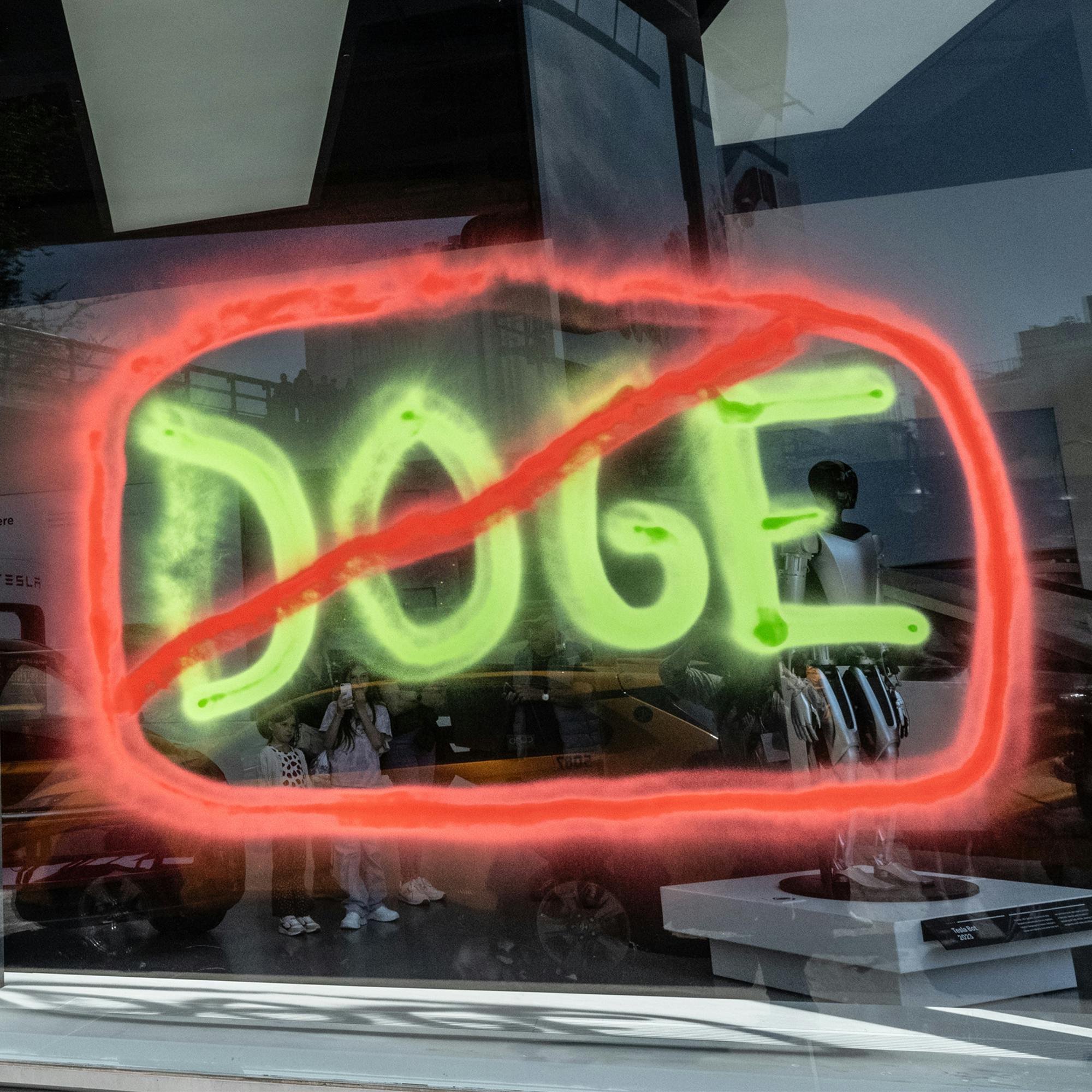
New role in President Trump's Department of Government Efficiency, also known as Doge. Protesters taking out their anger on the Tesla car and owners were busy all over the country. Tesla, the car company Musk founded and runs, has seen its stock price fall dramatically.
- [01:23]
Hanna Rosen
As you can see from this chart, the moment of reckoning for Tesla's founder has arrived. The company's earnings report showed that profits dropped 71% since this time last year. On a call with investors this week, Musk announced that he would spend a day or two per week on his Washington business, but that he would mostly turn his attention back to the struggling company. As Patrick George, the editor in chief of Inside EVs, wrote in the Atlantic this week, luck runs out.
- [01:55]
Charlie Warzel
I think he thought he would come in and, you know, gut the federal government and be seen as this great crusader and that everything would have worked out great, just the way it always has. He's had all this success before, right? But now, like people are, you know, they're running away from this company and that might be the greatest failure of all here.
- [02:15]
Hanna Rosen
I'm Hanna Rosen, this is Radio Atlantic. My colleague Charlie Warzel interviewed Patrick George recently about the tumultuous journey Tesla's been on from darling of the environmentally conscious to target of tire slashing. And the two of them land on Musk's blind spot, which caused him to miss this coming crash.
- [02:35]
Patrick George
Patrick George, welcome to Radio Atlantic. Thank you for joining me.
- [02:38]
Charlie Warzel
Great to be here, Charlie. Thanks for having me.
- [02:40]
Hanna Rosen
Their conversation explains so well how we got to this moment.
- [02:48]
Charlie Warzel
Covering Tesla in the 2000 and tens, the kind of hate mail we would get from people whenever we'd criticize the company or put something negative in one of the reviews of the Tesla or whatever. There were so many people back then who were such true believers in what he was doing. I mean, thinking that he is saving the world. And I'm kind of sad for those folks now who really believed in this environmental mission of the company. Those are the ones who are dumping their Teslas. Those are the ones who feel abandoned right now, who feel betrayed by this guy they once believed in, who has very much gone to what they perceive as the dark side.
- [03:25]
Patrick George
What has been going through your head over the last few months as we're watching Musk take this role in the government and have this interplay between his polarization and the stock?
- [03:38]
Charlie Warzel
You know, every now and then I have to step back when I read a sentence in the news or I even write a sentence on Inside TVs or for the Atlantic, you know, something like, president Trump holds a White House summit full of Teslas amid widespread protests against Elon Musk, his chief advisor and government cost cutter that are happening all over the world, including vandalism. And I just step back and I'm like, like, how did we get here? Is someone putting LSD in my coffee every morning? This is just such a baffling, bizarre outcome from the way that Tesla's trajectory has worked for the longest time and where it's at now. I mean, it is, for lack of a better term, it's kind of insane. Honestly. When I started covering Tesla and I was a young writer at Jalopnik, I started at the end of 2012 and one of the things, first things I did was my then editor in chief, Matt Hardigri and I, we interviewed Elon Musk from the Tesla factory floor when they were trying to get the Model S up and running. You know, the first car was the Roadster and that was kind of a science project, honestly. It was a Lotus Elise stuff with laptop batteries, more or less. And the Model S was their first real car and they were trying to get it ramped up and we talked to him on the factory floor and I remember, you know, him being at the time very tired, but, you know, charming, smart, but also self deprecating. We were doing stories on those early Model S's having all kinds of quality problems. And he was kind of like, yeah, yeah, we're working on it, but we're doing this Herculean effort to get it up and running. And you know, I still think the Model S, the original one, is the most important car of the 21st century, because that was what proved the case of electric vehicles for the whole world. Because they were golf carts. Before that, they were, you know, the. The Nissan Leaf Codas, things like that. And it became this it car. In Hollywood, you probably remember this, like, everybody, all the celebrities were trading in their Prius for the Model S. And it was fast and it was sexy. I mean, it could smoke a Porsche 911 in a drag race like a Prius. Couldn't do that. And over time, we covered this guy and his company. It's like, hey, here's this quirky guy who's kind of breaking all the rules and he's doing some cool stuff. And he's also clearly an asshole, too, and he's insane about some things. But what they're coming up with is this really interesting alternative to gas. And I can just say, personally, by the end of the last decade, I kind of realized that this is the future. This is just a niche alternative to gasoline. It's the future. And that wouldn't have happened without Tesla. But there are so many shades along the way of what happened with him that kind of inform where we're at now. Just the way that he treated the press, the way that he treated open access to his company, the way that he treated his own public image, the sort of vindictiveness against his enemies. He can be very vain, certainly. He's very obsessed with his own public image. Very vindictive. Obviously, calling that cave diver the pedo guy, or getting in a huge amount of trouble for saying he had the funds to take Tesla private. He had this Kanye west like, trajectory. It's like, this guy's brilliant, but he's also horrible. And over time, kind of the horrible part of him sort of overtakes that. But with this amount of wealth that he amassed came with this tremendous amount of power. And I think he has gotten really into his own myth and own legend about exercising that power in unprecedented ways.
- [07:05]
Patrick George
So I've always been fascinated with the correlation between Tesla's stock price and Musk as a Persona. There's an analyst at Moody's who said, I do think fundamentally that a significant fraction of Tesla's value is due to the fact that Elon can command this attention continuously, which sort of suggested to me that Musk is almost like a human meme stock, right? So I'm kind of curious, like, how much do you think Tesla's value is just tied to this future projection of Elon Musk as this guy who's going to either have that Edison esque ability to innovate beyond any constraints, or just that he can kind of brute force his way into making the future bend to his will.
- [07:54]
Charlie Warzel
I think that the value of the company, the image of the company, is extremely driven by him and by his involvement in it. Another analyst we talk to a lot who's one of the most bullish of all Tesla bulls, Dan Ives at Wedbush. He says repeatedly, elon is the heart and lungs of the Tesla story. And he said that Elon is Tesla and Tesla is Elon. The idea is that he has had so much success and he's generated so much value for the company before, that surely he'll do it again and he'll keep doing it. And he is the key driver of that. I'm not sure there is a company in modern times that is so intrinsically linked to one person. Probably the closest analog was Apple and Steve Jobs. I mean, this has also led to kind of a lack of accountability with Musk too, because I think that at any other company, certainly any company in the auto industry, that we would cover. If you've seen the value of the company get so tanked this hard over a number of months, that person, that CEO, would have been shown the door by now. But there is this belief that Musk is uniquely the one person who will deliver the future. And that is something he's built up himself. Certainly that's a myth he's built up himself. I go back to the early days of Tesla, the really early days, like in the 2000s, there was a New York Times article about Tesla Motors and what they were doing. And Musk, before he was CEO, he was just like an angel investor and heavily involved in the company, was furious because it didn't mention him at all. So he always wanted his image to be wrapped up in that. Long before he owned Twitter, he was one of the central figures on Twitter and really used Twitter to get around traditional media and get around press releases and events and things like that, to reach that audience directly and build up a following directly. And you said the phrase meme stock earlier. We hear that quite a bit now. And it's like, okay, admitting that Musk is damaging the company or wanting him out, that will collapse a lot of that value. So there is an incentive to sort of keep this vibe, I almost wanna say, grift going. So it keeps printing money, as it has before.
- [10:00]
Patrick George
I think this protest movement is extremely fascinating. I was in the Bay Area recently and I was blown away. Person I was visiting used to own a Tesla, used To. Yeah, well, this was a while back, but said that the person they sold it to, a friend, had it keyed the other day.
- [10:20]
Charlie Warzel
Right.
- [10:21]
Patrick George
Even just on a very small scale, if it's not a protest, there seems to be lots of acts of casual van and things like that. And then as recently as March, I think there was a protest at nearly every Tesla dealership in the United States. So the movement seems to be somewhat durable. And yet I think the very initial parts of this protest we watched coincide with a pretty substantial drop in the stock. So much so that you have Elon Musk and Donald Trump basically doing a Tesla infomercial on the White House South Lawn. Right. Teslas and EVs have always had a political valence. But does Tesla have a clear idea of what its brand is now? Because I don't know if it's going to reclaim that green progressive halo anytime in the near future.
- [11:15]
Charlie Warzel
I actually do think that the backlash against Tesla is the biggest crisis it's ever faced. Bigger than when it was a tiny startup trying to get its first real car out in 08, when the world was crashing. Bigger than when Covid happened and it had to shut down its factories. I think this is the biggest crisis it has ever faced as a company. And you said at the beginning of our chat, Charlie, you said the word polarizing, right? And Tesla's interesting because it's always been a polarizing brand. Like when it was embraced by liberals and Californians and the Hollywood crowd the rest of America hates. Oh, you have a Tesla. You're so smug. You're saving the world and now it's kind of flipped on its head. Now you have all of these folks in California who are trying, and kind of everywhere they're trying to get rid of their Teslas, like Democratic leaning, progressive leaning, even center leaning people who are done with the brand because of Elon, because of Doge. Meanwhile, you have Fox News defending him left and right, saying that he's an American hero who must be protected at all costs, and Pam Bondi saying she's gonna stick up for him. I mean, what a bizarre reversal this is. And at the same time, there is no evidence we have seen that buyers in red states, more conservative leaning folks, are going to be flocking to Teslas en masse. I don't want to stereotype here, but there are many, many studies and data points that we've reported on over the years that show that conservative leaning voters are more skeptical of electric vehicles than liberal leaning folks are. That's a climate change thing. And it's also just like how they've been trained to view EVs over the years. So it's like, are you for EVs or not? You want Elon to succeed, but you're not going to buy his car? You know, like, I have family in Deep Red Texas. And you know, when we were down there recently, everyone's saying Elon's the best, he's great. He's, you know, cutting government waste. Like, okay, well, would you buy one of his cars? Absolutely not. No. So, like, that is a problem. That is a problem with them being able to sell cars. And my personal theory is the ultimate test of this is going to be the new Model Y, which just came out. And for those of you who don't know, and I bet there's a good amount of people listening to this who probably own a Model Y, this is the best selling EV in the world. By some metrics, it's the best selling car in the world. There's a new one out, it looks a little different, the specs are better, it has more range, they fix the interior up, it's nicer. All things equal, this should be the best selling car in the world. Again, this should pull a repeat. And if this thing doesn't sell, if it has lousy, you know, it just went on sale now, so we're not going to know in the first quarter. But if a Q2, Q3, Q4 rolls around and this thing is sitting on dealer lots unsold, that is an existential problem for Tesla. That's a disaster moment for them. I think that would be the ultimate proof that they have totally alienated any potential buyers or fans that they might have once had.
- [13:54]
Patrick George
But at the same time, we just talked in this conversation about Musk's ability to buoy the company and the stock. Do you think that that is under threat? Essentially, yeah.
- [14:08]
Charlie Warzel
And that's where the disconnect is. Because the stock price at Tesla is all predicated on future stuff. It's solving autonomous, autonomous driving. It's robo taxis, it's artificial intelligence, which Musk has gotten really into in recent years. It's predicated on robots too. Like, they see the future as automation. It's not car sales, it's not duking it out with Nissan and Volkswagen over market share. He doesn't think that's going to propel the company to its trillion dollar value and take him to the stars and help him start his Mars colony someday. If he's just selling cars when we're talking about why its value is so high. It's not just because Elon is great. It's because for the last decade, Elon Musk has been personally promising that self driving cars, autonomous vehicles, robo taxis, are about a year away. Something he's been saying since 2016 about that is the value of the company. That's where all that money is wrapped up. It's the idea that this company specifically will solve self driving cars. Never mind the fact that Google's Waymo has years more experience, you know, many, many, many miles more experience actually deployed.
- [15:16]
Patrick George
They're on the roads.
- [15:17]
Charlie Warzel
They're on the roads, yeah. You could go to what, half a dozen cities in America and use a Waymo. So they're years ahead of Tesla and actually getting a quote, unquote robo taxi service on the road. But there's still that belief, with all they've invested, that they'll be the ones to deliver autonomous cars one day. That's the valuation of Tesla, part of it. But it's still a car company. Its revenue still comes from being a car company. Its revenue still comes from other car companies buying regulatory credits, meaning, like, you know, they pollute so much, so they buy credits from Tesla to offset their polluting. That's a huge source of their revenue. So he may have these grand dreams of robots and space and AI and everything else, but right now it does need to sell cars, it does need to move metal. And if it can't do that and the revenue tanks, you can forget AI and robo taxis. And the other thing I think about too is supposedly they are going to be launching their robo taxi service in Austin this summer. Okay, well, if he's made this brand so caustic and so controversial, who's going to want to use that service? I mean, is it really going to be some widespread thing like Uber or are people going to go out of their way to avoid it? And I think that latter outcome is a very real possibility here.
- [16:30]
Patrick George
When we're back, I asked Patrick George to explain why Tesla's crisis may be existential for reasons beyond Elon Musk.
- [16:39]
Charlie Warzel
Foreign.
- [16:46]
Patrick George
Reynolds here from Mint Mobile with a message for everyone paying big wireless way too much. Please, for the love of everything good in this world, stop with Mint. You can get premium wireless for just $15 a month. Of course, if you enjoy overpaying. No judgments. But that's weird. Okay, one judgment. Anyway, give it a try@mintmobile.com Switch upfront.
- [17:07]
Hanna Rosen
Payment of $45 for 3 month plan.
- [17:09]
Charlie Warzel
Equivalent to $15 per intro rate first 3 months only, then full price plan.
- [17:12]
Hanna Rosen
Options available, taxes and fees extra. See full terms@mintmobile.com don't miss your chance.
- [17:18]
Charlie Warzel
To spring into deals at Lowe's.
- [17:21]
Hanna Rosen
Right now. Get five select one pint annuals for just $5.
- [17:25]
Charlie Warzel
Plus get a free 60 volt Toro.
- [17:27]
Hanna Rosen
Battery when you purchase a select 60 volt Toro electric mower. With deals like these, your yard wins. Shop in store or online today. Lowe's we help you save valid through.
- [17:40]
Charlie Warzel
430 while supplies last. Actual plant size and selection varies by location. Excludes Hawaii.
- [17:48]
Patrick George
So putting aside Musk just for a moment here.
- [17:51]
Charlie Warzel
Yeah.
- [17:51]
Patrick George
The protests as we've mentioned have been noticeable.
- [17:53]
Charlie Warzel
Yeah.
- [17:54]
Patrick George
I'm curious, what are the non musk related threats to Tesla? Right, we have Tesla having this real genuine first mover advantage, especially in the United States. But it's not alone anymore. You've got Rivian, you've got Polestar, you've got a series of EV competitors taking the Musk and Trump out of it. What does the company have to worry about right now?
- [18:19]
Charlie Warzel
Yeah, let's start with competition because it's not just the startups you mentioned, it's that Tesla sparked this industry wide shift towards electrification. When we say electrification, that means more hybrids and eventually more a move to an all EV market. And this started in kind of the middle end of the last decade when all of these traditional automakers started chasing Tesla's value. Like when you're Ford or Toyota, you're looking at Tesla like why the hell are they valued so much more than we are? Like we need to be like Tesla, we need to become tech companies, we need to electrify and it took them years to do it. And I mean, let's be honest, like not all of them are pulling this off, this transformation from being traditional carmakers to being makers of software and battery powered vehicles. This is all we write about at inside EVs. It's just the struggles to do that. But they're getting there and some of them are now surpassing Tesla in many ways. You can buy a Hyundai or a Kia with more range than a Tesla has and faster charging. There's stuff Volvo's coming out with that has 400 plus miles of range. There's better performance from cars like Audi now that are electric also. So Tesla started this, but they haven't been able to keep up. And that's been a huge criticism of this company for a long time. Time is they haven't kept their product lineup fresh as every company should. Like there was the Cybertruck but beyond that, and then one update to the Model 3 sedan, beyond that there hasn't really been a lot. And meanwhile you have other companies coming out with like three row SUVs and more crossovers and just more different options in the EV space. And that's just in the west. The other problem is that once they set up shop in China, which is Tesla Shanghai factory is what has provided them with stable long term profits since the early part of this decade. But it also got the entire Chinese auto industry took that baton and ran with it. And I mean we see all the time, you probably heard the news last few weeks, The Chinese automaker BYD has a new technology for 5 minute EV fast charging. Nothing in America comes close to that and we probably won't for a decade or more. So with its incredible industrial might, China is racing way ahead of Tesla. And Tesla's kind of a stale brand there. So between the protests in America and Europe that are tanking sales, the fact that Chinese buyers are moving on to other brands, I think the picture doesn't look great for this company.
- [20:42]
Patrick George
A big thing that I have seen as sort of an EV dilettante, right. Is that the notion of, especially in America, Tesla's charging network and that infrastructural portion being really important to the company. The idea of the BYD extremely fast chargers, are those in your mind existential threats to Tesla?
- [21:04]
Charlie Warzel
Not any one thing. But put it all together and yes, and remember what we said about how so much of Tesla's value is locked up in solving autonomous cars. Well, BYD also has, they call it GoDEye, an autonomous driving system that they're putting on like Toyota Corolla priced vehicles in China. So like, I can't attest this myself, it's obviously hard for us to test Chinese cars as extensively as we would here. But like this company claims to have done something Tesla's promised for a long time, but hell of a lot cheaper. Then you have faster charging, then you have the fact that China's full of what, two dozen Tesla esque companies that are racing ahead. All these little things adding up, it's like a dam bursting. Almost all these things that this company pioneered, it can't keep up with at scale. Tariffs and geopolitical tensions keep BYD and the other Chinese car companies out of our market for now. I personally tend to think that's a temporary thing at best and that capitalism, even China's version of it, tends to find a way. But once that happens, one of these automakers is able to sell in this country or even build cars in Ohio or Michigan or Tennessee or whatever, and the Americans can get a taste of something that far surpasses a Tesla for much cheaper. I think that's going to be a real headache for that company.
- [22:24]
Patrick George
Well, and as you're saying all this, what's running through my mind is this complex threat matrix, you know, like everyone's sort of encircling Tesla in this way. And meanwhile, Elon Musk, who I said I was gonna keep out of it for a second, but I have to bring him back in, is it seems from the outside was not paying any attention to any of this.
- [22:49]
Charlie Warzel
Yeah, certainly busy. But he's also remarkably tactical. I don't believe, based on everything I've heard and read and interviewed and associates I've talked to about the guy, like, he does think many moves ahead. And I think part of the reason that Tesla's stock price shot up after the election was this belief that by working with Trump, Elon can sort of like carve out a regulatory framework like get rid of regulations in America that like limit the deployment of autonomous cars, essentially, that like by working with Trump they could, you know, deploy autonomous cars and robo taxis more quickly nationally and in a way that's favorable to Tesla. Because right now the regulations governing autonomous cars are, it's state by state, it's municipality by municipality, it's very patchwork. But if you had a federal framework and if that framework was favorable to Tesla, you know, that is a game changer for their ability to deliver on the promise of their stock price. That's where my mind goes for the car company specifically. And when Trump was still on the campaign trail right before the election, Elon said as much. He was basically up there being like, yeah, we need a regulatory framework that's gonna work for autonomous cars. That's all boring to say, but the idea is that when you watch Fox News and their defense of this great American business patriot, it's just that he's just a hero who's cutting government waste and getting rid of the deficit, when in reality I think that he used this to enrich his own companies and to clear out obstacles for the things he wants to do. Especially when Tesla's concerned for robo taxis. But that single minded focus on autonomy and AI has meant they've taken their eye off the ball when it comes to products, when it comes to cars people can buy. And he's been on record as saying that it's pointless for us to come out with another car that Has a steering wheel. Like why would you do that? It's like coming out with a horse and buggy. But the technology's not there yet. For now at least. It does have to be a car company and it does have to still do battle with Hyundai and General Motors and byd whether he wants it to or not.
- [24:49]
Patrick George
It sounds like a very classic sort of. As someone who's followed Musk for a really long time, his obsession with the future and I think genuine, actual, genuine enthusiasm for the possibility of things. His sci fi brain so overactive. Right. That it causes this. Like, I'm sure that there's an element of bullshitting here, right, with like we're going to be in Mars by 2030.
- [25:13]
Charlie Warzel
And everyone 10 years plus. Yeah.
- [25:15]
Patrick George
But I think there is also a genuineness too. Right. Like the steering wheel thing feels very real to me. Right. Like this is right around the corner. Of course we're not going to build another car with a steering wheel. Meanwhile, every year that future pushes further and further away is another year that Tesla doesn't have that product that can sort of of fill the gap between his understanding of what is to come and the reality that we're just not there yet.
- [25:40]
Charlie Warzel
Yeah, but this speaks to how they've been successful before. And it's just, that's the Musk mentality. You just kick down every door until you get what you want. And I go back to when they built the Model 3 for their first really affordable sedan. It's not just that it's a cheap electric car. It's built in a completely different way than cars were built before. And the factory that builds it had to be completely reset from how car factories worked. It's like just hit reset on everything and just do it. That's your goal and you just do it. But they are running into technological limitations with how they do autonomous driving. They are not there yet. And I've used Autopilot, I've used full self driving for many years. I have seen it get better.
- [26:20]
Patrick George
These are Tesla features.
- [26:21]
Charlie Warzel
Yeah, of course. Right. These are the self driving Tesla features, I should say. They are not really self driving. This is what we would call a semi autonomous driving assistance system that kind of help you on the highway or will take over some steering around town. If we're talking about full self driving and they're getting better. Full self driving tried to kill me on two separate occasions, Charlie, which really hurt my feelings. And it hasn't done that in a while. But it's still not 100%. And for true Autonomous driving to work, it has to be safer and better than a human every single time, in every single scenario, and they're not there yet.
- [26:58]
Patrick George
What is so difficult to put together for someone like myself, but I assume also a lot of different people who aren't paying attention to Musk and Tesla this granularly. We're talking about an inability to sort of fill the gap between the technological future of Musk's imagination and the current moment. Right?
- [27:21]
Charlie Warzel
Yeah.
- [27:21]
Patrick George
Do you think some of that is just the margins of starting to suffer these consequences for not delivering?
- [27:28]
Charlie Warzel
You know, a year ago, I kind of thought if Elon ever met his Waterloo, it would be his inability to deliver on these promises of autonomy and autonomous cars. Like, it would just get to the point where that technology is just not there yet, you know, and maybe someday it will. I think on a long enough timeline, yeah, probably humans will not be driving cars. Maybe that's 10 years from now or 100 years from now, I don't know. But lately I think that what may be his greatest downfall and what may be a kind of death blow to this company is his inability to understand people. He understands technology, but he doesn't get people. And he has said empathy is a weakness. He doesn't relate to other people well. He's blamed this on being neurodivergent, I guess. Either way, not a great people person. And I don't think he counted on people abandoning the Tesla brand as furiously as they are, as quickly as they are in response to him. In response to his actions with Doge. I don't think he counted on that. I think he thought he would come in and, you know, gut the federal government and be seen as this great crusader and that everything would have worked out great, just the way it always has. He's had all this success before, right? But now, like people are, you know, they're running away from this company, and that might be the greatest failure of all here.
- [28:45]
Patrick George
Patrick George, thank you so much for joining me on Radio Atlantic.
- [28:48]
Charlie Warzel
Thanks so much for having me, Charlie.
- [28:52]
Patrick George
This episode of Radio Atlantic was produced by Kevin Townsend and edited by Claudine Abade. It was engineered by Rob Smirciak and fact checked by Yvonne Kim. Andrea Valdez is our managing editor and Claudine Abade is the executive producer of Atlantic Audio. If you like what you hear on Radio Atlantic, you can support our work and the work of all Atlantic journalists when you subscribe to the Atlantic@theatlantic.com that's theatlantic.com Podsub Hanna Rosen is the host of Radio Atlantic. I'm Charlie Warzel. Thanks for listening.
- [29:41]
Charlie Warzel
To preserve democracy, one has to believe in it. To believe in democracy, one has to understand it, where it came from, how it works, what's true, what's not true, what others did before you, how it could be better, how to make a difference. I'm David Frum, a staff writer at the Atlantic. I'm starting a new show where each week I'll dig deep, deep into the big questions people have about our politics and our society. I'll explain progress that the peoples of the democratic world have made together and remind you that the American idea is worth defending. Listen to or watch the David Frum show wherever you get your podcasts.