Loading summary
Transcript83 lines
- [00:01]
A
Labor Day Savings are happening right now at the Home Depot. So what are you working on? Prep for fall with our wide selection of cordless power tools that make it easy to clear your lawn starting at $79. And once the leaves are clear, keep your yard looking fresh with colorful mums that bloom all season long. Shop Labor Day Savings now through September 3rd only at the Home Depot. See select stores for details.
- [00:31]
B
Put us in a box. Go ahead. That just gives us something to break out of because the next generation 2025 GMC terrain elevation is raising the standard of what comes standard. As far as expectations go, why meet them when you can shatter them? What we choose to challenge, we challenge completely. We are professional grade. Visit gmc.com to learn more.
- [01:09]
C
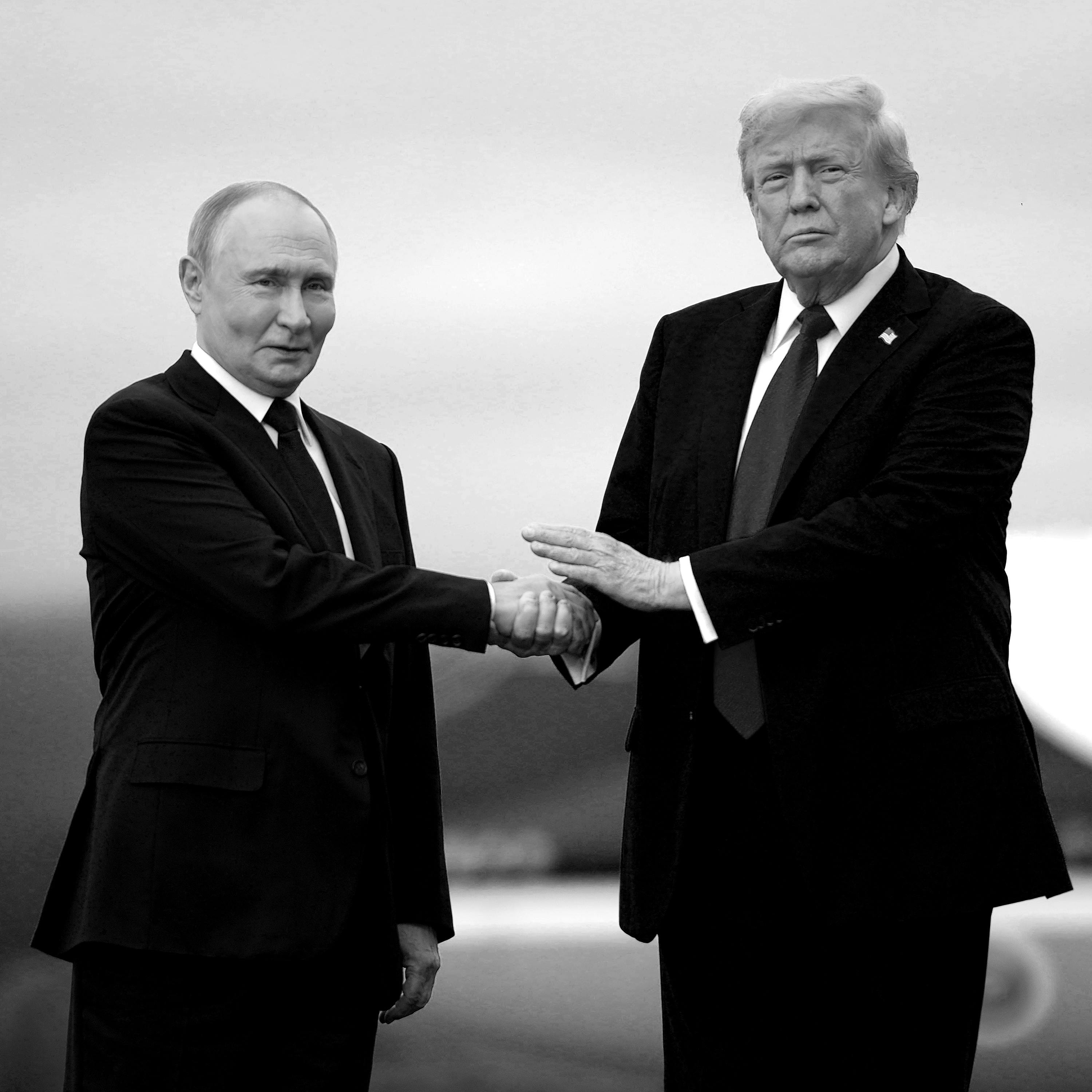
The past seven days brought two very strange international summits. One where President Donald Trump rolled out an actual red carpet on American soil for Russian President Vladimir Putin, a high stakes moment on the world stage.
- [01:24]
D
It was Putin's first time back on US Soil in more than a decade. He received a grand welcome, complete with a military flyover and a red carpet rollout.
- [01:33]
C
A few days later, Ukrainian President Volodymyr Zelensky visited the White House with a hastily mobilized posse of European leaders.
- [01:41]
D
The historic sequel, President Trump and Ukraine's President Zelensky back at the White House.
- [01:47]
C
The two leaders striking a cordial, collegial tone and also somewhat optimistic. The summits were historic, momentous, if more than a little chaotic, and yet it's unclear what, if anything, changed as a result of them. The war grinds on. Civilians are still dying in Ukrainian cities with Russian strikes hitting even as Zelenskyy was in Washington. Trump approached the two Ukraine talks with his usual brand of optimism, let's close the deal, win the Nobel Prize. But and this will come as a huge shock, ending a war is not so simple. I'm Hanna Rosen. This is Radio Atlantic. To help us understand what happened this week, what changed, what didn't, and what really needs to happen for this to end. Well, we have staff writer Anne Applebaum, a longtime reporter on both Russia and Ukraine, and staff writer Vivian Salama, who covers politics and national security. Vivian, welcome to the show.
- [02:51]
D
Thanks for having me.
- [02:52]
C
Anne, thanks for joining us.
- [02:54]
E
Thanks, Hannah.
- [02:55]
C
And before we begin, I want to say that we're recording this conversation at 10:00am Eastern Time on Wednesday because anything could happen. This is an evolving story. Vivian, you were actually at the White House for Monday's meeting between Trump, Zelensky and the European leaders. What did you take from watching it up close that the rest of us might not have seen.
- [03:15]
D
I have covered the White House now since, let's say, late 2016, when Donald Trump was elected the first time. And I have to say, I've never, ever seen the White House so chaotic.
- [03:24]
E
Really.
- [03:25]
D
I've never seen so many people, journalists included. And I'm not talking about just European and American journalists. There were Iranian journalists and Japanese journalists. I mean, just to show you how significant an event this was and how much the world is sort of looking at Washington at that moment to see if this would indeed result in a breakthrough or if it's just talks, to have more talks.
- [03:49]
C
So what you took from that is the world's eyes are watching. Like that was the symbolism for you, or was it the chaos is happening?
- [03:57]
D
A little bit of both, to be fair. The world's eyes were definitely watching, but there was also an element of chaos, just how quickly the event came together. You know, these leaders flying in on short notice. And the White House loves protocol. It loves to have days and months sometimes to organize things, to book hotel rooms and to do all this. I mean, all these leaders come with big delegations. You know, the city was basically turned upside down. And remember, the city was already turned upside down because we are in a so called state of an emergency because, you know, the National Guard has been rolled out and our police federalized. And so just days prior, we were sort of already in a state of chaos. And then suddenly you have these world leaders descending upon us on almost no notice. It definitely set the tone for the day.
- [04:43]
C
Right, I get it. It's like a Beyonce concert on short notice. It's like a huge event, but in a totally ma way. And so you're watching this over from Europe. It all came together very quickly. What is the view from Europe as this is all happening?
- [04:59]
E
So just to give you some context, we're in the middle of August, and in most European countries, this is absolutely the height of summer vacation and everything is shut. Offices, schools, shops. Nobody is doing anything. And the fact that so many heads of state were willing to get on a plane on basically 24 hours notice and fly to Washington, I think tells you how unbelievably alarming the Alaska summit appeared here.
- [05:31]
C
Oh, so it's alarming because we're reading it as a sort of, you know, the entourage showed up, they're supporting Zelensky. That's amazing. But you're saying it's coming out of a fear.
- [05:42]
E
Fear and confusion and a sense that maybe the White House doesn't really understand the rules of the game. So what happened in Alaska was that Putin got exactly what he wanted. He was treated as a world leader, as a superpower leader. There were American soldiers kneeling on the tarmac, rolling out the red carpet for him. The American president stood on the red carpet and waved and clapped at him. He had exactly the treatment that he wanted. He had the TV pictures that he wanted. And he went home having offered nothing and given nothing. He still never said that he wants to end the war. He's still never said that he would stop fighting. He's never said that he recognizes Ukrainian sovereignty. So he has given away nothing.
- [06:26]
C
Right.
- [06:27]
E
And Trump, interviewed afterwards, said the summit was 10 out of 10, and everything was great. And, you know, now Zelenskyy's going to Washington. And the instinct was we all need to be there to avoid a repeat of February and also to explain to the President that the war hasn't ended yet and we may have a long way to go. I mean, I think what was also alarming was that Trump had begun using Putin's language. So he dropped this word ceasefire, and he started talking vaguely about peace negotiations. And this is what Putin wants, because peace negotiations mean we can vaguely negotiate and he can keep fighting, whereas it's in Europe's interest and Ukraine's interest and everybody else's interest that there be a ceasefire, that the war stopped, at least for some period of time. And so he was using Putin's language, he was playing Putin's game. And Europeans felt that they better show up.
- [07:20]
C
Okay, so they came in a kind of, I don't know if maternal, like, we have to tell you something, we have to teach you something. There's something dangerous going on. And did that happen? What Vivian said was, you know, it was giant, but it was also chaotic. And it was hard, honestly, to read the signals coming out of the meeting. So what is the biggest change that you read coming out?
- [07:42]
E
The biggest change was that they got Trump to talk about security guarantees, even in an unclear way. And you're right, by the way, about the chaos. I mean, nobody really knows anything, and it's not clear whether anything has been decided or anything has changed. But to get Trump to acknowledge that any end to the war or any cease to the fighting, whatever we're calling it truce, temporary pause, whatever, is very dangerous, because Russia could restart the war at any time. And to prevent that, Europeans want Americans to understand that there has to be something given to Ukraine to prevent the Russians from invading again. So there needs to be some longer term. They're using the term Security guarantees. I mean, it's a tricky thing because actually Ukraine already has security guarantees from the United States. This was back in 1994. There's something called the Budapest Memorandum, signed by America, Russia, the UK And a couple others that was meant to guarantee Ukraine's borders and so on. So theoretically it's something that exists already. It's just that it was never ratified, it was never a big treaty. And so now the Europeans got Trump thinking along those lines and they consider that to have been a useful to push him in the direction of understanding that you need a structure to end a war. You don't end it just by stopping the fighting. You need to have other longer term solutions.
- [09:12]
C
Okay, I understand this is strange because it's like basically they're trying to educate him on basic things. You can't just wave your wand and end a war and say a word, ceasefire and roll out the red carpet and everything is fine. Like, you have to actually do something. You have to attend to the details.
- [09:28]
E
This is not how you end wars. You have to low level meetings you bring together under neutral negotiators, you discuss what the issues are, and then you have the meeting of the big leaders at the very end.
- [09:40]
C
Right.
- [09:41]
E
But this is all being done backwards. And that, I think, is also adding to the chaos. So people have the impression something big has been achieved, when actually we still don't know whether Russia wants to end the war or not.
- [09:51]
C
Right, right, right. Understood. Vivian. The leaders were received differently by Trump this time around. Like Zelensky, for example. Can you describe how and why it was significant and why are you laughing?
- [10:02]
D
Because Zelens, he was actually the only one received by Trump. The other ones were received by his head of protocol, which is pretty unusual as well. He was inside the White House and his head of protocol went out one by one, individually welcoming the leaders. He did have some fanfare for Zelensky. The color guard was out at the White House along the driveway, and he did come out of the West Wing and greet him and do all of that. But there was no official red carpet welcoming or the kind of. There was a military jet flyover when he welcomed Putin, which is pretty extraordinary. None of that was there for Zelensky, but he did have a warmer greeting than perhaps we had anticipated. Also because of the fact that their February meeting was so explosive. Listeners may remember that epic encounter that Zelenskyy had with Trump in February. And J.D. vance and Secretary of State Marco Rubio was there, where the entire Oval Office spray where the journalists go in it devolved very quickly into a shouting match because they accused Zelensky of not showing enough gratitude to the United States for its support. And so voices were raised and it became a very, very awkward event going from that to this week's events where Zelenskyy showed up in a suit for starters, because he was criticized by some supporters and journalists, pro Trump journalists, that he was not wearing a suit and that he was disrespecting the American President by doing that. This time he showed up in the same outfit that he wore at the Vatican to the Pope's funeral, which was a black sort of cargo blazer and black pants and a black button down shirt.
- [11:54]
C
So, okay, how to read all this is that, first of all, is that a midway concession on Zelensky's part, not a full concession. And on Trump's part, I'm trying to understand what you're saying about how he greeted the European leaders, because in words, he said, oh, I'm glad they came. You know, it's all good. It's good he has an entourage. But, but, but in the room, was there some different signal he was sending to this whole posse of people who showed up.
- [12:16]
D
So he was with Zelensky already when the Europeans arrived. And so, you know, we have to kind of forgive him for, for not going out and saying hello and greeting the European leaders individually. As far as Zelensky making concessions, yes, he had to make a lot of concessions this time around because of the fact that that first encounter in February went so badly that even European leaders afterwards really took Zelensky aside and gave him a talking to. In terms of the way that you manage Donald Trump, and to do so, you have to, you cannot engage him.
- [12:52]
C
Yeah.
- [12:52]
D
And Zelenskyy did engage him that time around. He did kind of try to put up a fight, and they told him that that's not going to be a winning battle. Ukraine needs the United States more than the United States needs Ukraine at this point. And he has to go in there and play the game. And so he did. This time around, obviously, the substance coming out of it was significant. As a result, whether or not it results in anything, it remains to be seen. But Ann talked about security guarantees. That definitely is a huge game changer for Trump in terms of his even political stance. I covered the campaign last year, and this was a huge issue. Trump, Trump repeatedly said on the campaign trail, we're done with supporting foreign wars. And just to allude to the fact that we are going to have security guarantees that the US Will support Ukraine moving forward, that really goes far from anything that he had ever promised on the campaign trail.
- [13:45]
C
So it is real. I mean, that is real.
- [13:48]
D
They're looking at it. And press secretary Caroline Levitt yesterday, so that was Tuesday, she went to the podium and said that the president was even considering having US Pilots be part of those security guarantees. That's extraordinary. And such a huge departure from what he was saying on the campaign trail where he was like, enough with the weapons, enough with the money. We're done with these wars.
- [14:12]
C
When we're back, Donald Trump's changing opinion of Vladimir Putin and whether that offers hope for Ukraine, that's in a moment.
- [14:25]
F
Running a business comes with a lot of what ifs, but luckily there's a simple answer to them. Shopify. It's the commerce platform behind millions of businesses including Thrive Cosmetics and Momofuku. And it'll help you with everything you need, from website design and marketing to boosting sales and expanding operations. Shopify can get the job done and make your dream a reality. Turn those what ifs into sign up for your $1 per month trial@shopify.com specialoffer.
- [14:54]
G
Hey, it's Ryan Reynolds here for Mint Mobile. Now, I was looking for fun ways to tell you that Mint's offer of unlimited Premium Wireless for $15 a month is back. So I thought it would be fun if we made $15 bills, but it turns out that's very illegal. So there goes my big idea for the commercial. Give it a try@mintmobile.com Upfront payment of.
- [15:16]
C
$45 for three month plan equivalent to $15 per month required new customer offer for first three months only. Speed slow after 35 gigabytes of networks busy. Taxes and fees extra. See mint mobile.com Vivian Since Trump's been elected, he seems to change his views about Putin. Like he's warm to Putin. But then Putin does something that frustrates him. Where is he now in his views on Putin?
- [15:45]
D
We've seen a pretty remarkable evolution in the way that Trump has, at least in his public comments, regarded and viewed Putin. Also, his advisors tell me that, you know, he has changed his tune, so to speak.
- [16:02]
C
Changed his tune, like understood who Putin is and what he's about, or at.
- [16:07]
D
Least has become a little more skeptical of Putin. Whereas, you know, in the first administration, he, he was really open to hearing Putin out, being influenced by Putin. I remember in the early days of his first administration, one of his top advisors explained the scene to me where Putin, in a very soft spoken, almost mumbling voice, lectured Trump about Kyivan Rus history dating back to the 11th century, just to explain to him that Ukraine is part of Russia and always should be. And Trump sort of listened intently, absorbed a lot of what Putin was saying to him. And that coupled with a few other instances during his first administration, the sort of what he calls the Russia, Russia, Russia gate of the investigation by the special counsel into influences of the Russian government on the Trump campaign. And then you had the first impeachment where so called perfect call with Zelensky. When Zelenskyy was first elected as president, that led to Trump's first impeachment because he had asked him do favors against his political opponents. All of that sort of played into his mind of Russia is a great nation led by a powerful man and Ukraine is a corrupt, backstabbing nation. Flash forward to his second administration. And I think he had been talking so much during his campaign about I will get the Ukraine, Russia war solved within 24 hours of being elected president. Well, that didn't happen. Obviously. We know governing is a lot harder than campaigning. And so he learned very quickly that this was going to be a complicated matter. But what ended up happening is that Putin didn't sort of pick up the phone and rush to call Trump either to congratulate him or anything else when he took office. And he started to become very resentful of that, coupled with the fact that when he finally did talk to Putin, Putin was like, I would never harm the Ukrainians. Everything is, it's fine. I'm never gonna do anything wrong and I'm gonna stop the bombing and let's just talk this out. And then the next day he would bomb a school. And Trump has actually said repeatedly that he assures me that he's not gonna do anything, but then he does, and I don't really like that. And so between that and some advisers who are around him who have really worked hard to make Trump realize that Putin's not your friend. Now, does that mean he likes to Zelensky more? I don't know about that, but he's at least cautiously dealing with Putin a bit more than we saw in the first Trump administration.
- [18:49]
C
And can we get into the tectonic shifts what the European leaders were afraid of, what we see reforming is this strange new alliance where the US Seemingly sides with Russia against European allies. Coming out of this meeting, how do you see that shift differently, if at all?
- [19:09]
E
It's not clear to me honestly, what has really changed. It seems to me that Trump's instincts are to agree with the last person he spoke to most people, assumed that he changed his language after Anchorage because of things Putin said to him. Steve Witkoff very frequently parrots things that sound like they're coming from Putin as well. So he's influenced by them when he talks to them, and he's influenced by the Ukrainians and the Europeans when he talks to the Europeans.
- [19:42]
C
Let's just say he's the special envoy to the Middle East.
- [19:44]
E
Yes, Steve Wytkoff is the special envoy to Russia and to the Middle East. He's somebody with no background in diplomacy and no knowledge of Russian or Ukrainian history.
- [19:55]
D
He's a real estate executive.
- [19:56]
C
He's a real estate executive.
- [19:58]
E
Real estate executive who, as I said, frequently repeats things that clearly come from Putin or from people around Putin. And it often looks like what Trump is doing is seeking to emerge as the winner from whatever situation he's in, whether he's in Anchorage or whether he's in Washington. It's important that he dominate the scene and that he run the show. I am not sure that he has a deeper strategy.
- [20:28]
C
You wrote after his meeting with Putin in Alaska that Trump has no cards in that situation. And you explain that. I think in this case conversation that the ways in which Putin emerged the winner from that. Do you think that's changed? Like, did Trump come out of this meeting with Zelensky with some cards or some things to play against Putin, like these security guarantees, for example?
- [20:51]
E
Maybe. I mean, the point is that really, almost unnoticed, Trump has been dismantling American sanctions on Russia. These are commercial sanctions that require constant updating. This administration hasn't been updating them. He's been cutting or seeking to cut funding for the Russian language media that the US has supported for many decades. He twice cut military aid to Ukraine. There have been many negative gestures towards Zelenskyy and so on that we've already talked about. The Russians see all of that, and they understand it all as a package of Trump reducing his ability to play in the situation, reducing his influence, and so on. So when I say he has no cards, I. It doesn't mean that the United States can't do anything. It means that Trump has been reducing what he's able to do. And if everybody else sees that, Europeans see it, Russians obviously see it, Ukrainians obviously see it. I don't know that Americans see it, but everybody else does.
- [21:51]
C
Yeah, it's difficult to read because on the one hand, you're describing a systematic shift in negotiating position, but on the other hand, the fact that he changes, given any meeting, means that kind of is a card. It's like I can have a meeting with Zelensky and the European leaders, and I can completely shift my position and talk about security guarantees, and then that's my card. You know, it is a little unpredictable.
- [22:13]
E
Talking about European security guarantees gives the Russians something new to be nervous about. I mean, remember, for them, you know, their assumption, I think right now we can safely say, is that they still think they're going to win the war.
- [22:27]
C
The Russians or the.
- [22:28]
E
The Russians.
- [22:29]
C
Yeah. Well, they are winning the war, aren't they?
- [22:32]
E
No, they're not winning. They're not losing, but they're not winning. They're not. They're moving. You know, at the current rate of fighting, they will conquer the rest of Donbas in four years.
- [22:44]
C
Four years.
- [22:45]
E
You know, they are putting a lot of pressure on Ukraine, but they're not winning very fast. But their assumption is that they will win because the US Will withdraw its support and Europe will get tired and Ukrainians will get tired and so on. So they're. They're still operating on that assumption. And the way that we change their minds and convince them that they're not winning is precisely by saying, no, actually, we're going to add more. We're going to do not just security guarantees, but we're going to do new sanctions, we're going to do new aid for Ukraine, we're going to change the rules again, we're going to do a big shakeup. And to be fair, there are people in Washington who understand that, and actually, that's their number of Republican and Democratic senators who've been trying to push the US in that direction for a long time. And, you know, this war is over when the Russians understand that they can't win. And for the last six months, we've been giving them the impression that they still can win. And so we need to change that calculus. And as I said, Europeans understand that that's why they were in Washington. Senate understands that that's why there's a Senate bill on the table to do that. Not clear whether Trump understands that or not.
- [23:49]
C
I see. So the important thing is what you just said, giving Putin the impression that he cannot win the war, that, to you, is the important card to play. That's the important pressure to keep on Russia in whatever way that happens. Got it?
- [24:02]
E
Yes. And Alaska was a step in the opposite direction.
- [24:05]
C
So, Vivian, what kind of peace deals are under discussion? Like, besides the security guarantees, did you get a realistic sense in Washington what is possible at this moment? There's pressure from senators There's Trump who's unpredictable. What seemed doable?
- [24:22]
D
Well, one of the things on the Sunday shows after the Putin summit, but before the Europeans came to town was this notion of concessions that both Steve Witkoff, who we were just talking about, and Secretary of State Marco Rubio were out there talking about the fact that when you have a negotiation and you want to reach a compromise, both sides have something to gain and have something to lose. And that's just inevitable. And that's the kind of talk that makes the Europeans very nervous. Certainly Ukraine, where Ukraine wanted to go, not just Washington, often talks about the February 2022 borders, the territory that was taken by Russia after February 2022 when it launched this full scale invasion. But in the Ukrainians mind, they've been fighting for their territory since 2014. They're talking about Crimea and the contested parts of eastern Ukraine that have been under stress long before 2022. And so they believe that not only should they regain that territory back, they fight for Crimea too, and was tried to kind of settle Ukraine's mind and say, you know this. And even during the Biden era where they say, let's just talk about February 2022 borders, you might lose Crimea, let's see how it goes. But at least we're going to try to fight for eastern Ukraine. The Trump administration kind of talks more in terms of freezes, where they say territory that was lost after February 2022, you're going to have to cut your losses. And that is something that not only the Ukrainians are believe is a non starter, but that the rest of Europe sees as very alarming because they believe that that kind of concession will just embolden Putin where he says, okay, this was a victory, now let's play along and we could regroup and kind of expand our gains.
- [26:12]
C
So everything you just said sounds a recipe for not agreement.
- [26:15]
D
It is so hard to imagine Ukraine accepting anything less than at least the borders before February 2022. And that would be really twisting their arms. And remember, for Russia, for Putin in particular, this is not about just a little bit of territory in eastern Ukraine. This is existential in Putin's mind for the future of Russia. He believes Ukraine does not have the right to exist. He believes it is part of Greater Russia and they have to regain it as part of that legacy. And so for him, he will stop at nothing to regain, you know, play along now and then revisit the war later. That remains to be seen. And so there is a concern, especially across Europe. European officials I speak with about this naivete within the Trump administration where they're so eager to cut a deal, but in doing so, you're redrawing the map of Europe and emboldening Putin. And so that is something that the Europeans, certainly, it was a big reason why they jumped on that plane on 24 hours notice, not only to help Zelensky kind of avoid a catastrophic meeting like the one in February, but also to moderate Trump's whims and say, yeah, we want a deal, but we want a deal that ensures the security and the sanctity of Ukraine.
- [27:36]
E
It's also really important to understand that Putin has not offered to concede anything. He's not giving back territory that he's conquered, and more than that, he's demanding territory that he can't conquer, that he hasn't been able to conquer. In fact, that he hasn't been able to conquer since 2014. And this is the rest of this Donbass province. So he's offering nothing. And I think the second point to make that's very important is that this is not a war over territory. Russia does not need more territory. This is a war to damage and undermine the sovereignty and legitimacy of the Ukrainian state as a prelude to undermining it and eventually taking it over or making it into some kind of state that's reliant on Russia. And the Russians are also perfectly happy to try doing that again through other kinds of pressure. Maybe they could end the war on unfavorable terms for Ukraine, then try to unseat Zelensky, then try to use propaganda to convince Ukrainians they were robbed. There's a whole kind of sequence of events that could follow. So the point is that until they have given up that goal, you know, the goal of destroying Ukraine as a sovereign nation, then the war is not over. And to pretend that it's over is very dangerous.
- [29:00]
C
That's complicated. Those are old Soviet dreams. I mean, basically, he wants the relationship he had with Estonia and so many other, you know, territories. How do you make somebody give up that? Like, how do you break someone of that goal?
- [29:14]
E
I remain convinced that the only way to do it is to persuade him that he can't win. It can't be done, that Ukraine is too strong.
- [29:22]
C
Got it.
- [29:23]
E
Its alliances are too powerful.
- [29:25]
C
Got it.
- [29:26]
D
I mean, just to emphasize, like, I don't think you can break that mentality. I mean, just to show you, as an example, Sergei Lavrov, the Foreign Minister of Russia, arrived in Alaska last week wearing a sweatshirt that said CCCP on it, which is The Soviet Union, ussr, they are still living in that era. Very much so. And some of it is mind games, obviously, but a lot of it is also just this nostalgia for that era. Can I just add one more thing that because we were talking about this earlier, I spent most of 2022 on the front lines in Ukraine. And I gotta tell you, the one thing I heard over and over again was, was that they believe that Putin has more stamina than the entire west combined, that the west will eventually move on, whether for politics, whether for economic reasons, whether because they just can't sustain all this aid, military and economic aid to Ukraine. But Putin's playing for the long game, and they knew that in Ukraine. I mean, this is a former Soviet, part of the Soviet Union. The Russians are not strangers to them. They know the Russians better than any of us, and they know that Putin is just waiting for the west to get tired.
- [30:39]
C
Interesting. So it's almost like they saw this moment coming. And that actually brings more significance to the fact that the European leaders showed up. It's like, wait, we're actually not out of patience yet. Like, we can be ripped from our vacations and show up for you on short notice.
- [30:55]
D
Yes. And it's also why Zelensky has to hustle so hard.
- [30:59]
C
Yeah, yeah.
- [31:00]
D
Because he does not want the west to forget about his country.
- [31:04]
C
Yeah. Okay. So you guys have described a lot of complicated mechanics that need to happen in order to bring this to a good place. We seem very far away from it, and Trump seems very far from understanding all of these dynamics that you just described. So what happens now? I mean, Trump said repeatedly at the Monday summit that he wants a joint meeting between him, Zelensky, and Putin, and that's what needs to happen. Is that realistic? How likely is that?
- [31:32]
D
They are cautiously optimistic at the White House that this is going to work out. The Kremlin has already suggested it won't. So I don't really know where we go from here. On Tuesday, the press secretary said that the wheels are in motion to try to get Putin and Zelensky to sit down together. And then, obviously, this broader summit. Zelensky seems game, but, you know, it takes two to tango. In this case, it would be pretty extraordinary if it happens. Gosh, I will camp out for days if I can, you know, just to be a fly on that wall. But not a lot of people are very optimistic that that's going to happen.
- [32:11]
C
All right, well, if it does, we will have you both back on. Thank you for joining me today and helping us understand what happened.
- [32:17]
D
Thanks for having me.
- [32:18]
E
Thank you.
- [32:23]
C
This episode of Radio Atlantic was produced by Rosie Hughes. It was edited by Kevin Townsend. Rob Smirciak engineered and provided original music, and Sam Fentress fact checked. Claudina Baid is the executive producer of Atlantic Audio. And Andrea Valdez is our managing editor. Listeners, if you like what you hear on Radio Atlantic, you can support our work and the work of all Atlantic journalists when you subscribe to the Atlantic. At theatlantic.com listener, I'm Hanna Rosen. Thank you for listening.