Loading summary
Transcript86 lines
- [00:00]
A
AI AI AI AI.
- [00:06]
B
Cut through the AI noise with AI solutions from PwC so you can solve the business problems that matter most. PwC.
- [00:22]
A
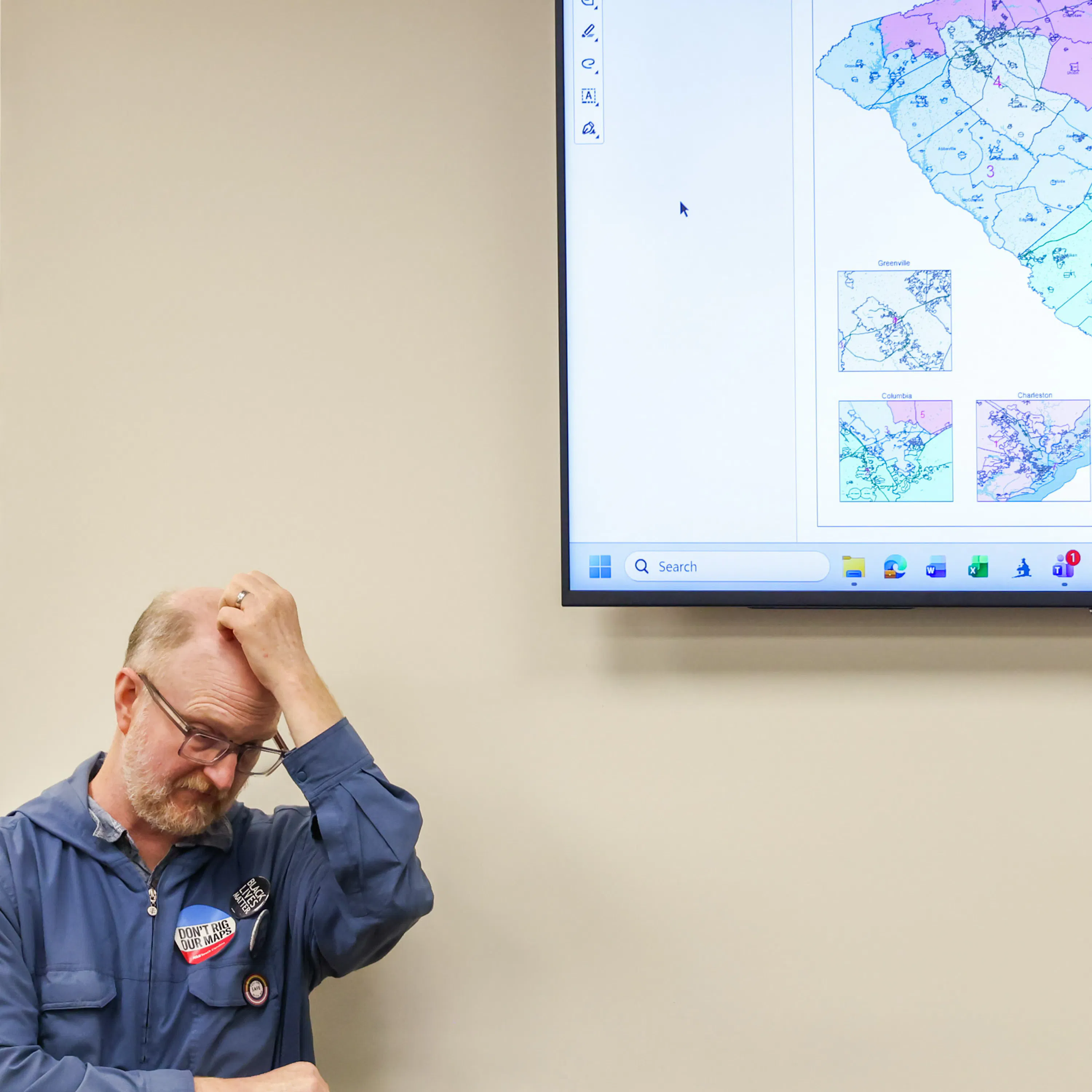
I hate thinking of politics as sport, but I'm going to do it here for a minute. The super bowl in this analogy is the midterms coming up in November. The game is redistricting, redrawing the boundaries to give your team the advantage. A couple of months back, Team Democrat is riding high. Gas prices are climbing. The Iran war is unpopular. And President Trump's approval rating is dipping below 40%. Shows the president's approval rating has marginally
- [00:52]
C
slipped since since the US Carried out
- [00:54]
B
strikes on Iran late last month.
- [00:55]
C
Take a look at this.
- [00:56]
A
There's really not much doubt in anyone's mind that the Democrats are going to win the Super Bowl. That is take back the House. And then a surprise twist.
- [01:05]
B
We will hear argument first this morning in case 24 109, LA vs Calais and the the Supreme Court.
- [01:12]
A
Should we think of them as the ref, the lead commissioner? I don't know. Anyway, the court gives the Republican team a late season advantage. The U.S. supreme Court today struck down one of Louisiana's majority black congressional districts, a decision that weakens key protections under the Voting Rights Act. They dilute the Voting Rights act in a way that instantly changes the playing field. States in the south that have been forced to draw maps to protect black voters start redrawing those maps like crazy. And suddenly Team Republican is back in the game. Did I do that sports analogy thing? I'm Hana Rosen. This is Radio Atlantic. The reason I hate this analogy is that with politics, there is a lot more at stake in this case, civil rights protections, access to representation, a democracy that feels equally democratic to everyone. Today I'm talking to staff writers Russell Berman, who's been covering the redistricting wars for the last few months.
- [02:16]
B
Thank you.
- [02:17]
A
And Van Newkirk, thank you. Who's been covering the Voting Rights act for a very long time.
- [02:22]
B
Hey, Van, by the way.
- [02:23]
C
Hey, Russell.
- [02:24]
B
Good to hear you.
- [02:25]
C
Good to hear you.
- [02:29]
A
Okay, before we get into the recent news about the Supreme Court, let's start at the beginning. Russell, you've been following this for a while. What kicked off what we are calling redistricting or gerrymandering wars?
- [02:43]
B
Well, gerrymandering is as old or nearly as old as the republic itself. It's been going on for more than 200 years in the United States by both parties to varying degrees over the years. But the current nationwide battle started nearly a year ago in Texas and really in the White House, where President Trump's political team saw an opportunity to take a state that was already gerrymandered in favor of Republicans and gerrymander it even more with the goal of protecting the Republicans quite narrow majority in the House of Representatives in advance of what they already knew at that time early in Trump's current term would be a very difficult midterm election this year. And so Trump lobbied heavily for the Republican dominated legislature in Texas to redraw its map. The Republicans complied. They passed the map over stiff Democratic objections that could add as many as five Republican seats in a House this year. And then of course, Democrats responded first in California, where Governor Gavin Newsom moved very quickly to try to match Texas, they passed a map both through the legislature by the voters to add as many as five Democratic seats. And then it was really off to the races nationwide. And over the last several months, we've seen nearly a dozen states either actually redistrict, redraw their maps, talk about it, try to and either fail or been overturned by the courts. And so this has really spread across the nation.
- [04:15]
A
Now, Van, when you hear that the one thing missing is, were Republicans and Democrats then going about these moves in the same way or was there any difference?
- [04:25]
C
Well, I think when you look at Republican led states and Democrat led states, there are heavy gerrymanders in each. I don't think you should see gerrymandering solely as a province of Republicans, but I think there is, especially in the south, an additional level that Republicans have access to just by the way that people vote. So they have been engaging it heavily in what is called partisan gerrymandering, but really operates on the axis of race because particularly in the south, black voters tend to vote one way and white voters tend to vote another way. So they have in their arsenal the ability to use these proxies for race to divide seats up and in a much more precise way than Democrats in most states can do.
- [05:23]
A
So when you say the south, that's mostly Republican states. Now on the Democratic side at least when this began, there was hesitancy from Democrats even about Newsom's idea of fighting fire with fire. Russell, has that changed? How are they feeling now?
- [05:40]
B
Yes, it's very much changed. Not everywhere. And it's important to remember that, you know, the Democrats were fighting this, to use a metaphor, fighting this battle with one hand tied behind their back in many places because for many years they were the party of good government, of anti gerrymandering. They tried to pass a nationwide ban on partisan gerrymandering. During the Biden administration, it fell short due to the Senate filibuster. But in certain states, including California, in New York, in Virginia, they had supported, to varying degrees, changes that banned partisan gerrymandering and basically created a system where redistricting was done through these non partisan commission. And so whereas Republican dominated states, all they needed to do in the past year was pass a new map through their state legislatures. Democratic states had to take an extra step of setting up in California and Virginia especially, whole elections, statewide referenda, so the voters could change their state constitutions and allow them to essentially to gerrymander.
- [06:45]
A
And why is that distinction important? Because what you said was procedural. So I just want people to understand what is the, like, spiritual importance of the different ways that they were going about this? Is it that the Democrats needed popular will? Is that the difference?
- [06:59]
B
Well, they needed popular will. They needed the permission of the voters, and they also needed to essentially go back on their position that they took much more recently against partisan gerrymandering. And so as you referred to, like they. Was there a hesitancy? Well, yes, initially, because they're against gerrymandering. And so now you have all these people, including former Attorney General Eric Holder and former President Barack Obama, who had been leading campaigns against gerrymandering, now in the position of urging Democrats to, as Gavin Newsom said, fight fire with fire and to match the Republicans seat for seat where they could in these Democratic states.
- [07:38]
A
Okay, so we really are in a different era of gerrymandering than we have been, just in the way that both parties are going about it.
- [07:46]
B
Definitely.
- [07:48]
A
Okay, that brings us to the latest battle, which was kicked off by Supreme Court decision. VAN what did the justices decide in Louisiana versus Calais?
- [07:58]
C
So in Louisiana versus Calais, this pivotal Supreme Court decision, the conservative majority, they band together to essentially say that partisan gerrymandering, if we call it partisan gerrymandering, it's essentially, unless you can prove that map makers were explicitly racist in creating maps that give some sort of disadvantage to minority voters, then essentially there's nothing that can be done.
- [08:33]
A
So the standard was intentionally racist?
- [08:36]
C
Yes. And also it says that actual maps made to remedy racism that create, say, a majority black district in Houston or in South Carolina, those districts now, by using race as a remedy, can be considered illegal.
- [08:58]
A
And how is that thinking different? Like when you heard that, what did that change about the thinking around the Voting Rights Act?
- [09:08]
C
So the VRA was intended to get at all of the little subtle ways that Southern states in particular were getting around the 14th amendment. So you had things that were facially race neutral provisions, policies that didn't come out and say, hey, we're gonna get rid of those black voters, but they did anyways. So if they could, you know, the poll tax and the literacy test. But beyond that, politicians in the south get really good at using maps to get rid of and minimize black voters in particular. And the VRA over the. The policymakers and the courts both said, enough with that. We understand that there are ways that you can draw a map on paper that doesn't say, these are the black voters over here and want to get rid of them, but still can disenfranchise them. So we are going to create what's called a results test or an effects test, which means that even if you do these things and don't say that we're racist about it, that they can be declared contra the VRA or illegal if they have a disproportionate effect on black voters. And essentially, now the single provision actually that has protected the most and created the most diverse Congress in history is gone.
- [10:36]
A
You know, I remember when we talked to you back in October, you caught yourself talking about the VRA in the past tense, like you said. Oh, I said was. And we had called that episode if the Voting Rights act falls. So do you think the Voting Rights act just fell?
- [10:52]
C
No, it's gone. It is gone. It is actually in many ways worse than being gone. Because if the provision that governs all this in the VRA is called Section 2, and if the Supreme Court had actually come out and said that Section 2, which essentially allows challenges to voting laws that discriminate on the basis of race, if it had just said that is unconstitutional, then, okay, we know what we're dealing with here. But when you say that Section 2 is still alive and that under Section 2, creating a remedy on the basis of race is itself illegal, then you essentially make it impossible now to make anything, any new map, any new voter law that goes back and says, wait, that was wrong. Let's help those black folks out. Now, the VRA will mostly govern what people call reverse racism, which is worse. So now it'll be more difficult to go back and remedy cases of discrimination against black folks.
- [12:00]
A
The Court's logic is that it's not needed anymore. It's not quite that there's no discrimination anymore. It's just we don't need this extreme remedy. We don't need this federal overrun.
- [12:13]
C
Well, in this decision, and as in Shelby county versus Holder, the majority holds that things have gotten Better. And it sort of completes the cycle. In 2013, Shelby county versus Holder, Chief Justice John Roberts said that, look at all these black politicians. There's so many. And that means that we're doing better and we don't have to do all this anymore to protect the ballot.
- [12:40]
A
And.
- [12:40]
C
And in this decision, which will decimate black ranks in Congress, the very thing that initiated this destruction of the vra, you still have the justices saying, oh, you know, things are doing well now. And now the sort of very insidious paradox here is that when, not if. When black representation is halved in the next year or two, the next couple cycles, that will not be able to be used as a rationale for fixing that problem.
- [13:18]
A
So what you're saying is, very concretely, when you undo the black districts, you'll undo the black representatives, but it's too late.
- [13:26]
C
It's too late.
- [13:27]
A
It's too late. You can't bring that up as a reason to justify the vra, because it's gone.
- [13:32]
C
Yeah. It's not just winning. You win and then you close the door.
- [13:35]
A
Yeah.
- [13:35]
C
Yeah.
- [13:36]
A
Okay. That is a huge effect of what just happened. Russell, since you've been covering this, tracking redistricting issues for a while, that decision came out, it was very recent. And what felt different, what happened?
- [13:52]
B
Well, it opened the doors for a whole new group of states in the south that had not yet redistricted in this election cycle to do so. I mean, within hours, or even maybe less than that, you had the governors and the legislative leaders in Tennessee, in Louisiana, in Alabama, making plans, calling the legislature back in for special sessions. In Louisiana, the governor, Jeff Landry, suspended an election that had already begun so that they could change the maps for the House and get Republicans another seat. Because this decision came almost, but not quite too late for these states to act in this election year. But so they had to rush, and rush they did.
- [14:40]
A
And how did they redraw the maps?
- [14:43]
B
So as we speak, they are still working on it, but what they have advanced is a map that there are two seats currently held by black Democrats in Louisiana, and Republicans would eliminate one of those seats. And so Louisiana in the next Congress would be represented only by one black Democrat.
- [15:02]
A
Van, do you think of a move like that as overtly racial or racially motivated or. Because the way it's presented, oh, this is just a horse race, like we're trying to win.
- [15:13]
C
I think in the aggregate, yes. I think when you look at the things that people that policymakers are saying on Twitter, when you look at the moves they make. And they're saying, hey, we want to get rid of people like Benny Thompson and Hakeem Jeffries. Like, okay, that seems pretty clear what you are doing, but is it clear?
- [15:36]
A
I mean, they're saying we want to get rid of the Democratic minority leader who's very vocal and popular.
- [15:41]
C
Well, this is one of those things where it's not clear enough to the court, but we know what's going on. I think it's clear
- [15:58]
A
after the break how all of this could affect the midterms. That's the horse race part and also democracy. That's in a minute.
- [16:17]
D
The Atlantic has debuted a first of its kind collaboration with the Seabourn Cruise Line to bring great minds onboard their ships for exclusive seaborne conversations. If you enjoy this Atlantic podcast, you will love Seabourn, which is dedicated to exploring the world in yacht like luxury. Join US for a 12 day voyage with the Atlantic, discover the sailing from Montreal to Boston and more@seabourn.com
- [16:45]
A
Russell can you talk about the significance of what happened in Indiana?
- [16:49]
B
Indiana was one of the few Republican states where the Republicans actually rejected President Trump's push for them to gerrymander. They wanted Indiana to essentially redraw the only two Democratic held seats in the state. And back in December in the state Senate, there was a very big dramatic vote. I went to Indiana to watch it. The lawmakers were, in some cases under threat from people who really wanted them to follow Trump's orders. There was all these swatting incidents. I talked to one Republican state, a senator, who told me his whole story and wouldn't give me his name because he was, you know, feared for his physical safety, not just his political future. And the Indiana Republicans, enough of them, defied that threat. They rejected this new map, and Trump and his allies vowed to punish them electorally.
- [17:43]
A
Why were they against what Trump wanted? What was it that they were saying? I understand that they were under threat, but. But what was the principle that they were defending?
- [17:53]
C
Well, we have a system that guarantees one person, one vote. And the only way you can determine that is when you take a census. So the census is supposed to be tied to how seats are apportioned, how states get however many seats in Congress. And that all trickles down to you as a voter, where you and how you are able to vote and who for. And so when you uncouple the drawing of maps from the census, you've essentially said now that we don't really care about that anymore. And that's kind of the, you know, that's the Bedrock of the whole operation.
- [18:36]
A
Okay, so then comes last Tuesday's election. What happened and did it surprise you?
- [18:41]
B
So there were a handful of Republican state senators who voted against Trump back in December who were on the ballot for reelection. And Trump and his allies, including Charlie Kirk's old organization, Turning Point usa, were really aggressive in backing primary opponents. To them, the Trump allies won a majority of those races. They defeated five of the incumbents who were on the ballot who had voted against the redistricting plan. And this was a show of force. This was a show that even though Trump is deeply unpopular with voters generally, he remains quite in control of the Republican Party, even in this state where the legislature rebuffed him. The timing of this is that the Supreme Court, the VRA decision, came out right around that time. And Republican legislators in the states that were affected right in the Deep south, now knew that they were gonna be under heavy pressure from Trump to act immediately, not to wait for the next normal opportunity to redraw their maps. And so Trump has been very clear, like in state like South Carolina, where you saw a similar dynamic to what played out in Indiana, you had Trump making implied and direct threats to hold these Republican legislators accountable at the polls if they defied him. But in states like Tennessee, Alabama, and Louisiana, they are moving forward.
- [20:11]
A
Okay, the last thing we need to digest before we get to the most current state of affairs is Virginia. Van, what happened there and how did it change things?
- [20:21]
C
So as part of the Democratic scramble to redistrict and match those gerrymandering gains that Republicans had, Virginia, they passed new maps that would take a couple seats away from Republicans in their congressional delegation. And Virginia, because of, as Russell said, they have had new laws governing redistricting, and they have a. It's pretty difficult to amend the Constitution of Virginia. You gotta follow a bunch of different rules. And their process for getting that amendment passed and went to a referendum recently, they were up against the wire. And so when Republicans challenged the new map that was passed by voters, they challenged it on procedural grounds. And the Virginia State Supreme Court actually overturned that Democratic favoring map on those procedural grounds. And so essentially, Democrats in Virginia who thought that they had done it, they were celebrating the state as kind of a model for how you gerrymander back against Republicans. All of a sudden, they found themselves at a loss, and they scrambled quite a bit to figure out what to do next. Right now, it seems like their course of action is taking this to the big Supreme Court, the United States Supreme Court, and trying to challenge the Virginia State Supreme Court's interpretation of Virginia law.
- [22:01]
A
Russell, I want you to get horse racy for a minute. Until very, very recently, and partly thanks to Virginia, California Democrats saw the House as theirs. You know, they could flip it. No one really doubted that. Is that still true?
- [22:18]
B
It is less true than it was a few weeks ago. The prognosticators still make Democrats a slight favorite to retake control of the House based on the fact that Republicans, of course, only have a very narrow majority, meaning that the Democrats only have to win a few net seats this fall. And of course, President Trump is deeply unpopular throughout the country, including in the districts where the election will turn. But, you know, if we were talking several weeks ago, we would be talking about how the Democrats had matched or even exceeded the Republican gains in this redistricting war. Well, now it's shifted back to the right, and Republicans, it looks like they will gain as many, potentially a double digit gain or a high single digit gain in seats just from redistricting alone, which gives them a pretty good buffer. And so when you ask about, will Democrats retake the House again, they are still slightly favored, but their majority would be significantly slimmer than it would have been otherwise. And of course, it's no sure thing and much less of a sure thing than it was a few weeks ago.
- [23:23]
A
Okay, I want to shift to more of the deeper significance for representative democracy, which. Van, you've gotten into some already. I'll start with you, Russell. We are already pretty polarized. The fights for control only happen at the margins anyway. So how significant, how big a deal is this gerrymandering? How much difference does it actually make?
- [23:46]
B
Well, it's a very big difference because we're seeing it on such a large scale. There are just a lot of seats that have been redrawn throughout the country over the past year. But the trend is, it's not gonna change the trend. It's going to accelerate, in all likelihood, a trend of polarization where you have representatives who worry more about their primary than they do about the general election. And so then they're gonna vote probably more loyally with their party. It might come to resemble more of a parliamentary system more than it already does. You're also probably going to continue to see very narrow House majorities where neither party has a big advantage. And so it's very difficult to pass legislation which was already very difficult to do. On the whole, it's likely to accelerate this trend toward polarization and sort of highly partisan political environment.
- [24:38]
C
The actual partisan outcomes from this wave of maps actually were Uncertain. One of the sort of disadvantages of randomly drawing a map this late in the decade is you don't actually have good information on where people live. So what you have done is created maps now mostly based on old data where we don't actually know how well the party might perform in a certain area. So I think I would just add that there is some uncertainty as to how much of a partisan advantage is going to be baked into any set of state maps. People are moving, People are moving.
- [25:22]
A
It could backfire. People are moving. You could create a kind of diverse district that you're not prepared to win. It's not necessarily gonna work out in the way that they want.
- [25:30]
C
Right.
- [25:30]
B
The other dynamic is in a place in places like Florida and Texas, Republicans are banking on a continuation of a trend in which Latino voters, you know, were more supportive of President Trump and the Republican Party in the last couple of elections, and they're banking on that continuing. But, you know, polls and special elections that have been held over the past year or so suggest that the pendulum has swung among Latino voters. And so that gives an opportunity, especially in these two states, for Democrats, at least in the near term, to essentially make those gerrymanders backfire to some extent on Republicans.
- [26:08]
A
What's incredible about this conversation we're having, I mean, Van, it wasn't that long ago that racial gerrymandering was illegal. Partisan gerrymandering was something Democrats were fighting to make illegal. What is it that we lose when we give up on this idea of a census based attempt at voting fairness?
- [26:28]
C
Well, for one, when you set the precedent that a state can essentially redistrict whenever and that they can use laws that usually govern natural disasters to suspend postpone primaries. I don't know if I believe philosophically in slippery slopes, but you create clear legal precedent for essentially not having a national norm for maps anymore, which I think we should look at ourselves at the very beginning of the ramifications of that. And this is not the end of whatever we're doing, mapping wise. Actually, congressional districts themselves are only one part of what is governed by our laws for gerrymandering, for example. So you could actually have states look at how they draw the boundaries for state houses, for how they draw in places where judicial seats are governed by districts. It's open season. It's open season both for the frequency and for the rationales for drawing new maps. And I think the era where a person sort of generally knew where they voted, who they voted for, who their congressperson was, that's all up in the air, I think we should expect change.
- [28:07]
A
And what is the. I know you said you don't like to go down a slippery slope, but what is the worst case scenario for that?
- [28:15]
C
In my opinion, the worst case scenario is always confusion. It's always not knowing a voter, not knowing a voter, not having the right information to be able to go out and cast a ballot. And so I kind of think we're already there in a lot of ways. So again, if you don't know who your congressperson is, if you don't know what district you vote in for the primary, if everything changes every election, I believe you're going to see drastic levels of fall off and turnout. People like to vote in a rational system that makes sense to them. And the less you can make it make sense, the more you can artificially lower turnout.
- [29:01]
A
Russell, I think I want to end on a bit of realism. What's yet to come. I mean, there isn't a magic moment where this ends. It feels like we're just rolling down this track, right?
- [29:13]
B
That's right, because we're in this moment right now where a number of states would have redistricted, but they've already had their primaries or in the case of Democratic states, they have more steps to overcome and there's just not enough time. And so after the elections in November, you're gonna see another rush to gerrymander in states like Georgia, for example, and a couple of other southern states where if Republicans retain power, they will try to add seats. And then Democrats have already said in a state like New York they're going to make another attempt to gain seats there. You're likely to see efforts in Illinois, in Maryland, potentially in Colorado and a few other Democratic led states. Whether they will be successful or not, you know, we'll see. But the next two years are probably going to be maybe just as active as the past year has been in gerrymandering. And I guess if there is any kind of glimmer of hope, if you're not a fan of partisan gerrymandering, it's if you're a reformer, you know this argument that maybe it needs to be darkest before it's dawn. Right. And that this will lead to both parties at some point saying, okay, where does this end? This is not the right way to govern. And you might see an effort to either compromise at the federal level or you could see some of these reform efforts that have had some success at the state level and at the municipal level, like pushes for proportional representation, pushes for open primaries or other formats that try to push against this polarization that we've seen over the past generation, perhaps they will get a little bit more momentum.
- [30:54]
C
And I do want to add, I don't think that the primary ramifications of all of these developments are going to be partisan. They are going to be racial. You have now a 58 seat congressional black Caucus. We expect that to be likely under 40 just this year. So you now have in Texas two black congressmen running against each other in the primary because they've been squished into the same district. That's going to be the most, I believe, visible change in this next year. And as Russell said, that ball's gonna keep rolling. So you're gonna have a dramatic, in a very short amount of time, reduction in the diversity of our Congress. And that, to me is gonna be the biggest legacy of this.
- [31:54]
A
And do you have any hope in the reform efforts that Russell mentioned?
- [31:59]
C
Well, the thing that I take as a glimmer was when I did look at South Carolina, which again, Russell mentioned, they just staved off. South Carolina Republican just staved off an effort to gerrymander out Jim Clyburn's seat. And Republican state Senate leader Shane Massie went down to the floor and gave a pretty remarkable speech defying Trump. I think that's one of the most clear eyed views of what's at stake here. I mean, we do know now that South Carolina Governor McMaster is looking to call a special session to bring the legislators back to vote again on a map that would gerrymander out Clyburn's seat. And the thing about special sessions, apparently in South Carolina is that they only need a majority vote. So it's, it does look like Clyburn's seat is in real danger. But, you know, I think Massie's read on what those ramifications are, especially if they get rid of Clyburn's seat. You are maybe getting rid of one of the most popular politicians in the state. There will be very angry voters and they might make a difference.
- [33:24]
A
Well, Russell Van thank you both so much for joining us and helping us understand this extremely complex, complicated issue.
- [33:31]
C
Thank you.
- [33:32]
B
Thanks for having me.
- [33:35]
A
This episode of Radio Atlantic was produced by Janae west and Rosie Hughes. It was edited by Kevin Townsend. Yvonne Kim, fact checked. Rob Smirciak engineered and provided original music. We also had music from Breakmaster Cylinder. Claudina Baid is the executive producer of Atlantic Audio and Andrea Valdez is our managing editor. Listeners, if you enjoy the show, you can support our work. And the work of all Atlantic journalists when you subscribe to The Atlantic@theatlantic.com listener, I'm Hanna Rosa. Thank you for listening.
- [34:21]
C
The developments that we are seeing in AI, this would be maybe the most fundamental thing ever really to happen.
- [34:29]
A
What's next for AI and what does
- [34:31]
D
it mean for us?
- [34:33]
A
Values are getting exported through software. We need to have this conversation on how those values get exported. Join Atlantic CEO Nicholas Thompson for the most interesting thing in AI brought to you by Atlantic Rethink, the Atlantic's creative marketing studio, now on YouTube and wherever you get your podcasts.