← Radio Atlantic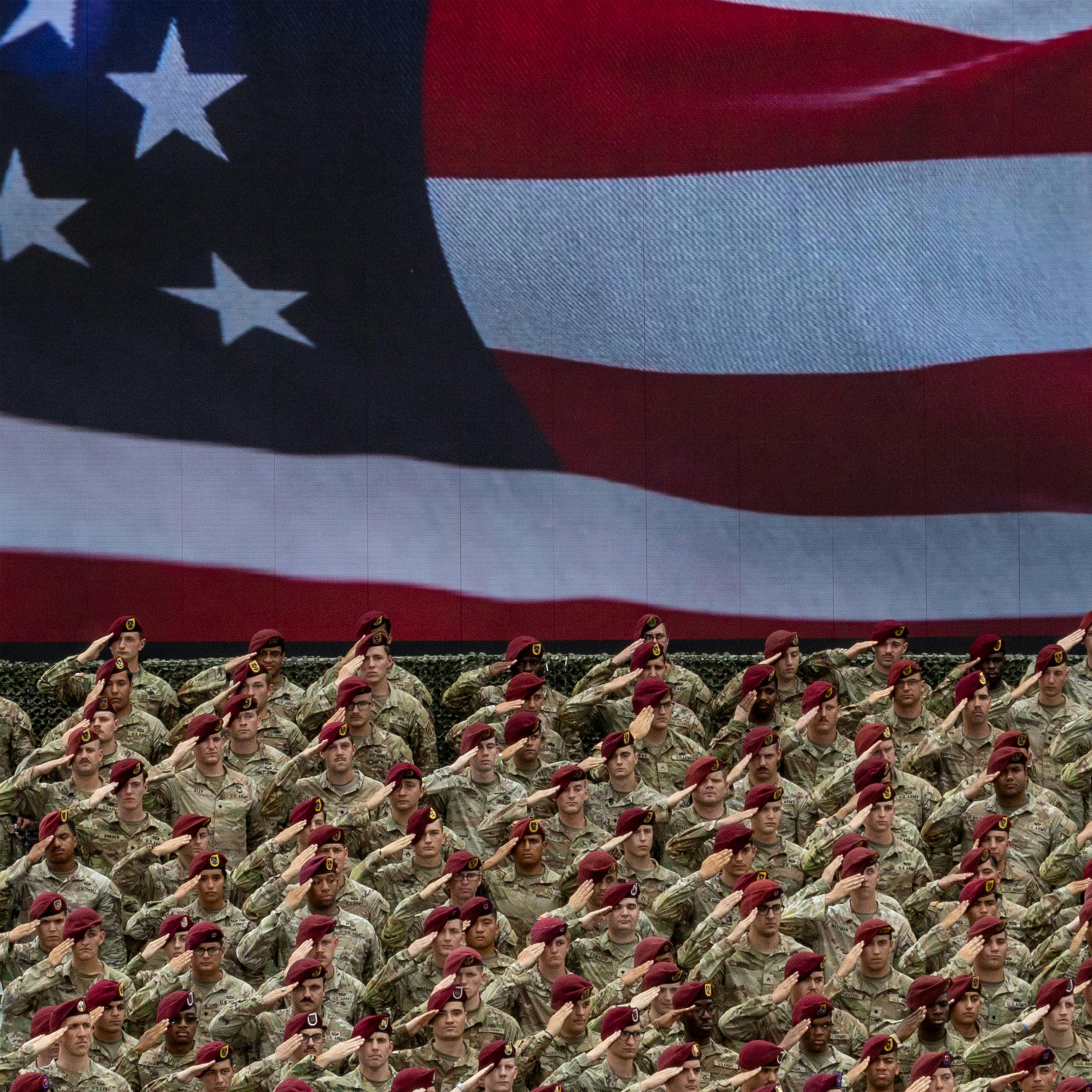
Radio Atlantic
The Real Problem With Trump's Parade
00:17:22
The military may start to see itself differently.
Loading summary
Transcript37 lines
- [00:07]
Hanna Rosen
The day after the Trump administration mobilized 700 Marines to respond to immigration protests in Los Angeles, and four days before his military parade in the nation's capital, President Trump walked out on stage to Lee Greenwood's God Bless the usa, God Bless the usa. And boasted about the crowd size.
- [00:30]
Donald Trump
It's a record crowd. You know, you never, you never had a crowd this big. That's an honor. You think this crowd would have showed up for Biden? I don't think so. I don't think. I don't think so. Maybe I'm wrong. Maybe I'm wrong.
- [00:44]
Hanna Rosen
This is stuff straight out of the Trump playbook. Brag about the crowd size, check. Mention Biden, check. Call the media, fake news and whip up the booze against them.
- [00:56]
Donald Trump
Look at them. Look at them all. What I have to put up with. Fake news.
- [01:02]
Hanna Rosen
Check. And check.
- [01:04]
Donald Trump
What I have to put up with.
- [01:06]
Hanna Rosen
There were chants of USA people bought campaign style merchandise. Make America great again. Hats and chains and fake credit cards that said, quote, white privilege card trumps everything. But the difference this time was that this all happened at a military base, Fort Bragg in North Carolina, and the crowd was full of active duty soldiers.
- [01:29]
Donald Trump
I was elected, winning all seven swing states, the popular vote by millions and millions of votes in all counties throughout America by 2,750 to 525. That's what I call a big number.
- [01:45]
Hanna Rosen
This is Radio Atlantic. I'm Hanna Rosen. Presidents have used the military as backdrop before. It's a delicate art. There have also been military parades in the past, but with the timing of it all deploying Marines and the National Guard, a country very much divided. This time feels different. And if it's indeed a delicate art, Trump is not being subtle. So on the eve of the big parade in Washington, better and bigger than any parade we've ever had in this country, as Trump put it. We called up staff writer Tom Nichols, who writes about the military for the Atlantic and has taught for 25 years at the US Naval War College, to help us think this through. So this military parade is happening this weekend. It's meant to celebrate the Army's 250th birthday. It also happened to be Trump's 79th birthday. And Trump has said it's going to be better and bigger than any parade we've ever had in this country. So, Tom, on the one hand, it's just a fancy parade with fireworks and all that. On the other hand, what, like, what message are you, who's good at reading military coded symbols, seeing in this parade?
- [02:58]
Tom Nichols
Well, first of all the military wasn't going to do this parade. So the idea that this just happens to be a military parade that just coincidentally happened on Trump's birthday is nonsense. Trump has wanted this kind of parade, and this is what he thinks the military does, is throw parades for the commander in chief. And he's doing it while he's sending troops into the streets of an American city. And I'm sure he's more than happy for that split screen to say, these are my guys, this is my army, my generals, my artillery, and if you screw with me, this is what it looks like in Los Angeles.
- [03:40]
Hanna Rosen
So you read it as my parade. You read the split screen as necessary to understanding this military parade, not just as kind of empty symbolism. He likes the look of it. He likes fit troops. Like, it's just aesthetically pleasing to him. That's not all it is in your mind?
- [03:58]
Tom Nichols
No, I mean, he obviously loves this stuff. I mean, Trump is in many ways very childlike. He likes shiny things and uniforms and big parades. And he's wanted this for a while. But I think he and the other people around him are also more than happy to create a second kind of symbolism here of, I'm the president, I'm the commander in chief, I can put tanks in the streets anytime I feel like it. Because, remember, he wanted to do this. He was aching to do this kind of stuff during the 2020 protests. And people in the Pentagon, including his own secretary of defense and the chairman of the Joint Chief, said this is a bad idea. And he has learned his lesson. He surrounds himself now with people who are never going to tell him that anything is a bad idea.
- [04:51]
Hanna Rosen
In the lead up to the parade, he gave this speech at Fort Bragg. Now, he's not the first president to give a speech in front of a military crowd. Presidents use the military as backdrop all the time. What was different about this speech?
- [05:06]
Tom Nichols
It wasn't a speech. It was a political rally. He didn't use the backdrop of a military base to say, I'm here to talk about the future military development, the Defense Department, international relations. He just stood up there in a completely partisan mode, wearing his little red hat, and he encouraged US army soldiers to join him in a big partisan hoot. Nanny. And this actually goes back to your question, Hanna, about what he's thinking about this parade. He very much wants those soldiers to say, remember, I am your only defender. I am the strong man who loves you. America hates you. And that is poisonous. It is a repudiation of everything that people from George Washington To George Marshall, to Brent Scowcroft, to others that have always stood for in serving this country, either in civilian roles or as military leaders. That's how other countries fall into civil war and chaos and mayhem, is that the military becomes an. When you politicize the military, the military becomes an independent actor. And it says, you know, there's Republicans, there's Democrats, there's rural, there's city, and there's us. And we are an interest group, and we are an independent group with an independent say in who runs this country. And you don't want the military saying, oh, the election next year, that'll be interesting, but we get a veto.
- [06:41]
Hanna Rosen
Right. So it's not just about Trump having an army or military that he can manipulate. It's about the military starting to see itself as an independent political actor.
- [06:51]
Tom Nichols
Absolutely.
- [06:53]
Hanna Rosen
I'm trying to imagine, actually, I don't want to get distracted, but I am trying to imagine what it would be like for the citizens of Washington to watch tanks roll down their street. That's kind of a profound image.
- [07:06]
Tom Nichols
Well, especially at a time like this. I mean, you know, context is everything. And when Donald Trump has been walking around, you know, like a wannabe dictator, talking about the military as his personal muscle, the symbolism of rumbling a tank down Constitution Avenue is, you know, I mean, look, these people know exactly what they're doing. They know the images they're creating and part of the goal here. And I think this is true in Los Angeles, and I think it's true with the Washington parade. Trump and his people want to acclimate Americans to the sight of the US Military in their streets, which is one of the most un American things, going all the way back to the founders who had a deep suspicion of a standing army. We honor the people who serve in our military. We value them, we cherish them. But, no, we don't want them driving Humvees through the streets of D.C. every day.
- [08:02]
Hanna Rosen
Yeah, it's a really good point. I've obviously seen National Guard in the streets before, but seeing tanks in D.C. streets, while on the other coast Marines are being deployed in Los Angeles has a very different feeling.
- [08:15]
Tom Nichols
It feels wrong. And in part because part of the protection of American freedom is embedded in our system of federalism. So that your local police are answerable to your local government, which in turn can be superseded by your state police, who answers to your state government. And if things really get tough, you have a National Guard of your fellow citizens, your neighbors, your friends, who are then answerable as well to the governor. You should have to go through a whole bunch of blown circuits before you get to the United States military being in the streets of our own country. And in part, not just because it's such a violation of, again, everything from George Washington onward. I mean, this whole thing with the parade is something I think that would make the father of the American Army George Washington ill. But it's also something that we avoid because it really is, you know, for conservatives who talk about not wanting to have a dictatorial central government, they're acting like they really want a dictatorial central government. When you talk about the army, you know, you're saying state, local, county government, none of that matters. The only real power in this country is right here in the White House in this one man.
- [09:39]
Hanna Rosen
Right.
- [09:40]
Tom Nichols
And it's also a bad idea because the military itself has hates these missions, and that's good. You want a military that doesn't like domestic policing missions.
- [09:50]
Hanna Rosen
Right. Well, speaking of bypassing local authority, this is all happening against the backdrop of Trump sending the National Guard and troops to Los Angeles to deal with the protests against ICE raids, which Trump has called lawless and an invasion. And Governor Gavin Newsom says he didn't ask for help and said the LA police could handle them. Why do you think he sent the troops then?
- [10:16]
Tom Nichols
Specifically to show that Gavin Newsom is not in charge of the state of California and that Karen Bass is not in charge of the city of Los Angeles. It's a very dramatic way of saying all power in this country belongs to me, Donald Trump. And if I see something in Los Angeles I don't like, I don't care who the people of California elected, they mean nothing. And I'm going to call out the army because I can, and I want to establish that I can.
- [10:50]
Hanna Rosen
After the break, how to engineer a crisis and how to counter. He does use the phrase liberate Los Angeles, but I'm still not clear what it serves him. Like, why there. And you said he saw things that he didn't like. Like there weren't particularly. I mean, at least, as Gavin Newsom puts it, and reports from Los Angeles, they weren't especially violent. They didn't get out of control. It wasn't a situation that the LA police could not handle, at least according to Gavin Newsom. So what is it that he's trying to do or accomplish? What's the symbolism? What does it mean?
- [11:39]
Tom Nichols
Oh, it's, you know, Trump has a genius for picking the right fights. Remember, his goal has nothing really to do with Los Angeles or California. The strategy here is let's go to a blue state. Let's go to one of the bluest cities in the blue states. Let's totally humiliate people that the American right really hates, and let's do it in a place where our narrative that America is under foreign invasion, which allows me to invoke these old laws, alien acts and so on, in response to an invasion. Let's go do it in the one place where I can count on the local population to do their part by cosplaying as exactly the kind of foreign invasion force that I need them to play. They will play their role. And if there was any place they're going to do it, it's going to be in Los Angele.
- [12:34]
Hanna Rosen
Right. So maybe it's an example of what people always say about Trump, that he can engineer his own reality. I mean, he can stage the theater and then walk into it.
- [12:43]
Tom Nichols
Well, when I touch strategy, there's an expression we use when we're talking about when you're trying to plan your operations and your opponent isn't particularly adept, and we call that a cooperative adversary. And Trump went someplace where he knows he has a cooperative adversary.
- [13:02]
Hanna Rosen
Right, Right. So then the protesters themselves. In his speech on Tuesday, Newsom said, it's time for all of us to stand up. He left it vague what he meant by that, but that's what he said. You wrote a couple of what I thought were chilling sentences directed at the protesters, telling them not to provoke the soldiers. What you wrote was, you will not be heroes, you will be pretext. What do you mean by that? Pretext for what?
- [13:30]
Tom Nichols
A bigger crackdown and for legislative action by these Republicans to say, yeah, go ahead, we won't stop you. If you want to invoke the Insurrection act, the American people on both the right and the left, unfortunately, especially on the fringes, have, I think, what George Will wisely once called a hunger for apocalypse, a kind of aching for drama where they wanna feel like they're part of a big tableau of a big adventure movie with a Hans Zimmer score. And Trump knows that. He has a great instinct for theater. He has a great instinct for what will trigger his opponents. And going to Los Angeles with the army, it's a very clever thing to do. And one of the things that you see that sometimes humiliates authoritarians is when they say, I must. There are terrible things happening. And people say, I was at work today. Everything seems fine to me.
- [14:28]
Hanna Rosen
Yeah. Yeah. Our writer Ann Applebaum wrote about this, that when there's a lull Kind of a lull in the action or even a downturn in support. There's a need to engineer a crisis. And that she's suggesting maybe this, what's happening in LA now is the engineering of a crisis. Kind of whip that theater back up again.
- [14:52]
Tom Nichols
It's absolutely what he's doing, and he's thinking ahead. You know, another of our colleagues, David Frum, made the point that this is a dress rehearsal. He's gonna look for opportunities, perhaps even during voting, where he's gonna say, oh, I see irregularities, I see problems. I see people saying they are being harassed at the polls. And by then, he will have gotten us used to, you know, in this kind of boiling, the frog approach. He will have us used to the just running roughshod over governors and sending in the army.
- [15:27]
Hanna Rosen
So if Americans have an appetite for this kind of drama, what do you think would be an effective way to counter this, what you called authoritarian tendency?
- [15:38]
Tom Nichols
Well, that's the thing, you know, people on social media get mad at me and they say, well, have you considered voting? You know, because people say, well, I voted yes, but did you vote in? Have you voted at the local and state level? There are things you can do. You can register people to vote. You can donate to organizations that are fighting this in court. And I think the courts, and I've written about this, the courts have become the last line of defense, and I think they're actually doing well. And I think one of the reasons Trump is doing all this is because he's been losing so consistently. He's trying to figure out a way to short circuit the boring drudgery of. Of the legal process that keeps working against him. So my answer is, look, the founders were great believers in stoicism. I believe there are times to go into the streets, but if the President is laying a gigantic trap, don't walk into it.
- [16:38]
Hanna Rosen
Tom, thank you so much for joining me.
- [16:40]
Tom Nichols
Thanks for having me, Hannah.
- [16:43]
Hanna Rosen
This bonus episode of Radio Atlantic was produced by Janae west and Rosie Hughes. It was edited by Claudina Baid and engineered by Rob Smirciak. Claudina Baid is the executive producer of Atlantic Audio, and Andrea Valdez is our managing editor. Listeners, if you like what you hear on Radio Atlantic, you can support our work and the work of all Atlantic journalists when you subscribe to the Atlantic. At theatlantic.com listener, I'm Hanna Rosen. Thank you for listening.