Loading summary
Transcript44 lines
- [00:01]
Hanna Rosen
This episode is brought to you by Lifelock. Not everyone is careful with your personal information, which might explain why there's a victim of identity theft every five seconds in the U.S. fortunately, there's LifeLock. LifeLock monitors hundreds of millions of data points a second for threats to your identity. If your identity is stolen, a US Based restoration specialist will fix it, guaranteed, or your money back. Save up to 40% your first year by visiting lifelock.com podcast terms apply.
- [00:37]
Hussein Ibish
Have you been seeing the pictures of Trump on the tarmac being greeted by various royals?
- [00:43]
Yeah.
- [00:44]
I wonder if you read it this way. He seems very relaxed.
- [00:47]
He is very relaxed. He's home. Yeah, he's come home. This is like outside the US this is his favorite place.
- [00:54]
I'm Hanna Rosen. This is Radio Atlantic, and that is Hussein Ibish.
- [00:59]
I'm Hussein Ibish and I'm a senior resident scholar at the Arab Gulf States Institute, and I write for many publications, especially the Atlantic.
- [01:08]
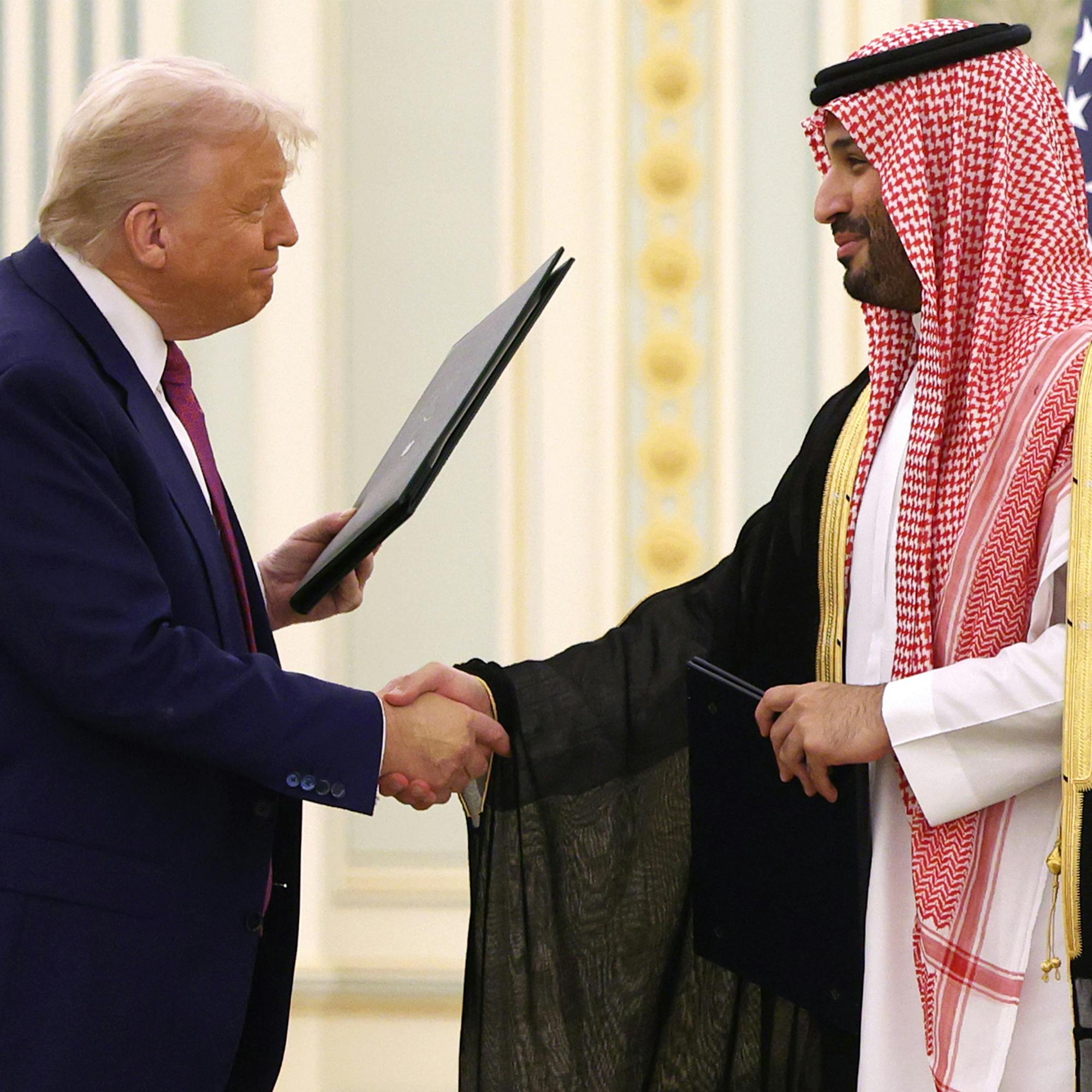
This week, we're watching the President's visit to the Gulf states, Saudi Arabia, Qatar and the United Arab Emirates. The pictures that we're referring to show Trump at the airport tarmac in Saudi Arabia being greeted by Crown Prince Mohammed bin Salman in a royal welcome. Lavender carpets, golden swords, Arabian horses. And Trump is smiling through all of it. This is a stark contrast to a few years ago, when mbs, as bin Salman is known, was a pariah in the west for his human rights violations. So what does Donald Trump's new approach to the Gulf states mean for our Middle east policy? And why is Trump so at home there?
- [01:53]
He lives in a world of patrons and clients. He lives in a world where authority is not questionable. And that's very familiar. It's a very familiar space to especially the Saudi royals, but all of them. And he understands them and they understand him, and he loves them, and they love him. He can be himself. The unedited version. He doesn't have to check his instincts. He just go with it.
- [02:23]
Yeah.
- [02:23]
And that's kind of unusual for Trump.
- [02:27]
The word that seems to summarize Trump's approach is transactional. That's the word that a lot of people use. So what are Middle east leaders getting from America and what is Trump getting from them?
- [02:38]
Yeah, it's pretty straight. It's pretty straightforward. Right. Middle Eastern, not leaders, but countries. What they're getting ultimately is protection. They're getting military protection, which is often unsatisfactory from their point of view, but they don't really have a good alternative to the United States. So they have to try to work to make it as good as possible. And that's what they're doing. They're buying goodwill from the U.S. they're also buying weapons, which they want and need. It's not, you know, purely just gifting. However, what Trump is getting in return is lots of money, and more for himself than for the country. There is money coming from the country. There are these large weapons sales of missiles and other things to Saudi Arabia, the biggest weapons sale in US History. And the UAE is looking at buying over a million semiconductor chips from Nvidia and so on. All three countries are buying lots of American stuff, which is a big boon to Trump's bid to revitalize American manufacturing. But there's also a grifting angle here, right? Trump is getting a lot of money for his own company. We've never seen this before. We've never seen even in the first Trump term. The level to which this state visit is also a private business visit is amazing because the projects include a Trump Tower in both Riyadh and Jeddah in Saudi Arabia, another Trump Tower in Dubai in the uae, and a Trump International golf course and resort in Qatar. There's also a cryptocurrency scheme connected to Sons in which a UAE linked company has just agreed to invest $2 billion with a B. $2 billion. The company is not going to look the same after this trip. It's going to go from being a very for its size mom and pop shop built on the vast inheritance that Trump's had from his father, Fred, but now he's taking it into the stratosphere. I mean, the amount of financial clout that's coming to his family owned, privately held business is just amazing. And what the Arabs are doing here is buying goodwill. It's an investment. It's an investment in, in Trump as a friend and, you know, ultimately also with the U.S. but right now, Trump has, you know, instituted les tat, c' est moi. He is the country, and the country is him. And until somebody stops him or until he leaves the White House, that's the way it's gonna be. And this is very understandable to a group of people who deal in patron client relations as a matter of course.
- [05:38]
Okay, so just to summarize, the transaction is they get protection, and what Trump gets is money for the country and money for himself.
- [05:46]
Exactly. They get protection and he gets money. We get money.
- [05:51]
Yeah, it is, it's very clear when you, when you describe it, the, the symbol, the concrete thing that is going to symbolize this trip for a Long time. Is this luxury jet from Qatar. How should we understand what this transaction is?
- [06:05]
Well, it's the absolute. I was waiting for you to bring it up because it is exactly the kind of icon, the avatar of this trip. It says it all. Qatar, which is an unbelievably rich country, 300,000, maybe 400,000 citizens, most of the country, between 2 and 3 million people, are expat laborers, foreign workers, Arab and Western technocrats. But collectively, those 350,000 or so Qataris are the largest single exporter in the world of liquid natural gas. And obviously all of the wealth goes to the citizens. I mean, it's just amazing. You've never seen a country with this level of per capita wealth and it uses that money for national interests. In this case, what they're done is one of the former prime ministers, who is a royal, has a jet, a luxury Boeing 747, that's kitted out not for a president, but for a wealthy man who enjoys luxury travel on his own private plane. So what the Qataris have done is they've said you can have the plane for use as president while you're in office, and after that it will be transferred to your presidential library, meaning he could still use it after that. So it's sort of been they've very cleverly muddied the waters or blurred the line between private and public here in order to give this plane to Donald Trump as an individual who. And they can say that they haven't, that they've given it to his presidency. Right.
- [07:55]
This is so interesting. Basically what you're saying is this is the president that the Gulf leaders have been waiting for. Trump is the man that they can finally deal with in the way that they want to.
- [08:07]
Yeah, well, in a lot of ways I think that's true. I remember a certain high ranking of formerly very high ranking Gulf individual who said just as much in 2016 after he was elected. They said he does the same things and he listed a bunch of verbs that were unlawful actions and said, we do that and he does that. It's not obviously unlawful in their countries. It's normative, but traditionally not allowed in the United States and in Western countries in general. And I think this man was absolutely correct when he said we do this and he does that. We do this and he does that and that they would feel very comfortable with him. They certainly would disagree about how much pressure he should put on Israel regarding Gaza, things like that. But I was thinking yesterday that there's really no daylight between Trump's positions on all the really most important issues and those of Saudi Arabia. You can't find a major irritant there, which is really amazing. Yes.
- [09:16]
Such as what? What issues?
- [09:18]
Well, I mean, anything you think of the war in Ukraine, the nature of U. S. Saudi relations, you know, how business should be conducted, the Yemen war talks with Iran. They both want a deal. They convinced him that lifting the sanctions on Syria was a good idea. They just agree more or less on just about any issue that can change overnight because if there was a spike in oil prices, they would disagree right away. But I was contrasting that in my mind with the problems that the US And Trump have with Israel right now, where there's disagreement about Gaza, about the ceasefire with the Houthis, about the talks with Iran, about many different, about the negotiations with Hamas. There are many irritants. Now, that's not to say the US Is closer to Saudi Arabia than it is Israel. I don't think that's true. The Israeli relationship with the US Is very deeply ingrained and protected by political influence in the US Especially from evangelical Christians on the right. But yeah, I think Trump is sort of ideal in many ways from say, a Saudi point of view.
- [10:38]
So now that we've established this nature of this relationship and where we are now, I want to understand what it means to the rest of us, not to Trump and his family.
- [10:48]
Hanna Rosen
Sure.
- [10:48]
Hussein Ibish
So when you hear about U.S. relations with Gulf states in the past, especially Saudi Arabia, human rights enters as a factor. Not always forcefully, but it's definitely a.
- [11:00]
Rhetorical factor with most administrations, whether they're Republican or Democrat. They do bring it up. Trump doesn't at all.
- [11:10]
Right, so how important is that departure or shift?
- [11:15]
Well, I mean. Yeah, well, I mean, MBS has learned one of the big questions about him when he was a young, rash leader in, you know, beginning in 2015 when he came in as Defense minister and a quick rise to where he is now, which is head of government, that is to say, he's the prime minister of Saudi Arabia. So he runs the government. And human rights issues became very serious in his early years with the arrest of the dissidents. You know, sort of adventure in Yemen that was ill advised and badly done, to put it mildly. And also the jailing of important people who are not perhaps on board fully with the changes, the reforms, the social liberalization or other concerns that MBS had about them. Who were jailed at the Ritz Carlton.
- [12:08]
Yeah. And of course, the 2018 murder of the Washington Post journalist Jamal khashoggi, which the CIA concluded that MbS ordered, although.
- [12:17]
He denied it, I was coming to that. That's the big enchilada right for many people, including me, because he was a friend of mine for 15 years, and I, you know, I was just. I'm still scarred by it, and I think I always will be. Mbs, what we've learned about him is that, you know, he's not a sociopath in the sense that he's educable. The question about him was always, is he young and rash and doing these things because he doesn't know better, or is he kind of nuts? And the answer is no. He's educable. He's evolving, he's maturing. Saudi Arabia remains a real human rights violator from the point of view of human rights norms. It executes a lot of people. Rule of law does not apply in the way we would expect. Dissidents, when they are found, when they exist, suffer, you know, arrest and imprisonment and long sentences. And even if they go as far as saying parts of the country should secede or leave Saudi Arabia, they can be executed, and they are sometimes. So it's not, you know, it's a happy story on human rights at all, but it's just way better than it was. And, you know, there are certainly more alarming cases around the world. You couldn't really say that around the time of the murder of Jamal, because Saudi Arabia was really one of the worst violators at that time. And now I think it's almost back to normative Saudi behavior. Hardly a good standard. It's a very low bar, but it's very different than he was years ago.
- [14:04]
Okay, so we need to take a quick break, but when we come back, I want to talk about what this trip means for the ongoing conflicts in the Middle east and the US's role in them. That's when we're back.
- [14:24]
Claudina Baid
Hey there. I'm Claudia Baid and I lead the audio team here at the Atlantic. I think a lot about what makes great audio journalism. It commands your attention but isn't noisy. It brings you closer to the subject, but leaves room for you to make up your own mind. And when you hear someone tell their story in their own voice, you understand it in a deeper way. When you subscribe to the Atlantic, you'll be supporting this kind of journalism. You'll also enjoy new benefits just for Atlantic subscribers on Apple Podcasts, Think ad free episodes of our shows and subscriber only audio articles. To join us, go to theatlantic.com listener. That's theatlantic.com listener if you're already a subscriber, thanks. You can head to the Atlantic's channel page on Apple Podcasts and start listening right now.
- [15:27]
Hussein Ibish
Okay, we're back. So I want to put this Gulf visit in the broader Middle east context. As Trump was heading to this trip, he made a number of deals that seemed like they were trying to clear away American entanglements in the region. So the US Ceasefire agreement with the Houthis in Yemen, the agreement with Hamas to release the last living US Citizen held hostage in Gaza, and then the announcement that the US Was going to lift sanctions on Syria.
- [15:55]
Yes.
- [15:55]
Do you see a pattern in this series of deals? Do you see a common goal? What is it?
- [16:01]
Yes, I think he's trying to reduce American exposure and involvement in conflicts in the region. Not in the region, but in regional conflicts. So, for example, the lifting of sanctions on Syria is a response to Gulf countries saying to him, in effect, you say you want us to handle our problems, fine. We want to, you know, invest in Syria and build. We can't have any influence in Syria if we don't spend money there because we don't have a militia or an army in Syria. The only way to get their attention is by investing in reconstruction and in other services where we can build constituencies of friends who will represent our interests and by extension, yours. And we can't do that. And if every time we write a check, we have to worry about the Treasury Department slamming us. So if you want us to handle our business, you got to take these sanctions off. The deal with the Houthis in Yemen is undoubtedly directly connected to another conflict ending or conflict containing policy of Trump, which is the negotiations with Iran. Trump definitely wants a deal with the Iranians, another version of, of the Obama peace deal, which he railed against, but is trying to resurrect. But he wants it to be longer and stronger and tougher on Iran. And he can get all of that because of what happened to the Iranians under Biden. I mean, he'll never give Biden the credit for having put Iran in this situation, but it was under his presidency that Iran was crippled in its regional status. And the biggest blow by Miles was the Turkish engineered downfall of Assad in Syria. You know, that's why letting the Saudis and the Emiratis and others, you know, do what they can in Syria without sanctions is part of that. You know, he needs to take advantage of this moment of Iranian weakness and the fact that they need 20, 25 years to rebuild their power and to rethink their national security strategy, because it was all based on the idea that Arab militia groups led by Hezbollah in Lebanon would provide a powerful forward defense against Israel and ultimately the United States. And that was tested and proved untrue. Hezbollah was decimated by Israel. So Iran is in very bad shape. It needs to rethink everything, and it needs time. And Trump understands this. And Trump wants a deal because he doesn't want to be put in a situation of having to confront the Iranians militarily. And Iran wants a deal. And the only country left that doesn't want such a deal is Israel. With Obama, the Arabs were totally against it, but now they're all for it because they want calm and regional stability.
- [19:04]
So that is the one big obvious point of disagreement which you mentioned, is Israel.
- [19:10]
Yeah.
- [19:11]
This is coming at a moment when Prime Minister Benjamin Netanyahu is warning that he's going to escalate in Gaza. As you've been seeing this Gulf trip unfold, what do you think it means for Israel, Gaza and America's role in all of that?
- [19:25]
I mean, it certainly incentivizes Trump to think very carefully about doing what he can to restrain Israel's worst impulses in Gaza. The situation in Gaza is so dire. After more than 70 days of complete blockade, no food, no medicine, no water, no electricity, no shelter, nothing, no supplies into Gaza, people have been reduced to the point of starvation. That's where we're headed here. And it's a crime. It's certainly a war crime, and it's probably a crime against humanity. What the Israelis are proposing to do is to go back into Gaza with full force force, all the population, 2.2 million who are not Hamas fighters and commanders, cadres and officials, into a tiny enclave in the south where they will be kept, supposedly protected, but actually kind of herded. Where they'll be kept with what the UN says is very totally inadequate plans for their food and water and medicine and shelter. Meanwhile, Israel proclaims it will scour the entire rest of the country for anything and everything connected with Hamas and, and destroy it. Gaza delenda est. You know, the bottom line is this is kind of the war that the most extreme factions in Hamas have been waiting for. It provides them with an open ended, long term insurgency. Now, obviously the Israelis can rely on brute force to crush Hamas, but I think they've started to get get the hint that as long as there are Palestinians in Gaza, there will be some form of Hamas, because Hamas is not a list of people and equipment. It's a name. And if you take a bunch of Palestinians and some of them say they're Hamas, then there will be Hamas. And that's likely to persist no matter what Israel does. And we're getting closer and closer to the end goal of where I think the logic of this, where Israel goes, which is depopulation. Gaza has to be, you know, depopulated of Palestinians in order to be free of Hamas and because the two go together under. In Gaza, under the circumstances. Right.
- [22:04]
So given that that's the current situation and given that Trump is now engaging in the Middle east, how does this change the calculus for how he and the US Engage?
- [22:14]
Everything that has happened in the region incentivizes him to stop the Israelis from going ahead with this plan, at least as it has been structured now. It's too extreme, it's too brutal, it's too genocidal, it's too over the top. And I really think the fact that he made such claims, close friends again and reinforce his relationship with these countries that don't want that, both at the emotional and the strategic registers that need it not to happen in every possible way is really important. It gives him every reason to hold the Israelis back and say, guys, come on, don't do this. Don't do this this way. Don't do it. And he is the only person in the world at the moment who has real leverage over Netanyahu because of the nature of the Israel, US Relationship.
- [23:11]
Yeah. Well, Hussein, this has been so clarifying. I really appreciate you helping us navigate and understand what this trip to the Gulf States might mean.
- [23:21]
Such a pleasure to be here. Thank you.
- [23:26]
This episode of Radio Atlantic was produced by Kevin Townsend and Rosie Hughes. It was edited by Claudina Baid. We had engineering support from Rob Smirciak, fact checking by Sarah Krolewski. Claudina Baid is the executive producer of Atlantic Audio, and Andrea Valdez is our managing editor. Listeners, if you like what you hear on Radio Atlantic, you can support our work and the work of all Atlantic journalists when you subscribe to the atlantic@theatlantic.com listener. I'm Hanna Rosen and thank you for being a listener.