Loading summary
Transcript52 lines
- [00:00]
A
The Atlantic has debuted a first of its kind collaboration with the Seabourn Cruise Line to bring great minds on board their luxury ships. Join us for a 12 day voyage with the Atlantic. Discover the sailing from Montreal to Boston and more@seabourn.com.
- [00:23]
B
This is Radio Atlantic. I'm Adam Harris in for Hana Rosen. This week began with President Trump giving Iran an ultimatum. Open up the Strait of Hormuz, cut a deal or face attacks on civilian infrastructure.
- [00:38]
C
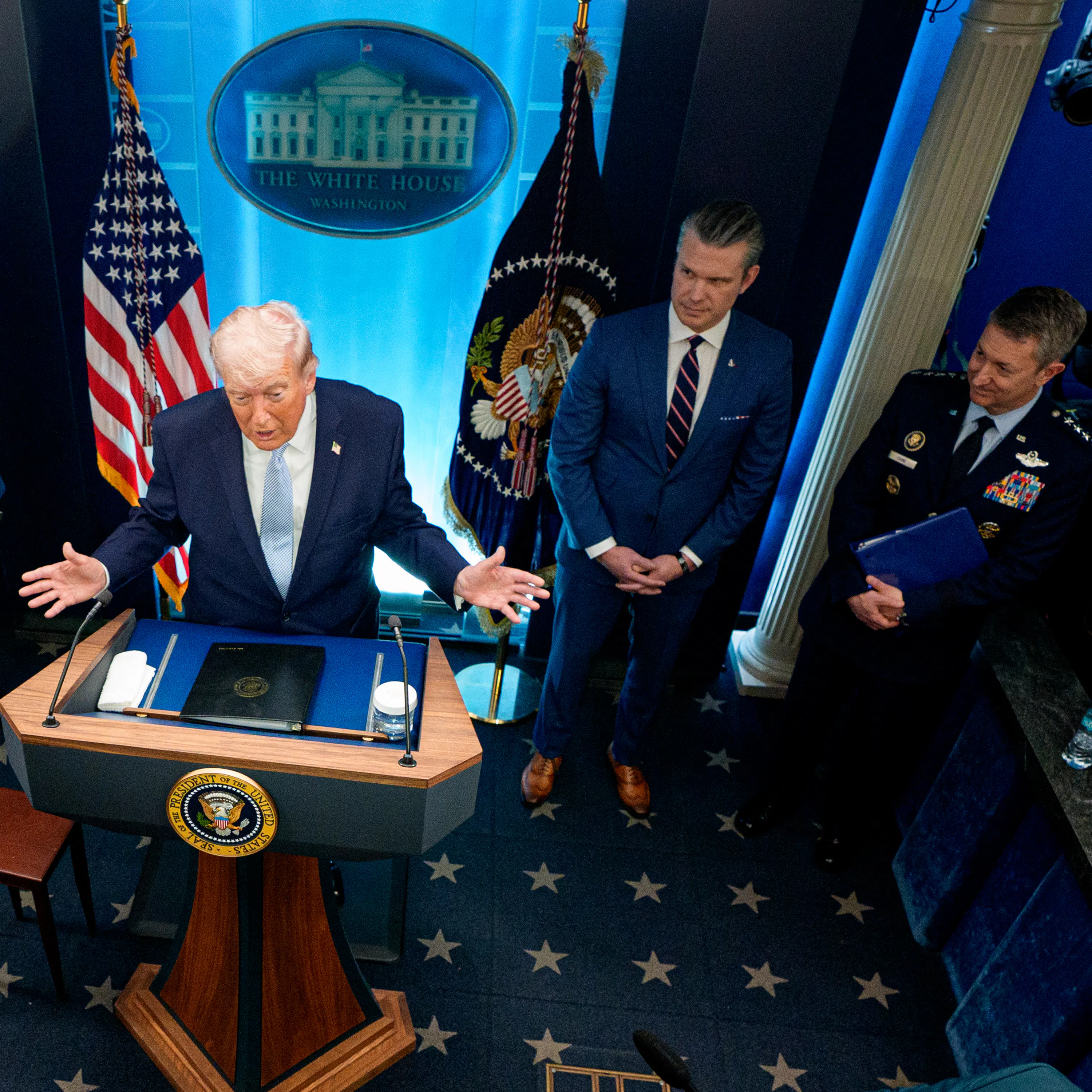
We have a plan because of the power of our military, where every bridge in Iran will be decimated by 12 o' clock tomorrow night. Where every power plant in Iran will be out of business, burning, exploding and never to be used again. I mean, complete demolition.
- [01:00]
B
That was him speaking at a Monday press conference. The next morning, he was even more direct. A whole civilization will die tonight, never to be brought back again, he declared on Truth Social. I don't want that to happen, but it probably will. In the hours before his Tuesday night deadline, the United States announced a two week ceasefire. While the talks play out, the deal already looks shaky, with Israel striking targets in Lebanon and Iranian state media saying the Strait is again closed. In response, talks are set to begin in Pakistan this weekend. But in the meantime, the President can't take back his words. Words that appear to meet the UN Definition of genocide and when uttered by a world leader, are taken as policy. To understand what comes next, I'm joined by two Atlantic staff writers who follow the military and foreign affairs, Nancy Youssef and Tom Nichols. Nancy, thanks for joining.
- [01:58]
A
Thanks for having me, Tom.
- [02:00]
B
It's great to have you.
- [02:01]
D
Hey, Adam, thanks for having me.
- [02:03]
B
So, Tom, we're speaking on Wednesday as the clock was winding down on Tuesday, I guess a very blunt question. Did you think he was going to go through with the threats?
- [02:15]
D
I didn't think it was impossible, but I think it would have provoked a constitutional crisis, which means that it was much less likely than not to happen because I think he would have had to order the military to do things that the military this time would have balked at. There are reports that the military is already giving the President lists of things that only had military applicability, which is not the same thing as erasing a civilization. So I didn't think it was likely to happen. But as I said in the piece I wrote that afternoon, when the President of the United States talks, you have to take it seriously, no matter how. I mean, we're used to Trump saying kind of loopy things and talking about, you know, sharks and his uncle and electricity and whatnot but nonetheless, he is the President, and the President's statements are policy. And so I said, well, it's not likely to happen, but we have to treat his statements as if it could happen and go from there.
- [03:17]
B
Yeah. And Nancy, what were your sources telling you about Trump's threats in the lead up to that deadline?
- [03:27]
A
So there was a lot of anxiety after that social media post right after Easter in which he threatened the destruction of civilization. And people were really trying to figure out what was in the realm of possible in terms of what could be done. The conversation I heard in the run up to the deadline was that the US Wouldn't be hitting historical sites or civilian infrastructure, but that they would go after what's called dual use, things that are used both by the military for military purposes and for civilian use. But then you can't just sort of declare dual use and then strike. It has to be proportional. You have to demonstrate it. So I think that was sort of the start of people looking for an off ramp from the rhetoric that we heard. And then by day's end, I couldn't figure out why at the time, you could feel that things had sort of calmed down in terms of the anxiety that I was feeling in the morning from sources, but we didn't quite understand why at the time. And I thought that maybe it was because even if the military had gone through, which, as Tom noted, would have caused a lot of mayhem, even that wasn't going to guarantee the fall of the regime. So the question I kept coming back to is, what is the military gain that comes with doing these unprecedented strikes? We've seen the Iranian regime survive the decapitation of its leadership, the destruction of its ballistic missile and drone capability, to what extent, we don't know. The destruction of its navy, largely. And they have survived. And historically we've seen them quite resilient. I mean, they were in an eight year war with Iraq and survived that. And so I couldn't understand how those strikes had they been carried out with all the consequences associated with it. Got the President one of the outcomes that he said he was seeking, which was the collapse of the regime.
- [05:21]
B
Yeah. And actually speaking of those outcomes that the President said he was seeking, right. You go back to even back to January, and you think about what the President was saying about the Iranian people, right? This was to help them overthrow the regime. And now we have something like 1700 Iranian civilians who have been killed in the strikes, including at least 250 children. What of the Iranian people in all of this? What was the administration thinking about those people when you were having these threats from the president?
- [05:54]
A
Well, it's an interesting question because this started at 2:30 in the morning in terms of presidential statements which he made from a truth social video, that this was for the Iranian people.
- [06:05]
C
Finally, to the great proud people of Iran, I say tonight that the hour of your freedom is at hand. Stay sheltered, don't leave your home. It's very dangerous outside. Bombs will be dropping everywhere. When we are finished, take over your government. It will be yours to take.
- [06:23]
A
And I think there were a lot of Iranian people who welcomed it and even still welcomed it because there was such profound frustration with the regime. We had seen massive protests in the run up to this in December and January, and real threats to the durability of the regime. But over time, not only through the strikes, but through the rhetoric we heard from the U.S. i think we saw an administration that conflated the regime and the. And we use this phrase sort of hearts and minds, and maybe people are quick to dismiss it. But if the objective was to get the Iranian people to rise up and to challenge the government, it's very hard to get that kind of mobilization when you're also attacking them and making what they saw as derogatory comments about their religion on Easter Sunday and all these things. And so I think for some Iranians, we heard about real splits within the diaspora, but internally, I think there was a real struggle between those who both found themselves stuck with a regime that they didn't want and a war that was conducted in a way that they
- [07:24]
B
didn't want on those goals and thinking about this was a war that the people didn't want. But now we've reached a point where we have reached a ceasefire. But I'm still kind of stuck in this idea that I don't know that we've ever gotten a clear definition of why the administration is there. They've said all of these various reasons why they're there, and now they're saying that, well, the Strait of Hormuz is reopening, and that's the sort of victory, but that was just a byproduct of war. So, Tom, Nancy, either of you can answer this one. Have they clearly defined our reason for being there?
- [08:05]
D
No.
- [08:06]
B
No.
- [08:08]
D
I mean, now we have a very clear reason, which is to reopen the Strait of Hormuz, which wouldn't have been closed if we hadn't gone to war in the first place. In that sense, yes, we created a clear war aim by starting a war. I think the important thing is to go back to the first day of this war and to realize, regardless of how many times Trump denies it, this was a regime change war. It was meant to be a regime change war. We're seeing that now. There was this piece from the New York Times that was very detailed and was kind of a minute by minute explanation of how the administration went to war. It was clear, Trump said, we're going to hit them really hard and then the regime's going to fall. And to their credit, and boy, how, how rarely do I say this about people in Trump's orbit, but to their credit, people like the CIA director said, I believe the word he used to describe that scenario was farcical. But Trump didn't want to hear it because, remember, Trump, wishcasts. I mean, I say this every time we talk about him. He tries to manifest things into being. He's like, yeah, yeah, I know it's a problem, but if we just do it, it will happen. If you build it, they will come kind of thinking. And he launched the war, expected the regime to fall, and it didn't. And when that didn't happen, everything went to hell. They didn't know what to do next. So he just said, general, have you got more operations? Yeah, we can, you know, we can hit plenty. There's Iran is a target rich environment. We can bomb stuff all day long. But as I used to teach at the Naval War College years ago, operational successes without strategic direction don't get you toward victory.
- [09:50]
B
What does the military do when they don't have that strategic direction and when they're pulling all of these different threads? Right. If this is a regime change, you're going to do a specific thing for regime change as opposed to, I'm doing a specific thing for liberation of people as opposed to, I'm doing specific things to open up a strait that wouldn't have been closed otherwise. So how do they plan when there is no strategic direction?
- [10:13]
D
That's not their job. Their job is plan operations. The very senior military leaders are supposed to ask that question. Now, what is it? You know, we have these packages, we have these target sets, we have these objectives we can achieve. What is it you want us to do, Mr. President? Where are we supposed to be going with this? And in the absence of that, they do operations. They say, okay, well, we can destroy some more factories, we can blow up some more airfields, we can take out some more boats. We can do that all day, at least until we start running out of ammo. So in the end, the people that are Supposed to know that are the kind of people that Pete Hegseth has been firing left and right. Look, this is one of the most war gamed scenarios in American, modern American history. We have been war gaming scenarios about fighting with Iran for almost 50 years. They've got tons of operational plans sitting on the shelves about everything. But if the president just kind of wanders into the candy store and says, give me one of those, give me one of those, and give me one of those, the military salutes smartly and says, yes, sir.
- [11:23]
A
Can I jump in, Adam? Because Tom made so many great points and I want to just build on a couple of them.
- [11:28]
B
Yeah, absolutely.
- [11:30]
A
The firings, we've had a lot of generals and admirals fired, including the head of the army during this conflict. Now, usually when a general admiral's fired during war for the conduct of the war, that didn't appear to be the case in this instance. This was personal animosity. A secretary who was micromanaging personnel decisions in the army looking to put his own stamp on that service. And while this was largely a war from the air and sea, the army had an important role. The air defenses that you heard about, the Patriots and the Thaads, those are army operated system, restocking the munitions that were used for them. It falls on the army chief of staff. And he was fired during this conflict. And so I think that's important to note just the pace at which these personnel changes were happening. The other thing I want to point out is for all the reasons that the United States gave for conducting this war, Iran was very consistent throughout. They wanted to survive as a regime. They wanted compensation for the damages to their country. And so I think to Tom's point, when one side doesn't have clear strategic aims and the other does, no amount of firepower can resolve that. And what you saw the Iranians do is take that strategy and marry it with an asymmetric warfare approach to take away the advantage that the United States had with much stronger munitions training planes, weapons, ships. And so that's where the strategy, I think, sort of, or lack thereof, played out on the battlefield.
- [13:05]
D
Two quick points. The other thing about Nancy's point about the army, the army took casualties. We spent a lot of time on, you know, watching television with the air war. But when some of those bases got hit, those were army people that we lost. The other is this looks a lot like Ukraine. It was exactly the same imbalance of interests. Putin went in, thought he was gonna just knock the Ukrainian regime over in a day or three days. Or four days. But also, when that didn't happen, Putin didn't have a clear set of goals. It was just throw more guys and more bodies and blow up more buildings. And just like the Iranians, the Ukrainians had a strategic goal, survive and control the territory and the government of Ukraine. And they did. They have so far.
- [13:54]
B
Nancy, we know that no one really wins in war in terms of human suffering. But even so, we now have the ceasefire. And I wonder, based on everything you've said here, is Iran actually the winner of the ceasefire?
- [14:10]
A
Well, I should start by saying that the ceasefire is very tenuous. I mean, almost immediately, Iran announced that the strait would be effectively shut down again because Israel, which did not believe in the part of the agreement that said that Lebanon would not be attacked, carried out extensive attacks on Lebanon. So it's all very fragile because there are three parties with three different interests, and we don't know the specifics of the deal. Now, having said that, Trump, among the reasons he gave is that he didn't want Iran to have a nuclear weapon. But I think what Iran discovered is that they actually have a deterrent capability that is immediately available to them right now that allows them to make revenue off of it, that allows them to have great influence over the global economy. And that was a Strait of Hormuz. I don't know that Iran needs to look to nuclear capabilities as much, having now been empowered with some control over the Strait of Hormuz. One of the things that they have said is that they want to maintain that control. And so what Iran has come out of this, I think, is a new form of deterrence against future warfare, not inviting sanctions through the prospects of a nuclear program, but rather sort of saying, if you punish us, it now affects the global economy, which certainly has that potential. That was always sort of their nuclear option of sorts, that if it came down to the threat to their survival, which this for them was, that they would exercise that option in the strait. And now that they have, I think going forward, we're going to see them try to continue to collect revenue, as they did during the war, to rebuild and potentially rebuild the regime from the strikes that they've endured throughout these past 39 days
- [15:56]
B
after the break, the turmoil inside the Trump administration over this war and what that means on the battlefield. Tom, one of the things that I couldn't necessarily wrap my head around, it was maybe an irony that was really troubling me on Sunday into Monday into Tuesday, as the president's threats became more hostile, severe, incendiary, whichever adjective you'd like to use there, and that was that he was saying things that people clearly identified as war crimes. And Congress has not yet declared a war. And so I guess constitutionally, this is still something that's worth asking. Will Congress ever declare a war, or does it matter at this point?
- [17:01]
D
No, and it doesn't matter at this point. There's a couple of things to think about and reasons that Democrats would be hesitant to declare a war as well. Wartime conditions vastly empower a president. What they want, what I think people like Tim Kaine and others among the Democrats wanted, was a war powers resolution to be able to reign in Trump by law and by budgetary authority from this conflict. But now that it's over, and I think it is over for the foreseeable future, there's no point in it. Republicans didn't want to do it because Trump kept sending them signals, stop saying war. It's a military operation. Which is part of the reason, I think, that the war was never popular. I've never seen this happen before where a president embarks on a major military operation and not only gets no bump out of it, but. But actually starts to bleed support over time. I mean, even in the first stages of Vietnam, the American people rallied around Lyndon Johnson. This is really unprecedented in modern times.
- [18:13]
B
Yeah. And you said that you think that it's over for the foreseeable future. Right. But if we are operating under the idea that the ceasefire is tenuous, what lead you to say that it's over?
- [18:23]
D
Because Trump's entire political body language for weeks now has been, get me out of this. I think what we saw from Easter onward and leading up to those really feverish statements was panic and flailing. He lost control of the situation within the first week when the things he wanted to happen didn't happen. And ever since then, he's been trying to manipulate markets and Wishcast solutions and announce things, hoping that just by announcing them, they become reality, like deals. We're going to make a great deal. They're begging me for a deal. None of that happened. And I think the last thing anybody wants in Washington right now is to have to go back into this. You know, Nancy and I were talking at one point about General Kaine's briefing, which really sounded like a wrap up. It didn't sound like a, here's where we are on the eve of a ceasefire. It sounded like a, well, it's been 39 days. Here's all the stuff we destroyed. Thank you and good evening.
- [19:32]
B
You know, I was actually, I was Watching that press conference on Wednesday morning as well. And there seemed to be like two different postures that were coming from Kaine and Secretary Hegseth. Am I wrong in that? Because General Kaine did seem as if he was wrapping things up.
- [19:51]
D
Over the course of 38 days of major combat operation, the Joint Force achieved the military objectives as defined by the President.
- [19:58]
B
But Secretary Hegseth kind of kept going back to this idea that, well, the reason why we're at this ceasefire and the reason why this deal came is because of the President's threats.
- [20:08]
C
Other presidents marked time and kicked the can down the road.
- [20:12]
B
President Trump made history because he's shown that he's willing to go there, and he is still willing to go there.
- [20:19]
D
So they still may shoot here and
- [20:20]
C
there, but that would be very, very unwise.
- [20:23]
B
Kind of leaving that option hanging out there felt like a different thing than what General Kaine was saying.
- [20:29]
D
Yeah, that's, of course, that's what Pete Hegseth's going to say, because, you know, while this war has been going on, there's been another drama going on at the Pentagon. Pete Hegseth's worried about his job. And if you wonder why the Secretary of the army came out in recent days and said, I'm not quitting. I have no plans to resign. I'm not getting fired, as far as I know, that's Dan Driscoll, and he has been floated as the most likely replacement for Pete Hegseth. So every time you see Pete Hegseth, just assume that all he's doing is speaking to Donald Trump and saying, please keep me in my job.
- [21:06]
B
Nancy, One of the things Tom mentioned was the deference that Republicans have had traditionally to the President over the last several years in both terms in office. But some members of his own party had become vocally critical of his threats in recent days. What are they saying now that this ceasefire has gone into effect?
- [21:29]
A
I think that you're hearing relief. I mean, throughout those statements, it was notable to me, yes, the Republicans that spoke up, but the silence that happened throughout, particularly after the President threatened to destroy a country's civilization, the silence after Hegseth and one of those press conferences talked about no quarter, and then days later, US service members were flying an F15E over Iran and had to escape because the Iranians shot it down. Like, there was a lot of really bombastic language that happened throughout this war. And again, I think Tom's right in terms of the audience that often Hegseth is speaking to, but it is heard around the world. And it was striking to me that we didn't hear the kind of pushback I think that maybe some would have expected, given the impact on the battlefield. You could feel the discomfort in that silence. But it wasn't enough to sort of challenge the President's assertions. And that was striking to me. I should also note that there was a willingness to kind of support funding in the war, which at the time the President was asking for 200 billion. I think the question going forward will be whether they continue to support the military. In terms of the budget, the president's asking for 1.5 trillion. Much of that will go towards rebuilding some of the damage that happened to ships. We saw the USS Gerald Ford, the newest aircraft carrier, caught on fire during this conflict. The restocking of munitions, particularly those air defenses. There is a cost, and I think the Republicans will be confronted with sort of whether they're willing to pay for it literally. And then in terms of political costs, given that the President had campaigned on the promise to not go into these kinds of wars in this region specifically.
- [23:20]
B
Yeah. And even considering his promises not to go into wars in these regions specifically and other ways that the President has sort of gone back on things that he said during the campaign, alongside the sort of increasingly erratic of sorts behavior that he has been exhibiting. Tom. Right. There have been calls from notable right wing figures for the 25th Amendment to be invoked. Of course, that is the most nuclear option there and probably the most involved option. But those folks were previous or former representatives, folks like Marjorie Taylor Greene, Joe Walsh, Adam Kinzinger. But you ended up getting folks like Alex Jones. Is there a point where the sort of more mainstream part of the party starts to push back if the President's behavior becomes even more erratic than it has been in recent weeks?
- [24:15]
D
Boy, that is a great question. Because what would constitute more erratic than starting a war half world away with a country of 90 million people and then threatening to erase their civilization from the planet? I think what you're seeing though is Republicans doing what? Rather than rising in opposition or thinking about the 25th Amendment, they're doing a much more time honored Washington tradition. They're going to the press and they're ratting each other out and they're distancing themselves from the President. I mean, you know that whole report about the decision to go to war, basically you had everybody in the room saying, well, I didn't think it was a good idea. Yeah, the only guy who gets thrown under the bus and in that whole account and he's thrown under the bus by all of his colleagues is Pete Hegseth. The other thing that's happening, and this goes back to the conversation you were just having with Nancy about budgets. Do the Republicans really want to go out there in a few months? Because just to back up for a moment, the economic damage from this war is going to reverberate now for months. And I think a lot of Republicans out there are saying, you know, I can't really do anything about the 25th amendment, but I don't want to run on a 40% defense budget increase while the president's saying we can't fund Medicare. So I think that's, you know, there's a lot of trouble for Republicans because of Donald Trump, but I don't think he goes anywhere. And I think that's actually worse than for Republicans. Instead of becoming the fuel for more Republican victories, Donald Trump has become a giant millstone, an albatross around the necks
- [25:48]
B
of Republicans now as he is, in your words. Right. An albatross around the neck of the Republicans. I still come back to this thought that this is just the second year of this administration. And so even if we have this sort of changeover and Congress, if Democrats reclaim the House, there's still several more years of a Trump administration. And I do wonder, and kind of left to wonder, where do we go from here, Tom? Nancy, where can the US Go from here in terms of its reputation? We have turned war crimes into a bargaining chip of political policy.
- [26:28]
D
I think if the Democrats win in November, his presidency is effectively over. And I think that will make him completely bananas, and he will say and do even crazier and more dangerous things that will harm the reputation of the presidency and the United States. But I also think that he will now be more constrained in what he can do, especially, I mean, I can't believe that we're even thinking of this because this was impossible a few months ago, especially if he loses the House and the Senate. But if he loses the House, which I think now is just, you don't ever want to say anything's inevitable, but seems inevitable, then I think you get crazier rhetoric, but more responsible government in
- [27:12]
A
the short term, I think on a global scale, what we saw from this war is another region that is sort of reconsidering its relationship with the United States. From a security perspective. In the run up to this, you'll remember that the president threatened to attack Greenland, and you saw the sort of shocks of that go through Europe in terms of could they count on the United States as reliable partner during this conflict. He threatened to leave NATO because they wouldn't come to the defense of the strait, and then later said that we didn't need NATO because we don't need the oil and we don't care about the strait. So again, there was sort of a tension there. The Gulf states had really pinned their security on their relationship with the United States. They had bases throughout the region because they thought those bases would be a security guarantee. As it turns out, it made them a bigger target. They had built defense relationships with the United States, hoping that that would lead to security. And again, it ended up making them a target. Now, there are a few options for the Gulf in terms of how they look at alternatives, but I do think we're going to see them start to diversify in light of how these past 39 days have gone. And so I think the most immediate takeaway is we're going to see another consequential part of the world really reassess its relationship with the United States, given the events of these past 39 days and how the war has played out and the impact that it's had on them and the US Response to that.
- [28:39]
D
One interesting thing here, I think, is we've worried a lot about terrorism and payback and all those other things that you should worry about when you embark on this kind of war. But Nancy's point about the Gulf states, the Iranians may decide to play nice with Europe and the United States to keep us occupied elsewhere. But really take it out on the Gulf states and make it clear, don't ever do this again. You chose poorly. It's possible that the Gulf states have to be more worried about that even than we do.
- [29:11]
B
Yeah. Well, there will be a lot to look out for in the coming days and weeks. Tom, Nancy, thanks for joining me.
- [29:19]
D
Thank you.
- [29:20]
A
Thank you.
- [29:23]
B
This episode of Radio Atlantic was produced by Rosie Hughes and Janae West. It was edited by Kevin Townsend. Rob Smirciak engineered and provided original music. Sam Fentress, fact Checked. Claudina Bate is the executive producer of Atlantic Audio, and Andrea Valdez is our managing editor, the Listener. If you enjoy the show, you can support our work and the work of all Atlantic journalists when you subscribe to the atlantic@theatlantic.com listener. I'm Adam Harris. Hanna will be back next week. Thanks for listen.