← Radiolab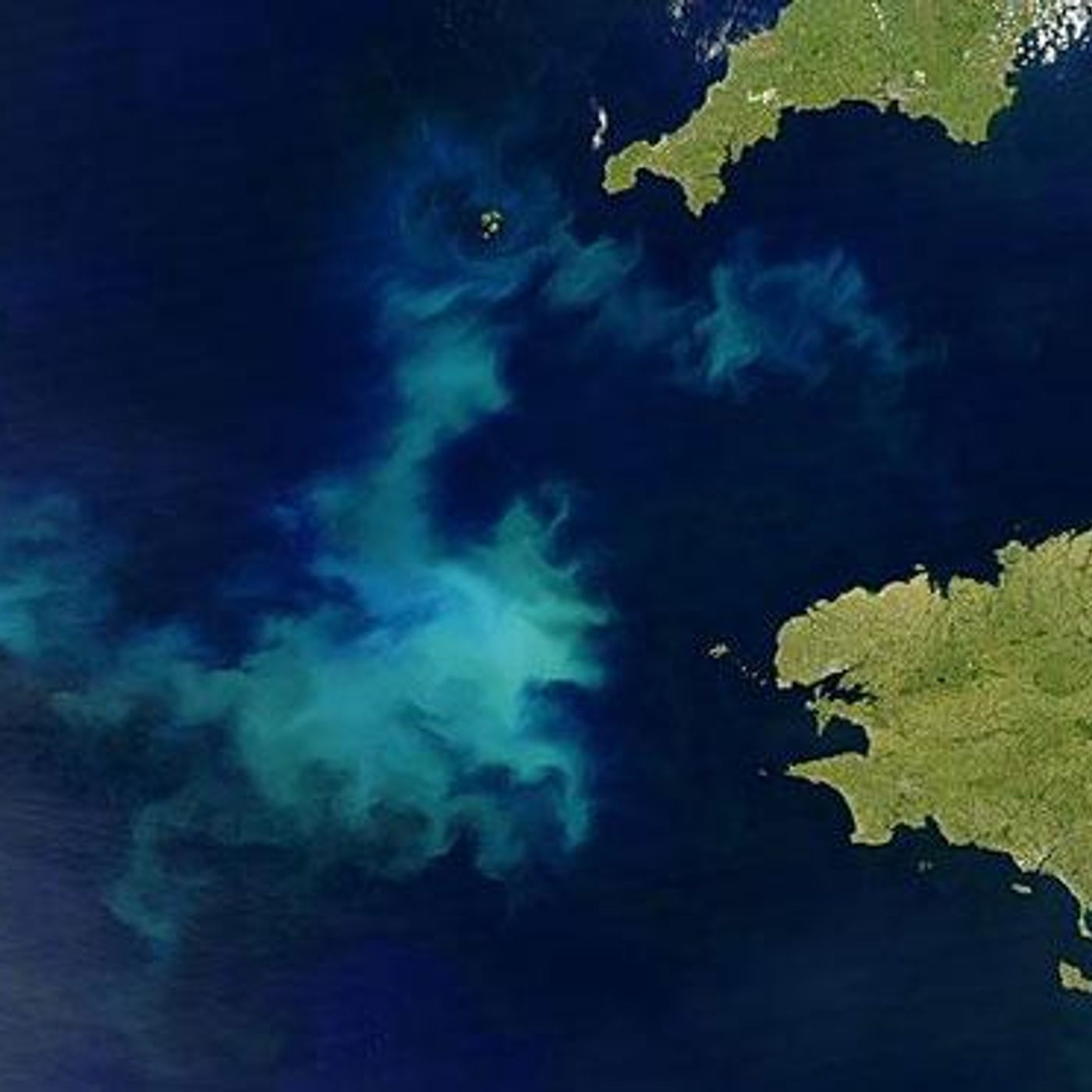
Radiolab
A War We Need
00:10:58
Every day, every moment, an epic battle is raging across the globe. It's happening in the ocean. And the evidence is both highly visible and totally hidden, depending on your perspective. In this short, the tale of an arms race involving trillions of sea creatures--and why their struggle is vital to our survival.
Loading summary
Transcript120 lines
- [00:01]
A
Building a portfolio with Fidelity Basket Portfolios is kind of like making a sandwich. It's as simple as picking your stocks and ETFs. Sort of like your meats and other topics and managing it as one big juicy investment.
- [00:16]
B
Mmm.
- [00:17]
A
Now that's pretty good. Learn more at fidelity.com baskets Investing involves risks including risk of loss. Fidelity Brokerage Services LLC Member NYSE SIPC.
- [00:28]
B
Member.
- [00:31]
C
Limu Emu and Doug.
- [00:34]
D
Here we have the Limu Emu in its natural habitat helping people customize their car insurance and save hundreds with Liberty Mutual. Fascinating. It's accompanied by his natural ally, Doug.
- [00:49]
B
Uh, Limu is that guy with the binoculars watching us.
- [00:52]
D
Cut the camera. They see us.
- [00:53]
A
Only pay for what you need@libertymutual.com Liberty.
- [00:56]
B
Liberty Liberty Liberty Savings.
- [00:59]
A
Very underwritten by Liberty Mutual Insurance Company and affiliates. Excludes Massachusetts.
- [01:03]
E
It's never too early for Lowe's Black Friday deals. Snag some of our biggest savings of the season right now. Like 25% off select pre lit artificial Christmas trees. And get yourself free select dewalt cobalt or Craftsman tools when you buy a select battery or combo kit before the Black Friday rush. Because everyone loves free stuff, right? Lowe's we help you save valid through 123 while supplies last. Selection varies by location.
- [01:32]
B
Oh wait, you're listening.
- [01:33]
C
Okay.
- [01:34]
B
All right. Okay. All right.
- [01:38]
F
You're listening to Radiolab.
- [01:41]
G
Radiolab shorts from WNYC.
- [01:48]
B
And npr.
- [01:51]
C
I'm Robert Krulowich. This is Radiolab, the podcast. And today we're going to talk about global warfare. A vast battle across the planet on a scale that is really hard to believe, involving trillions of deaths. And yet we really need this war. Because without it, I wouldn't be here, you wouldn't be here. Jad wouldn't be here. And you may have noticed he isn't here. And it's not because of awards, because he had a baby. But before Jad went on paternity leave, we sat down with Ari Daniel Shapiro.
- [02:25]
B
Okay.
- [02:25]
C
And he told us this story.
- [02:26]
B
Here it comes.
- [02:27]
G
Alright. Yeah. So here we are at the center for the Culture of Marine Phytoplankton.
- [02:31]
B
This is Willie. And I always say Willie Wilson.
- [02:34]
F
Willie Wilson is his name.
- [02:35]
B
Yeah.
- [02:36]
F
That's tough.
- [02:36]
B
Just like his grandfather actually.
- [02:38]
G
Yeah, My dad's William Wilson. There's a long line of William Wilsons.
- [02:43]
B
Your son.
- [02:43]
G
My son is Angus, but he's Angus William Wilson. So love that guy.
- [02:48]
B
Willie works at the Bigelow Laboratory for Ocean Sciences in Maine.
- [02:52]
F
Okay.
- [02:52]
B
And he studies these tiny plant like creatures that live in the sea called phytoplankton. He keeps them in a fridge in these little test tubes, half full of kind of greenish water.
- [03:07]
A
Let's have a look at that.
- [03:09]
B
He pulled one out and showed it to me. And it doesn't really look like there's that much going on in there, but.
- [03:13]
G
Actually, right at the bottom, you can see what looks like a white sort of goo.
- [03:20]
B
What is it? It's the carnage of war. In that test tube that Willie's holding are millions of tiny single celled plants called coccolithophores.
- [03:32]
F
Coccolithophores?
- [03:34]
B
Yeah. And there are lots of them in the sea.
- [03:37]
G
There's probably about 100,000 of these coccolithophores in a teaspoon of seawater.
- [03:42]
B
Tell me about the coccolith. Like, what do they look like?
- [03:43]
G
They're basically like tiny little translucent balls with a slight tinge of green. But the key thing is the outside.
- [03:53]
B
Of that ball, it has these white.
- [03:56]
G
Plates, tiny circular shields of.
- [04:00]
B
Because the coccolithophores are fighting for their lives.
- [04:05]
F
Fighting with whom?
- [04:06]
B
Each other. Viruses. These viruses that are shaped like diamonds. So here's what happens. Imagine you're a coccolithophore floating in the ocean, and along comes this diamond shaped virus, and it jams its diamond tip.
- [04:29]
G
Into you between these plates and actually get inside the cell.
- [04:33]
B
The chinks in the armor.
- [04:34]
G
That's right. It's like the chinks in the armor.
- [04:37]
B
And the coccolithophore just engulfs it.
- [04:41]
G
And the virus thinks, yes, I'm in here. And then it sort of makes straight to the nucleus.
- [04:48]
B
And it's at that moment that the viral takeover begins. The virus kind of hijacks the cellular machinery that's usually used by the coccolithophore to make more coccolithophore stuff, and it starts making more viruses.
- [05:05]
F
So inside the coccolithophore now, there are these little diamonds multiplying.
- [05:09]
B
Yeah. They're filling up that space. And eventually all these viruses head out of the coccolithophore in big belches or like a steady stream of viruses.
- [05:22]
D
Wow.
- [05:23]
G
And each one of these viruses has the ability to go on and infect another coccolithophore cell.
- [05:30]
B
In fact, those coccolithophores in that test tube that Willie showed me, if I.
- [05:34]
G
Shake this stuck to the bottom a.
- [05:35]
B
Little bit, those were in the process of dying.
- [05:38]
G
You smell that? Yeah. So what you're smelling there, that's the infection. That's dimethyl sulfide. You smell. So the infection is already occurring in this culture.
- [05:46]
B
And when the coccolithophore dies, those white shields kind of fall off the cell.
- [05:52]
G
They sort of gradually sort of rain off over the course of the infection.
- [05:57]
F
So as it's dying, after it's spewed out these viruses, it just sheds its plate and it kind of. And then it dies.
- [06:05]
B
Yeah.
- [06:06]
F
And that creates this white chalkiness.
- [06:07]
B
Yeah.
- [06:08]
C
Well, so this means, like, the coccolithophores are not doing very well.
- [06:11]
B
Well, they've got a couple of tricks up their little calcified sleeves. Sometimes when a virus enters, the coccolithoph will send out a chemical signal.
- [06:23]
G
They're sort of shouting, hey, it's too.
- [06:25]
B
Late for me, but save yourselves. Oh. And initially, this signal's pretty weak in the water. But as more and more coccolithophores are infected, the chorus of this chemical beacon grows louder and louder.
- [06:40]
G
And so the other cells, they hear.
- [06:42]
B
These messages and they change by messing with their DNA a bit. And they go from having those white shields on the outside to having these jaggedy scales, which we think might be impenetrable scales instead of these plates.
- [06:57]
G
That's right. Yeah, that's right.
- [06:59]
F
Why aren't they just scaly all the time?
- [07:01]
B
Because when they're scaly, they can't be the best coccolithophores they can be. They just don't grow as well.
- [07:07]
F
So scaly is an adaptation against the viruses.
- [07:10]
B
Exactly. And then finally, if all else fails, program cell death. The coccolithophores just commit suic.
- [07:19]
G
It just shuts down and kills itself to prevent propagation of viruses.
- [07:23]
B
But over time, the viruses have figured.
- [07:26]
G
Out how to prevent the cell from killing itself.
- [07:31]
B
So it delays the death of the coccolithophore for as long as possible to maximize the number of viruses that can get out.
- [07:40]
F
Wow, this is serious.
- [07:42]
B
Yeah, it's like an arms race.
- [07:43]
G
There's a constant battle to be fitter than you were several generations ago.
- [07:50]
B
Here's the crazy thing. This battle is happening all through the surface of the ocean. There are legions of coccolithophores dying all the time. And the coccolithophores are shedding their white.
- [08:05]
G
Shields, like taking millions of tiny little mirrors and putting them in the surface of the ocean.
- [08:11]
B
So many that you can actually see this carnage from space.
- [08:18]
F
You can see this from space?
- [08:20]
G
Yeah, you get massive blooms that cover almost the whole of the. The North Atlantic, and you get this sort of milky bloom that covers anything from, you know, off the. The west coast of Scotland and southern Iceland, almost All the way to Newfoundland in the southern hemisphere. You get this massive milkiness that circumnavigates the. The globe.
- [08:45]
B
These vast swirls of milky water curling around islands and continents.
- [08:51]
F
And that's all carnage from this battle.
- [08:54]
B
Billions and billions of soldiers that have fallen in the field that we can view from space.
- [09:00]
F
It probably is trillions, if you're talking on that scale.
- [09:02]
B
Yeah, I think it's.
- [09:03]
F
What's half the trillions?
- [09:04]
B
Quadrillion.
- [09:06]
F
You think it's wearing the quadrillions?
- [09:07]
B
Just say it. See how it feels. There are quadrillions of soldiers dying.
- [09:13]
F
How did that feel?
- [09:14]
B
It felt good. If I were to be an astronaut, how often would I see these sorts of blooms?
- [09:22]
G
All the time, somewhere on the planet.
- [09:25]
B
Every day, every hour.
- [09:26]
G
Every day, every hour, there's going to be a bloom going on somewhere. You know, a good example is of the Norwegian fjords. They start in the fjords in late April into May time, and then they sort of creep out of the fjords like this huge living amoeba. Fishermen hate it because the fish can't see the lures, so they can't catch the fish anymore.
- [09:51]
B
And as the shields rain off and fall down to the ocean floor, they build up and build up over time.
- [09:59]
G
Millions of years of sedimentation of these sort of chalk particles.
- [10:04]
B
That's actually what led to the creation of the cliffs of Dover, the White cliffs of Dover in England. Shut up. Really? Yes.
- [10:12]
G
This is geology in action.
- [10:14]
B
And not just that. When the coccolithophores get decimated by the virus, it kind of clears out the ocean for other phytoplankton to bloom, and then they get mowed down by their viruses, and then the coccolithophores might bloom again, and then they get wiped out. And this cycle in all these battles.
- [10:35]
G
I mean, it's all responsible for about half the oxygen that we breathe.
- [10:41]
B
Really?
- [10:41]
C
Half the oxygen?
- [10:42]
B
We breathe half the oxygen because when the phytoplankton bloom, they take in carbon dioxide and they release a puff of oxygen, and then they're cut down by these viruses, but they grow back up again and another breath is released. So the whole system is just kind of breathing.
- [11:15]
G
People think of the lungs of the planet are the rainforests, and that's kind of half the picture. But every other breath we take comes from the. The phytoplankton in the ocean that are going through these battles on a, you know, on a daily basis.
- [11:32]
F
So this is a battle that rages every single day somewhere in our oceans.
- [11:36]
B
Yeah, we need the battle to live. Ari.
- [12:01]
C
Thank you.
- [12:02]
B
Sure.
- [12:05]
H
Message 10 New hi, Radiolab. My name is Kaylin. I'm a Radiolab listener from Vancouver, British Columbia, Canada. Radiolab is supported in part by the National Science foundation and by the Alfred P. Sloan foundation, enhancing public understanding of science and technology in the modern world. More information about Sloan@www.sloan.org. end of message.