← Radiolab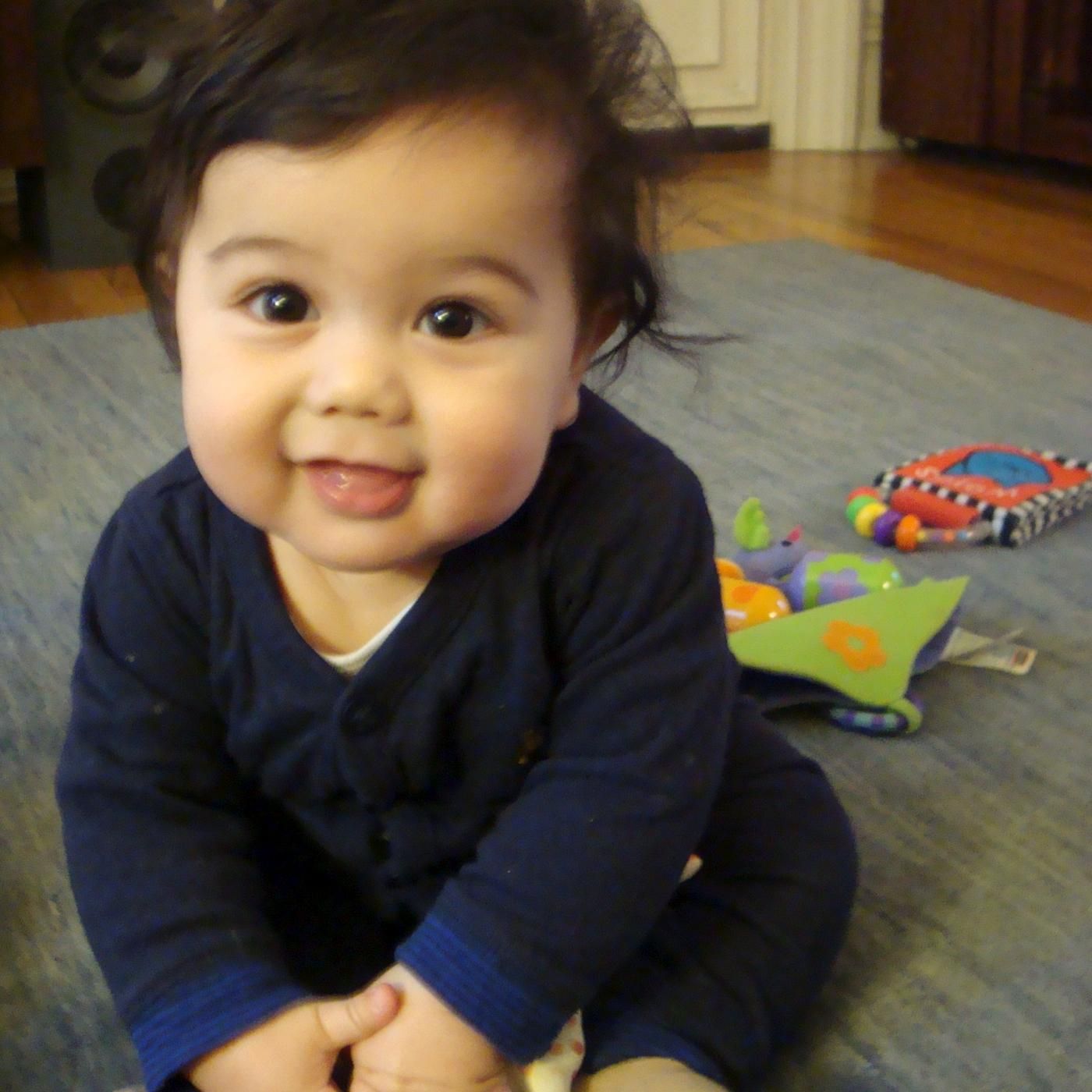
Radiolab
After Birth
00:10:06
Pardon the graphic pun, but hey! For this podcast, Jad--a brand new father--wonders what's going on inside the head of his baby Amil.
Loading summary
Transcript58 lines
- [00:00]
Venmo Stash Advertiser
With Venmo Stash a taco in one hand and ordering a ride in the other means you're stacking cash back Nice. Get up to 5% cash back with Venmo Stash on your favorite brands when you pay with your Venmo debit card. From takeout to ride shares, entertainment and more, pick a bundle with your go tos and start earning cash back at those brands. Earn more cash when you do more with stash. Venmo Stash terms and exclusions apply. Max $100 cash back per month. See terms at Venmo Me Stash terms.
- [00:30]
Marshalls Advertiser
When it comes to gifting, everyone on your list deserves something special. Luckily, Marshall's buyers travel far and wide, hustling for great deals on amazing gifts so you don't have to. That means your mom gets that cashmere sweater, your best friend, that Italian leather bag, your co workers unwrap their favorite beauty brands, and your nephews the coolest new toys. Go ahead. At prices this good, you can grab something for yourself too. Marshalls we get the deals, you get the good stuff. Shop now@marshalls.com or find a store near you.
- [01:02]
Lowe's Advertiser
At Lowe's before the holidays is the perfect time for upgrades and upkeep. During Black Friday, get up to 50% off, select major appliances and buy more to save more with up to an additional 25% off when you bundle, select major appliances plus grab select Dewalt 20 volt, max drill or impact driver kits for just $99. Lowe's we help you save valid through 12 3. Selection varies by location while supplies last. See lowe's.com for more details.
- [01:30]
Jad Abumrad
Wait, you're listening? Okay.
- [01:33]
Radiolab Sponsor Announcer
Radiolab is supported by Rippling. Finance teams often spend weeks chasing receipts, reconciling spreadsheets and fixing errors across disconnected spend tools. This can be frustrating, and that's not software as a service. That's sad software as a disservice. If you've been thinking about replacing stitched together tech stacks with one platform for all departments, Rippling can help. Rippling is a unified platform for global hr, payroll, IT and finance, helping people replace their mess of cobbled together tools with one system designed to help give leaders clarity, speed and control. By uniting employees, teams and departments in one system, Rippling works to remove the bottlenecks, busywork and silos in business software. With Rippling, you can choose to run hr, IT and finance operations as one, or pick and choose the products that best fill the gaps. Right now, you can get six months free when you go to rippling.com Radiolab. Learn more at r I p p l-I n g.com Radiolab terms and conditions apply. Radiolab is supported by Planet Visionaries, the podcast created in partnership with the Rolex Perpetual Planet Initiative. The show is hosted by Alex Honnold, who you may recognize from Free Solo, where he climbed El Capitan without ropes. Now he's turning his focus to the biggest challenge of all, protecting the only planet we've got. Every episode brings you stories that prove climate optimism isn't naive, it's a strategy. The episodes span the globe, from Arctic scientists and Amazon forest guardians to entrepreneurs reimagining fashion and food systems. You'll hear from explorers, scientists, activists and storytellers who we're working to reshape the future in practical, human ways. In one episode, Alex sits down with wildlife photographer Bertie Gregory to discuss how animals can teach humans resiliency, empathy and hope in partnership with the Rolex Perpetual Planet Initiative. Check out Planet Visionaries Listen or watch on Apple, Spotify, YouTube, or wherever you get your podcasts.
- [03:47]
Tonya Mosley
This is Tonya Moseley, co host of Fresh Air. You'll see your favorite actors, directors and comedians on late night TV shows or YouTube, but what you get with Fresh Air is a deep dive. Spend some quality time with people like Billie Eilish Questlove, Ariana Grande, Stephen Colbert, and so many more. We ask questions you won't hear asked anywhere else. Listen to the Fresh Air podcast from NPR and whyy.
- [04:16]
Charles Fernyhough
All right.
- [04:17]
Radiolab Sponsor Announcer
Okay.
- [04:19]
Charles Fernyhough
All right.
- [04:20]
Jad Abumrad
You're listening to Radiolab Radio Lab shorts.
- [04:25]
Tonya Mosley
From WNYC.
- [04:30]
Jad Abumrad
And npr. All right, so for this podcast, I want to talk about my kid. His name is Emil. This is him right here. And by the way, I do plan to make this interesting to people who don't have kids, because I was just one of those people two months ago. So bear with me. But okay, Emil, he's two months old, he's still in the munchkin phase, and he's just starting to tune in the world. So there are these moments, like yesterday, for example, where he gets real quiet and he just stares at me. It's kind of amazing, but it also kind of presents an interesting question which I want to explore right here. In fact, you can't avoid it. You're just staring at this thing and you're like, what is this little creature experiencing? Like here is a little human being that is brand new in the world. What does the world look like to a tiny baby? What does it smell like? What does it sound like? And I happen to find somebody who could Help me at least begin to answer these questions. Hello?
- [05:46]
Charles Fernyhough
Hi, Jad.
- [05:47]
Jad Abumrad
Hi. Is this Charles?
- [05:48]
Charles Fernyhough
Yes, that's right.
- [05:48]
Marshalls Advertiser
Woohoo.
- [05:49]
Charles Fernyhough
Good to talk to you, Charles.
- [05:51]
Jad Abumrad
Before we get started, can I just have you introduce yourself so I can get your name right?
- [05:55]
Charles Fernyhough
Okay. Hi, my name's Charles Fernyhough. I'm a writer and developmental psychologist from Durham University.
- [06:01]
Jad Abumrad
Back when Charles had his first child, Athena, he decided to tackle that question.
- [06:05]
Charles Fernyhough
What is it like? What's going on for this little person as a dad, you know, as an awestruck new dad, but also as a scientist. So he wrote a book called A Thousand Days of a Scientist's Chronicle of His Daughter's Developing Mind.
- [06:17]
Jad Abumrad
It's an amazing book where he basically goes through what we do and don't know about what's happening in the minds of little babies when they're brand new. So I put the scenario to him. Ok, Emil's brand new. When I'm sitting there holding him and we're staring at each other, what exactly is he seeing?
- [06:33]
Charles Fernyhough
One difference that does relate to their visual system is that the lens of their eye is absolutely crystal clear. Whereas your lens, my lens, because they're of a certain age, they've become slightly yellowed. So they filter out some of the blue frequencies of the light that we see.
- [06:51]
Jad Abumrad
So wait, paint the picture. What would that be like for them?
- [06:54]
Charles Fernyhough
I mean, this is my stab at imagining what this would be like. But if you can imagine being in a Greek village in the summer at.
- [07:04]
Jad Abumrad
Noon, the sun is directly overhead and it's one of those villages where everything is white.
- [07:09]
Charles Fernyhough
You know, the houses are all painted white, you're wearing sunglasses and then you suddenly take off those sung.
- [07:22]
Jad Abumrad
It's that bright.
- [07:23]
Charles Fernyhough
Yeah. I think light is a big. It's probably the biggest shock to newborn babies.
- [07:29]
Jad Abumrad
But it's interesting to consider that that blinding haze of whiteness might actually be how the world really is. We just don't see it in any case. Then I asked him about sound. Do babies hear things differently than adults the same way they see things differently? And he said, yeah, we think so. We think they hear echoes.
- [07:50]
Charles Fernyhough
The echoes are actually there, but our brains filter them out. But it takes some time for them to learn to do that. I mean, the science behind it is quite complicated. And I don't think I could explain it now, but it's to do with the relative times of arrival that the sound makes on the two ears. But the brain basically has to learn to make this adjustment. It can't do it straight away. And so A newborn baby's hearing, we guess. We don't know for sure again, because we can't know what it's like. But we guess that babies hear things in a very echoey way.
- [08:32]
Jad Abumrad
But it gets even stranger. Tell me about the experiment with the babies in the brain. Cap.
- [08:36]
Charles Fernyhough
Yeah. I described a study that was done with babies where they were taking EEG measurements. And these are the kind of measurements that you. You get when you put a net of 16 or so electrodes over the scalp. And these electrodes pick up the very small electrical changes that go on as your brain works. And it's a perfectly safe, harmless procedure which you can do with very young babies. Well, usually when you do these studies, you can see the way. See the way in which particular parts of the brain respond to different kinds of stimulus.
- [09:11]
Jad Abumrad
In an adult brain, he says, if you show someone a picture, you will see a little bit of electricity towards the back of their brain.
- [09:18]
Charles Fernyhough
If, on the other hand, you heard a sound, then the bit of your brain sort of slightly further forward from that, the auditory cortex would fire, and you wouldn't see any in the visual.
- [09:28]
Jad Abumrad
Cortex because different parts of the brain have different jobs. But what happened with these babies is that things got very strange. Like, the researchers would show them a bunch of pictures, like, boop, boop, here's a circle. Boop, here's a cross. And often things would work as they were supposed to. They would see, like, a little spark in the back of the baby's brain where vision is processed. Sometimes they wouldn't. Sometimes when they showed them, say, a cross, the vision part would be silent, but they'd see a spark in the.
- [09:57]
Charles Fernyhough
Auditory cortex, the hearing part of the brain.
- [10:00]
Jad Abumrad
So the picture would trigger a sound in their head.
- [10:02]
Charles Fernyhough
We don't know what it triggered in their head for them subjectively, but we do know that a part of the brain that shouldn't have fired did fire.
- [10:11]
Jad Abumrad
They were hear what you're saying, but not quite allowing to pass through your lips as if they were hearing the picture.
- [10:19]
Charles Fernyhough
But we don't know what they heard. But it's a good basis for saying that when a newborn's brain is developing, these different wirings that lead information into different parts of the brain are still taking shape.
- [10:36]
Jad Abumrad
It might be, he says, that inside Emil's brain right now, at two months, all of his senses are in a big synesthetic knot. So that when he hears my voice, maybe he sees flashes of color, or maybe when he looks at the wall, he hears tones, or maybe when light comes in through the window. He tastes it like salt or something. I don't know. I mean, that's the thing.
- [10:59]
Charles Fernyhough
We can't know. I mean, there is really strong philosophical grounds for being skeptical there. I mean, actually, I can't know that anybody is conscious.
- [11:09]
Jad Abumrad
Wait, what does that mean?
- [11:10]
Charles Fernyhough
I can't know that you're conscious.
- [11:13]
Jad Abumrad
But I. But I'm talking to you.
- [11:14]
Charles Fernyhough
Sure you are. But, you know, you could be a really smart zombie. You could be a robot. You know, I can't see you. You're 5,000 miles away. I mean, it may be that I'm the only person in the universe who is conscious.
- [11:27]
Radiolab Sponsor Announcer
Huh.
- [11:28]
Charles Fernyhough
We tend to, you know, the vast majority of us tend to say, well, he looks like me and he talks like me and he thinks like me and he perceives like me. So he's going to be like me. But it is a leap of faith.
- [11:40]
Jad Abumrad
Then I told him about the stare, how, you know, just in the last little bit, Emil has started to really stare at us. And we stare back and it's. That's not a leap of faith. That's for real. And he. He told me something really depressing in.
- [11:56]
Charles Fernyhough
Those first couple of months. The visual system is controlled by the subcortical regions, and they're kind of the old bits of the brain. The cortex is the relatively new, evolutionarily speaking, the relatively new part of the brain that surrounds the whole thing. And there's a switch between one kind of control system, the subcortical system and the cortical systems. But as the handover happens, and this is happening at about two months, it'd be interesting to know if he's doing this now. As the handover happens, there's a kind of struggle for power. And the subcortical regions, which were controlling vision, kind of don't immediately want to cede power to the cortical regions. So the baby temporarily loses control of where he or she is looking because of this struggle for power.
- [12:44]
Jad Abumrad
Really.
- [12:45]
Charles Fernyhough
The scientists call this sticky fixation. And it's where a baby will just keep staring at you. It's as if the baby can't take its eyes off you.
- [12:52]
Jad Abumrad
Yes, this is what's happening now. You're telling me this is a brain glitch.
- [12:55]
Charles Fernyhough
It's quite a well documented phenomenon. And it's bad news for the parents who think that their babies are gazing at them adoringly because actually, they just kind of. They don't know where to look. They can't control where they're looking. They don't know how to look away basically, ah, depressing.
- [13:10]
Jad Abumrad
This might actually be one of those cases where ignorance really is blood. Because the truth is you have to project. You have to make that leap of faith. Or at least you have to believe whatever it is. You have to believe so that when he looks at you and you look back at him, you smile. Because eventually that will teach this little dude how the world works, that humans operate on relationships which are these feedback loops which, okay, at this moment in time for him, are not real. They will be soon. Radiolab is funded in part by the Sloan foundation, the National Science foundation, and the Corporation for Public Broadcasting. Please go to our website Radiolab.org and you can check out more information there About Charles Fernyhough's book A Thousand Days of Wonder. It's a really great book.
- [14:22]
Radiolab Sponsor Announcer
Radiolab is supported by the National Forest Foundation, a nonprofit transforming America's love of nature into action for our forests. Did you know that national forests provide clean drinking water to 1 in 3Americans? And when forests struggle, so do we. The National Forest foundation creates lasting impact by restoring forests and watersheds, strengthening wildfire resilience, and expanding recreation access for all. Last year they planted 5.3 million trees and led over 300 projects to protect nature and communities nationwide. Learn more@nationalforests com.org Radiolab with vemostash a.
- [15:01]
Venmo Stash Advertiser
Tag on one hand and ordering a ride in the other means you're stacking cash back with Venmo Stash. Get up to 5% cash back when you pick a bundle of your favorite brands. Earn more cash when you do more with Stash Venmo Stash Terms exclusions apply. Match $100 cash back per month. C terms at Venmo Me Stash.