← Radiolab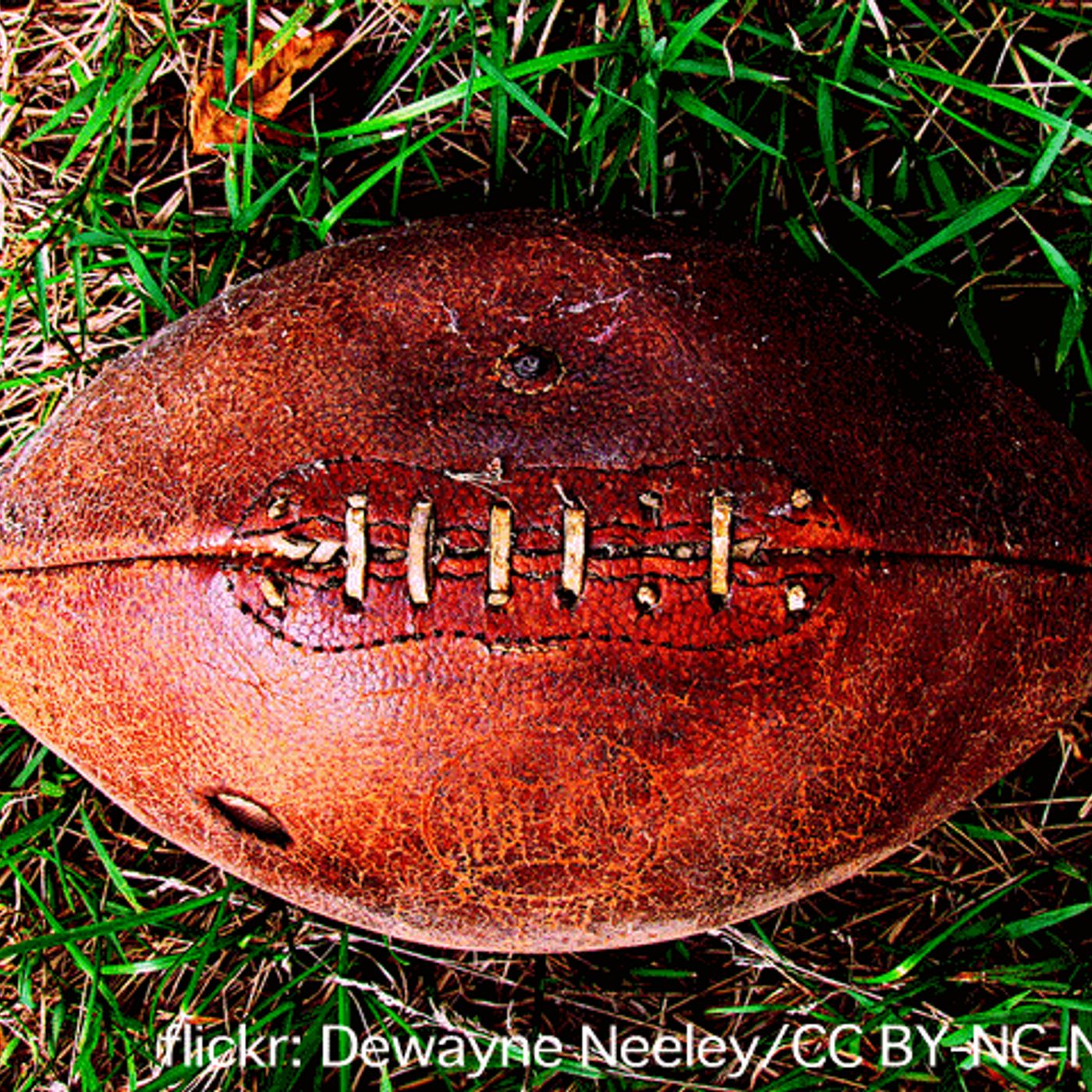
Radiolab
American Football
01:14:10
Today, we tackle football. It’s the most popular sport in the US, shining a sometimes harsh light on so much of what we have been, what we are, and what we hope to be. Savage, creative, brutal and balletic, whether you love it or loathe it … it’s a touchstone of the American identity. Along with conflicted parents and players and coaches who aren’t sure if the game will survive, we take a deep dive into the surprising history of how the game came to be. At the end of the 19th century, football is a nascent and nasty sport. The sons of the most powerful men in the country are literally knocking themselves out to win these gladiatorial battles. But then the Carlisle Indian School, formed in 1879 to assimilate the children and grandchildren of the Native American men who fought the final Plains Wars, fields the most American team of all. The kids at Carlisle took the field to face off against a new world that was destroying theirs, and along the way, they changed the fundamentals of f...
Loading summary
Transcript1 lines
- [00:00]
A
Another negative pregnancy test. But this Black Friday, you can feel in control of your conception journey again and get pregnant 10 times faster. It's Mira's biggest sale, and it could help you to stop feeling lost. Even if your cycles are long and ovulation has felt impossible to find, Mira measures four key hormones with clinical accuracy so you can finally see what your body is doing and time things right to get pregnant. Get 30% off Mira for Black Friday. Check out MiraCare.com when it comes to gifting, everyone on your list deserves something special. Luckily, Marshall's buyers travel far and wide, hustling for great deals on amazing gifts so you don't have to. That means your mom gets that cashmere sweater, your best friend that Italian leather bag. Your co workers unwrap their favorite beauty brands, and your nephews the coolest new toys. Go ahead. At prices this good, you can grab something for yourself too. Marshalls. We get the deals. You gift the good stuff. Shop now@marshalls.com or find a store near you. It's never too early for Lowe's Black Friday deals. Snag some of our biggest savings of the season right now, like 25% off select pre lit artificial Christmas trees and get yourself free. Select Dewalt cobalt or Craftsman tools when you buy a select battery or combo kit before the Black Friday rush. Because everyone loves free stuff, right? Lowes, we help you save valid through 123 while supplies last. Selection varies by location. Oh, wait, you're listening. Okay. All right. Okay. All right. You're listening to Radio Lab Radio from WNY and npr. All right. Should we get. Should we. Yeah, hold on. My donut now. Hey, I'm Jad Abumrad. I'm Robert Krulwich. Hi. Hi. And today, just for gigs, we're going to start. Thank you for coming in a park. So let me set the scene, please. A couple days ago, we gathered a bunch of radiolab listeners in McCarran park in Brooklyn. You guys are amazing for coming out today. Thank you so much. This is a random set of listeners. Random set of listeners. Whoever showed up as a result of a few tweets and Facebook postings come got about 70 people. It was a super cold day. This park was covered in snow and we had brought everybody there to help us make some noises that we would use in the segment like gasping or chanting or. And you'll. It was amazing. You'll hear them throughout the hour. But when people got there, we hadn't actually explained to them why we wanted them to make these noises. So Just to start things off, I just asked them a couple questions. Okay, so questions of the moment. First, let me just ask, how many of you guys like football? How many of you guys hate football? This is not a shocking revelation. No, kind of expected. How many of you guys think that football will disappear in the next 10 years? But these anti football sentiments, I believe they say more about you and I and our fans than the game. Although in fairness, I mean, there are a lot of people who I would even consider myself a. I watch for the ads. Okay? Whether you watch for the ads like you, or whether you love the game like I happen to, or loathe it like some others, football right now, it's huge. It is an American pastime. Ratings through the roof. 97 and a half million viewers. Sunday's game was the most watched event in America. American television history, Super Bowl Sunday has become a national holiday. It's massive. It's massively popular. That's not the same as. Well, I actually think it's massively interesting also. Here's a way to think about it. Sally Jenkins, the author of the book the Real All Americans, she puts it this way. Imagine a thousand years from now, maybe 10,000, maybe 100,000 years from now, we're all gone. All our history has been forgotten. All the silly trifling games we play have been lost to time. Imagine the future, human beings looking back on us. Let's say, you know, some archaeologist goes around digging. They're going to find these really, really huge stadiums. That's what they're going to find. Okay? Yeah. And they're going to understand, just like we understand about the Greeks, what was really important to us. Okay, so here's the thing, Radiolab listeners, we're going to do an entire hour on the game of. In part because it just seems to me that there are a lot of questions in the air about football right now about what it really is and what that means about us, what it might or could or can't become. Am I gonna like this? Absolutely. This, in a way, this whole hour is for the people like you who really don't care about football. And I am willing to wager that the end, they will care more. Particularly because of this first story, which comes from Sally Jenkins, who you just heard comes from her book the Real All Americans. This is a story not about the game, as you might think of it now, but about where it came from. It didn't come from the people you'd expect. Okay, I'm folding my hands, you see, here in my Lap. And I'm going to listen to this. Okay, you want to get in the three point stance? Yeah. We're ready to begin. And this is a story about the beginning. Well, or not quite. I mean, football. Football is as old as sort of the Celtic civilizations. I mean, you can trace primal games of, you know, Danish invaders kicking skulls around the shores of England. I mean, that's not football. That's just skull kicking. But organized football is really a creation of the 1860s and 70s in this country. It's a post Civil War creation. Comes along just really a couple of years after, you know, the last great conquering armies settled the West. Basically. She says, you had these kids whose parents had fought in the Civil War, and then some of them had gone west to fight the Lakota, the Cheyenne, the Arapaho, the Apaches. And now those wars were winding down, which, oddly enough, created kind of an issue for young men at the time. If you're a young student, say, back east at a fancy school like Harvard, how are you going to practice, prove your own toughness? I mean, your older brother, your father, they maybe fought at Gettysburg, battled Little Bighorn. What the hell have you done? The American frontier experience was over. There was this feeling among a lot of intellectuals that American men were losing their masculinity. They were being feminized, in a sense. And so, according to historian David Adams, who you just heard, those kids were desperate for opportunities to man up. There was this cult of manliness around this time, says David Adams, you see a bunch of violent sports take off. And in particular for our purposes, you see these kids at Harvard and Yale getting together and knocking the snot out of each other in this game. That's kind of like rugby, but just more violent. The game used to be basically brutality. The origin of football was such a profoundly different game. Writer Chuck Klosterman before him, historian Dr. Conrad Crane. You know, a first down instead of 10 yards was only five yards. You had three downs to get five yards. And basically all the teams did was sort of slam into each other and try to move the ball incrementally. It was almost as if every play of the entire game was a goal line standard. You know, the metaphor people always use when discussing football, of course, is military. It's the idea of taking land and giving land. Well, the origin of football that was even amplified. There were formations and strategies and that kind of thing, but it was pure, like right out of Napoleon's military playbook. I mean, where you. You concentrate your force. Yeah, should my shoulder next to your shoulder, next to his shoulder. It's like. It's a lot like you bunch up all. All your men and then pierce the other guy's army. Yeah, that was the basic idea. And so you just end up with piles of guys. Yeah. And inside those piles, there's all kinds of things that go on in those scrums. I mean, there's kicking, there's biting, there's gouging, eye gouging and crotch kicking and wow. Head wrenching. And remember, we're talking about Harvard boys doing this. I have to work to imagine that because I think of Harvard and Yale now and I think of like, I think pencil neck geeks. Yeah. I don't think of them as big guys. Well, at the time, they were the. I mean, there were all these wonderful stories about these chops that they would eat for dinner. I mean, they were drinking milk by the gallon. And the Ivies were the great power of the time physically as well as intellectually. But then along comes this school, this tiny little School founded in 1879 in the middle of nowhere that if you're a football fan or just a fan of American history, kind of changed everything. Where was Carlisle? Carlisle was in Pennsylvania. Right. Very close to Gettysburg. Let's go there. So tell me about car. What is the. So when was it formed and what was it there? The Carlisle Indian School is formed by a former. Well, actually, he was an active military officer at the time named Richard Henry Pratt. Big guy, shock of white hair, large nose. Pratt had served gallantly, quite gallantly in the Civil War, and then he had actually served out west in Oklahoma territory. He had fought American Indians himself. And it was after winning a lot of those fights, too many of those fights, really. We're talking 1870s now, that Pratt had a change of heart. And he suddenly became concerned about the very people he had just been fighting. The fact of the matter is that Indians were in very, very desperate situation. The bison were almost extinct. They were being pushed onto reservations and population had fallen to its almost all time low. Pratt and a lot of other policymakers came to the conclusion that something had to happen fast or Indians would literally become extinct. They would in fact, become the vanishing race. And so Pratt, he comes to Washington with an idea. His idea was to start a boarding school specifically for American Indian children. That was kind of a radical experiment. Children would be taken removed for several years at a time. They would be stripped of their, what was called their savage heritage. And they would be civilized, I. E. They would be white. Itized. It was it was forcible assimilation. Pratt had a slogan. Kill the Indians, save the man. That's Barbara Landis Carlisle, Indian school biographer. We went up to Carlisle to talk with her and her colleague Kara Curtis, and they told us that Pratt basically made that pitch. Kill the Indian, save the man. Not just to Congress, but directly to American Indian families all over the country. I want your son. How does that work? I want your children. Because white people are going to keep coming and coming. They want to settle in your lands. They want to take your lands, and you need to learn how to deal with these people. So we need to teach your children how to speak English. We need to teach them how to communicate with the white man so that when the white man comes and tries to get you to sign away the Black Hills, you won't fall for it again. And it was a convincing argument. Well, you know, back in those days, you're talking about survival over here. Would you mind introducing yourself? Okay. My name is Joe American Horse. I'm 79 years old, and I'm a grandson of Chief American Horse. Joe lives near the Pine Ridge Reservation in South Dakota. He's Lakota. He told us a story about his grandfather, who was a famous Lakota chief. In the 1890s, his grandpa led a delegation of American Indians to Washington. Well, he went to Washington, D.C. and he was down there, but there's a lot of people down there. Joe says his grandpa had this moment where he was just stunned by how many white people there were. His phrase was, they're like ants, and pretty soon they're going to come to our area. So he had the idea of trying to send his kids to school so they can intermingle or, you know, intercept or whatever. Basically, Joe says his grandpa just had this realization, we can't. We can't go back. We got to go forward. And it seemed to him Carlisle was the way forward. So where are we going now? This is our photo archive, as Kitzer admitted. Here's how it would work. They would come in, and they'd immediately have their picture taken on arrival. Then they'd be given an extreme makeover, which would also be photographed, which is really, really interesting. Wow. This is Tom Torlino. Wow. So this is Tom Torlino as he comes in. Barbara showed us a picture of a Navajo kid looking maybe 18 years old. This is 1880. This is when he arrives. So he's got kind of dark skin, high cheekbones. He has a long earring, and here you can see earrings. He's wearing an elaborate necklace that looks like it Might be made of bone. And he's wrapped in a blanket. And then here he is in a suit with clean cut hair. In the second picture, his hair is very short, not long, no blanket. He's wearing a three piece suit, sitting there with a cravat and a spread collar and a parted hair. Wow. It's like in a snapshot, you have Tom, Indian Tom, white man. And Sophie Joe Americanhorse said his family saw that transformation firsthand. And Sophie was there in Carlisle for five years and when she came back, she looks like a white woman. You know, she had a real tiny waist and bonnet and everything. And she can't speak Lakota. She forgot. Uh huh. Just think about this for a second. Just think about this. We spoke with one guy, Professor Eric Anderson, who teaches at Haskell. He's also part Potawatomi. Just imagine the parents, he says, the first time they see their kids, parents are seeing their students marched around in essentially the uniforms of what had not very long before, for many of the tribes, been the uniform of the enemy. At the very least, I think that would be startling. In any case, according to Sally Jenkins, after the kids were re cropped and redressed, Pratt would run him through a bunch of drills. I mean, Carlisle was a little military academy and the Indian kids were so unhealthy at first. They had been put on an unfamiliar diet. They had been sleeping indoors for the first time in their lives. And a lot of them were getting sick. I mean, we know that in the 39 year history of the school, at least 200 kids died of disease or poor health or even homesickness. And so Pratt was constantly trying to get the kids outside. And at a certain point he had hired some teachers. And Sally thinks that one of those hires, probably one of the first dormitory masters, this guy who had formerly taught at an Ivy League school, he showed the Carlisle Indian kids this game that the kids at Harvard were playing. Maybe he thought it would toughen him up, who knows? But suddenly they were playing football. Now keep in mind this is, you know, at a point talking 1882, where football's barely a thing. Not so many schools had teams. There wasn't such a thing as a head coach back then. They were volunteer coaches who tended to be students or ex students. But the Carlisle kids self organize, level the field, start to play. They even start to scrimmage some kids across town. And at one of those games, according to Barbara Stacy Matlak, who was a Pawnee student at Carlisle, later became a Pawnee chief, he broke his leg playing football. And Pratt said, that's it. No more football. Because in his mind, he was trying to civilize these kids, and football was doing the opposite. But a short time later, says David Adams, approximately three dozen Carlisle boys came in to Pratt's office, and they said, we want to play football. Do we know what they said exactly? We don't have. We don't have the exact words. But Pratt says at one point, he says, while they stood around my desk. I'm quoting him. While they stood around my desk, their black eyes intensely watching me, he says, the orator gave practically all the arguments in favor of our contending and outside football, and ended up requesting the removal of the embargo. According to his memoir, Pratt was sort of bowled over by the eloquence and passion of the appeal. So he said, okay, you can play if you do these two things. One he says, never slug. People who are looking on will say, there. That's the Indian of it. Just see them. They are savages, and you can't get it out of them. Okay. And the other one was, you have to beat the best teams in America. And at that early point in American football, far and away the most powerful team was Yale. Which brings us to October 24, 1896. It's. It's a raw fall day in New York. They played in New York? Yes, at the old Polo Grounds. Apparently, There was about 4,000 people in the stands, including a handful of newspaper men, New York newspaper men. Really? I mean, it was a big story. How did they publicize it? What did they say? Well, the newspapers became incredibly intrigued. On one side were the undergraduates of an old and great university. Eli, Eli, Eli. Yeah. Eli, Eli, Eli. They represent, physically, the perfection of modern athletics and intellectually, the culture and refinement of the best modern American life. On the other side. Was the Aborigine, the real son of the forest and plain, the red skin of history, of story of war, developed or veneered, as the case may be, by education. And if you read the newspaper stories, they're written as they're written in this kind of blood curdling, shot through with Indian cliches. You know, here come the Redskins. Here come the Redskins. Right, right. According to David Adams, in one paper, there's a reference to yodeling. The writer said that the fans were yodeling in that Indian fashion. I mean, try to put yourself in the shoes of a New Yorker. In the early 1880s, your contact with an American Indian was in a Wild west show. It was theater. And here comes a football game, and all of these American Indian kids run onto the field. And there's literally an instance in one of the first games where someone in the audience says, well, they look just like our boys. Because, of course, that's what Pratt wanted. Now, one thing that was immediately clear to everyone in attendance when they saw the Carlisle players was that they were physically outmatched. Their Average weight is 164, exactly 20 pounds. Lighter, too. The impression going in is that it'll be an absolute smear job, or at the very least, the odds were heavily against them. But three minutes into the game, in the midst of a big pile up, a Yali fumbles the ball. It comes squirting out. Carlisle guy picks it up and runs the entire length of the field, 63 yards and scores a touchdown. Now, nobody had scored on Yale in seven games. They were furious. So what they do is they use their bulk to slowly push the pile down the field twice to take the lead. And with three minutes left, Yale is up 12 to 6. Carlisle has the ball. Carlisle, running back, charges the pile and gets clobbered, falls backwards, and just as he's about to hit the earth, he laterals the ball to a teammate who grabs it, runs around the scrum the entire length of the field and scores. Carlisle scores a touchdown that would have tied the game, but called back by a referee who was a Yale man. Why? The call was that the referee claimed that a whistle had blown the play dead. And what was the crowd's reaction? Well, they were. They were furious. Yes, there was booing and hooting. Everyone knew it was a terrible miscarriage of justice. And some of the Carlisle players said, we're going to walk out of here. We are leaving this game. But according to David, at the last moment, Pratt runs down from the stands, comes onto the field and says, wait a second, wait a second, wait. Don't forget rule number one. Be a gentleman. Pratt did not want this game to end because of their tempers, even though they'd been wronged by that call. So the Carlisle boys finish the game, and when they walk off the field, They get a standing ovation. Carlisle wins. Incredible respect and renown in the aftermath of the game. In fact, one of the newspaper men after another Carlisle Yale game where something similar happened, wrote something to the effect of, Carlisle could beat 11 Yale men, but they couldn't beat 11 Yale men and a Yale referee. Yes, after the yale game of 1896, Pratt is committed. Pratt believes that it's the greatest thing that can happen to his school. It is an instant way to do what he's been struggling to do for 15 years at the Carlisle School, which is to prove the value of these American Indian kids against their white peers. To prove the value or to, quote, civilize them? Well, both to civilize them, but also to prove that given education and equal opportunity, they were the equal of their. Hmm, that's interesting. Of their white peers. I mean, he was. For all of his forcible assimilation methods, which were, you know, to remain extremely cruel and destructive, he truly believed in the concept of racial equality. The complicatedness of Pratt and of the whole Carlisle idea kept smacking us in the face as we were putting this show together. I mean, on the one hand, there were clearly students who felt that Carlisle was prisoner. In fact, Barbara Landis, when she took us on a tour of the grounds of the former Carlisle Indian School, she said that kids would even set fire to the buildings. Yeah, some did burn down, which is kind of typical on Indian campuses. A lot of fires and burning buildings. Why? It's a form of resistance. On the other hand, when we started looking around for original archival recordings of some of the earliest Carlisle players, pretty much the only recording we could find. This tape, we would like for it to be as much of your making as possible, was this oral history with a guy named. Your name. Your full name is Albert Andrew Exendine. Albert Ecksandine. All right. The interview was done in the early 70s, when he was 88. He entered the school just before 1899. You were 15 years old? Yes, ma'. Am. I can't really play you too much of this because the audio quality is really bad. But in the interview, Pratt comes up R, H Pratt. P, R, A, T, T. And Exendine talks about him with a great deal of affection and gratitude. We call him the father of Indian education. We call him the father of Indian education. Oh, he was a wonderful man. So he's a tough figure, Pratt. He's got a very mixed legacy. I mean, I like to say Pratt was his country. Hmm. Whatever you think of him, he was his country. So, okay, so 1896, he gets the bug. Like, he sees football's good PR. Yes. What happens next? Well, he hires. He begins looking around for coaches, full time coaches to come in and coach the team. And he winds up with a Cornell grad named Pop Warner. Glenn. Pop Warner. Now, Pop Warner was an interesting guy. Is this Pops right here? Just to give you a visual. What's Pop, though? W. Look at him. Barbara and Kara showed us pictures. Looks kind of like Mike Ditka, if Mike Ditka had Einstein's hair, pops a little bit of an outlier. He's got these Texas roots. He's a bit of a rogue, can be kind of vulgar. He liked to party a little bit. He liked to gamble. Yes, really. And that is exactly what he does in spectacular fashion when he gets to Carlisle. Because Pop Warner looks at his squad and he realizes that sure, they're fast, they got heart, but they're underweight and they're small. Way small. You know, while they might occasionally force a tie with a Yale, if they, you know, half killed themselves physically, they weren't going to beat the Ivy Leagues on any kind of consistent basis without. Without doing something different. And there was a very fine line between innovation and cheating. And Pop Warner starts exploiting that line absolutely. As hard as he can. And he comes up with the trick play. For example, 1903. Pop Warner devises the hidden ball trick. What is that? The hidden ball trick is the quarterback takes the ball and actually behind this huge pile of men, tucks it under another guy's sweater while the big pile of men is struggling in the mud in the center of the field, not knowing quite where the football is, but believing it's somewhere in the middle of the pile. Here's this kid who's standing, squirts around the end with the football hidden under his Jersey. And he's 30 yards downfield before anybody realizes it. And how does he keep the ball from falling out of his jersey onto the floor? I think they actually sewed the jersey so that the ball would stay in there without falling out. So they made a cheating pocket. They made a cheating pocket. Was that legal? Did they get a legitimate touchdown? Was it legal, you ask? Pop Warner would have said there was nothing in the rule book against it. Another thing he does which actually works brilliantly is he sews footballs onto the front of their jerseys, which were really bulky sweaters at the time. He sews leather football shaped patches onto the front of their jerseys in order to try to disguise who's got the ball really against Harvard. And the Harvard coach goes insane. And that's true. Pregnant. This is the kind of thing I mean. But Harvard did not take this lying down. Harvard retaliates by painting the footballs the same color as their jerseys. It's maroon everywhere. So when they held the ball against their chest, the ball basically, well, you can't see it. I mean, they all broke the rules. American football is essentially a rule breaking experience as opposed to British football, which didn't have referees, at least initially. British football ran on the honor system, but with American football, the refs were there practically from the beginning. And she says it was largely a response to the brutality of the game, but also to the kind of rule bending that you saw from Pop Warner and the Carlisle Indians. Every time Pop Warner came up with an innovation, the next year there was a rule against it. So immediately the Ivy League would get together and pass a rule and say, okay, no more of that. And that's how the rule book really burgeons in American football. And it's thanks to Pop Warner's sleights of hand and Pop Warner's greatest sleight of hand and maybe the Carlisle Indians most soaring moment. And I mean, that literally happened at a moment when the game almost disappeared. That's coming up. Start of message yes, this is David Adams, this is Conrad Crane, and I got an email message asking me to read Credit text Radiolab is supported in part by the Alfred P. Sloan foundation, enhancing public understanding of science and technology in the modern world. More information About Sloan@www.sloan.org. radiolab is produced by WNYC and distributed by NPR. Okay, there it is. Hope you can use that. Take care. Bye. End of message. Radiolab is supported by Bilt. Nobody wants to pay rent, but if you have to, Bilt works to make it more worthwhile. By paying rent through Bilt, you can earn flexible points that can be redeemed toward hundreds of hotels and airlines, a future rent payment, your next Lyft ride, and more. But it doesn't stop there. You can dine out at your favorite local restaurants and earn additional points, get VIP treatment at certain fitness studios and enjoy exclusive experiences just for built members. Every month, earn points on rent and around your neighborhood, wherever you call home, by going to joinbuilt.com Radiolab that's J-O-I-N-B-I-L-T.com Radiolab Hey, I'm Molly Webster and this is an ad by BetterHelp. So it happens every year. The seasons are changing, the days are getting shorter, and basically once it becomes dark outside of my window, I feel like the rest of the world disappears and I'm just alone and there's nothing left to do but watch television. This November, Better Help is asking everyone to reach out to our people. That could be your family, your friends, your neighbors, and to resist this call of the cocoon. And yeah, reaching out can take some courage. I've got text messages from January. I haven't responded to. And you know what? I'm gonna write em back right now. Hi sorry I've been missing. How are you? Why don't we all do this sooner? Therapy is the same way. BetterHelp makes it easier to take that first step. You just fill out a short questionnaire and they find a licensed therapist who they think you'll like. Our listeners get 10% off their first month at betterhelp.com Radiolab that's betterhelp.com Radiolab Radiolab is supported by Rippling Finance. Teams often spend weeks chasing receipts, reconciling spreadsheets and fixing errors across disconnected spend tools. This can be frustrating. And that's not software as a service, that's sad software as a disservice. If you've been thinking about replacing stitched together tech stacks with one platform for all departments, Rippling can help. Rippling is a unified platform for global hr, payroll, IT and finance, helping people replace their mess of cobbled together tools with one system designed to help give leaders clarity, speed and control. By uniting employees, teams and departments in one system, Rippling works to remove the bottlenecks, busy work and silos in business software. With Rippling, you can choose to run hr, IT and finance operations as one, or pick and choose the products that best fill the gaps. Right now, you can get 6 months free when you go to rippling.com Radiolab learn more at r-ip p l-I n g.com Radiolab terms and conditions apply. Radiolab is supported by Planet Visionaries, the podcast created in partnership with the Rolex Perpetual Planet Initiative. The show is hosted by Alex Honnold, who you may recognize from Free Solo, where he climbed El Capitan without ropes. Now he's turning his focus to the biggest challenge of protecting the only planet we've got. Every episode brings you stories that prove climate optimism isn't naive, it's a strategy. The episodes span the globe, from Arctic scientists and Amazon forest guardians to entrepreneurs reimagining fashion and food systems. You'll hear from explorers, scientists, activists and storytellers who are working to reshape the future in practical human ways. In one episode, Alex sits down with wildlife photographer Bertie Gregory to discuss how animals can teach humans resiliency, empathy and hope in partnership with the Rolex Perpetual Planet Initiative. Check out Planet Visionaries Listen or watch on Apple, Spotify, YouTube, or wherever you get your podcasts. Hey, I'm Jad Abumrad. I'm Robert Krilwich. This is Radiolab. And getting back to our story on the Carlisle Indian School and the birth of the modern game of football. One of the most important moments in this story happens at a time when football was right on the edge of disappearing. Talking about 1905, this was the most violent year in football to this point. 19 people died on the football field. 19, 1 9, 1 death is a lot. 19, that's crazy, because what would happen is that Carlisle would try and do these things to sort of open up the game. The Ivies would consistently respond by making the game more about brute force, more about violence. So you had all these deaths, and suddenly all the major programs were spooked. You know, Columbia pulls their football team. Harvard even thinks about doing that. And so, and this is kind of odd, into the phrase steps the President of the United States of America, Teddy Roosevelt, because he was a fan, according to Conrad Crane, he liked football. He liked the manly aspects of it, the tough aspects of it, but nobody liked people dying. And then there was his kit. His. His son was playing and getting beat up pretty badly as well. Broke his nose, slit his eyebrow. In one game. He got knocked out cold. So after the violence of 05, the President calls the presidents of all these colleges and so on to Washington. And according to David Adams, he basically tells them that the rules had to be rewritten. It had to become a little bit more safe, at least, or it would be banned. And out of that, we see a couple of rule changes. First, the schools decide, in order to loosen up the pile, so to speak, they're gonna tinker with the down yardage ratio. Instead of going from three downs to gain five yards, it becomes three downs to gain 10 yards, three downs to get 10 yards, or four downs to get 10 yards. Four would come a couple years later. But the second rule change, which is maybe the most important for our story, is for the first time, they legalized the ability to. To move the ball through the free floating air that surrounds us all. Okay, so where do we go? What's the next. So if I could. If I could place you in a moment, unless there's a moment before this you'd like to hit, I believe, November 23, 1907. Yes. Big moment. Okay. Can you set the scene? Well, the scene from the standpoint of broader American history. Things have gone airborne. You mean Wilbur and Orville, Right. I'm talking about not just them, but I'm talking about hot air balloons. There are aeronautical experiments happening really all over the world. In France, everyone is experimenting with flying machines. Things are going up in the air, but not so fast with football, because when the rule committee had made that rule about forward passing, they had also hedged a little bit, saying, if you throw a forward pass and your receiver doesn't catch it, you are penalized 15 yards, which back in the day was a monster amount. So nobody threw the ball. It was too risky. But story goes, as soon as that rule got passed, Pop Warner goes back to his garage. It's always a garage, of course, with a ball. And he starts experimenting, and he starts thinking, okay, what would be the most efficient way to toss this thing? People have to understand that the footballs in those days are not the footballs we have today with the nice, you know, whatever the oblate spheroid or whatever they call it, with the nice points and things. These are rugby balls. Just sort of imagine a deflated basketball. They're thicker in the middle. They're not as well shaped. They're really tough to get your hand on to throw right. And in 1906, there's a tiny bit of tape in Albert Ecksundine's oral history where he talks about this. In 1906, he says, pop called all the players together. He tells them, I think, boys, that you will have to learn to spiral a ball. He says, I think you're going to have to learn to spiral the ball to spiral the ball, because if you throw the ball in a spiral, it gets 10 times less air drag than if you throw it end over end. Plus, it's easier to catch. Yeah, they start experimenting with it a little bit in 1906, but they come out in 1907 as a throwing offense, which gets us to that game. November 23, 1907. Carlisle plays the University of Chicago. Last game of the season. We're in Chicago, and the Chicago team is arguably the best in the nation. The best. I don't think it's even arguable. Well, Carlisle is good at this point, though. Yeah, but Chicago's like Stagfield, and there are 27,000 people in the stands. Well, what happened was the Chicago players had decided to try to defeat Carlisle's innovative forward passing by just knocking the crap out of their receiver every time they came off the line of scrimmage. And so Carlisle's greatest receiver, Albert Ecksundine, our guy had been stymied the entire game because the minute the ball was snapped, Chicago players would hit him and try to throw him down or knock him out of bounds. So Pop Warner said to Eczendine, here's what we're going to do next time they hit you out of bounds. Sneak around the bench and get back on the field. By some accounts, this was Ecksdyne's idea. But whoever thought of it. On the next play, Albert Ecksdine, as expected, ends up out of bounds. But he keeps running. He runs around the back of the bench, runs around the spectators, maybe around the band, and comes back on the field. Right at that moment, Hauser, the quarterback of Carlisle, lets loose a vicious spiral. Can I have you read something? Sure. Can you hold on? This is Sally's description of that moment from her book the Real All Americans. For a moment, it was a frozen scene in a staged drama. The ball hung in the air, a tantalizing possibility. Could Exendine reach it? Would he catch it or drop it? Defenders wheeled and stared downfield. Spectators watching from the stands found that the breath had died in their collective throats. The spiraling ball seemed to defy physics. What made it stay up? When would it come down? In that long moment, 27,000 spectators mashed together on benches and crammed on platforms may have felt their loyalty to the home team evaporate in the grip of a powerful new emotion. They may have noticed something they never had before. That a ball traveling through space traces a profoundly elegant path. They may have realized something else. That it was beautiful. The ball struck its human target. Exendine caught the pass all alone and trotted over the Chicago goal line. The stadium exploded in sound and motion. It was the game breaker. The rest was just anti climax. The final score was 184 for Carlisle. But the very next year, the Ivy League passes a rule that you can't leave the field and then come back on. Oh, that's where that rule came from. Yes, that's where that rule comes from. And I gotta say, that description of the ball in the air is timeless in a way. That's exactly why football is still beautiful at times. That's when Carlisle in 1907 is when American football becomes the sport that you watch today. Oh, wow. Is this the field? This is the field. This is the field. Can we get out? Yeah. After we'd spent an entire day looking at, pictures of, you know, Albert X&9 and Pratt and Pop Warner and D. Sloan, Wolf and Tom Darlino and all these Carlisle players, Barbara and Kara, took us to the field where they practiced. All right, so this is the Carlisle Indian school football field covered in Snow. It's like 10 degrees out here. Really, really bright sun coming off the snow, and it's just empty. And we just kind of walked around and tried to imagine all the stuff we'd just seen in photos. It was a little bit like walking among ghosts. Yeah. That's the sound of the flag blowing in the background. I remember standing on that field and having this thought that I couldn't quite articulate. But later, Eric Anderson, that professor from Haskell, was a member of the Potawatomi Nation. He sort of put his finger and he essentially said that, like, there's a lot of room on a football field. I mean, there's room for anger and war and violence, but there's also room for pride and a kind of coming together. That's not a Pratt coming together where one side gets erased, but it is a coming together. Yeah. I mean, there is a middle ground. Clearly, it's more than a game. The stakes are higher than that. You know, will we as Indian people be accepted on our own terms and also in our ability to meet you halfway, Will we be accepted through this as the vehicle? It's clearly more than a game. A lot of people to thank for this episode. We had originally music made for us for that episode from Morgan o'. Kane. You can hear him right here playing the banjo. That's Morgan O K a n e music.com. check him out. Also, we had original music from Austin musician Shaky Graves. And the Albert Ecksndyne tape that we played is from the Research division of the Oklahoma Historical Society. Thanks also to the Cumberland County Historical Society and the US Army Heritage and Education center, where you can go and see tons of photos from both archives or you can come to us on our website, Radiolab.org, we have a ton of old archival football pics, a ton of those before and after pictures from the amazing, really amazing. And we also have a link to Sally Jenkins book, which is highly recommend. The Real All Americans. That's on our site, Radiolab.org thanks also to Reggie, Cathy and to Scott Graham, to Noah Robbins, to Michael Chernis, to Matt Delapina, Cole Wimpy, to J.R. mcCarthy, to Nick Capodice, Colin and Michelle Campbell, Ed Haber. And special thanks, very special thanks to our amazing volunteer cheer squad that came out and weathered the Brooklyn cold to scream and holler and bring this story to life. And speaking of that, very special thanks to Brenna Farrell who found the story and produced it with us, and production support from Damiano Marchetti. Well, that's a lot of people to have thanked, but we will have more to listen to and more people to bank in the second half of our program. Yeah, we're going to take a distinctly modern view on football coming up. Radiolab is supported by Rippling Finance teams often spend weeks chasing receipts, reconciling spreadsheets and fixing errors across disconnected spend tools. This can be frustrating and that's not software as a service. That's sad software as a disservice. If you've been thinking about replacing stitched together tech stacks with one platform for all departments, Rippling can help. Rippling is a unified platform for global hr, payroll, IT and finance, helping people replace their mess of cobbled together tools with one system. Designed to help give leaders clarity, speed and control. By uniting employees, teams and departments in one system, Rippling works to remove the bottlenecks, busy work and silos in business software. With Rippling, you can choose to run H R IT and finance operations as one, or pick and choose the products that best fill the gaps. Right now you can get 6 months free when you go to rippling.com Radiolab learn more at rip p l I n g.com/radiolab terms and conditions apply. Radiolab is supported by Planet Visionaries, the podcast created in partnership with the Rolex Perpetual Planet Initiative. The show is hosted by Alex Honnold, who you may recognize from Free Solo, where he climbed El Capitan without ropes. Now he's turning his focus to the biggest challenge of all protecting the only planet we've got. Every episode brings you stories that prove climate optimism isn't naive, it's a strategy. The episodes span the globe, from Arctic scientists and Amazon Forest Guardians to entrepreneurs reimagining fashion and food systems. You'll hear from explorers, scientists, activists and storytellers who are working to reshape the future in practical, human ways. In one episode, Alex sits down with wildlife photographer Bertie Gregory to discuss how animals can teach humans resiliency, empathy and hope in partnership with the Rolex Perpetual Planet Initiative. Check out Planet Visionaries Listen or watch on Apple, Spotify, YouTube, or wherever you get your podcasts. Hey, are we. Are we rolling? Jamie? We are rolling. Chuck, can you say how's your water? My water is refreshing. It's. It's delicious. We like to go a little bit heavy on the minerals here in public. Hey, I'm Jad Abumrad. I'm Robert Krulwich. This is Radiolab and today, still talking about football. Yes sir. This is the second half and you know, in the first half we talked about where football came from. Now we want to look at where it's going, which seems to be the big conversation these days. And as we were thinking about that, we ended up talking with one of Our favorite sports writers, Chuck Klosterman. I'm a writer and a journalist in Brooklyn. You may know him from his Ethicist column in the New York Times. He also writes about sports for Grantland. And he recently wrote an essay about football and its inherent contradictions. And it recalled for us this sort of Carlisle versus Ivey, free flow versus traditional sort of thing, but in a newer sort of modern way. Can I ask you. So you're. I want you to explain this statement. This is the thing I found most interesting about your essay. You say basically that by portraying itself as a super conservative, traditional, manly sport, but essentially operating is the opposite. Like this really liberal, wide open, anything goes kind of sport. Football became the most successful enterprise in American sports history. So you have this sense that it's pretending to be one thing, but actually another. What do you mean? Well, okay, it's. It's a unique thing in the sense that if you look at a sport like soccer or baseball, there is a real sense from the people who sort of, you know, the institution of the sport to keep the stuff sport the same, that they want the sport to sort of almost transcend time. It would be the same game now as it always is. Soccer particularly, they hate any kind of attempt to change the rules in this. Football works in the exact opposite way. Football is constantly evolving and constantly adopting new ideas and new technologies and is very willing to alter the game in order to make it a more free flowing or a more progressive game. I mean, football will add things like coaches can talk to the quarterback through a radio in their helmet. It has been determined that the receivers did not maintain, you know, the idea of instant replay was added very early on compared to other sports. The game itself, from an offensive perspective, they do it pretty fast, can't they? Is constantly being reinvented. Chuck says if you look at all the new formations that keep getting added, all the trick plays that are tried out every year, it is quite clear that football as a game, it actually is the most liberal sport in terms of adopting ideas. But the morality of the game in the center of it, the thing that really draws people to love it is sort of its almost most reactionary qualities that it still sort of comes down to the strongest, toughest win. And this is why I feel like football is both so built for American, you know, the American way of thinking and also so popular. It allows you to sort of think about the game in a very liberal, progressive way, in a Carlisle way. But spiritually, like your heart of it can still be this kind of old, comfortable, conservative mindset, those old ivy fundamentals of power and might and tradition. I'm just kind of of the belief that that's really what most people want. Most people want to think of themselves as progressive but feel conservative. And Chuck's whole argument is that it is football's unique ability to be both at the same time reactionary and simultaneously wildly inventive so that you can think about it one way and feel about it another. That is what makes football the most popular part of our sporting culture, which it is right now. By factor of three. What he means is that the NFL is three times as popular as the next most popular sport in America. And the question we got to, just because it's a question you can't really avoid right now, is, is it going to stay that way? Well, it's just. We're just a weird era for the sport. Like, this is certainly, in my lifetime, the strangest era. Like, some weird things are happening. One is that injuries after injury. There seems to be no limit to the amount that we can discuss the problems with the game. Concussions in football. If you're a coach, how do you handle all this discussion about neurologists and head injuries going forward? The idea that so many former NFL players are essentially, you know, decrepit. My former sinner. A lot of head problems. We study their brains after they die, and they have the brains of people who should have been 180 years old and had Alzheimer's or whatever. You know, there was just a kid from Ohio State who shot himself in a dumpster. He vanished. He sent a text to his mother saying, I am sorry if I'm an embarrassment, and basically texted his mom and said, it was like, I think it's concussions that are making me do this. These concussions have my head all effed up. And at the same time, it is an American pastime. There seems to be no limit to the popularity of the sport. Sunday's game was the most watched event in American television history. I think it's very plausible that the super bowl this year will be the most watched sporting event of all time in America. That is. And this is. Don't you feel a small, cold wind in the air? Like, I feel like. I feel like the chimes of death are tolling or something. Absolutely. Well, this will. There's really never been a serious discussion about should we, as a culture be playing football since. Since Roosevelt 1905. Yes. And yet no one seems to be stopping themselves from watching these games. So it's almost like There are these two silos, two separate streams in our collective unconscious that exist simultaneously and are both, like, shooting skyward. Okay, so we gotta be honest. Like, when Chuck was talking about his whole idea of silos shooting skyward. Cool idea, but I. We weren't really sure what that meant exactly. Hey, Monet. It's a pleasure to meet you. Thank you so much for letting me come down. There's so much more. That is, until our producer, Soren Wheeler, met this woman. I'm Monet Bartel. You could add something, like, if you want. I'm Monet Bartel. I'm a Libra. I enjoy long walks on the beach. I'm just joking. So Monet is a partner at a media production company. She lives with her husband and their four kids outside of Atlanta, Georgia. But I actually went to talk to her about her son Parker, because Monet says the very moment he was born. So what are you thinking when Parker's born? As soon as the doctor saw his third thumb, I was like, yes, we're going to the NFL, baby. Yes. And then Parker's 10 pounds and one ounce. He's the biggest thing. He walked out the womb. I'm still going with third thumb, third thumbs up. That's the best way I can put it. I hadn't heard that one before. All right, so Parker comes out, and he's the biggest thing I've ever seen. You know, I've prepared for months, and I've found the perfect outfit to take him home from the hospital in. And this joker's too big for it. So right then I'm like, oh, my God. Yes. Yes. Like, he's a boy and he's gonna play in the NFL. He's gonna play in the NFL. A lot of families passed out quilts. They passed down family businesses. Our family tradition was football. It was football. My dad played football. The Lions leading rusher was Mel Farr. Her dad is Mel Farr. He was a running back for the Detroit Lions. Actually rookie of the year in 1967. His brother played football. Miller Farr. Your uncle. My uncle. Her brothers, Mel Farr Jr. And Michael Farr, both played football. My cousin, Jerry Levias, who they. And when we say played. These guys, everybody. They all played in the NFL. Okay. Jerry Ball. I can't even. If I. I said I was going to actually write them all down, but it's something like 33, really, family members have played in the NFL. Oh, my God. Coming from a sports family, we had to play a sport. So I can remember getting up in the mornings before school, 6, 7 o' clock in the morning and having agility drills. We lived on a house, like just at home. In your backyard? Yeah, in the backyard. We lived on a hill. And I didn't have it as bad as my brothers because I played tennis. I started playing tennis at three. But like in the wintertime, my dad would strap my brothers to the sled and my dad would sit in the sled and they would have to run up the hill with my dad in the sled. Tire drills, everything. Do you have a sense of like, why? I think for my dad, sports opened up so many doors for him. My dad's from Beaumont, Texas. He was in Texas at a very, you know, during segregation. So sports allowed him to get out. It allowed him to provide an excellent lifestyle for his family. And being drafted to the Detroit Lions and being a football player in the Motown era. Weekends at my house consisted of. Marvin Gaye and Lynn Barney and Charlie Sanders, who are all in the hall of fame now. My father actually and Lynn Barney sang background on Marvin Gaye's what's going on. No. Yes, they do. My dad has a gold record. Oh, man, that's crazy. And when he stopped playing football. The continuing adventures of Melfar Superstar. He opened up his first car dealership. And then another and another. And for a time, the Melfar auto group was actually the largest African American owned business in the country. I mean, that's what football did for him. Football gave my dad a life. So Parker, if they had a toddler league, he'd have been in it. So you start looking for leagues. Absolutely. We moved to Georgia when Parker was 2 and I found one that started at 4. And I'm like, ooh, just two more years. It was like a countdown. Oh my gosh, one more year. And When Parker turned 4, I mean, I couldn't sleep the night before. I'm like, yes, tomorrow's the day. Parker has no idea what's going on. I go up there bright and early. First person in line. Here's my check. 4 years old, full on contact football at 4 with helmets. Helmets, pads, spring training. Wow. Parker had spring training. Okay. He's going through the tires. He's four. Okay. We don't even have team colors yet. But I'm there in what I feel like a team color should be. I'm there in Honolulu blue and silver because that's Detroit Lions colors. So this is just at the, at spring training. Then we get to the actual team practice. They immediately. They named him the Tank. He was just Plowing through people. They're like, tank, Tank. Like the coaches and the coaches at first practice, I'm not thinking about the other parents. And they're little normal sized children. And the fact that by, you know, after the first day of practice, three kids quit because Parker had just plowed them over. I'm like, yes, my son is a beast. And then the season starts. Football in where we live is huge. At four years old, they were tailgating. No, I'm serious. The coaches had matching outfits. They had headgear. Like, are you kidding me? You guys are talking on microphones. And I'm like, wow, this is, this is freaking serious. And the coaches are cursing like you guys are playing like a bunch of. I'm like, whoa, they're four. They don't even know what that is. Wow, it's that serious. Are you starting to think this is ridiculous at any point or. It's just they were. I'm like, this. No, I'm like, this is ridiculous. Monet says she knew that. But when Parker's team would take the field. Ha ha, hoo hoo, Go, fight, win. Didn't matter. You know, the proudest moment as a parent. My son gets a personal foul. I know, it's terrible. My son just tackles this guy. And the coach, you know, he would always say, make him eat dirt. So after he tackled him, my son took his head and was like, eat dirt. And I'm like, ah. I had to keep myself down. Cause the kid who's eating. Mom who ate dirt. I'm sorry. So that's when, that evening is when I realized I'm like, gosh, if my son was just attacked by a 65 pound 4 year old, I'd probably be a bit upset. So this is a progression. This is, okay, they've got the matching outfits, okay, they eat dirt. And then you go home and you reflect on the day and I start to, you know, I'm like, oh my gosh, what about this kid's mom? But then we get to the super bowl. So I'm fanatic again. The super, the four or five year old Super Bowl. Yes. Okay. My son has a trophy that it's probably three feet tall. The crazy part is that as all this is happening, as Parker's taking the field with his four and five year old teammates, a family member had really, really started showing signs. Signs of like, of ct. Chronic traumatic encephalopathy, which is what comes from like concussion. Concussion. After concussion. Symptoms include memory loss, sometimes bouts of anger. In this case it was depression. It Was suicidal thoughts. It was everything. Was it other family members saying, hey, have you noticed this? Or was it he himself saying, I don't feel right? It was every. Everybody else seeing was getting phone calls like, hey, I need you to come get him, because he's having dangerous thoughts. Yeah. And at that very time, knowing that, I went and signed my son up for football. What's going on there? Cause that's what we do. It's almost like a split personality. Registering him for football was just as natural as getting up every morning and brushing my teeth. Then you have the other half as a mother, daughter, niece of NFL athletes who sees what happens on the flip side. And while Parker was playing the part of her that did see what happens on the flip side, that that part would campaign to raise awareness of CTE with other parents. I was on a mission. I met with people. I was doing health fairs, helping create this pamphlet that would go out. Meanwhile, since Parker was playing, my dad now is affected. Really? Your dad, too? My dad is now showing signs. How old is he now? My dad just turned 70. And, you know, I'm seeing it now with his speech, with his thought pattern, you know, running backs. What do you do, man, you lead with the head. That was, you know. But I can't stop myself from wanting my son to play football. It's just the crazy. I can't even explain it. If he wanted to play, I would be out there. He would be at practice, you know, even. Who tosses the ball around with him in the yard, hoping that he'll fall in love with football? Me. And as for Parker, when I asked Parker how did he like the season, his favorite things were the trophy and the pizza party at the end. He had no desire. You want to play again next season? No. This past year or last year? Hey, Parker, do you want to play this year? No, I want to play soccer. Would you bring updates? Like, when would a next possible season be? Well, registration is in June. And this would be what kind of. He's eight. Yeah, I. I don't want him to. If he decides to play the game, cool. If not begrudgingly, but that's okay, too. I don't want to force him to play, especially this early. So I stand firm on both sides of the debate. I know. That's what makes it ridiculous. I stand firm that children should not play football. I also stand firm that children should play football, that it's a great sport. And her current solution to this quandary? He can be a kicker. So now we're out There. This year we're dedicated to teaching them how to kick. Maybe soccer's not such a bad idea. Yeah, good practice for that. All the kickers came from soccer. I'm like, what? What the what? There's no black kickers. There's no black punters. Even the kicker gets hit every so often, though. Every so often. But there is a stiff penalty for that. It was 15 yards. About this point in the conversation. Are you handsome? I forgot to unlock it. How was your day, Parker? Came home from school. Say hi to Mr. Wheeler. Hi, Mr. Wheeler. Hey there, Parker. How you doing? Good. Good to meet you. I'm not exactly sure how an 8 year old should look, but he's a pretty big kid. Come sit with me. I need to sit on your lap. So do you know why I came to talk to you today? Why? Why? You don't know why? Oh, about football? Yeah. Uh, I've played. I played for about six weeks, I think. Was that right? Something like that? Cause you just weren't really that into it. No, I just. Still, the only reason I don't want to play it anymore is because I made someone swallow dirt. And like, that stuff is kind of messing up my history and I don't want to get anyone else hurt. Messing up your history? Yeah, it's just messing up history in my life. I don't know what that means. What does that mean? That's messing up. It's like messing up. It's making me have bad memories. I want to have good memories. And I kind of made someone swallow dirt. Man, I feel guilty. It was an accident. I just tackled him and then it happened. Did you feel bad about it right away or you just feel bad about it now when you think back on it? I feel bad about it every time I think back. Really? Yes. I thought I heard somebody crying or something. I thought I heard tears or I saw them. So you didn't like doing that? Yeah. Do you like watching football? No, I'm not that into football like the rest of my family. Why not? I usually think about just having fun and not winning. Where'd you get that? Is that from your mom? No. I just know that winning's just for people trying to be better than everyone and bullying. Winning is for winners. No, like mom. That's what I mean. It's trying to have fun, not just to be rude to people. When you win, all you're gonna do is take a trophy and say you're better than them. It's not fair to the others. Do you like other sports Or I don't really care about that either. I really want to do synchronized swimming. Really? Is that true? Where did you come from? Is that true? Why? Mostly because when I saw something about it, it looked kind of cool, like people were doing a lot of cool swimming tricks. So I kind of thought it was something for me. You playing me? I want to do synchronized swimming. You're like, this guy's gonna come talk to me about football, and I'm gonna tell him that I want to do synchronized swimming. Right? No. You like it? Yeah, it sounds kind of good. He likes to swim, so we said swimming, but I guess we don't have to worry about that. Well, that would be a team sport. Yeah. So. Wow, this is kind of exhausting. Yeah, it's all right. We can stop. We can stop. Thanks to Monet and Parker Bartel for letting letting Soren invade their home and exhaust them on short notice. And by the way, when Monet went back and counted all the relatives that had been in the NFL, it wasn't 33, it was 13. But that's still. It's a lot. In any case, here's a logical question that we felt like we should ask at least somewhere in this show, given Tank's experience, you know, where football was practically his birthright, but he is opting out. Are there a lot of Tanks out there? Like, is football the sport tanking nationally generally? We asked Molly Webster to find out. It's funny, one of my friends, we call him Tank, but that's because he can drink a lot. And my dad can't remember his name. Just goes, how's Tank? How's that Tank fellow? Still drinking a lot. In any case, I started making some calls. The high school coaches. Hey, can you hear me? Winning teams, losing teams. Yep. Oh, sweet. And to kind of get a handle on the bigger picture, I called this guy, Brian Marcellus Wallerson, and I am a freelance sports reporter. I don't know. Would you want to name the places where I. No, we'll keep it short. Okay, so then, yeah, just a name in freelance sports writer. Okay, so in 2013, he was an intern at the Wall Street Journal's sports desk. In my first week, a article was published on ESPN that suggested, based on Sully Pop Warner youth football numbers. Hey, by the way, Pop Warner is. Is no longer the person Pop Warner, but he is a youth football league based on solely Pop Warner youth football numbers. Youth football was declining pretty significantly. Do you remember what the drop was? Around 5% a year between 2010 and 2012. When people saw these numbers, they were like, oh, my God, why? Exactly 5% doesn't sound too bad. Well, I mean, if you assume that the 5% drop doesn't change, that's what it drops by every year, then in 15 years, you're in the neighborhood of like 50% less kids playing ball. Wow. Well, if this is true, it spells the end of football. The idea is if you don't have the kids getting trained in, like, Pop Warner, then they're not going to middle school football, they're not going to high school football, and they're not going to college football. So they're not going to the NFL. Right. Needless to say, everyone was like, oh, my God, is this actually true or is there more to these numbers than meets the eye? So Ryan starts digging into them, see if I couldn't find a context to put them in. And he doesn't look just at Pop Warner numbers, he looks at all the youth football leagues. And what I began to realize was that the drop wasn't as drastic, but that there was indeed a drop, but it's not as big as everyone was saying. All right, okay. Your relief will be short lived because. Because there's a bigger story. When Ryan looked at participation across the all youth sports, not just football, I came back with noted drops in all of the biggest youth sports. It's not just that football's. Everything's decreasing. So nothing was rising except for lacrosse and for hockey. So we had our headline, kids aren't playing sports. You know, football gets all of the attention, Football gets all of the controversy. You don't really hear about basketball or soccer or baseball. So you don't have any reason to think that those sports aren't still as healthy as they've always been. But then when you go and look, you see a drop that is comparable to the drop in the sport that's got everybody's hair on fire. And you just wonder why this has been going on so silently. Is this an extension of the whole concussion thing? Yes, concussions were definitely part of the conversation, but so were, you know, budget issues and kids specializing in sports and getting burnt out. Basically everyone. Everyone had their reasons, and every school has their reasons. But the guys I talked to, they just kept coming back to land on this point that had nothing to do with safety. You know, the bottom line, if today, if a kid doesn't like the score, he just hits restart, he just starts the game over because they can get on a video game, they can play, they start losing, they hit reset, hit the button and play another game. They just hit a button and start over. That's J.T. curtis, J.J. woodward, and George Salas there in Louisiana, California, and Kansas. And I hear. I heard this refrain, not just from them, but I heard this in Ohio. I heard this in Michigan. And by this point, I was like, jesus, you know, that's a problem. It's funny, because it's as if all the coaches all across the nation are reading the same book or going to the same bar or something, because literally everyone I've talked to has brought this up. Is it just that everyone said it to each other so much that it's. No, I can tell you that's not it at all. It's because we all deal with the problem. So all these coaches I talked to were like, you can't go hit reset. You can't hit reset. You can't hit reset. Like, these kids are used to. Like, it's. I keep. I sound so old. They're basically saying that. What they find is they feel like there's some. Some commitment issue now. I only play if I win. I only want to win. Yeah. So the interesting thing was, is the coaches I talked to at the powerhouse schools were like, well, we're not actually having trouble getting kids because we win, but the other schools in their conference, they know that coaches and athletic directors. And then I talked to some schools that had forfeiting teams that ended up forfeiting games. They said, like, you just don't get the kids that will work their asses off and ride the bench. Well, everybody wants to win. It's just somehow it seems like they expect to win, or it isn't worth the effort, or it's just that there are so many options. Like, why would you choose the losing option? Tell you what, when I used to go home after school, I turn the TV on and there's three channels. It's all I had. And they usually were showing soap operas. And so there was really no reason. I had no reason to stay home. Now you go home, there's 150 stations. You can find something you want to watch, or you get out again. All right, so whether you think it's video games or parenting or fear of concussions or whatever reason you want to choose, it seems to be the largest thing that happens in these conversations about sports, like football, is that it doesn't actually seem to be about football. It's like some kind of negotiation between the generations. Because, like, back in the 1870s, the Harvard kids, they were using football as a way to say Back to the previous generation. Like, look how. Look how tough we are. Look how manly we are. Maybe this generation is turning away from sports like football, also to say something back to the previous generation, something about the world they want to live in. Sports do suggest things about society and about reality that we are slowly trying to move remove from existence the idea that somehow physicality matters more than the mind and that people really aren't equal and that if you yell at someone and challenge their manhood, that's awful. I mean, overt masculinity of any kind. It's not something that we're in the mood to celebrate these days. So it could be, if you believe writer Chuck Gloucesterman. And it could be that some kids are choosing away from sports like football, because to play football means that on some level, you have to support or at least entertain ideas that you don't like, you know, or at least you don't want to admit that you like. Except he admits it. I do think there's something unconscious about me that is drawn to the problems in the game that are based around what it really is, which is a. Two dudes slamming into each other. Yes. Because, you know, I mean, okay, this is like I'm doing. I guess I'm doing pop psychology on myself, but. Which you are fully entitled to do because. But I. I sometimes wonder if. If somehow part of me misses that from my life that, you know, that my life is built around sitting at a computer and avoiding conflict and basically thinking about things and going on the radio and talking about what they might mean, you know, and sort of like, what are they metaphors for? What is this culture? What is it telling about us? You know, and that. That. That perhaps football allows me to sort of. Even though I'm not playing it, I'm just watching it. But somehow by watching it, it allows me to tap into something that is no longer part of my life because my mind has trained me not to want it. My mind knows not to look for conflict. Now, do I suspect that I was socialized to believe that that would be a positive, exciting thing? Absolutely. I mean, I. You know, I talked about sports with my father more than we talked about every other thing we ever talked about. I had a great relationship with my dad. He passed away. I mean, I loved him. We had a great relationship, but we definitely spent more time discussing sports than I would say every other thing that we discussed. Even though he would always say, like, the most important thing. He'd, like I'd come home from whatever, you know, and he would be like, so how was school today? And I would tell him how school was briefly, and he would be like, well, you know, academics are the most important thing. And then we would talk about football practice for an hour. Like, like, you know, it's like, like, that would. It would be. That would be. That would be, you know, so I realized that my relationship to football goes back to, you know, my. I have two older brothers. Man, we spent so much time throwing the football around and, and my brother, one of both my brothers were very good football players and, like, one played at the college level. And as a first grader, I was so proud of that. You know, I would tell, you know, so there's all of these things that are, I'm sure, are creating obstacles for me seeing this clearly. And maybe the kind of person who's sort of like, this guy is crazy that he's not seeing the obvious thing that he is actually saying that we need to somehow find a moral, just justification for a game that's probably killing dudes for money. I don't know. It's not my fault. That's how I feel. I can't get around you, man. I'm sorry. Wow. There you go. I think that's. You have two new messages. Message one. Hi, this is Chuck Wilsterman. This is Monet and Parker Bartel. Hi, this is Kath Curtis calling. A bit of a cold, so here I go. Radiolab is produced by Jed Abramrod. Our staff includes Ellen Horn, Thorin Wheeler, Tim Howard, Brenna Farrell, Molly Webster, Melissa o', Donnell, Dylan Keith, Jamie York, Lynn Levy, Lynn Levy, Andy Mills, Kelsey Padgett, and Matt Kielce, with help from Ariane Wack, Joel Werner, Damio Marchetti, Latif Nassar, Kelly prime, and Danny Lewis. Radiolab involves many staff members with names that are hard to pronounce. Special thanks to Richard Tritt, Tom Benjy, Robert Wheeler, Jeff Miller, Fritz and Deborah Creedy, Fred Wardecker, Joe Flood, Eric Anderson, and the Cumberland County Historical Society. Goodbye. End of message. Okay, we're back. One last thing. One last thing. Okay. If you grew up on inside the NFL as I did, this is for you. It's the voice using the Chicago players crowded along the sideline as a shield. Ex and died. Circled the bench and slowly started running again behind the line of scrimmage. Hauser launched the ball 40 yards downfield. Exendine darted back onto the field all alone, near the Chicago goal. For a moment, it was a frozen scene in a staged drama. The ball hung in the air, a tantalizing possibility could ex and dine reach it would catch it or drop it. Defenders wheeled and stared downfield. Spectators watching from the stands found that the breath had died in their collective throats. The spiraling ball seemed to defy physics. What made it stay up? When would it come down? In that long moment, 27,000 spectators mashed together on benches and crammed platforms may have felt their loyalty to the home team evaporate in the grip of a powerful new emotion. They may have noticed something they never had before. That a ball traveling through space traces a profoundly elegant path. They may have realized something else. That it was beautiful. The ball struck its human target. Exendide caught the ball pass all alone and trotted over the Chicago goal line. The stadium exploded in sound and motion. On the Chicago sideline, coaches and players screamed with outrage. On the field, the referee signaled the score, but in the stands, the spectators marveled. The crowd held its breath in amazement for a time, then stifled its local pride and turned its enthusiasm and cheered for the Indians. The Chicago Daily Tribune reported it was the game breaker. The rest was just anti climax. The final score was 184 for Carlisle. The long pass had arrived in Chicago, although by a circuitous and out of bounds route. The Indians declared the trip had given such an exhibition of its possibilities as will not soon be forgotten in that vast throng. That was Mr. Scott Graham, voice of Inside the NFL. Thank you, Scott. You are the awesomest voice ever. And that was original music by Dylan Keefe. Bye.