← Radiolab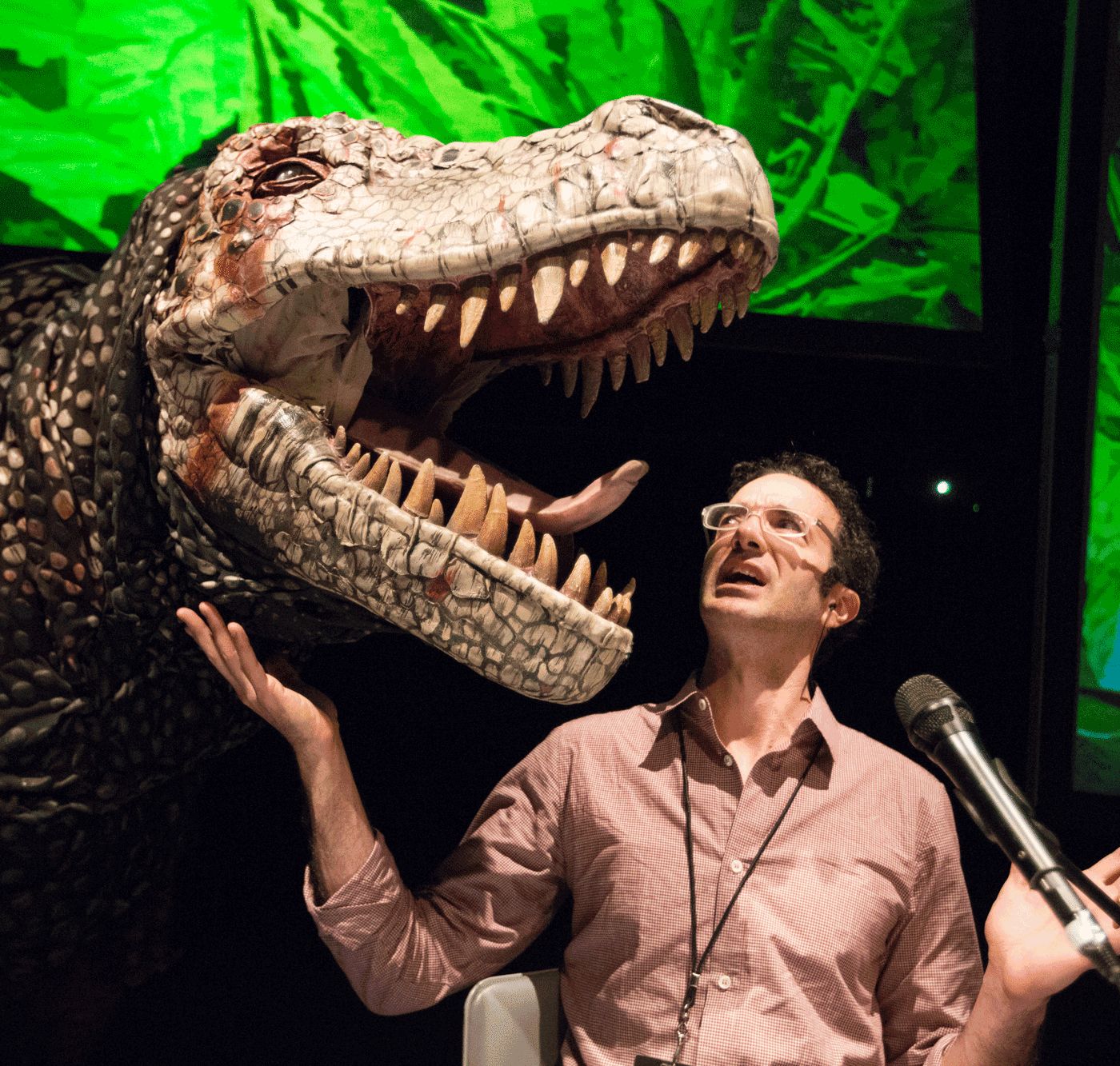
Radiolab
Apocalyptical
01:42:13
Cataclysmic destruction. Surprising survival. In this new live stage performance, Radiolab turns its gaze to the topic of endings, both blazingly fast and agonizingly slow.
Loading summary
Transcript576 lines
- [00:00]
Commercial Narrator
Your new home is now ready. Dr. Horton, America's builder has new homes that are ready today with new construction communities in Ellensburg and throughout the Greater Seattle area. Dr. Horton has the right home for you. At Dr. Horton, we're still building with flexible living spaces, smart home technology and two and three car garages. More communities and more homes available every day. Find your new home in Ellensburg now ready@dr. Horton.com Dr. Horton, America's builder and Equal Housing Opportunity Builder. Hey Fidelity, how can I remember to invest every month? With the Fidelity app, you can choose a schedule and set up recurring investments in stocks and ETFs.
- [00:42]
Jad Abumrad
Oh, that sounds easier than I thought. You got this?
- [00:46]
Commercial Narrator
Yeah, I do.
- [00:47]
Jad Abumrad
Now, where did I put my keys?
- [00:50]
Commercial Narrator
You will find them where you left them.
- [00:54]
Robert Krulwich
Investing involves risk, including risk of loss. Fidelity Brokerage Services, llc.
- [00:57]
Jad Abumrad
Member NYSE sipc. One day only Thanksgiving Day deals are coming to Lowes.com/members get early access to online Black Friday doorbuster deals on gifting.
- [01:12]
Commercial Narrator
Favorites like the still trending Cobalt mini.
- [01:14]
Jad Abumrad
Toolbox for just $14.98. Don't miss up to 50% off for one day only at Lowes.com we help you save. Battled 1127 only on Lowes.com, member only doorbusters and Midnight Eastern loyalty programs subject to terms and conditions. See lowe's.com terms for details. Subject to change while supplies last. Oh, wait, you're listening.
- [01:35]
Dan Moran
Okay.
- [01:40]
Jad Abumrad
You're listening to Radiolab Radio Lab from WNY and npr. Ladies and gentlemen, please welcome to the stage your hosts for this evening, Jad Abernrad and Robert Krolwich. What's up, Seattle? Okay, so Robert and I have been on tour for the last two months.
- [02:17]
Robert Krulwich
We went to city after city after city.
- [02:21]
Jad Abumrad
Something like 21 cities we went to.
- [02:23]
Dan Moran
You can hear.
- [02:23]
Jad Abumrad
We were both like sick kick their asses. But it was so much fun. And the show was called apocalyptical. It was about every endings.
- [02:33]
Chris Jones
Which is.
- [02:33]
Robert Krulwich
Not the most obvious topic to choose to invite people into a theater and say, hey, we're going to just tell you different stories that end really brilliantly. But these are. This is a series of ending stories. That's what we did that night.
- [02:44]
Jad Abumrad
And we did it with some amazing musicians and comedians and video artists who were projecting beautiful images on these massive screens above our head. And also we had puppets.
- [02:53]
Robert Krulwich
Enormous, beautiful, articulate, gorgeous puppets.
- [02:58]
Jad Abumrad
And you can see all this. We are releasing a really nicely shot video of this entire performance at the same time as this audio podcast. Go to Radiolab.org live you can watch the whole thing. You know, some of the best moments of the show were purely visual, so we'd encourage you to check it out. But what follows is the audio podcast version of that show, which we recorded live at the Paramount in Seattle.
- [03:22]
Robert Krulwich
The show actually begins with a radical rethinking of one of the most important ending stories that has ever happened on planet Earth, which is the story about the end of the dinosaurs.
- [03:35]
Jad Abumrad
There's all kinds of dinosaur puppetry, beautiful stuff at the beginning, which we're gonna skip over, but again, you can check it out@radiolab.org live. We're gonna jump to the part where we hear from scientists who have been forensically probing this moment and have a totally new way of thinking about it. Okay, we're gonna start you off with a guy. Well, the guy who started it off for us. This is a guy named Jay.
- [03:54]
Jay Melosh
Jaylo at Purdue University, and I study impact craters, among other things.
- [04:01]
Jad Abumrad
Not only can Jay Milan create impact craters with his mind, but he and his colleagues have been investigating this moment almost as if it were a crime scene that happened not 60 million years ago, but yesterday. And the story that they've put together, it's more than just interesting, it's frankly. It's frankly terrifying. And weirdly specific, as it happens. Take, for example, the seemingly simple question of when. When did it happen?
- [04:30]
Robert Krulwich
You don't mean, like, the year? That would be a little too specific.
- [04:33]
Jad Abumrad
No, I. I don't know if you remember, but Jay got even more specific than that. This was a casual question that I threw out. Listen to his answer. By the way, do we know anything about seasons? Was this a warm. A particularly warm.
- [04:43]
Jay Melosh
Actually, it was between. Well, this is a bit of a stretch, but it was some time between June and July.
- [04:50]
Robert Krulwich
Really?
- [04:51]
Jad Abumrad
You could say that. So specifically, how would you know that?
- [04:54]
Jay Melosh
The reasoning is we can. For example, this was the.
- [04:58]
Jad Abumrad
This was the first surprise. It's kind of a controversial idea, but basically goes like this. Jay says scientists have found some pollen in rocks which date from that time. Two different kinds of pollen. And based on an analysis of those two kinds of pollen, we know that.
- [05:11]
Jay Melosh
The impact took place between the flowering of the lotus and the flowering of the water lilies.
- [05:17]
Dan Moran
Whoa.
- [05:18]
Robert Krulwich
Okay, so that's a lotus you see flowering on the left. It's a water lily flowering on the right.
- [05:23]
Jad Abumrad
You can see this. If you look at our video online.
- [05:25]
Robert Krulwich
Fossils found at the impact site that had pollen from both of these flowers in the same rock would suggest that the impact did, in fact, take place.
- [05:35]
Jay Melosh
Somewhere Between June and July. It's one of those things in geology we get a glimpse of a moment far, far back in time.
- [05:44]
Jad Abumrad
So let's go deeper into that moment. All right, everybody, let's collectively rewind our minds back in time. Tens of millions of years into the past. 66 million years ago, to be precise. There they are, majestic beasts hanging out on the plains, eating their lotus leaves. Sometime in June, June 17, let's say. And everything on this day, pretty much normal.
- [06:30]
Jay Melosh
This particular fateful day was no different than any of millions and millions of previous days as far as the dinosaurs were concerned. But if there were any astronomers at the time, which there weren't, they might have had some inkling that something was coming.
- [06:45]
Jad Abumrad
Because had they looked up, they would.
- [06:48]
Jay Melosh
Have seen a tiny little dot of light in the sky. Whereas planets, the moon, move with respect to the stars, this would have had a constant bearing. And an old seaman could tell you that if you see something constant bearing, that's on a collision course with you.
- [07:06]
Jad Abumrad
And that thing, of course, is our.
- [07:08]
Jay Melosh
Asteroid zeroing in on the Earth.
- [07:10]
Robert Krulwich
I want to say that we do know quite a bit about this asteroid. From the size of the crater and from the amount of certain minerals found at the impact site, we know that the asteroid was roughly six miles wide and then again roughly six miles long, which makes it approximately the size of.
- [07:28]
Doug Robertson
Manhattan island or Mount Everest. It's roughly the size of Mount Everest.
- [07:33]
Robert Krulwich
That is Doug Robertson, a geologist who knows quite a bit about this asteroid.
- [07:36]
Doug Robertson
And by the way, it has a name. It's the asteroid. It's called Baptistina Baptistema. Why that's Baptistina, I don't know they name asteroids. On another subject, we do know that the Earth's moon was probably produced by a collision with something the size of Mars.
- [07:56]
Jad Abumrad
Whoa. I just threw that in because it's cool. It doesn't really relate to our story.
- [08:00]
Robert Krulwich
We don't have the whole evening here. Let's just stay to it, okay? The dinosaurs are here on Earth. They're eating their leaves. Meanwhile, up in space, our asteroid Baptistina is now hurtling towards the earth 20,000 miles an hour, very fast.
- [08:13]
Jay Melosh
20 times faster than a very fast rifle bullet.
- [08:17]
Robert Krulwich
Scientists couldn't be sure what would happen mathematically. I mean, when a Mount Everest sized bullet traveling at 20,000 miles an hour.
- [08:24]
Jay Melosh
Hits our atmosphere, the atmosphere is really just a very, very thin skin over the rest of the Earth.
- [08:30]
Jad Abumrad
So scientists thought, all right, if we're going to construct this story, let's just take it piece by piece. And first figure out what would happen when this big ball hurling through space slams into our atmosphere, which is made of gas, of course. So just to approximate, let's fire a bullet through some gas and watch what happens. Now. Here we basically showed a super slow motion video of a gun firing a bullet underwater. You can see it on our website, Radiolab.org it's very beautiful. See the bullet coming out and freeze it right there at the edge. Okay. Basically what you see is this bullet steaming through the water. And by the way, we use water as an approximation for gas because in gas you would have this same effect. I'm about to describe creating a wake behind it, and the wake gets wider and wider as it trails away from the bullet. And if you imagine this shape in three dimensions, really what you're looking at is a kind of a cone, like a funnel shape. And inside the walls of the funnel, inside that cone is nothing.
- [09:29]
Robert Krulwich
Nothing, Nothing. Because it's in water. So you're saying it's like a hole in the water?
- [09:35]
Jad Abumrad
That's what I'm saying. There's nothing in there. It's a vacuum in there because the bullet is shooting through the water. It pushes the water out of the way and for a beat, the water doesn't have time to come back together. And so all you have is emptiness in there, right there. This, what you're seeing, is a massive hole in the water created by a tiny little bullet. Now imagine that that bullet is six miles wide and the hole that it's making is right above your head.
- [09:58]
Robert Krulwich
Well, what does that mean? If you're a dinosaur looking up, what would happen?
- [10:01]
Jay Melosh
Well, if you were in the right place, and this is going to be the wrong place in a second or two, if you were in the right place to, to look behind the asteroid as it came in, you'd probably be able to see clearly through the space.
- [10:21]
Jad Abumrad
What does that mean? You would suddenly be looking at a nighttime hole in a daytime sky.
- [10:27]
Jay Melosh
Right.
- [10:28]
Dan Moran
Whoa.
- [10:29]
Jad Abumrad
To be fair, Jay did tell us that you would need special kinds of eyeballs to see this night hole in the day sky. And the dinos didn't have that. So science still, I mean, just imagine what a last image that would be to see day and night come together in the same moment. But according to J, you better not.
- [10:51]
Jay Melosh
Blink because before you could open your eyes again, The asteroid would have hit the surface. And if you're in a position to see that, then you're going to be engulfed by the violence that is just about to occur.
- [11:10]
Jad Abumrad
By the way, the audience was just Laughing at a Dinos de los Muertos graphic that just came on the screens.
- [11:15]
Robert Krulwich
So we know it was a big explosion, fine. That it was violent, fine. But I think we should be a little bit subtle about this because obviously if an asteroid is the size of Manhattan and it lands on your head, you're not going to feel very good about that. But if Manhattan is hitting the planet Earth, that's a little bit like a pebble hitting an enormous beach ball.
- [11:35]
Jad Abumrad
Yeah. And I can imagine that the little pebble size, relativistically speaking, the pebble would create some damage in the spot where it landed.
- [11:42]
Robert Krulwich
But let's suppose that you are a leaf eating mother of three hadrosaur living in New Zealand. Right. And you're just at the moment that the asteroid comes in, you're on the, you're antipodal, you're on the other side of the planet. Would you have any idea that this was happening?
- [11:59]
Jad Abumrad
That was the next question that we took to Jay. How much damage would this thing actually do?
- [12:03]
Jay Melosh
Well, we, we can do experiments, We can produce things, situations like this in small quantities in the laboratories.
- [12:16]
Jad Abumrad
Okay, you're all set in there. Which brings us. We're good to hear you. Good to this guy Peter Schultz and I like to do impact experiments. Pete Schiltz basically has every 13 year old's dream job. He gets to blow shit up for a living. Basically what Pete does is he works at this place that you're seeing right here on the screen. This is the NASA Ames laboratory in California. And the thing that they're putting together there in the middle frame that is a giant three story tall cannon.
- [12:47]
Robert Krulwich
What beat does is he takes projectiles. So for example, you're going to see him take a little glass bullet over there and he's going to load it into the top of the cannon and then he's going to fire it right into a stand up for planet Earth, which for him will be a sand pit.
- [13:02]
Jad Abumrad
And lucky for us, when we called Pete, he was just about to pull the trigger on this thing.
- [13:06]
Robert Krulwich
So we're calling you on a day in which you are trying to re. Experience the day actually.
- [13:12]
Commercial Narrator
Yeah, but I think we're going to survive. That's our plan.
- [13:17]
Robert Krulwich
Okay, hold on.
- [13:18]
Jad Abumrad
We gotta, we gotta assume the position. We have to cross our fingers. Okay, here we go. Here we go, here we go.
- [13:25]
Robert Krulwich
Voltage is good.
- [13:27]
Jad Abumrad
We have all of our ready lights. Battle's in. Here we go.
- [13:36]
Dan Moran
Rolling.
- [13:43]
Jad Abumrad
That is gorgeous that Jeff. Oh my gosh.
- [13:47]
Robert Krulwich
Are they gonna get instant playback?
- [13:49]
Jad Abumrad
What just happened? Oh my Gosh. That is the sound of a man very happy with his explosion. You can see every piece of this, of what's happening.
- [14:02]
Robert Krulwich
So based on experiments like this, people like Pete can figure out precisely what happened when the asteroid hit the Earth. They can quantify the explosion's power by basically leveraging up experiments like this. So according to Doug, the amount of energy that would have been unleashed when that thing came rushing in onto Earth is roughly this.
- [14:20]
Doug Robertson
It would hit the Earth with an explosion that's 100 million megatons.
- [14:37]
Jad Abumrad
Sarah Lipstay. Sarah, our guitarist, kind of swung her guitar around, had a metal moment. Don't look at her wrong or she'll.
- [14:43]
Dan Moran
Do that to you.
- [14:45]
Jad Abumrad
Okay, so here's essentially how Doug broke that down for us. Two tons of tnt, we're talking tons here, not megatons. Two tons of TNT will essentially do this. On One of the three screens, you see a 10 story building imploding. Two tons of TNT will take down a building. Now, 15,000 tons of TNT, that is what the United States dropped on Hiroshima in 1945. On a second screen, we see archival footage of the atomic bomb. That chaos is 15,000 tons of TNT. Now, these days, according to Doug Robertson, a hydrogen bomb.
- [15:26]
Doug Robertson
Current hydrogen bombs are typically of the order of 1 million tons of TNT equivalent.
- [15:34]
Jad Abumrad
Now, 1 million tons of TNT equivalent, that's what we call a megaton. And if you remember, Doug said that the asteroid impact was equivalent of 100 million megatons. So really what he's saying in concrete terms is that that impact was the equivalent of 100 million of those bombs going off all at once in the same spot.
- [15:56]
Robert Krulwich
Which is a lot.
- [16:00]
Jad Abumrad
That is true. That is true. However, it really depends on what you mean by a lot. Because I was doing a little Googling and I was surprised to learn that 110 million megatons is not nearly enough to destroy the planet. To destroy the entire planet, you would need you ready for this. 1100-000000-00000, which is 100 million times 110 million megatons of TNT. So going back to your hadrosaur situation, mother of three in New Zealand, if the thing came in antipodal to her, maybe she would feel the ground shake a little bit. But after a minute she'd be like, whatever. And she'd go back to eating leaves. She probably wouldn't notice it.
- [16:37]
Robert Krulwich
Oh, no, no, no. Because that's not what we were taught in homeroom by Mrs. McGrew or whoever your teacher was. Here's the classic explanation. There was an impact, of course, and kicked up an enormous amount of dust. You'll remember this. The dust then kind of covers the planet. It blankets the Earth, makes the Earth very cold, makes the Earth very nasty. All the big plants die, the little plants get sick, the dinosaurs get hungry. The dinosaurs get sick. And then gradually, you know, they get dead, deader and deader and deader from different things. 10,000 years, 30,000 years, 40, until you get like, oh, like 900,000 years later, you got a shivering last dinosaur sitting there in the cold going, and that's the end. That's the story we were told in.
- [17:20]
Jad Abumrad
School, is a long, slow, wintry collapse. Yeah. No, no. Why would we tell these good people that tired old story from Mrs. What is it? Ms. Magruder's.
- [17:29]
Robert Krulwich
I made her Magruder tonight. Okay, yes.
- [17:32]
Jad Abumrad
Let us offer up a completely different Scottish night tonight. Scottish. All right, we'll go with that. Let's actually flip the understanding completely. I think we should, based on new science. So. All right, here's what we're going to do. Keith, pull up that ballistics video that we showed earlier with the red sand. Can you sort of pull that up and blow it up to the three screens and then, yeah, rewind it back if you. Thank you. Oh, no, back just a bit more, all the way to the beginning. Okay, so this is a 6000 frame a second video that you're seeing here. This is from Pete's lab. At this point on the screen, all you're seeing is a pit of red sand. Now, what you see in the first few frames is you see the laser hitting right there, red sand flying in the air, super slow moving. Then the next frame forward, right there, you see some fire. You see a little bulb of fire erupt near the impact site. Right where the laser hits the sand, there's this little clump of flame and we freeze on that spot. Now, scientists can now measure the temperatures in that spot right there. Right there. And just to state the obvious, we know from those measurements that that spot right there would have gotten very, very, very, very, very hot.
- [18:48]
Jay Melosh
You know, way beyond the temperature of the sun. We're talking temperatures maybe 20,000 degrees.
- [18:55]
Dan Moran
Whoa.
- [18:55]
Jay Melosh
The sun's temperature is about 5,000 degrees.
- [18:58]
Jad Abumrad
And if we're talking temperatures four times hotter than the sun, well, anything that's that hot is going to instantly, instantly turn to gas.
- [19:10]
Jay Melosh
A very, very high temperature, high pressure gas.
- [19:13]
Doug Robertson
It's actually rock vapor, rock steam.
- [19:17]
Jad Abumrad
So imagine this thing comes barreling in this asteroid. It doesn't just bounce off the Earth. It plows into the Earth. It goes into the surface. Two miles in, five miles in, seven miles in 10 miles, in 20 miles into the Earth it goes. All the rock that's plowing into is turning into a liquid and then into a gas. And now watch what happens next. This is a basic physics experiment we're going to show you. On the screen you see a very lovely video actually of a hand dropping a metal ball into some sand. This is just a dude dropping a ball in some sand. Watch this right here. Ball goes in and like a millisecond after it makes impact, disappears into the sand. A little spear of sand goes shooting back in the opposite direction. Sort of a bounce back effect.
- [20:03]
Robert Krulwich
Does this always happen, this, whatever this is?
- [20:05]
Jad Abumrad
It's like Newton's law of something. Yeah, Newton's law of sand. No, but what you see is you see this fine plume of sand go shooting back in the opposite direction as a sort of rebound, right? Now imagine that that ball is an asteroid and that sand over there, that's the planet Earth. So, Keith, play that one more time. We play the video again, but this time as the ball drops and it gradually morphs into an asteroid. Thank you for those sounds. So you would get the same effect. You would get the.
- [20:48]
Robert Krulwich
The simple point is it's just something we do.
- [20:51]
Jad Abumrad
You wonder where we get all of our sound design. It's out of that man's mouth. That's where. So you would get that same bounce back effect of a fine plume shooting back in the opposite direction. But we know from, we just heard Doug describe that it would not be. It would not be sand in this case. It would be rock gas.
- [21:09]
Jay Melosh
This plume of hot gas expands upward and pushes right on through the atmosphere up into space.
- [21:15]
Doug Robertson
Some fraction hit the moon, really, Some fraction of that hit Mars.
- [21:20]
Jad Abumrad
Okay, so now you got this sneeze of rock vapor. It's out in space. Basic physics says that as it travels out farther away from the Earth, what's going to happen is it's going to start to cool down a bit.
- [21:30]
Doug Robertson
And when it cools, it recondenses into little droplets that basically form glass very quickly. Little droplets of glass about the size of sand.
- [21:40]
Jad Abumrad
Now, if you look at one of these little droplets of glass under a microscope, this is what it looks like right there on the screen. You see what looks like kind of like a translucent snowball. That is actually a magnified image of one of these bits of glass that fell from space that day. Most of them didn't land on the ground. I'll talk about that in a second. There it is. I don't know about you, but I find that totally terrifying because that's. It looks like a little baptistina, right? Tiny little asteroid. Except now imagine trillions of these things in a cloud, in a cloud of shrapnel going out, out, out away from the Earth. And what's going to happen next is that it's going to start to lose momentum, that cloud. And when it does, the Earth's gravity is going to grab back hold of it and say, come on back.
- [22:24]
Doug Robertson
And 90% of them come back to the Earth.
- [22:28]
Robert Krulwich
Will this falling glass do harm? Yes, because what happens is that the glass out in space starts to spread out, like north and south and east and west, and eventually it will appear in the sky over New Zealand.
- [22:43]
Jad Abumrad
It's now a global phenomenon. And, you know, it's really hard to imagine what the hadrosaur would have seen. But the thing to keep in mind is that these things as they're coming in, These bits of glass, 90 some odd percent, are burning up in the atmosphere. So very few of them are hitting the ground. So from her point of view, probably would have looked like the greatest meteor shower anyone has ever seen. With one significant bummer, which is this, when these little bits of glass come in, each one that burns up is depositing a little bit of heat into the sky. And collectively there's such a massive rain of these things coming in.
- [23:22]
Jay Melosh
Well, the heat would build up, the sky would turn red. It would be getting hotter and hotter.
- [23:35]
Jad Abumrad
And at a certain point, Jay wondered, well, how hot exactly would it have gotten? Like how much heat exactly would have built up there in the sky and then started to radiate down.
- [23:48]
Jay Melosh
We calculated the amount of heat that would come down a number, 10kW per square meter. And. Yeah, okay, well, we get this number. Well, what does that mean? Well, I went home and I hooked up a current meter and tried to measure the amount of heat produced in my oven for different amounts of power. And I could get about 7 kilowatts per square meter in my oven on broil.
- [24:16]
Jad Abumrad
Like 500 degrees.
- [24:17]
Robert Krulwich
Broil, you mean?
- [24:18]
Jad Abumrad
But that wasn't quite enough, not nearly. So Jay started measuring other kinds of ovens.
- [24:25]
Jay Melosh
And I finally found out that the heat would be, in fact, like being in a pizza oven. A pizza oven is about right.
- [24:32]
Jad Abumrad
Which means that if you, if you were a terrestrial dinosaur anywhere above the ground on the Earth on that day, you would have experienced some heat that is almost unimaginable. Maybe it started at 100 degrees because it was June, it was summer, but within minutes, it would have been 300 degrees, 500 degrees, 700 degrees, 900 degrees. Estimates are, on that day, temperatures topped out at something like 1200 degrees. At that temperature, nothing can protect you. Your scales, your fur, whatever you got, it's not going to do any good. Your blood will literally start to boil inside your body and you will die.
- [25:25]
Dan Moran
SAM.
- [25:55]
Jad Abumrad
So essentially, according to this theory, the dinosaurs and everything else on Earth that day would have been incinerated. Doug thinks that's what did them in. Not so much the impact, but all that ejecta that went up into the sky, came down as glass rain and created that heat. That's what did the men. And he would argue it didn't just do some of the men or even many of them, them in. He would say it did all of them in, all at once.
- [26:21]
Doug Robertson
There is zero evidence that any dinosaur made it through.
- [26:26]
Jad Abumrad
And the crazy part of this theory is that Jay and Doug think that the whole process, from the impact of the glass rain to the incineration of all of these species on the planet.
- [26:34]
Doug Robertson
It would have taken a few hours.
- [26:39]
Robert Krulwich
His best guess, he thinks, maybe two hours.
- [26:47]
Jad Abumrad
I mean, that's less time than a business lunch.
- [26:51]
Robert Krulwich
Yeah, you try getting East Northwest, anywhere on Mercer street at rush hour in two hours. Can't do that.
- [26:59]
Jad Abumrad
I mean, if you think about it, that is less time than you will spend in this theater tonight.
- [27:12]
Dan Moran
Sa.
- [27:39]
Robert Krulwich
That means that you're saying that an animal that had been supreme on the planet for 200 million years disappears in a few hours completely.
- [27:52]
Doug Robertson
Yes.
- [27:53]
Jay Melosh
Yep, that's what the evidence suggests. That's.
- [28:04]
Robert Krulwich
Well, you can consider the evidence, but also you could consider common sense. I mean, we've got a world filled with terrestrial dinosaurs. They were on every continent. They were even in Antarctica. And to say that they all disappeared in two hours, I mean, all that would. That suggests that there's none of them in out of harm's way, none of them in a cave somewhere, none of them in a grotto, none of them in a protected forest of any kind. I mean, the word all in that connection is just too much. I just don't buy it.
- [28:39]
Jad Abumrad
Well, yeah, I mean, the truth is that the science is never going to be so exact as to say, yeah, all of them disappeared or it happened on a single day or on an afternoon. I mean, no tool that we have is that precise. But what Jay is saying is that it happened fast, very fast. Nothing made it through. What I find interesting is that ultimately you don't need the ballistics or anything we've shown you so far to know that something major and sudden happened because you can see evidence of it literally etched into the earth.
- [29:12]
Dan Moran
So here's the spot where we first.
- [29:17]
Jad Abumrad
Found the kitty boundary. You can see it really well out in Colorado, actually. We sent one of our producers, Molly Webster out there to meet a paleontologist named Kirk Johnson. They hiked over a couple of hills. They found this one specific spot.
- [29:30]
Robert Krulwich
I'm like ready for a dinosaur to come around the corner.
- [29:32]
Jad Abumrad
And any minute they started to dig. We were digging down like a foot at this point from where we were.
- [29:45]
Dan Moran
Turns out for every three feet you.
- [29:47]
Jad Abumrad
Go down 10,000 years in time. See, the Earth has layers, kind of like a tree has rings. And every three feet down you go, you're going back in time about 10,000 years. And when you go all the way down, all the way back to 66.09 million years, you will find this one little skinny strip of rock.
- [30:14]
Dan Moran
That's the Kiki boundary. Gah.
- [30:18]
Jad Abumrad
This one skinny gray line, this, this gray crappy. Oh, that. This. Now, in a very real way, that line that you're seeing, that represents the day the asteroid hit the day just.
- [30:31]
Robert Krulwich
Above that line, that's a little bit after the day.
- [30:33]
Jad Abumrad
Just below that line is a little.
- [30:34]
Doug Robertson
Bit before the day.
- [30:36]
Jad Abumrad
The line is called the KT boundary. And what's cool is you can actually touch it. You can touch evidence of that moment. And in fact, Kirk, what he did that day was he took his finger and he dug a piece out and he handed it to Molly. This we're holding, I'm holding.
- [30:49]
Dan Moran
You're holding, you're holding the KT boundary.
- [30:53]
Jad Abumrad
It's like, it's almost like chunks of coal.
- [30:56]
Dan Moran
Yeah.
- [30:56]
Robert Krulwich
But it's not.
- [30:57]
Jad Abumrad
What you're holding is a dark gray.
- [30:58]
Reggie Watts
Mudstone, the carbon rich mudstone.
- [31:01]
Jad Abumrad
And in that mudstone you'll find all kinds of things amazing. And you'll find very rare minerals like iridium that probably came in on the asteroid and got smushed into that line. Those little glass balls I was talking about those little hell balls. Well, if you get out a microscope and you look at that rock, you will see them in there. We put up a funny cartoon of the little hell balls. They're all in that line. How thick do you think that line is? It's about an inch. Is like hidden in there is sort of the story of that day.
- [31:32]
Dan Moran
Absolutely.
- [31:33]
Robert Krulwich
And here's the crazy thing. If this is the line right here.
- [31:35]
Jad Abumrad
This little strip here Robert traces a picture of the KT boundary with his finger.
- [31:39]
Robert Krulwich
And then you dig just below the line you were going to find over and over again, dinosaurs everywhere. I mean, they're not going to be alive, of course.
- [31:46]
Jad Abumrad
He starts putting some toy dinosaurs onto the line and making them move.
- [31:49]
Robert Krulwich
I'm giving them a certain amount of energy which I shouldn't, but they're fossils and you, you will find dinosaur fossils from Europe and Idaho and Montana. This one says it was made in China, but if you just go above the line, you don't find any dinosaurs. So below the line. Scientists have looked everywhere above the line and they haven't. Well, everywhere they have looked anyway, they found nothing. Nothing. Nothing.
- [32:19]
Jad Abumrad
It's a different world.
- [32:20]
Robert Krulwich
That's the amazing thing.
- [32:21]
Jad Abumrad
It's a different world.
- [32:23]
Dan Moran
And it's pretty rare.
- [32:24]
Reggie Watts
You can go, this is one world and that's another world.
- [32:29]
Jad Abumrad
You're literally just pointing pinky to pointer, finger spread.
- [32:33]
Dan Moran
Yeah.
- [32:37]
Jad Abumrad
This is another moment where I would urge you at some point, not now, keep listening, but at some point, watch the video of this performance because what Sarah, Darren, Glenn and Keith do in this performance moment visually is pretty amazing.
- [34:31]
Dan Moran
It. It's.
- [35:53]
Jad Abumrad
Apocalypse brought to you by Sarah Lipstick with coaching their. Before we go to break, I just want to give a very special thanks to the people who shared the stage with us. Sarah Lipstate from Noveller, Darren Gray on the bass and Glen Koche on the drums. They're both from the band on Fillmore. We were so lucky to share the stage with those guys, along with video maestro Keith Skretch, who is doing the.
- [36:23]
Robert Krulwich
Live video, and our brilliant puppeteer Myron Gusto.
- [36:27]
Jad Abumrad
Oh my God, that guy. So good. Check out all of them@radiolab.org live. You can see them doing what they do visually. It's pretty. It's pretty worth watching. Anyhow. We'll be back in a second.
- [36:48]
Reggie Watts
Check, check. This is Keith Gretsch, the video maestro for apocalyptical. Radiolab is supported by Squarespace, the all in one platform dedicated to providing a simple way to create a website, portfolio or online store for business or personal use. Squarespace provides templates and drag and drop tools to create professional websites. Users create sites that are mobile ready, including 247 support, domain names and e commerce, all on the same platform. For a free trial, visit squarespace.com Radiolab.
- [37:19]
Maureen O'Leary
Radiolab is supported by Audible.com, a provider of digital audiobooks and more. With more than 100,000 downloadable titles across all types of literature, including fiction, nonfiction and periodicals. Audible's selection includes John Grisham's new novel Sycamore Row, and Peter Julius Sloane's 50 poker hand bunker, how to Win the Jackpot, Volume 1. To learn more about Audible and to get a free audiobook of your choice, go to audible podcast.com Radiolab what's your name? Amy.
- [37:55]
Jad Abumrad
Amy. Give it up for Amy.
- [37:56]
Robert Krulwich
Thank you.
- [38:05]
Jad Abumrad
Hey, I'm Jad Abumrad.
- [38:07]
Robert Krulwich
I'm Robert Krulwich.
- [38:08]
Jad Abumrad
This is Radiolab.
- [38:08]
Robert Krulwich
We're continuing with our live performance of Apocalyptical from the Paramount Theater in Seattle, Washington.
- [38:14]
Jad Abumrad
We just heard a new theory about the end of the dinosaurs. A very sudden, fast, dramatic end with.
- [38:20]
Robert Krulwich
A sudden musical kaboom at the very, very end.
- [38:22]
Jad Abumrad
Now for the next question. This is sort of the obvious next question, which is what made it through and how?
- [38:31]
Robert Krulwich
Well, we did ask scientists that question and here is what they told us. If on that day you were a creature in the ocean and you happened to to be within 300ft of the water surface. So if you imagine this room filled with ocean water, we're talking about you guys up in the balcony up there, it will not surprise you to learn you don't do very well. There's a certain amount of heat and mostly there's acid rain pouring in, so a lot of you will die. But down with the higher paying seats. If you're below 300ft, and this always happens to people with, you know, with the better, anyway, you do fine. And on land, it turns out plain.
- [39:20]
Doug Robertson
Ordinary dirt is a very good insulator. If you've got 1200 degrees on the surface, then about 3, 4 inches down, you would be comfortable there for several hours.
- [39:31]
Jad Abumrad
Oh, just a couple inches.
- [39:33]
Doug Robertson
You only need a few inches.
- [39:34]
Robert Krulwich
So that means you can, you could be a little worm. And if you squiggle down, you're okay. You could be a beetle. Squiggly down, you're okay. You could be a dinosaur tending to an underground nest. And if the nest is far enough below the ground, and a lot of them were, then the babies that hatch will have babies that hatch, will have babies that hatch. We will call their babies, years later, birds. And if you're an early version of a crocodile and you bury yourself deep enough into the mud, you also get through, as do the plants, roots. A lot gets through, actually.
- [40:05]
Jad Abumrad
And that actually brings us to what I find to be one of the coolest parts of the story. This is the part that involves all of us in this room. So it turns out on that day, as the fire was raging above on the surface, somewhere in a little Hole in the ground happened to be a furry little animal that has the distinction of being the great, great, great, great, great, great, great, great, great, great, great.
- [40:33]
Robert Krulwich
Great, great, great, great, great, great, great, great, great, great, great, great, great, great, great, great, great, great, great, great, great, great, great.
- [40:51]
Jad Abumrad
E grandma of everybody in this room. It is true. There was a creature down there. There was a creature down there.
- [41:02]
Robert Krulwich
I thought we should stop there because we were getting away with something and I didn't want to push it too far.
- [41:08]
Jad Abumrad
All of a sudden it was just you and me.
- [41:09]
Reggie Watts
Yeah.
- [41:09]
Jad Abumrad
Though there was a creature down there in a little hole. And when the dinosaurs got cleared away, this creature could step out of her hole. She could step out of her niche. She had more food, more places to roam. She could populate the planet, ushering in the age of mammals. And now here we all are in Seattle.
- [41:26]
Robert Krulwich
Oh, don't flatter yourself. It's not a straight line.
- [41:29]
Jad Abumrad
It's a wiggly line.
- [41:30]
Robert Krulwich
It's a wiggly line.
- [41:31]
Jad Abumrad
But here's the problem. We've never known anything about this animal that gave rise to all of us. We've never known what she looked like. We've never known how she spent her days. We've never known anything because we've had no fossils of her. But recently, actually, literally, as we were reporting this story, right in the middle of our reporting, a team of scientists led by a woman named Maureen o', Leary, who is herself a mammal, she took fossils that we do have fossils of this creature's descendants. And then using fancy algorithms, was able to cross reference the traits to work her way back for the first time to a composite picture of what we think our great great grandma looked like. So now, Seattle, a Radiolab exclusive. We present to you our great, great, great, great, etc. Grandma here, a giant rodent costumed thing runs out onto the stage.
- [42:27]
Robert Krulwich
All right, well this is what she looks like. And we ought to point out certain anatomical features that caught the scientists admiration. First of all, she has very, very pink and fleshy ears. So show them that. And a pale, soft underbelly, which all very nice fur as Jad is now demonstrating. Could you show them your profile just so they can see your head? Her skull is considered either rat like or crocodilian. You can go either way. But she does have enormous beady black eyes, a fleshy pink nose. And would you show them your teeth? She's kind of proud of her teeth because they can tear flesh and they can rip lettuce. She is an omnivore.
- [43:04]
Jad Abumrad
However, here Was the issue here was the issue that we ran into when we asked Maureen, the scientist who did this work. We're like, okay, now we've got an image of this creature that's amazing. What do we call her? What is her name? This was Maureen's response.
- [43:22]
Maureen O'Leary
Its official name is the hypothetical placental mammal.
- [43:28]
Robert Krulwich
What kind of a name is that?
- [43:29]
Jad Abumrad
Suddenly feeling bad for this?
- [43:32]
Maureen O'Leary
Well, it's not something that we thought.
- [43:33]
Jad Abumrad
Of as we were sort of busily working on the paper.
- [43:36]
Robert Krulwich
But then a funny thing happened. Our producer Molly was talking to Maureen and she was saying, gee, this is such an awful name.
- [43:42]
Jad Abumrad
And Maureen says to Molly, well, you could name it.
- [43:45]
Robert Krulwich
And Molly says to Maureen, wait, are you serious?
- [43:48]
Jad Abumrad
And Maureen says to Molly, I don't know. Are you serious? So we're like, hell yeah, we're serious. Let's crowdsource this, right? This is what mammals do these days. We crowdsource. I mean, think of this opportunity. A little radio show gets to name the ancestor of us all. So we put out the call to the Internet. We got a thousand submissions in response. Great names like Placentor.
- [44:17]
Robert Krulwich
Placentor.
- [44:18]
Commercial Narrator
First, first.
- [44:20]
Jad Abumrad
F, U, R, S, T, Nova, M, O. And after eight rounds of voting, the winning name was. Wait for it, wait for it, wait for it. On the screen you see the following letters appear one after another. S, C, H, R, E, W, D, I, N, G, E, R. Schrodinger. Schrodinger. I can't even tell you what a crisis this was for the staff. This is such a bad day. And the whole experience made us wonder, should we have died in that asteroid? Do we deserve to be here?
- [45:18]
Robert Krulwich
So if you're asking yourself, what is the moral of our story, here's what we've shown you. We have a big mighty species that died, and then a smaller species, which is you and I, we take its place. So you've gotten death and you've gotten resurrection, and you got it maybe in a single afternoon. So that's the argument we're making here. This is Jay Malash's argument that it was, boom, over.
- [45:39]
Jad Abumrad
I mean, it is the sudden of the whole over that is kind of unimaginable. I mean, like, there you are one day, you have evolved over millions of years to be this long necked, beautiful creature 70ft from your nose to your ass and then or tail. And then in an afternoon, like on one Tuesday afternoon, suddenly you, everyone you knew, gone.
- [46:04]
Robert Krulwich
Yeah, but there are other ways to think about this yet. The extinction, yes, was sudden. But in the grand sweep of time, it wasn't really an end. It was just a moment in a stream of endless change. Because everything we see around us, the tallest mountains, the size of oceans, the animals about us that seem so different from ourselves, every category that we have in our heads that seems so permanent, blurs. Given enough time, mountains erodes and become hills, then beaches. Animals change in all kinds of ways. The only thing that's constant, that's always, is change. We like to think of ourselves, we humans, as somehow inevitable or crucial, pivotal. That the past was a time when we were missing and the future will always have us in it. But that's an illusion, says this great science writer, Lauren Isley. We are rag dolls made out of many ages and skins, he says. Changelings who've slept in wood nests or hissed in the uncouth guise of waddling amphibians. We've played such roles for infinitely longer ages than we have been men. Our identity is a dream. We are process, not reality. What we call reality, says Isley, is an illusion of the daylight, the light of our own particular day.
- [47:37]
Jad Abumrad
Just a couple of notes before we go on. That whole dinosaur thing about the sudden fast end, that is just a theory. Verdict is obviously still out. In fact, in 2011, a team of scientists published a paper saying that maybe the asteroid that hit the Earth that created that devastation was not Baptistina, but another asteroid with a different name, but with the same size and dimensions and all that. So who knows?
- [48:01]
Robert Krulwich
Also, when I said to the people up in the balcony, if you were in the balcony, you might have been killed off by heat, I think that turns out to be a little bit wrong. If you had been in the shallow ocean on that day, it would have been acid rain. Some other factors that would have done you in, not so much the heat.
- [48:18]
Jad Abumrad
Okay, so this is the part of the show coming up where we. Well, we travel with a bunch of different comedians. Patton Oswald, Simon Amstel, Ophira Eisenberg, Kurt Brownoller. Actually, Kurt opened this particular show. You can see his full set@radiolab.org live. Super funny. But on this night, we had two comedians. And so right at this spot in the middle of the show, out walks a guy, one of the most talented.
- [48:42]
Robert Krulwich
Mammals he looks like. Actually, it's like someone with his finger in an electric socket. Huge amounts of hair that are standing, like, out. You know, like he's got a halo.
- [48:51]
Jad Abumrad
His name? Reggie Wood. We're just gonna play his whole set. It's a little Seattle specific in spots, but it's just. Well, hello.
- [49:07]
Dan Moran
Hello. Hello.
- [49:13]
Reggie Watts
Hello. Hola, Microsoft. Thank you. This is a moment that you have to take if you can, and if you can't, you know, then you've lost it. But once you have it, once you possess the moment, you can do so many things with it. A lot of people tend to just exist within it. Others pawn it off to moment brokers. Or if you're a big fan of moment shauns, you can do that also. The moment Glory blend of coffee, single origin from Argentina is excellent. You can get that at most Bauhaus or participating Stumptown Coffee Roasters. So definitely check that out. Really stoked that we finally closed down that awful Bauhaus coffee and books. It was just, what a terrible location, right? You know, right on, like, a corner where you can see it really visibly.
- [51:13]
Robert Krulwich
And.
- [51:15]
Reggie Watts
I don't like that. And I called the city comptroller, and I just said, we need to get rid of it, and we need to get as rid of many, many buildings, because a lot of those buildings are so old up on Capitol Hill. It's just. It gets old. And so I'd like to replace them with new constructions, mostly glass, some contemporary metal. And I want to be able to see the architect's idea and then see them have to shave off about 40% of that idea by replacing a lot of the materials with cheaper versions of the original design. I enjoy seeing that, and I would rather see that than a coffee shop that promotes a type of communal living that can only happen in an area that it is located in. I just prefer it. That's what I prefer. That's just me. Sorry, guys. I love new buildings. Okay, more, more, more. Okay. So obviously, as you know, Seattle is becoming Vancouver. And the thing is, like, I'm gonna do a song that is about that so you guys can get a little bit more used to the Vancouver culture that is spreading down. Kanata, Canada. Little Mr. Rogers reference. But Canada is the land of maple leaf. Okay, Here we go.
- [53:01]
Dan Moran
Okay.
- [53:03]
Reggie Watts
Okay, here we go. Any big fans of anybody born after 1990?
- [53:11]
Robert Krulwich
Okay.
- [53:11]
Reggie Watts
That's about the tonality you'd expect. Why is it always higher? I don't understand that.
- [53:23]
Dan Moran
Okay.
- [53:24]
Reggie Watts
Anyways, so you're gonna know this reference. This is from the old Buck Rogers series.
- [53:31]
Robert Krulwich
Biggie, Biggie, Biggie G, Buck.
- [53:33]
Reggie Watts
You know, that kind of stuff. So that's for you guys after 1990, so you guys can relate to what I'm doing on stage. And so I hope you like this. This is definitely, definitely a song.
- [53:46]
Dan Moran
Okay. It.
- [55:06]
Scott Brown
Sam.
- [55:57]
Dan Moran
Thank you.
- [55:58]
Reggie Watts
Thank you. Thank you very much. If you're down in Ballard and having a good time, it's because there is so much Scandinavian energy there that they.
- [56:22]
Robert Krulwich
Just do it right.
- [56:25]
Reggie Watts
So when you're at the Sunset Tavern, you're like, why isn't this turned into a glass tower? It's because the power of Norway. There's Norway. They're going to screw with that. You know what I mean? Like Norway at all. You know what I'm saying? There's Norway out of this. I mean, you're basically. You know what I'm saying? It's like a hot dog, you know, you think you want it and you're like, probably not. And I am pretty stoked. I've said this before, but I'm going to say it again. Just because we're in Seattle, I am pretty stoked about Vivace being replaced by a Starbucks. I just think that it makes sense. It makes sense. Let the people who do it really well do it better. You know what I'm saying? That's what I'm saying. So this song is going to be one of those songs where you're going to think to yourself, is this better than the original? Maybe. Okay.
- [57:32]
Dan Moran
All right.
- [57:37]
Reggie Watts
It's called Pastiche. In lieu of originality. Here we go.
- [57:42]
Dan Moran
It.
- [58:18]
Scott Brown
Way too much sugar. When I want a coffee, I want to taste real burnt and I want to compensate with some sugar on top.
- [58:25]
Reggie Watts
So it doesn't taste so shitty anymore.
- [58:27]
Scott Brown
Oh, yeah, yeah, yeah, yeah, yeah. We need a logo.
- [58:36]
Jad Abumrad
A logo, a logo.
- [58:38]
Scott Brown
A logo with an ancient character spreading her legs for the ocean. Yeah, yeah. Real, real, real, real, real, real.
- [58:49]
Reggie Watts
You know, the thing is. The thing is.
- [58:56]
Robert Krulwich
I think using.
- [58:58]
Reggie Watts
Using. Using logic. I think obviously it is smart to name a company after a character from Battlestar Galactica, but I just don't. It makes sense. And that's why I'm starting my own coffee business called Cylons. Cylons coffee is the best coffee. I have a new movie coming out called Silence of the Lambs, and it's a theme song. It's done by Garfunken Oates. Of course, you can probably guess what that song is called, the Sound of Silence, which is just. And sometimes. And sometimes. It's the sound of silence. Okay, so this song. Thank you for my next trick. It's been a pleasure. This is my last radicchio lab, and I am. In all seriousness, that's a totally different show. But Radiolab, it's been awesome, man. I mean, I discovered some really great friends the first time I did something for Radiolab, and I continue to find great friendships and a love and passion for sound and science and knowledge and art. And so I think that I'm lucky to be a part of it in the small way that I am. So, thanks, Radiolab, wherever you are. Okay, so this is a. This is a quick song.
- [60:58]
Dan Moran
Okay.
- [60:59]
Reggie Watts
And this song is. This song is a. This is a good one. Okay, here we go.
- [61:15]
Scott Brown
I turn out of thinking I don't know. No, I'm diving, first of all. We tried so many times but now we know the end is nigh. When I think of those thunderous lizards walking across this barren plain Lust for us, baby, I can't complain. But when those pterosaurs go tearing through the sky squawking with the laser precision, eyes swooping down, taking praise and knowing that that shining little dot in the distance is not a super extra shiny star or all the astrophysicists dinosaurs would have said. But in that time before the Internet. Oh, yes, I want to say that it was great to see how the Earth concocted a strange large lizard family. Those lizards made sounds and attacked each other and wore coats and clothing, but, oh, well, all of that got burned off. And the evidence of an actual intellectual society may not be apparent to us. Whoa. Yes, I know.
- [63:40]
Dan Moran
Yeah.
- [63:42]
Scott Brown
But what happened to the Sleestacks? What happened to. Oh, those slurping Sleestacks moving at probably a top speed of 3 miles per hour. Or the aliens that donated genetic material to the hominids in order to create the society of people that we are. And thus explains our fascination for diamonds and goals because we've just kind of dug it up for their spaceships. Oh, wow. Yeah.
- [64:34]
Dan Moran
I know.
- [64:34]
Scott Brown
It makes. Know it means know it means know it, know it, know it.
- [65:04]
Dan Moran
Sam.
- [65:33]
Reggie Watts
Thank you so much, guys.
- [65:35]
Jay Melosh
Thank you.
- [65:36]
Jad Abumrad
Thanks, Radiolab.
- [65:43]
Scott Brown
Give it up one more time for Reggie Wood.
- [66:01]
Jad Abumrad
Let's just take stock for a second, Robert. We did our super fast radical dino ending. Reggie did his Reggie ending, which.
- [66:09]
Robert Krulwich
Which you never are quite sure what he's saying, you know, can you imagine? We have scripts and everything. Imagine if I just went to All.
- [66:18]
Jad Abumrad
Evening Long, it would be outer space, man. Okay, so what's.
- [66:22]
Dan Moran
What's next?
- [66:23]
Jad Abumrad
What's our next ending?
- [66:24]
Robert Krulwich
We're ready for the pink ending now. The pink ending?
- [66:27]
Jad Abumrad
You mean like the color?
- [66:27]
Dan Moran
Well, yeah.
- [66:28]
Robert Krulwich
This is the one that answers. I think the most basic question you could ask in a show like this, this asks, when did endings begin? It's a serious question.
- [66:38]
Jad Abumrad
That's a weird one. When did endings begin? Wouldn't There always. I mean, the moment you had beginnings, wouldn't that then imply an end? Because the beginnings have to do something. End?
- [66:47]
Robert Krulwich
You'd think so. But if you think hard about the origin of the universe, I would propose that when the universe began, which by some interpretation was a huge explosion of energy which then condensed and cooled into matter, that that whole event came in without any notion of endings at all. When you get matter, when you get that condensation, you get a list of elements which we can now turn to in the periodic table of elements with which you are sure very familiar and enjoy every evening before dining or sleeping. Keith here now puts the periodic table up on the screen. So if we look at this, at this chart, and we start up in the upper left hand side with hydrogen, and we move through it to helium and lithium and beryllium and boron and carbon, and on and on. As we move through the list, I can tell you that every one of the first 82 elements on this chart, with two exceptions which I'll mention in a minute, every one of these has a version of itself that goes on forever and ever and ever until the end of time.
- [67:43]
Jad Abumrad
Every one of these, you're saying, is immortal? Is that what you're saying?
- [67:46]
Jay Melosh
Yes.
- [67:47]
Robert Krulwich
Now, here's the thing. When we get to number 83B, that's Bismuth. I would argue that this is where the universe invents endings.
- [67:55]
Jad Abumrad
Really? What is bismuth?
- [67:57]
Robert Krulwich
It's a rock. Kind of a shiny black rock.
- [68:00]
Jad Abumrad
And you're saying this shiny black rock is where death begins?
- [68:04]
Robert Krulwich
Yes, yes, I would say that that's a fair.
- [68:07]
Jad Abumrad
Why would that be?
- [68:07]
Robert Krulwich
Well, because all the atoms at the bottom of this chart are a little heavier than the ones at the top, meaning they have lots and lots of neutrons and protons.
- [68:15]
Jad Abumrad
Here Keith brings up an image of a bismuth atom with lots of jiggling protons and neutrons.
- [68:19]
Robert Krulwich
There's so many of them, as you can see, they're having a little trouble holding themselves together. And French scientists studying this atom recently determined that inevitably, inevitably, something will happen to this atom. It goes something like this.
- [68:35]
Jad Abumrad
Protons and neutrons fly off the atom. And amazingly, Robert's pew was perfectly timed, in this case with Keith hitting the button to do it visually. And that had never happened before.
- [68:44]
Dan Moran
Whoa.
- [68:46]
Jad Abumrad
You timed that so well. Do that again. Do that again.
- [68:49]
Robert Krulwich
Okay. I don't think I can do it twice. Well, no, you don't add sound effects. I'm doing the sound effects. You do the one more time. Oh, now, you're, like, going on strike. No, the point.
- [69:04]
Jad Abumrad
You made him angry.
- [69:07]
Robert Krulwich
Stop it.
- [69:08]
Dan Moran
All right.
- [69:12]
Robert Krulwich
The point I'm trying to make, Keith, is that this atom, when it loses protons, it loses its identity. When an atom declared decays, this atom is no longer bismuth if it doesn't have the right number of protons. That's the way chemistry works.
- [69:25]
Jad Abumrad
So you're saying, like, as it. As it sheds its protons and neutrons, it's dying?
- [69:28]
Dan Moran
That's right.
- [69:29]
Robert Krulwich
Now here's the cool thing. When we go back to the chart, to number 83, every element after it po at rum for ra rift, dibsig dis and rig, elements 84 to 118 also decay.
- [69:43]
Jad Abumrad
So on the periodic table, you see two teams. Basically, the. The ones at the top, they're foreverers.
- [69:48]
Robert Krulwich
They go forever.
- [69:49]
Jad Abumrad
And on the bottom, you have the ones that die, right?
- [69:51]
Robert Krulwich
That's correct. That's correct. With the two exceptions I mentioned. I should say 43 and 61. That's technedium and promethium. Nobody really likes those two. I find them actually unnecessary.
- [70:07]
Jad Abumrad
I tell you what, if they mess up the whole logic here, let's just get rid of them.
- [70:11]
Robert Krulwich
Let's get rid of them.
- [70:12]
Jad Abumrad
Get out. Get them out of here. We just poke two holes into the table.
- [70:18]
Robert Krulwich
Let me just say, when we've divided up like this, now you can see that bismuth is at the dividing line maybe of the universe. Because this is like. This is where you see. It's like the KT boundary with the dinosaurs.
- [70:28]
Dan Moran
This is a.
- [70:28]
Jad Abumrad
This is for everything.
- [70:29]
Robert Krulwich
For everything. But the cool thing is bismuth is pretty good for you.
- [70:33]
Jad Abumrad
Really?
- [70:33]
Robert Krulwich
People swallow little bits of bismuth every time they get tummy aches. That do this all the time. You recognize this color? Maybe.
- [70:39]
Jad Abumrad
Screen fills with pink.
- [70:40]
Robert Krulwich
The pink dimension. Do you recognize the product associated with this color? You know this product?
- [70:47]
Jad Abumrad
Pepto? Bismol.
- [70:48]
Robert Krulwich
Yeah, yeah, but just say it, right? Say it the way it should be said. Pepto. What did I say?
- [70:52]
Dan Moran
What?
- [70:52]
Jad Abumrad
Bismol?
- [70:53]
Robert Krulwich
No, no. Say only the first syllable. Pepto.
- [70:55]
Jad Abumrad
Biz.
- [70:55]
Dan Moran
Biz.
- [70:56]
Jad Abumrad
Are you implying that. You're implying that Bismol stands for Bismuth?
- [70:59]
Robert Krulwich
I don't have to imply it's true. There's two times Bismuth.
- [71:03]
Jad Abumrad
I don't know, Robert.
- [71:04]
Dan Moran
I mean, I was with you right.
- [71:04]
Jad Abumrad
Up until this point, but if I had to guess, I would say that Bismol is just the name of the dude that made Pepto. B. Jake F. Bismol.
- [71:13]
Robert Krulwich
No, I'm telling you that in each bottle of pink liquid there are little black rocks. And that's just the truth.
- [71:20]
Jad Abumrad
I don't know.
- [71:21]
Robert Krulwich
Let me just prove it to you. Prove it to me what? Hi.
- [71:27]
Jad Abumrad
Here, Robert appears on the screen in chemistry goggles in a laboratory with a.
- [71:32]
Robert Krulwich
Chemistry teacher by my side, Gail Cornell from Brooklyn. And what you then see us do is we take 10 tablets of Pepto B, we mush them up with a mortar and a pestle, we add some water, we add some hydrochloric acid, we shake, add some aluminum, and you get to see little bits of black rock precipitate out of the Pepto Bismol.
- [71:52]
Jad Abumrad
Lots of them. I was surprised at how much black stuff is in there.
- [71:55]
Robert Krulwich
And then I show the test tube to Jad. Jad, look, you can't deny scientific fact that hiding inside every single Pepto Bismol tablet is pure street level grade crystal bismuth. Inside Pepto B, you will find an element that not only cures tummy aches.
- [72:16]
Jad Abumrad
Berylene introduces death to the universe.
- [72:18]
Robert Krulwich
I think it's such a great element, we should have a toast to bismuth.
- [72:21]
Jad Abumrad
Yeah, let's have a toast.
- [72:22]
Dan Moran
Okay.
- [72:29]
Jad Abumrad
And we close the segment by both of us taking two big pint glasses, filling them up to the top with Pepto Bismol and chugging.
- [72:47]
Robert Krulwich
You always did it fast, just by a hair. So special thanks to Gail Carnot, my chemist, Sam Keane, who helped write this thing, Lauren Swarthout, who got us the got us the lab connection, and Zack Fannon who shot it, edited it and re edited it, and re edited it.
- [73:05]
Jad Abumrad
In typical Radiolab fashion.
- [73:07]
Robert Krulwich
And so now we will pause only.
- [73:08]
Jad Abumrad
To do some Bismuth.
- [73:17]
Maureen O'Leary
Foreign.
- [73:22]
Jad Abumrad
This is Darren Gray from on Fillmore.
- [73:24]
Robert Krulwich
And Radiolab is supported by Next issue, providing unlimited access to popular magazines like Wired, Vogue, Rolling Stone, People Fitness, Popular science, and over 100 more, all for a single price.
- [73:37]
Jad Abumrad
Listeners can read as much as they.
- [73:39]
Robert Krulwich
Want, all in one convenient app and try one month free@nextissue.com Radiolab hi, this.
- [73:48]
Jad Abumrad
Is Kurt Braunohler from the stage of the Paramount Theatre in Seattle, Washington. Radiolab is supported by Tableau Software, helping people see and understand their data. Tableau lets people connect to any kind of data and visualize it on the fly. Databases, spreadsheets, and even big data sources are easily combined into interactive visual visualizations, reports and dashboards. What is your data trying to tell you for your free trial? Visit Tableau Software at tab l e a u software.com Radiolab. Hey, I'm Jad Abumrad. I'm Robert Krulwich, this is Radiolab. And we're gonna go back now to the final segment in our show about End, recorded live at the Paramount Theater in Seattle. All right, we're going to close the show. We're going to shift the mood a bit. We're going to close out this show and our tour with a very different kind of ending.
- [74:54]
Robert Krulwich
Yeah, because unlike dinosaurs, you know, dinosaurs have no idea what's ever going to happen to them. But in this story, we have an ending in which the enders can see what's coming. It's coming right at them. Not fast, but in this case, very slow. So can you guys hear me easily? Yes, easily. Okay, good.
- [75:12]
Jad Abumrad
We want to introduce you to two guys, Chris Jones and Dan Moran. They're both actors in Manhattan.
- [75:17]
Dan Moran
Both been doing it about 30, 40 years.
- [75:20]
Robert Krulwich
30, 40 years.
- [75:22]
Jad Abumrad
Plays, movies, you name it.
- [75:25]
Dan Moran
Done five Woody Allen films.
- [75:27]
Chris Jones
Lottie Gosser's pantomime, Circus, Julius Caesar on Broadway with Denzel.
- [75:31]
Robert Krulwich
Moonstruck, the Sheriff movie.
- [75:33]
Chris Jones
Yeah, a lot of Shakespeare, a lot of comedies.
- [75:35]
Robert Krulwich
They've worked pretty much everywhere there is to work. As it happens, I know this story, cuz Chris, one of the actors, is an old friend. We met in a high school musical actually, many years ago.
- [75:45]
Jad Abumrad
Oklahoma.
- [75:46]
Robert Krulwich
You think everything is Oklahoma?
- [75:48]
Jad Abumrad
I don't know. I don't know.
- [75:49]
Jay Melosh
Musical.
- [75:49]
Robert Krulwich
Anything goes.
- [75:51]
Jad Abumrad
In any case, our story for both Chris and Dan begins 10 years ago. Dan was on stage, big stage, Washington, D.C. i was doing Streetcar, as in Streetcar Named Desire. And he was playing the lead role, Stanley Kowalski, you know, the guy that Marlon Brando made famous for yelling, hey, Stella. That guy.
- [76:15]
Dan Moran
And the woman playing Stella said, it's really sexy how your left arm doesn't switch swing when you walk. It's kind of like animalistic. I said, well, that's cool. So I used it.
- [76:30]
Jad Abumrad
He thought, all right, if it works, it works. I'll just play the character that way as a guy whose arm doesn't swing.
- [76:36]
Dan Moran
But after the show ended, I was walking down the street to Manhattan. I thought, why isn't my left arm swinging? What's going on now, Chris?
- [76:46]
Robert Krulwich
So right out of around the same time, he was in Delaware shooting a.
- [76:50]
Chris Jones
Film, a movie by M. Night Shyamalan.
- [76:54]
Jad Abumrad
Kind of a great movie, if you ask me.
- [76:56]
Chris Jones
Called the Village.
- [76:57]
Jad Abumrad
There are marks on the door.
- [77:01]
Chris Jones
I played Adrian Brody's father, and while.
- [77:03]
Robert Krulwich
Getting ready in wardrobe one day, he.
- [77:05]
Chris Jones
Noticed that I had a slight tremor, occasionally difficult time buttoning buttons with my right hand. I thought I had a pinch Nerve in my neck. I went to see an orthopedic guy, and he said, you should see a neurologist.
- [77:19]
Dan Moran
I went to a doctor, and he.
- [77:22]
Chris Jones
Said very gleefully, I think you've got Parkinson's.
- [77:30]
Robert Krulwich
Why? And he had to run a deficit of Parkinsonian.
- [77:33]
Chris Jones
He was pleased he was able to help me out.
- [77:36]
Dan Moran
He nailed it.
- [77:38]
Jad Abumrad
Now, Parkinson's, if you ask an expert, which we did.
- [77:44]
Maureen O'Leary
Cheryl Waters, Columbia University Medical Center Parkinson's.
- [77:49]
Jad Abumrad
Is a very mysterious disease.
- [77:51]
Maureen O'Leary
I'm not sure what to think about it now, because it keeps evolving and changing.
- [77:55]
Jad Abumrad
Some people, according to Dr. Waters, when they get the disease, nothing happens.
- [78:00]
Maureen O'Leary
Nothing. They come with tremor, and they die with a little bit of tremor, and nothing else ever happens.
- [78:04]
Jad Abumrad
But in other cases, for some reason.
- [78:06]
Maureen O'Leary
It could wreak havoc.
- [78:09]
Jad Abumrad
Because sometimes, and doctors really don't know why this is the case, sometimes the disease will just start to march through the brain. It'll begin deep down, low down in the brain stem, and then it will gradually inch its way upward. First, it'll attack this little cluster of.
- [78:25]
Maureen O'Leary
Cells in the middle of the brain that control movement.
- [78:28]
Jad Abumrad
And that's when you start to see the shakes.
- [78:29]
Maureen O'Leary
And then, little by little, there's a progression, a progression up, a migration to the surface to other areas of the brain that control thinking, memory, concentration.
- [78:42]
Jad Abumrad
And in those cases, the disease, it is inexorably progressive. So you got these different kinds of Parkinson's. One that sleeps, one that goes on the rampage. The problem is, when you're diagnosed, you can never quite be sure which kind you got, because for the people in.
- [78:57]
Maureen O'Leary
Whom it spreads, it can take decades.
- [79:01]
Robert Krulwich
When he said, you have Parkinson's, did you feel like you were in trouble at the time?
- [79:05]
Dan Moran
That was a joke. That was a joke. This is nothing. I'm fine.
- [79:10]
Robert Krulwich
In the beginning, Dan and Chris didn't really worry a whole lot about this, because they didn't have to. In fact, Chris, when I first was.
- [79:17]
Chris Jones
Diagnosed and was performing, he was doing.
- [79:19]
Robert Krulwich
A lot of Shakespeare. You know, if his hand ever started to shake a bit, it was always.
- [79:24]
Chris Jones
Nice to have a nice big cloak or cape for me to wear to hide my hand behind so that the audience wouldn't see the tremor.
- [79:31]
Robert Krulwich
Truth is, it didn't happen all that often. Wasn't much of a deal. Chris kept acting, Dan kept acting. And in both of them, their Parkinson's seemed to be the kind that stays.
- [79:41]
Jad Abumrad
Asleep for two years, three years, five years, seven years. But then after eight years, It just woke up.
- [79:57]
Dan Moran
I just found out that it got harder and harder to move.
- [80:01]
Jad Abumrad
Dan Says he's not quite sure when it happened, but suddenly his limbs were aching all the time. And that easy control that you have over your body as you're walking down the street where all the limbs are moving together and you don't have to think about it. For him, that started to disappear. He'd have to think about each leg, each foot independently.
- [80:21]
Dan Moran
Left foot one, right foot two. Left heel one, right heel, two.
- [80:28]
Jad Abumrad
Chris. He would actually have these moments where he would try to move his arm, where his brain would basically say to his arm, move, but his arm would just sit there stuck, like it wanted to move, but it just somehow couldn't.
- [80:42]
Chris Jones
I would freeze on stage. It was a nightmare.
- [80:48]
Jad Abumrad
And as things progressed, Dan would have these moments in rehearsals where suddenly he would just go blank.
- [80:55]
Dan Moran
I had done this TV show on fx. I had one scene where I couldn't remember five lines. I just couldn't remember five lines. We'd shot all night on this. I'd go to my dressing room, I'd do the lines that come back out. I'd blow it.
- [81:12]
Robert Krulwich
Now, this isn't an easy situation for anybody. But if you're an actor, if you're somebody who has to inhabit a character with a different rhythm than yours and different flow, use your body to do that, which is how you pay the rent. For actors, Parkinson's is just awful because it kills their craft.
- [81:27]
Dan Moran
Well, your face becomes a mask. So you haven't got your face, and.
- [81:31]
Robert Krulwich
Without face, you don't have flow the.
- [81:34]
Chris Jones
Way I like in. If you take a pebble and you throw it into a pool of water, it goes. And there's a ripple that goes. Concentric circles go out from the impact. If you take me, my body, my self, as an actor, and you throw a pebble into my pool, it goes, thud. There's no fluidity. There's no. It just stops.
- [82:03]
Dan Moran
Once I opened up to the acting world, I had Parkinson's. My agents dropped me. The calls pretty much stopped coming, and that was that.
- [82:16]
Jad Abumrad
But then one night, something happened.
- [82:22]
Robert Krulwich
How did this idea come up?
- [82:24]
Dan Moran
Well, it was my first idea, I guess.
- [82:27]
Chris Jones
You're a brilliant idea.
- [82:29]
Dan Moran
Thank you, buddy.
- [82:29]
Jad Abumrad
And we should say that these two guys, Chris and Dan, they've actually known each other for years.
- [82:34]
Robert Krulwich
The two of you met doing what.
- [82:36]
Chris Jones
A Month in the country, which is.
- [82:39]
Jad Abumrad
A classic play on Broadway. And Dan explains. It was late one night. He was having insomnia, which is a usual side effect of the medication he has to take. And he was just looking around for something to read, and he grabs this play off the shelf.
- [82:51]
Dan Moran
Yeah, I just picked it up.
- [82:52]
Jad Abumrad
It was a play by Samuel Beckett.
- [82:54]
Dan Moran
Endgame, a play in one act.
- [82:58]
Jad Abumrad
And he starts reading characters.
- [83:00]
Dan Moran
Ham, Clove.
- [83:01]
Jad Abumrad
I mean, this was a play that he knew. He had read it before. But that night, it seemed to talk to him in a way that was totally new. Bare interior, gray light, right from the start.
- [83:12]
Dan Moran
It started off with a guy shuffling on stage. Clove goes and stands under the window left, stiff, staggering, shuffling around. He looks up at window left, he turns and looks at window right. And I said, oh, yeah, I know.
- [83:25]
Jad Abumrad
Shuffling, he thought, huh? I feel this guy.
- [83:30]
Dan Moran
Can't sit, can't get comfortable.
- [83:31]
Jad Abumrad
Seemed familiar to him. And then on the next page, Ham stirs. Another guy enters the scene. Very red face, black glasses also in bad shape.
- [83:40]
Dan Moran
This guy's stuck in this wheelchair, can't walk anymore. He takes off his glasses, wipes his eyes, his face, the glasses, puts them on again.
- [83:47]
Jad Abumrad
So here you got these two guys. One can't sit, one can't stand. They're stuck in this little room with these two windows that look out. And outside those windows, either due to.
- [83:58]
Chris Jones
An asteroid, a nuclear holocaust, what used to be green is now gray.
- [84:06]
Dan Moran
Like a wasteland.
- [84:09]
Robert Krulwich
Is there anyone alive out there, do you think?
- [84:11]
Dan Moran
No. No.
- [84:14]
Jad Abumrad
Outside their window, they can see the ocean, but it seems to have stopped moving.
- [84:18]
Chris Jones
There are no waves.
- [84:21]
Robert Krulwich
Now in game. That's a term that comes from chess, and it refers to that moment in the game when they're just a few pieces and just a few moves left.
- [84:32]
Chris Jones
The last few moves before the inevitable outcome.
- [84:35]
Robert Krulwich
It's not the end, and it's the point right before the end. And it's the place where you become aware of the end for the first time. The dinosaur can't do that. But these two characters, they've run out of everything.
- [84:46]
Chris Jones
Out of painkiller.
- [84:47]
Dan Moran
Yeah, the painkillers are gone, out of biscuits.
- [84:50]
Robert Krulwich
And they have that awful awareness, and now they have to deal with it. Like, here we are.
- [84:55]
Chris Jones
What do we do? How do we fill up the time on this rock, hurtling through space?
- [85:03]
Dan Moran
The more I read it, it just felt like Parkinson's to me, being locked in a room with my body. I'm not getting out.
- [85:11]
Robert Krulwich
There's no cure.
- [85:12]
Dan Moran
I'm not getting out of this room.
- [85:13]
Robert Krulwich
And then on page three, one of the characters, a guy named Ham, stops what he's doing, and he says, enough.
- [85:22]
Dan Moran
It's time it ended. And yet it has. Hesitate. I hesitate to. To end.
- [85:32]
Robert Krulwich
And Dan says something about the line, and yet I hesitate I hesitate to. To end. Just flipped a switch for him.
- [85:40]
Dan Moran
Screw these people that won't hire me because I've got this fucking little disease that makes me shake or talk funny.
- [85:50]
Robert Krulwich
I don't need those people.
- [85:51]
Dan Moran
No.
- [85:52]
Robert Krulwich
Next morning, he calls Chris. Chris, describe the call. You're sitting there and one day the phone rings. Is that how this happened?
- [85:57]
Chris Jones
He says, how'd you like to get together and take a look at Endgame?
- [86:01]
Robert Krulwich
Chris remembers thinking, I don't know.
- [86:03]
Chris Jones
I'm not sure if I'm up to it.
- [86:04]
Robert Krulwich
It's a 70 minute long play. It's got 12,000 words.
- [86:08]
Chris Jones
The material is monumental.
- [86:10]
Robert Krulwich
But they thought, no, no, just. No pressure. Let's just. Let's just meet at each other's apartments. So one day Dan would read one part, Chris the other part. The next day they'd switch. They did this for almost a year, the two of them in each other's living rooms, reading the play back and forth, until finally they contacted the Beckett estate and got permission to put on one live performance in New York.
- [86:31]
Dan Moran
We decided Chris is having more trouble with his movement than I am. I have more trouble with my speech than Chris is. So I thought, well, why don't I take on the part with all the speech? And you got trouble with moving, so you do the part with all the movement. That makes sense.
- [86:45]
Robert Krulwich
So you both leaned into your weaknesses. Yes, well, so the obvious question is, why would two people in danger and in more danger over time, why would you decide to spend time staring at that danger straight in the eye? Like, that's just a weird thing to do.
- [87:03]
Dan Moran
That's the only way to do it. That's the only way to do it. I can't, like, go through the rest of my life being afraid of this fucking disease.
- [87:12]
Robert Krulwich
When he said that, I didn't quite understand what he was saying. Because if you are legitimately afraid of something, why would it make you less afraid to stare at its details? That would make me more afraid.
- [87:25]
Jad Abumrad
I don't know if it's about fear, really. I think it's about knowing.
- [87:27]
Robert Krulwich
Knowing what? Knowing.
- [87:29]
Jad Abumrad
Just knowing where you are. Like where you really are. You know, it's like a kind of journalism in a way. Like, I can imagine if you've got this thing that's been stealing from you for 10 years, right? Stealing your body, it's stealing your craft. At a certain point you want to know, like, where am I? Am I passed it? Has the end already happened for me? Am I broken? Or do I have something left? I mean, it's sort of, like, in one of the Beckett plays, not this one, but an earlier one there, character waltzes on the stage, and he says the following two sentences. I can't go on. I will go on. It's like those two sentences. Contradiction, right? I can't go on. I will go on. It's almost as if Dan is trying to figure out which sentence is he. Is he the I can't. Is it done? Or is he the I will. Like he's got something left. And the only way to know that is to look at the thing that's posing the question.
- [88:14]
Robert Krulwich
Yeah, but what if you put on the play and you find out, you get the wrong answer, you find out, I can't. This is what Chris was worried about.
- [88:22]
Chris Jones
The big issue for me was what happens to my sense of myself if we get to the performance stage of this project and it turns out.
- [88:35]
Robert Krulwich
That.
- [88:35]
Chris Jones
I couldn't cut it.
- [88:38]
Jad Abumrad
And yet they go on. After a year of reading this play back and forth in their living rooms, Chris and Dan decide, okay, it's time to find a performance space. Time to hire a director. Oh, they used to come dragging their asses into rehearsal, looking like, these guys.
- [89:00]
Robert Krulwich
Aren'T gonna be able to go from here to there.
- [89:03]
Jad Abumrad
That's Joe Gaffazzi, Chris and Dan's director.
- [89:05]
Robert Krulwich
Shaky and wiggly, as I used to call him.
- [89:07]
Jad Abumrad
He's known him for years. You did not call them that. Oh, yeah, you know, because that's what they were doing. Now, Joe says Dan and Chris were two of the best actors he's ever worked with. And oddly enough, in this case, their disease could be an asset.
- [89:19]
Dan Moran
I believe that because they're halfway home.
- [89:22]
Jad Abumrad
I mean, they could feel what Beckett's characters in this play were feeling better than anyone.
- [89:27]
Robert Krulwich
I never felt for a moment this.
- [89:28]
Dan Moran
Wasn'T gonna make the play better if.
- [89:30]
Robert Krulwich
They could get through rehearsals.
- [89:33]
Jad Abumrad
Easier said than done. Take the problem with the medication. Now, both of them, when they're peeking on their meds, they are sharp and they're clear, focused. But when the meds start to taper away, they get cloudy. So the hope was, if they were gonna rehearse together, they'd somehow they'd have to time it just right so that they pop their pills at the right time and rise together, get clear, and then taper off together at the same time.
- [90:00]
Robert Krulwich
The medication gives you about an hour and a half window.
- [90:03]
Jad Abumrad
Might be just enough time to run a few scenes.
- [90:06]
Dan Moran
Problem was, it wouldn't always work. I. Some days I'd walk in and Dan.
- [90:10]
Jad Abumrad
Says, even when he timed it just right. Sometimes the medication wouldn't take.
- [90:14]
Dan Moran
I would be completely locked up.
- [90:15]
Jad Abumrad
Chris would be right in the middle of a scene, doing really well and then get so tired he'd have to sit down.
- [90:20]
Chris Jones
Didn't have much stamina.
- [90:21]
Jad Abumrad
So it's like, let's just turn around.
- [90:23]
Robert Krulwich
Go home or break out the mattresses.
- [90:25]
Jad Abumrad
Which sometimes Joe says they actually did. We'd lay around on the floor, we just do something.
- [90:29]
Robert Krulwich
You'd lay around on the floor? Yeah, I said, let's lay down, let's.
- [90:32]
Dan Moran
Why don't we lay down, do the.
- [90:34]
Robert Krulwich
Lines laying down, that's actually a great exercise.
- [90:36]
Jad Abumrad
Point is that a lot of times rehearsals were a bust. And as they got closer and closer.
- [90:40]
Commercial Narrator
To the performance day, Dan would say.
- [90:42]
Dan Moran
Take me aside and say, you know, I gotta tell you, Joe, this is.
- [90:46]
Robert Krulwich
Okay, but I'm scared out of my mind, you know, scared out of my mind.
- [90:50]
Dan Moran
It's what became terrifying. And I said, well, that's good, you know, since when shouldn't we be scared? Right, Dan?
- [90:59]
Robert Krulwich
And then he'd remind Dan of a basic law of the theater.
- [91:02]
Doug Robertson
Terrible.
- [91:02]
Robert Krulwich
Rehearsals make great performances most of the time. But they knew this was a very different situation.
- [91:10]
Jad Abumrad
Very different.
- [91:14]
Maureen O'Leary
We're at 15.
- [91:15]
Dan Moran
Oh, thank you, baby.
- [91:16]
Jad Abumrad
Then came July 13th last year. The people are coming the night of the performance.
- [91:25]
Dan Moran
Rusy, you got our understudies.
- [91:28]
Jad Abumrad
A couple minutes before the show, Dan calls for the so called understudies and then runs to the back door to smoke a cigarette.
- [91:35]
Dan Moran
I'm looking out this door and having a cigarette where I looked out and had a cigarette many times before. Everything seems familiar, but I don't belong there. I feel like I. I feel like I. Like, what am I doing here?
- [91:57]
Jad Abumrad
He says he kept thinking, how did I think I could do this?
- [92:00]
Dan Moran
I mean, I'm gonna fuck it up, I'm gonna forget lines. I'm not the character, I'm not, I'm not fully the character. I haven't rehearsed enough, I haven't had enough rehearsal time.
- [92:11]
Jad Abumrad
And he says he actually walked out the door, got about halfway out because he's at that moment he was thinking, you know, that, I mean that question, can I or can I? I've got my answer. And I'm about to go out in front of hundreds of people and show them nakedly that I am broken, that I can't do this, that the end has already happened. Then he thought I started this ball.
- [92:34]
Dan Moran
Rolling and I couldn't stop it.
- [92:39]
Jad Abumrad
So no, just do what you have to do.
- [92:42]
Dan Moran
Just start at the beginning, go until the end, and then stop.
- [92:54]
Jad Abumrad
Okay? So the play begins with Dan in the middle of the stage. He's asleep in a wheelchair covered by a sheet. Chris paces around behind him, sort of shuffles about, looks out those windows, mumbles.
- [93:08]
Dan Moran
It started off okay. Chris was very worried about getting a laugh.
- [93:21]
Jad Abumrad
First sound he makes, he gets a laugh.
- [93:23]
Chris Jones
Right from the start, the audience got Beckett's humor. That was a great, great relief.
- [93:32]
Jad Abumrad
But then the thing Dan feared most happened. In one of the big speeches of the play, he went blank.
- [93:39]
Dan Moran
Oh, my God. What's my. I lost a line.
- [93:47]
Jad Abumrad
He says he stared down at his feet for 20 seconds, and then his wife Ruth fed him a line and he went on. That was one moment, but there was another moment, a series of moments, actually, that were entirely different. It began.
- [94:06]
Chris Jones
Finished.
- [94:07]
Jad Abumrad
It's finished just after Chris's opening. Monster, as Dan begins to speak.
- [94:13]
Dan Moran
Can there be misery loftier than mine? So I tried my damnedest to just stay with the story moment by moment. Enough. It's time it ended in the shelter, too. And yet I hesitate. I hesitate to.
- [94:36]
Robert Krulwich
To end.
- [94:37]
Dan Moran
Yes, there it is.
- [94:39]
Robert Krulwich
It's time it ended.
- [94:40]
Dan Moran
And yet I hesitate.
- [94:41]
Jad Abumrad
Dan says, as he was up there making that speech, that speech about how it's time to end. And yet he hesitates. A funny thing happened, you know, my.
- [94:49]
Dan Moran
Performance muscles started to take over.
- [94:52]
Jad Abumrad
His body loosened up. His legs, his arms, his mouth. Suddenly they were under his control in a way they hadn't been for months. He can move them without thinking.
- [95:00]
Dan Moran
It's quite remarkable. Clothes. Yes. Have you not had enough? Yes. We were able to do things on stage of what.
- [95:13]
Jad Abumrad
Through this huge stretch of the play. It was like the disease was gone.
- [95:17]
Dan Moran
That's always the way at the end of the day, isn't it, Clove? Always.
- [95:20]
Jad Abumrad
It's the end of the day like.
- [95:22]
Robert Krulwich
Any other day, isn't it, clove?
- [95:23]
Chris Jones
Looks like it.
- [95:24]
Dan Moran
What's happening? What is happening?
- [95:26]
Jad Abumrad
Something is taking its course. And then there we are. There I am.
- [95:35]
Dan Moran
That's enough.
- [95:37]
Jad Abumrad
It was over.
- [96:13]
Dan Moran
It was amazing. And then I remember walking backstage and Chris and I just burst into tears. We just started crying. It was not so much about the release of doing it, but I think it had more to do with family. Our kids and our wives and some really good friends could see that there's still some kind of possibility. And I do believe that it was mixed with feelings of like, oh, God, I'm going to miss this.
- [97:02]
Chris Jones
For me, a lot of times, when I commit to a project, one of the things that I'm sort of curious about is who. Who will I meet in the person of me in this project? Who will I find in the room when I work on the material?
- [97:25]
Reggie Watts
And.
- [97:27]
Chris Jones
I was pretty proud of. Who I found on this one.
- [97:44]
Jad Abumrad
There's something in this story that speaks to all the things we feel about endings. I mean, obviously it hurts. It hurts to end, as Dan says. And this is a line that gets me every night. Oh, God, I'm gonna miss this.
- [98:02]
Robert Krulwich
But there's also something, Something in what Chris says, that if you stare unblinkingly at the truth, you sometimes find something in yourself that you hadn't seen before, which is, in its way, a new beginning.
- [98:17]
Jad Abumrad
And so it's time.
- [98:18]
Robert Krulwich
Yeah, it's time to end.
- [98:21]
Jad Abumrad
You know, we've never quite figured out how to end this show about endings, except maybe to follow Dan's simple advice.
- [98:27]
Robert Krulwich
Start at the beginning, go until the end, then stop.
- [98:30]
Jad Abumrad
Yeah. So, ladies and gentlemen, we've started at the beginning, we've gone to the end, and now we will stop.
- [98:41]
Robert Krulwich
I'd like to go on a little bit longer. Just a little bit.
- [98:45]
Jad Abumrad
All right, then, Reggie, take us out. This moment right here, this moment. No one had a better view of this moment than me because I'm sitting there behind the desk. You get out from the desk, walk to the side of the stage, get the hyper realistic T Rex dinosaur masterfully puppeteered by Mr. Myron Guzzo, and you guys have like a breakdance dance off in the middle of the stage. 2, 500 people just do not know what they're looking at because they're seeing Robert Krulwich bust a move. I mean, like, bust a move in that, like, you know, young MC, like 1995 way bust a move. It's like, it was amazing. It's so amazing, in fact, that you have to go to the website right now, Radiolab.org live, and watch it. I also shot multiple videos from behind the stage because I was like in.
- [100:31]
Scott Brown
The middle of the show.
- [100:32]
Jad Abumrad
I can't believe I'm doing this. It was so. It was the most joyful thing I've ever seen. And I want to thank you for that, Robert, for allowing me to watch you do that night after night. And for Reggie for creating the music and for Sarah Lipstate, Darren Gray, Glen Koche, Keith Skretch. It was just awesome. It was awesome. That, plus the musical apocalypse. I will never forget those moments. I also want to thank our sound, Genesis, Jill dubois, and Dave Sanderson and Dylan Keefe. And to our tireless, fearless and fear inspiring tour manager Melissa o'.
- [101:09]
Robert Krulwich
Donnell.
- [101:10]
Jad Abumrad
And to the woman without whom any of this would have been possible, our director, Ellen Hoar. I'm Jad Abumran.
- [101:17]
Robert Krulwich
I'm Robert Crowicz.
- [101:18]
Dan Moran
Thanks for listening.
- [101:28]
Jad Abumrad
Pit Row one, seat ten. Are you ready?
- [101:32]
Dan Moran
Yes.
- [101:35]
Maureen O'Leary
Apocalyptic was performed live at the Paramount Theater in Seattle, Washington, by Robert Krulich, Jad Abumrad, Kurt Braunaller, Reggie Watts, Miriam Gusso, Glenn Kochi, Darren Gray, Sarah Lipstate, Keith Skretch. Our production team was Melissa O', Donnell, Tom Jefferts, Jill DeBoe, Dave Sanderson, Keith Skretch and Ellen Horn. Scenic and video design by Josh Higginson and Adam Schweitzer for Workhorse Endgame by Samuel Beckett. Presented through special arrangement with George Brucha, Inc. On behalf of the estate of Samuel Beckett. All rights reserved. Thanks oh, special thanks to Outback Concerts, Nick Nuciforo, Ruth Kreschka, Mary Beth Codel, Jim Burnfield and Kendra Snyder.
- [102:22]
Jad Abumrad
Wow. All right.
- [102:25]
Robert Krulwich
That was a minefield of proper nouns and you got through it.
- [102:29]
Dan Moran
Congratulations.
- [102:30]
Jad Abumrad
Also, while we're in the thank you mood, I want to thank the NPR music team for so graciously agreeing to videotape this performance for us. So thanks to those guys with the cameras that you see floating around.
- [102:42]
Doug Robertson
Radiolab is supported in part by the the National Science foundation and by the Alfred P. Sloan foundation, enhancing public understanding of science and technology in the modern world. More information about sloan.org Radiolab is produced by WNYC and distributed by NPR. Radiolab is hosted by Jad Abumrad. Our staff includes Ellen Horn, Soren Wheeler, Pat Walters, Tim Howard, Brenna Farrell, Molly Webster, Melissa o', Donnell, Jamie York, Dylan Keefe, Lynn Levy and Andy Mills, with help from Matt Kelty, Kelsey Padgett, Ariana Wack, Damian Marchetti, and of course, Scott Brown doing pro bono credit recitation tonight.
- [103:34]
Dan Moran
That's you.
- [103:34]
Robert Krulwich
You know your own name.
- [103:37]
Jad Abumrad
Give it up for Scott Brown.
- [103:45]
Commercial Narrator
Your new home is now ready. Dr. Horton, America's builder, has new homes that are ready today with new construction communities in Ellensburg and throughout the Greater Seattle area. Dr. Horton has the right home for you at Dr. Horton, we're still building with flexible living spaces, smart home technology and two and three car garages. More communities and more homes available every day. Find your new home in Ellensburg now ready@drhorton.com Dr. Horton, America's Builder and Equal Housing Opportunity Builder NYC now delivers breaking.
- [104:18]
Jad Abumrad
News, top headlines and in depth coverage from WNYC and Gothamist every morning, midday and evening by sponsoring our programming, you'll reach a community of passionate listeners in an uncluttered audio experience. Visit sponsorship.wnyc.org to learn more.