← Radiolab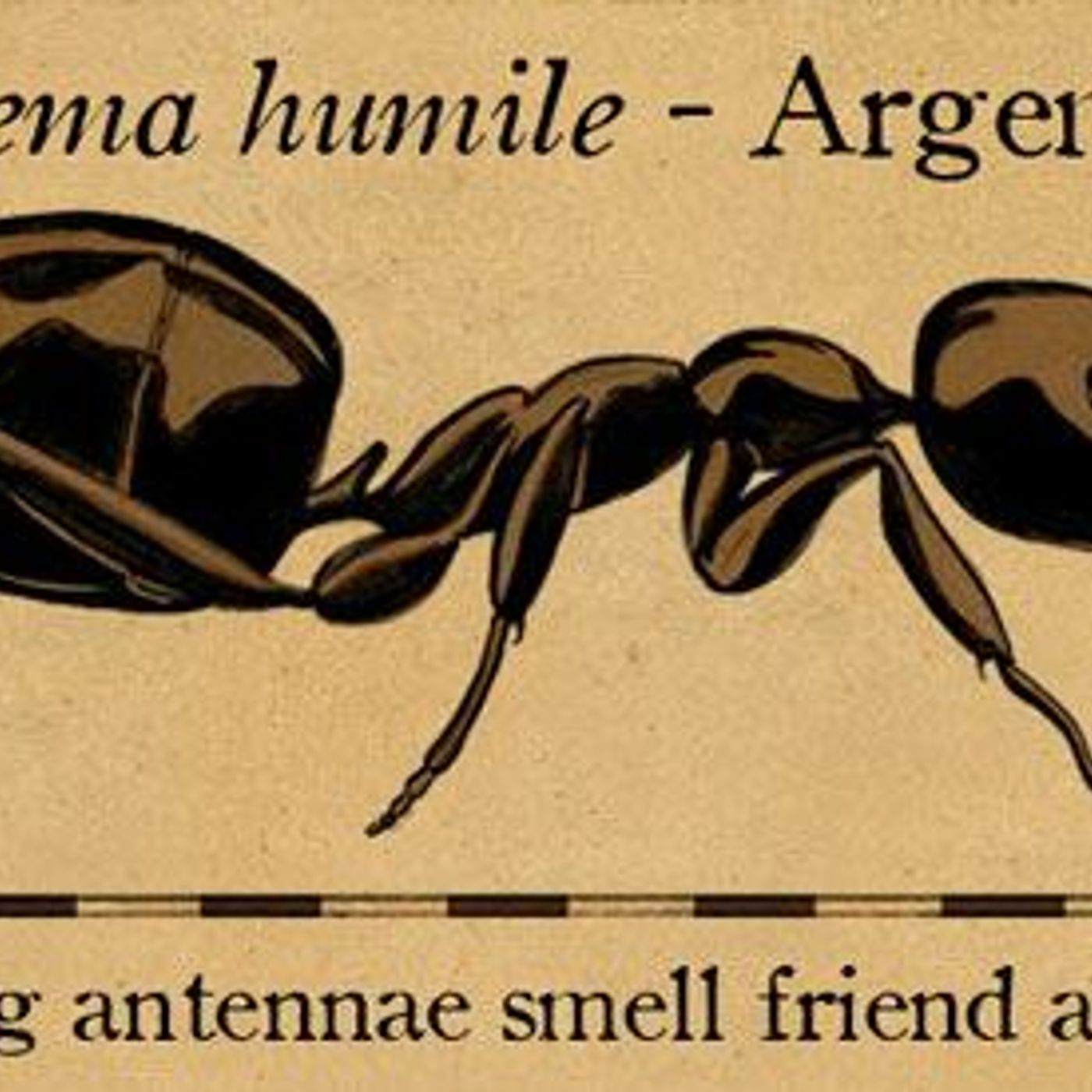
Radiolab
Argentine Invasion
00:19:07
From a suburban sidewalk in southern California, Jad and Robert witness the carnage of a gruesome turf war. Though the tiny warriors doing battle clock in at just a fraction of an inch, they have evolved a surprising, successful, and rather unsettling strategy of ironclad loyalty, absolute intolerance, and brutal violence.
Loading summary
Transcript233 lines
- [00:01]
A
Building a portfolio with Fidelity Basket Portfolios is kind of like making a sandwich. It's as simple as picking your stocks and ETFs, sort of like your meats and other topics and managing it as one big juicy investment.
- [00:16]
B
Mmm.
- [00:17]
A
Now that's pretty good. Learn more@fidelity.com baskets Investing involves risks, including risk of loss. Fidelity Brokerage Services, LLC Member NYSE SIPC Member. When the flu is keeping you up at night, don't try to tough it out. Knock out your flu symptoms with NYQUIL Intense Flu. You got this. It provides powerful relief of your flu symptoms so you can sleep well through the night. NYQUIL Intense Flu the nighttime sniffling, aching, aching fever. Best sleep with a flu medicine. Use as directed. Keep out of reach of children. Get ready to shop Lowe's Black Friday Doorbuster deals to save $150 on a 30 inc. Blackstone griddle now $299 plus choose a whirlpool top load washer or Midea top freezer refrigerator for just $398. These limited time doorbuster deals go fast, so get holiday ready. Today at Lowe's, we help you save valid 1128 through 12. One selection varies by location while supplies last. See lowe's.com for more details.
- [01:25]
C
Wait, you're listening.
- [01:26]
B
Okay.
- [01:27]
C
All right.
- [01:28]
B
Okay.
- [01:30]
C
All right. You're listening to RAD Radio Lab shorts from wnyc. Yes, and npr.
- [01:46]
B
Look, it's a gated community with electric gates.
- [01:49]
C
Electric gates. Hey, I'm Jad Abumrad.
- [01:52]
B
I'm Robert Krulwich.
- [01:53]
C
This is Radiolab, the podcast, and today it's nice out here.
- [01:57]
B
We're on a road trip in Escondido.
- [02:00]
C
California, which is close to San Diego.
- [02:02]
B
Regular suburban neighborhood.
- [02:03]
C
Sprinklers, lawns, nice houses. Pretty ordinary. Except this might be him.
- [02:08]
B
Do you think that's him for David Holway?
- [02:11]
D
Hey, how's it going?
- [02:11]
B
Good. How are you? David is an ecologist and an evolutionary biologist from UC San Diego.
- [02:16]
E
So yeah, you can just park.
- [02:17]
B
And when we saw him, he was standing in the street.
- [02:19]
C
Oh, he's got the things. He's got the things holding what looked like some kind of hookah pipe. When we got out of the car, he walked us over to the side of the road near a driveway and pointed down.
- [02:32]
E
You can see Argentine ants in the along the curb here.
- [02:35]
C
There's a little guy. Yeah, that's an Argentine ant right there.
- [02:39]
E
That is the Argentine ant. So I'm just going to collect some Argentine ants from the side of this.
- [02:42]
B
Side of this sidewalk, you are scraping the surface of the dirt with your fingers.
- [02:50]
C
As soon as he scrapes, about 100 ants just appear and start running in every direction.
- [02:54]
E
Yeah. So what we're seeing are just small numbers of workers that were probably in the leaf litter at the surface.
- [02:59]
C
Doesn't seem so small, though. It looks like they're everywhere.
- [03:01]
E
This is tiny.
- [03:02]
B
This is tiny. There's a lot of them.
- [03:04]
C
First hundreds, then thousands.
- [03:06]
B
These are wrecking up their day. Look at you. Now. The reason the three of us grown adults are now squatting on this little patch of dirt in somebody's front lawn is because around 10 years ago, David and colleagues discovered that this very spot at this particular driveway.
- [03:20]
E
Yeah, we're at 2211 eucalyptus.
- [03:22]
B
In front of this house was the.
- [03:25]
C
Edge of a vast empire.
- [03:30]
E
Right about at this driveway, and that.
- [03:31]
C
Empire ends right at that one driveway. Two.
- [03:33]
B
Two.
- [03:33]
C
One Eucalyptus.
- [03:34]
B
To demonstrate this, David takes this hookah thing that he's carrying.
- [03:37]
E
So there's a tube that you suck on that connects to a vial.
- [03:40]
C
He sticks the tube into the scrum.
- [03:41]
B
Sucks up a few ants, drops him into the vial.
- [03:45]
C
Okay. You just put one at one.
- [03:47]
E
It's that one right there.
- [03:47]
C
Okay.
- [03:48]
B
And then he walked just to the other side of the driveway, like 17 steps, sucked up some ants on that side.
- [03:54]
C
Here's a new. Here is a new gu. Plop them into the same cup and wait it.
- [04:00]
B
So far, nobody seems to.
- [04:02]
C
So you've got these ants from different sides of the driveway in the same cup, and at first they don't seem to notice each other. Okay, so we're watching. We're watching one guy, one. And then.
- [04:18]
B
Right away, wow.
- [04:20]
C
The two ants just lunge at each other.
- [04:22]
B
Oh, my God.
- [04:24]
C
They lock antenna. And soon they're in a ball.
- [04:27]
B
This isn't good.
- [04:28]
C
That is heavy duty fighting. They're like. They're seriously rolling around.
- [04:32]
E
One's got. Looks like it's got a hold of a leg and the other one's got a hold of a leg.
- [04:36]
C
Look at them.
- [04:37]
B
It's got its antenna ripped off because it got yanked out the entire one side. Look at that. See, one side of his legs are missing. He's going around in circles because he has nowhere else to go.
- [04:48]
E
It's no holds barred.
- [04:53]
C
Now here's the thing. What we saw in that cup between those two ants was a tiny version of what is happening all over the planet.
- [05:00]
B
This one family of ants, the one.
- [05:02]
C
On the left of the driveway, not.
- [05:03]
B
The right, has fought its way not only across huge hunks of America, they now control enormous swaths of the globe. And how they pulled this off, well, that's maybe more frightening than the fact that they've done it.
- [05:16]
C
Yeah.
- [05:16]
B
Now we're going to get to all that, but first we have to go back to the mid-1800s to a little place in the northeastern corner of Argentina.
- [05:24]
F
That's right.
- [05:25]
B
Have you ever been to this place?
- [05:26]
F
Oh, yeah, yeah, we've been there several times.
- [05:28]
B
Oh, yeah.
- [05:29]
F
Oh, actually on the first, that's Neil.
- [05:30]
B
Tutsui, he's an evolutionary biologist and says if you're an ant, this place is kind of special, meaning hellish, because it's a place where two rivers come together.
- [05:39]
F
Yeah, it's this region in the floodplain between the Rio Parana and the Rio Uruguay.
- [05:44]
C
A lot of different kinds of ants live there in this little spot. And he says when it rains, which it does there all the time, the.
- [05:52]
F
Floodwaters rise and everybody's home gets flooded and you have to flee.
- [06:00]
G
The ants are forced up into the trees or any high ground.
- [06:03]
B
That's ecologist Mark Moffat.
- [06:05]
G
And then as the water falls, all these different subgroups meet again and they have to start battling from scratch.
- [06:13]
B
That's my land.
- [06:14]
C
It's my land.
- [06:15]
B
My land. My land.
- [06:17]
C
My land. They battle relentlessly because this place is always flooding.
- [06:22]
G
And over time, eons of this, they simply, simply do not know how to stop killing each other.
- [06:30]
B
So you've got this breeding ground for incredibly nasty ants there in northern Argentina, all these different groups all fighting and.
- [06:36]
C
Fighting and more or less keeping each other in line.
- [06:40]
B
But one day. In the 1800s, a steamship rolls up to, say, Buenos Aires, which is a big part of the mouth of these two rivers.
- [06:52]
G
A boat pulls up, a ramp comes down, and somehow a couple of ants.
- [06:56]
B
From one of those Argentine ant families.
- [06:58]
G
Are up the gangplank, probably, you know.
- [07:01]
F
Within the first hour, you know, because.
- [07:02]
B
They'Re always fleeing floods. So they're pretty programmed to move. That's what they do.
- [07:06]
G
They're moving into coffee bags. You can imagine they're moving into all kinds of things.
- [07:10]
B
And then the boat pulls out and this family of ants leaves their war torn hellhole of a homeland behind.
- [07:24]
G
Until eventually, sooner or later, it was bound to happen. 1891 is the first time they were seen there.
- [07:31]
B
They show up in New Orleans and.
- [07:35]
G
Then 1907, they leapfrogged all the way to California.
- [07:40]
B
California, here I come.
- [07:43]
G
They were simultaneously found in San Francisco and Los Angeles, I believe.
- [07:47]
C
How did they get to California?
- [07:49]
G
Well, the Panama Canal wasn't Open yet. So it seems likely they took the train. Wow.
- [07:58]
B
Now, here's the thing about these ants that make them different from all the other ants. Because they grew up in this crazy blood soaked floodplain of death, their survival.
- [08:06]
C
Strategy was pretty simple. Kill everything. If it's not one of us, kill it no matter what.
- [08:13]
B
Other ants will have occasional sex with other ant groups, capture them and make them into slaves, Adopt their children.
- [08:20]
G
These ants, these ants don't fool around.
- [08:22]
C
They don't have sex outside the group, they never take slaves. And if they catch your babies.
- [08:28]
B
They eat them.
- [08:29]
C
And it turns out there's a side benefit to being a cruel segregationist, violent bastard. Because being that way allows these ants to stay pure.
- [08:41]
B
Genes stay the same. Genetically pure?
- [08:43]
C
Yeah, genetically pure. When they stay genetically pure, they can stay unified as a group. And when they do that, they can spread in ways the other ants just can't cause. See, ants use smell like that's how they know who's in and who's out. First thing they do when they meet another ant is they sniff them using their antenna.
- [09:00]
F
Something sort of like a tap, tap, tap, tap, tap, sniff, sniff, sniff, sniff, sniff.
- [09:04]
G
They register odor. It's a parallel to nationality in humans. As long as they sense that identity throughout the individuals they meet, they are happy.
- [09:13]
C
Now, with most ants, as they spread over vast distances, they start to commingle with other ants. Queens come and go and inevitably that smell, nationality dilutes. It begins to change.
- [09:25]
B
But with these Argentine ants, the smell doesn't change from queen to queen or from nest to nest, even if they go way off, conquer totally new territory, build distant nests.
- [09:35]
F
All these different nests function as sort of a fluid network. They can fuse and fission through time. For example, you might be nesting on the edge of a sidewalk and the sprinklers come on, everybody evacuates. And all the queens and workers and babies get moved to higher ground and may fuse with a nest that's already existing at the higher ground.
- [09:55]
B
So all these Argentine ants living across the south in the US they get along.
- [09:59]
C
And if you don't have to worry about each other and you've killed off.
- [10:02]
F
Everything else, they can focus their energy on producing more Argentine ants.
- [10:05]
G
And all you have to do is outnumber the enemy enough and you can.
- [10:09]
B
Wipe out anything, even an animal 5,000 times their size.
- [10:14]
G
Horned lizards are dropping in abundance out in California because the ants simply run all over them and they can never sleep. These lizards normal, but they simply can't grab these ants. They're too fast and too Small. And so they're literally being killed by their own food.
- [10:29]
C
Hmm.
- [10:30]
B
To sum up, they're very nasty, very loyal, and they're extraordinarily numerous. Put those three things together and what you get is Genghis Khan in an ant. See the USA in your chat.
- [10:45]
G
Rolling.
- [10:45]
B
During the 1950s, this tight knit, brutal family of ants starts to spread deeper.
- [10:50]
C
Into California, thanks in large part to all the new freeways. Because now they could spread faster and farther. Like, say you put out a potted.
- [10:58]
F
Plant on your front porch.
- [10:59]
C
The ants move in overnight.
- [11:01]
F
Next day, pick up that plant and move it, you know, 100 miles away.
- [11:06]
C
The next day, there they are in this new place that's so far away from where they were yesterday. And they can conquer that.
- [11:12]
B
And not only that, it is, after all, the 1950s and 1960s. And you got suburbs springing up all over America.
- [11:20]
C
Lots of lawns, lots of sprinklers that go on, off, on, off, on off. Which, if you're an ant, is in.
- [11:26]
F
Many ways very similar to home. Fresh terrain that's been exposed by the receding floodwaters. Humans have modified the habitat in California in ways that Argentine ants really like.
- [11:39]
B
So the Argentine ants are happy.
- [11:41]
C
And most people don't even notice this.
- [11:43]
B
Is happening until we get to the 1990s. In fact, in 1998, Neil, our entomologist friend, and his colleague Andy Suarez, they're now studying Argentine ants around San Diego. And they begin to wonder, how far can a family like this of ants spread and still remain pure and still remain loyal to each other? So in the summer of that year, Neil and Andy hop into a car and they go on a little road trip, starting in San Diego and heading north. They took a cup full of Argentine ants from San Diego, and periodically they would stop, get out of the car, kneel down with their ant hookah pipes and suck up local ants, whoever happened to be there, and then plop those ants into the cup with the San Diego ant. Now, if the ants think they're part of the same colony, they won't fight.
- [12:30]
F
That's right. So we put in ants from Los Angeles. Tap, tap, tap, sniff, sniff, sniff, sniff. And they recognize San Diego ants as being members of the same colony.
- [12:37]
B
So they know the colony extends at least from San Diego to Los Angeles. But they keep going.
- [12:41]
F
We go up to Santa Barbara. Tap, tap, tap, tap, tap. No aggression. Sniff, sniff, sniff, sniff, sniff.
- [12:45]
B
Nothing. No fighting.
- [12:46]
F
To San Luis Obispo. Tap, tap, tap, tap. Same thing. Sniff, sniff, sniff, sniff, sniff. They think they're all members of the same colony.
- [12:51]
B
Still no fighting.
- [12:52]
F
Up to San Francisco. Tap, tap, tap, tap. Same thing. Sniff, sniff, sniff, sniff, sniff. And this continues all the way to.
- [12:57]
B
A little town 100 miles north of San Francisco.
- [13:01]
F
And that site displayed no aggression towards the ants that we collected at the very beginning of our road trip from over 600 miles away in San Diego.
- [13:10]
C
Just think about that for a second, okay? Remember those anthills you might have had in your front lawn? Little mounds. Imagine one of those 600 miles wide, give or take, with trillions and trillions of ants in it.
- [13:24]
B
Scientists call this a super colony, the.
- [13:27]
F
Large California super colony.
- [13:29]
C
And as scientists kept tracking this colony.
- [13:31]
B
They realized these ants had hitchhiked far beyond California.
- [13:35]
H
They're all over Europe. Europe's got. Actually, Europe's got the largest colony known.
- [13:40]
B
That's Australian ant scientist Melissa Thomas. In 2002, she worked with David Hallway to chart just how far this one super colony has expanded.
- [13:50]
H
Australia has some where you are. We've got some here in Perth. Yes. And over in Melbourne and Sydney area.
- [13:57]
B
Up and down Spain, all around Italy.
- [14:00]
F
Around Greece, Japan, many Atlantic and Pacific islands. Hawaii, Easter is places like that.
- [14:04]
G
They've taken over much of northern New Zealand. They've taken over parts of South Africa.
- [14:10]
B
All these places are occupied by the same family of ants. Are they the same colony?
- [14:14]
F
They think they're all members of the same colony. In fact, we imported Argentine ants from Japan, Hawaii, Australia, New Zealand, Europe, brought them to UC Berkeley, and they put.
- [14:24]
C
All of these ants from all these different places in the same cup, like.
- [14:27]
F
We did on our road trip. Tap, tap, tap, tap, tap, sniff, sniff, sniff, sniff, sniff.
- [14:30]
B
And no fighting. You've got, say, an ant from Okinawa in Japan and an ant from Genoa in Italy. They're 6,000 miles distant, maybe 150 generations.
- [14:44]
C
Apart, and yet they still know each other.
- [14:47]
F
They still recognize each other as members of the same colony, because the smell.
- [14:50]
C
That bonds them together hasn't changed.
- [14:54]
F
At some point in the past, one colony in Argentina got picked up and moved around and spread and continue to spread and continue to spread. The descendants of those ants we have now, across all continents except Antarctica, they still think they're all members of the same family.
- [15:10]
C
So here you've got this monoculture, right, that's really violent on the edges.
- [15:15]
B
Yeah.
- [15:15]
C
But then if you're on the inside and part of the group, very, very peaceful.
- [15:19]
B
And since there's only one other creature that can do this, that can create an allegiance across vast, vast spreads of Earth, I couldn't help but ask Neil do you ever analogize to human history when you look at these things?
- [15:33]
F
It's tempting to, but I try not to because these sorts of situations are kind of a Rorschach. You can see whatever you want to in them. And so for our Argentine ant research, we've had people say, look, the lesson from this is that we should all be like Argentine ants and get along and cooperate, and we'll succeed. But then, on the other hand, I've had white supremacist websites cite my research and say, you know, this is evidence that the key to success is not mixing the races.
- [16:01]
B
The unsettling part is that, at least in efficacy, like, they're right, this has been a very successful formula for these ants.
- [16:10]
C
Well, if it lasts.
- [16:12]
B
Right? Which brings us to Jill. What's your whole big name?
- [16:18]
C
Jill Shanahan.
- [16:18]
B
Jill Shanahan. In 1995, Jill was working with Andy Suarez in San Diego, helping him map the ant empire. And one as part of her job, she found herself in a park in a housing complex just outside San Diego looking for Argentine ants. So do you find some? Yeah, I believe that there was a colony at the base of a tree. Now, before she left, she grabbed some Argentine ants from the lab. And these tree ants, they looked exactly the same as her lab ants.
- [16:44]
C
They're pretty easy to identify.
- [16:45]
B
And she figured they would just meet the new ants and go sniff, sniff, sniff, get along. They were ignore each other. But when she plopped one of these tree ants into the cup with one of her lab ants, these guys were fighting.
- [16:57]
C
One was more aggressive than the other.
- [16:59]
B
And started biting the other one.
- [17:01]
C
And then they grapple each other and.
- [17:02]
B
Get into a tight little ball and just. And you're watching this, and no one has ever seen Argentine ants fight before. You're seeing something nobody's seen before. Did you have any sense that that was happening? No, I guess. Which may explain why Jill is now in the interior design field. But this is a big deal, because.
- [17:22]
C
What it means is that another family of Argentine ants had made it over from the old country and brought that old fight to America. So scientists like Melissa began to wonder, how big is this new empire? And where do the two meet?
- [17:39]
H
Exactly. Our goal was to find where that territory met in nature.
- [17:44]
B
So Melissa heads out with her standard ant gear, the hookah pipe thing to suck up the ants, the fight cup to plop them into.
- [17:49]
H
Right.
- [17:50]
B
She'd do the fight cup test in all these different places in the area, trying to zero in on where that border might be.
- [17:56]
H
I'd slowly Sort of get closer and.
- [17:59]
C
Closer and closer, and eventually she finds herself walking down a street in a normal subdivision in Escondido. She looks down and she sees it. This thick channel of death.
- [18:10]
H
Dead bodies. Hundreds, Hundreds of thousands. Hundreds of thousands of dead bodies.
- [18:17]
C
And from all directions, live ants were.
- [18:19]
H
Pouring into this area and fighting to the death. Masses and masses of them fighting.
- [18:30]
G
Piles and piles of them killing each other.
- [18:33]
H
It's pretty extraordinary to.
- [18:34]
E
To see, actually, there were times when we didn't even need to get out of the car to find the super colony boundary because you'd see the dead workers spilling over the curb.
- [18:43]
B
Spilling, spilling.
- [18:44]
C
Which brings us back to where we started with that driveway and David Halloway.
- [18:47]
B
Oh, my God.
- [18:47]
F
Oh, my God.
- [18:48]
C
They're just like, almost bouncing off the bottom.
- [18:50]
B
This, then, is the price of empire. These ants have conquered a huge portion of the globe. Oh, yeah. But every day they pay the price in bodies. At the border, this guy has lost all you see. He's only got limbs on one side now.
- [19:04]
C
And that price might be going up because scientists have now figured out that several more families of Argentine ants have hitchhiked their way over. This is what I expected.
- [19:12]
B
Are they gonna die?
- [19:15]
E
Yeah, the ones that are really injured probably won't live too much longer.
- [19:18]
C
Oh, my God, those two. So in the end, this strategy of violence and intolerance seems to be pretty good. Until it meets itself.
- [19:31]
B
Or even worse, something badder than itself.
- [19:35]
C
Oh, my God, those two, when you shook the.
- [19:38]
B
Look, they got free. Oh, but that other one. Oh, he's just throwing into another fight. Oh, look, Robert, look, they're going into a circle. Oh, they're in the ball of death. Well, not quite. They've just separated.
- [19:49]
C
They sort of locked.
- [19:51]
B
Big thanks to Douglas Smith for production help on this piece.
- [19:54]
C
Douglas, I'm Jad Abumrad.
- [19:56]
B
I'm Robert Krulwich.
- [19:57]
C
Thanks for listening.
- [19:58]
D
Hi, my name is Andrew Bennett. I'm sorry, that's ridiculous. Hi, I'm Andrew Bennett, originally from Melbourne, Florida, currently residing in Siem Rev, Cambodia, and I'm a Radiolab listener. Radiolab is supported in part by the National Science foundation and by the Alfred P. Stone Foundation, Enhancing public understanding of science and technology in the modern world. More information about Sloan@www.sloan.org. all right, thanks a lot. You guys all have a good day. Bye. End of message.
- [20:35]
B
And Doug, here we have the limu emu in its natural habitat, helping people customize their car insurance and save hundreds with Liberty Mutual. Fascinating. It's accompanied by his natural ally Doug.
- [20:50]
C
Uh, Limu. Is that guy with the binoculars watching us?
- [20:53]
G
Cut the camera.
- [20:54]
B
They see us. Only pay for what you need@libertymutual.com Liberty.
- [20:58]
C
Liberty. Liberty. Liberty.
- [21:00]
F
Savings vary, underwritten by Liberty Mutual Insurance Company and affiliates.
- [21:02]
A
Excludes Massachusetts.
- [21:04]
B
Welcome to Walgreens.
- [21:05]
C
Looking for a holiday gift?
- [21:06]
F
Sort of.
- [21:07]
G
My cousin Freddie showed up to surprise us.
- [21:10]
C
Oh, sounds like a real nice surprise.
- [21:13]
B
Exactly.
- [21:13]
F
So now I have to get him.
- [21:14]
G
A gift, but I haven't gotten my bonus yet.
- [21:16]
B
So if we could make it something.
- [21:17]
F
Really nice, but also not break the bank, that'd be perfect.
- [21:20]
C
How about a keurig for 50% off?
- [21:23]
B
Bingo.
- [21:24]
A
Savings all season. The holiday road is long. We're with you all the way. Walgreens offer, valid November 26 through December 27. Exclusions apply.