← Radiolab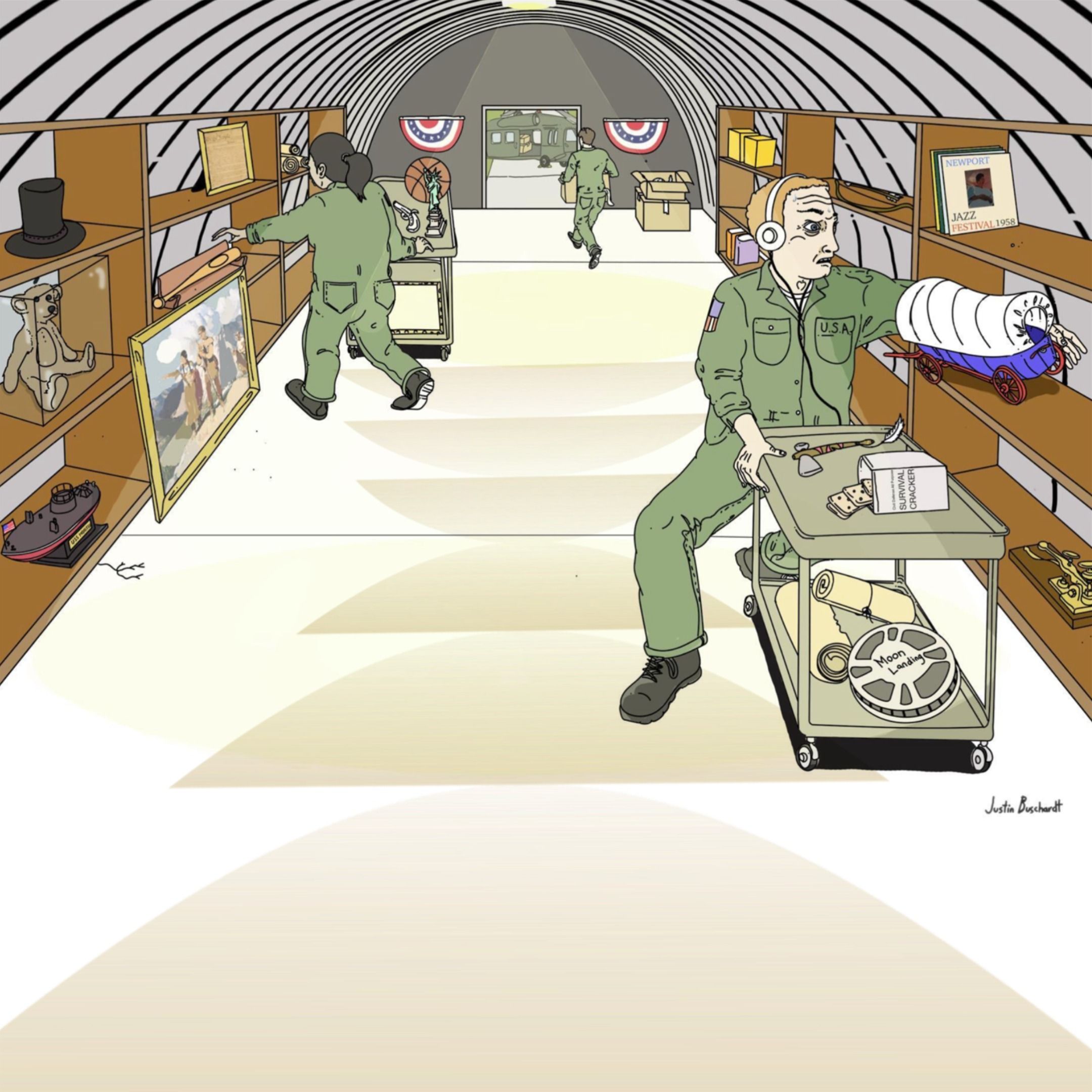
Radiolab
Atomic Artifacts
00:40:48
America represents many different things to many different people. What if you could only choose one thing, one physical object, to represent it all?
Loading summary
Transcript285 lines
- [00:04]
Lulu Miller
Choose to lean into it. Every Mazda is engineered to give you effortless control.
- [00:13]
Simon Adler
I wake up.
- [00:16]
Lulu Miller
So a few years back, I woke up in the middle of the night to my wife saying, lulu, get out. Fire. Fire. And I looked through the window, and in front of me was just a blaze of orange. The apartment building one over from us was on fire. And I had that moment. What do you take? I grabbed my kid, my computer, and this journal I was making of my kids, like footprints and photos and stuff, and that was it. I didn't even get my wallet. I didn't even put on my shoes. And now I know that's what I would take. Luckily, in my story, nobody was hurt. But the episode we're about to play for you is about this question of what to take if something much, much more destructive were headed our way. Figuring that out was a real project that the most powerful people in our country were grappling with. But it's a project you probably have never heard about before because it was kept entirely secret. We first released this story back in 2020, but with our big 4th of July 250 years celebration around the corner, I listened back and thought it was a strange but ultimately profound reflection on what this whole American national identity actually is. So, without further ado, here we go.
- [01:32]
Latif Nasser
Yeah.
- [01:33]
Jad Abumrad
Wait, you're listening. Okay.
- [01:35]
Latif Nasser
All right.
- [01:36]
Guest or Interviewee
Okay.
- [01:37]
Latif Nasser
All right.
- [01:39]
Simon Adler
You're listening to Radio Lab Radio from WNY Rewind.
- [01:51]
Jad Abumrad
This is Radiolab. I'm Jad Abumrad. This story begins, I guess you could say, with a mystery.
- [01:57]
Garrett Graf
Hi, it's Garrett.
- [01:58]
Simon Adler
Hey, Garrett. Simon here. How are you?
- [02:00]
Jad Abumrad
Sorry, I'm Right. And it comes from producer Simon Adler.
- [02:04]
Simon Adler
Yeah. So this mystery all started just a couple years back when this guy.
- [02:08]
Garrett Graf
I'm Garrett Graf, I'm a historian, journalist, author, et cetera, et cetera.
- [02:13]
Simon Adler
Was handed an ID badge.
- [02:15]
Garrett Graf
So I was working at Washingtonian magazine at the time, and one of my colleagues found a government ID badge as he was commuting in one day.
- [02:24]
Simon Adler
Garrett says his colleague was just walking down the street when he saw on the ground this id. And the colleague pretty immediately realized that this was not just any id. It belonged to somebody with a pretty high security clearance.
- [02:38]
Garrett Graf
He brought it in to me, and he goes, hey, you cover this stuff, you can probably figure out how to get this badge back to this guy. So I'm looking at the badge and trying to figure out sort of where this guy works, and it's clear it's for someone who works in the intelligence community. And when I turn the badge over, it had two sets of driving directions on the back. One labeled short term, one labeled long term.
- [03:06]
Jad Abumrad
Driving directions on the back of the id.
- [03:09]
Simon Adler
Yeah.
- [03:10]
Garrett Graf
To where the short term instructions obviously led to an office building in Arlington, Virginia. But the long term directions, you know, I didn't know what they would lead to or sort of just how dramatic it would end up looking like.
- [03:25]
Simon Adler
So Garrett shuffled over to his computer.
- [03:27]
Garrett Graf
I get on Google Maps, Google Satellite, and the directions, you're just like, clicking along. That is absolutely what I was doing. Like, sort of turn left here, continue
- [03:38]
Simon Adler
straight for 10 miles, keep right at
- [03:40]
Garrett Graf
the fork in the road, drive off down there.
- [03:44]
Simon Adler
Before long, his satellite journey has taken
- [03:46]
Garrett Graf
him miles from Arlington way out into Virginia. Getting more and more rural as I'm dragging west.
- [03:52]
Simon Adler
Rolling hills turn into farmland, then plains. And after several minutes of this and several hundred clicks, Garrett finds himself in the foothills of the Blue Ridge Mountains.
- [04:03]
Garrett Graf
And looking at the satellite, you know, I could tell that basically the road went sort of 100 or 200 yards further up and then disappeared into the side of the mountain.
- [04:13]
Simon Adler
Just dead ends into the mountain.
- [04:15]
Garrett Graf
Yep.
- [04:16]
Simon Adler
Now, whatever this road led to, Garrett didn't know what it was.
- [04:20]
Garrett Graf
It did not exist on the map that I was looking at.
- [04:23]
Simon Adler
But he had a pretty good hunch that whatever it was, was, was inside the mountain itself.
- [04:28]
Garrett Graf
You know, I had covered national security in Washington for years and interviewed people who had been whisked to bunkers on 9 11, for instance.
- [04:39]
Simon Adler
Okay.
- [04:40]
Garrett Graf
And so I assumed it was an evacuation facility that people would enter in the event of a surprise nuclear attack. And I was like, you know, wow, like this whole world, you know, exists out here and we just have no idea.
- [05:00]
Simon Adler
And Garrett just thought, I've got to know more about this.
- [05:03]
Garrett Graf
Exactly. And so that launched me on this quest to understand the history of the US Government's doomsday planning.
- [05:14]
Simon Adler
And eventually, this quest would lead him, and consequently us, to a pretty existential question about America. In fact, what he came across was a sort of cataclysm sentence for the United States. And it emerged in a moment when the nation was gripped fiercely by this sense that the end was near. I mean, even more fiercely than the moment we're living through right now. 1950s Cold War America.
- [05:45]
Garrett Graf
One of the things that's hard for us to remember now because we're looking at history as sort of where the Cold War ended, which is, you know, tens of thousands of nuclear warheads that could bring global annihilation in 17 minutes, was that for much of the 1950s, there was a real belief that the US might actually be hit by 50 or 60 atomic bombs, which would essentially
- [06:13]
Simon Adler
be like 50 or 60 Hiroshimas happening around the country.
- [06:17]
Garrett Graf
Yes. And you know, if you are looking at a Hiroshima sized bomb that explodes in Times Square, for instance, if you are in New Jersey or Brooklyn, you have not had a great day, but you have likely survived. If you were in a basement or you were in the center of a building, you might be injured for sure,
- [06:44]
Simon Adler
but you're not going to be vaporized in a moment.
- [06:46]
Garrett Graf
You wouldn't necessarily be vaporized in a moment.
- [06:49]
Simon Adler
And given the relatively low number of
- [06:51]
Garrett Graf
these bombs, dozens of bombs, not tens of thousands.
- [06:55]
Simon Adler
Even in the worst case scenario, a sort of all out strike from the Soviet Union, you know, most of the
- [07:00]
Garrett Graf
country would be untouched by the explosions from that, there would be fallout and radiation that would spread beyond. But nuclear war was thought to be a relatively survivable phenomenon. And so there was this whole elaborate process across the US government of really imagining what post nuclear war America looked like.
- [07:30]
Simon Adler
So just to play this out step by step, imagine it's a hot June
- [07:34]
Latif Nasser
day in Austin, Texas.
- [07:36]
Simon Adler
It's 1960. You're living in Austin, Austin, listening to the radio, when out of nowhere.
- [07:42]
Latif Nasser
This is your Austin Civil Defense director with an urgent message. Enemy missiles have been reported. The Austin area may be hit. There will not be time to evacuate. Repeat, there will not be time to evacuate.
- [07:57]
Simon Adler
And so you run down into the nearest fallout shelter as Austin and a number of other major US cities are decimated and you hunker down until finally several weeks later.
- [08:14]
Latif Nasser
This is your Austin Civil Defense Director. Our monitors report that those in shelters may come out without harm.
- [08:23]
Simon Adler
And as you crawl out of your shelter and look around, you just see destruction. You don't recognize Austin. You don't recognize America. Your house destroyed, your friends and neighbors missing. You have no food, no car. You have no idea what to do, where to go. You're terrified.
- [08:44]
Garrett Graf
But fortunately for you, every aspect of the US government had effectively this secret shadow, post apocalypse version of itself.
- [08:57]
Simon Adler
This is one of the first things that Garrett discovered when he started digging into this, that the government had a very detailed plan for what to do.
- [09:04]
Garrett Graf
So as a couple of examples, the National Park Service would run refugee camps because the belief was national parkland would not be targeted by nuclear war. And so parks like Yosemite would become these camps.
- [09:20]
Simon Adler
Like, did they have a specific portion of Yellowstone that they're like, oh, we've got some nice flat land here. This will be the place. We'll put up the Tent?
- [09:29]
Garrett Graf
Yes. I mean, the planning was done to the level of which roads people would enter, where they would park. Another agency, the US Post Office, would actually be the agency that was in charge of registering the dead and figuring out who was still alive, because the Post Office best understood where people lived.
- [09:52]
Simon Adler
So let's say you made it to one of these national parks turned refugee camps after the attack.
- [09:57]
Garrett Graf
When you arrived, you would be given one of these pre printed postcards. And they were just normal postcard size,
- [10:04]
Simon Adler
beige color, almost like a manila folder. And they were known as Pod form eight. And those exist. I have one. I bought one on eBay for $3. And looking at one of these on the backside, it reads, quote, I am. We are safe and can be reached at this address. And then it has some blank lines where you are meant to fill in the quote, members of family included in this notification.
- [10:29]
Garrett Graf
And you would fill out who survived in your party. And then beyond the post office, the U.S. department of Agriculture was in charge of figuring out how to feed America after nuclear war. And so they spent an inordinate amount of time figuring out sort of what the most survivable food could be. And they ended up amassing what they called survival crackers, manufactured in enormous quantity by companies like Nabisco.
- [11:07]
Simon Adler
Survival crackers. Is that what they say?
- [11:09]
Gabe Moy
Yeah.
- [11:09]
Simon Adler
November 63. Yeah, that's a good year for biscuits. In fact, on YouTube, you can find this genre of video where people go into old abandoned buildings or mine shafts. Oh, they're tin. They're tins, yeah. Like that tin out there. Survival biscuit, survival biscuits. Places that used to have fallout shelters. And they unearthed boxes and boxes and boxes of these things. How many boxes are there? 200, maybe.
- [11:33]
Garrett Graf
And they were sort of a particularly
- [11:35]
Jad Abumrad
unpleasant graham cracker, like very fibrous. It had a lot of nutrition.
- [11:40]
Simon Adler
Yep. Oh, it smells like chemicals. And of course, you can also find videos of people eating them. They're not bad.
- [11:47]
Garrett Graf
There's no flavor.
- [11:48]
Simon Adler
It's well aged. And I've actually eaten one in my US History class, freshman year of high school. Apparently the teacher had dug out the bin of biscuits from the school's fallout shelter before they could be thrown out. And any student who wanted to could come and eat one.
- [12:05]
Jad Abumrad
You had a fallout shelter in your high school?
- [12:07]
Latif Nasser
Was that under?
- [12:08]
Jad Abumrad
Under? Did I?
- [12:10]
Simon Adler
Yeah, I bet you did. I mean, throughout the 60s, the Office of Civil Defense went around retrofitting and stocking basically any building that they could get their hands on. And part of that, part of turning these buildings into fallout shelters was shipping out these crackers.
- [12:27]
Garrett Graf
I mean, in total, the government hid something like 160 million tons of these
- [12:33]
Simon Adler
crackers, which to put in perspective, is about 200 Golden Gate bridges wor worth of these things.
- [12:40]
Garrett Graf
Anyhow, moving on, the IRS ran calculations of how they would levy taxes, and the Federal Reserve built a mountain bunker with $2 billion cash hidden inside of it.
- [12:57]
Simon Adler
$2 billion?
- [12:58]
Garrett Graf
Yes. Think of it as the nation's bank of last resort. Okay, now what made that $2 billion sort of particularly amusing was the US found that most Americans had no interest whatsoever in $2 bills. But rather than pulp the unused unwanted bills, figuring that after nuclear war, people would be much less choosy, what the Federal Reserve did was they actually shrink wrapped the $2 bills and hid them inside the bunker.
- [13:31]
Jad Abumrad
Oh my God.
- [13:31]
Simon Adler
So if you or I went to take out a loan in this post apocalyptic world, we'd be walking out with a stack of $2 bills.
- [13:39]
Jad Abumrad
That's amazing.
- [13:39]
Simon Adler
Like what, what percentage of people working for the federal government would actually be saved to. To run all these things?
- [13:47]
Garrett Graf
Yeah, so the short answer is very few. In the grand scheme of things, I would presume, you know, in round numbers, probably about 10,000 government officials in Washington would be saved. And this actually gets to the heart of doomsday planning, which is the goal is not for any single American to survive nuclear war. The goal is for America to survive nuclear war. And like, America is an idea
- [14:26]
Simon Adler
which is arguably true of every country.
- [14:29]
Garrett Graf
But here we don't have, you know, a hereditary monarch that has been handed down through hundreds of years in a single unbreakable fashion. What we have are these institutions and sort of these historical totems that have bound us together generation by generation. And so if you are trying to preserve America, if you want to say that the America of the apocalypse is the America of before, you need these historical totems, you need these quasi religious artifacts from our past, Objects that capture
- [15:15]
Simon Adler
the idea of America that could be passed on to the folks who survived a nuclear attack so that they could rebuild it. But the thing is, they only had essentially one helicopter set aside to save stuff. The rest were reserved for saving people.
- [15:31]
Garrett Graf
And so there was a large task force that came up with this list of artifacts that needed to be saved.
- [15:39]
Simon Adler
Now, unfortunately, we don't really know how they came to their decisions. That information is apparently either lost to history or is still classified. But we do know some of the items that they vetoed.
- [15:50]
Garrett Graf
You know, the oil portraits of the former joint chief chiefs from the Pentagon, and a Number of animal skeletons.
- [15:57]
Simon Adler
And we also know of seven items that they landed on that they decided needed to be saved. So the sort of group A items there were three of them consisted of, maybe unsurprisingly, the Charters of Freedom. Okay, so the Declaration of Independence, the Constitution and the Bill of Rights.
- [16:16]
Jad Abumrad
Okay, so the Bill of Rights, the Declaration of Independence and the Constitution. Those feel like easy. That's low hanging fruit.
- [16:23]
Simon Adler
Yeah, that's easy. But then we get to the sort of group B items which get a little strange. There are four of them that we know of. So number one was a log from the USS Monitor.
- [16:37]
Jad Abumrad
The log of the USS Monitor.
- [16:39]
Simon Adler
Yes. Which was a Civil War era battleship that the Union had and which was eventually sunk.
- [16:47]
Jad Abumrad
So this was like an 1850s, 60s ship that was sunk?
- [16:51]
Simon Adler
Yes.
- [16:52]
Latif Nasser
Huh.
- [16:53]
Jad Abumrad
Was that. Do you have any. Why? Why?
- [16:56]
Simon Adler
So this is my speculation, but I think it's that when the USS Monitor was built, it was one of these early, what do they call it? Clad iron battleships. It was a demonstration of American ingenuity in wartime. It was us showing that we can innovate in the name of protecting our country and destroying our enemies.
- [17:16]
Jad Abumrad
Is there anything in the. That it was a Civil War era ship, that this was a moment that America was being torn apart?
- [17:23]
Simon Adler
Could be, yep. That we fought battles before and managed to piece ourselves back together.
- [17:28]
Jad Abumrad
It's also a symbol of sacrifice that we sacrifice for the preservation of the Union.
- [17:34]
Simon Adler
It's also possible that somebody who was on the committee was just like a big fan of the USS Monitor and was like, come on, guys, we got to save the log. Okay, so that's number one.
- [17:44]
Jad Abumrad
That's number one. And that was agreed to. That was agreed to, of all things America, that needs to be passed forward is this log.
- [17:50]
Simon Adler
Yeah.
- [17:51]
Jad Abumrad
Okay.
- [17:51]
Simon Adler
Number two, Lincoln's medical records post assassination.
- [17:57]
Latif Nasser
What?
- [17:57]
Simon Adler
And the logic there, I again am presuming, is that it's very likely that the US President will have been killed in the early moments of this nuclear exchange. And so to have the medical records of Lincoln and be able to say we've lost a president before, we've lost a heroic president before, and we've managed to pull ourselves back together, that seems to be the symbolic significance of those medical records.
- [18:26]
Arlo Ironcloud
I see.
- [18:27]
Jad Abumrad
Interesting.
- [18:27]
Simon Adler
Again, I'm no historian. This is me thinking about why the hell would they do this?
- [18:31]
Jad Abumrad
Right, right, right. Okay, so those are. Those are the first two.
- [18:34]
Simon Adler
That's one and two. Number three is the signed surrender documents from the Japanese at the end of World War II.
- [18:43]
Jad Abumrad
That's a great victory.
- [18:44]
Simon Adler
Great victory.
- [18:45]
Jad Abumrad
So these are so far, totems to great losses and great resilience.
- [18:52]
Simon Adler
Well said. All right, and then the final one breaks that mold slightly. It is a painting capturing the journey that Lewis and Clark made westward in 1806.
- [19:04]
Jad Abumrad
Oh, so it's about uncharted territories. It's also about conquest. It's also about the land. Interesting. Okay, those are the four.
- [19:12]
Simon Adler
Those are the four we know of
- [19:14]
Jad Abumrad
that seems so narrow to their point of view. I mean, why wouldn't you put the Dred Scott decision? You could put Ida B. Wells reporting on lynchings. Like, those are things that I feel like should be put into the helicopter. So I want to argue with this list, but where do you want to do with this list?
- [19:35]
Simon Adler
More importantly, I have several questions. Number one is what the hell are the appropriate objects at this point?
- [19:42]
Jad Abumrad
That's where my mind wants to go in this moment of profound change. It's such a hard question to answer right now.
- [19:48]
Simon Adler
Very complicated.
- [19:49]
Jad Abumrad
And so I feel like what you should do is you need to crowdsource this shit, Simon. Like, I don't know, like, oh, my God. That would create some fights.
- [19:58]
Simon Adler
Oh, so many. So many. Maybe we should just stay with the USS Monitor log and avoid all the conflict.
- [20:04]
Jad Abumrad
I don't think that would fly.
- [20:05]
Simon Adler
No. So, folks, when we come back from
- [20:09]
Arlo Ironcloud
break, this is a great.
- [20:13]
Simon Adler
We head out across this great nation of ours to ask today in the year 2020, can we agree upon a list of items that more fully represents what America was, what America is, and what America could be? That's when we come back from break.
- [20:31]
Arlo Ironcloud
Hats off to America, the home of the free and the brave.
- [20:45]
Lulu Miller
This episode is supported by BetterHelp. Hey there, Lulu here. So apparently every year, BetterHelp does a survey called the State of the Stigma Report, where they survey over 2,000Americans trying to figure out how people feel about seeking mental health support. Good news first, 85% of the people surveyed said that seeking mental health support is a good thing, which is significantly up from last year's result, which, okay, small study, but still fabulous. Refreshing. Take that. Stigma. Boom. The only bummer is that 74% of those same people said society discourages people from seeking the mental health support that they need. Why is that? Society? I say let's all do what we can to destigmatize seeking professional help for mental health. I mean, I seek professional help for my teeth, for my hair. Why not get professional help for what's going on on the inside of the head? You know, iron out some worries, get a little support. But seriously, if a friend or loved one comes to you seeming a little more overwhelmed or blue or scared than usual, why not encourage them to seek help? Praise them for doing it. And if they don't know where to begin, one thing you could do is suggest betterhelp. A short questionnaire gets them matched with one of over 30,000 fully licensed therapists available at any time of day at the push of a button. And if they don't like the first one they try, remind them that they can switch therapists at any time, as many times as it takes to find the right fit. Because mental health is important and none of us can do it on our own. So for any of you listening to this who are curious about therapy but worried about judgment, I say don't let stigma stand in the way of support. Start therapy with BetterHelp. Sign up and get 10% off at betterhelp.com Radiolab that's betterhelp.com Radiolab
- [22:26]
Simon Adler
on this
- [22:26]
Guest or Interviewee
week's on the Media, a small town whodunit filled with divorce, corruption and backstabbing. The mystery who is behind the brazen attack on a local newspaper.
- [22:37]
Simon Adler
Okay, I understand you're not people who
- [22:39]
Latif Nasser
are involved in this.
- [22:40]
Simon Adler
However, you are in big deep, right?
- [22:43]
Guest or Interviewee
Okay.
- [22:44]
Gabby Santis
Okay.
- [22:45]
Guest or Interviewee
Don't miss this week's on the Media from wnyc.
- [22:48]
Lulu Miller
Find on the media wherever you get your podcasts.
- [22:57]
Jad Abumrad
This is Radiolab. I'm Jad Abumrad here with Simon Adler.
- [23:01]
Simon Adler
Yes, yes, yes.
- [23:02]
Jad Abumrad
And okay Simon, let's do it.
- [23:06]
Simon Adler
Okay, well, so as we, as I told you before the break, we came across this list of objects our cold war era government planned to save to rally America after an atomic attack. Remind me of this log from the
- [23:21]
Jad Abumrad
US oh yeah, yeah, sorry you're about to do that.
- [23:23]
Simon Adler
A log from the USS Monitor, Abraham Lincoln's medical records post assassination, the signed Japanese surrender documents, and then a map of Lewis and Clark's journey west.
- [23:35]
Jad Abumrad
Right, right. All weighty objects, but a bit musty.
- [23:40]
Guest or Interviewee
Right.
- [23:40]
Simon Adler
And so the thought was let's go out and ask Americans, people other than the cigarette smoking pocket protector wearing bureaucrats of the 1950s, what they would want added to this list. Check, check.
- [23:55]
Jad Abumrad
And is your sense that you're going to find the one thing that we all agree on or.
- [24:01]
Simon Adler
Well, I think the exercise itself is sort of foolish. To convince oneself that you're going to get down to one item is just completely insane. So no, this was just me setting out to try to get some new answers. It's by no means Comprehensive or in any way scientific? It was just sort of a coronavirus. Interrupted attempt to kick off a conversation. All right. Walking down Canal street here on Sunday, February 16th. And so for my first stop. Hello, Hello.
- [24:31]
Gabe Moy
Wow.
- [24:32]
Simon Adler
Busy spot this Sunday, huh? I'm Simon. Very nice to meet you. How are you?
- [24:36]
Jad Abumrad
Good.
- [24:36]
Simon Adler
I wanted to go to a variety of American Legion halls.
- [24:40]
Jad Abumrad
We're sort of a vets association.
- [24:42]
Simon Adler
Yep. It's like a social club for veterans. The American Legion is a national organization. Right now it's close to 2 million members. This is Gabe. My name is Gabe Moy. I was drafted into the army during the Vietnam era. I spoke to him at the Chinatown American Legion Post 1291, which is actually the largest in the city.
- [25:01]
Jad Abumrad
Really?
- [25:01]
Simon Adler
Yeah. Wouldn't have guessed it. And we also swung down to post 1544 on Staten Island.
- [25:11]
Jad Abumrad
This is an interesting choice. What did you hear?
- [25:13]
Simon Adler
Their antique were very patriotic and stayed pretty close to that original list, I would say. The original written US Constitution. Definitely take the Constitution because that would put you on the right path, I
- [25:28]
Arlo Ironcloud
think the armistice from World War I and the signing of the World War II declaration of surrender because it shows that history repeats itself.
- [25:38]
Simon Adler
And the other answers we got were a little bit narrow. I would love to see the first convention pin of the American Legion in 1919 kept.
- [25:48]
Jad Abumrad
Huh. Okay. That's interesting. Ish.
- [25:51]
Simon Adler
So from there I thought, like, let's go to people that think about items a lot. Curators at museums. So let's call up some niche little museums around the country.
- [26:03]
Guest or Interviewee
But the Mississippi Coast Model Railroad Museum is currently closed to the power.
- [26:07]
Simon Adler
Unfortunately, many of them had already closed.
- [26:10]
Latif Nasser
We have temporarily suspended all operations.
- [26:12]
Simon Adler
The coronavirus.
- [26:13]
Guest or Interviewee
The Great Lakes Shipwreck Museum. Thanks for calling the Flamingo Museum and
- [26:17]
Simon Adler
didn't get back to me.
- [26:18]
Latif Nasser
Please leave a message and have a wonderful day.
- [26:21]
Simon Adler
But who did get back to me was.
- [26:23]
Latif Nasser
Let me plug you into the headset here. Just a moment.
- [26:25]
Simon Adler
Andrew Beckman from the Studebaker Museum in South Bend, Indiana.
- [26:29]
Latif Nasser
Big new Studebaker still there.
- [26:31]
Simon Adler
I'm here.
- [26:32]
Garrett Graf
Yep.
- [26:32]
Latif Nasser
Craftsmanship with a flare.
- [26:34]
Simon Adler
And he archives what's left of the Studebaker Corporation. They made horse drawn equipment, then cars. And for his item, of course, to,
- [26:42]
Latif Nasser
you know, rally American spirit afterwards, either Star Spangled Banner, the actual flag that flew over Fort Sumter, or one of the Iwo Jima flags.
- [26:50]
Jad Abumrad
Yeah, yeah.
- [26:50]
Simon Adler
Not like the sexiest thing, but it did come up more than once.
- [26:54]
Guest or Interviewee
Oh, yes, I agree.
- [26:56]
Simon Adler
This is Kerry McCoy and she and her company, flagandbanner.com know a thing or two about they sell one of, if not the widest selection of them in America. And she said, just look at when people go out and buy them.
- [27:07]
Guest or Interviewee
Flags are just kind of like church. When things are bad, people start going to church. When things are bad, flag sales will be soaring.
- [27:18]
Simon Adler
But then, as I broadened out further, they started to get more interesting.
- [27:22]
Guest or Interviewee
More particular images of the physical beauty of the United States by Edward Weston
- [27:27]
Simon Adler
and Ansel Adams, like these from Alexis Rossi of the Internet Archive and history professor Greg Smith. Smoke, perhaps.
- [27:33]
Jad Abumrad
Instead of the Lewis and Clark map, the Fort Laramie Treaty Council map, we
- [27:37]
Simon Adler
got one that was maybe a little too particular.
- [27:39]
Beth Simone Novak
This is a bit on the esoteric
- [27:41]
Simon Adler
side from NYU professor Beth Simone Novak.
- [27:44]
Beth Simone Novak
I would add the Administrative Procedure Act.
- [27:46]
Jad Abumrad
What does that do?
- [27:47]
Beth Simone Novak
It's boring, but it's this.
- [27:48]
Gabe Moy
Right.
- [27:49]
Beth Simone Novak
That we have that almost nobody knows about.
- [27:51]
Simon Adler
Thanks to it, we get to inform what regulations federal agencies make.
- [27:55]
Jad Abumrad
I see.
- [27:56]
Latif Nasser
All right.
- [27:57]
Simon Adler
And then we also got some suggestions, like this one from truck driver Buck Ballard. The AA book called Alcoholics Anonymous that we just called the Big Book, that were, I don't know, cleverly obtuse, because in. That is the key to recovery from pretty much anything. Just scribble out alcohol and write in crystal meth or a nuclear attack, whatever the case may be. And then I came to what I think is my favorite answer from Sharon E. Green.
- [28:23]
Guest or Interviewee
It's funny, because I'm a woman of color. I totally get the Kaepernick thing. Trust me. Get it, get it, get it, get it, get it. But I'm also, like, proud to be American because we're just so quirky.
- [28:36]
Simon Adler
She's a professor of history at the University of Alabama.
- [28:38]
Guest or Interviewee
Roll Tide.
- [28:39]
Simon Adler
Roll tide. And she suggested a concert recording.
- [28:43]
Guest or Interviewee
So, Newport Jazz Festival, 1958. You have all of these people in this picturesque setting listening to jazz these days. It's highbrow more often than not. But what keeps this particular concert earthy. Is mahalia jackson. Just the sacredness of this song, the Lord's Prayer takes you to a more solemn space.
- [29:52]
Lulu Miller
Thy kingdom come,
- [30:03]
Jad Abumrad
Thy
- [30:07]
Simon Adler
will be done.
- [30:11]
Guest or Interviewee
Is it touching you? I mean, it would make us stop and realize it's something bigger. Something bigger. Something bigger has a bit more power than we do, and there's some beauty in that. But Americans, as arrogant as we are, realize our limitations just for a second.
- [30:49]
Simon Adler
Yeah. And then Charity went on to say there was actually one more reason, in fact, the reason she picked this specific live recording.
- [30:59]
Guest or Interviewee
It's the audience that I'm actually thinking of. If you look in the audience, you're going to see people, black and white, male and female, sitting there together. This is the beginning of shared space. Like, I don't mean to buck the storyline you're going with here, but, like, I don't get it.
- [31:31]
Simon Adler
But then I ran into several people who thought that this exercise was one of the dumber things I could spend my time doing.
- [31:42]
Guest or Interviewee
I swear to God. And I don't mean this in the wrong way, but like.
- [31:44]
Simon Adler
And sort of chief among them being New Yorker writer Jill Lepore.
- [31:48]
Guest or Interviewee
The question after the apocalypse is not, do we have Abraham Lincoln's medical records? The question is, who are, are we? That we did this to each other?
- [31:57]
Simon Adler
Okay, but isn't the pushback something like, don't you need some of these totems to rally people and to tell them that, hey, we're still here?
- [32:08]
Guest or Interviewee
So what we need after the apocalypse is nationalism.
- [32:12]
Simon Adler
If not, if not a national identity that you're going to have people rally
- [32:15]
Guest or Interviewee
behind, it would have been the national identity that brought the apocalypse in the first place. Like, what we want to preserve are totems of what it was that drove us. That's. That's Banana song. Like, it's bananas.
- [32:29]
Simon Adler
Okay, well, so then let me pose the question this way. If we are trying to answer the question of who are we, that we did this to each other, are there any artifacts, are there any objects that you think would help us answer that question and then move forward from it?
- [32:47]
Guest or Interviewee
Like, I think I understand where you and I are parting ways in your supposition. In the aftermath of an atomic war, what would endure would be the nation state. It would not. I mean, the nation state was devised to grant rights to human beings under a written constitution. If under that system of organization, we actually kill one another, then the nation state would not deserve to endure.
- [33:24]
Arlo Ironcloud
Growing is about exploring. And if you're not able to explore fluidly, then you're not going to be able to grow.
- [33:36]
Simon Adler
And then the second of this one, two punch came from communications manager and ofttimes, host of Kili Radio Hamadaki API.
- [33:45]
Arlo Ironcloud
You're listening to Voice of the Lakota Nation across the pioneers reservation on 90.1 FM.
- [33:50]
Simon Adler
Arlo Ironcloud.
- [33:52]
Arlo Ironcloud
Oh, man. I've been on Keely radio for about 19 years now. Almost two decades. It's crazy.
- [33:57]
Simon Adler
Kili is a community radio station serving the Pine Ridge Reservation.
- [34:01]
Arlo Ironcloud
The Pine Ridge reservation is about 45,000 people, roughly the size of Rhode island, smack dab in the southwestern corner of South Dakota. And so, you know what it's like these days, man, we are redefining ourselves in this day and age after all the atrocities that have happened to our people in the past.
- [34:24]
Simon Adler
And what struck me with him was an atomic bomb descending upon civilization is essentially what happened to the Lakota Sioux tribe as well as the rest of the Native Americans in this country.
- [34:38]
Arlo Ironcloud
It's happened to our people in the past, big time. And so I often think about what would happen if something happened so drastic that we would have to leave.
- [34:50]
Simon Adler
And when his mind goes there, there's
- [34:53]
Arlo Ironcloud
just so much stuff that I would love to take with me. Bows, earrings, quilled bags, teepees, the sacred pipe. This pipe goes back 27 generations.
- [35:08]
Simon Adler
27 generations? What even is that, like, 800 years?
- [35:12]
Arlo Ironcloud
Yeah, we. We have that, and we. There's a great story behind that, Simon, and I'm teaching my children that. And I don't think it'd be very wise of me to, like, tell these stories on national radio. But that pipe, it represents us.
- [35:27]
Simon Adler
But even this.
- [35:28]
Arlo Ironcloud
Even this pipe, I don't even know. I don't know if we'd actually take it.
- [35:36]
Jad Abumrad
And why?
- [35:37]
Simon Adler
Because he says, if you look at the history of the Oglala Lakota tribe,
- [35:41]
Arlo Ironcloud
you know, we don't have anything written down. Our forefathers didn't write anything down. And that's probably the best thing for
- [35:49]
Simon Adler
us, because he says, when he looks to the broader United States, the United
- [35:53]
Arlo Ironcloud
States of America, the people that belong to it, sometimes I think they take the things that were written by your forefathers too literally, and they can't adapt it into the future.
- [36:04]
Simon Adler
Take, for example, the Bill of Rights. He says, because it was written down, it's rigid. Whereas a Lakota story, even one that's 27 generations old, Arlo can take that and adapt it to the present moment.
- [36:20]
Arlo Ironcloud
And that's what we're doing. We're adapting everything that we know we're moving forward in. Into the future.
- [36:29]
Simon Adler
And so given the choice, he says, the Constitution, Bill of Rights, Declaration of Independence.
- [36:34]
Arlo Ironcloud
Oh, I'm kind of an anachronist in that. I would burn them. I would let them go to dust. I know it probably hurts to hear. Hear that, but I. I think it would be kind of cool,
- [37:07]
Latif Nasser
Huh?
- [37:09]
Jad Abumrad
I suppose it's a. You kind of. It's. You're here, we are. This is the kind of the American thing at the. Of the moment, which is, yeah, do we preserve the thing or do we burn it down? Where do you land in all of this?
- [37:26]
Simon Adler
I don't even know Jet. I'm still sort of lost as to what to take away from this other than even though this is a story that I pitched and a story that I went out to report, I was sort of skeptical of it from the get go. In that.
- [37:43]
Jad Abumrad
I love that. Okay, yeah.
- [37:45]
Simon Adler
In that, like, I'm skeptical or I don't. I sort of bristle when I hear questions about what is the mood of America, what is the conversation America is having right now, these grand national questions about who we are. And I think the reason I bristle or I chafe at that is I remember as a kid growing up in Wisconsin, watching the news or listening to the news at the end of the day and hearing reporters talk about what was going on in America and just not relating to it or not seeing any of it on the ground at all. And I came to believe that either the news was exaggerating everything or they just weren't talking about me or anyone I had ever met. And so there's an arrogance in thinking you can take the nation's temperature. However, here I just spent the last two months doing this. And I think it's because despite everything I just said, secretly, deep down, I wanted to find something that we could all agree on, even now. And I'll say, there was one thing that kept coming up, you know?
- [38:57]
Guest or Interviewee
You know, I mean, what would tell our story?
- [39:01]
Simon Adler
And I don't think it was ever anyone's first choice, but, oh, maybe you
- [39:05]
Guest or Interviewee
should put a. I know what it is. Oh, yes. An image from the moon looking at Earth.
- [39:12]
Simon Adler
Almost everyone said they'd want to preserve something from the Apollo moon missions.
- [39:16]
Guest or Interviewee
I like it. That's what I'd put.
- [39:18]
Simon Adler
President Kennedy, Navy lieutenant in World War II, where he said, we shall send to the moon 240,000. We're. Put a man on the moon, A giant rocket.
- [39:29]
Beth Simone Novak
You know, this speech that Kennedy gave,
- [39:31]
Simon Adler
John F. Kennedy, putting a man in the moon.
- [39:33]
Latif Nasser
We are now approaching lunar sunrise. The earthrise photo on Apollo 8. Apollo 11 to visual contact the Apollo 11 space capsule.
- [39:43]
Guest or Interviewee
The actual, like, recordings of the audio from the Apollo 13 mission.
- [39:48]
Latif Nasser
Okay, standby, 13. We're looking at it.
- [39:51]
Simon Adler
And everyone had their own reason as to why.
- [39:56]
Guest or Interviewee
To help people remember the ways we as a nation have come together to survive something that doesn't seem survivable because nobody may ever get there again.
- [40:05]
Latif Nasser
It's the greatest industrialization our country ever saw.
- [40:08]
Guest or Interviewee
Talk about display of prowess, the ability to engineer resources.
- [40:13]
Latif Nasser
It's something that America did collaboratively.
- [40:18]
Jad Abumrad
It's like people are still yearning for that sense of unity and transcendence and a project. Yeah. A common mission, a common purpose.
- [40:27]
Simon Adler
But I think what I actually like most about it is America did this at a time when we were more polarized potentially than we even are right now. Like America was going through far more radical changes than I think we face today. And yet out of that maelstrom,
- [40:49]
Guest or Interviewee
we
- [40:49]
Simon Adler
did this transcendent thing.
- [40:51]
Latif Nasser
Yeah.
- [40:55]
Simon Adler
And so what this leaves me with is the feeling that I want to live in a time and a place, in an iteration of America, where we achieve something that inspiring. And I think maybe that's actually what we all want.
- [41:27]
Jad Abumrad
Producer Simon Adler. This episode was reported and produced by Simon, with editing from Pat Walters and reporting assistance from Tad Davis. Original music also from Simon. Special thanks to Luke Menon, Ben Ervin, Bill Pretzer, Jason Spear and Garrett Grafton for all his reporting that made this episode possible. I'm Jad Abumrad. Thanks for listening.
- [41:55]
Gabby Santis
Hi, I'm gabby. I'm from the bay area. California. And here are the staff credits. Radiolab is hosted by lulu miller and latif nasser. Soren wheeler is our executive editor. Sarah sandbach is our executive director. Our managing editor is pat walters. Dylan keefe is our director of sound design. Our staff includes jeremy bloom, w. Harry fortuna, david gable, maria paz, gutierrez, sindhu nainasambandan, matt kielty, mona maudgaukar, alex neeson, sara khari, natalia ramirez, rebecca rand, joanna strogatz, anissa vitze, arian wack, molly webster and jessica young, with help from gabby santis and maya appleby melamed. Our fact checkers are diane kelly, emily krieger, natalie middleton, angeli mercado and sophie semay.
- [42:53]
Latif Nasser
Hey, Radiolab. Michael, Tacoma, Washington Leadership support for Radiolab science programming is provided by the Simons foundation and the John Templeton Foundation. Foundational support for Radiolab was provided by the Alfred P. Sloan Foundation.
- [43:15]
Gabe Moy
1, 2. 1, 2, 3, 4. Gimme a break, give me a break, Break me off a piece of that Kit Kat bar Gimme a break, give me a break, Break me off a piece of that Kit Kat bar the chocolate crispy taste gonna make your day and wherever hear the people say Give me a break, give me a break Break me off a piece of that Kit Kat bar have a break, have a Kit Kat.
- [43:44]
Beth Simone Novak
Having the right people in your corner for life's biggest milestones makes all the difference. Like a friend who's there when you're house hunting or checking out a new ride, State Farm is there too, helping you choose the coverage you need. With a State Farm agent, you know someone is there to help you along the way. And and with so many coverage options, it's nice knowing you have help choosing a plan that fits your needs so you can continue celebrating all of life's milestones. Head to statefarm.com to get a quote like a good neighbor, State Farm is there.