← Radiolab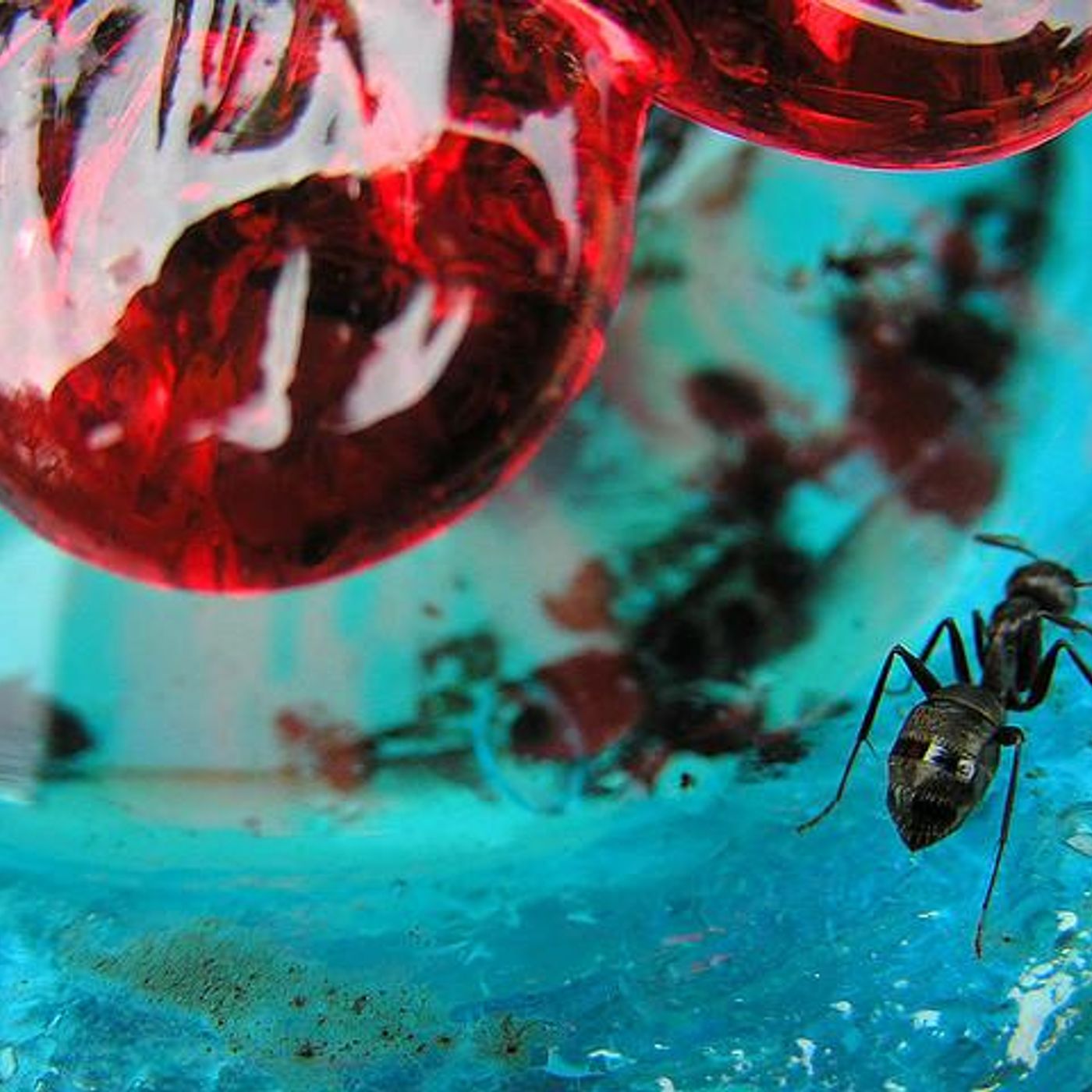
Radiolab
Chasing Bugs
00:20:28
Remember the first time you ever saw an ant hill? That parade of black insects pouring in and out of a small sand mound...most of us stopped, looked and then moved on to other parts of the playground. E. O. Wilson is the kid who never took his eyes off the mound.
Loading summary
Transcript82 lines
- [00:00]
Narrator/Announcer
A Sapphire Reserve story from the Foster sisters.
- [00:02]
Erin Foster
We went to Rome, me, Erin and her boyfriend.
- [00:04]
Jad Abumrad
The entire time.
- [00:05]
Erin Foster
I think that my boyfriend is going to propose to me. I knew he wasn't. Anyway, we booked this beautiful hotel with the edit through Chase Travel. Then later at a romantic dinner. No proposal and his card was not accepted. I pay with my sapphire reserve. The three time points on dining made up for the whole, you know, no proposal thing.
- [00:19]
Narrator/Announcer
Yeah, for you get $500 credit for the edit. A collection of luxury hotels with Chase Sapphire Reserve now even more rewarding. See More rewards@chase.com Reserve IT cards issued by JPMorgan Chase Bank North America member FDIC subject to credit approval terms Apply for delicious meals. You could go out to eat or you could just make a Marie Callender's meal. Marie Callender's classic Chicken Parmigiano bowl is so good. It has marinara sauce that's made from scratch and creamy mozzarella cheese over pasta. It's delicious with no artificial flavors, colors or preservatives and 30 grams of protein. You can find it in the frozen aisle. Marie Callender's what having it all tastes.
- [00:54]
Jad Abumrad
Like.
- [00:56]
Lowe's Advertiser
Lowe's Early Black Friday deals are going fast. Don't miss up to 50% off. Select major appl plus up to an extra 25% off when you bundle. Select major appliances. And with Christmas around the corner, you're gonna need more string lights, right? Save $4 on GE LED 100 count string lights now just $5.98 Lowes we help you save valid through 123 selection varies by location. Select locations only while supplies last. See Lowes.com for more details.
- [01:27]
Jad Abumrad
You're listening to Radio, the Podcast from New York Public Radio, Public Radio.
- [01:37]
Erin Foster
And npr.
- [01:38]
Jad Abumrad
Hello, JAD here. This is Radiolab, the podcast coming to you now with not one of our big hour long situations, but rather one of those in betweens that we do between seasons. Our next season is about two months off and one of the programs that we're going to be presenting is about people who fall in love with science and then fall out of love with science. And in that spirit, we thought we'd play a conversation for you now, which is more on the falling in love side. Robert Crowwidge, my esteemed co host, who you will hear in just a moment, recently interviewed maybe one of the greatest scientists alive, really. E. O. Wilson. He is a biologist. He is an entomologist, meaning he studies bugs. He's an author, a world famous conservationist. He recently started the Encyclopedia of Life, which Tries to make a list of every single species on the planet. He discovered so many things about how animals communicate, which you'll hear in a moment, particularly ants. And if you heard our emergent show, you will recognize a bit from that show that repeats in this conversation. But it's really cool to hear the whole conversation without too many edits, which is what we're going to play for you now. So here it is. Here's Robert Kruitz speaking with E.O. wilson at the 92nd Street Y here in Manhattan.
- [03:04]
Let's see, for starters, I'm just curious. Did you know, do you remember the moment when you said the word scientist, comma, I want to be one.
- [03:16]
E.O. Wilson
Not scientist, I guess. Entomologist. You know, I just wanted to work.
- [03:20]
Jad Abumrad
You said entomologist?
- [03:21]
E.O. Wilson
Yeah. Bugs. Oh, yes. When I was about eight or nine, I discovered that there were people who actually made their living chasing bugs. And, you know, every kid has a bug period. I was just set now never to grow out of mine. You were right of what you said. And I. Down in Alabama, we had people who were driving around in green trucks for the Department of Agriculture, and some of them were exterminating insects. And they were. Made their living by finding and studying bugs. And I said, well, that's what I want to do. Never mind being a fireman or anything. Like, I don't want to do that, kill bugs. I was frozen in that ambition at.
- [04:07]
Jad Abumrad
The age of 7, 5, 6, 8.
- [04:09]
E.O. Wilson
Or 9 when I really settled down for West Point.
- [04:14]
Jad Abumrad
Now, did science seize you or did science rescue you because you were. How many schools did you go to before you were the age of 14.
- [04:24]
E.O. Wilson
Or whatever it was? Yeah, it was about 13 or 14 schools in 11 grades. I skipped one grade. So that made me always the runt of the class, which didn't help. See, with the runt, social skills and.
- [04:39]
Jad Abumrad
The new kid every time, I was.
- [04:41]
E.O. Wilson
Always a new kid in the neighborhood. Yeah.
- [04:43]
Jad Abumrad
So that means what? Now you have a choice here? You could be the class clown or something, or you could go off into the forest and make friends with a worm or something like that.
- [04:53]
E.O. Wilson
Well, yeah, I guess that's a way of looking at it. I turned to nature and the woods and so on. And then I discovered that this eccentricity made me socially acceptable in an odd way. So I had the nickname Bugs when I was in my grammar school thing. But then I had a SN period.
- [05:12]
Jad Abumrad
A snake period.
- [05:14]
E.O. Wilson
Yeah. And this was in southern Alabama. I guess I was about 15 or 16 by that time. And there are about 40 species of snakes found down there. And in a period of time, about a year, I managed to find them all. I kept a lot of them in the backyard alive. And so I was now known as Snake Wilson. It wasn't because in this intense footprint culture. I went out for football at this point at Bruton High School in Alabama, and I weighed 112 pounds. I was the second lightest kid.
- [05:49]
Jad Abumrad
There are probably a couple of snakes heavier than you.
- [05:52]
E.O. Wilson
Wait a minute. Let me finish the story. I. You're a tough competitor. Anyway, so it turned out, you see, there was. There were 23 people on the squad, and I was the entire third string. But anyway, I got respect in part because I was doing all these strange things. And Alabamians are really. They're really very tolerant of eccentricity. They kind of like it, you know, the old ant that lives up in the attic, you know, that kind of thing. I got along very well, both as a naturalist, you know, fanatical collector and naturalist at the same. And then in high school, too, any rate. So I. At the age of 16, I decided that the time had come to get serious about professional entomology. And so I decided to select a group of insects to study. And I said, flies, they have marvelous, tremendous diversity. And so I would start collecting flies. I wanted to become the world expert on flies. But the year was 1945, and in order to study flies, as many of you understand, you have to have insect pens, special pins to put through the body of the specimens. Yeah, Insect pens were available at that time only from Czechoslovakia, and the supply had been cut off in the United States. Insect pens were unavailable. So I said, what's my favorite group of insects, you know, that I don't have to stick pins through? And that's the ants. So I got started my collection by going down to the drugstore and collecting these little pill bottles and that with rubbing alcohol, which is isopropyl alcohol. My collection started. I built a large collection of ants that I took with me to the University of Alabama. Could you say that that was launched.
- [07:59]
Jad Abumrad
But for the lack of pins and for the availability of rubbing alcohol, therefore, ants. Or was ants always going to be it, and you would have gotten to it by whatever route.
- [08:10]
E.O. Wilson
I think I eventually would have ended up with ants, but I would have been retarded there. I don't think I would have been able to do serious research until maybe I was 18.
- [08:24]
Jad Abumrad
Now let's get on to the joy of. This may not be obvious to a lot of people. The joy of Ant studies, because if you think about it, they do seem like somewhat indifferent to anyone who's observing them and so on. And you might not wonder exactly why somebody would get delight out of looking at ants. But I want to take you back to one moment which I think is one of my favorites ever. The question is, how do these little ants communicate with one another? The year is 1953 and you're considering the problem. We know that, at least for us, most of our communication goes because of things we hear or things we see. This does not seem to be the habit of ants. So you have some fire ants and the question is, you notice that a scout will go find a piece of food and somehow tell the other ants, look what I found, come here and get the food. How do you figure out how the scout ant tells the other ants that a there is food and where it is?
- [09:20]
E.O. Wilson
We had the idea even back then, people did biologists, that the ants were somehow laying a trail down and then they were telling the other ants, go out and follow that trail. But nobody knew where the trail came from and they didn't know really how it worked and they didn't know how ants communicated otherwise. And you're perfectly right. Human beings are really unusual. Along with birds, we are audiovisual. And that puts us in a tiny minority of all of the creatures on Earth which are primarily chemical in their communication. It wasn't understood or appreciated at that time. Pheromones. Many of you have heard the word pheromones. Pheromones are the key to understanding communication of the vast majority of animal species. We didn't know it then. And so one day I set out, I was culturing fire ants then in the laboratory at Harvard and I said, I'm going to get to the bottom of this. And the way I did it was to dissect these tiny, tiny ants. Very difficult to do, but I dissected them.
- [10:28]
Jad Abumrad
Now, wait a second, wait a second. So you're watching the ant going along and it's laying its abdomen or some part of its body leaning on the ground.
- [10:35]
E.O. Wilson
That's right. I can see the ant running along and under magnification I can see that it's sticking out its sting and dragging the sting. Something's coming out of that sting like.
- [10:47]
Jad Abumrad
Kind of like a fountain pen or something through the.
- [10:49]
E.O. Wilson
A little bit like that, yeah, yeah. And so I proceed to, believe me, folks, this is the way science goes. I mean, it really is simple minded. It's only later when you're doing the technical paper, you know, and you're producing the mathematical models and you're describing the micro analysis and so on that it looks tough. It's really. This is the way you're thinking when you're doing science. So I said I'm going to find out what the organs are inside this ant and I'm going to track down where that stuff is coming from. So what I did was to do anatomy and then, you know, just dissected. I knew approximately what the different glands were and so on.
- [11:29]
Jad Abumrad
You snipped off the part where the glands were.
- [11:31]
E.O. Wilson
You sort of. Well, you just dissect open.
- [11:34]
Jad Abumrad
Oh, you opened it.
- [11:35]
E.O. Wilson
Yeah. An ant and just the way you would any animal. Although it's exceedingly difficult when it's about the size of a grain of salt. That's the tough part.
- [11:45]
Jad Abumrad
But anyway, aren't your hands going?
- [11:47]
E.O. Wilson
Well, yes, your hand is vibrating and in fact it was down at the limit. I didn't go to a micro manipulator, you know, which is when you're doing it with controls. And I did it raw manually, but it was right at the limit. So the way I did it was I got these very fine needles in and because there was this inevitable vibration in your hand. You can see it when you put it in the microscope. Everybody has it. It's a little vibration but highly magnified. Allowed me to use a needle. Like a jackhammer.
- [12:20]
Jad Abumrad
Like a jackhammer.
- [12:21]
E.O. Wilson
I could do it if I did it just right, you know, and just open up the ant. Anyway, I took out the various organs one after the other and I made a preparation and I made an artificial trail.
- [12:32]
Jad Abumrad
Wait a second. Make sure I follow this. You've now got like six organs and you've got the little smushed each one of the six organs. And then you're going to take. Let me just see if I remember this. You're going to take a. A sharpened birch wood applicator stick.
- [12:46]
E.O. Wilson
Yes. And then I smeared out one organ after another. No effect.
- [12:52]
Jad Abumrad
Wait, wait. Where are their ants? Are there ants yet? You have broad answers.
- [12:55]
E.O. Wilson
I'm leading. I'm leading my artificial trails from the colony that I have in the lab.
- [13:01]
Jad Abumrad
So they're ants over here.
- [13:02]
E.O. Wilson
Yeah.
- [13:02]
Jad Abumrad
You got your birch stick here and you're drawing lines of gut stuff I.
- [13:07]
E.O. Wilson
Guess basically what it is. Yeah, just an or different organs. I've washed each one in turn and then smeared it out. And finally I came to a little finger shaped organ which we didn't know the function of. It was just a tiny little thing tucked down there and I smeared that out and incredible. It wasn't. I didn't have to tell them to follow that trail. They exploded out of the nest running along that thing.
- [13:31]
Jad Abumrad
Does that mean, like, if you'd taken the stick, could you go? And all the answers would go, de doop de doop.
- [13:37]
E.O. Wilson
Yeah, Well, I. What I actually. I started playing around with this. It was so effective for demonstrations. I would write my name and a column of 100, 200, 300 ants would come pouring out back and forth, and they'd actually write my name in ant. So. Well, that was the beginning, you know, just to show that there is some seriousness to this. That was the beginning, and we were able.
- [14:02]
Jad Abumrad
Offended ant lover somewhere in the room. All right, now I want to finish this little section because this is my favorite story of all. When you get bad, you get bad. This is once you begin to figure out how these chemicals and the fearom and the smells that they give off become communicating devices. You discover that when an ant dies, this doesn't happen to be exactly in that category. When the ant dies, ants not being the smartest creatures around, it just sort of dies. And it just sits there. And for the first day or two, all the other ants just don't even notice it. And then when it begins to decompose, it begins to give off a smell. And then the first time it gives off a smell, I guess the next ant that passes by goes, whoo. And says, we have a dead ant here.
- [14:45]
E.O. Wilson
That's right.
- [14:45]
Jad Abumrad
And he takes the ant and puts it in the dead place, I guess.
- [14:48]
E.O. Wilson
The ant.
- [14:50]
Jad Abumrad
Dead place.
- [14:51]
Erin Foster
Yeah.
- [14:51]
E.O. Wilson
I'll tell you about the experiment because I had a lot of fun with it. But first. But let me say that my chemist colleagues and I quickly worked out the chemical code of the ants we found somewhere are a good part of it. We found that the ants were communicating somewhere between 10 and with 10 to 20 chemical signals. They have glands all over their bodies that the function of which were unknown. And many of these glands produce pheromones. You know, some for to alarm, some to recruit, some to identify themselves as a member of a cast and so on.
- [15:25]
Jad Abumrad
And one of them says, I am dead.
- [15:27]
E.O. Wilson
Oh, I'm coming to that. Yeah. Well, how does an ant, when it dies, how is it identified, as you say, you know, how do the others know when an ant dies? Then for a while it just lies there. You know, if we saw one of us just lying on the ground like this, we'd probably do something. Maybe not in New York, but I.
- [15:50]
Jad Abumrad
Mean.
- [15:53]
E.O. Wilson
But usually we'd do something because, you know, we're audio, we're audio visual. But in the case of the ants.
- [15:59]
Jad Abumrad
An interesting idea is New York, most ant like city in America. Anyway, go ahead.
- [16:03]
E.O. Wilson
Anyway, the. So the ant begins to decompose. And I was really going crazy with this. We were so successful. I mean, we were making one discovery after another. It was wonderful. And I was going crazy with this. So I said, how does an ant identify a corpse? It's got to be in the substances that are being produced by decomposition. It's got to be. And in those days, we had just hit upon animal behaviors generally had just hit upon the idea of signed stimuli that animals don't grasp a whole lot of stimuli the way we do, you know, and assess they gestalt in a variety of signals. They usually work out of one substance or a very small number of substances or a site and then that releases their complex behavior. So I was going to find that. What's the corpse substance? It turns out, well, this is how science works across. It turned out that for some reason I never found out the chemist had already identified a large number of decomposition substances in rotting insects. And so with that as my guide, I gathered in pure form on my laboratory shelf a whole variety of them. And the place for a while smelled like a combination between an outhouse and a charnel house.
- [17:39]
Jad Abumrad
I'll list you some of the smells you have. Rotten fish smell, peasy smell, rancid body smell.
- [17:45]
E.O. Wilson
Yeah, that's the fatty acids that you have.
- [17:49]
Jad Abumrad
So when people were walking up the corridor at your, in your building, what did they like, stay?
- [17:54]
E.O. Wilson
I never tried to explain to them, but there were, it was, it was a very strange smelling place. You know, skate hole with one of the. That's, that's the essence of feces.
- [18:07]
Jad Abumrad
Yes.
- [18:08]
E.O. Wilson
Well, any rate, I then started with my, you know, typical experiments. I started daubing dummy ants with tiny, tiny amounts of these different substances and observing and nothing happened until finally I came to one of the substances, oleic acid.
- [18:27]
Jad Abumrad
Oleic acid?
- [18:28]
E.O. Wilson
Yes. A fatty acid of a particular kind. Bingo. The ants then picked it up and the dummy with nothing but the only signal they had was oleic acid. And they took it and dropped that dummy on the refuse pile. And so I had it. I essentially had it.
- [18:48]
Jad Abumrad
Now here's where you get bad.
- [18:49]
E.O. Wilson
Ah, yeah, that's a trite. Okay, well, you know, you get to play around at this point. So I said, what would happen if I put oleic acid on a live amp? What happens is that nothing this ant says if they said anything, you know, nothing the ant does, does any good because now it is a corpse. And the other ants pick this live kicking ant up and out it goes. And it's dropped on the refuse pile.
- [19:17]
Jad Abumrad
So it's a wiggly, obviously alive, perfectly healthy. And the other ants thinking you're dead, you're dead, you're dead all the way to the grave.
- [19:25]
Goodbye.
- [19:25]
E.O. Wilson
Goodbye. What happened then was that the ant would proceed to clean itself. Ants are always cleaning themselves. And finally. But if it didn't clean itself enough when it got back, it's picked up and brought out till finally it's clean enough and then it can re enter the realm of the living.
- [19:44]
Jad Abumrad
You have once sometimes described the process of science as you do it as a form of storytelling. What did you mean by that?
- [19:54]
E.O. Wilson
Well, I mean, I think as everyone here understands that human beings are the storytelling species. The way we think is a narrative. You know, we build scenarios forward. And when we're making a decision, running one scenario after another forward, we're telling a story to ourselves. I'm going to do this, that will, then that will follow and so, and so will probably do this and so on and I will lose that or gain this or I will finish that. And they tell stories of real past what happened to me. And then of course this allows them to make fictional stories. The scientists tell stories and he hopes they will be true stories. He's thinking, oh there's this, there's that, this creature is doing this, that creature must be detecting this or have evolved in such a way. And then they make you make a series of stories and these are called hypotheses. And the fancy term then for doing science by storytelling is the method of multiple competing hypotheses. And then you figure you do the experiments to find out which of the two, which of the stories is.
- [21:16]
Jad Abumrad
That was a conversation between E.O. wilson and Robert Krulwich, my co host and let us know what you thought. Radiolabnyc.org is our email address. Want to thank the 92nd Street Y for making that available to us. Also want to thank as always the Alfred P. Sloan foundation, the Corporation for Public Broadcasting and the National Science foundation for making all of this possible. I'm Jad Abumrad. Thanks for listening to this podcast from Radiolab. Hope you enjoyed it. See you in a couple of weeks.
- [21:53]
Erin Foster
NYC now delivers the most up to date local news from WNYC and Gothamist. Every morning, midday and evening with three updates a day. Listeners get breaking news, top headlines and in depth coverage from across New York City by sponsoring programming like NYC now, you'll reach our community of dedicated listeners with premium messaging and an uncluttered audio experience. Visit sponsorship.wnyc.org to get in touch and find out more.