← Radiolab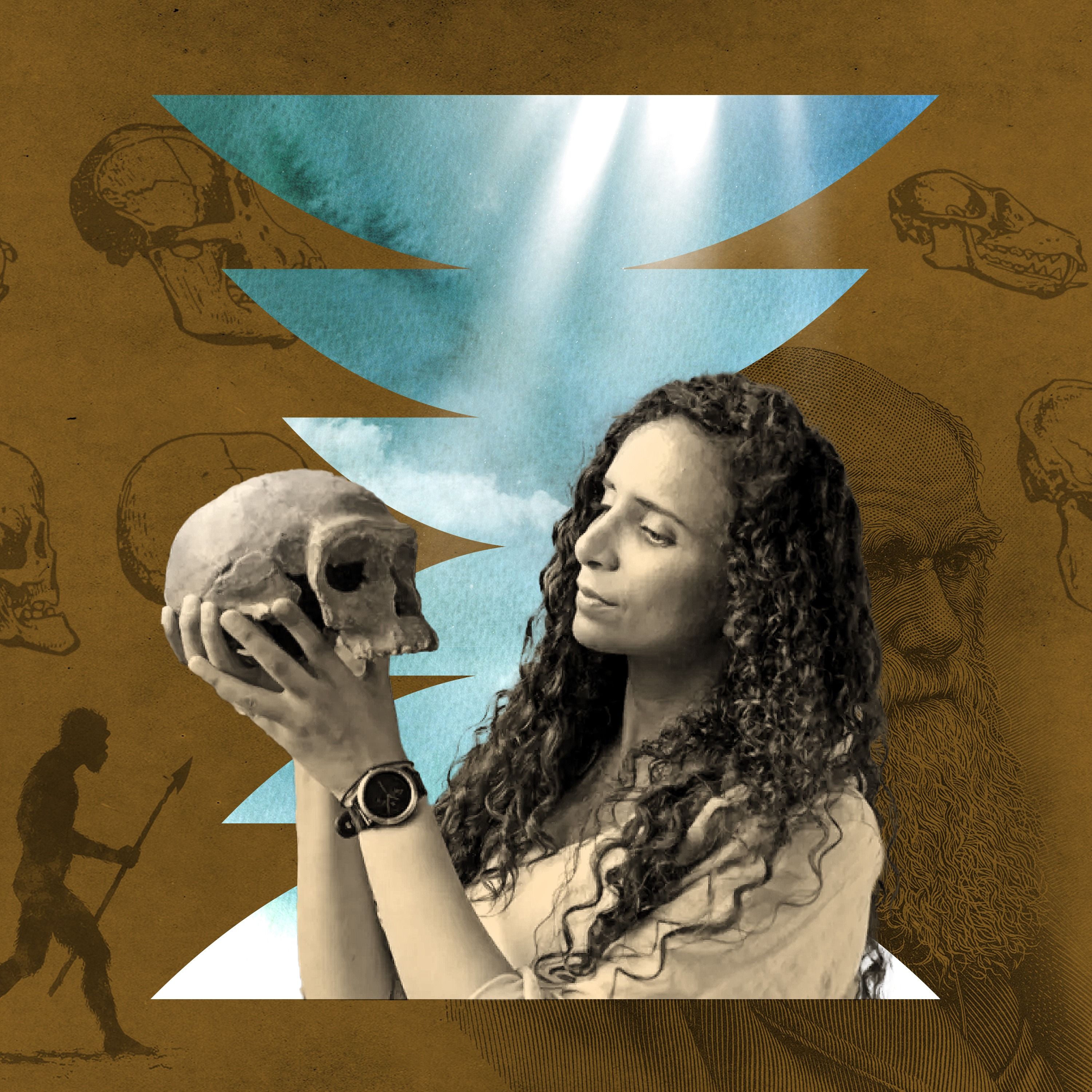
Radiolab
Creation Story
00:34:53
Ella al-Shamahi is one part Charles Darwin, one part Indiana Jones. She braves war zones and pirate-infested waters to collect fossils from prehistoric caves, fossils that help us understand the origin of our species. Her recent hit BBC / PBS series Human follows her around the globe trying to piece together the unlikely story of how early humans conquered the world. But Ella’s own origins as an evolutionary biologist are equally unlikely. She sits down with us and tells us a story she has rarely shared publicly, about how she came to believe in evolution, and how much that belief cost her. Special thanks to Misha Euceph and Hamza Syed.EPISODE CREDITS: Reported by - Latif NasserProduced by - Jessica Yung and Pat Walterswith help from - Sarah QariFact-checking by - Diane Kellyand Edited by - Pat Walters EPISODE CITATIONS: Videos - “Human” (https://www.bbcearth.com/shows/human), Ella’s show on the BBC and PBS Signup for our newsletter!! It includes short essays, recommenda...
Loading summary
Transcript205 lines
- [00:01]
Radiolab Announcer
Radiolab is supported by AT&T. Few things feel better than knowing someone is in your corner. Like when your friend saves you a seat when you're running late. That's why ATT has connectivity you can depend on, or they'll proactively make it right. That's the ATT guarantee. Terms and conditions apply. Visit att.comguarantee for details. AT&T connecting changes everything.
- [00:22]
Latif Nasser
Radiolab is brought to you by Progressive Insurance. Do you ever find yourself playing the budgeting game? Well, with the name your price tool from Progressive, you can find options that fit your budget and potentially lower your bills. Try it@progressive.com, progressive Casualty Insurance Company and affiliates. Price and coverage match limited by state law. Not available in all states. Wait, you're listening.
- [00:48]
Ella Al Shamahi
Okay. All right. Okay. All right. You're listening to Radiolabs Lab radio from wnyc. Latif, how do I pronounce your name? Cuz I'm pronouncing it the Yemeni way.
- [01:08]
Latif Nasser
To pronounce it the Yemeni way. I'm like, I'm excited about you pronouncing.
- [01:12]
Ella Al Shamahi
It the Yemen way because it's used heavily by Yemenis. Lovely.
- [01:16]
Latif Nasser
Like, just to mean, like, something's nice or something or.
- [01:18]
Ella Al Shamahi
Yeah. Or how's your day going at least?
- [01:22]
Latif Nasser
Oh yeah, I love it. Oh, that makes me feel so warm. Wait, now pronounce your name for me so I know what, how to say your name anyway.
- [01:30]
Ella Al Shamahi
Allah.
- [01:31]
Latif Nasser
Allah.
- [01:32]
Ella Al Shamahi
Allah. It's like at the end, it's too much. Everyone kept calling me Allah and I was like, I know I'm great, but you know, I think that's too far, guys.
- [01:46]
Latif Nasser
Hey, I'm Latif Nasser, this is Radiolab and I'm talking with Ella Al Shamahi. She's a paleoanthropologist and evolutionary biologist. And she's like, honestly, the modern day Indiana Jones. She travels all over the place collecting fossils. Sometimes this takes her into active war zones or through pirate infested waters. And she does all of this to help piece together the story of how humans came to be.
- [02:14]
Ella Al Shamahi
The thing is, as well, our story is kind of epic, man. Our story's epic.
- [02:20]
Latif Nasser
She's got a new TV show out now on the BBC and pbs. And in it she explains that the origin of our species is kind of surreal.
- [02:30]
Ella Al Shamahi
We lived in a world that was a bit like Lord of the Rings. There was obviously the Neanderthals, which so many people have heard of, but there were all these other species, including one of my favorites, Homo floresiensis, who are Basically, these hobbit, like humans, they were really short. They were about three and a half feet tall. Now, that means humans the size of penguins were living on this island in Indonesia called Flores. And on this island, there were giant rats and elephants the size of cows. So humans the size of penguins were hunting elephants the size of cows.
- [03:02]
Latif Nasser
And at the same time that you had the Neanderthals and these penguin people, there were also other groups like the.
- [03:09]
Ella Al Shamahi
Denisovans, the Neanderthals of Asia.
- [03:11]
Latif Nasser
There was a species called Homo naledi, another one called Homo luzinensis.
- [03:16]
Ella Al Shamahi
This was the world that we were.
- [03:17]
Latif Nasser
Born into, a world where our little tribe was competing with these other little human Ish tribes and often losing.
- [03:26]
Ella Al Shamahi
We were constantly not succeeding. And then we did. And we did in the biggest way possible.
- [03:36]
Latif Nasser
And the fact that we did that, it was us and not one of these other groups. Ella says that was extremely unlikely. The story of how that happened is amazing. It's what her TV show is all about. But what I wanted to talk to Ella about was this other very unlikely thing, her origin story and the fact that she's the one telling us about all this stuff in the first place.
- [04:00]
Ella Al Shamahi
Okay, so what you're referring to there is something which I guess I have not really known how to talk about God up until quite recently. In fact, one of my friends turned around and said, just last year you said that you might go to your grave with this. I was like, oh, yeah.
- [04:17]
Latif Nasser
Why? Why is. Why was. Why has this been so tender?
- [04:21]
Ella Al Shamahi
I. You come from a religious background, right? I do.
- [04:25]
Latif Nasser
I was very devout.
- [04:27]
Ella Al Shamahi
No way.
- [04:28]
Latif Nasser
Yeah. And then I went off to high school, I went off to college, and I was like, oh, this isn't what I thought it was. And the. Yeah. I don't know.
- [04:37]
Ella Al Shamahi
I did not know that.
- [04:38]
Latif Nasser
Yeah.
- [04:39]
Ella Al Shamahi
I never get to have this conversation with people who have any kind of religious background, let alone a Muslim background.
- [04:47]
Latif Nasser
Yeah.
- [04:49]
Ella Al Shamahi
I think my fear is that I do not want my story to be a stick to beat people who are in religious communities with.
- [05:00]
Latif Nasser
I don't want that either. And actually, I feel like hearing Allah's story in her own words and how surprising and insightful and moving it is. Like, I think it'll do the opposite. So I just asked Ella to tell me about it. Starting from the beginning.
- [05:17]
Ella Al Shamahi
The community was incredibly tight. It was incredibly protective. It was absolutely overprotective as well. You know, like, I.
- [05:24]
Latif Nasser
As a woman, I'm sure. Yeah.
- [05:25]
Ella Al Shamahi
Oh, my God. Yeah. Like, I didn't wear trousers. I didn't wear Makeup. It was an ultra conservative community.
- [05:32]
Radiolab Announcer
Where were you?
- [05:32]
Latif Nasser
Where were you again? Where'd you grow?
- [05:34]
Ella Al Shamahi
Birmingham, England. Birmingham, yeah. Yeah. So. So my parents are Yemeni, but the community was kind of quite pan Arab. And regardless of the denomination you came from or the sect or whatever, you were pretty much anti evolution. And I really, really took to it.
- [05:52]
Latif Nasser
Like, for me, okay. So the way when I grew up, it was this feeling of, okay, evolution is true, but Allah is this invisible hand guiding evolution. It feels like you didn't have that. Yeah, no.
- [06:08]
Ella Al Shamahi
Clearly, you know, your family exists. Clearly there were families and individuals who did explain things like that.
- [06:15]
Latif Nasser
Right, right, right.
- [06:16]
Ella Al Shamahi
But there was no space for evolution in my family, and there was absolutely none in the missionary world.
- [06:24]
Latif Nasser
And what did you believe? Like, what was the creation story that you believed?
- [06:31]
Ella Al Shamahi
Yeah.
- [06:32]
Latif Nasser
How did you think people came to be.
- [06:34]
Ella Al Shamahi
So I personally believed that we were created in a week, basically. God created us in a week, as in the whole world, including Adam and Eve.
- [06:42]
Latif Nasser
It's weird. I feel like I know the Christian creationist story better than I know the Muslim creationist story in a way. Or is it very similar? Very similar.
- [06:49]
Ella Al Shamahi
They're very, very similar. The one difference is that the Christians give God a day off. Muslims are like, God doesn't need a day off.
- [06:58]
Latif Nasser
Anyway. So Ella was all in on this version of Islam, and before she even learned how to drive, she started sharing it with other.
- [07:06]
Ella Al Shamahi
Yeah, I became a missionary at the age of 13 and, like, traveled the UK being a missionary.
- [07:12]
Latif Nasser
And missionary means, like, you were going to. Who were you going to talk to?
- [07:16]
Ella Al Shamahi
Well, I was speaking to more lapsed Muslims.
- [07:19]
Latif Nasser
Okay. Yeah.
- [07:19]
Ella Al Shamahi
But also to the wider public.
- [07:22]
Latif Nasser
That was a hard. What years were these?
- [07:24]
Ella Al Shamahi
Like, basically, you know, in the 90s, I was basically, certainly in the 2000s.
- [07:28]
Latif Nasser
Because I was thinking, like, after 2000, that would have been a much harder job talking to the lay public about Islam.
- [07:34]
Ella Al Shamahi
Yeah. Well, except that we felt like we had clearly been misrepresented by these lunatics. Right. By these terrorists. And also, remember, our communities were therefore under more attack.
- [07:45]
Latif Nasser
Right.
- [07:45]
Ella Al Shamahi
I'll say. I was really young. It was kind of the world I knew. And I guess I have always been an all or nothing kind of person. Like, I clearly do not know how to do things in halves. And so I was like, okay, so this is the world around me. I'm not gonna just do it in the calm, chilled out way that I should have done it. Like my siblings.
- [08:05]
Latif Nasser
You were more, like, hard edge about it maybe, than your siblings.
- [08:08]
Ella Al Shamahi
I think I was more hardcore.
- [08:09]
Latif Nasser
Hardcore you were more hardcore than your siblings.
- [08:11]
Ella Al Shamahi
I mean, you know, if you were to speak to them, and I don't want to put words in their mouth, they're just like. You just didn't have any chill, you know, so it's really funny. So they look at me now and they're like, yeah, still don't have chill. Like, you just went from one extreme to the. You know, it's just really funny. Cause they're not wrong. Like, I could have just, you know, they're just relaxed.
- [08:32]
Latif Nasser
Was it one of those things? Like, I remember, for us, like, it was like. Like. And I was. I feel like I was somewhat similar as you. Like, because, like, a bunch of my friends, like, they would. They would go to the mosque, they'd go to masjid, and then they would, like. But then it's like, afterwards, like, it's like Friday night, like, we're gonna go drinking and we're gonna have fun. Like, it was like, that kind of thing.
- [08:48]
Ella Al Shamahi
We would have had thoughts about you.
- [08:51]
Latif Nasser
No, no, I didn't do that. But my. My buddies did that. And I was the straight edge kid who was like, no, no, no, I'm not drinking. I'm not. I'm not. I'm not smoking weed. I'm not doing any of these things.
- [09:01]
Ella Al Shamahi
So I was so strict that those guys wouldn't have even been my friends, except that I might have taken them on as projects.
- [09:08]
Latif Nasser
Right.
- [09:09]
Ella Al Shamahi
So, okay, imagine you're a missionary, and you're that age, and you're good, right?
- [09:15]
Latif Nasser
Yeah.
- [09:16]
Ella Al Shamahi
Your big thing that's hanging over you is what you're going to do at university.
- [09:19]
Latif Nasser
Because that was a big deal in your family.
- [09:20]
Ella Al Shamahi
Yeah, in our family, having a master's degree is the equivalent of a high school education.
- [09:24]
Latif Nasser
Wow. Okay. And who were. What are all these people? What did they study?
- [09:27]
Ella Al Shamahi
All kinds of things. Historians, some legal, but, like, theology kind of legal minds. And my dad was very encouraging of us going into the sciences.
- [09:38]
Latif Nasser
Other people from her community had studied science to go into medicine or engineering, but Ella had a different idea.
- [09:45]
Ella Al Shamahi
I was like, I'm gonna go study evolution because I'm gonna destroy Darwin's theory.
- [09:50]
Latif Nasser
Wow.
- [09:50]
Ella Al Shamahi
Yeah. I tackled the underlying assumptions of things.
- [09:54]
Latif Nasser
And then to expose them and then to persuade them, and then to, like.
- [09:58]
Ella Al Shamahi
Like, to basically proselytize my version of it.
- [10:03]
Radiolab Announcer
Yeah.
- [10:04]
Ella Al Shamahi
You know. Okay, so you're saying it's like this. Well, actually, have you considered. It's actually like this.
- [10:08]
Latif Nasser
Yeah.
- [10:09]
Ella Al Shamahi
Have you considered the data could actually fall into this interpretation instead?
- [10:13]
Latif Nasser
And why that? Like, why was that the thing you fixated on?
- [10:16]
Ella Al Shamahi
Because I'm a missionary, my whole. My whole purpose is like, to bring people to the message, to bring people to God. Right. And one of the biggest reasons why they're not is that they. They believe that God doesn't exist. And the reason for that is the evolution exists.
- [10:34]
Latif Nasser
So it's like. It really is like a. Like for you. I mean, it feels like it's. It's like the same debate from, like, Darwin's time. Like, it's like, oh, my God.
- [10:42]
Ella Al Shamahi
Yeah.
- [10:42]
Latif Nasser
You think we came from apes? We came from God.
- [10:44]
Ella Al Shamahi
Yeah. That whole monkey story ain't gonna fly kind of thing.
- [10:47]
Latif Nasser
So. So, okay, so. So when you applied, like, what did you say or what did they.
- [10:52]
Ella Al Shamahi
Yeah, somebody asked me this recently. They were like, hold on, hold on. So in the interview, and you were like, yeah, so I'm just gonna be destroying your theory from the intersection. Yeah, that's right.
- [11:00]
Latif Nasser
Yeah.
- [11:01]
Ella Al Shamahi
What did you say? None of that. I just was like, I really want to study genetics. I think it's amazing. I love all the evolution classes, blah, blah, blah, blah.
- [11:11]
Latif Nasser
But you were lying. That was a lie.
- [11:12]
Ella Al Shamahi
I mean, I.
- [11:14]
Latif Nasser
Was it?
- [11:14]
Ella Al Shamahi
I guess so. I'm not happy with the fact that you used that word, but I guess it was. Yeah, because it was a lie of omission.
- [11:21]
Latif Nasser
Right?
- [11:21]
Ella Al Shamahi
For sure. Yeah. Well, actually, I guess it must have been a lie, because when they ask you, why do you want to study this? The actual answer is, because I want to destroy this. And I clearly wasn't saying. Ah, damn it.
- [11:32]
Latif Nasser
Did you. Was this like a private mission or did you talk to people about this?
- [11:38]
Ella Al Shamahi
The other missionaries all knew about this. Yeah, so. Yeah, so. But it wasn't, you know, I was never turning around telling the, you know, other classmates who were.
- [11:45]
Latif Nasser
You were a double agent, basically.
- [11:47]
Ella Al Shamahi
I like the sound of that. I mean, if you'd have known me at the age of 18, I was a dork. So the idea of being a double agent is somewhat hilarious. Look, I was obsessed. I was a woman on a mission. And so I turn up to University College London, which, for those of you in the know, is known as the godless place on Gower street because it's the first university to have, like, allowed non Church of England.
- [12:15]
Latif Nasser
Wow.
- [12:15]
Ella Al Shamahi
People to kind of join up. And I went to the Darwin building because Charles Darwin himself, he lived there, and that was my department. And by the way, it's kind of hilarious because I was dressed in very, very conservative Muslim garb. I wasn't even just in a hijab. I was in the full. So I wasn't just in the head covering. I was in the full jilbab, which is like that full cloak, by the way. Not that there's anything wrong with dressing however you want. I'm like, man, you just be you. You know, There were a few girls on hijab, actually, but they were interested in more medical genetics. They weren't kind of doing what I was kind of what I was covertly up to.
- [12:54]
Latif Nasser
Right.
- [12:55]
Ella Al Shamahi
I remember there was one girl who was also kind of vaguely associated with my world kind of thing. And she was there, and I was so excited because I thought I'd found, like, a partner in her. I was like, oh, my God. And I was sitting there, and I was like, right, so this bit of the theory, like, I'm just thinking that actually there's a different interpretation that you can have for this data. Blah, blah, blah. And she just freaked. And she looked at me, and she was just like, look, I'm here because this is a mandatory course. I have to pass this evolution class, otherwise I don't get my degree.
- [13:25]
Latif Nasser
Like, she had a firewall up.
- [13:27]
Ella Al Shamahi
Yeah.
- [13:28]
Latif Nasser
But for Ella, there was no wall. Like, she was pushing these two worlds right up against each other.
- [13:34]
Ella Al Shamahi
So there's, like, two things going on, right? So I'm just living my life being a missionary. I have an arranged marriage via my imam, by the way. My dad wasn't even involved.
- [13:44]
Latif Nasser
That started in university or in grad.
- [13:46]
Ella Al Shamahi
School or it was my first semester at university. The imam suggested to me that, yeah, he wanted me to marry one of his other students. And I was like, okay. And so that took a while. What were you excited about?
- [13:58]
Latif Nasser
Were you flattered? Did that feel good or did that feel icky?
- [14:01]
Ella Al Shamahi
You know what? Like, I. I didn't know him. I had three chaperoned meetings with him to decide if I was gonna agree to marry him. And then we basically never talked, ever. I can't explain it enough. I just didn't know him, you know? And, like, we had to get my dad to agree. And so that took a while. Cause dad didn't want me getting married before I'd finished my first degree. And so we had to wait. And so, you know, all of this was going on. I was, you know, traveling up and down, like, doing this, doing that. And at the same time, it's like. It's just constantly, like, picking at this theory of Darwin's. Right. I mean, effectively, what I was doing was trying to unpack a massive puzzle. Now, everybody else had already unpacked it 150 years ago. And I'm coming along being like, hold on, hold on.
- [14:47]
Latif Nasser
We can put these pieces together another way.
- [14:50]
Ella Al Shamahi
We can. Just haven't thought of something. Give me a minute. And by the way, some people do that to great success. Some people have won Nobel prizes on the back of this. I just picked the wrong puzzle.
- [15:00]
Latif Nasser
Right. So Ella is going to class every day, learning about the evidence for evolution and the story the scientists say that that evidence tells us. And of course, she's looking for holes in that story. And one of the first holes that Ella had always noticed was that particular moment in evolution when one species somehow, like, poof, becomes another. Like, how does that happen? And then one day she's sitting in class and the professor starts talking about.
- [15:35]
Ella Al Shamahi
This experiment, the Drosophila fruit fly experiment.
- [15:39]
Latif Nasser
Yeah.
- [15:40]
Ella Al Shamahi
So basically, because the. Because Drosophila lived for such a short amount of time, you can basically, like, you know, instead of it being, you know, a mountain pops up between two animals, and it takes, like, you know, hundreds of thousands of years for them to evolve. You're doing it with Drosophila in a lab, and you're kind of doing it in a much shorter timeframe. You're just kind of separating them.
- [15:58]
Latif Nasser
Yeah.
- [15:59]
Ella Al Shamahi
And without getting into it, they were starting to see the process of speciation in the lab. And I was like, oh, that's not good.
- [16:10]
Latif Nasser
Because if we're watching them become new species, we're watching evolution, which I don't think happened.
- [16:17]
Ella Al Shamahi
Yeah. But my. My only comfort with that experiment was that it was being done in the lab. And I just thought, okay, but that might not be happening in nature. Yeah, maybe it's being forced in the lab. Maybe in nature that wouldn't be happening.
- [16:35]
Latif Nasser
But she keeps going to more lectures, and eventually she's running into other problems.
- [16:39]
Ella Al Shamahi
Like stratigraphy, just the layers of Earth and that kind of sequence of animals that you get in them, and they are broadly chronological. And you do see an evolutionary process there. Yeah, you just do. It's really, really hard.
- [16:55]
Latif Nasser
It's like you dig deeper, you see simpler things, kind of generally.
- [16:58]
Ella Al Shamahi
Yeah. You know, it is. Forgive my language. You can't broaden. You're like the BBC, right? You can't broadcast swearing.
- [17:06]
Latif Nasser
No, we can broadcast swearing. Yeah.
- [17:07]
Ella Al Shamahi
Oh, nice. Sorry, I've been cleaning up my language.
- [17:11]
Latif Nasser
No, go for it.
- [17:13]
Ella Al Shamahi
Yeah. Like, you would be looking at these stratigraphic sequences, and it was a, you know, forgive my language, but it was a. Motherfucker. Because you were just like, right, we haven't Gone from complex to simple. By and large, we go from simple to complex or more complex, and it was just a consistent pattern. And it's very, very hard to explain that. So then I was like, okay, theologically, the real, real issue is Adam and Eve, right? So technically speaking, I can believe in evolution as long as it's not Adam and Eve. As long as it's not us, we're the exception, Right, Right, right.
- [17:53]
Latif Nasser
So you're like, okay, so you gave a little ground. You were like, this makes sense. I can give a lot of ground.
- [17:58]
Ella Al Shamahi
All other species.
- [17:59]
Latif Nasser
All the other species.
- [18:00]
Ella Al Shamahi
All the other billions.
- [18:01]
Latif Nasser
That's right. But not us.
- [18:04]
Ella Al Shamahi
Yeah. And then what happened was I came across retrotransposons, which are very, very complicated to explain, but basically, it's like a foreign organism's DNA within. Within our own bodies, within every.
- [18:15]
Latif Nasser
So retrotransposons, they're little bits of DNA from, for example, a virus that infected our ancestors millions of years ago and just, like, got stuck in our genome and passed on from generation to generation. They're like this little historical record of something that happened to us a long, long time ago. And the reason Ella remembers this is that when she was learning about retrotransposons in a lecture, the professor mentioned this weird fact about these little bits of.
- [18:46]
Ella Al Shamahi
DNA, the pattern of mutations within the retrotransposons that we have align on a family tree with what you would expect from evolution if you then looked at those same retrotransposons within chimps.
- [18:58]
Latif Nasser
In other words, these little bits of DNA, I mean, there are hundreds of them, are lodged in the chimp genome in. In exactly the same places that they're lodged in our genome.
- [19:08]
Ella Al Shamahi
How does that. Like, the only interpretation for the mutations that you find in retrotransposons is that it is evolution through descent with modification over, you know, hundreds of thousands.
- [19:18]
Latif Nasser
There's no other interpretation like, God would have had to copy paste or something.
- [19:23]
Ella Al Shamahi
This is the thing, because one of the arguments that. For those of you who don't know, one of the arguments that creationists use to explain, well, why is our DNA so similar? Right? Like, why is our DNA so similar to chimps? They're like, yeah, but they look similar and they have so many similar behaviors and they have so many similar mechanisms. And on a level, on one level, you're like, oh, okay, that is actually like, there is some logic to that. Yeah, Retrotransposons, they're not functional.
- [19:49]
Latif Nasser
Yeah.
- [19:50]
Ella Al Shamahi
It's not like, oh, it's a bit of DNA. That helps me process for example, water or helps me process carbohydrates. It's a non functional bit of DNA and yet its mutation pattern fits almost perfectly with an evolutionary family tree. And it was just like, ah, it's just, Sorry. That's the noise that you make when your whole life is about to fall apart. That exact noise is the noise you make. And I was just in hell. Like, I was in hell. There'd be times where I'd just be looking out my window, just going, oh my God, like, what is this? Like, what am I gonna do?
- [20:36]
Latif Nasser
Were you living with this guy at that point or what? Were you living with this guy?
- [20:40]
Ella Al Shamahi
My ex husband? Yeah.
- [20:40]
Latif Nasser
You're married?
- [20:41]
Ella Al Shamahi
Yeah. Our marriage wasn't doing great, partly because we had an arranged marriage and we didn't know each other, but partly for a number of different reasons, one of which was this issue, like, you know, he, like, I was clearly struggling and then there was a moment, just an awful moment, which was kind of. I was just in the shower and as you often do in the shower, you're kind of just having a conversation with yourself. You're also, you know, bluntly naked and you're very exposed, but you're in a safe place. Right. And I kind of. I basically tell myself that I have to find the strength to be honest, that I just, I believe in evolution. And I just fell to the floor. Like, I just, I was like hysterically crying. I was just so, so distraught. And the, the reason I was so distraught at this point was that I knew that meant I was going to have to leave my world.
- [21:51]
Latif Nasser
How do you leave your whole world and try to join another one? And what does it do to you if you do that? We'll be right back.
- [22:13]
Radiolab Announcer
Radiolab is supported by AT&T. Few things feel better than knowing someone's in your corner. Whether you're celebrating a win or trying to work through a loss. Staying connected matters. Check ins, no matter how casual or quick they may seem, are moments that matter. AT and T wants to ensure these moments are always in reach, with their guarantee that covers both wireless and fiber Internet service that is all about having your back. Staying connected matters. That's why in the rare event of a network outage, AT&T will proactively credit you for a full day of Service. That's the AT&T guarantee. That's a wrap for now, but if you're thinking of reaching out to someone who has been on your mind, go for it. Credit for fiber downtime lasting 20 minutes or more or for wireless downtime lasting 60 minutes or more caused by a single incident impacting 10 or more towers must be connected to impacted tower at onset of outage. Restrictions and exclusions apply. See att.com guarantee for full details at and t Connecting changes everything.
- [23:06]
Latif Nasser
This is Ira Glass, the host of this American Life. So much is changing so rapidly right now with President Trump in office. It feels good to pause for a moment sometimes and look around at what's. What to try and do that. We've been finding these incredible stories about right now that are funny and have feeling, and you get to see people everywhere adapting and making sense of this new America that we find ourselves in. If you haven't listened in a while, I honestly think these are some of the best stories we've ever done. This is American Life every week, wherever you get your podcasts. Hey, I'm Latif Nasser, this is Radiolab. I'm talking with Ella Al Shamahi, who went into college as a creationist and came out an evolutionary biologist, a 180 that she feared would basically destroy her life as she knew it.
- [23:56]
Ella Al Shamahi
I had no idea what was going to happen with my family. You know, this hadn't happened in my family before. Right. But what I did know is it was going to drive a massive wedge.
- [24:07]
Latif Nasser
And why did it feel like, why did it feel so existential, like, like, like you. These things could not coexist. There was no room for you to believe in evolution and, and still be a part of your community because it's.
- [24:20]
Ella Al Shamahi
Such an extreme thing in my world and say that you believe in evolution and, you know, that's just. We just didn't do that. And by the way, all cases where that did happen, like, let me tell you, loads of those girls got cut off. Thank God my siblings came through in the way that they did.
- [24:40]
Latif Nasser
Wow. How did they come through?
- [24:43]
Ella Al Shamahi
They decided to embrace me regardless. They decided that I was their sister, regardless. Makes me want to cry.
- [24:53]
Latif Nasser
And what about your friends and other people in the community?
- [24:56]
Ella Al Shamahi
I didn't tell people. I just disappeared. I didn't tell people.
- [25:00]
Latif Nasser
You just ghosted people?
- [25:01]
Ella Al Shamahi
Yeah, I literally just disappeared. And that's because I was a missionary and I knew the training. And the training is if somebody, you know, falls, you go collect them, basically. And I did not have the energy. And also, this is the strange thing, I didn't want anyone else to follow me because I didn't want them to go through what I was going through. I was like, no, you know what? You don't need to learn about evolution. You just stay where you are.
- [25:26]
Latif Nasser
This is awful.
- [25:28]
Ella Al Shamahi
It was truly awful time. I had no idea how to exist in a secular world. Suddenly, every single thing did not have a rule attached to it, which you might think is freeing, except if that's the only thing you've ever known, that's terrifying. It was like you went into the bathroom with the left foot. You left it with the right foot. You wrote with your right hand. The prophet would have done it with your left hand.
- [25:50]
Latif Nasser
Situation.
- [25:51]
Ella Al Shamahi
Yeah. It's like every single thing is prescribed. And suddenly it was like, good luck. I didn't make eye contact with men.
- [25:58]
Latif Nasser
Yeah.
- [25:59]
Ella Al Shamahi
I literally never made eye contact with men. I, I, I took my headscarf off and I basically, I turned up to the. To like a gas station.
- [26:09]
Latif Nasser
Yeah.
- [26:10]
Ella Al Shamahi
And it was the most anticlimactic and has probably informed a huge part of my personal life since. Because no man cared. Like, I had been told my whole life that, like, you know, my hair was like. And, you know, got to cover up because it's a fitness. It's like it's corrupt it like it corrupts the earth if you. And it's a bad translation, but, like, you know, isn't. It's all these things that you, these things you've got to do to not.
- [26:40]
Latif Nasser
Because it's like raw. It's like raw sexuality. It's like that kind of thing. Is that the feeling?
- [26:43]
Ella Al Shamahi
I don't know what it was, because let me tell you, nobody cared. Like, nobody cared. Nobody. I cannot express this enough. There were no men dropping from my sheer beauty. Nobody was fainting. Nobody was doing anything. Like nobody cared. And it was so funny. But it was, you know, it was quite an adjustment. It was like, I've got to now learn to fit in. And it's funny because I think anthropologists traditionally, and as you know, I am a paleoanthropologist, you kind of go and sit with these exotic and inversed commas tribes, and you kind of learn their ways. And I was like, my exotic tribe is just central London. That's it. Me. And I would sit there studying people's behavior and going, all right, so this is how they act. Okay, so this is. Okay. All right. So that's, you know, I wrote a book about the handshake, Right. Writing a book about the handshake does not come because somebody is like, just casually not questioning. Writing a book about the handshake comes when you are obsessively reading the behavior of every person around you. Because in your culture, you never shook hands with Men, right? I had this one friend who was just like, oh, you must be so relieved to be free. And I was just like, do you understand the trauma that I've just been through? I didn't want this. This isn't what I wanted. Certainly, like, now, 10, 13 years later, I can look back and go, I'm glad that I'm not constrained by dogma, unless I pick that dogma. But let's not pretend that this is a fun world. I mean, I'd definitely rather be here, but let's not pretend it's perfect. I think the community thing is such a. I think this is what I have found really, really, really difficult to explain to so many of my secular friends who are basically my tribe now. Let's. Yeah, I will never, ever, ever be in a community like that again. I think religious communities are warm. They engulf you, they embrace you. Your hot water goes off. Everybody offers you their place. Somebody ends up in hospital. And people get angry with the hospital administration because they're like, what are you talking about? Only two people during visiting hours. And what's this visiting hours? This person needs us all around the clock. And it's just kind of, oh, my.
- [28:57]
Latif Nasser
God, I feel I'm raising kids right now, and I'm not raising them in the mosque that I grew up in. And it's like, it's sad. I yearn for that.
- [29:07]
Ella Al Shamahi
It's so difficult. It was like I didn't know who I was anymore. And the people that were around me that would normally love me and knew who I was, they were all new to.
- [29:21]
Latif Nasser
And in the midst of all this upheaval, Ella was still going to school and starting to become obsessed with the thing she would spend her entire career studying our origin story. That moment when there were all these little groups of proto humans living together on the planet at the same time, but also very much separate from one another.
- [29:41]
Ella Al Shamahi
I think it is no surprise that having gone through what I've gone through, that when I look at our story, the science of our story, that I. I feel something. Like, I feel something. We know that everybody from outside of sub Saharan Africa and even some people within Sub Saharan Africa have some Neanderthal DNA in them. And that can only be explained by basically one of our great, great, great grandparents getting it on. Yeah, Having sex with a Neanderthal. So there's a scandal in the family, basically. Now, usually. Right. The way this would be presented is, oh, there's some Neanderthal DNA. So that means there was some kind of intercourse, blah, blah, Blah. Right. We take a moment, and instead it's like. Hold on a second. Right. That means that one of our ancestors. Not like a theoretical one of my. And your ancestors.
- [30:34]
Latif Nasser
Yeah.
- [30:36]
Ella Al Shamahi
Was half. Half.
- [30:38]
Latif Nasser
Right.
- [30:38]
Ella Al Shamahi
And I'm. I'm not mixed race, but I'm mixed heritage, so I'm a British Arab. Right, right. Let me tell you, that was confusing growing up at times. Right? At times I was like, it's a bit weird. I'm like, what would it be like to not just be mixed heritage, not be mixed race, but mixed species? Like, what would that have been like? And what would the mother have felt like? How would she have felt? Would she have been sitting there hoping that the child would look more Homo sapiens than Neanderthal because, you know, she doesn't want them to get ostracized. She doesn't want them to get cheesed.
- [31:09]
Latif Nasser
Wow. Like, pregnant. Like that. Mom is sitting there pregnant, like, thinking about what her baby. Whether her baby's gonna have a brow ridge or a chin or something.
- [31:17]
Ella Al Shamahi
Seriously.
- [31:18]
Latif Nasser
Is there any evidence to suggest that crossovers like Neanderthal and Homo sapiens, us couplings, made us more successful? Like that? Those.
- [31:30]
Ella Al Shamahi
Yeah, yeah, yeah. So we were the new kid on the block. And, for example, when we entered into Neanderthal territory, Neanderthal territory being kind of Europe and northern Asia, we would not have had immunities to local diseases. So when we interbreed with those people, it's effectively like a cheat. So suddenly we end up with immunities to things that would have taken us, ourselves, tens, if not hundreds of thousands of years to evolve for. There are some really, really good examples, actually. And the best one is the Tibetan example. Are you familiar with this one?
- [32:07]
Latif Nasser
No. Tell me.
- [32:08]
Ella Al Shamahi
So Tibetans live at, obviously, very high altitude. And the mechanism, the genetic mechanism, by which they are able to exist at high altitude is very different from the genetic mechanism that exists in other populations who exist at high altitude. And the mutation is actually one that they inherited off Denisovans.
- [32:30]
Latif Nasser
Like, we drank their superpowers kind of thing.
- [32:34]
Ella Al Shamahi
Yeah, yeah.
- [32:35]
Latif Nasser
Okay, so now. So there are these sort of hybrid people.
- [32:41]
Ella Al Shamahi
Yeah.
- [32:43]
Latif Nasser
And you are kind of like, in a way, you're one of these crossover people. I mean, this experience, this ordeal that you went to. Yeah, yeah, yeah. But, like, what? So, okay, so if this is. If that's the value of the crossover person, it's like, oh, I can get. I now have superpowers from both worlds or something. What did you gain from that crossover?
- [33:09]
Ella Al Shamahi
I. I would say I was so traumatized by it and still am, like within a, like a second, I could get quite upset about it. And I think when you've been through that, you are much more patient with people who deny the science, don't trust the science. Because I understand that I am, when I am trying to persuade somebody of a scientific point, nine times out of 10, I'm not trying to persuade them of one scientific point. I'm effectively taking apart their worldview.
- [33:51]
Latif Nasser
Yeah.
- [33:52]
Ella Al Shamahi
And because I've gone through that, I approach that with empathy by and large. Doesn't mean that every so often I don't get irritated, but I just fundamentally at my core understand that when somebody has that belief, it's not one belief, it's a belief system. And I then approach it as such. So then what I find myself doing is I actually have less interest in debating that point with them and more interest in bonding with them as a person and showing them who I am and me seeing their humanity. That's why it gently does it for me in terms of methodology and also fundamentally, in my mind, accepting that they may never believe me, they may never accept my version of events. And that's okay.
- [35:04]
Latif Nasser
Ella Al Shamahi again. Her show is called Human. It's on PBS and the BBC. Man, she's so good in it. And it really features the full menagerie of proto humans. The team of fully human humans who put this episode together. Not even one Neanderthal. Among them was Jessica Young and Pat Walters with help from Sara Khari. It was fact checked by Diane Kelly. Special thanks to Hamza Syed and Misha Yousef and you for listening. We will be back soon with another episode. I just have to kill this tiny elephant first. Catch you later.
- [35:47]
Ella Al Shamahi
Hi, I'm Monica and I'm from Mexico City and here are the staff credits. Radiolab was created by Jad Abumrot and is edited by Zoran Wheeler. Lulu Miller and Latif Nazar are our co hosts. Dylan Kiffey is our director of sound design. Our staff includes Simon Adler, Jeremy Bloom, W. Harry Fortuna, David Gable, Maria Pazoutieres, Sinduyan Sambandan, Matt Kilty, Annie McEwen, Alex Neeson, Sarah Carey, Sarah Sandbach, Anisa Bitze, Arianne Wack, Pat Walters, Molly Webster and Jessica Young, with help from Rebecca Rand. Our fact checkers are Diane Keeley, Emily Krieger, Ana Pujormasini and Natalie Middleton.
- [36:39]
Latif Nasser
Hey, Radiolab.
- [36:41]
Ella Al Shamahi
Michael, Tacoma, Washington Leadership support for Radiolab science programming is provided by the Simons foundation and the John Templeton Foundation. Foundational support for Radiolab was provided by the Alfred P. Sloan Foundation.
- [37:02]
Radiolab Announcer
Did you know Tide has been upgraded to provide an even better clean in cold water. Tide is specifically designed to fight any stain you throw at it, even in cold butter. Yep, chocolate ice cream? Sure thing barbecue sauce. Tide's got you covered. You don't need to use warm water. Additionally, Tide pods let you confidently fight tough stains with new coldzyme technology. Just remember, if it's gotta be clean, it's gotta be Tide. NYC now delivers the most up to date local news from WNYC and Gothamist every morning, midday and evening with three updates a day. Listeners get breaking news, top headlines and in depth coverage from across New York by sponsoring programming like NYC Now. You'll reach our community of dedicated listeners with premium messaging and an uncluttered audio experience. Visit sponsorship.wnyc.org to get in touch and find out more.