← Radiolab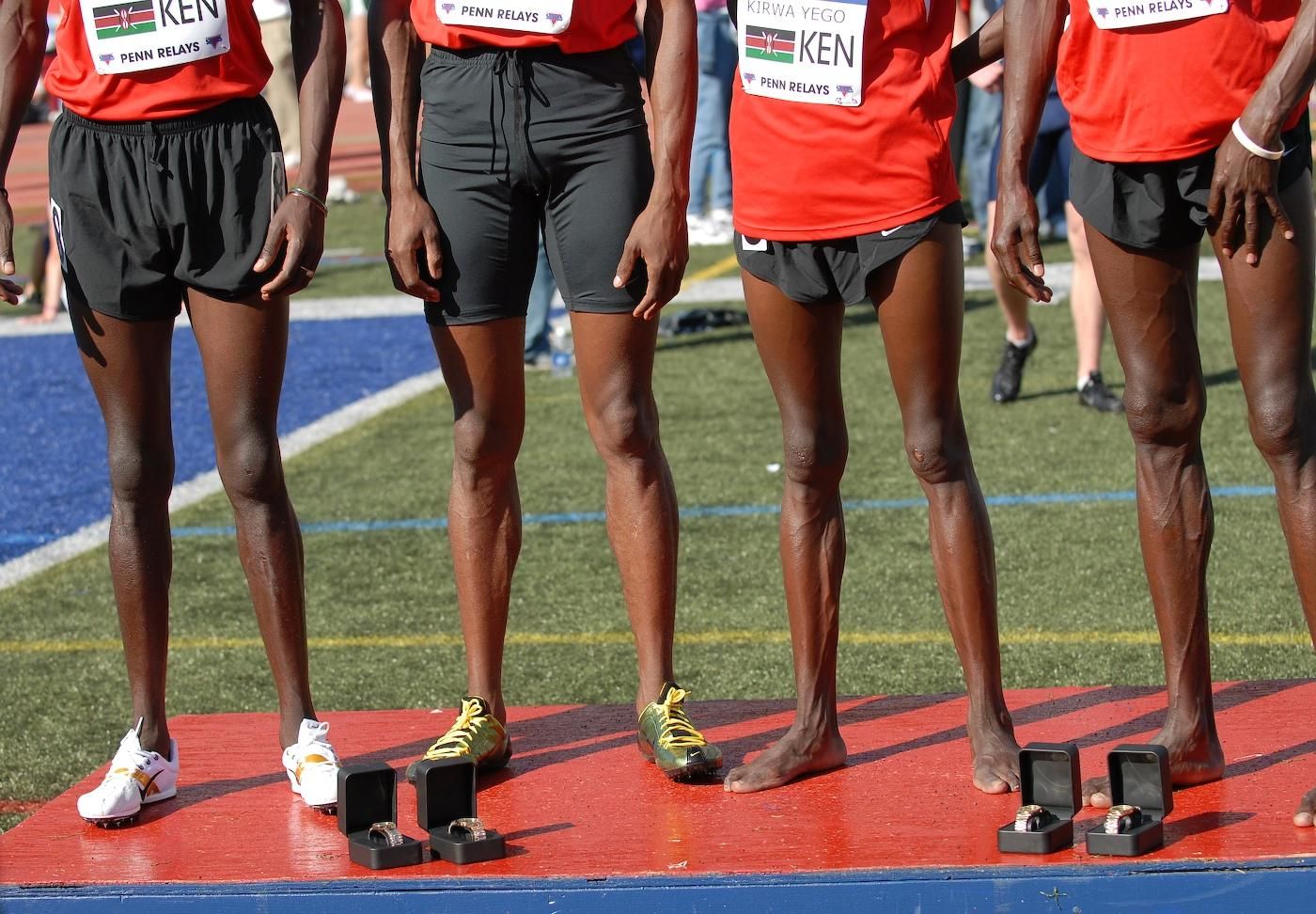
Radiolab
Cut and Run
00:25:10
Legions of athletes, sports gurus, and scientists have tried to figure out why Kenyans dominate long-distance running. In this short, we stumble across a surprising, and sort of terrifying, explanation.
Loading summary
Transcript125 lines
- [00:00]
A
Hey, it's Austin James. Yes, I'm living with diabetes, but it doesn't have to define me. Thanks to the freestyle libre 3 plus sensor, I get real time glucose readings throughout the day. The freestyle Libre 3 Plus sensor is small and easy to wear, giving me the freedom to focus on my life as a parent and a musician. Now this is progress. You can get a free sensor at freestyleibre.us offer available for people who qualify. Visit MyFreestyle US to see all terms and conditions. Certain exclusions apply. Data on file Abbott Diabetes Care or prescription only. Safety info found @freestyleibre us. When it comes to gifting, everyone on.
- [00:33]
B
Your list deserves something special.
- [00:34]
A
Luckily, Marshall's buyers travel far and wide, hustling for great deals on amazing gifts so you don't have to. That means your mom gets that cashmere.
- [00:43]
B
Sweater, your best friend that Italian leather bag.
- [00:46]
A
Your co workers unwrap their favorite beauty.
- [00:48]
B
Brands, and your nephews the coolest new toys.
- [00:51]
A
Go ahead.
- [00:51]
B
At prices this good, you can grab.
- [00:53]
A
Something for yourself too. Marshalls, we get the deals. You you gift the good stuff. Shop now@marshalls.com or find a store near you. It's never too early for Lowe's Black Friday deals. Snag some of our biggest savings of the season right now, like 25% off select pre lit artificial Christmas trees. And get yourself free select dewalt Cobalt or Craftsman tools when you buy a select battery or combo kit before the Black Friday rush. Because everyone loves free stuff, right? Lowes? We help you save valid through 123 while supplies last selection varies by location. Location. Oh wait, you're listening. Okay. All right. Okay.
- [01:37]
B
All right.
- [01:39]
A
You're listening to Radiolab, Radio Lab shorts from WNYC.
- [01:49]
B
And npr.
- [01:52]
A
Hey, I'm Jad Abumrad.
- [01:53]
C
I'm Robert Krolwick.
- [01:54]
A
This is Radiolab, the podcast. And today, since we are right about to have the New York City Marathon zip through our neighborhood here in New York, we have a puzzle. Yeah, it's a puzzle. It's a puzzle. Yes, it is a puzzle. And it comes from NPR's East Africa correspondent, Gregory Warner. I prepared for this story by taking a jog through Nairobi. Well, all right, so where do we start with this, Greg? I think we should start in 1968. I mean, there's a lot of places we could start, but let's start there. Let's try it. So 1968 Summer Olympics in Mexico City. Mexico City. Thankfully a city of peace on the Olympic opening day at 7900, one of the highest elevated Olympics and That's difficult for runners because there's less oxygen. And one of the big races that everybody's looking forward to is the 1500 meter between the 23 year old American favorite, Jim Ryan. Jim Ryan of America, number 300, he's the world record holder. And this guy named Kipchoge Kano. Kip Kano of Kenya. Number 565, Kip Kano. He's got Kip Kano. They bill him as an untrained Nandi tribesman from Kenya. He's actually a policeman from a long line of cattle rustlers. Martin Woodruff was to win a silver. And here's what you need to know about kip. He's running three different races at this Olympics. Not only the 1500, but also the 5000 meter and the 10,000 meter if you include the qualifying matches. He'll be running six Olympic events in eight days. Wow, six races in eight days, which would never be done today was hardly done then. So first up, 10,000 meter, the 10,000 meter race, he's in the lead, two laps away from finishing when he collapses. He falls off the track. He gets rushed to the Kenyan doctor, who's a German guy who diagnoses him with a gallbladder infection, which turns out is incredibly painful. Actually hurts the most when you take deep breaths like when you're running. And if you don't treat it, your gallbladder could burst. So basically the doctor sends Kip to bed, says there's no way you can run. But Kip, he runs the next race anyway, ends up getting silver. Wow. He's sent to bed by the German doctor again, who literally says, okay, this time you have to stay in bed. If you run any more races, you could die. Back to the track for one of the most memorable events of the whole games. The 1500 meters. Three days later, it's the big matchup against Jim Ryan. And Kip is apparently he just leapt out of bed an hour before the race and he said something like, if I die, I'm gonna die on the track. So Kip Kano starts off, they're up and running three and three quarter laps of the stadium. He starts out dead last. Kano running last and then moving up.
- [04:46]
B
To the middle of the pack.
- [04:47]
A
Now by the end of the first lap, he's in third.
- [04:49]
C
Norbot of Germany second and Kip Kano third.
- [04:52]
A
In the third lap he takes the lead. And here comes Kip Kano coming up with his teamma. He goes ahead, but that's okay for Jim Ryan. Jim Ryan's known to have the greatest kick in the sport. Kick, kick. Right at the end of the race, every runner gives this extra boost and Ryan's got the best kick in the business. Jim Ryan is beginning to move. So he's thinking there's no way that Kip Kano, at altitude, suffering a gallbladder infection, can hold out against my kick. And in the final lap, it looks like he's right. He starts shooting up the field, gaining on Kip Kano, who is clearly in pain. He's sort of grimacing, gritting his teeth. 300 yards left, the crowd lurching Kano, 200 meters left to the finish line. And even though he is in an ungodly amount of pain, even though pain is shooting through his entire body, amazingly, he does not slow down. Jim Ryan never catches him and he wins.
- [06:01]
C
And Ryan, completely disgusted when he hung on around that last turn, it was, oh, I was hysterical.
- [06:10]
A
This is John Manners.
- [06:11]
C
I'm a semi retired journalist who for many years had a specialty in covering the exploits of Kenyan runners, African runners in general.
- [06:21]
A
He was watching that race in a.
- [06:22]
C
Bar about 50 miles north of New York.
- [06:25]
A
But as a kid, Manners actually lived in the part of Kenya that Kip Kano is from, my people. And so when Kano won, it sparked a question for Manners that he would spend the next 40 years thinking about.
- [06:37]
C
I wanted to find a reason why my people, as I chose to regard them, were great.
- [06:44]
A
Because on that day in 1968, Kip Kano didn't just win a race, he ushered in an era of East African dominance in the sport. It's Kenya one, it's Kenya two, it's Kenya five. That is almost hard to believe. The Kenyans have done it again. One, two and three. Yep.
- [07:06]
C
It was once again the Kenyans, the.
- [07:08]
A
Eighth successive gold medal in Olympic history. It's a world record. A world record. So 1968 was the beginning of the Kenyan dominance in running. Yeah.
- [07:19]
B
But in the United States, we think of Kenyans as being good runners, but really it's this one tiny, small geographic swath within Kenya where all the runners come from.
- [07:30]
A
That's David Epstein. He's a senior editor at Sports Illustrated. He wrote a book called the Sports Gene. And the geographic swath that he's talking about is in western Kenya. It's a mountainous region spread out about the size of Massachusetts. And the people who live there are a particular tribe of Kenyans called the Kalenjin. Pretty small group of people.
- [07:48]
B
This tribe accounts for about 0.06% of the world's population.
- [07:53]
A
But from this one tiny tribe has.
- [07:56]
B
Come this unbelievable fount of talent that I think is unparalleled in any other sport ever.
- [08:03]
A
There's all kinds of statistics.
- [08:05]
B
It sort of becomes laughable. You know, there have been five American high school runners who have broken four minutes in the mile.
- [08:13]
A
The first was actually Jim ryan, but.
- [08:15]
B
There'S one high school in E10 in Kenya that had four sub four milers at the same time. There are 17American men in history who have run under 210 in the marathon. That's about four minutes and 58 seconds per mile pace. 17American men in history. There were 32 Kalenjin who did it in October of 2011. So you start to look at these statistics and it appears to be the greatest concentration of elite athletic talent ever in any sport anywhere in the world.
- [08:45]
A
And that's the question.
- [08:47]
C
I mean, how does that happen?
- [08:48]
A
That was John Manners question 40 years ago.
- [08:51]
C
Something has to account for this extraordinary set of numbers.
- [08:55]
A
But what? And there have been any number of scientists and sports gurus and athletes that have gone to this place to figure out what's happening, what's the secret here, you know, and there's all kinds of theories. Like it's something about the tree that they used to make the spoon which they used to mix the cornmeal. What would the tree do? Well, this was this Swedish scientist who came in and looked at ugali, which is like cornmeal. It's the basic staple food of Kenyans because he wanted to mix it with the water from the spring in the pot that Kalenjin used, thinking that something chemical was happening that was making these guys, you know, run super fast. What I mean, you know, it's kind of silly, but a lot of people here tell me it's the bananas. But people have also suggested some more reasonable theories. Well, according to John Manners, people talked.
- [09:44]
C
A lot about altitude and the ability to process oxygen and what have you.
- [09:47]
A
Other people have said it's because the Kalenjin have a high starchy diet or.
- [09:51]
B
Because they run to school. This is a very prominent phenomenon. We know that the runners that come from the Kalenjin tribe that become great runners, they're much more likely to have run to and from school long distances, like 10k to and from school. But there are millions of kids in Kenya who run to and from school.
- [10:05]
A
Or who live at altitude. The problem with all of these is that these are not specific to the Kalenjin.
- [10:10]
B
Yeah.
- [10:11]
A
So then you get the socioeconomic arguments, the salary of a runner is attractive. You know, 10 or $20,000 a year seems like a fortune worth striving for. But the country is not so poor that it can't send competitors to the athletic competitions. This is Malcolm Gladwell's argument, actually.
- [10:28]
C
Very close.
- [10:29]
A
Yeah. There's a social pressure to it. This is how you get out. Yeah. And there's so many role models. I mean, every village has some kind of champion. The problem with that argument, I mean, there's actually no problem with the argument. It makes sense, but it doesn't say how the Kalenjin got so good in the first place that they created these role models.
- [10:45]
C
I mean, where did the role models come from?
- [10:47]
A
So the idea you're left with is maybe there's something genetically different about them that makes them better than us. This is obviously a dangerous idea. And in fact, when David Epstein was writing his book about sports and athletics.
- [11:04]
B
I almost backed out of writing the book because I realized I was going to have to address ethnic differences and gender differences. I really did almost back out of it. There were scientists who confessed to me that they were withholding data, that they.
- [11:16]
A
Had studies that showed a genetic advantage, but they wouldn't show him because they were afraid that they'd lose tenure. But he says, you have to acknowledge the obvious.
- [11:26]
B
One aspect of innate biology that clearly helps Kalenjin that's been studied by scientists is their body build. So the Kalen are what's called a Nilotic people. They're from. They have ancestry at very low latitude. I was crisscrossing the equator when I was visiting their training camps. And when you have your ancestry in a hot and dry climate, you evolve a certain body type for cooling. And we know this. We've known this for over a century. It's called Allen's rule that organisms, not just humans, all organisms that evolve in hot and dry climates have a certain body type, namely very long and thin limbs, so that there's a lot of surface area through which heat can dissipate. Their limbs get thinner the farther away they get from their center of gravity. So they have extremely thin ankles and extremely thin calves, which is particularly important because your leg is like a pendulum. And the more weight you have, farther away from your center of gravity, the more difficult it is to swing. This has been tested in the lab, too. Right. So you take a runner and put eight pounds of weight around their waist, it increases the energy they have to use to run at a given pace. But if you take that same eight pounds and put it in the form of two four pound weights around their ankles. It's like over 25% the increase in energy they need to run at the same pace.
- [12:37]
A
So if you have fat ankles, find a different sport.
- [12:40]
B
Right? You're not going to win the New York Marathon if you have thick ankles.
- [12:44]
A
And so it gets you to this place where you think, well I don't know, maybe Kalenjin from this area, maybe they have this built in advantage. It's physics. I don't know. Somehow to sort of just peg it all on physics smells like an argument that I really don't like.
- [12:59]
C
Oh, nobody likes it.
- [13:00]
A
I don't think it's a question of like or dislike. I think it's just not the reason I watch the Olympics. I mean, you know, going back to Kip Kano who overcame a gallbladder infection to break the Olympic world record in 1968. He didn't win because he had thin ankles, he won because of something which is the reason we watch sports. You know, it's that essence. The willpower or triumph over adversity. Right. The triumph of the human over everything.
- [13:27]
C
Yes.
- [13:29]
A
And this is where I ran across a completely new, fascinating and somewhat terrifying way of explaining why the Kalenjin are so good. And it's an idea that eventually led me to go to Kalenjin country myself. That's perfect way of beginning a little cow hoot to get to Iten, which is in the mountains, the air is cool, there's a lot of cows, a lot of people. And at around 5:36am all you hear is the pitter patter of feet. And then all these people just pass you all of a sudden. And then you know, you wait for a few more seconds, people pass you again because everybody's running. I even started morning jogging when I was there. I'm not really a morning jogger, but I just kind of got into the flow. Anyway, while I was there I met this guy, his name's brother, Colm O'. Connell. Colm O'. Connell. I'm Irish of course. Came to Kenya in 1970. Famous running coach who works with a lot of canyon runners. So I met him in an Irish pub in Eldoret, which is there's only one sitting in the little kabuch there, if you will. When I asked him this question, what is it that makes the Kalenjin so good? This is what he told me. When you train an athlete.
- [14:42]
B
To a.
- [14:43]
A
High level, you need to remember that they live on the edge of injury, they live on the edge of overtraining, they Live on the edge of the pain. Pain. Pain tolerance, yes. Now, look to some degree, everybody who's a runner talks about this insidious, protean nature of pain, how it finds all the places you become breathless and your lungs have needles. The best runners have to learn to mentally override these distress signals, to run despite the pain. He actually calls it expanding your pain barrier. But Colm o' Connell says for the Kalenjin, pain is something else entirely. You know, your ability to withstand pain that, in a sense, in the Kalenjin tradition, made you a man, quite literally.
- [15:29]
C
The central event of their young lives will come up when they are going to be initiated into the tribe.
- [15:36]
A
That's John Manners again. Remember, he spent part of his childhood in Kalenjin territory. And he says when he was a boy, say, 12 years old, he would notice his friends had scars on their.
- [15:46]
C
Arms and legs, marks of having burned their arms and legs with hot coals.
- [15:51]
A
He soon learned they were practicing for this initiation moment.
- [15:55]
C
You know, you're facing it for 10.
- [15:57]
A
Years at least, because as a Calentine teenager, boy or girl, you have to go through an experience which is so painful. It's a kind of theatrical orgy of pain. And here's what happens. First you have to crawl naked through stinging nettles, which is like formic acid, you know, and African stinging nettles are much, much stingier than the Western stinging nettle. But then your fingers are squeezed together. Then you get beaten on that bony part of your ankle where it really hurts. But all that's just warm up, because then one morning comes the circumcision. Now, we have some idea of how circumcision works. Maybe some of us are circumcised. So you perform it on a baby. And it's one kind of experience. I've gone through that myself. I've seen it done. I've had to hold the legs also of my nephew. It's hard. But the Kalenjin circumcised somewhere right after puberty. So around age 13 to 17. The foreskin is not only cut, but it's tied into a bow. More than the tied into the bow thing. I gotta stop there. I kind of froze. I don't really know how to describe it past there.
- [17:10]
C
I believe the. Either the top or the bottom of the foreskin is pierced, and then the head of the penis is pushed through the opening.
- [17:20]
A
And the thing is, it's not just the cut, actually.
- [17:24]
C
When he undergoes the operation, he is obliged to be absolutely stoical, still unflinching.
- [17:30]
A
So in some versions of this ceremony, mud is caked on the face and then the mud is allowed to dry. If a crack appears in the mud, your cheek may twitch, your forehead may crinkle, and if that happens, a little crack will appear in the mud and all the people around will know to immediately start beating you with large sticks. The worst part though, is not just the beating. It's that after that moment, if you don't make it through this ceremony, you get labeled a kebitet, a coward. You're a pariah in society. You're not part of society. In the olden days, you didn't have access to the economic opportunities to afford what's called the bride price, which is what you need to get a wife. However, if you show yourself to be a true warrior, if you make it through this experience, then, hey, you get the rights of reproduction. You may even have two or three wives. So Manners wondered, and he's just speculating here, but maybe if you have 2000 years of this sexual selection of ensuring that the stoical tough guy types get to have babies, the sensitive types don't. Maybe it's not just that the Kalenjin are built for speed. It's not just that they have the body type. Maybe they have some sort of innate ability mentally to persevere through pain.
- [18:47]
B
Huh.
- [18:48]
A
And is that a cultural ability? Or would he say that all that selection has filtered into their DNA in some way? Well, so Manners says he isn't sure. And there's certainly no gene for stoicism that's been discovered. And any athletic success has to be ascribed to a host of factors. But can I play one cut here? I'll play. Yeah. So, all right. So I was in E10, I was thinking about that question, and I met this kid named ellie Kipkoge. He's 19 years old. He's a self described bookworm.
- [19:22]
D
From the very beginning, I never wanted to go through the traditional form of circumcision because I knew the ordeal as it was so bad.
- [19:28]
A
And actually what he said was, please circumcise me in the hospital. I want to do the, the cowardly way. But his relatives said no, you'd shame the entire family. And if you don't do it, you're.
- [19:38]
D
Not a full man. That's how they put it.
- [19:42]
A
So he felt like he had to just do it.
- [19:44]
D
It's so hard. There's beatings. You're supposed to stay for nine hours inside cold water, then early in the morning, around 7 in the morning, circumcision they use a sharp stick. I hope you understand that. Chapstick. So it's just bad.
- [20:05]
A
He said the whole initiation ritual actually went on for a couple of weeks. It was more than just the cut. And during the whole time, he was kept in a hut on the outskirts of the village. His face was powdered white like a ghost. And he was told, whenever you leave.
- [20:18]
D
This hut, you are not allowed to walk.
- [20:21]
A
You're not allowed to walk, so you're.
- [20:23]
D
Supposed to run very fast. So you're running very swift, having the pain.
- [20:30]
A
And before the circumcision, Ellie was never a runner. Afterwards, when he was done with initiation and he was back in high school.
- [20:37]
D
I said, oh, let me give it a try, so I could run. And I feel pain, I feel pain, I'm feeling pain. And I wanted to stop. Then I realized, no, let me try to persevere.
- [20:45]
A
Let me just try.
- [20:46]
D
Let me try one more time. One more time. And two minutes later, I'm at school.
- [20:51]
A
Ellie joined his track team, started running to school, and during his lunchtimes.
- [20:55]
D
After training for two weeks and three weeks there, I became an expert and I was known as the school athlete.
- [21:01]
A
After how long?
- [21:01]
D
After two weeks alone. Two weeks alone.
- [21:03]
A
Two weeks.
- [21:05]
D
That's how it began.
- [21:05]
A
That's a crazy story. Is that really true?
- [21:07]
D
Yeah, it is true. So probably my ability of running was a bit higher than the rest.
- [21:11]
A
Turns out Ellie's mom was an accomplished athlete. Okay, so you're saying you had some physical ability to run, but you just didn't really do it before?
- [21:18]
D
I never realized that I could run.
- [21:21]
A
So we didn't talk at all about women. But Kalenjin girls also go through an initiation rite of their own. Female genital mutilation. Same type of ritual, not the same ceremony, but a similar type of stoical testing ceremony.
- [21:35]
C
And to me, this made no sense.
- [21:36]
A
This is John Manners again.
- [21:37]
C
Obviously, the women are not the warriors. They don't need to be brave. Why is it important for them to show courage during this operation? And when I asked this question of my Kalenjin friends many years ago, they were kind of astonished at the question, as though the answer should have been self evident. And the answer they gave me was, a woman who shows cowardice during this operation might bear cowardly sons.
- [22:05]
A
So some Kalenjin might say that Elie actually got two things from his mom. One was his physical prowess, his speed on the track. The other was a mental ability to persevere through pain.
- [22:17]
D
Yeah, people usually say it's called a blessing in Kaleji you call berurta. Blessing is what you get from probably your forefather, probably your grandmother, so he or she blesses you with that activity. That's what they used to say, the blessing.
- [22:37]
C
That's pretty interesting.
- [22:38]
A
That's interesting.
- [22:38]
C
Although we're using inheriting words or blessing words, what we're really talking about is the pressure of a culture that is simply choosing to deeply, psychically reward certain behaviors and create expectations for those behaviors and create success around those behaviors. Those are all cultural, not biological things, but they. They are the equivalent. I think it's both. And I don't know what proportion each contributes to the ultimate result. I have no way of judging.
- [23:15]
A
But whatever the mechanism and whatever it is, it'll probably stay a mystery. Of all the explanations out there for why this one group of people is so good at running, this is the first one that's made me want to run. Once I met Ellie and talked to these runners in Kenya. You know, this is an embarrassing story because I don't run very fast, But I got to the gym, and I was on the treadmill, and I was like, I'm taking it up to seven, you know, seven miles an hour. Like, 7.1, actually. I went. And, you know, that's not, like, very fast, but that would usually be my end run. Like, at the last five minutes, I might do a 7.1, but I did the whole 25 minutes at 7.1. And I thought, why did I ever think that this was undoable before? Why was I staying at, like, 6.8? If we're trying to figure out what makes these runners so great, and our first answer is a totally scientifically, factually true, but somehow demoralizing, absolute that puts one set of people over there and the rest of us over here. We all have our body type that we're born with. But then, if the second explanation of this challenge and advantage may be just as inaccessible to the rest of us, but still, it feels like a more egalitarian version of advantage, even if we're talking about a very specific culture. Yeah, I think if you run with this extreme pain for a month after having been circumcised, and somehow that gave you a certain culturally troubling but also real relationship to pain, that feels like a fair advantage to me. Not that I would wish it on anyone. Actually, even Ellie does not wish it on his kids. When he has kids.
- [24:56]
D
The system is changing from the traditional format to the new format right now.
- [25:00]
A
I mean, he's part of a new generation of kalenjin. He says for his contemporaries, the pain free hospital circumcision is becoming slowly less of a stigma.
- [25:09]
D
And I can't imagine my son going through the same procedure as their father. So my son or my son's won't go through the same procedures I did, but didn't.
- [25:20]
A
I mean, don't you want your son to be to have the benefits of what you.
- [25:26]
D
The benefit is only about the perseverance part of it. And I believe perseverance can get through many ways.
- [25:32]
A
He tells himself he's going to be able to pass on those Kalenjin values without resorting to the ancient rituals.
- [25:38]
D
I will teach him how to persevere.
- [25:42]
A
And he thinks his kids will still be able to be champion runners if that's what they want to be.
- [26:03]
C
Our thanks to Gregory Warner, NPR's East Africa correspondent.
- [26:07]
A
Also, we we should say thanks to Fia Benin for production help on this piece. Thank you, Fia. And thank you guys for listening. I'm Jad. I'm Robert. We'll see you next time.
- [26:19]
B
That's my kitty cat, Max.
- [26:21]
A
And this is Richie. Radiolab is supported in part by the National Science foundation and by the Alfred.
- [26:27]
B
P. Sloan foundation, enhancing public understanding of.
- [26:31]
A
Science and technology in the modern world.
- [26:34]
B
More information about Sloan@www.sloan.org.