← Radiolab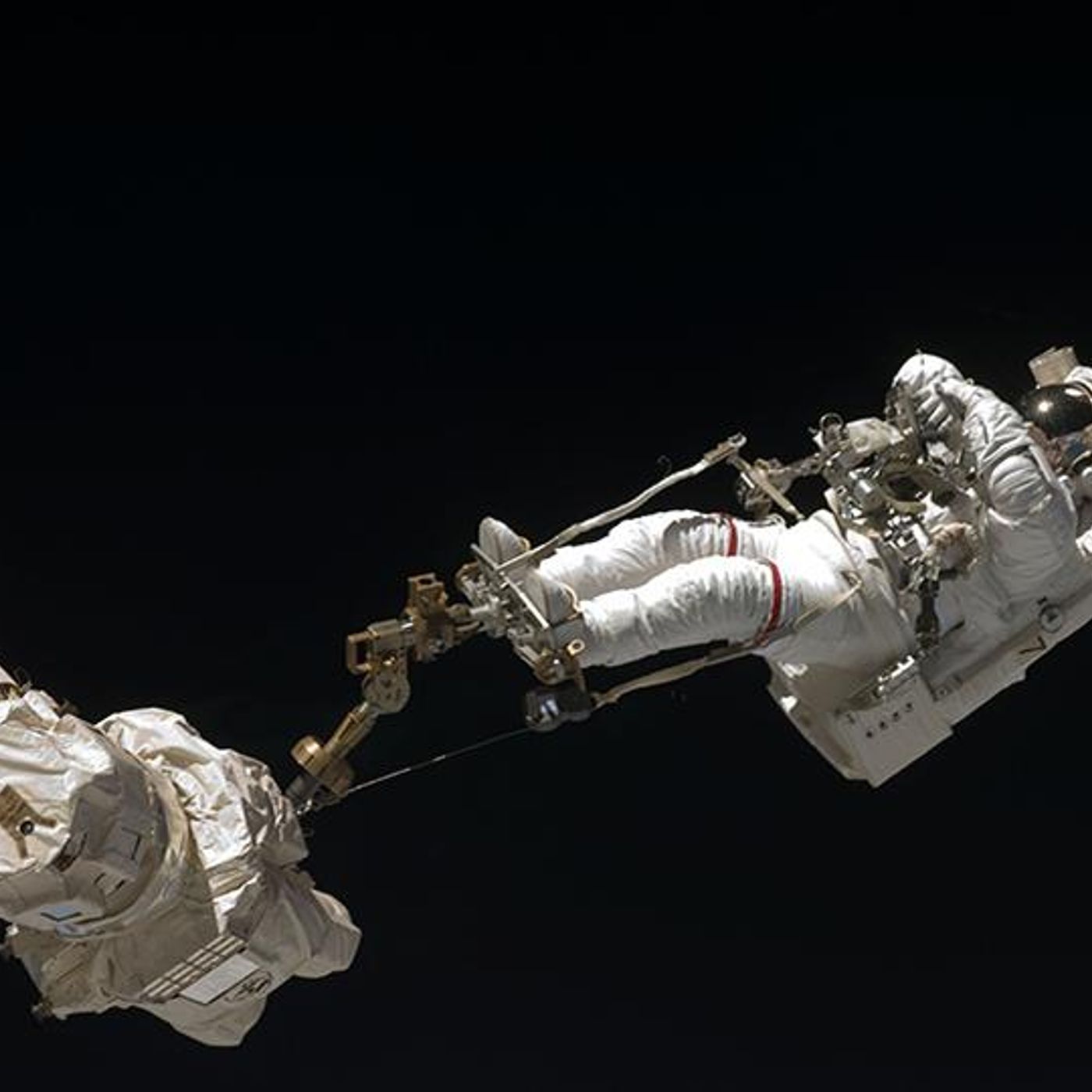
Radiolab
Dark Side of the Earth
00:19:31
200 miles above Earth's surface, astronaut Dave Wolf -- rocketing through the blackness of Earth's shadow at 5 miles a second -- floated out of the Mir Space Station on his very first spacewalk. In this short, he describes the extremes of light and dark in space, relives a heart-pounding close call, and shares one of the most tranquil moments of his life.
Loading summary
Transcript145 lines
- [00:00]
Jad Abumrad
Hey, Fidelity. How can I remember to invest every month?
- [00:05]
Fidelity App Representative
With the Fidelity app, you can choose a schedule and set up recurring investments in stocks and ETFs.
- [00:12]
Science Friday Host (Ira Flatow)
Huh.
- [00:13]
Jad Abumrad
That sounds easier than I thought.
- [00:14]
Fidelity App Representative
You got this?
- [00:15]
Walgreens Customer
Yeah, I do.
- [00:17]
Jad Abumrad
Now, where did I put my keys?
- [00:19]
Fidelity App Representative
You will find them where you left them.
- [00:23]
Dave Wolf (NASA Astronaut)
Investing involves risk, including risk of loss. Fidelity Brokerage Services, llc. Member NYSE SIPC welcome to Walgreens.
- [00:33]
Fidelity App Representative
Looking for a holiday gift?
- [00:35]
Walgreens Customer
Sort of. My cousin Freddy showed up to surprise us.
- [00:39]
Fidelity App Representative
Oh, sounds like a real nice surprise.
- [00:41]
Walgreens Customer
Exactly. So now I have to get him a gift, but I haven't gotten my bonus yet. So if we can make it something really nice but also not break the bank, that'd be perfect.
- [00:49]
Fidelity App Representative
How about a keurig for 50% off.
- [00:52]
Walgreens Customer
Bingo savings all season?
- [00:54]
Robert Krulwich
The holiday road is long. We're with you all the way. Walgreens offer, valid November 26 through December 27. Exclusions apply.
- [01:01]
Jad Abumrad
Wait, you're listening. Okay. All right. Okay. All right. You're listening to Radiolab, Radio Lab shorts.
- [01:13]
Dave Wolf (NASA Astronaut)
From WNYC.
- [01:18]
Jad Abumrad
And npr. Hey, I'm Jad Abumrad.
- [01:22]
Robert Krulwich
I'm Robert Krilwich.
- [01:23]
Jad Abumrad
This is Radiolab, the podcast. And we've just finished our in the Dark tour, which is the thing we've been, you know, yammering on about for the last. And we wanted to play for you in this podcast one of our favorite stories from that show.
- [01:35]
Robert Krulwich
Now, this was designed for the eye as well as the ear, this particular performance. So you will not see the Palabolos Dance Theater, which means you will not see. Oh, my.
- [01:47]
Jad Abumrad
Pretty amazing stuff happening on that stage.
- [01:49]
Robert Krulwich
Yeah. Strangely beautiful Shadow plays on huge white canvas on a gigantic stage.
- [01:55]
Jad Abumrad
You could go to the website and you can see pictures@radiolab.org yeah, these guys are really. They're magicians. They really are. We should also note that this story was scored live by the amazing Tao Nguyen, with Jason Slota on the drums, Jamie Riotta on the bass, and it was recorded masterfully at UCLA's Royce hall by Reverend John Delore.
- [02:15]
Robert Krulwich
So here it is.
- [02:16]
Jad Abumrad
So, for our final segment, we were thinking through this show, we thought, you know, who would have a really interesting perspective on darkness?
- [02:24]
Robert Krulwich
Maybe somebody who works in a rich, dark environment. Astronauts, for example.
- [02:29]
Jad Abumrad
Yeah. So we called up NASA, talked to an astronaut. We connected our little studio in New York to their studio in D.C. to talk to an astronaut, but he was a little late. And here's the funny thing. When you are on hold with NASA, this is literally what you hear. This has a blast off feel to It.
- [02:52]
Dave Wolf (NASA Astronaut)
Yeah, it does.
- [03:00]
Jad Abumrad
This is amazing.
- [03:01]
Robert Krulwich
This, by the way, is literally the case. You dial 1-800-NASA or whatever and they.
- [03:04]
Dave Wolf (NASA Astronaut)
This is like Go to the Moon music.
- [03:09]
Jad Abumrad
Uh. Oh. Hello. I hear someone breathing. Can you hear me?
- [03:16]
Dave Wolf (NASA Astronaut)
It's probably. I'm breathing.
- [03:19]
Robert Krulwich
That's an interesting way to meet.
- [03:21]
Jad Abumrad
So this is our guy. Dave Wolf is his name. He's a NASA astronaut.
- [03:24]
Dave Wolf (NASA Astronaut)
Have been since 1990, over 20 years.
- [03:27]
Jad Abumrad
He wasn't really sure why we had called him.
- [03:29]
Dave Wolf (NASA Astronaut)
What's our topic here?
- [03:31]
Jad Abumrad
So we explained to him that, you know, we're doing this show called in the Dark. We're gonna do it on stage in front of some very nice folks. Do you have any stories that relate? And right off the bat, he says.
- [03:42]
Dave Wolf (NASA Astronaut)
You'Ve triggered an interesting darkness story. I have.
- [03:46]
Robert Krulwich
Well, that's why we're calling you up.
- [03:47]
Jad Abumrad
Yeah.
- [03:48]
Dave Wolf (NASA Astronaut)
Okay. You're taping and you're ready? Yep. Darkness is an interesting theme in space because there's nowhere where the contrast between light and dark is any more extreme.
- [04:01]
Jad Abumrad
Dave has done dozens of spacewalks, and he says there have been times when he's just sort of out there floating in space next to the craft. And maybe the ship tilts a little bit and the wing blocks light that's coming from the sun or the moon and it creates a shadow. And he says the darkness of that.
- [04:17]
Dave Wolf (NASA Astronaut)
Shadow is blacker than any black you thought it could be out there in space. The shadow has no light in it. There's not reflected light from dust in the air, the Earth around you, or clouds.
- [04:29]
Jad Abumrad
It's just pure, absolute dark.
- [04:32]
Dave Wolf (NASA Astronaut)
And you can reach into a shadow so deep, so black, that your arm can appear to disappear.
- [04:44]
Jad Abumrad
Wow.
- [04:44]
Dave Wolf (NASA Astronaut)
Right in front of your face, your head is in the bright light and your arm is in this depth of.
- [04:52]
Jad Abumrad
Darkness, and it's just gone. Like it's been cut off.
- [04:54]
Dave Wolf (NASA Astronaut)
Yeah.
- [04:55]
Jad Abumrad
Wow.
- [04:58]
Dave Wolf (NASA Astronaut)
But I do want to tell you an experience I had in my first space walk, late 97. I had this experience.
- [05:06]
Jad Abumrad
Okay.
- [05:07]
Dave Wolf (NASA Astronaut)
It was from a Russian spacecraft. You might remember the MIR spacecraft.
- [05:14]
Jad Abumrad
So Dave was up there. He was with two Russian cosmonauts, and he and Anatoly Solovyev, they were suited up and getting ready to make their first walk into space, or his first walk.
- [05:25]
Dave Wolf (NASA Astronaut)
And we did all the preparations to get the suits ready, and we're in the airlock and.
- [05:34]
Jad Abumrad
The door opened and they floated out.
- [05:37]
Dave Wolf (NASA Astronaut)
We clipped our tethers off outside, and.
- [05:41]
Jad Abumrad
He and Anatoly gently float to the work site.
- [05:44]
Dave Wolf (NASA Astronaut)
And it was dark out. And dark up in space means you're on the night side of the Earth, in the shadow of the Earth. And there were no external lights on this spacecraft. This was really, really dark. And we were over the ocean. And at night that basically means you don't see the Earth.
- [06:09]
Jad Abumrad
You don't see it at all.
- [06:10]
Dave Wolf (NASA Astronaut)
Not at. When it's a moonless night, you don't see the Earth. In fact, all it might look like to you is the absence of stars.
- [06:24]
Jad Abumrad
I want you to imagine this with me. He's up there in this darkness and the Earth with all of us on it is somewhere far, far below him, but he can't see it. And all the while, and this is really important for what happens next, he is shooting through space. He's rocketing across the dark shadow of the earth at five miles a second. That is 16 times the speed that we're all moving right now because we are on the Earth. But he says at that moment he didn't feel any of that. It just felt like he was suspended.
- [06:51]
Dave Wolf (NASA Astronaut)
In this cocoon of black, floating gently. He thought, all right, no problem.
- [06:56]
Jad Abumrad
This is kind of peaceful.
- [06:58]
Dave Wolf (NASA Astronaut)
It was just me and the spacecraft and blackness. And sudden. This blazing light blasts him from below.
- [07:17]
Robert Krulwich
What was it?
- [07:18]
Jad Abumrad
It was the sunrise, you know, because he and the ship were moving so quickly at the sunrise, which normally happens here on Earth. Very, very slowly, calmly at that speed up there. The sun comes screaming from the eastern edge of the Earth straight across. The Earth lights up everything in seconds.
- [07:33]
Dave Wolf (NASA Astronaut)
And the Earth lights up below me. Suddenly I can look down 200 miles and see that we're moving at 5 miles per second.
- [07:43]
Jad Abumrad
Oceans, whoosh, clouds, whoosh. Des whoosh. And he's like.
- [07:47]
Dave Wolf (NASA Astronaut)
And I clutched onto these handrails like there's no tomorrow. White knuckled in my spacesuit gloves because I suddenly had this enormous sense of height and speed.
- [08:00]
Jad Abumrad
He says it was sort of like if you're just standing comfortably on the ground and then someone just flips on the lights suddenly and you realize actually I'm not on the ground. I am on a 400,000 foot ladder. Crazier still, in that sunrise moment, the.
- [08:15]
Dave Wolf (NASA Astronaut)
Temperature also by upwards of 400 degrees.
- [08:20]
Robert Krulwich
In the moment.
- [08:21]
Dave Wolf (NASA Astronaut)
In the moment.
- [08:23]
Jad Abumrad
Really this is the most extreme thing I've ever heard.
- [08:25]
Dave Wolf (NASA Astronaut)
Are you air conditioned or whatever you are? We are totally dependent on that spacesuit. But the colors, what you're seeing on that Earth is so spectacular. The greens and blues and the delicate pastel like colors, the contrast and the brights are just, aren't present in anything I've Ever seen, other than up in space.
- [08:55]
Jad Abumrad
Dave and his Russian buddy Anatoly, they're out there for hours doing repairs on the ship. So they are, because of their speed, they're going in and out and in and out of these days and nights.
- [09:05]
Dave Wolf (NASA Astronaut)
So it's 90 minutes of a light, dark cycle. So you have 16 nights and 16 days for every Earth day.
- [09:14]
Jad Abumrad
Which means as they're working, this change is happening over and over and over. Every 45 minutes, they go from blazing light to quiet, dark, blazing light to darkness.
- [09:31]
Dave Wolf (NASA Astronaut)
You can get lost. You get stories of people doing spacewalks that lose their orientation or feel like they're falling, falling.
- [09:42]
Jad Abumrad
So he says the only thing to do in that circumstance is just to focus on your job. Look straight ahead only at the screw. Only at the screw.
- [09:51]
Dave Wolf (NASA Astronaut)
Don't look down. Is kind of. It's. It's real in this business.
- [10:01]
Jad Abumrad
So we would have been perfectly happy to end the story right here because Dave and Anatoly finished that right repairs, Job well done. They get ready to come back into the spacecraft. But we cannot not tell you what happens next.
- [10:13]
Dave Wolf (NASA Astronaut)
Yeah.
- [10:13]
Robert Krulwich
Because this flirts with a very different kind of darkness.
- [10:16]
Jad Abumrad
Yeah. So the two of them pull themselves by their tethers to come back into the airlock to go back in.
- [10:23]
Dave Wolf (NASA Astronaut)
But when it was time to come back in, they couldn't get back in.
- [10:27]
Robert Krulwich
You were locked out of your spaceship.
- [10:29]
Dave Wolf (NASA Astronaut)
You could call it locked out. We were trapped outside, yes.
- [10:33]
Jad Abumrad
Essentially, their airlock was busted. They couldn't repressurize it. And if you can't get it at the right pressure, you can't re. Enter.
- [10:39]
Dave Wolf (NASA Astronaut)
And we worked on it for four or five hours and ran out our resources and we.
- [10:44]
Jad Abumrad
Wait a second. Ran out of oxygen or what?
- [10:48]
Dave Wolf (NASA Astronaut)
Yeah, plenty of oxygen. It turns out what you run out of first is your carbon dioxide scrubbing unit. That takes the CO2 out of your suit. And now the problem with this one is usually in a space accident, you figure it'll only hurt for a moment. But when you die of CO2 intoxication, that drags out. That's a miserable way to go.
- [11:16]
Robert Krulwich
What does he mean?
- [11:17]
Jad Abumrad
Did you ever find out? Looked it up. What happens is, first you get a headache and then your muscles start to twitch. Eventually your heartbeat starts to accelerate faster, faster, faster. You go into convulsions and then you die.
- [11:38]
Dave Wolf (NASA Astronaut)
Luckily, the life support system has an extra cartridge that gave us an extra six or so hours. We used all that and trying to fix the hatch and we couldn't get it to hold air. And we were done.
- [11:56]
Jad Abumrad
Did you know you were done? I mean, you were you.
- [11:57]
Dave Wolf (NASA Astronaut)
Yeah, yeah, pretty much.
- [12:01]
Robert Krulwich
You mean done like in over?
- [12:03]
Dave Wolf (NASA Astronaut)
Yeah, yeah. No more ideas.
- [12:08]
Jad Abumrad
Done like in dead. So they decide, okay, we gotta do something. Last ditch maneuver. If we can't get our usual airlock to work, maybe we can make a new one. Because, see, on the Mir space station, it's this big cylinder with these rectangular modules that jut out. And one of those modules is the airlock. But there are these adjacent ones, ones which are normally just living quarters. They thought, well, if we can't get our usual airlock to pressurize at the right, you know, pressure, maybe we can go to the next one over and.
- [12:39]
Dave Wolf (NASA Astronaut)
Try and pressurize it, essentially treating that next module in as a airlock. And we opened the hatch into that next module. And in order, though, to go into it, we had to disconnect our umbilicals. Because you can't close a hatch over your umbilical. Right. And the umbilical was providing our cooling to our suits. So as soon as we disconnected. Well, that gives you maybe five, eight minutes at max before you.
- [13:10]
Jad Abumrad
What?
- [13:11]
Dave Wolf (NASA Astronaut)
I don't even want to talk about it. It's so bad.
- [13:15]
Robert Krulwich
Did you look that up?
- [13:16]
Jad Abumrad
Yeah, look this one up, too. Essentially, what happens is you boil inside.
- [13:20]
Dave Wolf (NASA Astronaut)
Your spacesuit in a very ugly way.
- [13:26]
Jad Abumrad
So Dave and Ed totally think, okay, we've got to get through this tiny hatch into this room. And they've got to do it fast. But they also know if you struggle.
- [13:34]
Dave Wolf (NASA Astronaut)
Hard and go too fast, you won't get much time at all in that suit before that heat builds up on you.
- [13:41]
Jad Abumrad
So he thinks, okay, hurry, hurry. But slowly, slowly.
- [13:46]
Dave Wolf (NASA Astronaut)
What I did not anticipate was as soon as we disconnected our umbilicals that the visor would fog up and you'd now be having to feel your way through. You're blind. Yeah, you could spit and kind of get a little area through the fog. So I'm in the airlock trying to make my way into the next section. And I was crawling along the wall, moving into the next section. And I spit on my visor, you know, to make a little hole to look through and get a hint. And it was an area I had been sleeping in some weeks before. And I had left picture of my family taped with Scotch tape on the wall. And I spit on the visor and my helmet light went there. And there was this picture of my family right here in this moment as I was scooting across the wall in what was likely My last minutes. So this is how it's going to end. So this is it. And look, it's so strange. There they are. And I look back at that and I shudder.
- [15:13]
Jad Abumrad
Now, of course, Dave and his partner made it back into the space station, barely.
- [15:19]
Dave Wolf (NASA Astronaut)
But it didn't strike me really till months later on the Earth how close that had been. And what a strange situation.
- [15:32]
Robert Krulwich
This Russian guy must be your best friend, like he must be.
- [15:36]
Jad Abumrad
Yeah, we do.
- [15:36]
Dave Wolf (NASA Astronaut)
Look. They probably call each other and say 20 years later you go, well, not many people have been through anything like that together and are there to talk about it. And you just reminded me of something.
- [15:50]
Jad Abumrad
So we're going to leave you with one last story from Dave. He was kind of a story machine. This is from that same stay in space involves the same friend, Anatoly. They were out there doing some work on the ship, floating in space again. And then mission control radios and tells them to pause for a while.
- [16:07]
Dave Wolf (NASA Astronaut)
We had a period where we had to wait through the night to go on with our work. So he says, look, David, all in Russian of course, I wanted to show you something. And we hooked our tethers on, pushed ourselves about six feet away. We had about six feet of tether so that our eyes couldn't see anything but out in space. And I, I turned my air conditioner down a little, you know, so it was kind of warm. And I was floating in this spacesuit, just looking out into the blackness of space. And I felt like I didn't have a spacesuit on. It was so comfortable. The air temperature was just right. I felt like I was just out in the universe in the stars. I couldn't see anything but stars all around me. I couldn't feel anything outside. A spacecraft going 5 miles per second out in the universe.
- [17:12]
Jad Abumrad
Was that what he wanted to show you?
- [17:14]
Dave Wolf (NASA Astronaut)
Yeah, I think so.
- [17:16]
Robert Krulwich
This is his rocking chair on the.
- [17:18]
Dave Wolf (NASA Astronaut)
Front porch thing or a hammock almost. He didn't want to talk. He said, let's just begin. Quiet. Turn your helmet light off so you don't get any reflected light. Just relax, Raslavavayat. Relax.
- [17:38]
Jad Abumrad
Relax.
- [17:41]
Dave Wolf (NASA Astronaut)
Relax, relax.
- [18:09]
Robert Krulwich
Now, had you been there in the theater? This is the moment where we gave everybody a little pinpoint of light, a little hand carried star that they could put over their heads and wave together.
- [18:24]
Jad Abumrad
Like 2000 tiny little lights from the seats. It's like a canopy of stars. We saw this happen again and again, like 18 times, I think we performed this. And every time it was just like breathtaking. Yeah, Sam, This whole show came together thanks to so many people on stage and off. And we want to make a couple of thank yous before we go.
- [19:19]
Robert Krulwich
Very, very special thanks to Meg Bowles, who found our astronaut.
- [19:22]
Jad Abumrad
She found Dave Wolf.
- [19:23]
Robert Krulwich
Yes. Also to Palabolos, the dance company, and to the Palabola.
- [19:27]
Jad Abumrad
Yes. Starting with Itamar Kubovi, Lily Bins, Matt Kent, Renee Jaworski, Greg Laffey.
- [19:32]
Dave Wolf (NASA Astronaut)
Yeah.
- [19:32]
Jad Abumrad
And the dancers, Chris Whitney, Heather Favretto.
- [19:35]
Robert Krulwich
Anthony Oliva, Christina Conger, Evan Adler, Anna Keshif, and the Olvera twins, Edwin and Roberto.
- [19:41]
Jad Abumrad
We love you guys.
- [19:42]
Dave Wolf (NASA Astronaut)
Yeah.
- [19:43]
Jad Abumrad
Demetri Martin, thank you so much for coming and, you know, creating this show with us, Tao Nguyen and Jason Slota, thank you so much to them and Mike Faba, Jake Fine, Serena Wong, John Delor, Melissa Lacasse, Dave Foley, Nick Nusiforo.
- [19:54]
Robert Krulwich
Caitlin Fitzwater, Rebecca Lehrer, and Rosalind Lutine Lutes. Most of all, most, most, most of all to Alan Horn, who loved doing this and made it so fun to do.
- [20:07]
Samuel de Klerk (Radiolab Listener)
Start OF MESSAGE hi, my name is Samuel de Klerk. I'm originally from Gauteng, South Africa, and I'm a Radiolab listener. Radiolab is supported in part by the National Science foundation and by the Alfred P. Sloan foundation, enhancing public understanding of science and technology in the modern world. More information about Sloan@www.sloan.org. thanks.
- [20:31]
Dave Wolf (NASA Astronaut)
End of Message.
- [20:34]
National Forest Foundation Representative
Rideiolab is supported by the National Forest Foundation, a nonprofit transforming America's love of nature into action for our forests. Did you know that national forests provide clean drinking water to 1 in 3Americans? And when forests struggle, so do we. The National Forest foundation creates lasting impact by restoring forests and watersheds, strengthening wildfire resilience and expanding recreation access for all. Last year, they planted 5.3 million trees and led over 300 projects to protect nature and communities nationwide. Learn more@nationalforests.org Radiolab this is Ira Flaydo.
- [21:14]
Science Friday Host (Ira Flatow)
Host of Science Friday. For over 30 years, the science Friday team has been reporting high quality science and technology news, making science fun for curious people by covering everything from the outer reaches of space to the rapidly changing world of AI to the tiniest microbes in our bodies. Audiences trust our show because they know we're driven by a mission to inform and serve listeners first and foremost with important news they won't get anywhere else. And our sponsors benefit from that halo effect. For more information on becoming a sponsor, visit sponsorship.wnyc.org.