← Radiolab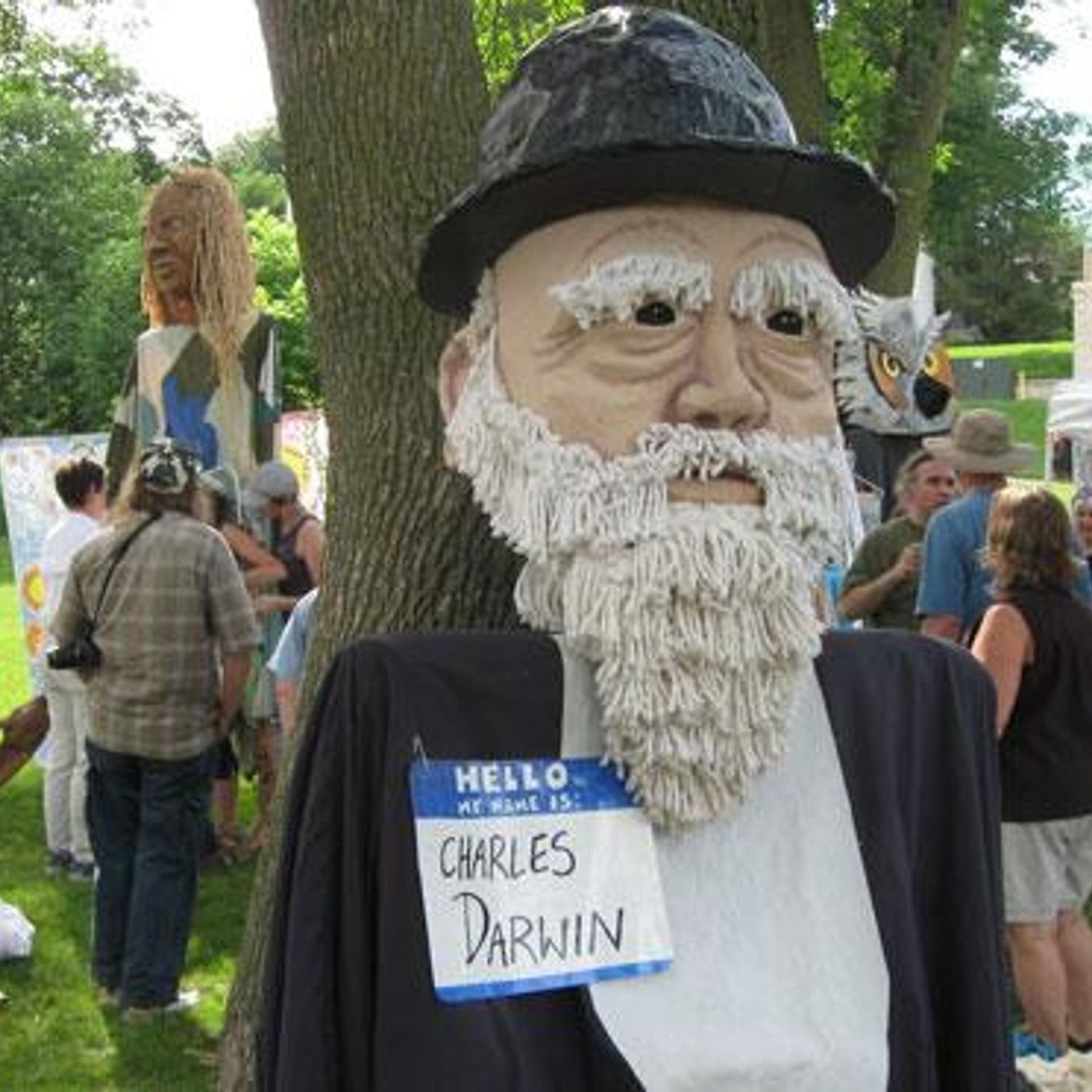
Radiolab
Darwinvaganza
00:25:43
For this week's podcast, Radiolab throws a birthday party for Charles Darwin!
Loading summary
Transcript186 lines
- [00:00]
Fidelity App Advertiser
Hey Fidelity, what's it cost to invest with the Fidelity app? Start with as little as $1 with.
- [00:07]
Radio Lab Narrator
No account fees or trade commissions on.
- [00:10]
Fidelity App Advertiser
US stocks and ETFs. Hmm, that's music to my ears. I can only talk.
- [00:17]
Radio Lab Narrator
Investing involves risk, including risk of loss. 0 account fees applied to retail brokerage accounts only. Sell order assessment fee not included. A limited number of ETFs are subject to a transaction based service fee of $100. See full list of Fidelity.com commissions Fidelity Brokerage Services LLC Member NYSE SIPC.
- [00:33]
State Farm Advertiser
Lets say your small business has a problem. Like maybe one of your doggie daycare customers had an accident. You might say something like doggone it.
- [00:44]
Fidelity App Advertiser
Hey Chihuahua.
- [00:46]
State Farm Advertiser
Holy schnauzers. But if you need someone who can actually help, just say like a good.
- [00:51]
Robert Krulwich
Neighbor, State Farm is there.
- [00:52]
State Farm Advertiser
And get help filing a claim from your local state farm agent for your small business insurance needs. Like a good neighbor, State Farm is there. Get ready to shop Lowe's Black Friday doorbuster deals to save $150 on a 30 inch blackstone griddle. Now $299 plus choose a whirlpool top load washer or Midea top freezer refrigerator for just $398. These limited time doorbuster deals go fast, so get holiday ready. Today at Lowe's we help you save valid 1128-12. One selection varies by location while supplies last seeloads.com for more details.
- [01:36]
Radio Lab Narrator
You're listening to Radio Lab, the podcast from New York Public Radio, Public Radio, WNYC.
- [01:46]
Fidelity App Advertiser
And npr.
- [01:47]
Jad Abumrad
Hello, I'm Jad Abumran.
- [01:49]
Robert Krulwich
And I'm Robert Krylwich. And this is not the regular Radiolab news.
- [01:53]
Jad Abumrad
No, this is Radiolab, the podcast. Meaning would you like to explain?
- [01:57]
Robert Krulwich
Yes, it's Radiolab in between our regular season shows. So this is gonna be a little shorter probably than the regular shows and a little less produced, but a lot of fun because it's birthday time. I'm gonna say happy Birthday, of course, to Charles Darwin or Chuck Darwin, as I sometimes like to call it.
- [02:13]
Jad Abumrad
Oh, more Charles Darwin birthday.
- [02:16]
Robert Krulwich
Just be quiet and listen to me for just a second. I want to say that a lot of people, when they think about Charles Darwin, think, think about a brilliant, brilliant man who 150 or so years ago woke up some morning and thought, wow, I have a wonderful, deep insight into the nature of how life changes.
- [02:34]
Jad Abumrad
Well, it was wonderful and it was deep. It was one of the deepest ever.
- [02:36]
Robert Krulwich
Yes, but it wasn't instant. And that's the first Thing we ought to say about Charles Darwin is that he did not have an excelsior idea. He had a notion which gradually formed into an idea which then required an enormous amount of hard, hard work. And to begin, I'd like to play you a story I did a number of years ago with David Quammen, who's one of the best scholars about Darwin that I know. He's actually a professional journalist, but we call him a scholar.
- [03:07]
Jad Abumrad
We're suddenly living in a world where scholars and journalists are on par.
- [03:11]
Robert Krulwich
Well, why not? You know, because David works very hard, but he doesn't even work as close to hard as Chuck Darwin, as I like to call him. So let's listen to this story, which is Darwin working out a theory. 150 years ago, when people asked how come you can go to Australia and there are kangaroos hopping, hopping around everywhere, but you go to places that look almost exactly the same, say grasslands in Africa, and there are no kangaroos. Now, why is that? Why don't the same kinds of places have the same kinds of animals? Well, 150 years ago, there was an answer. It was a simple one, says science writer David Quammen.
- [03:52]
Radio Lab Narrator
God has made kangaroos and put them in Australia.
- [03:55]
Robert Krulwich
So God did it.
- [03:56]
Radio Lab Narrator
He decided that was what God wanted to do. God created every species individually and put them down wherever they are. Actually, I call that special creation plus special delivery.
- [04:08]
Robert Krulwich
So that was the explanation even among some of the most learned people around. But then, says Quammen, Darwin came along.
- [04:15]
Radio Lab Narrator
And said, wait a minute, I don't think that's the explanation. I think these things all evolved from common ancestors.
- [04:23]
Robert Krulwich
So the reason you find kangaroos only in Australia and New guinea, he said, it's not God's doing. It's because the earliest kangaroo ancestors evolved there. And then they spread out, but they couldn't get across the water that surrounds Australia. They went about as far as they could go. Every plant, every animal that you see, Darwin proposed, got where it is today on its own.
- [04:45]
Radio Lab Narrator
Animals and plants must disperse. They must be capable of dispersing in order to explain what we see on the planet by way of evolution.
- [04:55]
Robert Krulwich
So it was critical to Darwin's theory to show how living things got to where they are today. And this can get kind of tricky. For example, cabbages. You can find cabbage plants on islands near Antarctica. Now, how would a cabbage get there?
- [05:10]
Radio Lab Narrator
Well, either God put it there, or it got there on its own.
- [05:14]
Robert Krulwich
Yeah, but how does a cabbage seed cross an ocean on its own?
- [05:18]
Radio Lab Narrator
Yeah, how?
- [05:19]
Robert Krulwich
Well, it turns out that Darwin obsessed about this question, vegetable voyaging. For years he concocted experime experiments that were so delightful and so unlike what you'd imagine.
- [05:31]
Radio Lab Narrator
Exactly, exactly. You remember the old TV show, watch Mr. Wizard?
- [05:35]
Robert Krulwich
Yeah.
- [05:36]
Radio Lab Narrator
That was Darwin. That was Charles Darwin.
- [05:38]
Robert Krulwich
Here's a perfect example. Darwin wondered, how might a radish travel? Well, he imagined that a radish might accidentally get swept to sea on a windy day. But now the question, do radishes float? Well, Darwin had his butler, Mr. Parslow, pour salt water, kind of like ocean water, into a tub. And into that tub they plopped radishes and carrots and rhubarb and celery. Mr. Parslow was, he was one of these proper English butlers?
- [06:09]
Radio Lab Narrator
Absolutely, yeah.
- [06:10]
Robert Krulwich
I guess there weren't too many other butlers in the vicinity who happened to do this sort of thing.
- [06:13]
Radio Lab Narrator
Probably not, no.
- [06:15]
Robert Krulwich
But Mr. Parslow also dropped in seeds.
- [06:17]
Radio Lab Narrator
He tried cabbage seeds, radish seeds, pepper cress, as in water cress.
- [06:24]
Robert Krulwich
And then they watched to see what floated for how long. Then they'd remove the wet seeds and they'd plant them to see if they would still grow. Some did better than others. With radish seeds he got 42 days worth of floating and with Cress, 42.
- [06:41]
Radio Lab Narrator
Days plus a wonderful quantity of mucus. Darwin said, if I recall correctly, so.
- [06:46]
Robert Krulwich
It'S stinky but it's getting there.
- [06:48]
Radio Lab Narrator
A slimy mess that still travels the oceans. And that's typical of Darwin, that he would not say, you know, a disgusting or a gross quantity of mucus. He would say a wonderful quantity of mucus because everything about the natural world was wondrous to this guy.
- [07:03]
Robert Krulwich
Okay, so that's 42 days for the radish, 42 days for the cress. How much now for dried asparagus seed?
- [07:10]
Radio Lab Narrator
85 days. They stayed afloat 85 days. And then he took them out and planted the seeds and they germinated.
- [07:19]
Robert Krulwich
So let's do the math. Darwin did. If an asparagus seed can float for 85 continuous days and an ocean current moves roughly 38 miles a day, let's multiply 85 times 38. That means an asparagus can sail 3,230 miles across the sea, that's, that's like Magellan. Asparagus is king.
- [07:44]
Radio Lab Narrator
Well, at least among those Darwin looked at. Yeah.
- [07:47]
Robert Krulwich
So yes, ocean crossing vegetables are possible. But Darwin didn't stop there. One day his 8 year old son Francis said to him, you know dad, dead birds float kind of like ships. And his father said, yeah, he seems.
- [08:04]
Radio Lab Narrator
To have been a terrific father.
- [08:05]
Robert Krulwich
So Francis said, well, why don't we feed a bird some seeds? So the seeds get inside the bird and. And then, you know, shoot the bird and then pop it in the tub, the corpse and let it float for a while.
- [08:17]
Radio Lab Narrator
So he suggested that, and Darwin said, you bet, Francis. That's a great idea.
- [08:20]
Robert Krulwich
Then after a month or whatever, they opened up the dead carcass and they pulled out the seeds inside and they.
- [08:27]
Radio Lab Narrator
Planted them and found that those seeds.
- [08:29]
Robert Krulwich
Also germinated, thereby establishing the principle that seeds can either float on their own or they can hitch a ride as.
- [08:36]
Radio Lab Narrator
Passengers inside a bird, as passengers attached to the foot of a bird.
- [08:40]
Robert Krulwich
Which then led Darwin back to animals and to the last science article he ever published in which he proposed the possibility of flying clams. Now, at this point, Darwin wasn't so well.
- [08:53]
Radio Lab Narrator
He's suffering from degenerative heart disease. But he's still working. He's still very much alive mentally.
- [08:58]
Robert Krulwich
And one day he gets a letter from a shoe salesman, a young guy named Walter Crick. The way the story goes, you imagine Crick out in the woods collecting beetles when he just happened to see it was a water beetle. And when he got down and looked.
- [09:11]
Radio Lab Narrator
Real close, attached to one of the legs was a little clam. A little freshwater clam.
- [09:16]
Robert Krulwich
A very little clam? Yeah, very little.
- [09:18]
Radio Lab Narrator
Small enough that the beetle scarcely noticed it. And Crick thought, hmm, that's kind of curious.
- [09:23]
Robert Krulwich
So he wrote Darwin and he said, you know, I think you might be interested in this. And sure enough, Darwin wrote right back. And he asked him all kinds of questions that Crick couldn't answer because, after all, he was in the shoe business.
- [09:34]
Radio Lab Narrator
So he did something better than, you know, fake it. He sent the beetle with the shell attached to Darwin. He mailed it.
- [09:40]
Robert Krulwich
He just popped it into an envelope.
- [09:41]
Radio Lab Narrator
He popped it into an envelope.
- [09:43]
Robert Krulwich
Was the clam still attached to the beetle?
- [09:45]
Radio Lab Narrator
It was. It was.
- [09:46]
Robert Krulwich
So he said, okay, well, you take a look for yourself.
- [09:47]
Radio Lab Narrator
Yeah.
- [09:48]
Robert Krulwich
So a day or two later, the beetle and the clam did arrive at Darwin's house in an envelope. But they were separated now, and the.
- [09:54]
Radio Lab Narrator
Beetle, the beetle was dying by the time that he got it.
- [09:58]
Robert Krulwich
Wasn't feeling very well.
- [09:58]
Radio Lab Narrator
He wasn't feeling very well.
- [09:59]
Robert Krulwich
But right away, Darwin could see a possibility here.
- [10:03]
Radio Lab Narrator
This is very interesting. This goes back to the whole subject of dispersal, of how creatures can travel from one place to another.
- [10:10]
Robert Krulwich
Maybe this little clam can fly from.
- [10:12]
Radio Lab Narrator
Place to place, right, because this beetle is a swimming beetle. But it can also Fly.
- [10:17]
Robert Krulwich
So maybe clams can fly from pond to pond hitchhiking on a beetle. Darwin couldn't prove this because he felt kind of badly watching that little beetle he had suffer.
- [10:27]
Radio Lab Narrator
So this is why I mention it at the end of my book because it's such a wonderful example of the kind of fellow this guy Charles Darwin was. He writes back to W.D. crick and says, Dear Mr. Crick, as.
- [10:39]
Robert Krulwich
The wretched beetle is still feebly alive, he wrote, I put it in a bottle with chopped laurel leaves. Now he knew that those leaves give off a gas that would very gently help this beetle die.
- [10:51]
Radio Lab Narrator
In one of the very last acts of his life, he decided that he needed to put this beetle out of its misery. And then a few weeks after that, Darwin died himself.
- [11:03]
Robert Krulwich
There is a postscript to this story. It turns out that years and years later the shoe salesman Walter Crick had some grandchildren. And one of Walter's grandsons just happens.
- [11:14]
Radio Lab Narrator
To be Francis Crick.
- [11:17]
Robert Krulwich
The Francis Crick.
- [11:18]
Radio Lab Narrator
The Francis Crick co discoverer of the structure of DNA with James Watson.
- [11:23]
Robert Krulwich
So perhaps the greatest champion of evolution in the 20th century who deciphered the structure and the code of DNA both.
- [11:31]
Radio Lab Narrator
That guy's grandpa, his grandpa was a pen pal sharing beetle specimens with Darwin.
- [11:37]
Robert Krulwich
And how strange and wonderful is that? And it is kind of strange.
- [11:42]
Jad Abumrad
Don't you did you ended the piece with how strange?
- [11:44]
Robert Krulwich
No, no, not that I ended the piece that way, but that it's very strange.
- [11:47]
Jad Abumrad
You who always sweat the ending and torture me on the endings, you end it with how strange is that?
- [11:53]
Robert Krulwich
Well, here's why. Because think about science the way it's done today.
- [11:57]
Jad Abumrad
Yeah.
- [11:59]
Robert Krulwich
You have to finish high school, you have to get good grades, you have to take the SATs, you have to get into college, you have to be a major in science. You have to go to a PhD and get the GRE and the publisher reviews and the white book.
- [12:11]
Jad Abumrad
No, it's very specialized now.
- [12:13]
Robert Krulwich
And look at that. Look at their science. This is Charles Darwin with the butler and the tubs.
- [12:18]
Jad Abumrad
I like that part of it. It's very optimistic in a way and very homespun. You know, here's what I don't get. He comes up with this idea in like 1830 something, right?
- [12:28]
Robert Krulwich
Yes. He's, he's a young man when he, when he, when he figures out maybe species evolve in this peculiar way, right?
- [12:34]
Jad Abumrad
So he's got the idea in 1838 and he's a young dude and then it's only like 20 something years later that he finally 21, 21 years later that he finally actually comes out with it. So.
- [12:44]
Robert Krulwich
And publishes it.
- [12:45]
Jad Abumrad
What happened in the gap? Was he tested?
- [12:47]
Robert Krulwich
Well, that's one of the. That's one of the great questions is why did Charles Darwin wait so long to announce the idea? One version of that is that he just wanted to do what you just heard him do. He wanted to be sure, test data. He wanted to test evidence and evidence and so on. The other reason is actually a more romantic and interesting and also sad reason because it tells you that from the beginning, this idea had deep problems with its audience. In this case, Charles Darwin's audience was a precious audience. It was the woman he fell in love with.
- [13:23]
Jad Abumrad
Who was her name?
- [13:24]
Robert Krulwich
I don't think I should tell you because I think you're going to learn it from Deborah Heiligman, who is an author of a new book called Charles and Emma. Anyway, Deborah sat down with me when you were talking, and she tells me. Let's see. Let's go back to when Charles was in his mid-20s. Here we go.
- [13:43]
Fidelity App Advertiser
Okay. I'm 28. I got this promising career, this great theory I'm thinking about.
- [13:48]
Robert Krulwich
And now he has to make his next big decision. Should he get married or not?
- [13:52]
Fidelity App Advertiser
Right.
- [13:52]
Robert Krulwich
What does he do?
- [13:53]
Fidelity App Advertiser
Well, he makes a list of pros and cons.
- [13:56]
Robert Krulwich
Is it called pro marriage or con mar.
- [14:00]
Fidelity App Advertiser
It's called marry, not marry. This is the question.
- [14:06]
Robert Krulwich
Well, let's hear the not marry things.
- [14:10]
Fidelity App Advertiser
Fighting with her like that could be a problem.
- [14:13]
Radio Lab Narrator
He wrote down quarreling.
- [14:14]
Fidelity App Advertiser
Quarreling, yes. And he did, you know, he loved children, and so he really thought about having children, but he also worried about, again, the time it would take to raise children and the expense and also the anxiety.
- [14:30]
Robert Krulwich
Meanwhile, what was on the pro side? If I do marry, what do you get?
- [14:34]
Fidelity App Advertiser
He was looking for somebody who would sit on the sofa with him and, you know, make nice and, you know, whatever. But I think when he made that.
- [14:43]
Robert Krulwich
He can make music and play some kind of.
- [14:47]
Fidelity App Advertiser
Yes, right.
- [14:48]
Robert Krulwich
They did play. What did they play?
- [14:49]
Fidelity App Advertiser
They played Charles and Emma, played backgammon. But now we gave away that it was Emma. Sorry.
- [14:53]
Robert Krulwich
Okay. Sorry. No. So there they are. We're wondering which way to go.
- [14:55]
Fidelity App Advertiser
But there was one big question that he did not put on his list.
- [14:59]
Robert Krulwich
What was that?
- [15:00]
Fidelity App Advertiser
God.
- [15:01]
Robert Krulwich
Why God?
- [15:02]
Fidelity App Advertiser
He really was beginning to think that he was having problems with God and with religion in general. And he knew very often that if the man was a skeptic, a religious skeptic, and the woman was a believer, things went along fine until there was some problem, somebody got sick, somebody died, and then the woman was miserable because the husband wasn't a believer.
- [15:25]
Robert Krulwich
And if the husband isn't a believer, Jed, then that person's probably going to go to hell for not having faith in God. So when you go on to your eternal rest, you're in hell and your wife is in heaven. And so that's a long time to be apart.
- [15:38]
Jad Abumrad
So you want to stay with them here and there.
- [15:41]
Robert Krulwich
Yeah. Darwin falls in love, as it happens, with one of these religious groups, girls, Emma, and he falls really in love with her. But she says to him, uh, oh, I don't know, I want to live with you forever in heaven.
- [15:54]
Jad Abumrad
And she's a believer.
- [15:55]
Robert Krulwich
Yeah. So during their courtship, they talk about this. He shares his doubts about the existence of God. She shares her hope that he will come out, come to faith. But she does agree to marry him.
- [16:06]
Jad Abumrad
In spite of that.
- [16:07]
Fidelity App Advertiser
And she, you know, when he's there, she's all happy because he's so Charles, and she loves him and he's great. And then he goes away. I can so relate to this. And then she starts to worry because he's not there to sort of distract her with his wonderfulness. She worries about his not having faith or losing his faith. I mean, to me, it's never clear exactly what he's thinking. I mean, I don't think it was clear to him. He was struggling with it, let's put it that way. She probably knew she wasn't going to really change his mind, but she just knew that prayer was really helpful to her. And she saw him in pain, emotional pain, and she thought if he would just pray, maybe he would feel better. But she didn't want to really say that to him. So she wrote it down and said sometimes it's easier to write something down. And she wrote him, I think, three letters during their time together, maybe four. He kept those letters with him all the time. And he wrote. He knew. He just had a feeling he would die first. And he wanted her to know after he was gone that he really took her concerns seriously.
- [17:14]
Robert Krulwich
He also, on the letter, letter itself, wrote some later point. When I'm dead, know that many times I have kissed and cried over this. So they were. They had an arrangement. He grieved for her, she grieved for him. And they were. They had very different ideas about what death meant until something happened in their lives. It has a kind of feeling of real deep tragedy about it.
- [17:50]
Jad Abumrad
What.
- [17:52]
Robert Krulwich
Who's Annie?
- [17:54]
Fidelity App Advertiser
Annie was their second child, their oldest daughter, and really the apple of their eye. She was a wonderful little girl. And Charles Darwin later said she was his favorite, which I always have mixed feelings about, because I don't think a parent should have favorites, but there you go.
- [18:13]
Robert Krulwich
Do you know why she was his favorite?
- [18:15]
Fidelity App Advertiser
She was spirited. She was kind. She was musical like Emma, but she was orderly, like Charles. Emma was a slob. Annie was very attentive and connected to both of her parents, but some scarlet fever had run through the household. It seemed, in retrospect, like Annie never got quite better. After about a week of that, right around Easter, by the way, Annie just got worse and worse, and she finally died. He and Emma said to each other in letters, right then we just have to stay close to each other. Emma wrote to him, you are my prime treasure and always have been.
- [18:59]
Robert Krulwich
This is one of those moments where, for a lot of couples, you know.
- [19:02]
Fidelity App Advertiser
You can kind of go, you could break up. And considering what death meant to each of them and how different, the different meanings they took, it's pretty amazing to me that I think it brought them even, even closer.
- [19:15]
Robert Krulwich
But the sense along the way is that the reason that Charles Darwin hung onto his idea and didn't publish, one of the reasons is that he was worried that Emma would have. And there's reason, right, for him to feel that way, because she so much more or less intimated that.
- [19:32]
Fidelity App Advertiser
Well, the thing that's great about Emma was that you asked me before, I think, what. How they changed after Annie's death. I think they became a little bit more. I think they saw each other's point of view just a little bit more. I think. I think Charles saw. Oh, would be probably really nice if I believed in it, afterlife, because then I could see Annie again, and that would be lovely. And I think probably as Emma watched Charles working and probably as she saw, struggled with what was the sense of Annie's death. You know, maybe there was no sense. Maybe it was just one of those things that happens. I believe that they actually started to come together more than go apart in the way they were thinking.
- [20:10]
Robert Krulwich
Neither surrendered their point of view.
- [20:12]
Fidelity App Advertiser
Neither surrendered. But I think that they were really able to see the other person's point of view, which is really what all we need, right? And so Emma, who was never much interested in science, by the way, but she was always his first reader and his best reader. So whenever he was sending something out for publication, she always read it. Back in 1842, he had first shown her, and her alone, this sketch of his species theories, just in case he should die. And he wrote her a letter saying, in case I should die, I'm entrusting you to publish this. Well, you know, she was the one who was so worried he was killing God, and yet he trusted her, and he knew he could trust her. And so Emma read it in manuscript, and she didn't object to anything. She didn't object to anything that would, you know, maybe have sort of personally offended her about God. In fact, she cleaned it up. Cleaned up his language because he wasn't good with commas and, you know, and he had spelling mistakes. And so she cleaned it up and made his arguments stronger for him.
- [21:20]
Radio Lab Narrator
So.
- [21:20]
Jad Abumrad
Wow. So emotionally, she traveled a great distance.
- [21:22]
Robert Krulwich
She did.
- [21:23]
Jad Abumrad
But here's my question. If he can do so much work to convince the scientists, his colleagues, that this is a theory that is true, and if he can, you know, through a sort of personal loss and time and understanding, convince his wife, through love, really, that it's true, why can't he convince the rest of us? I mean, Ike Aike, our producer here to our right, just handed me a paper which says that there was a Gallup poll of 1018Americans. Less than 4 out of 10 say they believe in the theory of evolution. That's less than 40% of them.
- [22:02]
Robert Krulwich
It's been that way, by the way, for decades. You know, for decades. Darwin has never had a majority. No.
- [22:09]
Jad Abumrad
So why?
- [22:10]
Robert Krulwich
Well, there are probably two simple reasons. One is that people don't like thinking of themselves as beasts or animals. And Darwin insisted, he always insisted, we are not closer to the angels. We are not separate. We are not different. We are beasts.
- [22:25]
Jad Abumrad
Well, couldn't you at least say to sort of counter that argument? Okay, we're beasts, but we're turbocharged beasts. We're like special beasts.
- [22:32]
Robert Krulwich
You can say that. But that's not the only problem.
- [22:35]
Jad Abumrad
What's number two?
- [22:36]
Robert Krulwich
The second one, I think, has to do with everybody's desire for. Well, let me just introduce you to Adam Gopnik, who has written another book about Charles Darwin.
- [22:48]
Jad Abumrad
He's written more than one?
- [22:49]
Robert Krulwich
No, another one. In our series of mini books that we are visiting here, we have the Quammen book, we have the Hollywood book, and we now have the Gopnik book. But I sat down with Adam and we talked about what is the problem really, with Darwin's theory.
- [23:02]
State Farm Advertiser
Now, nobody understood in the 19th century better than Charles Darwin that death is the great reaper out of life. He didn't believe in immortality, and he believed in what he called the wedge of death. He understood that that's how species proceed, that's the nature of life, is to involve a great deal of death. But that realization, of course, provided him absolutely no comfort for the loss of his own child. Knowledge about the common experience gave him no ease in his core experience. And that, I think, Robert, is the deepest reason why we have trouble with Darwinism. Because we look to big ideas to take common experience and give us comfort about our core experience. And no matter how we try to and pull it apart, no matter how we try and search it, Darwinism won't do that for us. We can't say, I read Darwin and now I feel better about my life.
- [23:50]
Robert Krulwich
Because actually it makes you feel kind of worse. Because if you ask, how'd I get here? There's an explanation in Darwin's rating for that. But if you ask the what everybody asks, if he goes, why, what's it for? How does it end? What's the point? Then the answer is a very unsatisfying one, is don't know or don't speak to that or there is none or there is none. That's hard.
- [24:16]
State Farm Advertiser
There is none is very hard for people to take. I think too that it's, you know, I do think that there's a tragic grandeur in Darwin's view of life, but it doesn't make me feel sad. It makes me feel there is meaning there to be had. Darwin's love, Charles love for Emma, Charles love for Annie still speak to us 100 years later. We're moved by them. We're stirred by them. We see pictures of our own life and our own loves in them. Human life isn't meaningless because it ends. And one of the great changes in the human spirit that Darwin ushers in Darwin heralds is a belief that the future is as important as our past and that our real afterlife lies in our children and in the afterlife of our ideas and values more than it lies in the inheritance of our ancestors.
- [25:09]
Robert Krulwich
And the now is part of a river.
- [25:12]
State Farm Advertiser
Yes, that we're in a long river of time, a long river of life. And after all, you know, it's one of the things we try and teach our children. When we talk about giving our kids a moral education, that's all we mean. We mean we want them to be aware that they are not unique consciousnesses which are little dictators of reality. We want them to be aware that they are fishermen and fisherwomen standing along the long stream of life where many, many, many have stood before, where their place is unique but not specially privileged. That's what we mean, they look down.
- [25:45]
Robert Krulwich
At the grass and at the fish. That those are cousins.
- [25:48]
State Farm Advertiser
That those are cousins. That those are distant great, great, great grandparents. That I think has the virtue of being a genuinely and profoundly inspiring view of how we got here and what we're doing here. And also has the not small advantage of being true.
- [26:11]
Robert Krulwich
Well, not everybody would agree with Adam that this is true, but that's Adam's view.
- [26:15]
Radio Lab Narrator
I would.
- [26:16]
Robert Krulwich
Yeah, I know you would. Adam Gopnik wrote Angels and Ages. It's a short book about Darwin, Lincoln and modern life.
- [26:22]
Jad Abumrad
Oh, he put them together.
- [26:24]
Robert Krulwich
Yes, he put. Because they were born on the exact same day, the same birthday.
- [26:28]
Jad Abumrad
Okay.
- [26:28]
Robert Krulwich
Deb Heiligman, she wrote Charles and Emma and David Quammen wrote the Reluctant Mr. Darwin.
- [26:51]
Jad Abumrad
Radiolab is funded in part by the Alfred P. Sloan foundation, the Corporation for Public Broadcasting, and the National Science Foundation. I was about to say I'm Robert Krulwitz, but I'm not Robert Krulwit. No, thank goodness. I'm Jedi Boomerad.
- [27:04]
Robert Krulwich
And I'm Robert Krolwich.
- [27:05]
Jad Abumrad
We'll see you in two weeks.
- [27:12]
Fidelity App Advertiser
Foreign. What's it cost to invest with the Fidelity app? Start with as little as $1 with.
- [27:23]
Radio Lab Narrator
No account fees or trade commissions on.
- [27:25]
Fidelity App Advertiser
US stocks and ETFs. Hmm, that's music to my ears. I can only talk.
- [27:33]
Radio Lab Narrator
Investing involved risk, including risk of loss. 0. Account fees apply to retail brokerage accounts only. Sell order assessment fee not included. A limited number of ETFs are subject to a transaction based service fee of $100. See full list@fidelity.com commissions Fidelity Brokerage Services LLC, NYSE, SIPC.
- [27:49]
State Farm Advertiser
If your small business is booming, you might say cha Ching. But you should say, like a good.
- [27:55]
Radio Lab Narrator
Neighbor, State Farm is there.
- [27:56]
State Farm Advertiser
And we'll help your growing business. Like a good neighbor, State Farm is there.