← Radiolab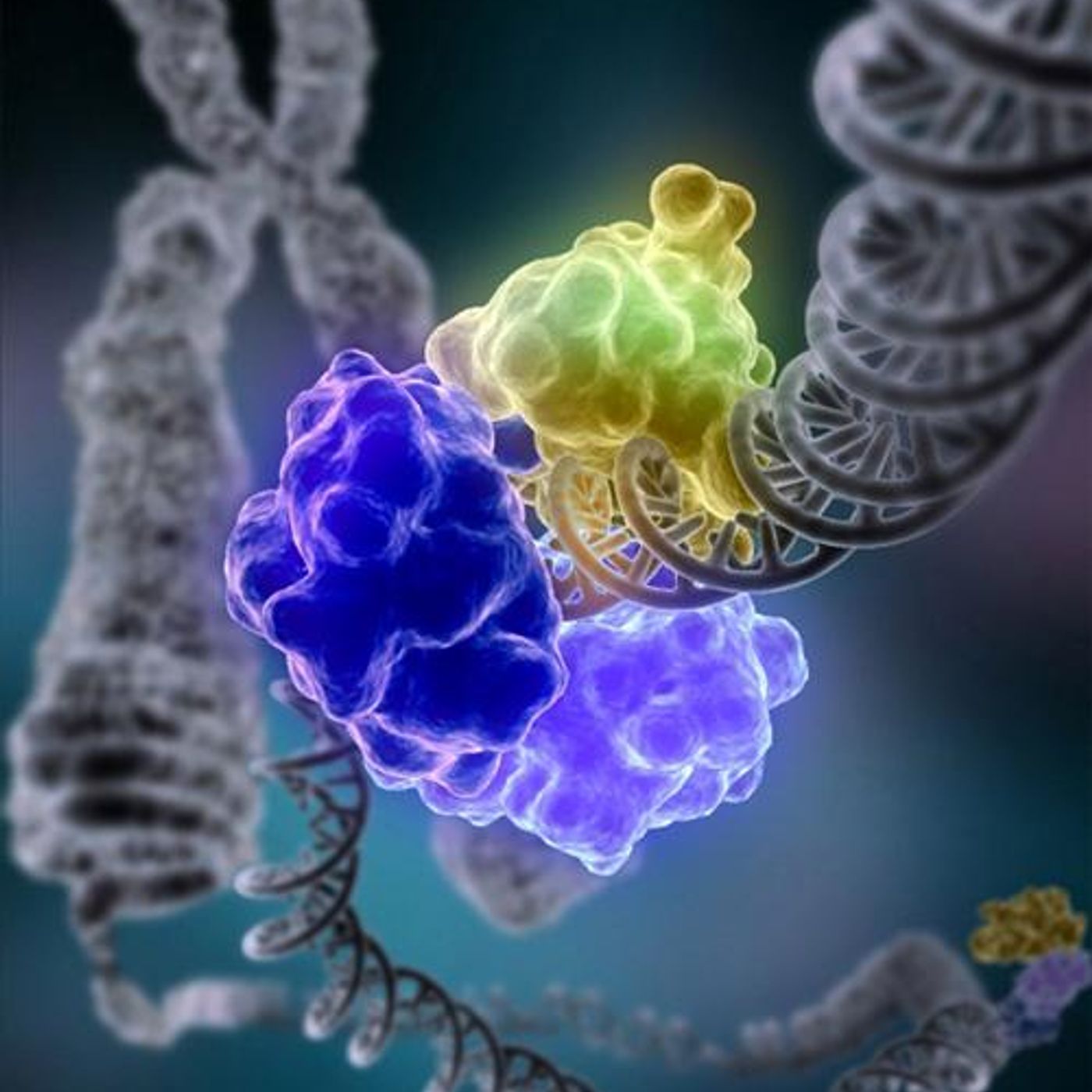
Radiolab
Double Blasted
00:19:28
In early August of 1945, Tsutomu Yamaguchi had a run of the worst luck imaginable. A double blast of radiation left his future, and the future of his descendants, in doubt. In this short: an utterly amazing survival story that spans ... well, 4 billion years when you get down to it.
Loading summary
Transcript153 lines
- [00:00]
A
Oh, wait, you're listening. Okay.
- [00:02]
B
All right.
- [00:04]
A
Okay.
- [00:05]
B
All right. You're listening to Radiolab.
- [00:09]
C
Radiolab shorts from wnyc.
- [00:15]
A
Yes, and npr.
- [00:19]
C
Sam, are you there?
- [00:20]
B
I am here. Hello?
- [00:21]
C
Okay.
- [00:22]
A
Hey, Sam.
- [00:22]
B
Hello. How are you?
- [00:23]
A
Good. How are you?
- [00:24]
B
Good.
- [00:25]
C
So, to begin with, we're talking to author Sam Keane, Radiolab regular, and he has just written a wonderful new book called the Violinist's Thumb. And in it he tells a story which is actually kind of encouraging, I think.
- [00:40]
A
Yeah. To get to that part, though, you have to make it through the worst luck imaginable and a thousand year curse.
- [00:47]
C
Yeah, well, I don't even know where to begin with you, but maybe just.
- [00:52]
A
Tell us the fellow's name.
- [00:53]
B
The fellow's name is. I hope I'm pronouncing it right. Tsutomu Yamaguchi.
- [01:01]
A
He is Japanese, of course.
- [01:03]
B
Story takes place in Japan, specifically on August 6, 1945.
- [01:07]
C
What is his job, this fellow?
- [01:08]
B
He's a ship engineer. He designed big military and shipping boats for Mitsubishi.
- [01:15]
A
And Mr. Yamaguchi had spent the last couple of months working in Hiroshima.
- [01:19]
C
But now, finally, he's about to leave.
- [01:21]
B
The next day to return home.
- [01:23]
C
And on the morning of August 6th, what's happening with him?
- [01:27]
B
He gets partway to work and he realizes that he has forgotten his incon.
- [01:32]
C
What's an incon?
- [01:33]
B
It's a seal that they use to stamp documents. Oh, that was his signature, which, you.
- [01:39]
A
Know, was important for his work.
- [01:40]
B
So he goes back home to his boarding house, gets waylaid by the owners of the boarding house he's at, and they say, would you come to have tea with us? And he's very polite. So he sits down for tea for a while with them. Then finally they let him go. He grabs his ink on, hops back on the bus, takes his bus to a streetcar, gets off the streetcar and he starts walking. And at this point, it's about 8:15 in the morning, he's got about a.
- [02:06]
A
Mile to walk to get to the Mitsubishi plant. So he's walking by some farms to get to the city when all of.
- [02:11]
B
A sudden he hears something overhead. He looks up in the sky and.
- [02:17]
A
He sees a plane way, way up above him.
- [02:19]
B
And he can just see a very tiny speck descending from the belly of the plane.
- [02:26]
C
And he knows right away that's a bomb. I mean, Japan is at war after all.
- [02:30]
B
And he's been drilled in air raid tactics.
- [02:33]
A
So he drops to the ground, covers.
- [02:34]
B
His head, and he plugs his thumbs into his ears and he waits for the big bang to Go off.
- [02:44]
C
But this time, before there's even a.
- [02:46]
B
Sound, there was a very hot flash of very bright white light that sort of bathed over him. Then after that came the roar. It actually picked him up off the ground and threw him. He could feel the air sort of raking over his belly, and it threw him down and he landed unconscious.
- [03:20]
A
Okay, before we move forward with Tsutomu's day, and it does not end here, let's just rewind the story about a fraction of a second back to that moment when he's on the ground, crouching with his fingers in his ears, and that light comes. Well, the thing about that white light.
- [03:35]
B
Is that it is filled with gamma rays, which are basically like really high powered, intense X rays.
- [03:42]
A
And in that instant the light hits him, those gamma rays shoot through his skin into the cells of his body where his DNA is, where they slam into water molecules that are clustered around the DNA.
- [03:53]
B
DNA is a very thirsty molecule. It has lots of water nearby it. And gamma rays, when they come crashing in, they knock electrons right off the water molecules, and it forms these very reactive molecules called free radicals, which become.
- [04:11]
A
Like hungry little beasts.
- [04:13]
B
And they start to go after DNA. They're very greedy for electrons because they're missing an electron at this point, and they see this big molecule nearby, DNA, they go right after it and they start ripping electrons off. They basically cut it at various points.
- [04:33]
C
All of which is to say that the moment the light hit him, Tsutomu Yamaguchi's DNA got shredded.
- [04:40]
A
Where did the bomb land in proximity to him? Like right near him? Or was it miles and miles away?
- [04:46]
B
He was about a mile or so away. It's a little hard to judge, but he was about a mile or so away. And he just remembers waking up lying in the potato field.
- [04:58]
C
So then what happens?
- [05:00]
B
He wakes up and he has no idea how long he was unconscious because the bomb sucked up so much dirt that it sort of made the entire area dark. It was like storm clouds over the entire city. So he couldn't tell how long he'd been unconscious. But he got to his feet and sort of started staggering through this potato field.
- [05:24]
C
And he looks down at his arms.
- [05:26]
B
It looked like he had this horrendous sunburn on both of his forearms, especially his left forearm, which was closer to the bomb. But he's walking by people who are torn open and bleeding or staggering. They're clearly not going to make it. And he's just sort of wandering through this field before he realizes that he should go report to work.
- [05:49]
C
He's going to go to Mitsubishi.
- [05:52]
B
He didn't know what to do. He was sort of dazed. That was the only thing he could think of to even try to do. It was the only real anchor he had to the city.
- [06:01]
C
But when he gets to the Mitsubishi plant, it isn't there. It's just rubble. His co workers are dead. So he decides what he's got to do is he's got to find a way to get home and back to his family.
- [06:13]
B
And he starts hearing a rumor that there are going to be trains leaving Hiroshima to go south, which is where he's from. And he decides he's going to get to the train station no matter what. The unfortunate part is that he has to cross over rivers to get to the train station. And most of the bridges have been knocked out.
- [06:32]
C
At this point, he finds himself walking along one river, literally filled with bodies that are beginning to pack together.
- [06:41]
B
And he's desperate enough where he actually starts crawling over this bridge of bodies in the river because he had no other way of getting across. And they were clogging the river at a lot of points, so he starts crawling over them. But he gets to a gap in the river, so he has to turn back. He goes a little bit downstream and he finds that there's a railroad trestle across the river at this point, and there's one beam of it intact. So he climbs up this little tower and basically, like a tightrope walker, starts walking across this railroad trestle to get to the other side.
- [07:21]
C
Eventually, he does find the train station.
- [07:23]
B
And there's predictably, kind of a mob waiting to get on these trains. But he pushes his way through, gets to the train, and he sits down.
- [07:31]
C
And the train leaves to take him home to Nagasaki.
- [07:35]
A
Go away.
- [07:36]
C
He's Nagasaki.
- [07:37]
A
He's going from Hiroshima a day later to Nagasaki.
- [07:40]
B
He's going to Nagasaki the next day.
- [07:42]
A
I don't like where this is going.
- [07:44]
C
Does he find his family?
- [07:46]
B
He gets to them. He finds him at home.
- [07:49]
A
Spends a day swimming in and out of consciousness.
- [07:51]
B
And the next day, August 9, he gets up, gets to Mitsubishi headquarters. He's bandaged up, not looking very good, and. And he starts telling his boss and his fellow engineers about this enormous bomb that had exploded and devastated the city. And after a minute or so, his boss cuts him off and he says that this is complete baloney. You're an engineer, calculated how could one bomb destroy an entire city? And as soon as he finished saying that, the Yamaguchi felt the same flash that he'd felt in Hiroshima followed by.
- [08:29]
A
That same roar for a second time.
- [08:33]
B
Yamaguchi's thought while this was happening was, oh, my God. He thought the mushroom cloud had followed him from Hiroshima. In a sense, I guess he was right. It had sort of followed him there.
- [08:44]
A
And again in that flash, gamma rays flood his body.
- [08:47]
B
They would have created free radicals again, and it would have attacked his DNA a second time.
- [08:56]
A
A second time he pulls himself up, staggers out of the building.
- [08:59]
B
It didn't collapse this time.
- [09:00]
A
And he climbs up a hill nearby.
- [09:02]
B
He starts looking over at Nagasaki, which.
- [09:05]
C
Is burning just like Hiroshima was three days before. And the sky is black with clouds again.
- [09:11]
B
And he could see where his neighborhood was. And it looked like his neighborhood was completely burnt out, too.
- [09:19]
C
He does eventually find his family. They've made it into an air raid shelter, and they do try to restart their lives. But within a short time, his health.
- [09:28]
B
Starts sinking pretty quickly. His hair fell out. He had boils erupting on his body. He kept throwing up. His face swelled. He lost hearing in one ear. His arm, he reported, looked like whale meat. This sort of bright red raw meat because he'd had sort of this blackened crust over it. And when the second bomb came, it incinerated that and fell off.
- [09:53]
A
Now, the really scary thing for scientists at the time who had begun to study the effect of radiation on the body was that it seemed like all that physical trauma, that was just the beginning of the nightmare. Because, remember, these gamma rays attack the DNA. That makes you you. And that's not just a problem for you. That's the same DNA that you pass down to your kids and their kids, and they're kids kids.
- [10:17]
C
What if those genes stay broken down through time?
- [10:21]
B
There was a famous quote from Herman Mueller, the person who first figured out that exposing genes to radiation could cause a lot of damage to them. And he told the New York Times, if the bomb survivors could foresee the results a thousand years from now, they might consider themselves more fortunate. If the bomb had killed them, he thought that it would propagate like a biblical curse through the generations.
- [10:50]
A
And when the actual damage was done, how long did that take?
- [10:54]
B
It's over within a millisecond, the gamma rays coming in. That is over in a millionth of a billionth of a second. That happens pretty much instantaneously. And the free radicals doing their damage is over after about a millisecond.
- [11:11]
A
Wow. So a millisecond creates this in Mueller's, you know, forecasting Thousand Year Curse.
- [11:18]
B
Exactly. It's over at that point.
- [11:20]
A
And Here was a guy who got.
- [11:21]
B
Blasted twice within the span of three days.
- [11:26]
C
How many people on earth were in both blasts?
- [11:29]
B
There's only a handful of people that they know of who were in what they call the blast zone, about a mile or a mile and a half zone in both cities. And Yamaguchi was one of those few people.
- [11:45]
A
So the question was, was Mueller right? Did these bombs create some kind of genetic curse that would echo through time? How long would it last?
- [11:54]
C
For the next 40, 50 years, scientists both in Japan and in America began to track birth defects, incidence of cancer in the children of those who had been hit or blasted by the bomb.
- [12:06]
A
Which brings us back to Mr. Yamaguchi.
- [12:08]
B
Couple years later, Yamaguchi and his wife did decide that they did want to have children.
- [12:14]
A
So he recovers.
- [12:15]
B
He does recover. He goes back to work at Mitsubishi again. It's been so good to him. He had to go back there. I mean, it's not their fault, right? Anyhow, so he gets back on his feet, his health returns, and in the early 1950s, he and his wife decide that they want to have some more children. As you can imagine, there was a lot of anxiety about this kind of throughout the world. People really didn't know what was going to happen, especially because the initial blast of radiation really hit pregnant women hard. There were a lot of birth defects. It ended up producing a lot of babies with very tiny heads called microcephaly, and they had very low IQs. They couldn't do anything for themselves.
- [13:04]
A
Nonetheless, Mr. Yamaguchi and his wife decide they're gonna go for it.
- [13:08]
B
And they do have children.
- [13:10]
A
Children, plural?
- [13:11]
B
Yeah, they had two daughters after that, and the two daughters initially are fine. They don't have any noticeable birth defects or any birth defects, but they ended up starting in their teenage years and then, especially as adults, having a lot of health problems. They had a lot of immune problems, and they quite naturally blame it on the fact that. That their father got exposed to the nuclear bomb twice and their mom got.
- [13:40]
A
Exposed once, but still no cancer, no birth defects.
- [13:44]
C
And roughly 60 years later, as far.
- [13:47]
B
As I know, they're still alive.
- [13:48]
A
Really?
- [13:49]
B
Yeah.
- [13:50]
A
Now, here's the amazing thing.
- [13:51]
B
In Japan generally, though, there's really no evidence that the next generation of people really suffered. The children of atomic bomb survivors in Japan were really didn't have a higher incidence of birth defects or cancer or anything like that.
- [14:10]
C
Now, of course, the people who were directly exposed to radiation, obviously, they had.
- [14:13]
B
A ton of health problems, but it somehow just didn't get passed on. To the next generation, it seems.
- [14:20]
A
Seriously, I find that so surprising.
- [14:22]
B
Yeah, I just assumed that the next generation of children would have reported a lot of health damage, a lot of birth defects, a much higher rate of cancer, but that didn't happen.
- [14:36]
A
Why not? I mean, like, how could it not affect the next generation? I mean, given the way that the gamma rays attack the DNA, it just seems like it would have to.
- [14:46]
B
Well, there is evidence that people.
- [14:50]
C
Sam says there's a couple of things that might have happened here. First of all, if you're talking about damage getting passed down through generations, the key thing for DNA is what's going on inside your sperm and your egg cells. Those are the sex cells.
- [15:02]
B
That's the only DNA that gets passed to the next generation.
- [15:06]
A
And he says, maybe these sex cells are just hardier than we thought.
- [15:09]
B
And probably even more importantly, it turns out that after 4 billion years, DNA can do a pretty good job of repairing itself. There's one gene in particular called the p53 gene, and that's sometimes called the guardian of the genome. And it looks for DNA damage wherever it can.
- [15:37]
A
It's sort of like our guardian angel embedded in our genes. And there's a lot of different ways that DNA can get messed up.
- [15:43]
B
DNA is a double helix, which means.
- [15:46]
A
It'S got these two strands of chemicals.
- [15:48]
B
The A, C, G and T letters.
- [15:51]
A
That all fit together sort of like a zipper, so that the letters always.
- [15:55]
B
Match, A always matches with T, and C always matches with G. So if you can read one side of the DNA strand, you know what has to appear on the opposite strand.
- [16:07]
A
So when one of the two strands gets damaged, this p53 gene, it sort.
- [16:12]
B
Of whistles over these certain handyman proteins, and they come over, they'll basically cut that strand out, throw it away, and.
- [16:20]
A
Pop in a new one. Because if you've got A and C on one side, you know, you need T and G on the other.
- [16:24]
B
Pretty simple. It's an ingenious system. Other times both strands get snapped, and that is kind of an emergency for your body.
- [16:32]
A
When that happens, this little guardian gene.
- [16:34]
B
Will basically force the cell to commit.
- [16:36]
A
Suicide because it can't afford to have that cell turn cancerous.
- [16:42]
C
Now, I don't think we want to leave the impression that, you know, you can stand in a bomb blast and your children will not be affected. For sure. For sure. Because I don't think we're that sure.
- [16:50]
B
No, There is evidence that people from Chernobyl, for instance, did show higher signs of birth defect. There was different kinds of radiation that got into the food supply. And when radiation gets in your body, it's kind of like a bazooka at short range. And it does a lot more damage to your DNA.
- [17:09]
A
Which is why in 2011, with the reactor meltdown, the Japanese government immediately quarantined all contaminated food and animals. But still, what's sort of beautiful here is that something that seems so unbelievably intricate and fragile, like a strand of DNA, that little tiny flame that we pass into the future, that. That can be so surprisingly resilient, that we can be so resilient.
- [17:36]
C
What happened to Mr. Yamaguchi?
- [17:38]
B
What was he actually lived all the way until 2010.
- [17:42]
C
2010.
- [17:44]
B
He lived 65 years after that.
- [17:47]
A
How old was he?
- [17:49]
B
He was. Let me look up to make sure. He was 93 years old when he finally died.
- [17:58]
A
Oh, my God.
- [18:09]
C
Big thanks to Sam Keane, whose work is. Well, we like what he does a lot. And he has a new book, which. It's a long title. Go ahead and read it.
- [18:20]
A
It's called the Violinist's Thumb and Other Lost Tales of Love, War, and Genius As Written by Our Genetic Code.
- [18:27]
C
And what he does is he just takes a look at everything that's happened in the 10 years since the Human Genome Project ends, and he asks, what have we learned? And that's what the book tells you. Tells you what we've learned, which is a lot.
- [18:38]
A
Yeah. I'm Jad.
- [18:40]
C
I'm Robert.
- [18:41]
A
Thanks for listening.
- [18:43]
D
Hey, Radiolab team, this is Matt Snodgrass. I am a Radiolab listener from Portland, Oregon, and here is my reading of the credits. Radiolab is supported in part by the National Science foundation and by Alfred P. Sloan Foundation. Enhancing the understanding of science and technology in the Modern world. More information about sleep Sloan@www.sloan.org. thank you guys for this opportunity. This is awesome. Best of luck. Bye.
- [19:20]
B
End of mess.