← Radiolab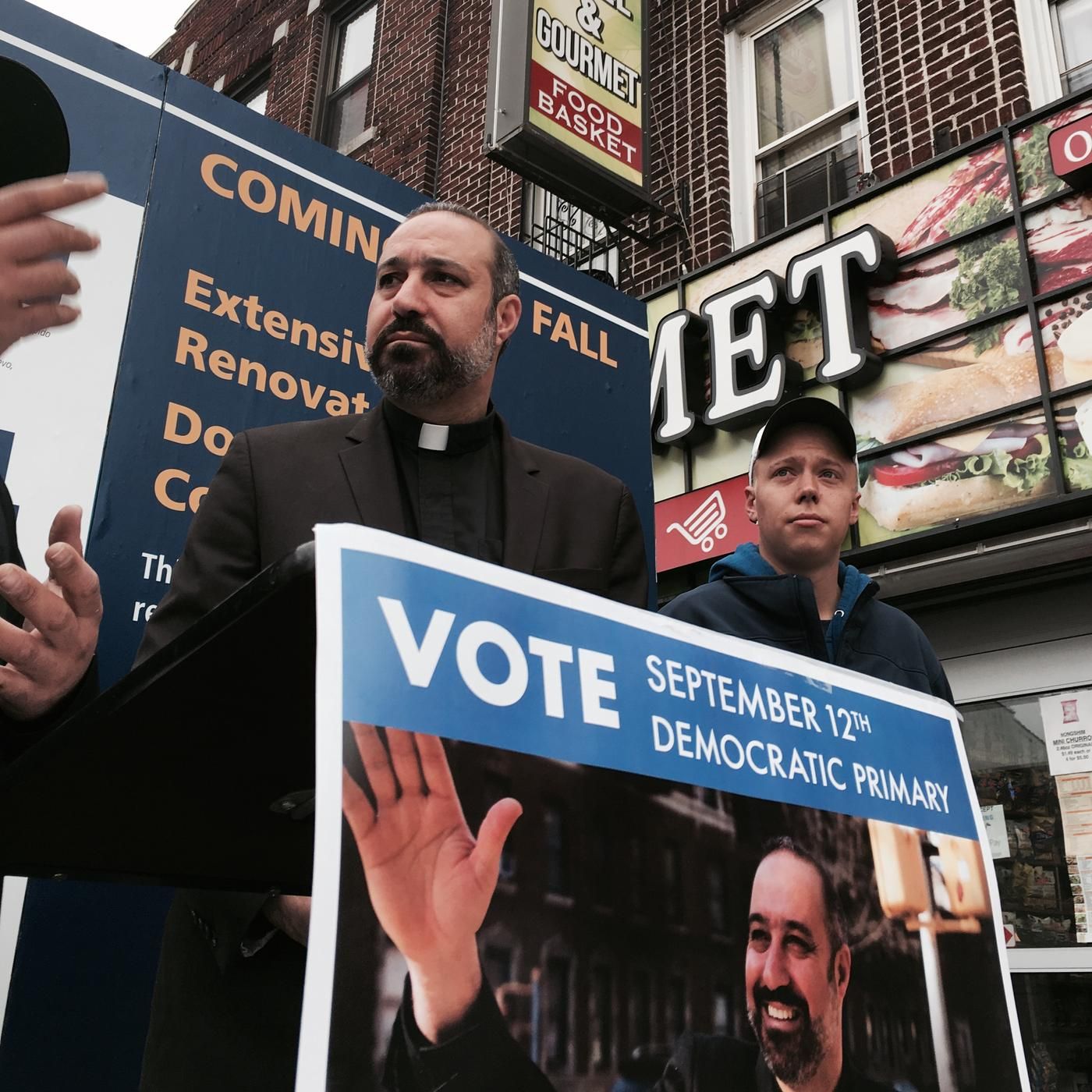
Radiolab
Father K
01:11:16
Today, while the divisions between different groups in this country feel more and more insurmountable, we zero in on a particular neighborhood to see if one man can draw people together in a potentially history-making election. Khader El-Yateem is a Palestinian American running for office in Bay Ridge, Brooklyn, one of the most divided, and most conservative neighborhoods in New York City. To win, he'll need to convince a wildly diverse population that he can speak for all of them, and he'll need to pull one particular group of people, Arab American Muslims, out of the shadows and into the political process. And to make things just a bit more interesting, El-Yateem is a Lutheran minister. This story was reported and produced by Simon Adler, with help from Bethel Habte, Annie McEwen, and Sarah Qari. Support Radiolab today at Radiolab.org/donate.
Loading summary
Transcript698 lines
- [00:00]
Simon Adler
Suffering from dry, tired, irritated eyes.
- [00:03]
Khader El Yateem
Don't let dry eyes win. Use Sustain Pro.
- [00:06]
Simon Adler
It hydrates, restores and protects dry eyes.
- [00:08]
Khader El Yateem
For up to 12 hours. Sustain Pro Triple Action Dry Eye Relief. Businesses that are selling through the roof.
- [00:14]
Simon Adler
Like Untuck it, make selling and for.
- [00:16]
Robert Krulwich
Shoppers, buying simple with Shopify, home of.
- [00:19]
Khader El Yateem
The number one checkout on the planet.
- [00:21]
Simon Adler
And with shop Pay, you can boost.
- [00:23]
Khader El Yateem
Conversions up to 50%. Businesses that sell more, sell on Shopify.
- [00:27]
Simon Adler
Upgrade your business and get the same checkout Untuck it uses. Sign up for your $1 per month trial period at shopify.com podcast free. All lowercase go to shopify.com podcastfree to.
- [00:38]
Khader El Yateem
Upgrade your selling today.
- [00:43]
Simon Adler
Wait, you're listening.
- [00:44]
Robert Krulwich
Okay.
- [00:46]
Simon Adler
All right.
- [00:47]
Robert Krulwich
Okay.
- [00:48]
Simon Adler
All right. You're listening.
- [00:51]
Kayla Santos Suoso
Listening to Radio Lab.
- [00:53]
Simon Adler
Radio Lab from wnyc.
- [01:01]
Jad Abumrad
I'm Jad Abumrad.
- [01:02]
Robert Krulwich
I'm Robert Krulwich.
- [01:03]
Jad Abumrad
This is Radiolab.
- [01:04]
Robert Krulwich
And today we have a little experiment in democracy, diversity and division.
- [01:08]
Jad Abumrad
Yeah. Comes to us from our reporter, producer, Simon Adler.
- [01:11]
Simon Adler
Okay.
- [01:12]
Jad Abumrad
All right, Simon.
- [01:13]
Simon Adler
Okay.
- [01:13]
Jad Abumrad
What do you have to tell me?
- [01:15]
Simon Adler
So a couple months back, I took the train down to southern Brooklyn to a little neighborhood called Bay Ridge, best known for its portrayal in the movie Saturday Night Fever.
- [01:33]
Jad Abumrad
You weren't heading there for disco?
- [01:35]
Simon Adler
No, not exactly. The auditorium appears to be filling up. I was actually down there to go to this Catholic high school auditorium. Oh, how you doing? Hey. Sort of the classic high school auditorium sloping down with the stage in front and like an American flag on one side of the stage and a New York state flag on the other. Maybe 1,000 seats. And I would say half of them are filled. Like, surprisingly, there's a big turnout for this thing. You look familiar. I look familiar? Have you seen me before?
- [02:02]
Kayla Santos Suoso
Well, maybe because you're handsome.
- [02:05]
Simon Adler
And it would not be unfair to say that the crowd has an average age of 62. The reason I was there. So what brings you here tonight? Conceited debate was to watch the local candidates for the New York City City Council duke it out. Who's most likely to do something for you, do you think?
- [02:23]
Kayla Santos Suoso
I have no idea. I've been hurt on both sides.
- [02:26]
Simon Adler
And can I ask you a question or two? As I was talking to people beforehand, weaving in and out of the rows of chairs, the issues that people were concerned about were really what you would expect.
- [02:37]
Kayla Santos Suoso
I'll be in this neighborhood for five years. I've been fighting for a light at.
- [02:40]
Simon Adler
This level of politics.
- [02:41]
Kayla Santos Suoso
In the meantime, I get aggravated. We have to run for our lives when we cross the streets here, it's.
- [02:46]
Simon Adler
Horrible, you know, small stuff.
- [02:48]
Kayla Santos Suoso
Taking away the 5 cent bottle tax.
- [02:51]
Simon Adler
You drink a lot of Mountain Dew or something. So those 5 cents are going to add that.
- [02:54]
Kayla Santos Suoso
My water bottles, it jumps up the price when I buy those 24 packs of water.
- [02:59]
Simon Adler
But please, take your places.
- [03:02]
Kayla Santos Suoso
We're about to begin.
- [03:04]
Simon Adler
Eventually, the emcee for the evening, this woman in her 70s, dressed from head to toe in pink, walks out onto the stage. This is America in action. We've got a great selection here. She invites the candidates up. Five Democrats, four Republicans. They sit down at their respective tables and okay, we're ready. It gets underway. Get on our mark, get set, go. And at first, as your city councilwoman, I will help and make sure that those that have limited income are on fixed income. It's pretty dry. We'll have enough resources and be helped to take care of their pets. Pets, yeah. So they don't have to put them down and they don't have to put.
- [03:47]
Kayla Santos Suoso
Them out into the street.
- [03:49]
Simon Adler
But then about an hour, hour and a half into it, there's this moment.
- [03:53]
Kayla Santos Suoso
Where, what are your solutions for the overcrowding in schools in this district?
- [03:57]
Simon Adler
Bob Capano, one of the Republican candidates, this guy, Bob Capano, goes off on this rift. It's a matter of budgetary priorities. It takes money to build schools. So perhaps if we put an end to some of the city's sanctuary city policies, like spending $27 million to defend those here illegally who commit felonies from deportation, perhaps we would have more money to build more public schools. And then, just as it seemed like people were settling down, moving on to.
- [04:32]
Kayla Santos Suoso
The next question.
- [04:34]
Jad Abumrad
The Democrats.
- [04:35]
Khader El Yateem
Right.
- [04:35]
Kayla Santos Suoso
All right, let's have no Congress, please.
- [04:38]
Simon Adler
This man on the far right side of the auditorium stands up and then goes on to say.
- [04:46]
Kayla Santos Suoso
Get the freaking.
- [04:47]
Simon Adler
Asians out of here. Get the Arab people and the freaking Asians out of here. Why are you selling your houses?
- [04:54]
Kayla Santos Suoso
You let everybody.
- [04:56]
Simon Adler
Why are you selling your houses? You're letting everybody take over. Everybody sort of sat up in their seats and nobody was quite sure if this thing was gonna escalate. And shortly after he said this, one of the candidates up on stage, this tall guy, like 6 foot 3, salt and pepper beard, stood up from behind the table and actually walked out in front of it.
- [05:23]
Khader El Yateem
And I wanna say something and at.
- [05:25]
Simon Adler
Least forgive me and, and said, there.
- [05:28]
Khader El Yateem
Is an elephant in the room. And it's called racism and discrimination in this community right here. You have an opportunity in September12 to send a message to Trump and to the world that the people of the 43rd district are not afraid to send the first Arab American City council to represent them.
- [05:50]
Simon Adler
So the reason I was at this debate is like, it feels right now like America is just at its own throat. It's certainly as divided as I've ever seen it. And I just keep wondering, like, in this moment, can one person stand for all of us anymore? And here you've got this guy, the guy you just heard, Khader El Yateem, a Palestinian American trying to win an election in one of the most conservative and most divided neighborhoods in New York. And he's running on behalf of a group of people who currently are at the flashpoint of those divisions. Arab American, Muslims. And just to make things a little more complicated, Khader El Yateem is a Christian.
- [06:37]
Khader El Yateem
The grace of our Lord Jesus Christ, the love of God and the communion.
- [06:41]
Simon Adler
Of the Holy Spirit, a Christian minister.
- [06:53]
Khader El Yateem
Yeah, we want to go in the office.
- [06:54]
Simon Adler
Yeah. Is that okay?
- [06:55]
Robert Krulwich
Yeah.
- [06:56]
Simon Adler
Check, check, check. I sat down with him in his office for the first time this past March.
- [07:03]
Khader El Yateem
I am an Arab American Palestinian, Christian, Lutheran pastor in southwest Brooklyn running for office.
- [07:09]
Simon Adler
Slow that down.
- [07:10]
Khader El Yateem
Say that for me.
- [07:15]
Simon Adler
Could you say that once more?
- [07:17]
Khader El Yateem
An Arab American Palestinian Lutheran pastor in southwest of Brooklyn who is running for City Council. Because I want to bring a new bold, fresh, inclusive, powerful voice to present our district and City Council.
- [07:33]
Simon Adler
You've got a nice cadence there. You said that one.
- [07:36]
Khader El Yateem
You know, being a preacher, you know, it helps a little bit too.
- [07:40]
Jad Abumrad
What's this guy's backstory? How did he end up being in Brooklyn and running for. For the seat for City Council?
- [07:46]
Simon Adler
Well, so he was born and raised in Bethlehem on the west bank in.
- [07:50]
Khader El Yateem
A Palestinian Christian home into a family that was poor to a middle class.
- [07:56]
Simon Adler
His father was a carpenter and made most of his money carving, you know, those little like, nativity scenes with the wooden camel and the wooden Christ. He carved those for a living.
- [08:06]
Khader El Yateem
My mother was a housewife and she helped my father in the factory. They worked extremely hard to provide for us a good life. So it was amazing, wonderful, simple life. It wasn't complicated. So I went to school, grew up.
- [08:20]
Simon Adler
In the church, and after high school, Elia team went into the seminary at.
- [08:24]
Khader El Yateem
The Bethlehem Bible College.
- [08:26]
Simon Adler
And then when he was in his second year, this was 1989, I was.
- [08:29]
Khader El Yateem
Arrested by the Israeli soldiers. I was picked up from my bed from home at three in the morning, and they took me to prison.
- [08:39]
Simon Adler
And for what reason?
- [08:44]
Khader El Yateem
I don't know. I never been given a reason why I Was arrested. I never been convicted of anything. I was picked up from my bed at three in the morning from my father's house and taken to prison. I was in solitary confinement in a small cell.
- [09:00]
Simon Adler
He says that the Israeli soldiers basically.
- [09:02]
Khader El Yateem
Tortured him, Hitting me and putting me outside against the wall with a bag on my head under the rain and the cold. And they kept asking me, tell us what you did wrong. Tell us what you did wrong. I said, I have nothing to.
- [09:14]
Simon Adler
And a few months later he was released with no explanation.
- [09:18]
Khader El Yateem
Just was a bizarre experience.
- [09:19]
Simon Adler
And when he got home, after I.
- [09:22]
Khader El Yateem
Came out from prison, there's a lot of people came to our house. They say, oh look, see what they did to you. Now you have to do this to them. You know, they come to recruit you to belong to a political party.
- [09:35]
Simon Adler
In this case it was the Palestinian Liberation Organization, which at the time was explicitly an armed resistance movement that often targeted Israeli citizens.
- [09:46]
Khader El Yateem
They say, oh, look, see what they did to you. Now you have to do this to them. And I said, absolutely not. This is not the way I want to live the rest of my life. You know, I always wanted to be engaged in a place where I can bring hope, I can help people. And the only way I can do that was through become a minister.
- [10:09]
Simon Adler
So he doubled down on his studies, finished seminary, was working in Palestine and. And then in the early 90s, he was actually sent to start a new Lutheran church in Bay Ridge, Brooklyn.
- [10:24]
Khader El Yateem
So I came to Brooklyn 1995. I remember on the first day I.
- [10:29]
Simon Adler
Was shocked because biking down 5th Avenue, if you take the whole neighborhood in and we are in Bay Ridge, which I actually did not too long ago on a bike. What you notice is on the right we have Leif Erikson Park, A nod to the neighborhood's Scandinavian past. This sort of crazy mix of different kinds of people. The Bay Ridge Bakery. Beautiful neon sign. Looks like it hasn't changed much since the 1960s. Johnny pumps a fireman bar. Firefighter bar. Did I hit record? I did hit record alright. Skinflint's Pub. It's sort of like looking at a geological cross section of the neighborhood's history. The Beanpost Pub or the Schnitzel House. On the left, you can see how groups of people layered themselves on top of groups of people making themselves part of one of the most deeply mixed neighborhoods in the country. And when you get just a little bit south, it's impossible to not notice. One of the latest groups trying to settle in Abu Ar Kram Furniture almost got hit by a car oops The Yemen cafe. El Zahar. Halal meat. Women walking around in hijab. Got a hookah lounge. Hookah nuts. That sounds nice. Turkish kebab Azar. And how large is the Arab community in the 43rd district?
- [11:56]
Khader El Yateem
We don't have the exact.
- [11:57]
Simon Adler
Because again, Father Elia team, when the.
- [11:59]
Khader El Yateem
Census department came 10 years ago, they told the Arab community, if you are an Arab, check white. So we don't have specific numbers, but.
- [12:09]
Simon Adler
The estimates I heard are somewhere between 20 and 30,000.
- [12:12]
Khader El Yateem
Wow.
- [12:13]
Simon Adler
Living in southwest Brooklyn, that's a huge community. Yeah, I mean, that's only about 10% of the total population. But in a Democratic primary for city.
- [12:22]
Khader El Yateem
Council, we need only about 4,000 votes to win.
- [12:25]
Simon Adler
4,000 votes total?
- [12:26]
Khader El Yateem
Yeah.
- [12:27]
Jad Abumrad
That's it.
- [12:28]
Simon Adler
That's it.
- [12:28]
Robert Krulwich
Wow.
- [12:29]
Khader El Yateem
Yeah, I mean, the turnout is very low and we have an open seat, so we'll have a bigger chance winning because we're not running against an incumbent.
- [12:38]
Jad Abumrad
What's the margin of victory? Typically?
- [12:40]
Simon Adler
They can be squeakers. I mean, just several years back, the race was won by just 31 votes.
- [12:48]
Jad Abumrad
What?
- [12:48]
Robert Krulwich
31?
- [12:49]
Simon Adler
Yeah. So it would seem that if this guy can just. Well, despite the fact that there's never been an Arab American on city council before, it seems that if he can get out the Arab American vote, he's got a shot.
- [13:02]
Robert Krulwich
Well, shot. I mean, you just told us there's a lot of Arabs there. So he should own this election.
- [13:07]
Simon Adler
Well, yes, but at the same time.
- [13:10]
Kayla Santos Suoso
This neighborhood is such a microcosm.
- [13:13]
Simon Adler
I think that Islam is an evil ideology.
- [13:16]
Kayla Santos Suoso
That's what I think of, like, everything that's going on. This is Kayla, Kayla Santos Suoso.
- [13:21]
Simon Adler
She's the former deputy director of the Arab American association of New York.
- [13:25]
Khader El Yateem
I am something else. I'm what you call an American.
- [13:28]
Simon Adler
And she said, if you look around the neighborhood, you'll see all these sort of national level issues playing out on the ground.
- [13:34]
Kayla Santos Suoso
It's like a, you know, like a shadow play or something.
- [13:36]
Simon Adler
And I think it's an ideology. Take the travel ban. I mean, you've got one of the.
- [13:40]
Kayla Santos Suoso
Largest Muslim neighborhoods in the country.
- [13:42]
Linda Sarsour
Right.
- [13:43]
Simon Adler
Right next to all of these people who voted for Trump who support the travel ban. No immigration whatsoever. None. Zero. And shifting national demographics.
- [13:52]
Kayla Santos Suoso
We're one of the last remaining New York City neighborhoods where there is still a strong white working class, but is in the process of being priced out.
- [14:03]
Simon Adler
Gentrification is really hitting white people hard. And so clearly there's going to be tension there.
- [14:09]
Kayla Santos Suoso
Like, we've just got a lot of the elements of the struggles and the anxieties that are going on on a national level.
- [14:16]
Simon Adler
So.
- [14:20]
Khader El Yateem
Candidate log 1:10am with all of this.
- [14:23]
Simon Adler
In mind, we're still out there in.
- [14:25]
Khader El Yateem
Search for new voters. Hudar Elia team candidate signing out along.
- [14:30]
Simon Adler
With the help of his campaign manager.
- [14:31]
Kayla Santos Suoso
He's full of dad jokes. It's kind of amazing.
- [14:34]
Simon Adler
The woman you just heard a couple seconds ago, ago, Kayla.
- [14:36]
Kayla Santos Suoso
Now I'm the campaign manager for Elya team for city council.
- [14:39]
Simon Adler
Have you guys become like best friends?
- [14:41]
Khader El Yateem
She's my mother in law.
- [14:43]
Kayla Santos Suoso
Why do you call me your mother in law?
- [14:44]
Khader El Yateem
Because I love my mother in law.
- [14:46]
Simon Adler
Set out to represent the Arab community.
- [14:49]
Khader El Yateem
I am a candidate going where no other candidate have gone before.
- [14:53]
Kayla Santos Suoso
Oh my God, here we go.
- [14:57]
Simon Adler
Captain.
- [14:58]
Kayla Santos Suoso
See Captain, don't encourage this behavior.
- [15:01]
Khader El Yateem
So Captain Kirk. Captain.
- [15:04]
Simon Adler
But dad, joke aside, it's true. He really is trying something that's never been tried before. And one reason that it's never been tried before is that those 20 some thousand Arab Americans for the last 20 years they've been hiding.
- [15:19]
Linda Sarsour
Like for me, just it's been unnerving to be in a district where you don't feel like people are watching out for you in your community.
- [15:25]
Simon Adler
This is Linda Sarsour.
- [15:26]
Linda Sarsour
I'm a Palestinian Muslim American community organizer, born and raised in Brooklyn, New York.
- [15:31]
Simon Adler
And she says the key thing to know is that not long after the.
- [15:34]
Linda Sarsour
911 attacks, the US government in 2003 did engage in a registration program, a.
- [15:39]
Narrator/Producer
Registry called NSEERS, the National Security Entry.
- [15:44]
Simon Adler
Exit Registration System, which meant that males.
- [15:47]
Linda Sarsour
Over the age of 16 who were from these like 29 countries of origin.
- [15:51]
Simon Adler
Countries that had a historic connection to terrorism.
- [15:54]
Linda Sarsour
Bangladesh, Pakistan, Iran, Iraq, Egypt. Go down the list.
- [15:58]
Simon Adler
People from those countries that were visitors, temporary workers, non US citizens had to come and formally register with the federal government.
- [16:08]
Khader El Yateem
FBI told me, give me people, Muslim people. They're treating us like animals. That's it.
- [16:13]
Simon Adler
Linda was there with some of these men providing translation services in this post.
- [16:19]
Linda Sarsour
Office like room where there are all these windows.
- [16:21]
Simon Adler
The men would be called up one at a time, photographed, fingerprinted, look at.
- [16:25]
Linda Sarsour
Their passports, ask them general questions. And I noticed that at one point that there were some men that were being told to either leave or just go home and got some stamps in their passport with future appointments or they were telling them to go to the 10th floor. That's when my like something like I got punched in the stomach. Like I felt really nauseous. I was like, what's going on here? So when I went to ask the officer, she was told the 10th floor was the FBI headquarters.
- [16:49]
Simon Adler
This wasn't just some information gathering operation. They were planning to deport people. And as this realization sunk in, throughout.
- [16:56]
Linda Sarsour
The waiting room, I can't tell you the faces that these people had. Like, they didn't know what their destiny was. And in fact, about 10% of those that did go register were put on deportation proceedings. And many of them were deported.
- [17:08]
Simon Adler
No going home, no packing a bag.
- [17:11]
Linda Sarsour
And I think that's where the divide starts.
- [17:13]
Simon Adler
And so the Arab American population in New York and at Bay Ridge learned it was better to not show up, to not be counted.
- [17:20]
Linda Sarsour
Yeah.
- [17:21]
Simon Adler
And then just a few years later.
- [17:23]
Linda Sarsour
The Associated Press came out with their investigative reports.
- [17:26]
Simon Adler
The Associated Press reports details how police used informants. The New York Police Department has operated an intelligence unit targeting Muslims. Turns out that after 9 11, the NYPD was putting large sections of the community under varying degrees of surveillance. This is Matt Appuzzo.
- [17:46]
Khader El Yateem
I'm a reporter for the New York.
- [17:47]
Simon Adler
Times based in Washington. And he, along with his team at the AP back in 2011, broke this story. We found out there was a unit called the Demographics Unit, secret team of NYPD intelligence officers. These detectives, they were mapping the human terrain of New York, snooping around neighborhoods, going into different shops, all the Muslim.
- [18:05]
Linda Sarsour
Butcher shops, the cafes, the bookstores, bars.
- [18:08]
Simon Adler
And nightclubs, restaurants, marking down things like they play Al Jazeera and it's this.
- [18:14]
Kayla Santos Suoso
Far from a mosque, used informants known as mosque crawlers.
- [18:17]
Linda Sarsour
Our mosques were under surveillance.
- [18:19]
Simon Adler
And so the Arab community in beiridge, who had done nothing wrong, they were terrified. I mean, the police were even keeping track of their kids.
- [18:27]
Linda Sarsour
Like, which parks do. Our kids were playing soccer.
- [18:32]
Simon Adler
Couple things worth noting here. One, in the end, the operation never turned up any terrorists.
- [18:37]
Linda Sarsour
And two, when those things happened, none of their local representatives, no state legislator, no local elected officials stood up and said, this is wrong. Don't target my constituents. You know, these people are from my district, nothing. And what that does is it makes you feel like the people, quote, in power don't care about us, like we were out on our own. And I started realizing that there was going to have to be a moment where we had somebody in a local area, somebody who was Arab, stand up and protect us.
- [19:08]
Jad Abumrad
And this is where Elia team steps in.
- [19:10]
Simon Adler
No, not quite yet. So first, Linda started to raise these thoughts with imams and business leaders, a.
- [19:17]
Linda Sarsour
Whole bunch of leaders from different institutions.
- [19:19]
Simon Adler
And they decided the first step was.
- [19:20]
Linda Sarsour
To run a candidate for the New York City Council.
- [19:23]
Simon Adler
The idea was start small and Start in a place where they have a strong base. Bay Ridge, which also happened to be Linda's neighborhood. And according to her, a lot of.
- [19:32]
Linda Sarsour
The unions and a lot of the people in politics were like, linda, this is your seat. You have to run for the seat. So I saw it, like, unfold before my very eyes.
- [19:42]
Simon Adler
But Donald J. Trump is calling for a total and complete shutdown of Muslims.
- [19:48]
Khader El Yateem
Entering the United States.
- [19:50]
Linda Sarsour
The politics changed.
- [19:52]
Simon Adler
I think Islam hates us. You know, nobody talks about it.
- [19:54]
Kayla Santos Suoso
We need American Muslims on our front lines.
- [19:57]
Jad Abumrad
Yes.
- [19:57]
Simon Adler
We have to look at mosques.
- [19:58]
Khader El Yateem
It's not politically correct.
- [19:59]
Simon Adler
Radical Islamism. We have to see what's happening.
- [20:02]
Linda Sarsour
And joining me now is Linda Sarsour.
- [20:04]
Simon Adler
Executive director of the Arab. In this new political climate, I profile and grew. Linda Sarsour. Linda Sarsour.
- [20:11]
Khader El Yateem
Linda Sarsour.
- [20:12]
Linda Sarsour
I started doing a lot of national work.
- [20:14]
Simon Adler
She was on all the cable news shows, became a national figure and really a polarizing one.
- [20:20]
Jad Abumrad
Why is that?
- [20:21]
Simon Adler
Well, in large part because, and I'm sure she would hate me saying this, but her brand, oddly, is very similar to Donald Trump's. She can be very reactive. She's just going to say it like it is.
- [20:32]
Linda Sarsour
I say it straight. I'm very Brooklyn, and maybe it's because I was born and raised here, but I tell it like it is. I don't really.
- [20:36]
Simon Adler
And more than just telling it like it is, she's a provocateur. She's tweeted some tongue in cheek posts about how Sharia law wouldn't be that bad. But more recently, she called CNN anchor Jake Tapper a member of the alt right. I mean, she's brash and feminist.
- [20:50]
Kayla Santos Suoso
Poster child. Linda Sarsour.
- [20:52]
Simon Adler
Linda Sarsour, Linda sour tits. The conservative media. I don't need counseling after I hear Linda Sarsour speak. I just need a bucket jumped all over her for it. Here is the witch, Linda Sarsour. She is a radical, anti Semite. I will not submit to you taking these missteps and warping them into totally un claims. Linda Sarsour.
- [21:12]
Narrator/Producer
She is an extremist who has back.
- [21:14]
Kayla Santos Suoso
Terrorists in the back.
- [21:15]
Simon Adler
Won't be happy until this whole goddamn country is. Must you make us assimilate. Thank you for being truthful. Witch.
- [21:24]
Linda Sarsour
So it just didn't feel right at the moment and didn't want to run for the New York City Council.
- [21:29]
Simon Adler
And so after four or five years of planning, organizing, and laying the groundwork so that Linda Sarsour could run and represent the Arab community, there was suddenly this moment of, oh, God, what are we gonna do? You know this, by the way, again, is Kayla Santos Suoso, who at the time was working with Linda at the Arab American Association.
- [21:51]
Kayla Santos Suoso
And then I remember a moment when at the association, I walked in and I said to her, like, I just got out of a meeting that Father K was in. And I was like, well, at that time, I was like. I think I was calling him Reverend Elia Team. I don't remember what I was calling him, but I was like, don't you think he'd be a great person to run for council? And she, like, slammed her hand down on the table and she's like, kayla, I was just thinking about the same thing.
- [22:13]
Linda Sarsour
It was like a light bulb went off.
- [22:16]
Kayla Santos Suoso
So we both started going through our.
- [22:20]
Linda Sarsour
Heads of, like, why he meets us in the middle.
- [22:21]
Kayla Santos Suoso
He's got all these connections with people outside of the Arab community.
- [22:24]
Linda Sarsour
He's a parent of public school students. He worked at an Orthodox Jewish hospital.
- [22:28]
Kayla Santos Suoso
He's clergy liaison to the nypd. He's Lutheran, he's Arab, but he's Christian, he's not Muslim.
- [22:34]
Simon Adler
And they started thinking, like, he's going to be able to get votes that no other Arab could.
- [22:39]
Kayla Santos Suoso
Like, oh, my God. He's like the most intersectional, let me not use that jargony term. He's like the person with the most complex identity that might just be so complex that it'll work.
- [22:53]
Khader El Yateem
And so they reached out to me and they said, listen, we want you to do this.
- [22:56]
Simon Adler
And, you know, he thought about the fact that doing this, it would require him to quit his job, it would be tough on his family. But it felt again, like here was an opportunity to help the people around.
- [23:07]
Khader El Yateem
It, to help the people in my community. So I think, I'm not sure of it, like, the end of December, where I became, like, yes, 100%. And so I will bring our voice to city council. A couple months later, I announced on February, February 26, this is not only my campaign, this is your campaign.
- [23:33]
Simon Adler
At La Sage restaurant, a local Lebanese restaurant.
- [23:36]
Khader El Yateem
This is your campaign.
- [23:38]
Simon Adler
He's up front shouting into the microphone, blowing out the speakers.
- [23:42]
Khader El Yateem
Every single seat was filled. We are going to win, and we are going to win.
- [23:47]
Simon Adler
And his message to them was essentially.
- [23:49]
Khader El Yateem
We cannot sit and live in the shadow anymore. We have to be engaged, we have to be involved. We have to be part of the decision making in this country. We have to bring our perspective to the table, because the fact is other people cannot represent us. So let's make history together. We have to present ourselves. Boy, I'm really getting lucky with the parking spots.
- [24:24]
Kayla Santos Suoso
It's your relationship with God.
- [24:25]
Khader El Yateem
I think so.
- [24:26]
Simon Adler
And pretty much right off the bat, those words like us and ourselves. They presented a series of challenges for Father Elya team. The first one being there is a.
- [24:36]
Khader El Yateem
Large number of Arab Americans who are American citizens, but they are not registered and they refuse to be part of the political system in this country because them to trust it.
- [24:46]
Simon Adler
Like here is a community that has avoided government to the nth degree for the past decade and a half.
- [24:53]
Jad Abumrad
So what does he do?
- [24:55]
Simon Adler
Well, during the month of Ramadan, which.
- [24:57]
Kayla Santos Suoso
Is the holy month, three or four.
- [24:58]
Simon Adler
Nights a week, he would show up to the mosques with a stack of literature and a larger stack of voter registration forms. Do you mind if I leave my backpack in the car here? On the night, I tagged along with him and his campaign manager, Kayla.
- [25:12]
Kayla Santos Suoso
This mosque is actually technically outside.
- [25:13]
Simon Adler
It was hot, muggy. El Yateem was dressed in his minister garb, you know, suit and collar.
- [25:19]
Khader El Yateem
And I'm using the board.
- [25:22]
Simon Adler
And as we walked into the mosque, I take my shoes off here. It wasn't at all clear to me how this was going to go.
- [25:29]
Khader El Yateem
Considering what's happening in the Middle east, the war and the division and the different groups. I was not sure if they were ready to support a Candace of an Arabic Christian to represent them.
- [25:40]
Simon Adler
So we're standing in the back of this huge room that has like green carpet and a low, low ceiling. There are like 700 people there standing shoulder to shoulder, all praying in unison.
- [25:55]
Khader El Yateem
They have to do this ritual four times.
- [25:57]
Simon Adler
And then there was a break in the prayer.
- [26:03]
Khader El Yateem
They are going to allow me to speak now to address the people so they know that I am here.
- [26:08]
Simon Adler
So we sort of tiptoe through all these people. We are up at the front of the mosque. They introduce him, And he launched into this speech. Basically saying, you know, this is our hypocrisy historic opportunity for the Arab community to send their first ever Arab American to city council. And even with the language barrier, you can hear the passion in this speech and a response that was tepid at best. So when he was done, we headed out to the front of the mosque. And as the service let out, this sea of 700 people come crashing out of the mosque.
- [27:09]
Khader El Yateem
Good luck.
- [27:12]
Simon Adler
And their excitement for him is on open display. They're giving him hugs. They're saying, we're behind you. We love you, believe in this guy.
- [27:23]
Khader El Yateem
I think he is the best candidate.
- [27:25]
Simon Adler
In the field and he will, will represent the community. Only you can Represent the community. We are behind you 100%.
- [27:33]
Khader El Yateem
Good luck. Congratulations.
- [27:35]
Simon Adler
And that evening, 12:25 in the morning, we are at mosque number two. We went to a second mosque. And then a third.
- [27:48]
Khader El Yateem
How you doing? Good to see you.
- [27:50]
Simon Adler
Each time, that same energetic response. People are just pouring out. He seems to know everyone. And most importantly, where did all of the pens go?
- [27:57]
Kayla Santos Suoso
I have 10 pens.
- [27:59]
Simon Adler
People were signing his petition to get on the ballot.
- [28:02]
Robert Krulwich
Address?
- [28:02]
Simon Adler
39 Arden Avenue. Okay, so just sign here and registering to vote.
- [28:07]
Khader El Yateem
Register him, please. Register him.
- [28:10]
Simon Adler
So you just registered to vote?
- [28:12]
Kayla Santos Suoso
Yes, this is my first time registering.
- [28:13]
Simon Adler
Many of them for the first time.
- [28:15]
Khader El Yateem
You're the best.
- [28:16]
Simon Adler
Did you just register?
- [28:18]
Khader El Yateem
Oh, no. First time. First time, yeah.
- [28:21]
Simon Adler
Only for him.
- [28:22]
Khader El Yateem
Register voter.
- [28:23]
Simon Adler
You know me.
- [28:23]
Khader El Yateem
Oh, what's up, brother? 100%.
- [28:29]
Kayla Santos Suoso
Ultimately, everybody thinks we're insane when we say we're investing a fair amount of our resources in people who have never voted before. And people are kind of like, are you what? You know, like, don't do that. It's a waste of money.
- [28:40]
Simon Adler
Because for many of these people, the whole thing about registering and then later.
- [28:44]
Khader El Yateem
Voting, it was a foreign language to them. No, register.
- [28:48]
Simon Adler
Sometimes when he'd ask people to register to vote, they'd respond, but why?
- [28:52]
Khader El Yateem
We already gave you money. I understand, but this is the process.
- [28:56]
Simon Adler
Other people thought that just registering to vote was the same as voting for him.
- [29:00]
Khader El Yateem
I said, no, no, you did not vote for me. The vote is September 12th. He said, but I signed the bill Neighbors two weeks ago.
- [29:06]
Simon Adler
And on top of that, we did see signs of that mistrust of government.
- [29:11]
Khader El Yateem
I have the register.
- [29:12]
Kayla Santos Suoso
Well, you don't have to. Do you want to get the first Arab American in city council?
- [29:16]
Simon Adler
Yeah, sure.
- [29:17]
Khader El Yateem
But I don't know this.
- [29:19]
Simon Adler
I don't do this.
- [29:20]
Molly Webster
It's okay.
- [29:21]
Simon Adler
It's all right.
- [29:21]
Kayla Santos Suoso
It's the first time for a lot of people, so it's fine.
- [29:23]
Khader El Yateem
I'm kind of hiding under the radar.
- [29:24]
Simon Adler
Right now, you know, kind of information I'm giving you. But still, this is crazy.
- [29:29]
Kayla Santos Suoso
I didn't think that we would get.
- [29:30]
Simon Adler
This much after going forward from mosque to mosque through all of Ramadan by, like, three months before the election, we.
- [29:36]
Khader El Yateem
Have registered close to 300 voters.
- [29:38]
Simon Adler
So just at the mosques.
- [29:40]
Khader El Yateem
Yeah.
- [29:41]
Simon Adler
Do you think you can get those 4,000 votes from the Arab community alone?
- [29:46]
Khader El Yateem
We are, you know, not counting on the Arab. We're counting about 1,000 votes from the Arab community.
- [29:56]
Robert Krulwich
Wait, only a thousand votes?
- [29:58]
Simon Adler
Yeah, just a thousand.
- [29:59]
Robert Krulwich
Didn't you just say there were tens of thousands of Arab Americans Living there.
- [30:02]
Simon Adler
Well, yeah, there are, there are, there are.
- [30:04]
Robert Krulwich
So.
- [30:04]
Simon Adler
But first of all, if I get.
- [30:06]
Kayla Santos Suoso
This correct, about 250 Arab American votes were cast in the last council primary.250.
- [30:13]
Simon Adler
Even getting to that 1000 number was going to be a heavy lift. And there's one more wrinkle here. So in Brooklyn, we have about 800 families that attend our church. The folks you might expect to be his most ardent supporters, other Arab American Christians. We are Min Orthodox Church in Egypt, like Sharif here. Sharif S H E R I F I am a deacon in the church. You gonna vote for Elia team? I don't know yet. They were really uninterested in supporting him. Will you be voting for Father Khader El Yateem? No. No, no, no. You won't be. No.
- [30:47]
Khader El Yateem
In the beginning of my campaign, I tried to reach out to them.
- [30:50]
Kayla Santos Suoso
No. For me personally, no, I haven't.
- [30:53]
Khader El Yateem
And I feel pushback. No, no.
- [30:55]
Simon Adler
I don't know why is that and what's going on?
- [31:00]
Khader El Yateem
Well, the Arabic Christians in our district are. The vast majority are Republicans. So, yeah, I will say 95% of them are Republicans. So that's number one. Number two, you have the situation in Egypt where Christians are being attacked.
- [31:21]
Simon Adler
44 now have been killed after bombing Christian churches in Egypt.
- [31:24]
Khader El Yateem
And churches are being burned.
- [31:26]
Simon Adler
St George's Church in Taunton ripped apart by these radicals. ISIS claiming responsibility. Many of the dead are children.
- [31:35]
Khader El Yateem
You see, there's tensions.
- [31:38]
Simon Adler
Well, and so is there a level of distrust in the Christian Arab community of you, because you are so close with the Muslim Arab community here.
- [31:48]
Khader El Yateem
I mean, I will give you an example. I have very close friend of mine, his name is Francois. And so people went out to him and saying, we cannot support him. And he said, why not? Why? He said, because he's very close with the Muslims and they will take advantage of him. But this is the dynamics. This is what's happening.
- [32:06]
Simon Adler
So eventually they decided only going after the Arab vote.
- [32:10]
Kayla Santos Suoso
It wasn't the right numbers game. Like, that's just not. It's just not gonna work.
- [32:13]
Simon Adler
And so what that meant was I.
- [32:15]
Khader El Yateem
Need to get 3,000 votes from non Arabs in the district to win this election.
- [32:21]
Simon Adler
In other words, he was going to have to convince the majority white voters that he could represent them too, which wasn't going to be easy. All right, walking down fifth here, as I discovered when maybe a month before the election, I went on a stroll to try to take the pulse of some of the neighborhood's white residents. Have you lived here in Bay Ridge.
- [32:41]
Kayla Santos Suoso
For a while, all my life.
- [32:42]
Simon Adler
Has the neighborhood changed a lot?
- [32:43]
Kayla Santos Suoso
Yes. It's more foreigners than American and it's scary.
- [32:49]
Jad Abumrad
Listen, you're talking to a 78 year old Irish woman. You have newcomers coming into our district. What do they know about it? Nothing. They do not know.
- [33:05]
Simon Adler
And when I asked them about father Elya team specifically, what. Do you know anything about him?
- [33:10]
Jad Abumrad
No, I don't and I don't care to. Honestly, I'd never heard of him.
- [33:16]
Kayla Santos Suoso
The one that's running. Right.
- [33:20]
Jad Abumrad
He's Egyptian.
- [33:22]
Simon Adler
He's Palestinian.
- [33:23]
Kayla Santos Suoso
Okay, still Egyptian. That's how I feel. It just completely turns me off.
- [33:30]
Simon Adler
And just to be clear here, you're a Democrat?
- [33:33]
Jad Abumrad
Yes. Yeah, yeah, yeah.
- [33:35]
Simon Adler
These are Democrats.
- [33:36]
Kayla Santos Suoso
If anybody asks me to, to vote for Donald Trump when he was running, I would turn around and say hell no. But I feel this is our country, this is America, and I feel American person should be in for office.
- [33:50]
Robert Krulwich
Was that representative of what you heard?
- [33:52]
Simon Adler
Was that on that street on that day? Yes, but clearly it's not like everyone down there has these opinions and this by no means excuses their behavior or language, but I think it explains some of it that they see rent prices going up and dozens of new Arab folks moving into the neighborhood every month.
- [34:12]
Jad Abumrad
But these are not the gentrifying forest.
- [34:13]
Simon Adler
Though this is, oddly enough, the Arab immigrants and even more so the Chinese immigrants. They in some ways are. Let's talk about the issues that I hear and every issue jumping back to the debate from the top of the piece. This is one of the Republican candidates, Liam McCabe. Overcrowded schools, whether it's infrastructure and transportation, it can be traced to one particular issue in South Brooklyn and that is illegal home conversion. Absolutely. My signature issue. Developers or landlords are taking these single family homes, knocking out all the walls on the ground floor and the second floor and then putting up these temporary walls, building these very tiny, cramped domiciles that they can then rent out to 10 or 15 families.
- [35:00]
Khader El Yateem
Oh, wow.
- [35:01]
Simon Adler
And what that does is, first of all, it's incredibly uns for the people living in the house, but also it's putting stress on the sewer system and streets. It causes classroom sizes to go up, housing prices go up because there are just less actual single family homes on the market. It's making the neighborhood more dense than it was ever meant to be. And so for a lot of these people who have lived in this neighborhood for a long time, I think it feels like their daily lives are being affected by these forces outside their control and they are reacting emotionally to those Things.
- [35:35]
Khader El Yateem
So you're fighting for. I'm fighting for the district. Fighting to make sure the quality of life.
- [35:40]
Simon Adler
Just one example. A couple months before the election, Elia team was going around knocking on doors and what are your views on illegal immigration?
- [35:49]
Khader El Yateem
We need to do immigration reform. We need to make sure the undocumented are protecting our sanctuary city.
- [35:55]
Simon Adler
No, no, you don't have my vote.
- [35:56]
Jad Abumrad
It's not a sanctuary city.
- [35:58]
Khader El Yateem
I'm not interested in to follow federal law. Get the fuck out of my sight. All right. Thank you.
- [36:02]
Simon Adler
Get the fuck out of my sight.
- [36:03]
Khader El Yateem
Thank you. You paid federal law.
- [36:11]
Simon Adler
And several of the Republican candidates. You know, I deeply believe that illegal immigration is a big root cause of this. We're trying to harness those emotions. Those who come here illegally get a handout of public health benefits.
- [36:25]
Khader El Yateem
That must stop.
- [36:26]
Narrator/Producer
And it.
- [36:29]
Khader El Yateem
One Republican candidate wrote about me, I am a radical leftist Palestinian cleric.
- [36:37]
Simon Adler
Presumably they're using the word cleric insinuating that you are not in fact Christian, but you are Muslim. Is that the insinuation there?
- [36:43]
Khader El Yateem
Yeah, I mean that is part of their plan. They're trying to use the fear of the people against my candidacy. Then the comments underneath that post, it is just terrifying. I'm gonna hang him. For example, one guy said, oh, this one, I cannot read it on radio, but I will show it to you.
- [37:03]
Simon Adler
I'll read it. He's a fucking asshole and should be treated as such.
- [37:08]
Khader El Yateem
I have lived in this community for the past 22 years and never in my life faced anything like this. And it is very interesting because the attacks not only coming from Republicans but also coming from from Democrats in the race. But the Democrats, they don't kind of under the table.
- [37:23]
Simon Adler
El Yateem claims that some of the Democrats are making the argument that yes, he might be able to win a Democratic primary, but because he's Arab he won't be able to win the general election. So don't waste your vote on him. And Justin Brannon, who's really the establishment Democratic frontrunner in the race.
- [37:41]
Khader El Yateem
His flyers and his lit says our neighborhood, our guy. So for me as an Arab American who living here, what that's supposed to mean, it is dog whistling a statement of exclusion.
- [37:55]
Simon Adler
I'll just say on that, as a white dude from Wisconsin, when I see that flyer, I don't see that division in that. Am I just blind to it?
- [38:08]
Khader El Yateem
You have to understand the context of the neighborhood. And the context is everything wrong in the neighborhood is blamed on the Arab and the Chinese. You know, if the street is dirty because of these Damn Arabs. You know, like when I go out and say I'm fighting for the community and say hosi, he's just only fighting for his community. It means only the Arab people. But if somebody else said the word community, it's okay. It means everybody.
- [38:33]
Simon Adler
And I don't mean to push back, but it seems like you. Okay. It seems like you two are essentially doing the same thing to one another. Yeah. He's saying when you say the word community, it's only about the Arab community. And when he says our neighborhood, you're saying he's just talking about the white folks in Bay Ridge. Isn't it the same thing happening in both directions?
- [38:53]
Khader El Yateem
Well, it could be, but we need to understand the background. We have a president who used so much rhetoric. He came up with a Muslim ban and building the wall and attacking minorities and people of color. Our councilman and his staff never took a stand on these issues and came out in support of the Arab and Muslim community. That's. You have to look at the history.
- [39:16]
Simon Adler
And while it seems like maybe his opponents are playing up this kind of identity politics over and over again, I saw Eliatim making explicit attempts to reach out across those boundaries.
- [39:29]
Khader El Yateem
These are Republicans for Elyatim. You hear that?
- [39:32]
Simon Adler
Take this, for example. At this noisy firefighter bar, he strolled up to this table of burly white men.
- [39:39]
Khader El Yateem
How are you?
- [39:40]
Simon Adler
And just started giving hugs. And I mean, just listen to how Brooklyn he sounds here.
- [39:44]
Khader El Yateem
How you doing?
- [39:45]
Simon Adler
Let's hear that once more.
- [39:47]
Khader El Yateem
How you doing? Is he behaving? Can I give you a kiss at least?
- [39:52]
Kayla Santos Suoso
The whole thing has been a really delicate line. Kayla Santos Suoso because we really wanted to be honest and not adjust to too much, but while also, like letting people know that this campaign wasn't just for the Arab community, it was for them as well.
- [40:09]
Simon Adler
And so the campaign was also focusing on things that. Well, things that mattered to everyone. What's happening here? They're doing a complete renovation of the station.
- [40:18]
Kayla Santos Suoso
There's no R train at this station.
- [40:20]
Simon Adler
You know, real daily life concerns the.
- [40:23]
Khader El Yateem
Station is going to be closed for.
- [40:24]
Simon Adler
At least five months.
- [40:25]
Khader El Yateem
As you see, it's chaotic on a cloudy morning.
- [40:27]
Simon Adler
Elia team set up a podium right in front of the cordoned off staircase of a closed subway station and railed against the MTA for doing, with next to no warning at all, these repairs that were really just cosmetics weren't needed at all.
- [40:39]
Khader El Yateem
We think about our students, we think about our small business owners, the mobs and pop shops who will be affected and impacted from closing this station for no reason.
- [40:50]
Simon Adler
I mean, what's more unifying here in New York than complaining about the subway? And he also went after specific groups, groups who were traditionally white.
- [41:03]
Khader El Yateem
I just want to say thank you so much for this opportunity to invite me to be with you tonight, like.
- [41:09]
Simon Adler
On this rainy Thursday night in this YWCA multipurpose room that felt a lot like an elementary school cafeteria.
- [41:17]
Khader El Yateem
And I thank you for inviting me to share my reasoning why I'm writing for City Council, and also to tell you that I will be very proud to be the first one to represent the Democratic Socialists in City Hall.
- [41:30]
Robert Krulwich
Who are the Democratic Socialists?
- [41:33]
Simon Adler
These are the Bernie Sanders people. And the important fact to know is there are lots of anti establishment white people in this district, this neighborhood.
- [41:42]
Kayla Santos Suoso
In the presidential primary went Bernie and went Trump.
- [41:45]
Robert Krulwich
He beat Hillary.
- [41:45]
Simon Adler
He beat Hillary in this district.
- [41:47]
Robert Krulwich
So Elia team has to put on the clothes of Bernie, a Brooklyn Jew.
- [41:53]
Simon Adler
And watching him try to do that, a couple things struck me.
- [41:55]
Khader El Yateem
He said, I was born and raised in Bethlehem, Palestine, and my father actually also Carpenter. No relation. No relation. No relation.
- [42:07]
Simon Adler
First, how he was intentionally bringing parts of himself to the forest while pushing other parts into the background.
- [42:13]
Khader El Yateem
So I'm gonna tell you that we have some commonalities together. And second, we are committed to justice. And I think that's why you are here tonight. Right. Otherwise you are in the wrong room.
- [42:23]
Simon Adler
No how he highlighted specific policies that represented those parts of himself.
- [42:29]
Khader El Yateem
Issues like economic justice, a free education, our universities. I have two daughters in college. And I know how much it. I know that my wife and I, we have to get a second job to be able to pay for them to go to college.
- [42:43]
Robert Krulwich
So did they decide to support him or no?
- [42:45]
Simon Adler
Well, in fact, they did. You are a socialist. He was endorsed by the Democratic Socialists of America, both the local and national chapters of the organization, which was a huge deal.
- [42:58]
Kayla Santos Suoso
Yes, 100%.
- [42:59]
Khader El Yateem
And I was like, okay, we are in business.
- [43:02]
Kayla Santos Suoso
Now it's. Now it's interesting, right, because with that.
- [43:05]
Simon Adler
Endorsement came some real support.
- [43:07]
Kayla Santos Suoso
I came to the campaign through the dsa.
- [43:09]
Simon Adler
DSA seemed like a good conduit.
- [43:11]
Kayla Santos Suoso
I am a Democratic.
- [43:12]
Simon Adler
Social media. Locally, they committed hundreds of volunteers.
- [43:15]
Kayla Santos Suoso
We had 150, 200 volunteers yesterday.
- [43:18]
Simon Adler
The sort of manpower that allowed them to flood the neighborhood and knock on thousands of people. My name is Michael.
- [43:27]
Kayla Santos Suoso
My name's Tasha. With hotter Elliott team campaign trying to.
- [43:32]
Simon Adler
Convince people to vote.
- [43:33]
Kayla Santos Suoso
When people understood his stances on the legislation. I think people were really excited about that.
- [43:39]
Khader El Yateem
I'm feeling good. Da da, da. Da, da da da.
- [43:43]
Simon Adler
And more than just helping them knock on doors, because of the national endorsement, on many evenings of the week, they actually had folks from all over the United States phone banking for him, calling from places like Florida to Bay Ridge, Brooklyn, again, pitching people to vote for Father El Yateem.
- [44:00]
Khader El Yateem
I am trying to show that my candidacy for City council, it is for everyone in this district, and I find.
- [44:11]
Simon Adler
This so fascinating about you that I see such a contradiction in everything you're saying there, that you're saying you want to represent the whole community, which I'm sure you do. But at the heart of it, like, what's motivating that is wanting to give voice to this group of people that don't have a voice.
- [44:26]
Khader El Yateem
Absolutely. I mean, that is 100%, and I cannot deny that. I mean, one of the most motivating factors in me running because I wanted to make sure my community has a voice and has representation, but I'm running to represent everyone. You know, it's just weird. Yeah, I mean, it is weird because.
- [44:49]
Simon Adler
You know, was that a question in your mind going into this, like, how do I walk this incredibly tiny tightrope of telling the Arab community, I am you, and this is our moment, but simultaneously telling the majority of the neighborhood, like, but I'm still you, too. Like, don't worry, I can be both.
- [45:15]
Khader El Yateem
People have to understand my identity. I mean, I went and knocked on thousands of doors. We talked to people. And my talking points at the door was always, I'm a father of four. My wife is a school nurse. I love this community. And I didn't speak only about the Arab and Muslim community. I spoke about affordability and livability in the community. We spoke about transportation. We spoke about police accountability. We spoke about things that people in the community said in this district, said, yes, we are going to support you. We need somebody like you who can go on our behalf. So at the end of the day, my identity is who I am. I am running as who I am, and I will not allow anybody to take that away from me.
- [46:05]
Simon Adler
And so just a couple of days before September 12, before the election, I checked in with Kayla to see how things were looking. How many days do we have left here?
- [46:14]
Narrator/Producer
Five days.
- [46:21]
Jad Abumrad
Yeah.
- [46:22]
Simon Adler
And apparently she told me, as Elia team and his canvassers had been going around to all of these doors knocking, they had been taking notes on people. And in those notes, each person was given a number, from one to five.
- [46:34]
Kayla Santos Suoso
Based on their level of support. One is like, that person was so pro. Elia team you didn't even need to go to that door. You're just marking them down. Five is like, sorry, I'm voting for somebody else. Twos and ones are positive IDs, and.
- [46:48]
Simon Adler
Just a couple of days before the election, an election I'll remind you, they only need 4,000 votes to win. The number of positive IDs they had was 5,500. So you currently have 5,500, give or take.
- [47:01]
Kayla Santos Suoso
Yeah, ones and twos.
- [47:03]
Khader El Yateem
So it will be very interesting to see how the primaries will be translated in numbers when September 12th comes.
- [47:10]
Jad Abumrad
Okay, well, we're gonna take a break, and when we come back, it'll be Election Day. Election Day.
- [47:17]
Simon Adler
This is Jeffrey, and this is Marjorie from Boise, Idaho.
- [47:21]
Jad Abumrad
Radiolab is supported in part by the.
- [47:23]
Simon Adler
Alfred P. Sloan foundation, enhancing public understanding of science and technology in the modern world. More information about Sloan@www.sloan.org.
- [47:35]
Narrator/Producer
Radiolab is supported by BILT. Nobody wants to pay rent, but if.
- [47:39]
Kayla Santos Suoso
You have to, Bilt works to make it more worthwhile.
- [47:41]
Narrator/Producer
By paying rent through Bilt, you can earn flexible points that can be redeemed toward hundreds of hotels and airlines, a future rent payment, your next Lyft ride, and more. But it doesn't stop there. You can dine out at your favorite local restaurants and earn additional points, get VIP treatment at certain fitness studios, and enjoy exclusive experiences just for BILT members. Every month, earn points on rent and around your neighborhood, wherever you call home, by going to joinbilt.com Radiolab that's J-O-I-N-B-I-L-T.com.
- [48:08]
Kayla Santos Suoso
Radiolab.
- [48:11]
Narrator/Producer
Radiolab is supported by Rippling. Finance teams often spend weeks chasing receipts, reconciling spreadsheets and fixing errors across disconnected spend tools. This can be frustrating. And that's not software as a service. That's sad software as a disservice. If you've been thinking about replacing stitched together tech stacks with one platform for all departments, Rippling can Help Rippling is a unified platform for global hr, payroll, IT and finance, helping people replace their mess of cobbled together tools with one system. Designed to help give leaders clarity, speed and control. By uniting employees, teams and departments in one system, Rippling works to remove the bottlenecks, busywork and silos in business software. With Rippling, you can choose to run hr, IT and finance operations as one, or pick and choose the products that best fill the gaps. Right now you can get 6 months free when you go to rippling.com Radiolab learn more at r I p p l-I n g.com Radiolab terms and conditions apply.
- [49:17]
Molly Webster
Hey, I'm Molly Webster and this is an ad by BetterHelp. So it happens every year. The seasons are changing, the days are getting shorter, and basically, once it becomes dark outside of my window, I feel like the rest of the world disappears and I'm alone and there's nothing left to do but watch television. This November, Better Help is asking everyone to reach out to our people. That could be your family, your friends, your neighbors, and to resist this call of the cocoon. And yeah, reaching out can take some courage. I've got text messages from January I haven't responded to. And you know what? I'm going to write them back right now. Hi, sorry I've been missing. How are you? Why don't we all do this sooner? Therapy is the same way. BetterHelp makes it easier to take that first step. You just fill out a short questionnaire and they find a licensed therapist who they think you'll like. Our listeners get 10% off their first month at betterhelp.com Radiolab that's betterhelp.com Radiolab.
- [50:24]
Narrator/Producer
Radiolab is supported by Planet Visionaries, the podcast created in partnership with the Rolex Perpetual Planet Initiative. Stay tuned for a trailer and subscribe wherever you get your podcasts.
- [50:39]
Simon Adler
I'm Alex Honl, professional rock climber and founder of the Honl Foundation. I want to let you know about a brand new season of the Planet Visionaries podcast in partnership with the Rolex Perpetual Planet Initiative. This is the podcast exploring bold ideas and big solutions from the people leading the way into conservation. Join me in conversation with the likes of climate champion Mark Ruffalo, biologist and photographer Christina Mittermeier, and one of the most successful conservations of our time, Chris Tompkins. Join us on Planet Visionaries wherever you get your podcasts.
- [51:11]
Jad Abumrad
Jad Robert Radio Lab.
- [51:13]
Robert Krulwich
And we're going to go back to Simon Adler.
- [51:14]
Simon Adler
Should we do Election Day?
- [51:15]
Robert Krulwich
Yeah.
- [51:15]
Jad Abumrad
Yeah, let's have an election.
- [51:16]
Simon Adler
Okay.
- [51:17]
Jad Abumrad
What? What happens?
- [51:18]
Simon Adler
So the election. This is September 12th. All right, so it is six in the morning, 2017. The sun is yet to rise. We are outside the Elia Team get out the Vote headquarters. Here we go.
- [51:31]
Kayla Santos Suoso
Where's the lift that we're using for this?
- [51:33]
Jad Abumrad
I got no map.
- [51:36]
Simon Adler
So I Show up at 6 in the morning and everything is already abuzz. We're already over there. It's crazy. There were dozens of volunteers, staff, workers.
- [51:42]
Kayla Santos Suoso
You're all so amazing. Thank you for coming this morning, hovering.
- [51:46]
Simon Adler
Around these plastic folding tables that were set up Everywhere. Don't leave without one or two signs.
- [51:52]
Kayla Santos Suoso
So what we're gonna do is we're gonna give you a giant stack of literature.
- [51:54]
Molly Webster
Make sense?
- [51:55]
Simon Adler
All right, Sweet. And shortly after I got there, Kayla and father Elya team both arrived.
- [52:06]
Khader El Yateem
You guys are there?
- [52:07]
Simon Adler
We are.
- [52:07]
Kayla Santos Suoso
Hey, we're matching. That's pretty awesome.
- [52:11]
Khader El Yateem
Yeah, it's got the memo.
- [52:12]
Simon Adler
Yeah, right. They were in matching Democrat blue. Kayla in blue jeans and a blazer. Father Elia team in an Oxford with the white collar.
- [52:22]
Khader El Yateem
Can't believe we are saying today's election day.
- [52:25]
Robert Krulwich
Wow.
- [52:25]
Khader El Yateem
This is September 12th. September.
- [52:27]
Simon Adler
And as quickly as he arrived.
- [52:29]
Jad Abumrad
No opposition in sight, and enjoy yourselves.
- [52:33]
Simon Adler
He was sent out to start the day.
- [52:35]
Jad Abumrad
Yeah, 86th.
- [52:37]
Khader El Yateem
Beautiful day in the neighborhood. And so it's a beautiful day in the neighborhood.
- [52:43]
Simon Adler
We hopped in his car, and that was sort of the beginning of the day. And really his job was just to shake as many hands of as many people as he could in as many different disparate parts of the district as possible.
- [52:53]
Khader El Yateem
Are you voting today, Rahat Sote? You speak Arabic or English?
- [52:56]
Kayla Santos Suoso
What should be the basis of whether or not you win a race is ID and poll ID as many positive IDs as you can. Pull out as many of those people on election day.
- [53:06]
Simon Adler
Pull out, meaning pull them to the polls.
- [53:09]
Kayla Santos Suoso
Exactly. Get as many of your positive IDs out to the polls as you can.
- [53:14]
Simon Adler
And for their campaign to do this.
- [53:15]
Kayla Santos Suoso
We have to effectively have two different operations.
- [53:20]
Simon Adler
First and foremost, hello, do you speak Arabic?
- [53:25]
Kayla Santos Suoso
There's got to be an Arab community operation.
- [53:27]
Simon Adler
Did you vote?
- [53:28]
Kayla Santos Suoso
So we have, like, Arabic speakers.
- [53:30]
Simon Adler
Their assumption was that an Arab voter is going to need their hand held much more tightly to get them to the polls.
- [53:38]
Kayla Santos Suoso
Like, a lot of these people have never been to the polls before.
- [53:40]
Simon Adler
And so. Okay, can you just give her a message then? They had, like, six people on their phones just going down these lists. I'm going to speak to calling people saying, have you come out and voted today? Bring all the family. Thank you so much. Simultaneously, that same person who's been called.
- [53:56]
Linda Sarsour
I'm basically the person that actually makes.
- [53:58]
Kayla Santos Suoso
Sure that you go vote.
- [53:59]
Simon Adler
Is being flanked by a group of canvassers.
- [54:02]
Kayla Santos Suoso
All right, this is a Mohammed marching.
- [54:04]
Simon Adler
Up to their apartment and banging on their door, saying.
- [54:09]
Kayla Santos Suoso
1C, 2E, 3D, 4A, and 4D.
- [54:14]
Simon Adler
Come out and vote.
- [54:15]
Kayla Santos Suoso
We're gonna pull you out.
- [54:16]
Simon Adler
I think we're coming to you guys.
- [54:20]
Jad Abumrad
What time?
- [54:20]
Kayla Santos Suoso
We're gonna say, like, what time are you going to the polls?
- [54:22]
Simon Adler
Up to what time? Nine or.
- [54:24]
Jad Abumrad
Yeah, nine.
- [54:26]
Simon Adler
We need you to go vote.
- [54:27]
Kayla Santos Suoso
Father K needs you to go vote.
- [54:29]
Simon Adler
They had this very long script they would go through, and I don't remember all of the Arabic, but they would often say, so are you going to the polls today? And the response would be, inshallah, like God willing. And they weren't supposed to accept that. They'd have to say, no, no, no, no, no, no, no. Inshallah, tomorrow, today. Not God willing, you willingly. And then they would have to get them to say either like, I promise on my head or I promise on my heart. And if they got either of those, then they felt like they had imposed social pressures that would work on the Arab community. And then on top of all this.
- [55:01]
Kayla Santos Suoso
We have to do the standard operation of get out the vote with the triple prime voters, which is like the voters that have that reliably vote in primaries in this community. Largely white, largely over the age of 50.
- [55:12]
Simon Adler
All right. St. Nicholas, old folks home.
- [55:16]
Khader El Yateem
He voted.
- [55:17]
Kayla Santos Suoso
You're sitting back again.
- [55:19]
Khader El Yateem
I am back again.
- [55:20]
Simon Adler
Going into nursing homes, sending out even more canvassers and even Woo Team Elia Team. The occasional shout out the passenger window of your car. And early on in the day, back at the campaign headquarters. Okay, they're going to 77.
- [55:36]
Khader El Yateem
No, I need somebody who's a freak now.
- [55:38]
Robert Krulwich
What do you need?
- [55:40]
Simon Adler
He was clear just how complicated and resource intensive running these two parallel campaigns was.
- [55:46]
Khader El Yateem
Just a couple of people to vote.
- [55:48]
Simon Adler
Where I'm gonna sit? Elia Team had just received a call from several Muslim women saying that they needed a ride to the polls. His wife, Grace, was going to go pick them up, but she needed someone to go with her. I'm gonna go with them to get the voters. So this organizer, Ouidad, said she would.
- [56:04]
Jad Abumrad
Do it, but no, no, no, you can't. You can't leave the table. You gotta do intake.
- [56:09]
Kayla Santos Suoso
Yeah, yeah, I'll deal with it.
- [56:10]
Simon Adler
One of the campaign directors, Andy, said, no, you've gotta stay here.
- [56:14]
Khader El Yateem
What's up? What's up? Ali to go with the group.
- [56:17]
Simon Adler
I'll take care of this.
- [56:18]
Jad Abumrad
To pick up a voter.
- [56:19]
Simon Adler
Yes, Muhammad.
- [56:21]
Jad Abumrad
Can it be Muhammad?
- [56:22]
Simon Adler
Like, just send Mohammed.
- [56:23]
Kayla Santos Suoso
He doesn't speak Arabic, and I think.
- [56:25]
Simon Adler
They need Arabic, but turns out Muhammad doesn't speak Arabic.
- [56:29]
Kayla Santos Suoso
You mean someone who speaks Arabic?
- [56:30]
Simon Adler
Which it's.
- [56:31]
Khader El Yateem
No, not necessarily.
- [56:32]
Simon Adler
Eventually it turned out to not actually be a problem. So why doesn't Muhammad just do it, please. No, I know, I know. So why doesn't Muhammad.
- [56:38]
Khader El Yateem
It's taking too much to stop.
- [56:41]
Simon Adler
Hey, Mohammed, go with. Come here.
- [56:43]
Jad Abumrad
So go.
- [56:44]
Simon Adler
But Then with dad pointed out that if these are women it would be more appropriate for all those going to pick them up to be women. I'm letting you know cultural sub.
- [56:57]
Kayla Santos Suoso
Muhammad can be here. Muhammad can take my place for a little bit.
- [57:00]
Simon Adler
What are you going to.
- [57:02]
Jad Abumrad
I'll take your post.
- [57:03]
Simon Adler
And so finally, crazy day, hectic. They said we d just go and this was all for just two votes. But I will say despite all that, midway through the day it did appear like this two pronged approach was working.
- [57:17]
Kayla Santos Suoso
This is his first time voting.
- [57:18]
Khader El Yateem
I voted. You did?
- [57:19]
Linda Sarsour
Yep.
- [57:19]
Khader El Yateem
Good.
- [57:19]
Kayla Santos Suoso
Yeah, you did. That was 50 doors.
- [57:24]
Simon Adler
That's 50 doors.
- [57:25]
Kayla Santos Suoso
Yeah. 71 people.
- [57:26]
Simon Adler
The canvassers were getting good feedback and on the street.
- [57:30]
Khader El Yateem
Both first time water we registered him.
- [57:33]
Simon Adler
Arab folks and hello, I voted for your white folks were coming up to him and saying like that's what I'm talking about. Hey, we voted for you. Khabar Elia team. Khabar Elia team. This is Rabia, a canvasser who's been with the campaign from the beginning. You don't understand what this means for the Arab American community.
- [57:51]
Linda Sarsour
You only know what it means.
- [57:54]
Simon Adler
It's pretty personal.
- [57:57]
Kayla Santos Suoso
Have you voted today?
- [57:59]
Jad Abumrad
Right.
- [58:00]
Simon Adler
I'm going to get all emotional.
- [58:02]
Kayla Santos Suoso
You're getting emotional.
- [58:03]
Simon Adler
I don't want to be emotional.
- [58:05]
Linda Sarsour
My husband is banned in Malaysia because he's from Yemen.
- [58:11]
Simon Adler
Okay. I can't do this cuz I'm. Thank you. Hope you voted.
- [58:17]
Jad Abumrad
Thank you.
- [58:19]
Simon Adler
So yeah, it is very personal. But then.
- [58:29]
Khader El Yateem
Hi, how are you?
- [58:30]
Simon Adler
In Elutim's car at about 2 in the afternoon.
- [58:33]
Khader El Yateem
How's the numbers looking?
- [58:35]
Simon Adler
They got their first sense of what voter turnout was looking like.
- [58:48]
Khader El Yateem
Yeah, Right, right, yeah.
- [58:57]
Jad Abumrad
So the number said that we're underperforming in a few pole sites where we should be doing better and you know. Sorry, let me start that again. I'm like frazzled now.
- [59:09]
Simon Adler
This is Mohammed Khan, the campaign's treasurer.
- [59:13]
Jad Abumrad
Yeah. The number said that, you know, poll sites where we have strong support are showing lower turnout than we were hoping for. So obviously we don't know who people are voting for but we're guessing that since less people are voting there overall, that means that less folks are voting for us. And then poll sites where we know our opponent has strong support, seeing higher.
- [59:33]
Simon Adler
Turnout and so what are the strategies to remedy that?
- [59:39]
Jad Abumrad
So we just need to allocate more canvassing resources to areas where we see underperformance so we can turn more people out to vote.
- [59:47]
Simon Adler
So go knock on those doors hard.
- [59:49]
Jad Abumrad
Knock on the doors. Pull people out of their homes and make sure they vote.
- [59:55]
Simon Adler
And so with about four hours remaining.
- [59:58]
Linda Sarsour
So right now it's all about talking to individuals, dragging people off the street.
- [60:01]
Simon Adler
All of the leaders of the campaign, including Linda Sarsour, you literally got to.
- [60:05]
Linda Sarsour
Find people that are recognizable, hit the streets.
- [60:08]
Khader El Yateem
Barbershops, I gotta steam at them.
- [60:10]
Simon Adler
Of North Bay Ridge, they were literally going into Arab owned stores telling them.
- [60:14]
Linda Sarsour
You gotta go to the polls and if you did not, I'm taking you right now.
- [60:16]
Simon Adler
Barbershops, delis, hookah lounges.
- [60:18]
Linda Sarsour
Yeah, he's gonna go.
- [60:24]
Khader El Yateem
He's going to leave the store and go. He's changing his clothes.
- [60:26]
Kayla Santos Suoso
You going to vote?
- [60:27]
Khader El Yateem
See, he's taking him to vote.
- [60:28]
Simon Adler
And while this was happening. Yeah, I don't live in your district.
- [60:31]
Khader El Yateem
I'm here to help out.
- [60:32]
Simon Adler
I'm here to canvas for you. The final push of volunteers were showing up.
- [60:36]
Jad Abumrad
It's a.
- [60:36]
Khader El Yateem
It's a good time to push again.
- [60:38]
Simon Adler
Do we go a fourth pass?
- [60:39]
Khader El Yateem
Yes. Go, go, go, go. All right, people, let's go, let's go, let's go, let's go, let's go. Come on.
- [60:45]
Simon Adler
And when they got the updated turnout.
- [60:46]
Kayla Santos Suoso
Numbers, we have two of our pole sites that have been hit at 150, 15% of turnout already.
- [60:51]
Simon Adler
It seemed to be working.
- [60:52]
Kayla Santos Suoso
So we just got to keep that up.
- [60:54]
Simon Adler
What's the emotion at the moment?
- [60:56]
Kayla Santos Suoso
Yeah, I don't know. I mean, it's a close race. At least it feels like it. Based on the turnout numbers that we're seeing and the way that turnout's happening. There's basically two strongholds that are currently developing. North Bay Ridge, South Bay Ridge.
- [61:09]
Simon Adler
So South Bay Ridge, which is largely white, seems to be turning out hard for the establishment candidate Justin Brannon. And North Bay Ridge is where the majority of the Arab Americans live. And in that moment, the campaign makes a decision.
- [61:24]
Kayla Santos Suoso
So at this point, we're zeroing in all of our efforts on just, you know, everything north of 75th street that.
- [61:31]
Simon Adler
The only way to win is to push hard to get as many votes as they can in those Arab American neighborhoods. And essentially right off trying to convince the white voters.
- [61:43]
Robert Krulwich
So this is like, you know, we got to. It's. Our people are going to make the difference. So we go for our people.
- [61:47]
Kayla Santos Suoso
Yes, we're doing good. We got to stay in our town. Yeah, that's it. Focus on our part of town.
- [61:53]
Simon Adler
And so with like an hour remaining, everyone went out. Let's do this for one final push.
- [62:07]
Kayla Santos Suoso
Went to work and now going to come back.
- [62:10]
Simon Adler
Cars were driving by Honking their horns for him.
- [62:12]
Khader El Yateem
It's a revolution in southwest Brooklyn.
- [62:14]
Jad Abumrad
Really.
- [62:14]
Khader El Yateem
You believe this? Look at this. It's incredible. We just broke the 12 hour shift. I just noticed. How are you? Hey, thank you so much. Good morning today. I hope you win. Thank you so much.
- [62:29]
Simon Adler
I just saw your picture.
- [62:30]
Khader El Yateem
I said, that's my man. Thank you much, so, so much, brother. Thank you.
- [62:34]
Jad Abumrad
Yes.
- [62:35]
Simon Adler
I'm going, I'm going. All the best. God bless you so much. Can you take a picture of us? Sure.
- [62:39]
Narrator/Producer
Yeah.
- [62:40]
Khader El Yateem
How are you, sister?
- [62:41]
Narrator/Producer
Ready?
- [62:41]
Khader El Yateem
One, two. Take a view. Thank you.
- [62:57]
Simon Adler
By my watch, it is 9 o'. Clock. The campaign is over. I was with Elia team right when we hit 9 o'.
- [63:10]
Jad Abumrad
Clock.
- [63:11]
Simon Adler
And in that moment, I don't know from where, but someone handed him.
- [63:16]
Khader El Yateem
What's up baby?
- [63:17]
Simon Adler
An infant. And he was just standing on this dark street, his back against a minivan, his face illuminated by the light pouring out from his campaign headquarters with this baby in one arm and his cell phone pressed tightly up against his ear, asking Kayla how the numbers look, what the numbers were looking like. All of his volunteers, staff and supporters were gathering in the patio of this bar pizzeria called the Firefly, waiting there for Eliatin to arrive, as well as the results.
- [64:00]
Khader El Yateem
Kayla called me as I was walking up to the Firefly Pizzeria because at that time the numbers from South Brooklyn came in.
- [64:08]
Simon Adler
She said, I've added these results with what we already know.
- [64:11]
Khader El Yateem
And she said, we lost. The moment before I walked into. So let's see what happened. The Firefly.
- [64:51]
Simon Adler
After word got around that they had in fact lost. Turn around, Turn around. Linda Sarsour. So stood up on this picnic table and addressed everyone.
- [65:01]
Kayla Santos Suoso
I know, a lot of folks who.
- [65:03]
Linda Sarsour
Are here who are not children of.
- [65:05]
Kayla Santos Suoso
Immigrants or if you're not Arab, American or Muslim, Muslim.
- [65:07]
Linda Sarsour
You do not understand what this campaign meant to us and to our communities and for us, it is not over. And I want to say to Father.
- [65:15]
Narrator/Producer
Khadr.
- [65:18]
Linda Sarsour
Father Khadr did not have to do this. He did not have to quit his job, a father of four.
- [65:25]
Kayla Santos Suoso
But Father Khadr did it.
- [65:27]
Linda Sarsour
He did it to help us build the political voice that we knew we always had in the this community to allow people to pay attention to us and our issues.
- [65:37]
Khader El Yateem
Thank you.
- [65:40]
Narrator/Producer
Guys.
- [65:40]
Linda Sarsour
We're doing this again.
- [65:42]
Simon Adler
We're coming back for the second round.
- [65:58]
Jad Abumrad
Wait, so we lost? Do we. Do they know why?
- [66:02]
Simon Adler
Yeah. So he ended up losing by just under 700 votes, which is about 7% of the total votes cast.
- [66:08]
Jad Abumrad
Do we know what Accounted for the difference?
- [66:11]
Simon Adler
Yeah, we can't know for sure. Why? Because the voter records don't come out until December. But there are a couple things that we do know. One was that there were no Arabic translators at the polls.
- [66:25]
Jad Abumrad
Really?
- [66:26]
Simon Adler
Yeah.
- [66:26]
Kayla Santos Suoso
Let me see how far I can get. I'm just following.
- [66:29]
Simon Adler
We actually had reporter Sara Kari go down into one of the polling locations to see exactly what was going on.
- [66:34]
Khader El Yateem
Hi.
- [66:35]
Kayla Santos Suoso
Can I just ask what languages you guys are translating?
- [66:38]
Simon Adler
Cantonese and Mandarin.
- [66:39]
Kayla Santos Suoso
How about you? Cantonese, Spanish, English to Spanish. Okay. Is there somebody. An Arabic translator?
- [66:47]
Simon Adler
Unfortunately, Arabic is not a pro. The language to have an interpreter in Brooklyn. It's a state, actually. In New York, I believe it's a state law. Turns out what languages are provided in any borough of New York City are decided upon based on census data. And because there is no census data.
- [67:07]
Jad Abumrad
Oh, come on. That makes me so angry.
- [67:09]
Simon Adler
Yeah, that's why.
- [67:10]
Robert Krulwich
Did they say, you can't come here, or did they just go neutral?
- [67:15]
Simon Adler
Well, the problem was the interpreters that the campaign was attempting to provide for these folks at several of the polling locations, they were actually turned away from the polls.
- [67:24]
Robert Krulwich
They were told by New York state officials, by the election people, by the.
- [67:27]
Simon Adler
Folks working the polls, really. Which, it turns out, is illegal.
- [67:32]
Jad Abumrad
They were illegally turned away.
- [67:33]
Simon Adler
They were illegally turned away. But despite all that, they did, in fact, get out more Arab American voters than have ever turned out for a race like this. Like, by a factor of four.
- [67:47]
Robert Krulwich
Oh, four. That's interesting.
- [67:49]
Simon Adler
Where they ended up coming up short, it would seem, is with the white voters. And nobody has a perfect explanation for this. But I did talk to some political movers and shakers down in the area, and they offered up sort of three different explanations. One is that the message that he was delivering to the white folks just failed to connect. The second one is that having these two campaigns at the same time, one for the Arabs, one for the white folks, that. That just damned him from the beginning.
- [68:16]
Jad Abumrad
Just like in terms of resources or in terms of messaging, either.
- [68:20]
Simon Adler
And then the third one is that this had nothing to do with him. This had nothing to do with his campaign. Just in this moment, there were not enough white folks who would be willing to vote for an Arab candidate no matter what.
- [68:34]
Khader El Yateem
Are you tired of this?
- [68:35]
Simon Adler
No. It's nice to hear, to be able to speak back to it. I'm not used to that. But where. Emotionally, where are you? Are you, like. Have you, like, gotten past a couple weeks? After the election, I headed back down to Bay Ridge to sit down one more time. With Father Elia Team.
- [68:55]
Khader El Yateem
Well, the truth is that I haven't taken a day off yet.
- [68:58]
Jad Abumrad
Wait, why?
- [68:59]
Khader El Yateem
Because I've been so busy.
- [69:02]
Simon Adler
Why are you doing this to yourself?
- [69:03]
Khader El Yateem
Not doing this to myself. It is just the outcome of this campaign has been unbelievable. So the moment we finished with the campaign, we continue to meet to discuss the political power that we have built and what we are going to do with it. Because we have almost 3,000 people came out and voted. We can make a difference in any election. And that's why I said, we cannot slow down now. We need to continue to educate the community. We need to continue to be engaged with them. We cannot lose the momentum. We cannot afford to. To lose the momentum. We just can't. So this is also.
- [69:37]
Simon Adler
Are you a politician now?
- [69:38]
Khader El Yateem
Like, is that what this is? The will of the community? We have demands. We have political power. And we have an address now. And the address is Khader Elia Team. So elected officials, you want to talk to us, you come and speak to us through Khadr Elia Team. That's the only way you can talk to us.
- [70:04]
Jad Abumrad
Wow.
- [70:04]
Simon Adler
Yeah. I feel like what struck me in that conversation was like, he spent his entire campaign trying to speak to all sorts of different groups. He was saying, I can represent you all. I am yours, everyone. But in that final conversation, what I heard from him in that was him becoming more and more a voice of just one group, one community, his community.
- [70:32]
Jad Abumrad
Well, that's. Yeah, but is that, you know, this is the game. I feel like this is him recognizing the nature of the game and deciding to come from a position of strength. And I say all four.
- [70:43]
Robert Krulwich
I'm all four. So you want him to basically tighten his grip on the Arrow vote and then walk into room after room across New York City and say, when you want our votes, deal with me. I've got votes to push. I've got votes to give and withhold. I'm a boss.
- [70:57]
Jad Abumrad
I tell you what I want. I want that community to step out and be heard and have a voice. And this is how it happens.
- [71:04]
Robert Krulwich
I think it has to. If you believe in this system, it has to be possible for someone talented enough to be able to stand up and say two things at the same time. Two things that seem contradictory that he does believe in, and that has to be possible.
- [71:18]
Jad Abumrad
Yeah, I understand that. But I mean, in this particular moment, in this particular. I mean, I don't think identity politics is a choice in this moment. You know, I mean, you remember the woman who's, like, still Egyptian Still Egyptian. He's being seen as one thing that he is not.
- [71:32]
Robert Krulwich
That doesn't mean he's not.
- [71:33]
Narrator/Producer
He's not choosing to.
- [71:34]
Robert Krulwich
He doesn't have to become one in.
- [71:35]
Jad Abumrad
That environment, what do you do? You can't just, like, pretend to have a rainbow coalition when there's no chance of that, or you can just.
- [71:40]
Kayla Santos Suoso
You just fight.
- [71:42]
Simon Adler
You got that out of your system.
- [71:46]
Jad Abumrad
Yes. Sorry.
- [71:48]
Simon Adler
As you were saying? I'm sorry.
- [71:51]
Jad Abumrad
Yes. So how does he feel about all this?
- [71:52]
Simon Adler
Well, yeah, I was going to say, oddly enough, I tried to put all of this in front of him. Well, that brings me actually to the question that I think is at the heart of everything I've watched is you were really trying to transcend identity politics. You were trying to at one time speak to those people, and yet at the same time say, no, my Arabness has nothing to do with this. You tried to do both. And I think that I worry that that is why it didn't work.
- [72:27]
Khader El Yateem
I don't know. I have to think about what you just said, but I went out there as myself, as an Arab American Lutheran pastor, but I had to take stance on issues that really matter to me and to the things that I am passionate about.
- [72:48]
Simon Adler
But does that mean you're sort of a better person than you are a politician?
- [72:53]
Khader El Yateem
I like to see myself like that, definitely. I mean, I did what I thought, what my team thought was the right thing to do.
- [73:03]
Simon Adler
And would you. Would you run again? Sure. Yes. It's worth noting that since we first aired this episode, Father El Yateem and his family have moved to possibly an even more politically complicated place, the state of Florida.
- [74:03]
Robert Krulwich
Our story was reported and produced by.
- [74:05]
Jad Abumrad
Simon Adler with production help from Bethel hobte and Annie McEwen.
- [74:09]
Simon Adler
Real quick, some special thanks to Abir Kawas and Paula Katinas, David Lewis and Bridget Bergen. From the WNYC newsroom, Ralph Perfetto and Justin Brannon, Rebecca Chison, David Fox, Sara Khari and Annie McCune for their help gathering tape, the Muslim Democrats of New York, Salaam Arabic Lutheran Church, and everyone on the Khader Elya team for city Council team for putting up with me for eight months.
- [74:33]
Jad Abumrad
Obviously thanks to Simon.
- [74:34]
Robert Krulwich
You're welcome.
- [74:34]
Jad Abumrad
All right, well, ready? Get out of here.
- [74:37]
Robert Krulwich
I'm ready to go.
- [74:38]
Jad Abumrad
All right.
- [74:39]
Khader El Yateem
Hi there.
- [74:40]
Jad Abumrad
My name is Mikhail Marcinka and I'm calling from Kansas City, Missouri, and I'm going to read the credits. I apologize in advance if I mispronounce any of the names. Radiolab was created by Jet Abumrad and is produced by Soren Wheeler. Dylan Keefe is our director of sound sound design. Our staff includes Simon Adler, Rachel Cusick, David Gebel, Bethel Hopti, Tracy Hunt, Matt Kilty, Robert Krolwich, Annie McEwen, Lateef Nassar, Melissa O', Donnell, Ariana Wack and Molly Webster, with help from Amanda Aronczyk, Shima Ali, David Fox, Nigar Fatali, Phoebe Wang and Katie Ferguson. Our fact checker is Michelle Her IT.