← Radiolab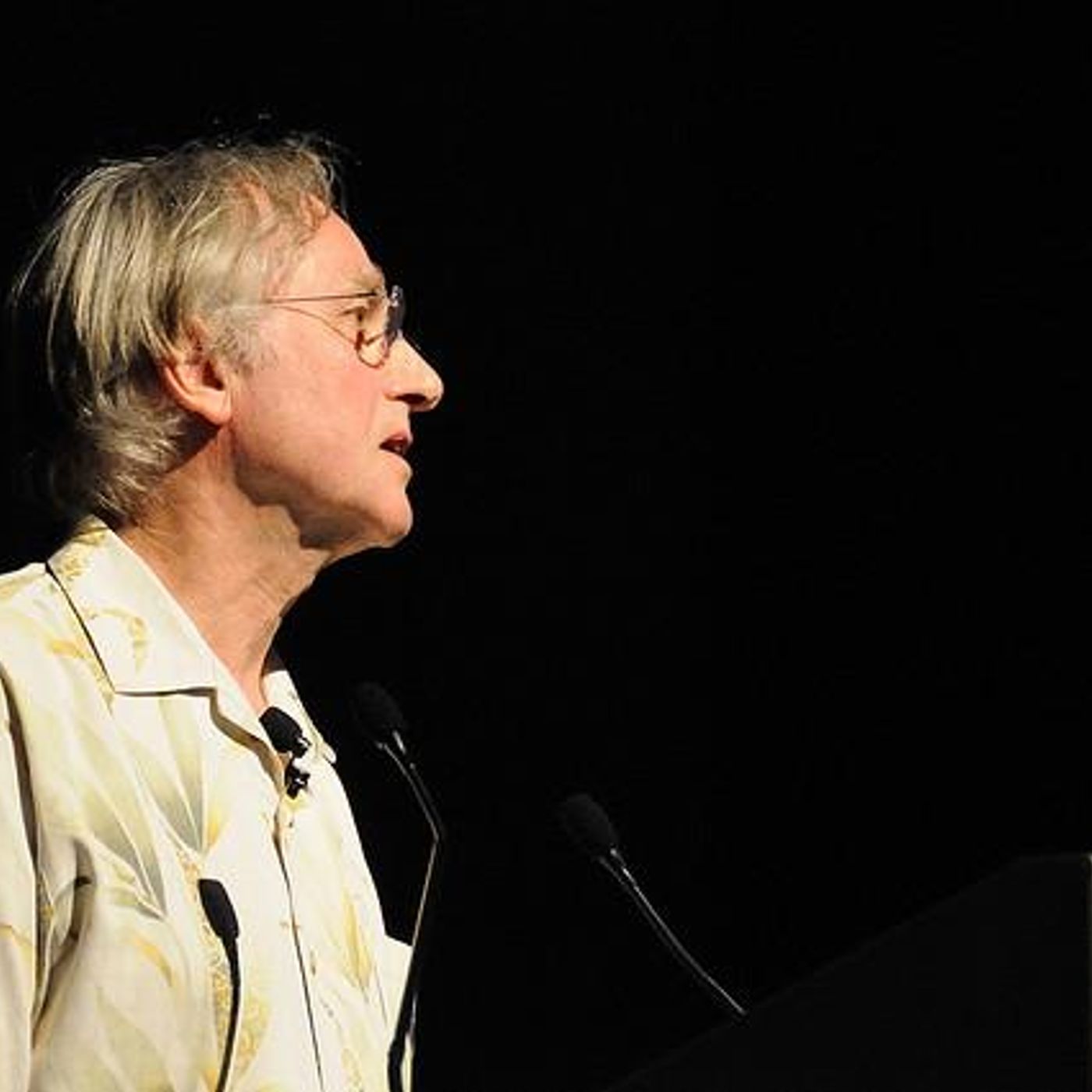
Radiolab
In Defense of Darwin?
00:18:15
When evolutionary biologist Richard Dawkins' daughter was six years old, he told her that flowers are not here for beauty, not here for the bees, but instead merely to copy their own DNA. Sigh, what a Dad. So is Richard Dawkins always so gloomy and reductionist about the world? Well yes, but he would say that his vision of the world is anything but gloomy, he even calls it romantic. In this conversation from the 92nd St Y, Robert challenges Dawkins on this and a number of other sticky spots on the topic of biological evolution.
Loading summary
Transcript41 lines
- [00:00]
Announcer
Hey Fidelity, what's it cost to invest with the Fidelity app? Start with as little as $1 with no account fees or trade commissions on U.S. stocks and ETFs.
- [00:12]
Robert Krulwich
Hmm.
- [00:12]
Richard Dawkins
That's music to my ears.
- [00:14]
Announcer
I can only talk.
- [00:17]
Robert Krulwich
Investing involves risk, including risk of loss. 0 account fees applied to retail brokerage accounts only. Sell order assessment fee not included. A limited number of ETFs are subject to a transaction based service fee of $100. See full list of Fidelity.com commissions Fidelity Brokerage Services, LLC member NYSE SIPC.
- [00:33]
Lowe's Advertiser
At Lowe's Loyalty is royalty With Christmas right around the corner, treat yourself for less during the holiday season. Rewards members get early online only access to Black Friday doorbuster deals on Thanksgiving Day like the Hisense Side by side fridge. Just $799. Not a member. Join for free today. Lowes we help you save bow at 11:27 only on Lowe's.com, member only doorbusters and Midnight Eastern loyalty programs subject to terms and conditions. See lowe's.com terms for details. Subject to change.
- [01:01]
Robert Krulwich
Oh wait, you're listening. Okay.
- [01:04]
Richard Dawkins
All right. Okay. All right.
- [01:08]
Robert Krulwich
You're listening to Radiolab. Radiolab Sharks from wnyc.
- [01:16]
Announcer
Yes, and npr.
- [01:21]
Robert Krulwich
Hi, I'm Robert Kryllowich and this is Radiolab, the podcast. Jad Abumrad, who's normally at my side, is still at home eking out the very end of his paternity leave with his brand new baby. So I've been very careful not to disturb him. Which means, though I do have to find somebody else to fight with. And I did manage to get into a nice little tussle with Richard Dawkins, one of the great defenders of Charles Darwin. He's the Charles Simone professor of Public Understanding of Science at Oxford. He also comes from a long line of combative Englishmen, including a guy who tried to burn down an Ivy League college in the United States. In fact, why don't we begin with a little biographical sketch of Richard Dawkins that I used to introduce him to an audience at the 92nd Street Y in New York City, and then we'll get onto the discussion. I told them that Dawkins great, great, great, great, great, great, great, great, great grandfather going back to the 1700s, was the major commander of the British forces who fought George Washington here in the American Revolution. And it was Richard Dawsons Dawkins, great, great, great, great, great, great whatever. Sir Henry Clinton who hired Benedict Arnold to be the British spy who almost captured West Point, which is Washington's stronghold, didn't do it though, because they caught the spies and so forth. It was Dawkins great great great great great great grandfather who commanded the British occupation forces here in New York City in 1777. 78. It was his great great great great great great great grandfather who authorized raiding parties on a variety of seashore communities. If you live in them, please hold your fire. Egg harbor in New Jersey, attacked by his great great grandfather, New Bedford, Massachusetts, a part of Martha's Vineyard called Vineyard Haven. Most insidiously, he okayed an attack on New Haven, Connecticut, with the plan to burn down Yale College. Fortunately, his forces, as they often were, were repulsed. Ultimately, Sir Henry Clinton lost the war and went home. But Sir Henry's great great great great grandson, Richard Dawkins, has been back to America over and over and over again to do battle with more modern Americans, whom he calls the most scientifically illiterate populace outside the third world. So Richard Dawkins does not mince words. And when we began our conversation, which was about evolution and Charles Darwin, he opened with a surprisingly forceful statement.
- [03:28]
Richard Dawkins
As an academic scientist, I am a passionate Darwinian, believing that natural selection is if not the only driving force in evolution, certainly the only known force capable of. Of producing the illusion of purpose which so strikes all who contemplate nature. But at the same time as I support Darwinism as a scientist, I am a passionate anti Darwinian when it comes to politics and how we should conduct our human affairs.
- [03:57]
Robert Krulwich
So he's given us something of a riddle. I mean, he loves Darwin, but he also loathes Darwin. And then for extra spice, he wants you to know that anybody who thinks there's a purpose, a reason why we live and look and behave the way we do, is under a terrible illusion. There is no purpose to our existence, no reason why we're here. That's basic Darwin, he says. So I thought, okay, let's do the purpose thing first. The Darwin's theory, I think, does a very good job on because it can tell you why something is shaped the way it is or has the color it is or does the function is because. Because, because. But if you step back and you ask the bigger question, what's it all for? This happens, involves your daughter. Your daughter is driving around with you and you're looking, she's six years old. She sees a field of flowers. You say to her, well, what do you think they're for? She said, well, to make the world pretty and to help bees make honey for us. You think, well, I was sorry to tell her that this Wasn't true. And I explained to her that the flowers are not there to make the world beautiful and they are not there to delight bees or anything else. They're in the world to copy their DNA. This is to a six year old, but essentially what you're doing there is, you're addressing, you're opening the notion to her that the world is a purposeless, indifferent machine where the meaning of things is not clear, if it exists at all. You found it, I think, kind of brave to say to your daughter, look, step into the wind of truth.
- [05:26]
Richard Dawkins
It's exciting. Exciting. I mean, it's a far more exciting view of flowers to understand what they're really doing. And a six year old, she had no problem understanding that. I explained it to her. But to come to your what's it for? Question, it's a piece of massive presumption to think that the what is for Question deserves an answer. There's no reason at all why something should have a for about it. If I said to you, what, what is the sun for? Or what is Mount Everest for? You would say, don't be so silly, it's not an appropriate question. But because it's flowers, you sort of feel that there ought to be a what is it for Question.
- [06:14]
Robert Krulwich
No, actually I think it's a harder question than that. I think human beings, I think most human beings have some deep impulse to explain their being here, to wonder about the origins of here and the destiny of them and here. And that question, the meaning of it all, is not a silly question.
- [06:38]
Richard Dawkins
That's not a silly question and it has a perfectly good answer, which is not an answer to be couched in the language of purpose. It's an answer to be couched in the language of scientific causation. What brought us all to be here? What is the explanation for our existence? That has a perfectly good scientific answer. And you go back in evolutionary time to the origin of life, and you go back before the origin of life, to the origin of the world, the origin of the solar system, the origin of the universe, and it becomes deeply mysterious. Needless to say, it's not a question I could even begin to answer. And I don't think that at the present stage physics can either. But, but to the extent that there's going to be an answer, it's going to come from science. And that is a deeply satisfying kind of answer to the question, why are we here? We already have, in principle, the answer to that question, and it is not an answer of the form. We are here in Order to achieve some purpose. It's an answer of the form. We are here because something happened which led to something else that happened which led to something else that happened.
- [07:50]
Robert Krulwich
Are you, Let me just ask you the harder question. Is this hard looking and this telling your 6 year old this leads to this, leads to this, this kind of reductionist way of thinking about everything, does that seem to you to be less than joyously imaginative?
- [08:07]
Richard Dawkins
No, no. I think that's kind of super romantic. To actually understand that flowers are devices, beautiful devices, elegant devices which are shaped precisely to attract insects and hummingbirds and bats to take pollen from one to another. That is such a mind blowing thought compared to the tame sort of washed out view that flowers are just sort of nice things to have around.
- [08:48]
Robert Krulwich
Don't encourage them. So I lost that round, at least with the New York audience. And I know that a lot of you listening who kind of agree with those New Yorkers that, you know, this is the name of the game. If you know the details, the glorious, beautiful details, that's enough. Now, if you've been listening to this podcast long enough, you know that for some of us it's not quite enough. But anyway, I then asked about the second proposition. I asked him, what does it mean when you say that you're a passionate Darwinian and at the same time a passionate anti Darwinian?
- [09:21]
Richard Dawkins
As an academic scientist, I believe that Darwinism not only is the true explanation for why evolution happened, in particular why evolution led to the spectacularly elegant, beautiful, beautiful, complicated and apparently designed structures that we see. It's therefore a theory of immense elegance, of immense power, of immense scientific beauty. But if you try to apply the lesson of Darwinism as the social Darwinists did to human society, then you end up with a kind of super Thatcherism. You end up with or even Hitler, for example.
- [10:11]
Robert Krulwich
He said there are people who love Darwin. He mentioned the science fiction writer H.G. wells. Wells assumed that survival of the fittest means that only the fittest and the best creatures get to survive. But Darwin didn't say that. He didn't use the phrase survival of the fittest in his book. And he didn't ever say that evolution is there to make better and better creatures. As you just heard Richard Dawkins say, evolution isn't for anything. But when H.G. wells read Darwin, he decided Darwin was teaching us to get rid of our less fit brothers and sisters.
- [10:44]
Richard Dawkins
The New Republic, where Wells outlines his Darwinian utopia, contains some blood chilling lines so unpleasant that I find it hard to read them aloud. Perhaps I mean it's such a striking thing. I'll bring myself to.
- [10:58]
Robert Krulwich
It's pretty bad.
- [11:00]
Richard Dawkins
Sorry, I'm having trouble finding. Oh, yes, here we are. And how will the new republic treat the inferior races? How will it deal with the black, the yellow man, the Jew, those swarms of black and brown and dirty white and yellow people who do not come into the new needs of efficiency? Well, the world is a world and not a charitable institution. And I take it they will have to go. And the ethical system of these men of the new republic, the ethical system which will dominate the world state, will be shaped primarily to favor the procreation of what is fine and efficient and beautiful in humanity. Beautiful and strong bodies, clear and powerful minds. And the method that nature has followed hitherto in the shaping of the world whereby weakness was prevented from propagating. Weakness is death. The men of the new republic will have an ideal that will make the killing worth the while. That was H.G. wells in something like 1902. I forget exactly when it was published, but.
- [12:08]
Robert Krulwich
I understand this to mean your notion about anti Darwinian is that in our brains we have these tendencies to make war against people who are not like us, to assign different roles to men and women, to perhaps favor our biological children over stepchildren. And in our brains we have the other places where we might make war against the tendencies that we've inherited, against that.
- [12:34]
Richard Dawkins
I think that's right. I mean, you put the dilemma rather well, that here we do have our evolved tendencies which have these unpleasant features, and it must be in some sense elsewhere in our brain that we have the desire to fight them. And I think it comes after long period of education. We have moved away from the Maurys of our wild ancestors, and thank goodness we have. I'm not quite sure. It's a very difficult historical process to wonder quite how that's happened, but it very clearly has. I mean, like contraception is in itself is good enough evidence that we do go against Darwinian principles. So it can be done. And the fact that most of us spend most of our lives striving for purposes, striving for goals which have nothing to do with propagating our selfish genes is further evidence that it can be done.
- [13:34]
Robert Krulwich
So this notion, then, is that we live in a world carved by these forces, and. But our job in part is to recognize the good from the bad, choose and fight for the good as we understand it.
- [13:48]
Richard Dawkins
This is my suggestion. I mean, obviously that's a matter of taste, whether you want to do that, but most people who Live in civilized society. Do want to do that. And I would like to live in the sort of society which is not run on Darwinian principles, while fully acknowledging that the brains and bodies that we possess were put there by Darwinian principles in the first place.
- [14:12]
Robert Krulwich
You mentioned in the reading there's something about this unique gift of foresight. Now, as I understand how normal evolution works is you're in a particular place, a specific environment, it gets cold, say, and you got a few more feathers than the other bird, so you have that advantage of having a few more feathers. So he shivers, shivers, shivers and dies and you go out and have a baby. Now this idea, however, is, it's based in time, in this moment. Now, you said something about how human beings have the unique gift of foresight. How does that.
- [14:49]
Richard Dawkins
Well, the example you give of the bird with the most feathers surviving and laying the most eggs, that's exactly how it would work. And there is no foresight there. But human beings can look ahead and say, well, in a few decades time it's going to get cold as an ice age forecast. So let's develop some new technology that will coats. We could do coats. Yes, that's foresight. And foresight has literally never happened before in the whole history of life.
- [15:21]
Robert Krulwich
But if people with this foresight decide, ok, let's breed a set of flying horses so that we can leave the cold places and gallop off to the warm places, at that point, is evolution as you understand it over. In other words, does that new ingredient adding foresight to the mix take away one of the essential bits of this, that somehow it happens without a plan. Now there's a plan.
- [15:46]
Richard Dawkins
Yeah, I presume I don't need to say to this sophisticated audience that your example of the making horses that flies are hypothetical.
- [15:55]
Robert Krulwich
Well, I have a horse that flies in the second roll, but he's quite it at the moment.
- [16:00]
Richard Dawkins
Yes, it does suggest that theoretically in future centuries, perhaps evolution could take an entirely new human guided turn and you really could plan for the future of evolution?
- [16:16]
Robert Krulwich
Well, let me ask you the tougher question. If you know and I know that we as a group, as a species, are capable of creating flying horses or whatever, does that then take us above all the other animals and above all the other plants and give us back our special place that Darwin sort of made, I thought tumbled us from?
- [16:36]
Richard Dawkins
Yes, I think that there are lots of big differences between humans and other species. There are lots of big differences between each species and each other species, but humans are especially differently different. And one of the respects in which, that's true, is exactly what you've said. I think there are others too, but.
- [16:53]
Robert Krulwich
The big, big, big difference, says Professor Dawkins. And when we finished our conversation at the Y, he and his wife, the actress Lala Ward, kind of gave it a final dramatic flourish. They did a reading from his book, A Devil's Chaplain. But he insists that our great advantage as a species is we finally have the brain power to make our own future for ourselves.
- [17:15]
Richard Dawkins
For good Darwinian reasons, evolution gave us a brain whose size increased to the point where it became capable of understanding its own provenance, of deploring the moral implications, and of fighting against them.
- [17:41]
Announcer
Stand tall, bipedal ape. The shark may outswim you, the cheetah outrun you, the swift outfly you, the capuchin out climb you, the elephant outpower you, the redwood outlast you. But you have the biggest gift of all. The gift of understanding the ruthlessly cruel process that gave us all existence. The gift of revulsion against its implications, the gift of foresight, something utterly foreign to the blundering short term ways of natural selection. And the gift of internalizing the very cosmos.
- [18:54]
Robert Krulwich
And speaking about gifts, when it comes to internalizing the very cosmos, we turn to the Alfred P. Sloan foundation and to the National Science foundation and of course to the Corporation for Public Broadcasting. I'm Robert Krulwich. Chad will be back with the very soon. I'm thinking you better be so long. For now, Diego Black Friday at the Home Depot. Y gracias a su systema de conexion rapida yarmado fasil podras pasar mastienpo DS frutando de la temporada encuentra todo lo que necesecitas para llenartu casa de espiritu una videno en la tienda oper Internet Note Pierdas Black Friday and the Home.
- [19:46]
Announcer
Depot NYC now delivers breaking news, top headlines and in depth coverage from WNYC and Gothamist every morning, midday and evening. By sponsoring our programming, you you'll reach a community of passionate listeners in an uncluttered audio experience. Visit sponsorship.wnyc.org to learn more.