← Radiolab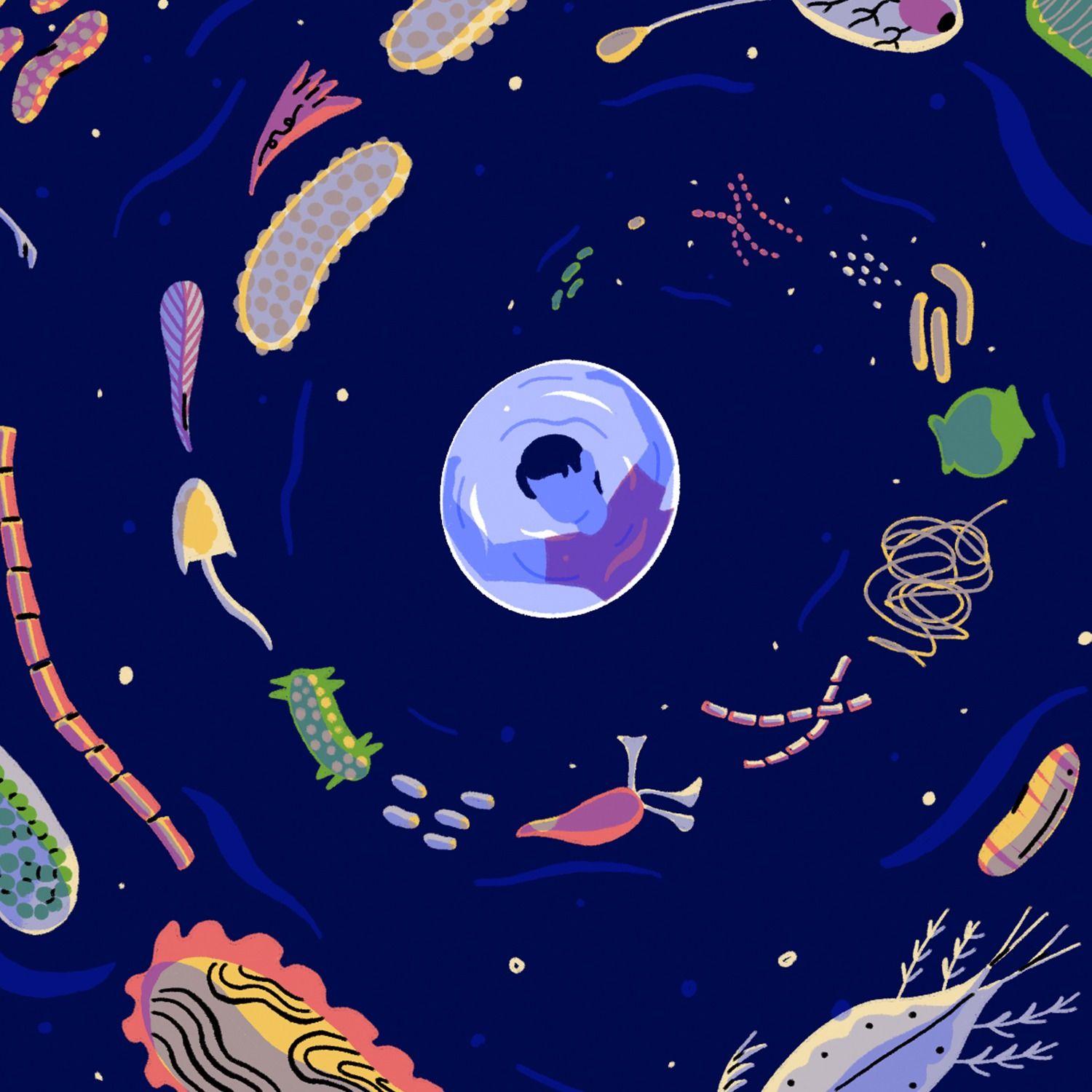
Radiolab
Life in a Barrel
00:54:42
This week, in an episode we first aired in 2022, we flip the Disney story of life on its head thanks to a barrel of seawater, a 1970s era computer, and underwater geysers. It’s the chaos of life. Latif, Lulu, and our Senior Producer Matt Kielty were all sitting on their own little stories until they got thrown into the studio, and had their cherished beliefs about the shape of life put on a collision course. From an accidental study of sea creatures, to the ambitions of Stephen J Gould, to an undercooked theory that captured the world’s imagination, we undo the seeming order of the living world and try to make some music out of the wreckage. (Bonus: Learn how Francis Crick really thought life got started on this planet). EPISODE CREDITS: Reported by - Latif Nasser, Matt Kielty, Heather Radke, Lulu Miller and Candice WangProduced by - Matt Kielty and Simon Adlerwith help from - Arianne WackOriginal music and sound design contributed by - Matt Kilety, Simon Adler, Alan Goffinski, a...
Loading summary
Transcript476 lines
- [00:00]
WNYC Studios Announcer
WNYC Studios is supported by Odoo. When you buy business software from lots of vendors, the costs add up and it gets complicated and confusing. Odoo solves this. It's a single company that sells a suite of enterprise apps that handles everything from accounting to inventory to sales. Odoo is all connected on a single platform. In a simple and affordable way. You can save money without missing out on the features you need. Check out Odoo at O D O o dot com. That's O D O o dot com.
- [00:32]
Molly Webster
Hey, it's Molly Webster. I have a surprise for you. Next month, myself and producer Mona Medgalker are going to do an AMA about our Snail Sex tape episode. You can ask us anything about snails and the behind the scenes of making an episode work. How long did it take us to make? How did we come up with the sound effects? Why are snails and slugs related to the AMA? Will be on April 16 and in order to come you have to be a member of the Lab. So go to Radiolab.org join right now. Sign up. Use the code word snail to get a discount on your membership. And also if you sign up now, you get a snail enamel pin. If you're already a member of the Lab, come to the ama. Thank you for listening. Can't wait to see you there. April 16th. Hey, it's Molly. Before this episode starts, I wanna let you in on a little secret, which is that Radiolab is doing an Ask me anything about our recent episode Snail Sex Tape. So the AMA is gonna be with myself and our producer Mona Medgalker, who is like a snail expert, a sneckspert, and you can ask us anything, how the episode got made, how we came up with the idea do snugs really exist? So come to the ama.
- [01:54]
Lulu Miller
Now.
- [01:54]
Molly Webster
The catch is, in order to come, you need to be a member of the Lab. So if you're not a member of the Lab, go sign up now, fools. So you can come see us. Go to radiolab.org joinradiolab.org join use code SNRAIL so you get a discount on your first year of membership. And as a thank you for signing up right now, we will send you an enamel snail pin that we are about to drop. It's very cool. We all want it on our jean jackets. So I can't wait to see you April 16th. And until then, we have a really great episode for you today. It is a story Lulu and Latif reported back in 2022, all about the chaos and messiness of life. And I'M talking life with a capital L, like the kind that evolution gets involved in. So let's go listen.
- [02:48]
Latif Nasser
Yeah. Wait, you're listening.
- [02:49]
Reinhard (Ecologist)
Okay.
- [02:51]
Narrator/Poet
All right.
- [02:52]
Elisa Beninka
Okay.
- [02:53]
Heather Radke
All right.
- [02:55]
Alex Honnold
You're listening to Radiolab Radio Lab from wnyc.
- [03:03]
Latif Nasser
Rewind. Okay, so let me just. Because I also don't entirely know what's going on.
- [03:11]
Lulu Miller
I'm Lulu Miller.
- [03:12]
Latif Nasser
I'm Latif Nasser.
- [03:13]
Lulu Miller
And we also have with us producer Matt Kilty.
- [03:17]
Latif Nasser
We have three different pitches.
- [03:19]
Lulu Miller
Yeah, we're gonna. You guys.
- [03:20]
Latif Nasser
Wow.
- [03:21]
Heather Radke
We're doing three different things.
- [03:21]
Lulu Miller
Yeah, mine's very little, but I need. You gotta leave me 15 minutes.
- [03:26]
Latif Nasser
15 minutes. Okay. And then. Okay. A little context. A while back, the three of us found ourselves in a studio together because our editor, Soren, he knew that we were independently working on these three different stories. Oh, so you don't know that, Lulu, you do know the stories or you don't know?
- [03:41]
Lulu Miller
No, I don't know. And unbeknownst to us at the time, he decided that each of our stories pitted chaos versus order in a way that could upend some of our deepest beliefs about how life works.
- [03:55]
Latif Nasser
Yeah.
- [03:55]
Lulu Miller
And so he wanted to just get us in the ring together.
- [03:58]
Latif Nasser
It's a cage match. It's a story. Cage match.
- [04:00]
Lulu Miller
Yeah, and we'll get to all that.
- [04:01]
Latif Nasser
But should I start?
- [04:03]
Heather Radke
Yeah.
- [04:04]
Lulu Miller
Latif has got story number one.
- [04:06]
Latif Nasser
All right. Okay. So we're starting at the University of Rostock in Germany.
- [04:11]
Hendrik Schubert
Yeah, the story started here in Rostock
- [04:13]
Latif Nasser
with this ecology professor named Hendrik Schubert. Did it pronounce that right?
- [04:19]
Hendrik Schubert
Absolutely. Great, you got it.
- [04:21]
Latif Nasser
So back in the early 80s, Hendrik finishes his undergrad degree in ecology at Rostock, studies in a couple different departments there, goes on to teach for a while at a different university.
- [04:29]
Hendrik Schubert
And then by chance, I got the professorship here in Rostock in my former department.
- [04:35]
Latif Nasser
He came back home.
- [04:35]
Hendrik Schubert
It was really by chance. I never dreamed of.
- [04:38]
Latif Nasser
But the job was department chair. So basically now he was going to be the boss of his former teachers.
- [04:45]
Hendrik Schubert
Yes.
- [04:45]
Lulu Miller
Awkward.
- [04:46]
Latif Nasser
Yeah, it's kind of a funny dynamic. Right? Anyway, one day he walks into this temperature controlled lab that they have there and he sees one of his old
- [04:54]
Hendrik Schubert
professors, mentor of mine, Reinhard.
- [04:57]
Latif Nasser
Reinhard here. Kloss.
- [04:58]
Reinhard (Ecologist)
Yeah, my name is Reinhard. Her cloth.
- [05:02]
Latif Nasser
And right next to Reinhart, he also sees, much to his surprise, I saw this barrel. A bright blue hundred liter barrel.
- [05:10]
Reinhard (Ecologist)
Yeah, my barrel. For my experiments.
- [05:13]
Latif Nasser
And Hendrik.
- [05:14]
Hendrik Schubert
Hendrik knew this barrel when I was still a student and we had a practical course where we.
- [05:19]
Latif Nasser
Because as an Undergrad, he had done this experiment with Reinhardt where they had filled these barrels full of seawater water
- [05:26]
Hendrik Schubert
from a lagoon of the Baltic Sea.
- [05:29]
Latif Nasser
And they were tweaking the nutrient levels just to watch how it would affect the, you know, tiny microorganisms living in
- [05:36]
Reinhard (Ecologist)
the water, like copper pots, zoo planktons.
- [05:39]
Latif Nasser
But it was a simple little experiment that had only lasted for two weeks. And now more, you know, a decade later, Reinhardt still had that barrel, you know, just sitting there.
- [05:49]
Hendrik Schubert
So I asked Reinhard, hey, what are you doing with this? And he told me.
- [05:53]
Latif Nasser
So Reinhardt then tells him the story
- [05:56]
Reinhard (Ecologist)
so I can go back to the late 80s.
- [06:00]
Latif Nasser
So a few months after the initial experiment in 1989, something unthinkable happened.
- [06:05]
Reinhard (Ecologist)
The big jump in history.
- [06:09]
Latif Nasser
The Berlin Wall fell.
- [06:10]
Reinhard (Ecologist)
The Berlin Wall fell.
- [06:12]
Latif Nasser
Rostock was in East Germany. And all of a sudden just felt like overnight everything changed. The currency changed, the head of state changed, the university changed its name, its curriculum. Like all these very specific things about Reinhard's day to day life all of a sudden just changed.
- [06:27]
Reinhard (Ecologist)
Yeah, it's a cultural shock.
- [06:30]
Latif Nasser
Cut to six months later, June 1990. In all the chaos, Reinhard had totally forgotten about the barrels. Until one day a colleague of his in his department wanted to do a different experiment. And so came to him and was like, hey, could you. Was just bugging him, like, could you just get those barrels out of there?
- [06:48]
Reinhard (Ecologist)
I was asked to remove these barrels for their own experiment.
- [06:53]
Latif Nasser
So he does it one by one. So he, like takes the one, he like shimmies it over, he dumps it
- [06:57]
Reinhard (Ecologist)
out, empties the water and wash out
- [07:00]
Latif Nasser
the sediment, takes the other one. So he started doing that, and then he gets to the control barrel, which is the one in the experiment that they, you know, they had done nothing to. It was just sitting there under a light source, right? As a comparison for the other barrels where they were tweaking things, okay. And like, for some reason he's about to tip it over and then he stops himself and he's like, you know what? Let me just like take a little sample of this and look under a microscope and see what's, what's actually like in this barrel.
- [07:24]
Reinhard (Ecologist)
Is there still life in it or is it not in it?
- [07:27]
Latif Nasser
And so he looks at it and he's totally dumbstruck by what he sees.
- [07:33]
Reinhard (Ecologist)
Sample filled with many, many organisms, with zooplankton and algae and so on.
- [07:39]
Latif Nasser
I mean, he hadn't even touched this thing in months. Nobody had.
- [07:42]
Reinhard (Ecologist)
I thought that there will be nothing just more or less dead.
- [07:47]
Latif Nasser
But when he looks, he sees that it's not just alive, it's thriving. There's like tons of different species. So there are phytoplankton, these are like little plants and a lot of them are green zooplankton which are basically like the animal y type of plankton, some of which eat the phytoplankton, some of which eat the other zooplankton. And then there are bacteria which are basically like the equivalent of the mushrooms or the whatever that are recycling the whole system. Unwittingly, he had created a little natural world.
- [08:21]
Heather Radke
Quick question, clarification. Did he create it or did he just preserve it?
- [08:24]
Latif Nasser
Yeah, I think it's like a semantic thing.
- [08:28]
Heather Radke
That's, that's what I love.
- [08:30]
Latif Nasser
Like, like, sure. So, so maybe he didn't create it, but he, he, like he sustained it. He didn't sustain it because he didn't touch it. It just happened. It's like a thimble of ocean that he got and somehow this symbol of ocean is continuing to live.
- [08:43]
Heather Radke
Okay, cool.
- [08:44]
Latif Nasser
Okay. So also when he sees that it's alive, part of the other reason that it excites him is that at that time in the 80s and 90s, there was this kind of open question in the field of ecology about the natural course of an ecosystem. And I'm kind of like bastardizing the question in a way that I understand it. So like, but, but this is basically, I think, what it is. If you could just give an ecosystem the basic things it needs, right? Like sunlight and space and whatever. But there were no humans around to mess with it, you know, no comets, no earthquakes, no nothing. No outside confounding factors. What would happen? What would that ecosystem do?
- [09:27]
Lulu Miller
Huh?
- [09:28]
Reinhard (Ecologist)
Cool.
- [09:28]
Matt Kielty
Okay.
- [09:29]
Latif Nasser
And there's sort of two options here. You know, like it might be that all the creatures get, you know, to some certain population level and with a bit of eating one another and more being born over here, and then it basically stabilizes, you know, beyond the day to day, up and downs. Basically it's like a line in the end.
- [09:45]
Heather Radke
Like a never ending line of harmony.
- [09:47]
Latif Nasser
Yeah, okay. Or maybe would you see like more like a cycle? Like there, there would be more of one thing for a while and it would dominate for a while, but then it sort of crashes and because there's not enough of another thing for it to eat, and then another thing takes over and then instead of like, like a. So in, in this case, instead of like a line, what you have is
- [10:04]
Lulu Miller
a circle, a circle of life.
- [10:07]
Latif Nasser
That's right, that's right. It's what Mufasa says in the Lion King. The circle of life. That's the song, right? So two options, line or circle, which are kind flavors of balance.
- [10:18]
Reinhard (Ecologist)
The prevailing view was when they are left alone, the nature tend to get balanced.
- [10:27]
Latif Nasser
But here in this barrel, Reinhardt thought, I have the perfect opportunity to answer this question. I've got an ecosystem that's totally untouched by humans. And the species in that ecosystem are born, reproduce, and die at a super quick clip. So in just a few months time, I'll be able to see like hundreds of generations worth of transformation. And so he starts tracking how the various species are doing week after week. He's like interrupting Christmas with his family because he's like, I gotta go, sorry. Looking at and scrutinizing like a glass of water over and over and over again. And everyone's like, this is the most boring thing. Like, even his colleagues, who are like scientists who do boring.
- [11:13]
Nick Lane
Other stuff.
- [11:14]
Latif Nasser
Other stuff.
- [11:15]
Lulu Miller
Stale water.
- [11:16]
Latif Nasser
Exactly. They are all like, this is like. They're like, what even is this experiment? But from another way, it's like he is a God overseeing a tiny universe where he is watching it, and it's like generations are passing in effectively the blink of an eye for him. And he's watching this, like, very dramatic story unfolding, but he's trying to figure out, like, what exactly is the shape of it? Like, what is the plot?
- [11:45]
Lulu Miller
He's like, am I in a suspense movie? Am I in an apocalypse?
- [11:48]
Latif Nasser
That's exactly what's happening. And he can't figure it out because of what he is seeing. It's like a microbial Game of Thrones or something that he's like watching. Like, the species that are there, they're booming, they're crashing. One type of creature could be the dominant species in the barrel for hundreds of generations. And then just. It's a blip from then on. Like, it just crashes and then it never comes back.
- [12:13]
Heather Radke
It's like Rome rises. Things are gonna be on top of the world forever. And then the barbarians come and they're like, oh, hell no, it's Germany now.
- [12:21]
Latif Nasser
Right, Right, right. And he watches this play out in this barrel for over six years, waiting for the harmony. Oh, and he just never.
- [12:35]
Lulu Miller
It never came.
- [12:36]
Latif Nasser
It never came. No line, no c.
- [12:43]
Reinhard (Ecologist)
In this nutshell of a small ecosystem, nature is chaos, chaos, chaos.
- [12:50]
Latif Nasser
What Reinhardt had discovered in this barrel was that this tiny ecosystem, when left to its own devices, was completely chaotic.
- [12:58]
Lulu Miller
So what does that mean? Mean, like, is that saying it's just booming and busting at random, or does that mean.
- [13:05]
Latif Nasser
Well, so first of all, maybe I
- [13:07]
Elisa Beninka
should tell a little bit what chaos is because. Because for most of the people, chaos is just total random. But it's not.
- [13:15]
Latif Nasser
This is Elisa Beninka.
- [13:16]
Elisa Beninka
I'm Elisa Beninka and I'm a theoretical ecologist.
- [13:20]
Latif Nasser
Reinhardt brought her in to analyze his data, and she says the way to think about chaos is not whether it's random or not, but to what extent we can predict what's going to happen.
- [13:29]
Elisa Beninka
So actually, chaos is the system which is high predictability on the short run, but cannot be predicted in the long term. And the weather is actually the best example for that. Meteorologists can do forecast up to two weeks.
- [13:46]
Latif Nasser
After that, they're no better than you or I trying to predict the weather. And in the case of this barrel
- [13:52]
Elisa Beninka
species, could be predictable for around 15, 30 days. After that, you couldn't know who is going to be in advantage, huh?
- [14:01]
Latif Nasser
So it's not like, you know, things are just happening completely randomly for no reason whatsoever. It's just that we, like. Like it's beyond us to see why things are happening or what's going to happen, which to Reinhart, you know, suggested there's no line, there's no circle, like harmonious natural balance. That's all bs, like. Like at any moment, the natural equivalent of the Berlin Wall could fall and just upend the whole system.
- [14:38]
Hendrik Schubert
He told me, I never have seen a stable state.
- [14:42]
Latif Nasser
So when Hendrik, the student turned department chair, ran into Reinhardt and his barrel, Reinhardt told him about all of this data he collected.
- [14:50]
Hendrik Schubert
Sometimes I had a stable state for some weeks or even months, but then suddenly the system shifted again and I decided to follow up.
- [14:59]
Latif Nasser
And then with you know, the help of Elisa and others, Reinhart gets his work published in Nature. And according to Hendrik, there was this immediate blowback from other. Some other ecologists, yes, because it sort of thumbed its nose at this whole field of study.
- [15:15]
Hendrik Schubert
Like, if this is true, why should we do any research anymore?
- [15:19]
Latif Nasser
If we're trying to bring a system back to order and you're saying there's no such order to begin with, what the hell are we even doing?
- [15:27]
Hendrik Schubert
Well, if there is chaos in nature, why do we do restoration or whatever?
- [15:32]
Latif Nasser
But you know, Hendrik, he was also skeptical of the result for, you know, scientific reason. Because, you know, even if Reinhardt found chaos inside this one barrel, it doesn't
- [15:43]
Hendrik Schubert
mean that chaos is something mandatory. He showed that there might be chaos.
- [15:51]
Latif Nasser
Hendrik is Like, I'm redoing this whole thing, really. Let's see what happens. So this time he repeats the experiment.
- [15:59]
Hendrik Schubert
Similar setup and improved setup.
- [16:02]
Latif Nasser
Try to control for all possible variability
- [16:05]
Hendrik Schubert
to get our best, let's say. And for a year, twice with eight
- [16:10]
Latif Nasser
barrels this time, they scoop and measure, scoop and measure, scoop and measure, et cetera. What did you and your colleagues find?
- [16:19]
Hendrik Schubert
We had signs of chaos in some of the vessels and in some of the compartments tested.
- [16:27]
Latif Nasser
So not all eight.
- [16:29]
Hendrik Schubert
Not all. And not always the same.
- [16:32]
Latif Nasser
Like, when there was chaos, it was playing out in different ways in the different barrels, which provides me, at least with a little sigh of relief, because in some ways it's saying, like. Like, we still don't know.
- [16:44]
Candice Wong
Or.
- [16:45]
Lulu Miller
Or is it just now like a multiverse of chaos where we can't even tell if it's gonna be chaotic or when it's gonna be chaotic? Like, I just see deeper, deeper, deeper chaos, which I, you know, which fine, I'm okay with.
- [16:58]
Latif Nasser
Really.
- [16:59]
Lulu Miller
Yeah.
- [17:00]
Latif Nasser
For me, it was. For me, reading about this study, I found it. Personally, I found it quite jarring. I think you really. I really wanted there to be, like, a hidden order to everything that is not about us, that has nothing to do with us, where things make sense. And. And for that not to be there, I think, is very unsettling. Like, when we do conservation or restoration or whatever, it just feels like you'd be throwing your hands up.
- [17:25]
Lulu Miller
My thought was, like, if the order is gone, if there is no guaranteed harmony, that actually makes conservation work even more important. It's like, if we don't intervene and protect the order, it's not guaranteed.
- [17:38]
Latif Nasser
Who cares about your choices? If it's chaos anyway, if it's. If there are things that are beyond your control, that are gonna. That are gonna happen, screw it all anyway.
- [17:47]
Lulu Miller
It's like the idea of the moral arc of the universe bends towards justice. I don't think it does, which is terrifying. So what? You. You have to fabricate a form of justice and. Yeah, there's a pandemic.
- [17:59]
Latif Nasser
Wait, can I interrupt you?
- [18:00]
Lulu Miller
Yeah.
- [18:01]
Latif Nasser
Okay. Write that version of the Lion King. See how many kids go to see that.
- [18:05]
Lulu Miller
Okay. Ready?
- [18:08]
Latif Nasser
Yeah.
- [18:08]
Nick Lane
Do it.
- [18:09]
Latif Nasser
Go. Make the song. Elton John. Go for it.
- [18:11]
Lulu Miller
Okay. Neumanniah singing Nemah. I'm very excited to hear what's going next here, Simba. Based on the work as confirmed by Reinhardt, there is no delicate harmony awaiting you. And if you don't choose wisely and show respect to your fellow creatures and plants and bacteria and fungi, the everything will die. The balance is not delicate. The balance is not there at all. And the song is not the circle of life. It's the giant abyss of no promises, vortex of life.
- [18:54]
Latif Nasser
But then why are we going to watch any of the rest of the movie? Like, even if you're a Lion King, your Lion Kingdom is going to like the Roman Empire. It's going to crumble and fall and like, who cares?
- [19:07]
Lulu Miller
I for sure think that's coming. I think we're probably out of here pretty soon, but let's make it decent for the other humans and creatures that will get to live in the short future. Sure.
- [19:21]
Matt Kielty
Yes.
- [19:25]
Latif Nasser
Okay, so that was round one of our chaos off.
- [19:30]
Matt Kielty
Yeah.
- [19:31]
Lulu Miller
So we're going to take a quick break and you can use that time to really ruminate on whether you believe chaos is totally empowering and great or
- [19:39]
Latif Nasser
has let all the air out of your spiritual balloon.
- [19:45]
Lulu Miller
And then when we come back, round two, we've got another smackdown, order versus Chaos coming up from producer Matt Guilty.
- [20:09]
Molly Webster
This episode is sponsored by BetterHelp. Guys, it's tax season. Are you as stoked as I am?
- [20:15]
Matt Kielty
No.
- [20:16]
Molly Webster
No, of course you aren't, because taxes can be super stressful. I know that I'm going to owe money and so I'm avoiding all the emails from my accountant. I'm not alone. 88% of Americans reported financial stress at the start of 2026. So it's normal. But it doesn't mean you have to white knuckle your way through when life feels overwhelming. Therapy can help. BetterHelp makes it easy, it says, by matching you with one of their over 30,000 licensed professionals tailored to your needs. And if it's not a perfect fit, you can switch it anytime. And look, a therapist can't fix your money problems, but they can help you address shame, guilt, avoidance. Get matched with a qualified professional on BetterHelp. You can sign up and get 10% off at betterhelp.com Radiolab that's betterhelp.com Radiolab
- [21:09]
Latif Nasser
Radiolab is supported by Planet Visionaries, the podcast created in partnership with the Rolex Perpetual Planet Initiative. Stay tuned for a trailer and subscribe wherever you get your podcasts.
- [21:23]
Alex Honnold
I'm Alex Honnold, professional rock climber and founder of the Honnold Foundation. I wanted to let you know about a brand new season of the Planet Visionaries podcast in partnership with the Rolex Perpetual Planet Initiative. This is the podcast exploring bold ideas and big solutions from the people leading the way in conservation. Join me in conversation with the likes of climate champion Mark Ruffalo, biologist and photographer Christina Miller, and one of the most successful conservationists of our time, Chris Tompkins. Join us on Planet Visionaries wherever you get your podcasts.
- [21:53]
Ira Glass
This is Ira Glass of this American Life. Do you know our show? Okay, well, either way, I'm going to tell you about it. We make stories, old fashioned stories that hopefully pull you into the beginning with funny moments and feelings and people in surprising situations. And then you just want to find out what is going to happen and cannot stop listening. That's right. I'm talking about stories that make you miss appointments and ignore your loved ones. This is American Life. Every week, wherever you get your podcasts.
- [22:25]
Latif Nasser
Lulu Latif, Radiolab. And we're back with Matt.
- [22:29]
Heather Radke
Okay, so my turn.
- [22:30]
Lulu Miller
Yeah, yeah, yeah.
- [22:32]
Heather Radke
I think I see how these things go together because Latif, Latif has this little barrel ecosystem that was in chaos, which is not totally random, but it's like a weird, wildly fluctuating thing. But I have a story that kind of like steps that up because we found a part of life you could argue, the most important part where it looks like things are actually fully, completely random. And I say we because.
- [23:00]
Nick Lane
Hello?
- [23:00]
Matt Kielty
Hi, can you hear me?
- [23:02]
Latif Nasser
Heather, we can hear and see you.
- [23:03]
Heather Radke
I reported this story out with our contributing editor, Heather Rackey.
- [23:07]
Matt Kielty
Yes, yes, yes.
- [23:08]
Heather Radke
And Heather actually first heard this story from this guy, Chris Hoff.
- [23:11]
Chris Hoff
Thank you, Heather.
- [23:12]
Matt Kielty
Who's a philosopher of science at Case Western Reserve University. Chris, how did we come to the store? You kind of. You wrote me an email and said,
- [23:21]
Chris Hoff
I have a great story for you.
- [23:23]
Matt Kielty
Yeah, you're like, I got a hell of a tail.
- [23:25]
Chris Hoff
Exactly. Tap in your seatbelt.
- [23:29]
Heather Radke
Okay, so we're going back in time
- [23:31]
Matt Kielty
to some big callers, cool music, back
- [23:34]
Heather Radke
to late 60s, early 70s, and to this guy, Professor Gold, the floor is yours. Stephen Jay Gould.
- [23:41]
Stephen Jay Gould
I want to start by presenting the basic argument in a somewhat abstract form.
- [23:46]
Matt Kielty
Maybe you've heard of him.
- [23:47]
Stephen Jay Gould
Darwin, in fact, never said that.
- [23:48]
Latif Nasser
Oh, yeah. Oh, he's the greatest. He's one of the best science writers of all time.
- [23:52]
Nick Lane
In his new book, Full House.
- [23:53]
Heather Radke
Yeah, he wrote some big deal books. Mismeasure of man is one.
- [23:56]
Latif Nasser
Right.
- [23:56]
Matt Kielty
Wrote a lot about evolution, the fundamental
- [23:58]
Stephen Jay Gould
principles of Darwinian theory, a lot about
- [24:00]
Matt Kielty
the history of science.
- [24:01]
Heather Radke
But before Gould was a public thinker, he was just a young man who really loved fossils.
- [24:11]
Matt Kielty
He had like the kind of classic
- [24:12]
Chris Hoff
moment where his dad took him to the American Museum of Natural History. I was four or five, to haul dinosaurs.
- [24:18]
Matt Kielty
He sees the T Rex.
- [24:19]
Stephen Jay Gould
I remember Standing under the Tyrannosaurus and a man sneezed. I thought the Tyrannosaurus had come to life, was about to devour me. But at that moment of fear, I just let fascination creep in.
- [24:37]
Chris Hoff
He was, like, absolutely hooked.
- [24:38]
Latif Nasser
Oh, I didn't know that.
- [24:39]
Matt Kielty
That's cute.
- [24:40]
Latif Nasser
That's his own.
- [24:41]
Heather Radke
And Gould says after that moment, this fascination with fossils just started to unlock all these questions.
- [24:46]
Stephen Jay Gould
Questions like, why are we here on this Earth? What are we related to? How is the Earth built? What has its history been through time? What's been the pageant of change over this immense span of years?
- [25:00]
Matt Kielty
So Gould felt himself drawn to the field of paleontology, the study of fossils. But that actually became kind of a
- [25:05]
Chris Hoff
problem for him because paleontology was not really seen as, like, a real science.
- [25:12]
Heather Radke
You don't really get to answer big, fun questions in paleontology.
- [25:14]
Matt Kielty
You kind of look at a lot of fossils.
- [25:16]
Chris Hoff
Yeah. Heather, you described it as stamp collecting. Yeah. I mean, this is the problem that Gould was attempting to confront. You know, if we're going to survive as a science, we need to find a way of contributing answers to important questions.
- [25:32]
Heather Radke
So in 1967, Gould gets his PhD
- [25:34]
Chris Hoff
and he's immediately hired at Harvard.
- [25:37]
Matt Kielty
And then one day, this guy, Tom
- [25:38]
Chris Hoff
Shopf, a paleontologist at the University of
- [25:41]
Matt Kielty
Chicago, called up Gould, said he'd read some of his research and he'd been
- [25:44]
Chris Hoff
wondering if they could do anything really cool, basically with computers and the fossil record.
- [25:51]
Heather Radke
Gould's like, oh, that could be something.
- [25:55]
Matt Kielty
So the fossil record is like, everything we humans know about what existed before us.
- [26:00]
Heather Radke
It's what allowed us to start thinking about evolution. It kind of became the foundation for Darwin.
- [26:04]
Matt Kielty
And for this guy Shop, he thought, well, maybe there's actually still something in there, and we could use these new, powerful machines to pull it out and start answering some big, important questions.
- [26:14]
Stephen Jay Gould
Why are we here on this Earth?
- [26:16]
Heather Radke
And so Gould we related to was just like, yes.
- [26:20]
Chris Hoff
Yeah, exactly.
- [26:21]
Matt Kielty
Okay, so let's set the scene. It's like 1972. Schopf, Gould.
- [26:26]
Latif Nasser
Right.
- [26:26]
Chris Hoff
And they invite this guy, Dave Raup,
- [26:29]
Heather Radke
another paleontologist who had done these really cool studies, looking at seashells and geometry.
- [26:36]
Matt Kielty
And then there's this fourth guy, Dan
- [26:37]
Chris Hoff
Simberloff, an ecologist who was really into, you know, mathematical modeling.
- [26:42]
Matt Kielty
So we got three paleontologists and an ecologist.
- [26:45]
Heather Radke
By the way, sounds like a beautiful beginning to a joke. Three paleontologists, an ecologist and a computer walk into a bar.
- [26:50]
Chris Hoff
Yeah.
- [26:51]
Matt Kielty
Okay. It's the winter of 1972.
- [26:54]
Heather Radke
These four guys go up to Woods Hole, Massachusetts, where there's this sort of
- [26:57]
Matt Kielty
holy grail of fossil records, this fossil
- [27:00]
Heather Radke
record of marine life, marine invertebrates.
- [27:02]
Matt Kielty
What are we even talking about? Like shellfish or what?
- [27:04]
Heather Radke
Yeah, mollusks.
- [27:05]
Chris Hoff
Yeah, mollusks. Ammonites.
- [27:08]
Matt Kielty
Oh sure.
- [27:08]
Chris Hoff
Trilobites. Trilobites, Yeah.
- [27:11]
Heather Radke
I mean your various bites.
- [27:12]
Hendrik Schubert
Yeah.
- [27:13]
Chris Hoff
Stuff on the sea floor.
- [27:14]
Matt Kielty
And in this book for each species, it basically has where this first appears
- [27:17]
Chris Hoff
in the fossil record, where it disappears in the fossil record.
- [27:21]
Heather Radke
So they grab this book, they go to a house somebody had, and then
- [27:24]
Matt Kielty
they go to the computer, take their
- [27:26]
Heather Radke
big book out, they start entering all the data. Uh huh. And then they're like, okay, what next?
- [27:35]
Matt Kielty
I mean the problem, okay, like a computer need, like you can't just say computer, make a cool thing. You have to ask a computer a question.
- [27:42]
Chris Hoff
And you get the sense that they just did not know what question to ask the computer. They didn't have a good question to answer that evolutionary theorists would care about.
- [27:57]
Heather Radke
So like for five days they don't know what to do.
- [28:00]
Matt Kielty
And then right before it's like the last day, RALPH is like, what if we have the computer simulate evolution at random?
- [28:10]
Latif Nasser
And why would they do that?
- [28:12]
Heather Radke
Well, because evolution, you know, is not a random process. Right. Darwin established, it's like, it's small incremental change over long periods of time.
- [28:19]
Chris Hoff
But it's not just that. Right. It favors certain things.
- [28:23]
Heather Radke
Right? Yeah, yeah.
- [28:24]
Matt Kielty
And it favors like adaptive traits.
- [28:26]
Heather Radke
Right. The fittest survive.
- [28:27]
Chris Hoff
Yes. And if you're not fit, you just die.
- [28:30]
Heather Radke
You get wiped off the face of the earth because the strongest push you off.
- [28:33]
Matt Kielty
Because they're better suited for the.
- [28:34]
Heather Radke
Right. They're better than you.
- [28:35]
Chris Hoff
Yeah, right.
- [28:36]
Matt Kielty
What a bunch of jerks.
- [28:37]
Heather Radke
Way of the world. But. So all they had was this really simple question, right?
- [28:42]
Chris Hoff
If things were just happening by chance, what would we see?
- [28:47]
Heather Radke
So what they do is they make a computer program and they start with, let's say they start with a species in this program. They don't give that species any definable characteristics, anything like that. It's just this nondescript species.
- [29:00]
Latif Nasser
Can you just name the species? Just because.
- [29:02]
Heather Radke
Yeah, let's call it, let's call it
- [29:05]
Latif Nasser
bloop, bloop, bloop, bloop, bloop.
- [29:07]
Nick Lane
Okay, Bloop, bloop.
- [29:09]
Heather Radke
It's just this bloop, blah, bloop. And then they program the computer so that at just, it's an arbitrary number. It's like let's say 100 years. 100 years of bloop. Living. The computer's like, okay, I now assign all of you bloops, one of three things at random. So thing number one could be nothing happens to the bloops. The bloops just get to keep on living, go through to the next round. So that's one option. Or the computer could pick number two, which is a little tweak to bloop. And from bloop you get bleep, bleep, bleep, bleep, bleep, bleep, bleep, bleep, bleep. Whole new species.
- [29:48]
Latif Nasser
So it's just bloops, bleep, bleep, bleep. Then it's bloops and bleeps and they could just.
- [29:53]
Heather Radke
Now they could go forward and they can go to the next stage.
- [29:56]
Matt Kielty
So number one is nothing happens, you move on. Number two, you can change, evolve, speciate. Or the third thing that can happen is bye bye bloop.
- [30:07]
Heather Radke
Dead, extinct, dead forever.
- [30:10]
Latif Nasser
Bye bye bloop rip.
- [30:12]
Heather Radke
So that's it. 1, 2, 3.
- [30:14]
Matt Kielty
Live, die, or speciate.
- [30:16]
Lulu Miller
Rock, paper, scissors, shoot.
- [30:17]
Heather Radke
Yeah, exactly. And the computer's picking them at random, okay?
- [30:21]
Chris Hoff
So they produce these simulations running bloop
- [30:24]
Heather Radke
after bloop through this program over millions of years.
- [30:26]
Matt Kielty
And then they go to the computer, they like print it out, and all of a sudden they see something pretty
- [30:33]
Chris Hoff
bananas, which is the simulations that they produced looked remarkably like the actual fossil record.
- [30:41]
Heather Radke
Wait, what is that?
- [30:44]
Chris Hoff
I can share a screen.
- [30:45]
Heather Radke
Chris showed us these graphs, okay, so
- [30:47]
Chris Hoff
this is a graph of the actual fossil record.
- [30:50]
Heather Radke
For the sake of this, just imagine tree of life sort of evolution, you know, image. And you could see, okay, mollusks, they start here, they die here. And trilobites, they start here, die there.
- [31:02]
Matt Kielty
And then Chris showed us the graphs of these simulations.
- [31:05]
Chris Hoff
You see this one over here?
- [31:07]
Heather Radke
Oh, whoa.
- [31:08]
Matt Kielty
Basically, if you were to zoom in on these branches, you'd see at the end of each of the branches, the extension extinction points of the species. And the ones from the computer are the exact same as the ones from the fossil record. So, like, bloops and bleeps are going extinct, just like trilobites went extinct, just like ammonites went extinct.
- [31:30]
Heather Radke
So for me, it's like, I'm like, huh, wow. Yeah, these do look similar. But I'm like, so what?
- [31:39]
Latif Nasser
Yeah, so what?
- [31:40]
Heather Radke
So what?
- [31:40]
Chris Hoff
So I think, well, the key here is kind of seeing the resemblance that these randomly simulated groups bear to real groups and then remembering that these are just going extinct randomly, whereas we thought these were going extinct through natural selection.
- [32:01]
Lulu Miller
That is wild. So it's like, it's just like computer programming equals life.
- [32:06]
Heather Radke
Computer programming of nothing but chance and randomness, which is totally counter to like the sort of order of natural selection.
- [32:14]
Matt Kielty
So natural selection would be like, you've got a bird with a like awesome beak and cool eyes and it's like, can fly like a baller. And then there's like a lesser bird that's kind of a weenie bird and it's got like me, it can't see in three dimensions and it's like not good at sports. It's like basically this is heather bird
- [32:35]
Latif Nasser
really projecting yourself onto weenie bird.
- [32:37]
Matt Kielty
But in this scenario, in like the Darwinian idea, it's like athlete bird with its great eyes, its great wings, wins the evolutionary battle. Heather bird goes extinct. Weenie birds as a kind of bird, as a species, cease to exist. But what these computer simulations were showing is that extinction doesn't work that way. And that actually heather weenie bird and super athlete bird have equal chance of not necessarily thriving but like existing.
- [33:11]
Latif Nasser
So. So it's like if those two species were born at the same time, weenie bird and athlete bird, it's up to chance which one would survive longer than the other one.
- [33:23]
Heather Radke
Right. So fitness might explain why one species does better than another. But what they saw suggests that when it comes to extinction, it's not fitness or out competing one another. It's just random, but it's a little
- [33:36]
Matt Kielty
hard to get your mind around.
- [33:37]
Lulu Miller
But wait, but I have a question going back to that Marine, you know, their Ed and Woods hole. What did they all do? We know what they thought at that moment.
- [33:45]
Matt Kielty
Yeah, we did.
- [33:46]
Heather Radke
They were all totally shocked.
- [33:49]
Matt Kielty
Crystal, just the way he heard it
- [33:51]
Chris Hoff
is basically when, you know, the printouts come out, they're like, oh my God.
- [33:59]
Heather Radke
Also like we should say it's at this point point that we got Chris a better microphone.
- [34:03]
Chris Hoff
This is a mic gain of 8.
- [34:05]
Lulu Miller
Yay, Chris, you sound great.
- [34:06]
Heather Radke
Anyways, but basically like they were kind of freaked out because the idea is like, if Darwin can't explain why things go extinct, then the question is why do things go extinct? Like, is it just chance and randomness?
- [34:24]
Matt Kielty
And that question would send the three of them off in very different directions.
- [34:29]
Heather Radke
So Gould, for Gould, he actually this was mostly just like a big huzzah
- [34:35]
Matt Kielty
moment because paleontology had sort of knocked down a piece of Darwin and put forward this new question.
- [34:40]
Chris Hoff
Yeah, exactly.
- [34:41]
Heather Radke
And as Chris put it, it put
- [34:42]
Chris Hoff
paleontology at the high table.
- [34:44]
Heather Radke
But Gould, Gould kind of leaves extinction behind.
- [34:47]
Stephen Jay Gould
It goes back to what I said at the very beginning, that we want to know why we're here.
- [34:51]
Heather Radke
And he starts using randomness and chance to look at things like diversity and adaptation.
- [34:57]
Stephen Jay Gould
To a large extent. It is a grand scale accident that we're here. Evolution has oddly contingent pathways. It would never run the same way twice.
- [35:04]
Heather Radke
And he starts writing all sorts of books. He becomes kind of like famous Stephen Jay Gould. But then Raup, the guy who came up with the question to ask the computer. He becomes obsessed with extinction and stays
- [35:16]
Chris Hoff
on that track for the rest of his professional career.
- [35:19]
Heather Radke
He ends up writing this book which I have right here. Extinction, Bad genes or bad luck?
- [35:25]
Lulu Miller
Oh, question mark.
- [35:27]
Heather Radke
And to Ralph, the answer was it's both. Like, you can't discount fitness, but when it comes to extinction, there's so much other stuff happening. The climate is changing or an asteroid hits Earth, sea levels can rise and fall drastically. Like all that stuff is outside of your control. You could sort of die at any moment. So he sort of charts this middle ground view, which is probably how Gould saw it too.
- [35:52]
Matt Kielty
But then you have Tom Shopf, the guy who started the whole project, and he just goes, full randomness.
- [35:59]
Chris Hoff
I mean the impression that I get was like, pretty much from the word go, he was like, randomness is the order.
- [36:07]
Matt Kielty
Shop developed this idea called Species as Particles.
- [36:11]
Chris Hoff
Species as particles in space and time.
- [36:14]
Matt Kielty
He believed that if explained distinction is truly random, then as a whole, species are sort of indistinct, like they have no real differences between one another, that
- [36:25]
Chris Hoff
there are no like, better or worse. The way he puts it, there's no inferior or superior beings. There's just ones that survive and ones that don't.
- [36:39]
Matt Kielty
Schock began writing a book trying to flesh out this theory. But in 1984, at the age of 44, he was in Texas doing field work with students and he died suddenly of a heart attack.
- [36:49]
Heather Radke
While reporting this story, we talked to some paleontologists and we're like, well like who? Like do we know? Is it sort of like the route? Bad genes, bad luck? Is it the Shop? Total randomness? Like what is what drives extinction? And the answer we got is that we still don't know. Like, we still haven't answered the question they sort of uncovered with this computer in Woods Hole.
- [37:17]
Lulu Miller
Well, I gotta say I'm rooting for Shop. I mean, if it doesn't matter how quote unquote fit or muscly or well honed or sleek, our model is, that doesn't relate to how long we're gonna like Hang around on Earth. It means in a very real way, like, we're all equally good. And for me, it creaks open all this possibility that might be waiting behind things that we look at and deem unfit or deformed or weenie bird esque. Like, it gives all this, it returns all this possibility that gives me a sense of like, thrill. Like, it makes me want to look at the things I'm discounting, you know? Totally.
- [38:02]
Latif Nasser
I don't know. I don't know. I'm not sure because. Okay, so to me, like, it's like, it's this, right? Like, let's say we, we used to have this idea of fitness where it's like, okay, there are the cool kids who are fit and they, in the old mentality to be like, yeah, like, this is like, we're. We're Team Human. There's some people that get picked first for Team Human who are the ones who are helping us survive, and some people who get picked last for Team Human who are like. But then this, it seems like this, if it's like, oh, okay, your survival, actually even the fittest people, like, they're not necessarily helping you survive. Those fitting those super fit characteristics, like, you could still get hit by a bus. And like, that's the way they go. So it's not like, oh, now all the people who are picked last on the team, like, they have the same chances of survival, but it's not like the people who are picked last, they aren't now brought up to the team of the people who are picked first. It's like the people who are picked first are now brought down to the level of the rest of us, where any of us.
- [38:58]
Lulu Miller
But that's the same thing.
- [38:59]
Heather Radke
No, no, no. This is what I, When Lulu was talking, I'm like, no, it's just a matter of perspective. And it's like everything has the same value, which means it's like wonderful and beautiful. Or everything has the same value, which is. It has no value.
- [39:10]
Lulu Miller
It's pointless and defeated. Yeah.
- [39:12]
Matt Kielty
But that's kind of awesome. That's great. It's great.
- [39:14]
Heather Radke
Yeah. And you can sit, you can sit in either reality and bask in that. It's just up to you which one you want to bask in.
- [39:21]
Lulu Miller
Yeah.
- [39:22]
Matt Kielty
Did you want to reflect, Matt, about how it had changed you?
- [39:25]
Heather Radke
No.
- [39:26]
Latif Nasser
Yeah. Do it. Do it.
- [39:27]
Lulu Miller
I want that.
- [39:28]
Heather Radke
Well, I mean, the thing, the only thing I would say is that like, one of the things we learn when reporting the story is that 99.9% of all things that have ever existed on Earth have gone extinct.
- [39:42]
Snap Judgment Promo
Basically.
- [39:44]
Heather Radke
Basically everything that's ever lived has eventually died. Whether or not it seems like chance is a big part of that, but we don't fully know, but whatever, everything dies. And I sort of maybe naively always existed with this thought that, like, we as species are progressing towards something like some sort of better world eventually for us and, I don't know, other species, and kind of really believed in the idea that in some way your actions, the actions that you take, the things that you do are rewarded in some way to continue to strive towards something better. And instead, in doing this reporting, it's like, oh, no, no, no, no, no, no. You, your kind and every other kind eventually just gets wiped off the face of the Earth. You have no foresight. You don't know it's coming. It just happens. And not only does it just happen, but in the long run, it. And I guess in some way I'm like, I. It just feels deeply nihilistic. And I'm kind of like, well, what are we doing here?
- [40:55]
Lulu Miller
I got us. This is making me think of a song for the shape.
- [40:59]
Matt Kielty
A song with a shape.
- [41:03]
Lulu Miller
I was like, okay, if it's a circle, yours is telling us. It's like it's the cliff of life, and we're all gonna die who knows where and when, so why even try? Just eat some French fries.
- [41:31]
Latif Nasser
When we come back, we're gonna take the chaos question all the way back to the beginning.
- [41:41]
Snap Judgment Promo
Did you ever wonder what it's like to live alone, hidden in the woods, not speaking to a single soul for 30 years? Or wander the desert, uncover a hidden well, and dive to the bottom of the deepest water hole for 2,000 miles? The Snapdragon podcast takes you there with amazing stories told by the people who. Who live them with an original soundscape that drops you directly into their shoes. Snap judgment. Listen and subscribe wherever you get your podcasts.
- [42:16]
Lulu Miller
For our final round of this order verse Chaos throwdown, just to stir the pot or the barrel a little bit, I have with me a special guest who is going to in person.
- [42:28]
Latif Nasser
You have a special guest?
- [42:29]
Lulu Miller
Yep. They're gonna beam in now.
- [42:31]
Matt Kielty
They're beaming in.
- [42:31]
Lulu Miller
They're beaming in, so just wait. They're coming. Oh, my gosh, they're coming.
- [42:37]
Latif Nasser
Oh, it's Candice.
- [42:40]
Heather Radke
Hi, everyone. I'm back, and all is right in the world now.
- [42:44]
Lulu Miller
So Candice Wong is our former intern, and she is the one who got us into this final mess when she told me that we should take a Closer look at how it all began.
- [42:55]
Candice Wong
Do you guys have a sort of thing you think about when you think of the origin of life?
- [43:01]
Nick Lane
Sure.
- [43:01]
Latif Nasser
In the ocean.
- [43:03]
Matt Kielty
Primordial ooze.
- [43:04]
Heather Radke
It's like cauldrons of heat.
- [43:06]
Lulu Miller
Heather, did you just say primordial ooze?
- [43:08]
Matt Kielty
Yeah, primordial ooze.
- [43:09]
Latif Nasser
Oh, isn't it soup? Is that. That's how I remember it.
- [43:13]
Candice Wong
The primordial soup.
- [43:14]
Matt Kielty
Maybe that's right.
- [43:15]
Candice Wong
So it's this idea that life somehow emerged out of this crazy chaotic soup of chemicals, which I remembered learning about in the ninth grade.
- [43:24]
Lulu Miller
Yeah, yeah, me too. I even learned about it on this very show a few times.
- [43:28]
Candice Wong
Yeah, I remember that.
- [43:29]
Lulu Miller
But apparently the reason that the primordial soup theory is so widespread all goes back to one singular experiment done in 1952 that involves a soup bowl of soup.
- [43:44]
Latif Nasser
Can of soup, Please tell me.
- [43:45]
Matt Kielty
Barrel of water.
- [43:47]
Lulu Miller
A cauldron. It involves a cauldron, but it's kind
- [43:48]
Candice Wong
of barrel esque or like a glass flask or something.
- [43:51]
Lulu Miller
Yeah. So, Candice, okay, tell us about the experiment and who. Who our guy was.
- [43:55]
Candice Wong
Okay, so our guy is Stanley Miller. This is grad student in 1952 UChicago.
- [44:01]
Matt Kielty
And I'm looking at Stanley Miller.
- [44:03]
Latif Nasser
Oh, oh, there's a picture. Should we look at it?
- [44:05]
Heather Radke
Like, what?
- [44:05]
Matt Kielty
You see, somebody took a sexy pic of him.
- [44:08]
Lulu Miller
It's like Bill Nye the science guy with no hair, fondling a globe full of lightning.
- [44:14]
Heather Radke
This is the sexy photo you're talking about?
- [44:16]
Matt Kielty
Yes, kind of.
- [44:19]
Narrator/Poet
I kind of feel like, come on.
- [44:21]
Matt Kielty
I mean, I think sexy's too much. It's too much. But look at.
- [44:24]
Lulu Miller
He's got swag. He's got. He's got science swag. Anyway, Candace, sorry, Please go on.
- [44:31]
Candice Wong
Yeah, so he's looking for an experiment to do and thought of this old theory from 1920s, basically that primordial soup theory that we just talked about.
- [44:40]
Lulu Miller
The theory had been floating around, but it had never been tested.
- [44:42]
Candice Wong
Yeah. And so Stanley was like, okay, I'm gonna test this out.
- [44:45]
Lulu Miller
He took his little cauldron, filled it with all these gases.
- [44:49]
Candice Wong
There's like ammonia, hydrogen, methane, all those things that people thought were in the early atmosphere. And then he was like, okay, I'm gonna create a little storm. And he
- [45:01]
Lulu Miller
zapped it like a bolt of the early Earth's lightning.
- [45:05]
Candice Wong
Yeah, lightning, basically. And he's watching the cauldron for only a day, and he finds that it starts turning a little pinkish. And he's like, oh, my goodness. Like, is there something going on here? And then a week later, it turns deep red, turbid red.
- [45:21]
Heather Radke
Like smoky red.
- [45:22]
Candice Wong
Yeah, it's like rusty blood red water that's collecting at the bottom.
- [45:26]
Heather Radke
Oh, the water's becoming red. I see, I see.
- [45:28]
Candice Wong
Yeah. So it is kind of like a little like red soup at the bottom.
- [45:32]
Lulu Miller
So he pulls this red borsch out of the cauldron and he looks to see what's in there and he finds amino acids. Amino freaking acids.
- [45:43]
Latif Nasser
Wow.
- [45:44]
Candice Wong
The stuff of life.
- [45:48]
Lulu Miller
So, like, does anyone know what an amino acid is?
- [45:52]
Latif Nasser
The ingredients of DNA. Right. Like it's like that's.
- [45:55]
Lulu Miller
No, but it is the ingredients of pretty much everything else in the cell. So the little motors and enzymes and all the stuff that actually makes a cell work.
- [46:06]
Nick Lane
Yes, amino acids, the building blocks of life. So it was a kind of a, almost a meme as an experiment. It's a beautiful experiment.
- [46:15]
Lulu Miller
So this is Nick Lane, professor of
- [46:17]
Nick Lane
Evolutionary biochemistry at University College London.
- [46:20]
Lulu Miller
And he says that as beautiful and scientifically fantastic as Miller's experiment was the idea that it explains the origin of life is a bit of a leap.
- [46:32]
Nick Lane
You know, going back to Frankenstein. The idea that you have electricity and lightning and you zap things and they come to life, they spring to life and all you need is another lightning strike and lo and behold, you know, fast forward 4 billion years and we've got humans. You know, if that doesn't persuade a 13 year old, well good, because it doesn't persuade me either.
- [46:52]
Latif Nasser
Huh? Why not? Like, what's wrong with that?
- [46:54]
Lulu Miller
Well, Nick says, you know, amino acids are great and all, but it's another
- [46:57]
Nick Lane
10 or 12 steps to make something living.
- [47:00]
Lulu Miller
To make an actual living thing that can make copies of itself, you need RNA and DNA and a cell membrane and all the intricate goodies inside.
- [47:08]
Nick Lane
This is asking a lot of spontaneous chemistry, that all of these steps should just happen without anything to direct it.
- [47:17]
Candice Wong
How do you get from just a bunch of ingredients in a soup to like very structured, complicated life? That's a very, very far gap to jump.
- [47:27]
Lulu Miller
I mean, Miller himself worried about this during his lifetime.
- [47:31]
Candice Wong
Yeah, but the most famous critic of this whole primordial soup idea was actually Francis Crick.
- [47:37]
Lulu Miller
As in the guy who helped discover little thing called DNA.
- [47:40]
R
Nobel Prize win winner Francis Crick published an extraordinary book called Life Itself in which he argues from a scientific point of view that life could not have got started on this planet.
- [47:52]
Lulu Miller
So this is a snippet from a call in radio show where they are discussing what Francis Crick saw as a far more logical explanation of how life began.
- [48:02]
R
To cut a long story short, he suggested it was sent here by an alien civilization from the other side of the universe.
- [48:10]
Nick Lane
Yes. Francis Crick proposed was what he called directed panspermia, which is to say some alien civilization put some cells, some bacterial cells on a rocket and crashed it on the Earth.
- [48:21]
R
One of those spaceships crashed into the early Earth. Its cargo of bacteria spilled out and eventually became us. And that's honestly how Francis Crick, the Nobel Prize winner, saw the beginning of life on this planet.
- [48:38]
Heather Radke
Yeah. Seems more feasible than a glass cauldron.
- [48:41]
Lulu Miller
Than a lightning bolt.
- [48:41]
Heather Radke
Than a lightning bolt.
- [48:42]
Nick Lane
I mean, my immediate reaction is that it's bonkers. But there's a kind of less extreme but more real version of that, which is that organic molecules can form in space and will be delivered to Earth on meteorites. And that's definitely true. That does happen. There's no question about that. But if we.
- [49:04]
Lulu Miller
Wait, wait, we got us. Okay, the resident person who knows less here. I mean, what?
- [49:12]
Nick Lane
Well, plenty of amino acids, the same amino acids that Stanley Miller had produced, that all of those have been found and more from space. In space? Yes.
- [49:22]
Lulu Miller
How are they found?
- [49:23]
Nick Lane
Because they arrive on meteorites or people have occasionally taken samples of things, but mostly from meteorites.
- [49:30]
Lulu Miller
Says it's not just amino acids.
- [49:33]
Nick Lane
Bits and pieces of the building blocks of DNA have been found there as well.
- [49:37]
Lulu Miller
That's wild.
- [49:37]
Nick Lane
Yes. It's amazing that this cosmic chemistry happens and is delivered to the Earth. And so maybe they had something to do with the origin of life. Yes, maybe, maybe.
- [49:46]
Lulu Miller
But for Nick, as a full way to explain the origin of life, that's
- [49:50]
Nick Lane
still, you know, that's two steps too far.
- [49:53]
Lulu Miller
Even if amino acids or DNA apparently are always raining down from the sky, you still have those 12 other steps he mentioned.
- [50:00]
Nick Lane
How do you get it to do the things that cells do, which is to say, grow, divide and copy itself.
- [50:06]
Lulu Miller
And so his best guess for how, or rather where life began, and he's scientific, he's like, this is just my guess. I'm not saying it is. Is a particularly hellish spot that looks very. Not conducive to life.
- [50:21]
Nick Lane
I personally think life started in deep sea. Hajithar. You can get these vents anywhere. Some of them can be very deep, five or six kilometers down, way beneath
- [50:32]
Lulu Miller
the surface of the water, far from any sunlight, where the heat from inside the earth is churning up and creating these craggy rock structures.
- [50:42]
Nick Lane
They can be beautiful spires, pinnacles of rock, 60 meters tall. I mean, I like to think of them as gothic Cathedrals or something. They're full of little details, little doodles of rock. They're beautiful things to look at.
- [50:55]
Lulu Miller
And according to Nick, they've got the goods, they've got the materials, the right chemicals. Methane and carbon and hydrogen are swirling around in the water. They've got the energy source, not lightning, but this constant churn of the Earth's heat. But finally, what he thinks make them really special is their structure.
- [51:14]
Nick Lane
The amazing thing about these vents is they. They mimic the structure of cells in that it's kind of a round space with a wall around it. And you can think of a cell as a kind of a bag of solution with a membrane around it.
- [51:31]
Lulu Miller
And because you've got the materials, the constant churning energy, and these rock walls that kind of force everything together that's
- [51:41]
Nick Lane
making these gases react together to form organic molecules which are forming inside the pores themselves. They will form spontaneously in this kind of environment into what we call protocells, a little bit optimistically, maybe, but effectively a membrane around a bag of water with some stuff inside.
- [51:59]
Lulu Miller
Huh. It's like the matter and magic you need to make. Life is lush there. It's like you got it all.
- [52:07]
Nick Lane
Yes, it's got the right materials and it's got the structure. And I think that's what's been missing from the chemistry, and it's what's missing from the soup, and it's what's missing from, you know, delivery of organic molecules from space by panspermia. It ends up in a soup. How does that soup form structure? Well, the Earth itself forms the structure for you in the first place in these hydrothermal vents. There is a beautiful link between the geology of the planet with active volcanic systems and active turnover of the surface of the planet and the bottom of the oceans. And the way that living cells work, it's as if a living planet gives rise to living cells which have the same structure. Both the planet and. And the cell is a little bit like a battery. It's got a positive charge outside, a negative charge inside, a membrane surrounding it. And they're both. They're both like that. And there's a lovely, lovely sense of continuity that a planet gives rise to living cells.
- [53:09]
Latif Nasser
Wow, that is very cool. But, Lulu, you've been. You've been championing chaos this whole time, and now you're serving up a story that's like this. To me, this is like. This is order. Like you're putting order right back at the beginning of it all.
- [53:25]
Lulu Miller
Well, that's interesting. I mean, what.
- [53:28]
Latif Nasser
Yeah, right, like the soup or the panspermia are both, like, very chaotic. Like some random thing just fell to Earth or a random lightning bolt hit a random, you know, piece of gas at the right time. Like, those are pretty chaotic. But if it's like, oh, look, there's this chimney that was being built and there were a whole bunch of them, and they have the exactly right gradient and the right this and the right
- [53:49]
Lulu Miller
that, like, then it's a very orderly planet, I guess. I mean, I was seeing Nick's explanation as yet another loss. You know, he's pointing out that our beginning, even our scientific beginning, isn't as clean of a story as we thought. You know, there was no lightning strike, no clear moment where it all began. Just this slow and, like, bad breath out of event churning, clumsy mix of chemicals in a dark, dank pit. To me, that. That rips away the last shred of order that I thought the old soup version had, you know?
- [54:29]
Latif Nasser
Huh? Yeah.
- [54:31]
Lulu Miller
I don't know.
- [54:31]
Latif Nasser
Cause it's like, to me it sounds like maybe at the very beginning of life there was an orderliness built right on top of the orderliness of the planet itself.
- [54:45]
Lulu Miller
You are making me think. If I just. If I focus on the structure of the vent and the cell, there is a sense of belonging in that. Like the. Every cell in our body looks a little like this planet. Maybe we don't matter and the fact that we're here is random, but we do belong.
- [55:08]
Narrator/Poet
It's all chaos. Everything is chaos. It's okay us. Everything is chaos. It's all chaos. Everything is chaos. From the day we arrived on this
- [55:19]
Lulu Miller
planet
- [55:21]
Narrator/Poet
in darkness and far from the
- [55:25]
Lulu Miller
sun,
- [55:27]
Narrator/Poet
there is more that we need than and just lightning concede more chance that it would never be done. And as we fight for our place here, competing through struggle and strife,
- [55:51]
Heather Radke
you
- [55:51]
Narrator/Poet
can't anticipate who gets to dominate in the contest for the greatest in life. It's the chaos of life that confounds us. Choose despair or hope. It matters now us till we lose our place. It just came.
- [56:50]
Lulu Miller
Uh, guess that's it. This episode was reported by Latif Nasser, Matt Kielty, Heather Radke, Candice Wong and me, Ulu Miller.
- [56:59]
Latif Nasser
It was produced by Matt Kielty and Simon Adler with sound and music from Matt Kielty's Simon Adler and Jeremy Bloom.
- [57:06]
Lulu Miller
Bloom. Big thanks to Alan Gefinski for creating that song and Alita Gafinski for belting the heck out of it. Thanks also to Chuck Cheeseman, Sarah Luterman, Doug Irwin, Candice Wong.
- [57:18]
Latif Nasser
Thanks to David Sapkowski whose book Rereading the Fossil we drew on for the story about Stephen Jay Gould and extinction. Thank you to Nick Haddad, Ayanna Johnson, Chris Clausmeyer, Laura Verheag, and Noel Bolen.
- [57:32]
Lulu Miller
That'll do it. Thanks for listening.
- [57:35]
Heather Radke
Goodbye.
- [57:39]
Gabby Santis
Hi, I'm Gabby. I'm from the Bay Area, California, and here are the staff credits. Radiolab is hosted by Lulu Miller and Latif Nasser. Soran Wheeler is our Executive editor. Sarah Sandbach is our executive director. Our Managing editor is Pat Walters. Dylan Keefe is our director of Sound design. Our staff includes Jeremy Bloom, W. Harry Fortuna, David Gable, Maria Paz Gutierrez Sindhu, Naina Sambandan, Matt Kielty, Mona Mudgauker, Annie McKeown, Alex Neeson, Sara Khari, Natalia Ramirez, Rebecca Rand, Anissa Vitze, Arian Wack, Molly Webster, and Jessica Young, with help from Gabby Santis. Our fact checkers are Diane Kelly, Emily Krieger, Natalie Middleton, Angeli Mercado, and Sophie Semay.
- [58:33]
Lulu Miller
Hi, I'm Maddie and I'm from Frederick, Maryland. Leadership support for Radiolab's science programming is provided by the Simons foundation and the John Templeton Foundation. Foundational support for Radiolab was provided by the Alfred P. Sloan Foundation.
- [58:54]
Home Depot Announcer
Spring starts at the Home Depot and we are bringing the heat to your backyard this season. Fire up the flavor with our wide variety of grills for under $300 like the next grill 4 burner gas grill that's perfect for hosting your spring cookout. Then set the scene and turn your outdoor space into the go to spot the patio sets for every budget. Bring it this season with grills that deliver flavor and patios that set the vibe from the Home Depot. Start your spring with low prices guaranteed at the Home Depot exclusion supply. See homedepot.com Pricematch for details.
- [59:24]
WNYC Studios Announcer
Every day, WNYC Studios is working to get closer to New York and to New Yorkers. The underwriting we get from businesses helps power our independence. Learn how your organization can join in at sponsorship.wnyc.org.