← Radiolab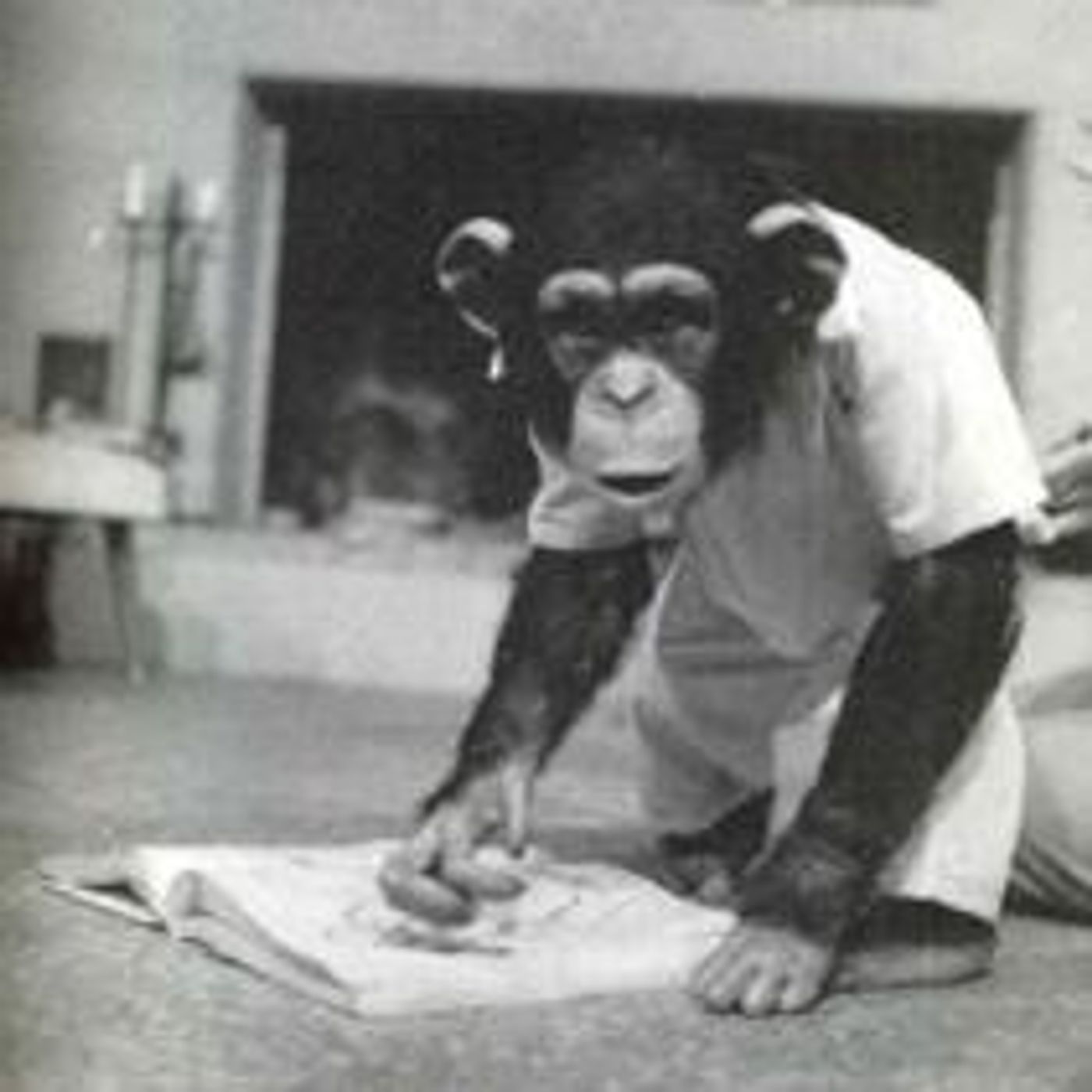
Radiolab
Lucy
00:57:01
Chimps. Bonobos. Humans. We're all great apes, but that doesn’t mean we’re one happy family. This hour of Radiolab: stories of trying to live together.
Loading summary
Transcript466 lines
- [00:02]
Jad Abumrad
Wait, you're listening. Okay. All right. Okay. All right.
- [00:09]
Soren Wheeler
You're listening to Radiolab Radio Lab from WNYC.
- [00:17]
Jad Abumrad
And npr.
- [00:19]
Robert Krulwich
All right, let's start with an Encounter.
- [00:22]
Jad Abumrad
Yes. Hello?
- [00:26]
Sue Savage-Rumbaugh
Hello?
- [00:26]
Jad Abumrad
Okay, can. Can you hear me?
- [00:28]
Barbara Smuts
Okay, I can barely hear you.
- [00:29]
Jad Abumrad
Okay, so this is, well, our produce, Dr. Lulu Miller, was calling around, trying to find some stories for this hour. Let's see. And she ended up on the phone with a woman named Barbara Smuts. Is that any better?
- [00:41]
Sue Savage-Rumbaugh
Yeah.
- [00:42]
Robert Krulwich
Barb Smuts is now at the University of Michigan. But years ago, she was a field researcher in Tanzania, working with the great.
- [00:48]
Jad Abumrad
Jane Goodall, you know, following chimps at a distance and writing down everything they do and that kind of thing.
- [00:54]
Robert Krulwich
Right.
- [00:54]
Janice Carter
Okay.
- [00:55]
Robert Krulwich
And when she was in Tanzania, she ran into, in Gombe National Park, a particularly young male chimp named Goblin.
- [01:02]
Jad Abumrad
Will you tell me the story of Goblin?
- [01:05]
Barbara Smuts
Oh, sure.
- [01:07]
Jad Abumrad
First of all, what does he look like?
- [01:09]
Barbara Smuts
Well, he's an adolescent male. If he stood up, he would come up to quite a bit above my waist.
- [01:16]
Jad Abumrad
Yeah.
- [01:17]
Barbara Smuts
And almost immediately, he started picking on me in the sense that, you know, he would walk past me and just kind of jab me casually as he went by. And sometimes he would punch me with the fist. Sometimes he would just kind of whack me with an open hand or just kind of use his body to just kind of shove at me as he went past. You know, he'd look at me as he approached, and I'd be going, oh, no.
- [01:43]
Jad Abumrad
And is that something they would often do with humans, or was this.
- [01:46]
Sue Savage-Rumbaugh
No.
- [01:47]
Jad Abumrad
Rare.
- [01:48]
Barbara Smuts
No. He was in a phase of life. When a male. As a male matures, he rises in rank. And before he challenges any other adult male, he rises kind of step by step through the female hierarchy. He basically intimidates female after female until they give in and acknowledge that he's superior, and then he'll pretty much leave them alone. So he was at the point where he dominated all but probably two of the adult females and you and me. So that's part of it is where Goblin wasn't. The other part of it is that I'm really small.
- [02:24]
Jad Abumrad
So as you're out there doing. What do you think is going on? Did you think he just.
- [02:29]
Barbara Smuts
Well, I just felt like he was a bully and I was an easy target. And in the evening, I would say to Jane Goodall, you know, I'd tell her what happened, ask her what to do, and she would say, just ignore him. You know, eventually he'll get bored and he'll stop doing it, which was you know, this kind of standard advice, this sort of myth of total scientific objectivity, just ignore it and it'll go away. But instead, he escalated. I remember one time I was sitting at the top of a hill, and he came up behind me and jumped on my back, which forced me to roll down the hill. And he kind of rolled down with me. You know, we were like this ball rolling down a hill again. I would tell Jane and ask her what to do, and she would always say the same thing, just ignore it. But one day, during the rain, it was the rainy season, so we all carried raincoats with us. And when it wasn't raining, we would carry them on our backs so that it wasn't in the way. And Goblin walked up to me one day and yanked on my raincoat. And these raincoats, they were like our most valuable possession, the raincoat. So he grabbed it, and he was going to run away with it. And so we had this tug of war. And so the two of us were standing facing each other, you know, tugging on this raincoat. And then I did something that was not premeditated at all. I just leaned forward and I punched him as hard as I could in the face.
- [04:13]
Jad Abumrad
Oh, my God. What did you think, like, right after you'd done it? Were you shocked at yourself that you just.
- [04:21]
Janice Carter
Yeah.
- [04:21]
Barbara Smuts
I'd never punched anybody before, you know, much less a chimp who I was supposed to be studying from a distance. So I was shaking.
- [04:30]
Jad Abumrad
What did he do?
- [04:31]
Barbara Smuts
He just collapsed. He, like, turned into a little baby, you know, he collapsed on the ground and started whimpering. And then he looked to Figan, who was the alpha male at the time, who was sitting nearby, and he was like Figgin's little sidekick. He always kind of hanging out with Figan and playing up to him. He ran over to Figan screaming like this, being just beat up on me. Come on, let's get her. And fortunately, Figan did not take it seriously. I remember he just reached over with this great big hand, and without even looking at Goblin, he patted him on the head a few times and then went back to whatever he was doing. Because it could have been really bad if he had taken it seriously. I did not go back and tell Jane Goodall I had punched Goblin in the nose. And I just. I didn't tell the story for a long time.
- [05:26]
Jad Abumrad
Why not?
- [05:27]
Janice Carter
Well.
- [05:31]
Barbara Smuts
I think, you know, I would have gotten a lot of disapproval.
- [05:35]
Robert Krulwich
Yeah.
- [05:36]
Barbara Smuts
Anyway, Goblin never bothered me again.
- [05:43]
Jad Abumrad
So here's the reason we played that story. Because here you've got this moment where you've got a scientist, Barbara Smuts, who's, you know, trained scientist, got scientific rules of objectivity and all that, and she totally loses it.
- [05:54]
Roger Fouts
Yeah.
- [05:54]
Jad Abumrad
She slips. And for just that moment, she's not really a human, he's not really a chimp. The raincoat is the only important thing.
- [06:04]
Robert Krulwich
The borders have dropped is really what's happening.
- [06:06]
Jad Abumrad
Yeah. Now, we're used to thinking of borders, you know, between us and the animals as being fixed. And most people would say, this is good. Keep them there, keep us here, keep us separate.
- [06:17]
Robert Krulwich
But not in this hour. We're gonna meet people who decided to go the other way. People who are trying to live intimately, and I mean really intimately, really, with big wild animals.
- [06:32]
Jad Abumrad
Something you could either call incredibly stupid or. Or our last great hope because there.
- [06:40]
Robert Krulwich
Are so many of us on the planet.
- [06:42]
Jad Abumrad
So coming up, we've got two stories of radical experiments in sharing. I'm Jad Abumrad.
- [06:51]
Robert Krulwich
I'm Robert Krulwich.
- [06:52]
Jad Abumrad
This is Radiolab. Okay. Story one. This whole show and way began with a conversation with this fellow, Charles Siebert.
- [07:03]
Charles Siebert
I am an author and a journalist.
- [07:07]
Jad Abumrad
And he wrote a book called the Washoula Woods Accord, which is a great book, in which he tells a story, which he told us in the studio as well, about a chimpanzee named Lucy. So let's just start at the beginning. Who is Lucy?
- [07:20]
Charles Siebert
Lucy is a chimpanzee that actually, this was found out later born to a circus entertainer born in their camp.
- [07:30]
Robert Krulwich
What country are we in in?
- [07:31]
Charles Siebert
In the US They. They traveled up and down the East Coast. The May Noel Chimp Ark show, something like that. They were very popular in the 40s and 50s. They were wildly popular, apparently.
- [07:41]
Robert Krulwich
Oh, so this was a mom and pop entertainment operation that would go from town to town in the middle Atlantic states.
- [07:46]
Charles Siebert
Exactly.
- [07:47]
Jad Abumrad
And so Lucy was born to two of the chimps that performed in this thing.
- [07:50]
Charles Siebert
Yeah. And they used to do things like they used to stage wrestling matches with human beings. The he man of the town would come in and challenge the chimp to a wrestling match.
- [07:57]
Jad Abumrad
Really? What would happen?
- [07:59]
Charles Siebert
You know, a chimpanzee, an adult chimpanzee is about five times the strength of a human. And this guy would walk in thinking, you know, I'm gonna give this chimp my money. And, like, one swipe of this chimp's forearm and the guy would be on Queer street and be carried out. It would end so quickly.
- [08:14]
Robert Krulwich
And then the house band would go.
- [08:18]
Charles Siebert
He'S out of there.
- [08:19]
Jad Abumrad
Okay, so Getting back to our story about Lucy. This is a story that begins in 1964, and it's one that Charles would have never heard about had he not bumped into this obscure old memoir long out of print. Yeah. What's the name of the book? Do you actually have it with you?
- [08:35]
Charles Siebert
Yeah, hold on. It's called Lucy Growing Up Human. A Chimpanzee Daughter in a Psychotherapist's Family by Maurice K. Temerlin.
- [08:50]
Jad Abumrad
Maurice K. Temerlin. He is the psychotherapist.
- [08:52]
Charles Siebert
He's a psychotherapist and he's also the.
- [08:54]
Jad Abumrad
Dad in this story. And his wife Jane, who's a social worker, she's the mom. Now, the thing to know was that especially for Maurice Temerlin, this was more than just adopting a baby chimp. This was an experiment.
- [09:05]
Robert Krulwich
Yeah.
- [09:06]
Jad Abumrad
He wanted to know, given the right upbringing, how human could Lucy become?
- [09:11]
Charles Siebert
You know what he says early on in this book? Would she learn to love us and.
- [09:17]
David Garland
Perhaps have other human emotions as well? Would she be well behaved, rebellious, intelligent or stupid? What about sexual?
- [09:27]
Jad Abumrad
Maurice Temerlin actually died in 1989, but these are his words, read by radio host David Garland.
- [09:32]
David Garland
Would she mother her offspring? Could she learn to talk? How intelligent might she be?
- [09:37]
Jad Abumrad
And so how did they get her?
- [09:38]
Charles Siebert
He says that he and his wife Jane made all the arrangements, went and got the chimp.
- [09:43]
David Garland
On the day the infant was born.
- [09:44]
Charles Siebert
The mother was anesthetized.
- [09:47]
David Garland
In the early morning of her second day, Jane fed the mother a Coca Cola, which had been spiked with phencyclidine, a drug which puts chimpanzees into a deep, pleasant sleep.
- [10:02]
Charles Siebert
And the baby was taken away.
- [10:05]
David Garland
Jane named her Lucy and brought her home on a commercial airline, carried in a bassinet, her face covered with a lacy blanket. We were blissfully unaware of the complexities we were creating on the day Lucy came home.
- [10:19]
Robert Krulwich
So the baby was a day or two old?
- [10:21]
Charles Siebert
Just two days old.
- [10:22]
Robert Krulwich
So it wasn't weaned?
- [10:23]
Charles Siebert
No. And that was part of the experiment.
- [10:25]
Robert Krulwich
They bottle feed her?
- [10:26]
Charles Siebert
Yeah.
- [10:26]
David Garland
She quickly learned to hold her own bottle. At two months, her eyes would focus. At three months, she was trying to climb out of her crib to go to people. And at six months, she was pretty mobile on all four limbs.
- [10:39]
Jad Abumrad
Memoir goes on that by the time she was about a year old, she.
- [10:43]
David Garland
Was eating at the table with us, forks, spoons, knives. She would see us using silverware and immediately do so herself.
- [10:49]
Jad Abumrad
She began to dress herself in skirts.
- [10:50]
David Garland
She would often grab my hand, pull me to my feet and beg Me to chase her, always looking back to see that daddy was not too far behind.
- [11:00]
Charles Siebert
You know, he really went at this with this sort of full bore earnestness, you know, when he calls her his darling daughter.
- [11:08]
David Garland
I took great pride in my daughter's achievements.
- [11:10]
Charles Siebert
He does feel like a real parent to Lucy.
- [11:13]
David Garland
She was so responsive to being looked at, held and stroked.
- [11:17]
Charles Siebert
But he's also, make no mistake, treating this as a very intense, cutting edge experiment.
- [11:23]
Jad Abumrad
The next phase of the experiment which occupies a good deal of the book, involves one of those talents that we thought used to only be limited to US Language. Okay, can you introduce yourself please?
- [11:35]
Roger Fouts
Okay. My name is Roger Fouts. I'm a professor of psychology and have worked with chimpanzees since 1967.
- [11:43]
Jad Abumrad
Roger Foutz was called in by Maurice Temerlin to address one of the crucial questions of the experiment.
- [11:49]
David Garland
Could she learn to talk right?
- [11:51]
Jad Abumrad
And at the time he was the guy. He'd just been part of a team that had proven for the first time that chimps could use sign language to communicate. So his job with Lucy was to teach her how to sign.
- [12:02]
Roger Fouts
And I think I came into her life when she was, as I remember it was 1970, I think it was four or five. She was four or five years old.
- [12:09]
David Garland
Roger taught her signs for airplane, baby doll ball, banana barrette.
- [12:15]
Robert Krulwich
Right, Berry.
- [12:16]
Roger Fouts
Yeah, yeah. So I was sort of like Blanket the Tudor friend, babysitter that would come over for a few hours, bow tie each day and spend some time just, you know, just playing with Lucy. I would work on signs.
- [12:29]
David Garland
Can't.
- [12:29]
Roger Fouts
We'd read books together or we'd go for walks and I would chat with her, basically cry dirty.
- [12:37]
Jad Abumrad
And he says that Lucy, enough, just sort of picked it up, picked it all up.
- [12:41]
Roger Fouts
It was like a game.
- [12:43]
Charles Siebert
She learned some 250 signs. And the big question is, okay, so is it mere mimicry or are they able to spontaneously create words and put them together in a new original way? And there's been a lot of anecdotal evidence that in fact Lucy did spontaneously.
- [13:05]
David Garland
Create words in a later session when shown a piece of watermelon, Lucy tasted.
- [13:10]
Roger Fouts
It and she called it candy drink.
- [13:13]
Jad Abumrad
Huh.
- [13:13]
Roger Fouts
And a radish had gotten quite old and one day, you know, she was calling it food and food for I think several days of the study. And then she decided to eat this old radish and she took a bite and spit it out. I said, well, what is that? She called it cry hurt food.
- [13:29]
Robert Krulwich
Wow.
- [13:30]
Roger Fouts
She would also lie to me.
- [13:32]
Jad Abumrad
Really?
- [13:32]
Roger Fouts
Yes, yeah, yeah.
- [13:33]
Jad Abumrad
And lying, we should also say, is another one of those things that people used to think only we do.
- [13:38]
Roger Fouts
During one of my sessions, I came in and she had a potty accent and that she had been potty trained, but sometimes she didn't always make it. And I was upset because I was now faced with having to clean it up. And so I said, whose is that? And she said, sue.
- [13:53]
Jad Abumrad
Who's Sue?
- [13:54]
Roger Fouts
Sue was one of. One of my students that would come in and spend time with Lucy, too. I said, no, Sue's not here. And finally she blamed it on sue, said Lucy. And sorry, and so on.
- [14:04]
Jad Abumrad
Sue. Yes, this is Sue. Sue Savvy Drumboff, a grad student of yours, who says she didn't actually see that line take place.
- [14:10]
Sue Savage-Rumbaugh
Yes. Well, I wasn't there, but she told.
- [14:12]
Jad Abumrad
Us that when she met Lucy, she was blown away by, well, the incongruity of it all. Like, for instance, every time she would walk in the house, Lucy would just.
- [14:22]
Sue Savage-Rumbaugh
Walk casually into the kitchen and search through the cupboard for the kind of tea she wanted that day and put some water in a kettle and put it on the stove and make us tea.
- [14:33]
Roger Fouts
Yeah, it became a routine. I'd come in and she would start the tea.
- [14:36]
Sue Savage-Rumbaugh
It was the casualness with which she did it, the kind of air about it that, yes, I'm making tea and I would like you to have some too, because tea is what we did. And so the thing to do was to sit down and to casually sip the tea with Lucy and casually look through the magazines, listen to the radio.
- [14:58]
Jad Abumrad
What magazines would she look at?
- [14:59]
Sue Savage-Rumbaugh
Well, she looked at, I think, House and Garden and some magazines that had pictures of women and children in them. Whatever the Timberlands had out.
- [15:09]
Jad Abumrad
Wow.
- [15:09]
David Garland
Lucy had developed an awareness of our emotions. If Jane is distressed, Timberland's wife, Lucy, notices it immediately and attempts to comfort her by putting her arm about her, grooming her or her kissing her. If Jane is sick, Lucy would exhibit tender protectiveness toward her, bringing her food, sharing her own food.
- [15:28]
Jad Abumrad
And as we get to this next part, this is sort of the midpoint of the memoir. It's useful to sort of remember a basic fact of biology. Speciation happens when you've got one group of creatures that gets divided into two, and then these two groups evolve away from one another and eventually they get so far away from each other that they can't have babies.
- [15:46]
Robert Krulwich
And nature makes sure that they can have babies by making one species basically undesirable to the other. You look across, you're a baboon you look across at a chimp and you go, eh, yeah.
- [15:57]
Jad Abumrad
You're only sexually attracted to your own kind. That is essentially what a species is. Now, this isn't something you're supposed to be able to learn or unlearn.
- [16:07]
Robert Krulwich
This is just the way it is.
- [16:08]
Jad Abumrad
Yeah. Which brings us to some troubling passages in the book, beginning really on page 105. Can you read it?
- [16:16]
Roger Fouts
Yeah.
- [16:17]
Jad Abumrad
And we should warn that this next minute and a half contains a sexual reference.
- [16:22]
Charles Siebert
One afternoon around five o', clock, Jane and I were sitting in the living room when we observed this sequence of behavior.
- [16:28]
David Garland
Lucy left the living room and went to the kitchen, opened a cabinet and took from it a glass, opened a different cabinet and brought out a bottle.
- [16:35]
Charles Siebert
Bottle of gin.
- [16:36]
Jad Abumrad
Gin.
- [16:37]
Charles Siebert
Yeah.
- [16:37]
Jad Abumrad
Yeah.
- [16:37]
Charles Siebert
She loved gin and tonics.
- [16:38]
Jad Abumrad
That's actually not the important part. It's what happens next. She takes her gin, goes back to the living room, sits on the couch, and there's really no other way to say this. She starts to masturbate. But even that's not the important part. It's actually in the very next moment that a boundary that took approximately 6 million years to establish dissolves. Mr. Temerlin sees Lucy doing this and he thinks this. This is a perfect experimental moment. So he runs off to the mall.
- [17:19]
Charles Siebert
Buys a copy of Playgirl magazine and brings it back to her.
- [17:23]
Robert Krulwich
This is full of naked guys.
- [17:24]
Charles Siebert
Yeah. And Lucy would masturbate to these centerfolds.
- [17:30]
Sue Savage-Rumbaugh
I was not a part of that. I was never there when Lucy looked at the porno.
- [17:35]
Jad Abumrad
But sue says that she was there for what happened next.
- [17:39]
Sue Savage-Rumbaugh
Yes. I was there when she was introduced to her first adult male chimpanzee.
- [17:45]
Jad Abumrad
Had Lucy ever seen another chimpanzee before?
- [17:48]
Sue Savage-Rumbaugh
Never seen another chimpanzee from the moment of birth.
- [17:50]
Jad Abumrad
Wow. She says they brought this male chimp.
- [17:52]
Sue Savage-Rumbaugh
In to see if Lucy was attracted to chimpanzee males.
- [17:57]
Jad Abumrad
And was she?
- [17:59]
Sue Savage-Rumbaugh
I. Well, the male chimpanzee would sit there with his hand held out toward her and she was very frightened and she tried to move away.
- [18:12]
Jad Abumrad
It was then, says sue, that she realized that in every way that mattered, Lucy was no longer a chimp.
- [18:21]
Sue Savage-Rumbaugh
She was stranded right in between this great divide that I knew was there between humans and non humans. And I did not know how to negotiate this. There is no category in our language except a mythical one for something that's not human and not animal.
- [18:53]
Barbara Smuts
Message 8.
- [18:55]
Jad Abumrad
Hi, this is Charles Sebert calling a little too late on Friday, I'm afraid, to read the show credits. Here goes Radiolab is funded in part by the Alfred P. Sloan foundation and the National Science Foundation. Radiolab is produced by WNYC and distributed by npr. Npr. Hey, I'm Jan Abumrad.
- [19:22]
Robert Krulwich
And I'm Robert Kwilowich.
- [19:23]
Jad Abumrad
This is Radiolab. Today we're listening to a story about Lucy.
- [19:29]
Robert Krulwich
The confused chimp. Confused chimp is the chimp that's raised.
- [19:32]
Jad Abumrad
As a human, dressed like a human, talks like a human, even, well, a little bit anyway, sexually attracted to humans.
- [19:38]
Robert Krulwich
So the thing to understand before we go on in this story, says Charles Sebert, is you can do this and you can do it heartily, and you can get one confused chimp. But at some point, nature reasserts itself, at least in this way. As a chimpanzee grows, it becomes very strong, very strong.
- [19:57]
Jad Abumrad
And that, says Charles, is usually the point where the human owner throws in the towel.
- [20:01]
Charles Siebert
And, you know, there are people who really. Who can't have children, who have chimps as their substitute children. And they all have to go through that moment where the chimp gets too big, too strong, too willful, too sexually mature, and they invariably relinquish the chimp.
- [20:18]
Jad Abumrad
But in Lucy's case, what happened?
- [20:20]
Charles Siebert
So in Lucy's case, the Temerlins really hung on way longer than Most. Lucy was 10 going on 11. They had by this time rigged up an entire portion of the house for this very strong, willful animal, you know, behind bars. Padded rooms.
- [20:36]
Robert Krulwich
So you can bounce behind bars. Bars. They built a cage inside the house.
- [20:39]
Jad Abumrad
In their house, which defeats the entire purpose of the whole thing.
- [20:43]
Charles Siebert
That's right.
- [20:44]
Robert Krulwich
Was she destroying things?
- [20:45]
Charles Siebert
Oh, God, she was tearing the house to shreds.
- [20:47]
David Garland
Lucy was into everything. She could take a normal living room and turn it into pure chaos in less than five minutes.
- [20:55]
Charles Siebert
Just. And with company, she would just jump on a guest and start bouncing up and down.
- [21:01]
David Garland
Our friends and relatives began to visit us less frequently. Now that she's grown and is five to seven times stronger than I am, she could tear us apart, literally.
- [21:12]
Charles Siebert
It was more and more challenging and time consuming and upsetting to the extent that he and his wife finally said, all right, we can't do this anymore. This is too much.
- [21:21]
Jad Abumrad
Experiment over. The memoir ends with a big, fat what will happen to Lucy? On the final page, Maurice Temerlin says, well, we know we can't keep her, but we don't. We don't know what to do. The end.
- [21:43]
David Garland
I was raised in the romantic tradition, and I like books to have happy endings. If they don't have happy endings, they should have tragic endings. I hate books which have no ending like this one.
- [22:04]
Janice Carter
Hi.
- [22:05]
Jad Abumrad
Hi. Is this Janice?
- [22:06]
Janice Carter
Yes, it is.
- [22:08]
Jad Abumrad
This is Janice Carter. Not only does she know the ending of the story, she's actually the key player in it.
- [22:14]
Janice Carter
Well, I hope we have a decent conversation because the lines are really terrible.
- [22:19]
Jad Abumrad
Took us a really long time to find Janice Carter. She lives in a remote part of Gambia in Western Africa. And that'll become relevant in a second.
- [22:28]
Robert Krulwich
How did you meet Lucy?
- [22:30]
Janice Carter
I met her. One of my part time jobs that I had to put myself through grad school was to clean Lucy's cage. That's how I met her. I cleaned up after her.
- [22:42]
Jad Abumrad
In fact, Janice says she was one of the few people who could actually handle Lucy when she was out of her cage.
- [22:46]
Janice Carter
Which surprised the Timberlands because she had been quite difficult with previous caretakers.
- [22:52]
Robert Krulwich
Was that because you were stronger than the predecessor caretakers or you were cleverer?
- [22:58]
Janice Carter
Well, I think it was probably more timing. I think that the time that I entered Lucy's respect, she was looking for something, something outside of that sphere of mom and dad and I was a friend.
- [23:15]
Jad Abumrad
In any case, Janice ended up being in Lucy's life at the exact moment when the Temerlins finally decided what they were going to do with Lucy.
- [23:22]
Janice Carter
They visited a number of it's 1977.
- [23:25]
Jad Abumrad
They had just spent a year traveling around the world looking at different options. Zoos, research labs, chimp retirement homes, which were these facilities that were springing up to house chimps like Lucy, you know, who'd been raised by humans or, or in the circus. But every place they visited, she says was just too depressing for them too cage like for this being that they essentially considered their daughter. And so the decision they came to was that the best way to honor Lucy, the best way to really make her happy was to simply let her go in the wild. And they asked Janice to help them do it. Did you have any idea or any experience of what you were getting yourself into?
- [24:10]
Janice Carter
0. I didn't have a clue.
- [24:19]
Jad Abumrad
So after a 22 hour flight, Janice, the Temerlins and Lucy arrive in Dakar, Senegal.
- [24:25]
Janice Carter
I remember arriving really early in the morning. How hot it was even early in.
- [24:31]
Jad Abumrad
The morning compared to Oklahoma. This was just different.
- [24:35]
Janice Carter
Lots of insects, mosquitoes and high, high, high humidity. It was the rainy season.
- [24:42]
Jad Abumrad
After they landed, she says they piled.
- [24:43]
Janice Carter
Into a car and crossed the Gambia.
- [24:45]
Jad Abumrad
River and made their way to a nature reserve. Nature reserve, which was basically just a.
- [24:49]
Janice Carter
Bunch of big cages, really large enclosure.
- [24:52]
Jad Abumrad
There, sitting right outside in the jungle. So they get there, coax Lucy into one of these cages, say their goodbyes for the night, and they leave her to spend her very first night alone outdoors. After a few weeks, Maurice and Jane Temerlin decided to leave. And the plan was that Janice, for just a little while, would stay behind, you know, to help Lucy with the transition.
- [25:25]
Janice Carter
She started to lose her hair and get skin infections and. No, I wasn't happy being there either. I hated it.
- [25:37]
Jad Abumrad
How long did you think you would be staying there?
- [25:40]
Janice Carter
Three weeks.
- [25:41]
Jad Abumrad
Three weeks, wow. It's worth saying that Janice Carter has actually never left.
- [25:51]
Janice Carter
At the end of those three weeks, there was just no way that I could leave Lucy.
- [25:57]
Jad Abumrad
The weeks turn into months and then into a year, and still Lucy's stressed out. She's not eating, her hair is falling out. By this point, a whole other group of chimps shows up at this nature reserve. These are former captives like Lucy, and they start to deteriorate as well. So Janice decides what she needs to do is change locations. So she takes Lucy and all these other chimps to this abandoned island that she'd found.
- [26:24]
Janice Carter
Long, narrow island.
- [26:26]
Jad Abumrad
This is in the Gambia River, a.
- [26:27]
Janice Carter
Mile wide at its widest point. Very thick, green forest.
- [26:32]
Robert Krulwich
And the idea here was that you would release them and they would be able to do whatever in the island and learn how to climb trees and learn how to forage and learn how to establish relationships with each other. Was that the notion?
- [26:47]
Janice Carter
Yeah, in a nutshell. And you would think that if you gave them freedom, they would just jump for joy. And that's. That's the last chapter of the book.
- [26:58]
Jad Abumrad
But it's not what happened. She says that when Lucy and the other chimps got to the island and she let them loose, they clung to her during the day. She'd walk them around the island and point out to them, here are the fruits you should be eating. These are the leaves you should be eating. But they weren't interested in any of that stuff. Oh, no, they were actually more interested in her stuff, which is what they were used to.
- [27:20]
Janice Carter
I had human objects and tools that I needed for my own survival and they wanted to use them. Like when I would cook or brush my teeth or take a bath or anything that I wanted to do, they wanted to be doing it with me.
- [27:39]
Jad Abumrad
Janice figured the only way this was going to work is if she could somehow keep the chimps away from her and her tools. And so here's where she does something really radical. She had run into a couple of British army officers who were passing through the Gambia, on some kind of wilderness training thing. And she somehow convinced them to build her a cage, a giant metal industrial cage. Then to fly it over to her.
- [28:03]
Janice Carter
Island and drop it. Thunk.
- [28:06]
Jad Abumrad
Right in the center. The thing about this cage is that it wasn't for the chimps, it was for her.
- [28:13]
Janice Carter
Yes.
- [28:13]
Robert Krulwich
You lived in a cage?
- [28:15]
Janice Carter
I lived in a cage, yes.
- [28:17]
Jad Abumrad
Wow. And in the beginning, she says her cage didn't even have a roof.
- [28:30]
Janice Carter
No. In the rainy season, it rained on me.
- [28:33]
Jad Abumrad
The only thing above her head was this fine wire mesh to keep the chimps out.
- [28:37]
Janice Carter
And the chimps all wanted to be inside with me when I said no. Then they climb on top of the cage and sleep out in the open on the wire on top, right above me. Every time there was any sound in the night of a hyena or anything, they would immediately squeal and defecate and urinate right on top of me.
- [29:01]
Jad Abumrad
Oh, God.
- [29:03]
Janice Carter
Then I put corrugates on the roof, but then they started dancing on the corrugates. They really liked the sound that it made. So they were all day long busy dancing. It sounds funny and. And it was at times, but it distracted them from being chimps.
- [29:20]
Jad Abumrad
Yeah. After about a year, says Janice, most of the chimps lost interest in her, you know, because they couldn't get her tools. She was stuck in a cage. They gave up. They stopped hanging around her and they just wander off into the forest and forage for themselves.
- [29:42]
Janice Carter
But Lucy would stay behind. She, for obvious reasons, thought that she was different than all the rest of the chimps.
- [29:51]
Jad Abumrad
And so Janice and Lucy entered into a kind of sign language battle of wills.
- [29:56]
Janice Carter
If I came out of the tent to look to see if they were all gone, there she was, right there, looking nearly forlorn at me and using sign language to take. Tell me to come out, to be with her.
- [30:08]
Jad Abumrad
But Janice would sign to Lucy, no, Lucy go. Lucy would then sign back, no, Janice, come.
- [30:15]
Janice Carter
No, Lucy go.
- [30:16]
Jad Abumrad
No, Janice come.
- [30:18]
Janice Carter
Lucy go.
- [30:19]
Jad Abumrad
And this went on and on.
- [30:21]
Janice Carter
I tried and I tried and I tried and I tried, but Lucy wouldn't move.
- [30:25]
Jad Abumrad
She would just stand there, waiting for Janice to help her.
- [30:29]
Janice Carter
Sometimes I would stay inside the kids all day long and I would try to ignore her, ignore that she was there thinking that if I ignored her, then she'd go off with the others. But that didn't work. And if I did look at her, then she would sign that she was hurt. She would use a sign for hurt.
- [30:49]
Jad Abumrad
Meanwhile, she wasn't foraging for herself, she.
- [30:51]
Janice Carter
Was getting thinner and I tried everything and really, really knocked myself out trying to do things for her. And I just started to think maybe she never was gonna do it. And we would argue about it. I would. I ate everything. I was eating ants. I was eating the sticky latex from figs. I was doing everything that I was finding really nauseating to do just so that she would watch me do it and think, wow, if she's doing it, then I'm gonna do it too. And she wouldn't do it. She just turned her head away. And I honestly thought at one point that she would rather starve to death than have to work for her food. I was losing hope.
- [31:40]
Jad Abumrad
But incredibly, Janice kept at this for years. She'd have to toss Lucy some food, some of hers, just to keep Lucy from starving, but she kept at it. And then one evening, after a really, really long day.
- [31:54]
Janice Carter
Oh, what a drag of a day.
- [31:56]
Jad Abumrad
Janice and Lucy are walking through the forest, and they both stop because they're so beat and crash.
- [32:02]
Janice Carter
And we just. We fell asleep on the ground together. When I woke up, Lucy was actually holding my hand. And she had a leaf.
- [32:15]
Robert Krulwich
She's holding out a leaf?
- [32:16]
Janice Carter
Yes. She reached out and she offered it to me, and then I offered it to her. And she ate. Was a miracle. It was an absolute miracle.
- [32:31]
Jad Abumrad
And after that, says Janice, things turned.
- [32:34]
Charles Siebert
And actually, from that moment on, Lucy did start to make the effort and.
- [32:40]
Jad Abumrad
Go off and be a chimp.
- [32:42]
Charles Siebert
And be a chimp.
- [32:43]
Jad Abumrad
That's Charles Siebert again.
- [32:44]
Charles Siebert
And it was not too long after that that Janice went away and left the island.
- [32:50]
Robert Krulwich
Mm.
- [32:56]
Jad Abumrad
Janice says she'd, you know, periodically circle in a boat just to keep an eye on Lucy. But she says she never, not once, set foot on that island. At least not for a year. Then one day, she decided to go back.
- [33:15]
Janice Carter
This day is the first day that I went actually on the island.
- [33:19]
Jad Abumrad
She pulled her boat up to the tip of the island where there was this little clearing, and she parked. And as she did, Lucy and the other chimps who'd heard the boat came out of the forest and into the clearing, and Lucy and her walked toward each other.
- [33:31]
Janice Carter
And I took with me some of the. Lucy's possessions that had been important to her, like her mirror. And she used to like to draw and books just to see how she responded to it.
- [33:43]
Jad Abumrad
And what did she do?
- [33:45]
Janice Carter
Well, she was. She looked at the thing, she looked at the book, she looked at herself in the mirror, and she signed to herself in the mirror. Then all of a sudden, she grabbed me. I mean, really Grabbed me, one arm, circled all the way around me and she sort of held me really, really tight. It just really made me breathless and I started crying. She started to give these soft little pants and I. I feel pretty certain what she was saying to me was, it's okay, you know, it's all okay now.
- [34:35]
Jad Abumrad
At that moment, somebody in Janice's boat snapped a picture of her and Lucy hugging. It's a picture that Charles Siebert printed in his book. And it's one of those images that when you see it, I don't know why, it just haunts you. Lucy has her head against Janice's chest and Janice has her arms around Lucy.
- [34:54]
Charles Siebert
It's one of the more fraught moments. You have to just look at the picture. I mean, it sort of made me want to write the book. Something about the complexity and the invertedness of that picture.
- [35:09]
Janice Carter
After that, the other chimps had started to go and she wanted to go with them and she got up, but then she. She didn't turn back to look at me. She just kept walking. She wanted to go with the other chimps and she did.
- [35:30]
Jad Abumrad
A year later, Janice went back to visit Lucy again. But when she got there this time, Lucy was gone.
- [35:38]
Janice Carter
And I went to all the different places looking to see if we could find anything. And we did. We found her, the body.
- [35:45]
Jad Abumrad
She was lying right near the place where Janice's cage had been. Just a skeleton.
- [35:52]
Janice Carter
The skull and her hands and her feet were separated from the rest of the skeleton.
- [36:01]
Robert Krulwich
So how did you know that that was her body?
- [36:04]
Janice Carter
She had a split between her front teeth and she was very long and there was nobody else missing.
- [36:12]
Jad Abumrad
And maybe the saddest, strangest thing was.
- [36:15]
Janice Carter
That we didn't find any signs of her skin or hair.
- [36:20]
Jad Abumrad
It appeared that Lucy had been skinned.
- [36:23]
Charles Siebert
And no one knows actually what happened. But because the hands were taken, which poachers do. They thought one of the conjectures which makes it really unbelievably tragic is that they think that Lucy, always the first to approach humans, just sort of guilelessly approached poachers, not knowing that they were that and that they just took advantage of their unwitting and overeager prey. But that's. That was Lucy's end.
- [36:53]
Janice Carter
The scenario that I have developed to cope with her death is that a fisherman or someone who. Some local person that just happened to pull up next to the land and was going to take a break or cut a raffia palm down or do something, and because she always felt confidence around humans, she probably approached the person Perhaps as you surprised the person and just on reflexive defense, she was probably shot. I've got no other explanation.
- [37:45]
Jad Abumrad
Janice Carter still lives in Gambia where she now works not just with the chimps, but with the local population to protect the habitat for the chimps. And Charles Siebert's latest book, which is a really tremendous book, is the Washula Woods Accord. Our sincere thanks to him for turning us on to the Lucy story. Also, if you go to our website, Radiolab.org you can see pictures of Lucy and Janice and also that particular picture that I describe of the hug. It's just one of those pictures you really just have to see. It's@radiolab.org My name is Micah and I'm.
- [38:32]
Janice Carter
Calling from Lincoln, Massachusetts with my son Jude.
- [38:36]
Barbara Smuts
Radiolab is supported in part by the National Science foundation and by the Alfred P. Sloan foundation and enhancing public understanding of science and technology in the modern world.
- [38:48]
Jad Abumrad
More information about Sloan@www.sloan.org. thanks.
- [38:59]
Robert Krulwich
3A 2A 1.
- [39:00]
Jad Abumrad
Hey, I'm Jad Abumrad.
- [39:02]
Robert Krulwich
Wow, that was a big head.
- [39:03]
Jad Abumrad
Sorry, I was just feeling it. I was feeling it. I'm Robert Krulwitz, this is Radiolab. We've been, we shouldn't be laughing because we've been listening to a really, really sad story about a chimp named Lucy.
- [39:13]
Robert Krulwich
Who, who was born as a chimp, raised as a human and died in well under because she ran into a human that she trusted and probably shouldn't have.
- [39:22]
Jad Abumrad
Yeah. And so the question that we want to ask now, and we asked this question to Charles Siebert, you know, guy who wrote a lot about chimps, is what's the lesson that we should draw from this?
- [39:31]
Charles Siebert
It's a good question. I think what it says points back to something I said earlier, that the only option now and the best way to dignify and honor like what they are, who they are, they're more than what is to fence them, ourselves off from them in little pockets of their home that we leave alone. That would be coexistence.
- [40:03]
Robert Krulwich
Or if you can't do it that way, and there's a very good reason why you couldn't do it that way, because there are what, six now 6.8 billion people in the world, soon to go up to 9 billion.
- [40:14]
Jad Abumrad
Too many of us.
- [40:15]
Robert Krulwich
Too many of us.
- [40:15]
Jad Abumrad
So what do you do?
- [40:17]
Robert Krulwich
Well, one thing you might try, I mean, it's kind of a far out notion, but you could go back to the Lucy experiment, the one we just.
- [40:25]
Jad Abumrad
Described, that ended very badly.
- [40:26]
Robert Krulwich
Yeah, but this Time you do it. How shall I put this? You do it differently.
- [40:33]
Bill Fields
Test, test, test.
- [40:34]
Jad Abumrad
There's a place in Iowa where this is kinda happening. Kinda. We sent our producer, Soren Wheeler, to check it out.
- [40:41]
Soren Wheeler
Getting ready to go visit Sue Savage. Rumba.
- [40:43]
Jad Abumrad
So to set things up, what was the name of this place?
- [40:45]
Soren Wheeler
The Great Ape Trust. Although I think the name is kind of in flux. But anyway, the Great Ape Trust, which is this place in Des Moines, Iowa, where it's kind of like a compound where they keep very special group of bonobos.
- [40:57]
Jad Abumrad
Is it bonobos or bonobos? How do they say it?
- [41:01]
Soren Wheeler
I think they say bonobos.
- [41:03]
Jad Abumrad
Okay.
- [41:03]
Bill Fields
His microphone started working again.
- [41:06]
Soren Wheeler
So when I got there, Bill Fields.
- [41:08]
Bill Fields
Who'S the director of the place, director of scientific research.
- [41:11]
Soren Wheeler
That's him right there.
- [41:12]
Bill Fields
I am Bonobos studies.
- [41:13]
Soren Wheeler
Bill took me inside. And then there's this place where they keep the bonobo. But Bill had to kind of go in there ahead of me without his authority. Ask Kanzi if they are ready to see me.
- [41:27]
Bill Fields
Do you want the visitor to come see you? That's Kanzi. Okay.
- [41:33]
Soren Wheeler
All right.
- [41:34]
Bill Fields
We're gonna bring the visitor to see you.
- [41:36]
Soren Wheeler
And I walk into this room, which is this kind of big concrete room.
- [41:39]
Bill Fields
Here comes Kanji. He'll be coming right through here.
- [41:41]
Soren Wheeler
The rules are, when there are visitors, that the bonobos are kind of kept behind this fence.
- [41:46]
Jad Abumrad
Oh, there's a fence in the room? Yeah.
- [41:48]
Soren Wheeler
And just on the other side of the fence is Kanzi.
- [41:55]
Robert Krulwich
Whoa.
- [41:57]
Jad Abumrad
What does he look like? Is he big?
- [41:59]
Soren Wheeler
He's pretty big. Maybe if he stood completely upright, he'd be a little bit shorter than I am. But he's built. And more than that, he's. He's just got this kind of presence. I mean, he looks at you, like, directly in the eye. He was standing there with his arms just kind of swinging. His fingers are amazing.
- [42:24]
Bill Fields
Oh, they're so soft and sweet.
- [42:26]
Soren Wheeler
It's not like going to a zoo. It's a little bit more like there's another person on the other side of that wire.
- [42:35]
Bill Fields
Kanzi.
- [42:35]
Robert Krulwich
I have a music.
- [42:41]
Soren Wheeler
So here's one of the first things that Kanzi does when I come in. Like, there's these two, you know, like a big plastic salad bowl. He would take these two big plastic salad bowls face down on the concrete and put his hands on them and run them. Around the room, round and around, circle. And then he just slams himself up against the wire. Wow.
- [43:13]
Jad Abumrad
Why? What do you think he was doing?
- [43:15]
Soren Wheeler
I didn't know what to think.
- [43:19]
Robert Krulwich
Do you like him?
- [43:21]
Charles Siebert
You Do I like him too?
- [43:24]
Bill Fields
I like him.
- [43:25]
Soren Wheeler
He likes you.
- [43:26]
Bill Fields
Okay, what's Liz gonna.
- [43:30]
Soren Wheeler
You see the microphone? So here's. Here's Kanzi's story. Sue, you remember sue from the last story.
- [43:37]
Sue Savage-Rumbaugh
Sue, savvy drum bop?
- [43:38]
Jad Abumrad
Oh, yeah.
- [43:39]
Soren Wheeler
After she worked with Lucy, this is about 30 years ago, she got Kanzi and she raised him.
- [43:44]
Jad Abumrad
I mean, she from a little bitty.
- [43:46]
Soren Wheeler
Bonobo, she would, you know, carry Kanzi around with her all the time, loving him.
- [43:50]
Sue Savage-Rumbaugh
And as much as I love my.
- [43:52]
Soren Wheeler
Son, she becomes like watch movies when.
- [43:56]
Sue Savage-Rumbaugh
We went to bed at night and.
- [43:57]
Soren Wheeler
They had a mother to Kanzi. This sounds a little bit like the Lucy thing. But the difference here is that with.
- [44:03]
Sue Savage-Rumbaugh
Kanzi, we never wanted to take him away from his mother, Matata.
- [44:08]
Soren Wheeler
Kanzi also has a bonobo mother.
- [44:09]
Sue Savage-Rumbaugh
Matata was born in the Congo, so she carried the knowledge of the bonobos culture as best she could across the country. I was a member of a different species. I had a different kind of language, a human kind of language.
- [44:22]
Soren Wheeler
Sue says that the whole idea of the experiment was to create kind of an emotional bond between her and Kanzi that would fill Kanzi with an innate.
- [44:30]
Sue Savage-Rumbaugh
Desire to understand what I was going to say, to understand how I felt, to want to communicate with me.
- [44:37]
Soren Wheeler
And so pretty soon Kanzi is using this. They have a kind of a special keyboard with these symbols. And you can touch the symbol and it makes a computer voice. Says a word.
- [44:45]
Roger Fouts
Egg. Good.
- [44:46]
Janice Carter
Can you find Milk?
- [44:48]
Jad Abumrad
Milk, Good.
- [44:49]
Soren Wheeler
He's using this cymbal keyboard to communicate with Sue.
- [44:53]
Jad Abumrad
How about Sue? Sue?
- [44:55]
Janice Carter
Very good.
- [44:56]
Soren Wheeler
This is the two of them sitting in front of the keyboard practicing.
- [44:59]
Jad Abumrad
And how many words can he do?
- [45:00]
Janice Carter
How about Chow?
- [45:02]
Soren Wheeler
Over 600.
- [45:03]
Jad Abumrad
Really?
- [45:03]
David Garland
Yeah.
- [45:04]
Soren Wheeler
Wow. And then this is where to me, it just gets Kanzi, as he got older, started being able to communicate without the keyboard. She would talk to him and he would talk back. I'll give you an example. When I was there, there was one point where we were outside.
- [45:24]
Bill Fields
We're here. Kanzi, where are you?
- [45:27]
Soren Wheeler
Like, Kanzi has this outside space and we're outside too, but he's still fenced in like before. And Bill and Kanz, Kanzi are having this kind of back and forth.
- [45:36]
Bill Fields
What's out there? Do you see something?
- [45:40]
Soren Wheeler
Kanzi seems to be saying, there's something I want to show you, or there's something you need to see. It's not quite clear what's going on.
- [45:46]
Bill Fields
I don't see it yet.
- [45:47]
Soren Wheeler
And Bill can't quite figure it out either. So Kanzi takes us Then from the tool site over this other place where there's. Out in the yard, there's this big pit that we can't see into because we're behind the fence. But Kanzi is basically pointing down in the pit.
- [46:03]
Sue Savage-Rumbaugh
There's something down in the hole.
- [46:05]
Janice Carter
You have to go in to look at that, Bill.
- [46:07]
Soren Wheeler
And according to Bill and Sue saying there's something there.
- [46:13]
Jad Abumrad
How is Kanzi saying this? I mean.
- [46:15]
Soren Wheeler
Well, I mean, to you and me, it would sound like. I mean, like I could tell that Kanzi was gesturing at something.
- [46:25]
Sue Savage-Rumbaugh
You got it in here. Come in here. But is it dangerous?
- [46:29]
Soren Wheeler
What is it Bill and Sue are hearing?
- [46:32]
Sue Savage-Rumbaugh
Does it live under the mud?
- [46:34]
Soren Wheeler
Words.
- [46:36]
Jad Abumrad
So has it got teeth?
- [46:39]
Sue Savage-Rumbaugh
It's got teeth. It's got big teeth.
- [46:41]
Bill Fields
And you want us to get rid of it? Are you scared of it? Not too much. You can handle it. Well, I can't come in there right now, but I can in a little bit and we'll check it out.
- [46:55]
Jad Abumrad
We were so interested in this situation. You're hearing right here.
- [46:58]
Bill Fields
It's too cold out here. I'll come and look.
- [47:00]
Janice Carter
I'll come and look.
- [47:01]
Jad Abumrad
Like what it like, Are they really talking? So we decided to call up Bill Fields. Hello?
- [47:06]
Robert Krulwich
Hello?
- [47:06]
Jad Abumrad
Hello.
- [47:07]
Bill Fields
Hello, this is Bill.
- [47:08]
Jad Abumrad
Hey, Bill. So we heard a bit of tape that Soren recorded where you guys were outside, and Kanzi was pointing in a hole or something. And it just sounded like you guys are having some kind of real bilingual exchange. I mean, is that really what was happening?
- [47:22]
Bill Fields
Yes, that's what was happening. We have begun to be able to decode his speech. If you say, kanzi, what do you want for breakfast? He'll point on the Lexagram keyboard. He wanted grapes, onions, tofu. Say, okay, I'm gonna go tell everybody we're gonna have grapes, onions, and tofu. And he will just respond with. Right now, like, vocally, yes.
- [47:42]
Jad Abumrad
What does that sound like?
- [47:43]
Bill Fields
I'm gonna see if I can do.
- [47:46]
Robert Krulwich
So it's in English.
- [47:48]
Bill Fields
Yes.
- [47:48]
Robert Krulwich
Oh, man.
- [47:49]
Bill Fields
Yes. When he speaks to me and I understand it, it's in English.
- [47:53]
Jad Abumrad
The first time it happened, says Bill, he was a grad student, and he and Kanzi were outside.
- [47:57]
Bill Fields
I was sitting on a stump, and.
- [47:59]
Jad Abumrad
Kanzi was sort of in a field nearby. But at a certain point, he says, kanzi stopped what he was doing, turned.
- [48:04]
Bill Fields
Right to Bill, and I'll do my best to reproduce it for you. He said to me, ch ace like that.
- [48:15]
Jad Abumrad
He said what?
- [48:15]
Bill Fields
He said Chase, but it was very hard for him to say it.
- [48:19]
Jad Abumrad
Don't you just ask yourself, like, really? Am I sure? That's what I heard.
- [48:23]
Bill Fields
Not anymore. I used to. It is such a common occurrence in our lab. And it's not just my experience. It's my staff's experience. It's Sue's experience.
- [48:32]
Jad Abumrad
And Soren, what about you? I mean, you were there. Do you buy what he's saying?
- [48:35]
Bill Fields
Kanzi speaks words.
- [48:37]
Soren Wheeler
Uh, I still don't know. Yeah, I mean, the science isn't there. But what I do buy is that there's. There's real communication going on. And I think it may be like a new kind of communication, like something. This is something I don't think has happened anywhere else. Bill and sue have literally created a third culture, a culture that is neither just bonobo or just human. It's something and something in between. And I think that that culture and those relationships are real.
- [49:09]
Jad Abumrad
Yeah.
- [49:10]
Soren Wheeler
Now, the weird thing about that is that with all the. All the great things that come out of that, there are also moments of real confusion.
- [49:20]
Jad Abumrad
Like what?
- [49:20]
Bill Fields
Well, one time we had a principal investigator who was visiting the lab at that time, and she was having a very strong disagreement with Dr. Savage Rumbaugh about method. And this really upset Kanzi.
- [49:37]
Jad Abumrad
Why was the investigator screaming at sue, or what was she doing?
- [49:40]
Robert Krulwich
Why do you call him an investigator? Is that like. Is this some kind of academic visitor? Is that what we mean?
- [49:45]
Bill Fields
That's how scientists are referred to. You have the principal investigator, the co investigator.
- [49:49]
Robert Krulwich
It's not Columbo with a gun, packing a gun. This is like, just some guy from some college somewhere.
- [49:54]
Bill Fields
It's a scientific investigator.
- [49:55]
Jad Abumrad
Okay, so just to fill out the scene, you've got Sue, Bill, and this investigator in one room, and Kanzi in a different room behind some glass. So Kanzi can actually see what's happening in their room. He can see that this investigator is getting angry with sue, his human mom, getting more and more animated.
- [50:14]
Bill Fields
It was professionally aggressive and loud.
- [50:16]
Jad Abumrad
And what was the argument about? Do you remember?
- [50:19]
Bill Fields
Oh, yes. It was about the format that we were going to use for archive video.
- [50:25]
Jad Abumrad
That's it.
- [50:27]
Robert Krulwich
Well, you know, wars have been fought over stupider things.
- [50:31]
Jad Abumrad
And as sue and this lady are arguing, what was Kanzi doing?
- [50:34]
Bill Fields
He was banging on the window. So I went to speak to him.
- [50:39]
Jad Abumrad
He walked into Kanzi's room. Kanzi then went to the keyboard and told him, you have to punish that investigator for screaming at Zu.
- [50:48]
Bill Fields
He wanted me to go in there and. And stop her from doing this. It was my responsibility to take care of things, and that if I didn't do it. He was going to bite me.
- [50:59]
Jad Abumrad
Really?
- [50:59]
Robert Krulwich
So were you being told, man up. This woman is being attacked, and you're supposed to pound or bite that investigator. And if you don't bite her, I will bite you? Is that what.
- [51:08]
Bill Fields
Essentially, yes. And I defaulted to human culture. I said, kanzi, I really can't go argue. I can't interfere. I just default faulted to the way things would happen in the human world. And so later I told sue that Kanzi told me he was going to bite me. And sue said, kanzi's not going to bite you. And 24 hours later, after he threatened.
- [51:32]
Jad Abumrad
To bite me, he says sue was putting Kanzi back in his enclosure, but Kanzi pushed past her, ran down the hall, found Bill in his office, came.
- [51:40]
Bill Fields
And found me, and he bit me.
- [51:42]
Jad Abumrad
He bit you?
- [51:44]
Robert Krulwich
Where did he bite you?
- [51:46]
Bill Fields
On the hand. It was really serious. I lost a finger. What happened was the hand was bitten and they had to reattach all of the ligaments so that the rest of my hand would work. I had three surgeries that week. The first one was 14 hours, the next one was about eight hours, and the third one was about three hours. But the problem was I apparently had sensitivities to drugs we didn't know about, and they had given me morphine, and I arrested. It stopped my breathing and my heart.
- [52:16]
Jad Abumrad
You almost died?
- [52:17]
Bill Fields
Yes.
- [52:19]
Jad Abumrad
Wow. Zer.
- [52:20]
Robert Krulwich
But do you think if you'd bit her, then he wouldn't have bitten you?
- [52:23]
Bill Fields
I'm certain of it, yeah.
- [52:26]
Jad Abumrad
So what did you do then? I mean, did you just come back to the lab and pretend nothing happened or.
- [52:30]
Bill Fields
I came back to the lab about 14 days after the event. I was not ready to, but I didn't know what else to do. But for eight months, I didn't speak to Kanzi, and he kept trying to make up with me.
- [52:45]
Jad Abumrad
How would he do that? Would he. Would he type in his keyboard sorry or.
- [52:50]
Bill Fields
He refused to tell me he was sorry, but he would keep calling me.
- [52:54]
Jad Abumrad
Bill says he'd use the keyboard to ask the other researchers to get Bill. Get Bill.
- [52:59]
Bill Fields
And what he wanted me to do is just come down and renew my friendship with him and just act like nothing had happened. And I simply wouldn't go and see him. And sue came to me and tried to talk me into going to see him. And I said, when Kanzi's ready to apologize. But she'd come back and say, no, Kanzi's not going to apologize. He doesn't think he should. And I just stood on My ground, you know, Kanzi's gonna apologize to me.
- [53:23]
Jad Abumrad
Finally, one afternoon, eight months later, one of his colleagues came up to him.
- [53:27]
Bill Fields
And told him, kanzi wants to tell you he's sorry. And as soon as I got down there, he threw his body up against the wire pressing up against me. And he just screamed and screamed in my mouth, which was this very submissive scream. It was very clear he was sorry and he was trying to make up with me. And I asked him on the keyboard, are you sorry? And he told me, yes.
- [53:51]
Robert Krulwich
When you say he threw himself against the wire, that meaning against the separating device between you and him?
- [53:57]
Bill Fields
Yes, he just pressed his body up against that wire. And so I put my body up against him and we just pressed up against each other.
- [54:06]
Robert Krulwich
Do you see what's happening here? You're telling us a story which reads more and more and more like a soap opera between a community of beings. The fact that one of them is a little bonobo and the other one is a guy is almost incidental to the story. It's like, I could put this on Channel 5 if I wanted.
- [54:25]
Bill Fields
It's. It's just primates.
- [54:28]
Jad Abumrad
We are all the same, really.
- [54:34]
Bill Fields
Just primates.
- [54:35]
Jad Abumrad
I am all alone now, plain old human me.
- [54:43]
Soren Wheeler
Currently, the Great Ape Trust is not just Kanzi. There's about seven different bonobos there and a dozen or so kind of staff and researchers. And while they're certainly not the same, they have created at the very least, some middle ground. And for sue, that's not about a solution to any conservation problem or some scientific breakthrough. It's something deeper and more personal.
- [55:11]
Sue Savage-Rumbaugh
When I am with bonobos, I feel like I have something that I shared with them long ago, but I forgot. As we've clothed ourselves and separated ourselves, we've gained a wonderful society, but we've lost a kind of soul to soul connection that they maintain. And it sometimes seems to me as though we're both a kind of a disadvantaged species. They have things that I've lost, I have things that they don't have. I feel like if I could have their abilities and keep mine, I would be whole.
- [56:15]
Jad Abumrad
You can find more information about anything that you heard in this hour at our website, Radiolab.org We've also got Lucy pictures and Janice and Kanzi pictures there. And you can subscribe to our podcast that's@radiolab.org I'm Jan Abumrad.
- [56:29]
Robert Krulwich
I'm Robert Krulwich.
- [56:30]
Jad Abumrad
Thanks for listening Radio the Video Lab is produced by Jad Abumarad Abum Abumorad Jad Abumarad.
- [56:41]
Janice Carter
Our staff includes Michael Raphael, Shoren Wheeler.
- [56:44]
Jad Abumrad
Ellen Horn and Lulu Miller, with help.
- [56:46]
Charles Siebert
From Adi Narayan and Tim Howard.
- [56:49]
Roger Fouts
Special thanks to David Garland.
- [56:51]
Janice Carter
This is Billfield signing off.
- [56:52]
Soren Wheeler
Bye.
- [56:53]
Janice Carter
Bye.