← Radiolab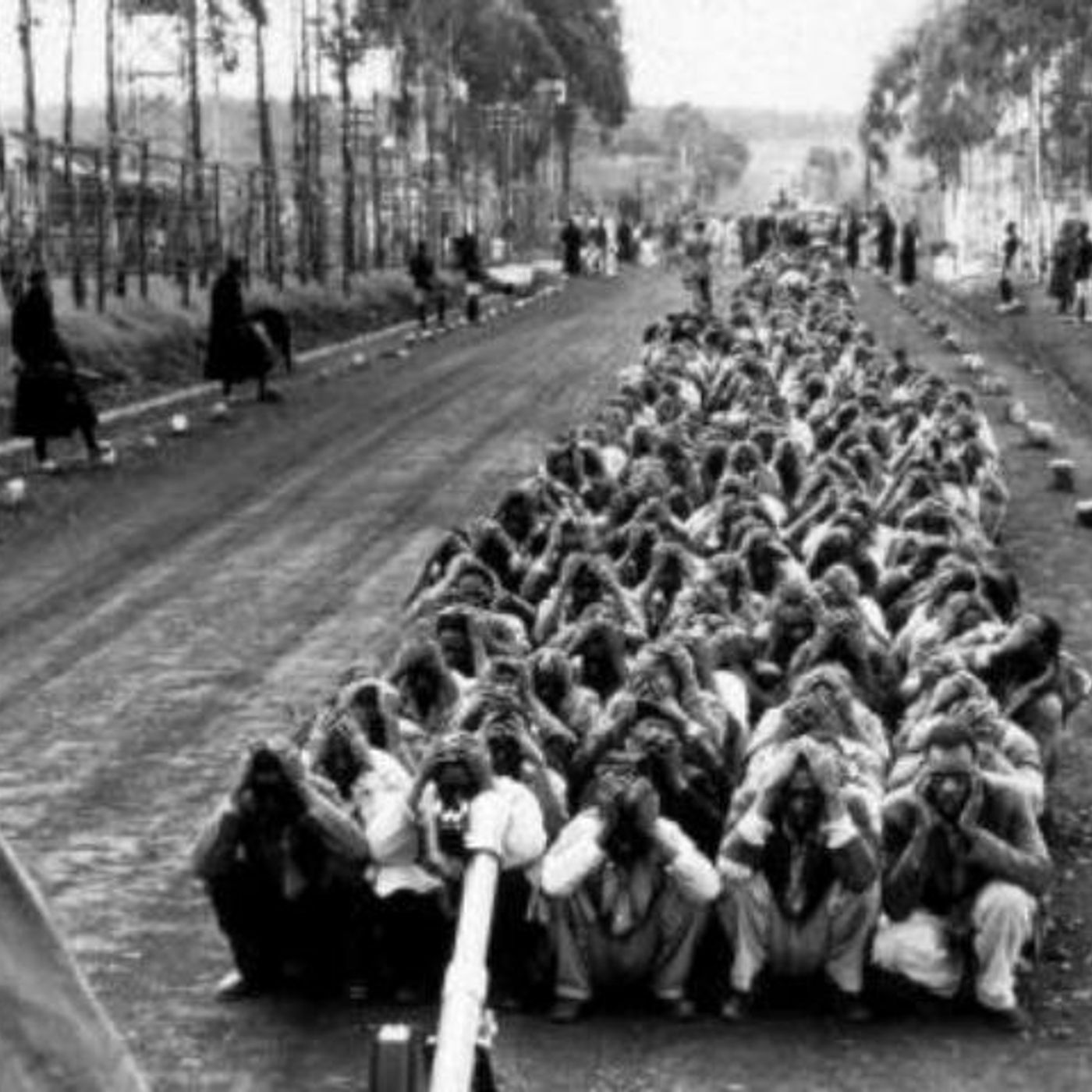
Radiolab
Mau Mau
00:43:31
This is the story of a few documents that tumbled out of the secret archives of the biggest empire the world has ever known, offering a glimpse of histories waiting to be rewritten.
Loading summary
Transcript389 lines
- [00:02]
A
And Doug, here we have the Limu.
- [00:05]
B
Emu in its natural habitat, helping people.
- [00:08]
C
Customize their car insurance and save hundreds with Liberty Mutual.
- [00:13]
B
Fascinating. It's accompanied by his natural ally, Doug.
- [00:18]
A
Limu is that guy with the binoculars watching us. Cut the camera.
- [00:21]
C
They see us.
- [00:22]
A
Only pay for what you need@libertymutual.com Liberty Liberty Liberty Liberty Savings vary unwritten by.
- [00:28]
D
Liberty Mutual Insurance company and affiliates.
- [00:29]
B
Excludes Massachusetts.
- [00:30]
E
When it comes to gifting, everyone on.
- [00:32]
D
Your list deserves something special. Luckily, Marshall's buyers travel far and wide, hustling for great deals on amazing gifts.
- [00:39]
E
So you don't have to.
- [00:40]
A
That means your mom gets that cashmere.
- [00:42]
D
Sweater, your best friend that Italian leather bag, your co workers unwrap their favorite.
- [00:47]
E
Beauty brands, and your nephews the coolest new toys.
- [00:50]
D
Go ahead. At prices this good, you can grab something for yourself too. Marshalls, we get the deals.
- [00:56]
E
You gift the good stuff.
- [00:57]
D
Shop now@marshalls.com or find a store near you.
- [01:02]
A
It's never too early for Lowe's Black Friday deals. Snag some of our biggest savings of the season right now, like 25% off select pre lit artificial Christmas trees and get yourself free. Select Dewalt cobalt or Craftsman tools when you buy a select battery or combo kit before the Black Friday rush. Because everyone loves free stuff, right, Lowes? We help you save valid through 123 while supplies last. Selection varies by location. Oh wait, you're listening. Okay.
- [01:35]
D
All right.
- [01:36]
A
Okay.
- [01:37]
D
All right.
- [01:39]
F
You're listening to Radiolab Radio Lab from wny.
- [01:45]
B
See?
- [01:45]
A
Yep. Hey, I'm Jad Abumrad.
- [01:51]
C
I'm Robert Krulwich.
- [01:52]
A
This is Radiolab. Today we're gonna start off with a building.
- [01:56]
C
Not just any building, but a building that is heavy with secrets.
- [02:02]
E
Yeah.
- [02:02]
A
And it's a building we first really learned about, or at least got a.
- [02:06]
E
Picture of from this woman, Katie Engelhardt. I'm a reporter at Vice News in London.
- [02:11]
A
And Katie, like now all of us.
- [02:13]
E
At Radiolab is obsessed, devastatingly obsessed with.
- [02:17]
A
This place called Handslope Park.
- [02:19]
E
So Handslope park is this huge sprawling complex in Buckinghamshire near a town called.
- [02:25]
A
Milton Keynes, which isn't too far from London. And our producer, Jamie Yorke, Check, check, check. Happened to be in London on vacation. So we asked him, well, why don't you just grab your tape recorder and go down there?
- [02:36]
B
Yeah, let's do this.
- [02:37]
C
Check it out.
- [02:38]
E
So it's a bit of a drive.
- [02:40]
A
From London, about an hour and a half on the M1, M2.
- [02:43]
E
You approach this sort of beautiful town with adorable little Posh cottages and little pubs.
- [02:51]
F
Not from around here. I'm looking for Hanslop Park.
- [02:54]
E
Yeah, I mean it's, it's your sort of typical ye olde British village.
- [02:58]
A
Watch out the guard dogs.
- [03:00]
C
Very, very secure place.
- [03:02]
A
About a four minute drive past that ye olde town, you go through some fields, crest over a hill and there it is, this massive, massive building surrounded by razor wire.
- [03:16]
F
See what's going on here?
- [03:17]
E
So the archives are held in a purpose built building from the 90s.
- [03:23]
A
And these are archives, by the way, from the largest empire ever known.
- [03:26]
E
It's like if you were creating a movie set for like a secretive government compound where they keep secret files, you would literally just make this.
- [03:36]
C
Jamie parked a quarter mile away, then walked up to the gate.
- [03:39]
F
There's a big, looks like electrified fence.
- [03:43]
A
Through the gate, taller than me, past.
- [03:45]
C
These traffic spikes, just as he barely stepped inside.
- [03:49]
B
Are you in a call? I am.
- [03:52]
C
Car.
- [03:52]
A
We're not, I'm not comfortable with any.
- [03:54]
B
Of this activity you're doing.
- [03:56]
A
A guard grabs him, takes him to a guard house.
- [03:58]
D
But can I just ask what that is?
- [04:00]
F
It's a microphone.
- [04:01]
D
Can you just disconnect it while you're in here though, please?
- [04:05]
C
And then where is your vehicle?
- [04:08]
A
Right, okay, I'll go for a walk with you.
- [04:10]
C
They walk him.
- [04:11]
F
Are you gonna escort me all the way back to my car?
- [04:14]
C
The entire quarter mile back to his car.
- [04:18]
A
Now we've heard it said that the files in that building, if they were ever released, could rewrite 200 years of history. No idea if that's true.
- [04:27]
E
We just don't know.
- [04:28]
A
But we're starting to know.
- [04:29]
C
And today we're going to focus on the one story that has so far anyway tumbled out kind of by accident.
- [04:36]
A
And it's a story. That we find kind of startling. And we should also warn that there's some stuff coming up that is graphic and disturbing. So if you're listening with kids, you might want to skip this one. Although if you're not listening with kids, don't skip it. Don't skip it. Okay.
- [05:04]
B
Our story is of Kenya. Kenya was always seen.
- [05:08]
A
This is historian David Anderson.
- [05:10]
B
In a kind of sepia tinted haze, many years ago came white men of adventure. Pioneers who found the country beautiful, the climate kind and the soil fertile. Bougainvillea, sunshine, smiling, happy servants.
- [05:24]
A
David says that in the 1910s, 20s, 30s, the British public was obsessed with Kenya. You had books, eventually television programs. It was one of the crown jewels of the empire. And so you had all of these Brits leaving Britain and going to Kenya to start a new life.
- [05:38]
B
And many, many of the settlers who flocked out to Kenya were lower middle classes who could have a much better salary and a much better living standard in Kenya than they ever could back at home. They stayed and founded the young colony where men make their homes, where their children are born, taught, and grow strong and healthy.
- [05:58]
A
Now, it probably goes without saying that this new life for the British citizen came at the expense of the Kenyan who was already living there.
- [06:04]
D
Two problems that were always encountered in Africa and in general with colonization is the issue of land and the issue of labor.
- [06:11]
A
That's Harvard historian Caroline Elkins. She'll play a big role in our story.
- [06:14]
D
So in Kenya, they solved the land problem by simply alienating it and giving it to the white farmers, but then becomes the labor problem. How do you force Africans to labor cheaply on plantations, right? Like in this case, tea and coffee? Well, the way you do it is you create what are called native reserves. We had them here for Native Americans.
- [06:33]
A
She basically says that the native Kenyans were forced off of their land into slums where they could build, barely eke out a living. And so the only option they had was to work for the white people. And that's how it went for decades, until the Second World War.
- [06:49]
B
Axis aggression has started. War crowds gather.
- [06:52]
A
1939.
- [06:54]
D
Suddenly, thousands and thousands of men, young.
- [06:56]
A
Kenyan men, are forced into war.
- [06:58]
B
The people of Africa are doing excellent work to help the allied cause.
- [07:02]
A
Many get thrown into the British Army.
- [07:03]
D
King's African Rifles, among the finest troops in the empire, where they came in contact with ideas of independence. And they anticipated when they returned.
- [07:14]
C
Today is victory in Europe's day.
- [07:19]
D
That they would have access to land, that their conditions would be getting better. But nope, they find their condition has not only not gotten better, it's gotten worse.
- [07:33]
A
And so after the war, a few of these vets from the largest ethnic group in Kenya, called the Kikuyu, they.
- [07:40]
D
Get together and they decide to take an oath. Now, oathing is traditional amongst the Kikuyu. So, for example, men 100 years ago or more would take an oath pledging allegiance to their ethnic group as they went to war with somebody else. In this case, they take an oath pledging themselves to kick all Europeans out of the colony. Then the oath would go something like this. I pledge to kick all Europeans out of the colony, out of Kenya. And if I don't, may this oath kill me. I pledge to take up arms against the Europeans. If I don't, may this oath kill me. Now, of Course, the last thing that was said always was, if I reveal the contents of this oath, may this oath kill me.
- [08:22]
A
She says the first thing they did was attack the settlers livestock doing things like hamstringing cattle.
- [08:28]
C
Hamstringing cattle.
- [08:30]
D
Cut their hamstrings. Oh, cut their hamstrings so they can't walk.
- [08:33]
A
They started destroying property. Their oaths started to involve things like.
- [08:37]
D
Goat eyeballs, ram scrotums, intestines, blood, things that absolutely repulsed the local European settlers and put terror into them.
- [08:45]
A
And why did they end up calling themselves the MAU MAU?
- [08:48]
D
That's a good question. The etymology of that is much debated with nobody quite agreeing on how it came to pass. But MAU MAU is, many think, is a Swahili derivative of sort of more and more that there's, you know, some say it has to do with Europeans. I don't believe this one overhearing what was the MAU MAU oath.
- [09:08]
A
Whatever the case, in 1952, the colonial government, which was sort of the British arm in Kenya, they declare a state of emergency.
- [09:18]
D
And those pledging allegiance to the MAU MAU, they escalate. They start going after the loyalists, the.
- [09:25]
A
Kenyans who'd been helping the settlers, savagely.
- [09:27]
C
Attacking the defenseless, shooting them or killed.
- [09:29]
A
They murdered them, murdering one, assassination after the next.
- [09:32]
B
Men and women with their bodies carved forever.
- [09:34]
A
They raid loyalist villages with clubs, knives, and fire. In the British, they're terrified.
- [09:40]
B
Troops are in the streets of Nairobi.
- [09:42]
D
This is the night of the Long Knives coming into reality, and it's only about to get worse.
- [09:48]
A
And that happens on the night of January 24, 1953, which was the murder.
- [09:53]
D
Of the Ruck family. The Rucks were these very young, lovely couple.
- [09:57]
A
Roger Ruck was a farmer. Esme Ruck was a doctor who actually administered to the local population. And they had a little boy named Michael who was six.
- [10:05]
D
Just that day, the little boy had fallen off his pony and his. One of their trusted servants carried him back up to the house.
- [10:12]
A
Later that night, a group of MAU MAU crept out of the forest, lured Roger and Esme Ruck out of the house, killed them, and then the whole gang, including that same servant that had helped the boy, they march into the house, go up to the little boy's room, and they hack him to death.
- [10:27]
D
And there's a very famous photo of the young boy's bed absolutely bloodied, which is in every major newspaper.
- [10:35]
A
And almost overnight, MAU MAU becomes synonymous with pure evil in our mind, in.
- [10:42]
D
Children'S mind, MAU MAU were bigger than life. Darkest, dark people that you ever saw.
- [10:49]
B
Men, Men. Men.
- [10:50]
D
Men.
- [10:50]
A
Men. And actually, as we were reporting this story, one of our producers, Latif Nasser, told us about how his mom grew up next door to Kenya in what is now called Tanzania. And to her and her friends, the MAU MAU were like, like a monster to children. The boogeyman, that was sort of a.
- [11:09]
D
Threat all the time. Our mother especially would refer to if you don't drink your milk or if you don't sleep. MAU MAU Acheh to MAU. Mauke Bolani sao. The MAU MAU will come and get you.
- [11:24]
A
And how scared were you? You know what?
- [11:27]
D
Just the word MAU MAU would make us run, crawl under the bed.
- [11:32]
C
I'm old enough to be one of the people who thought there were communists.
- [11:37]
D
They're get you in the middle of the night.
- [11:38]
C
Yes, they were like ISIS or some weird sort of self organizing terrorist group.
- [11:43]
D
Yes, the most bestial, horrible, awful, savage movement that had ever hit the face of the British Empire.
- [11:49]
A
Okay, so here's where we get to the part of the story that is in deep flux. After the murder of the Ruck family, the settlers demanded that the colonial government do something. And they did. They pursued the MAU MAU fighters, supposedly small band of fighters into the forest. There were skirmishes that lasted for years. Story goes, the MAU MAU movement never quite gained traction. And ultimately the British quelled the rebellion. They handled it. Now, as for how they handled it, for the longest time people would look back, it was this giant blank spot. No one quite knew what happened. And here's why. According to David Anderson, by the time the British finally decide to leave Kenya, this is 1963.
- [12:31]
B
By that time, Kenya is around the 20th different colony that Britain will leave. So it's about halfway down the list. So there's already in place a process. At the Uhuru stadium, the articles of.
- [12:45]
A
Independence were handed by the Duke to.
- [12:47]
B
The country's prime minister.
- [12:49]
A
There's a formal exchange of powers. They set off fireworks. And then at midnight, the Union Jack.
- [12:55]
B
Was lured for the last time.
- [12:57]
A
The Brits roll out.
- [12:58]
B
In other words, they run a smooth and colorful and happy exit.
- [13:03]
A
And at some point in that well worn exit process, either right before the exit or right afterwards, there was, as.
- [13:10]
B
David calls it, the weeding of documents.
- [13:15]
E
I mean, the British government conducted very, very sophisticated purge operations in all of its former colonies.
- [13:22]
A
It's Katie Englehart again. She says everywhere you look, Uganda, Palestine, Rhodesia, Zanzibar, Nigeria, Jordan, Malaya, Hong Kong.
- [13:28]
E
There are stories of papers being kind of tightly packed into boxes and dropped at sea. A lot of papers were burned.
- [13:36]
B
There's a joke in among Indian historians that on the day that India achieved its independence, when the celebrations were taking place in Delhi, you could hardly see what was going on on the podium because the wafts of smoke blowing across from the bonfires of burning documents, all.
- [13:52]
A
Of which is to say that it was, you know, assumed for 30 years that that blank spot of the MAU MAU emergency would just stay blank and the story of the evil MAU MAU would just continue because there were no documents to say otherwise. But then we get to Caroline Elkins.
- [14:05]
C
How did you, like, once upon a time, you were a curious young grad student or something?
- [14:12]
D
Yeah, more or less. In fact, we even have to go back further. You know, I'm dating myself at age 45, but I have to go back to my undergraduate years talking 1990. I was at Princeton, and we were, you know, you do senior theses there, and Princeton was ahead of its time, and I got lots of funding and I went off to London and Kenya.
- [14:29]
C
How old are you when you're taking this trip?
- [14:31]
D
Oh, I'm 20.
- [14:33]
C
So Caroline is working in Nairobi, and I'm doing research.
- [14:36]
D
At the time, my senior thesis was looking at the Kikuyu, which is the largest ethnic group in Kenya, the Kikuyu. And I was looking primarily at the shifting roles of women and the ways in which they were impacted by colonialism.
- [14:47]
C
So Caroline would wake up every morning and would walk to this old colonial building right in Nairobi city center called the National Archives.
- [14:55]
D
It's loud, it's dusty. It's. You know, sometimes you had to jump under the desk for several hours because there was a shootout across the street.
- [15:05]
E
Really?
- [15:05]
D
Yeah.
- [15:05]
A
Wow. Yeah.
- [15:06]
D
That was quite a Saturday, you know, Long story short.
- [15:10]
C
So one day she was at the archives flipping through some files when I.
- [15:14]
D
Came across some files on detention camp Kameti. Detention camp now being the Goodwill Kiti.
- [15:24]
A
Kameti. You say?
- [15:25]
D
Kameti. K A M as in Mary I T I.
- [15:28]
A
And this was in Nairobi, just outside Nairobi.
- [15:31]
C
Okay.
- [15:31]
D
And I said, gosh, you know, I know nothing about this. So she calls over the archivist guy named Evanson. And I said, evans, you got anything else like this? He said, yeah, let me take a look. And then Evanston starts bringing me some other files also related to Kamiti. Very bureaucratic files.
- [15:50]
C
These pages were filled with details, numbers of prisoners. A lot of them were women.
- [15:55]
D
Well over a thousand because they would mention 100 of this and a couple hundred of that. And at that point I thought, what's going on?
- [16:03]
A
So short time later, she gets back.
- [16:05]
D
To Princeton, and being the good little undergraduate history major that I was, I searched high and low about detention camps in Kenya.
- [16:13]
A
Nothing much.
- [16:13]
C
Yeah, no mention of this center anywhere.
- [16:15]
D
There's nobody who had done a systematic study of it.
- [16:18]
C
Okay.
- [16:18]
D
And that's what I was after.
- [16:24]
A
So without anything else to go on, Caroline just started driving up country, as.
- [16:28]
D
They say, in the middle of nowhere. Kenya.
- [16:30]
A
All these tiny little villages in the central province.
- [16:32]
D
I mean, really, if you wanted to find middle of nowhere on the map, I was in it. I would just show up at somebody's little shamba or farm one day. Next thing you know, I'm conducting an interview. Can you ask her while working about how many people?
- [16:49]
A
These are tapes she recorded on a few of her trips. She would speak to people through her research assistant, Terry Wyremu.
- [16:54]
D
I mean, some of these interviews would go on for hours. Then one interview begets the next. Every time you finish an interview, you say, you know, do you have somebod else who I could talk to? They say, oh, yeah, I've got. My friend lives three bridges up and four hills over.
- [17:07]
A
So she would talk to that person and then the person they referred to and then the person they referred to. And this is what she did for, like, five years.
- [17:21]
D
I went and interviewed several hundred villagers.
- [17:24]
C
And what exactly are they telling you?
- [17:28]
D
Stories.
- [17:30]
B
You.
- [17:30]
D
You can't imagine.
- [17:37]
A
What those stories were. What those stories have begun to unravel is up next. This is Darlene calling from Kampala, Uganda. Ragerlab is supported in part by the.
- [18:47]
D
National Science foundation and by the Alfred.
- [18:50]
A
P. Sloan foundation, enhancing public understanding of.
- [18:53]
D
Science and technology in the modern world.
- [18:56]
A
More information about Sloan@www.sloan.org.
- [19:02]
D
Radiolab is supported by BILT. Nobody wants to pay rent, but if you have to, Bilt works to make it more worthwhile. By paying rent. Through Bilt, you can earn flexible points that can be redeemed toward hundreds of hotels and airlines, a future rent payment, your next Lyft ride, and more. But it doesn't stop there. You can dine out at your favorite local restaurants and earn additional points, get VIP treatment at certain fitness studios and enjoy exclusive experiences just for built members. Every month, earn points on rent and around your neighborhood, wherever you call home, by going to joinbuilt.com Radiolab. That's J-O-I-N-B-I-L-T.com Radiolab.
- [19:38]
E
Hey, I'm Molly Webster and this is an ad by BetterHelp. So it happens every year. The seasons are changing, the days are getting shorter, and basically once it becomes dark outside of my window, I feel like the rest of the world disappears and I'm just alone and there's nothing left to do but watch television. This November, Better Help is asking everyone to reach out to our people. That could be your family, your friends, your neighbors, and to resist this call of the cocoon. And yeah, reaching out can take some courage. I've got text messages from January I haven't responded to and you know what? I'm gonna write em back right now. Hi, sorry I've been missing. How are you? Why don't we all do this sooner? Therapy is the same. BetterHelp makes it easier to take that first step. You just fill out a short questionnaire and they find a licensed therapist who they think you'll like. Our listeners get 10% off their first month at betterhelp.com Radiolab that's betterhelp.com Radiolab.
- [20:45]
A
Radiolab is supported by Planet Visionaries, the podcast created in partnership with the Rolex Perpetual Planet Initiative. The show is hosted by Alex Honnold, who you may recognize from Free Solo, where he climbed El Capitan without ropes. Now he's turning his focus to the biggest challenge of all, protecting the only planet we've got. Every episode brings you stories that prove climate optimism isn't naive, it's a strategy. The episodes span the globe, from Arctic scientists and Amazon forest guardians to entrepreneurs reimagining fashion and food systems. You'll hear from explorers, scientists, activists and storytellers who are working to reshape the future in practical human ways. In one episode, Alex sits down with wildlife photographer Bertie Gregory to discuss how animals can teach humans resiliency, empathy and hope in partnership with the Rolex Perpetual Planet Initiative. Check out Planet Visionaries Listen or watch on Apple, Spotify, YouTube, or wherever you get your podcasts.
- [21:50]
E
VRBO last minute deals make chasing fresh.
- [21:53]
D
Mountain powder incredibly easy. With thousands of homes close to the.
- [21:56]
A
Slopes, you can easily get epic Pow Freshies, first tracks and more. No need for months of planning.
- [22:03]
E
In fact, you can't even plan.
- [22:04]
D
Pow Pow is on its own schedule.
- [22:08]
E
Thankfully, somewhere in the world, it's always snowing. All you have to do is use.
- [22:13]
A
The last minute filter on the Apple.
- [22:14]
E
To book a last minute deal on.
- [22:16]
D
A slope side private rental home. Book now@vrbo.com.
- [22:25]
A
Hey, I'm Jad Abumrad. And I'm Robert Krulwitz this is Radiolab. Before we get to the stories that Caroline was referring to, we should say that as we were sort of reporting this story, we really kind of fell in deep, to the point where Jamie York, who had already gone to London to get hassled by those guards at Hounslow park, he then decided to spend part of his vac in Kenya, basically following in Caroline Elkin's footsteps. Yes. And that's when he stumbled into something kind of surprising.
- [22:54]
F
So I got picked up early one morning in Nairobi and driven about three hours into the countryside. And okay, after what felt like five right turns, 37 lefts, we finally wind up in this completely rural place. It really does feel like the middle of nowhere.
- [23:13]
A
It's like a little village or something.
- [23:14]
F
Yep. Little cluster of houses and rolling hills in a county called Nyeri. Got my stuff, got out of the car, followed Terry, who had arranged the trip.
- [23:23]
D
My name is Terry Oirimu Gichuki. I am 41 years old.
- [23:27]
F
This is the same Terry who translated for Caroline Elkins many years ago. Anyhow, fast, a few kids, and Terry walks me into this little clay hut. There's a table in the center of the room. There's a handful of plastic chairs around it. And eventually people start showing up.
- [23:49]
C
Women.
- [23:52]
F
Nine women who are all in their late 80s, early 90s, Make introductions. And honestly, I'm a little bit disappointed because the MAU MAU, I thought, were just men, fighters. And seeing these women, I thought, oh, no. I realized most of the men have died of old age.
- [24:17]
A
Oh, so you thought you weren't going to meet anybody?
- [24:19]
F
Exactly. I'm curious for myself, but I thought, okay, I'll just ask. How many of the women, like, show of hands, how many of you identified as Mamo? Instantaneously, everyone put their hand up.
- [24:36]
A
All nine people.
- [24:37]
F
Yeah. And then started to sort of chuckle.
- [24:40]
D
They find it funny that we are asking them because it's obvious they were supporting MAU MAU.
- [24:45]
F
They were like, of course we were supporting the MAU MAU. We were the MAU MAU. Like, that was everybody.
- [24:51]
A
Oh, interesting. So it wasn't just like a small band of militants.
- [24:54]
F
It wasn't a small band of militants amongst the Kikuyu. It was almost everyone.
- [24:59]
A
This is one of the first things that caught Caroline Elkins attention, made her really question that official narrative. Because when she was doing interviews 15 years ago, she says everyone.
- [25:08]
D
She spoke to everyone to a person. And we're talking hundreds of interviews, started with, I took the oath on such and such a date. Very interesting.
- [25:18]
A
Seemed to her what you had here was not a small insurrection. This was a mass movement. And she would discover that the British response to it was also massive. 1953, shortly after the murder of the Ruck family, the white settlers marched, demanded that the colonial government do something. And so what happened is that the colonial soldiers, they came to the village, they started going to villages across Kenya.
- [25:43]
D
They rounded everybody up, slaughtered their cattle, slaughtered their goats, burned down their homesteads.
- [25:48]
A
And put them into these prison villages.
- [25:51]
D
Some 800 barbed wire villages throughout Central Province, Kenya. The village was like a concentration camp.
- [26:05]
B
The thing to grasp here is that this is very carefully designed and very practical.
- [26:10]
A
David says there was a very carefully planned system at work. The barbed wire villages were primarily for women and children. Men were usually sent to these detention camps, which were basically prisons. Now, the logic of those camps was actually thought up by a group of British academics who met in 1953, sort of an emergency meeting to discuss the, quote, MAU MAU problem. And they decided at that meeting that clearly the real reason the MAU MAU.
- [26:36]
B
Are rebelling was that they were captured by some kind of mental illness.
- [26:41]
A
Had nothing to do with the fact that their land had been taken away from them. No. It was that they were temporarily crazy. And the committee decided it must have something to do with those oaths.
- [26:49]
B
Oaths were seen by the British as a primitive way of capturing a cuckoo mind and making the person unreasonable and insensible. The only way they argued you could get rid of the oath was to convert the person back to sanity. Part of that involved a confession of what they'd done. Once confessions were made, they would then be rewarded by a better prison regime, then be moved into another compound, given privileges, given better food. You moved along the system. They called it a pipeline. You moved along the pipeline until you were released.
- [27:24]
A
But you first had to confess.
- [27:25]
B
To confess. To confess.
- [27:29]
A
This is Gitu Wak Hungary. Freedom fighter.
- [27:33]
C
I joined the MAU MAU freedom struggle.
- [27:37]
A
When I was 17 years of age. He quickly became an organizer, a recruiter, and therefore a target.
- [27:44]
C
They had to search for me, and they caught me.
- [27:51]
B
They put me into a detention camp.
- [27:53]
C
They want us to say loudly that.
- [27:57]
B
We forsake the MAU MAU struggle.
- [28:01]
C
But we refused. We refused.
- [28:06]
A
In fact, one man told us a story of how in one of the barbed wire villages, every once in a.
- [28:12]
D
While, the Maumau would come to the.
- [28:14]
A
Edge of the forest just outside the village's fence. These were the fighters that hadn't been captured yet. They'd come Right to the edge of the camp where a lot of the children would be playing.
- [28:23]
D
And because no grown up would suspect children would understand anything about what was happening in the people in the village used to use their children to take messages to the people in the fighters in the forests.
- [28:39]
A
That's how they passed food and information to the fighters and in a way, kept things going. The point is, according to David, that inside the camps, you had massive resistance. And so in many cases, the British colonial soldiers would double down. Warning. The following is pretty graphic. There's a BBC documentary called White Terror that has tons of these frighteningly common stories of abuse from detainees.
- [29:05]
B
He told me how, naked, tied by his feet to the bars, he was brutally beaten on the testicles with a stick.
- [29:11]
A
One of them is a man giving a tour of the prison cell he was kept in.
- [29:15]
B
Then they seared his eyes with hot coals. They kept him there for eight days.
- [29:20]
A
There's another story of these three men who were made to strip naked.
- [29:25]
B
One of the men was made to put his head into a bucket of water. Then the white officer held one of the prisoner's legs aloft, while a guard held the other. And another guard brought some sand, which they started to push into the detainee's anus with a stick. They kept on doing this, alternately putting in sand and water, all the while pushing the mixture in with the stick. That act still gives me nightmares to.
- [30:00]
A
This day.
- [30:02]
B
Because that was something that should never be done to a human being.
- [30:08]
A
In that period of coercive violence. It lasted throughout the 1950s.
- [30:17]
B
Now, the MAU MAU were bad guys.
- [30:19]
D
Listen, there's nothing to excuse this kind.
- [30:21]
B
Of terrorism, but the Kenning campaign was a sledgehammer used to crack a nut.
- [30:29]
C
There have been a lot of different estimates to try to pin down the scale of the British campaign. They range from 160,000 people killed, maimed, tortured, detained, to much, much higher numbers. Caroline Elkins did her own calculations, and.
- [30:44]
D
According to her, by the time it was done, nearly the entire Kikuyu population of a million and a half people were detained, tortured, murdered, systematized force labor. And you have to look at scale and, if you will, the balance sheet of this. How many Europeans died? 32.
- [31:06]
A
32.
- [31:08]
C
Why isn't this a tale that everybody in the world knows, in the event, say, of the enslavement of the Hebrew people under the Pharaoh. They were slaves in Egypt. The pharaoh wouldn't let them out. Moses had to cross the river. It becomes the national story of the Hebrew people in this situation. You have Jomo Kenyatta, who I believe is a Kikuyu, becoming the first president. Why wouldn't he make this the national story?
- [31:34]
D
Well, Kenyatta comes out of detention, and one of the first things he does is he denounces MAU MAU as being hooligans. The same organization that accelerated independence in Kenya.
- [31:47]
A
She says the same movement that scared the British, scared him. He didn't want them suddenly organizing and taking his power.
- [31:53]
D
So for decades, from 1948 until 2002, the ban on MAU MAU that had been put in place by the British colonial government remained in place, meaning it.
- [32:04]
A
Was illegal to even talk about it. But eventually, in 2005, Caroline publishes her book Imperial Reckoning, which included the hundreds of interviews and painted a picture of just a systemic violence. The book was well received, but she says a lot of critics told her, nice story, but no, this is an act of fiction.
- [32:31]
C
An act of fiction.
- [32:32]
D
I made it up.
- [32:33]
C
But you had all these interviews.
- [32:34]
D
Right. But one of the lines of critique was that it's all based upon oral testimony. Oral testimonies are unusable. There is no story here.
- [32:43]
A
She says a lot of that was just blatant racism.
- [32:46]
D
You know, Africans make up stories, but.
- [32:48]
A
Buried in there is sort of a legitimate concern. I mean, memory is faulty. We know that oral histories are notoriously unreliable. If you're going to rewrite an entire history, you need to get beyond personal anecdote.
- [33:00]
B
You need documents that illustrate and prove it beyond doubt.
- [33:07]
A
And as we mentioned, besides those few that you found, the documents didn't seem to exist. Nonetheless, fast forward 2009. That book, Caroline's Imperial Reckoning, became the.
- [33:20]
D
Basis of a very large lawsuit.
- [33:21]
E
These Kenyan independent veterans.
- [33:24]
A
In June of 2009, five MAU MAU veterans representing over 5,000 MAU MAU flew.
- [33:28]
E
To London, the seat of an empire.
- [33:30]
A
They say is responsible for torturing them, and filed a lawsuit against the British.
- [33:34]
D
Government, the first time the British government had ever been sued by a former colonized population.
- [33:38]
B
The MAU MAU veterans want an apology and some form of recompense for what happened.
- [33:43]
F
Are you at all nervous going into the court?
- [33:45]
B
I think the word nervous is not the word out of use. I tell my partners to write on. I was not at all convinced that we're going to go anywhere but down.
- [33:53]
A
That's Martin Day. He represented the MAU MAU veterans in court. And the reason he was so sure that the case was going to go down in flames was, well, same issue.
- [34:01]
B
You just didn't have the Documents.
- [34:03]
A
All he had were stories that weren't exactly rock solid.
- [34:07]
B
Yeah, it was a nightmare. Old Kenyans in their late 70s and 80s. First of all, most Africans in my experience find dates extremely difficult, but people in their 70s and 80s almost impossible.
- [34:19]
A
And this was actually a huge problem because in the British system, if you're going to bring forward an old case like one that's more than six years.
- [34:26]
B
Old, the key question to the judge is, can you still get a fair trial?
- [34:30]
A
And the government could plausibly argue, no, too much time has passed.
- [34:34]
B
We were really worried that the judge would say, well, look, there can't be a fair trial, because actually these witnesses are so old, so up and down just in terms of their memories, that really their evidence isn't worth a great deal. So to recap, I wasn't really optimistic.
- [34:49]
A
But then it's kind of a last ditch effort. He contacted historian David Anderson to act.
- [34:54]
B
As an expert witness, because David had.
- [34:56]
A
Written a book about African history that was chocked full of legal documents.
- [35:00]
B
And they approached me to ask whether there was material in the legal cases I dealt with that might be useful to them.
- [35:07]
A
And that's when he told them something that would ultimately lead all of us back to that scary building of secrets. He told them, for the past 20 years, he has had this hunch.
- [35:17]
B
Well, so long before the MAU MAU trial came to court, I and a number of other historians believed that documents had been brought back from Kenya to Britain.
- [35:29]
A
David says in that same Nairobi archive where Caroline Elkins had found the document.
- [35:33]
D
About detention and thought, gosh, you know, what's going on?
- [35:37]
A
In that same place, somebody else had found another document that had also fallen through the cracks. And this one was a simple packing.
- [35:43]
B
Slip listing of documents for transportation and of their packing up and removal.
- [35:47]
A
Now, as for where those documents were moved to, well, no one knew.
- [35:51]
B
No.
- [35:51]
A
Maybe to an incinerator or bottom of the Ocean.
- [35:54]
B
But from 1997, 98, 99, like a.
- [35:57]
A
Starving man with a single Pringle, David kept on.
- [35:59]
B
And I eventually bought documents from the National Archives in Britain that confirmed the.
- [36:04]
A
Stuff from Kenya actually landed in an airport in Britain on leave of independence.
- [36:08]
B
I then was able to find out who took them, which van they went in. I even got the car's registration number.
- [36:14]
A
But that's when the trail went cold. They filed document request after document request.
- [36:19]
B
And we get nowhere.
- [36:21]
A
Then something totally unexpected happens.
- [36:25]
B
Two historians working on southern Africa actually got access to Hounslow Park.
- [36:31]
A
They got inside. One of them was a former colonial administrator so he could work some connections to get his way in. Anyhow, afterwards, he sends David Anderson a.
- [36:44]
B
Text message telling me that in Hlo park, he'd seen miles and miles of shelving of documents from other colonies, including Kenya.
- [36:54]
C
Was that a figure of speech, miles, or was that.
- [36:56]
B
I think he meant it literally. He'd seen a vast hangar, as he described it, with row upon row upon row of documents.
- [37:06]
A
So when Martin Day, the lawyer, contacted David Anderson and asked him, can you help us with our case? David said, here's what I can do. I can't actually give you any documents because I don't have any, but I can outline for you the documents that I think might be out there, the.
- [37:20]
B
Documents I believed the British government were hiding away.
- [37:24]
A
So he wrote a witness report for the judge summarizing everything he knew, giving.
- [37:27]
B
All the details I had. I didn't mention Hounslope Park. I didn't say what I thought they were. I just said I knew they'd come into Britain and I wanted to know what happened to them.
- [37:37]
A
The judge read that report and then basically asked the government, do you have him or not?
- [37:41]
B
Look, if you can't answer this question, you'll be held in contempt of court. In other words, I will interpret this as you're withholding information, and that basically means you lose the case. That decision was the turning point. Half a century on from Britain's withdrawal from Kenya, documents detailing the alleged brutality employed by the British colonial authorities have finally been released. And suddenly, having spent years denying these documents existed, within four days, they found them. Kenyans were waiting in Nairobi today for.
- [38:13]
A
The news from London.
- [38:14]
C
Well, you can see there is the.
- [38:16]
B
Reaction of these people here. They've won an important battle here today.
- [38:20]
E
I mean, we're talking. We're talking something like 300 boxes of files, you know, tons of missing documents, 15,000 papers relevant to the case.
- [38:29]
C
This again is Katie Engelhardt of Vice News. She reported on the trial on the extensive number of files that the government produced.
- [38:36]
E
100 linear feet, I think those files held, and they contained really, really damning evidence of Britain's conduct in Kenya.
- [38:45]
C
The files made it clear that the central government in London did know what was happening in Kenya. There was specific documentation of rounding up of MAU MAU fighters. There was even a memo about a Kenyan being roasted alive.
- [38:57]
E
And there was this pleading letter written by detainees that had been smuggled out of a camp. And it said, hurry, hurry, hurry, in order to save our souls. I mean, absolutely damning evidence.
- [39:06]
C
The government ultimately agreed to pay about 20 million pounds to the people who brought this lawsuit to. Which works out to roughly $4,600 each.
- [39:15]
B
Yes.
- [39:15]
A
Here's what I don't understand. Why would they even save those documents?
- [39:20]
B
Well, looking through the collections that have now emerged, it's quite clear to me that they wanted to save documents that showed that not all the European staff in Kenya had been happy about compulsive force.
- [39:37]
E
There was a letter written in 1953 by the colony's attorney general. He observed that detention facilities, Kenya were, quote, distressingly reminiscent of conditions in Nazi Germany or Communist Russia.
- [39:49]
A
Oh, interesting. So you think the people, some of the British officers in Kenya saved the files precisely because they were damning?
- [39:57]
B
Yes, they saved stuff that would demonstrate that we didn't like this.
- [40:04]
A
Whatever the reason, here's why the MAU MAU case has become so much bigger than just the MAU MAU case. As soon as journalists and historians learned about the existence of those files, they started to relentlessly poke and request more documents. And soon those 1500, very soon that.
- [40:18]
E
Became 8800 files and then 20,000 files and then 1.2 million files. And at the time, the estimate was that the files occupied about 15 miles of floor to ceiling shelving.
- [40:32]
C
What?
- [40:33]
E
Yeah, 15 miles.
- [40:35]
B
The process that has been invoked by the Mamau case is going to have even wider repercussions than people yet realize.
- [40:45]
A
We got a little. Arrived in just a little waft of that when we were talking with a woman named Mandy Banton, a senior research.
- [40:52]
D
Fellow at London University.
- [40:54]
A
She used to work at the National Archives in London. And we called her just to help us parse all this stuff. And at one point I asked her, is this just a Kenya thing? And she said, oh, no, no, no, it's not.
- [41:04]
D
It's not by any means.
- [41:05]
A
Then she explained that after the MAU MAU case, the Foreign Commonwealth Office, which is the technical name for the place that was holding those documents, almost immediately.
- [41:13]
D
Afterwards it admitted that it actually had documents from 37 former colonies which had been. Yes, exactly.
- [41:24]
C
You mean that there could be dirty stuff from Malaysia, dirty stuff from Palestine, dirty stuff from Cyprus?
- [41:31]
D
I mean, obvious sort of trouble spots, if you like.
- [41:36]
A
I mean, this is like a rewriting of history, essentially, is what.
- [41:38]
D
Well, it is a rewriting of history. And I mean, there are now quite a lot of people looking at these, you know, comparatively newly released records.
- [41:47]
A
Now, both David and Katie cautioned us that the new stuff, when it comes out, might not be quite as revelatory as all those Mao. Mao files.
- [41:57]
E
Well, I think there are nuggets. I think there are nuggets. And I think. I mean, I think historians will find them.
- [42:04]
A
For David Anderson, one of those nuggets might be the documents about the Cold War.
- [42:08]
B
Those could be historically really very, very.
- [42:10]
A
Important for Caroline Elkins.
- [42:12]
D
Israel and Palestine, then Malaya and Singapore.
- [42:15]
E
And I want to know what's in those Hong Kong files.
- [42:17]
A
There's over 250,000 documents on Hong Kong, just Hong Kong. Which sort of brings us to the situation that we are in now.
- [42:26]
B
Just the most ridiculous, ridiculous, stupid situation.
- [42:30]
A
Imaginable, which is that, for the moment, the British government's policy is that all.
- [42:35]
B
Documents must be reviewed and redacted before release.
- [42:39]
E
So each file needs to be looked over by what's called a senior sensitivity reviewer, although colloquially it's just weeders. It's basically retired senior diplomats. So if you can imagine, you've got 15 miles of papers and you've got literally a couple of dozen retired diplomats.
- [42:57]
B
And they sit in an office literally turning pages, trying to stay awake.
- [43:01]
A
Sitting here, I just imagine, like, take a little sip of tea and redact all day long. Sip redact, Sip redact.
- [43:11]
E
And at the rate that we're going.
- [43:13]
A
By the time these files finally see the light of day, it will not.
- [43:17]
E
Be within my lifetime. I mean, it could literally be hundreds of years.
- [43:21]
F
I keep thinking about these two groups of elderly folks.
- [43:24]
A
Again, producer Jamie York, the litigants in.
- [43:26]
F
The MAU MAU case are in their 80s and 90s. It just strikes me that what a crazy lucky break for them, that in the very final years they're alive, they survive to hear this apology from the British government in acknowledgement of the story they'd been telling for 50 years.
- [43:43]
B
Well, I thank you for the others.
- [43:46]
F
Won't be so lucky.
- [43:47]
B
Yeah, thank you for putting it that way. Because I. Having got to know the plaintiffs in the case, when they came to London, it was very clear to me that what mattered to these people was not a financial settlement at all, but rather acknowledgement, just simple acknowledgement that these things had been done to them. So on the day that the barrister for the Crown stood up in court and to all of our astonishment, said, quite simply, the British government admits the tortures. Once I gathered my wits and looked round behind me in the courts, two of the plaintiffs were in tears. And it brought home to me what a traumatic, appalling experience this had been for them from start to finish. So, yes, I agree, for them to get that triumph was remarkable, Remarkable.
- [45:16]
C
But, says our producer Jamie York, it was really remarkable only for some people.
- [45:23]
F
So when I went to Kenya and I was talking to these people who had lived through the emergency, I wanted to know about what they thought of the settlement. And a lot of them were like, what settlement?
- [45:40]
D
They had rumors about the government of Britain agreeing to apologize.
- [45:46]
F
Some of them had heard about it, some of them hadn't. But it doesn't really matter to them because the people who got paid, that's just a tiny sliver of the vast majority of people who suffered. What this one guy told me is that what he and most people, what they want, need isn't so much an acknowledgement, it's to get back what was taken from them.
- [46:12]
D
Pieces of land, a place where one can keep some goats or cows.
- [46:22]
B
So.
- [46:22]
F
That he can do what any 80, 90 year old wants to do, leave something behind.
- [46:30]
D
To give their children and grandchildren a better life.
- [46:47]
B
Sam.
- [47:13]
C
Special thanks to Mattathia Schwartz for first bringing us this story and to Martin Mavingina and to Faith Alube of the.
- [47:20]
A
Kenyan Human Rights Commission, Nyakanyuha Kenda for the use of their music and Shruti Pinanameni for production support. This story was produced by Matthew Kielty. Original music from Matthew Kielty and a hell of a lot of travel and reporting support from Jamie York. I'm Jedi Boomeran.
- [47:39]
C
I'm Robert Krulwich.
- [47:40]
A
Thanks for listening.
- [47:49]
F
Hey, this is michael. I'm calling from culver city, california. Radiolab is produced by jad abumrad. Our staff includes brenna farrell, ellen horn, david gable, dylan keefe, matt kielty, andy mills, lateef nasser, kelsey padgett, ariane wack.
- [48:04]
A
Molly webster, soren we wheeler and jamie.
- [48:06]
F
York, with help from damiano marchetti, molly.
- [48:09]
A
Jacobson and alexandra lee young.
- [48:12]
F
Our fact checkers are eva dasher and michelle harris.