← Radiolab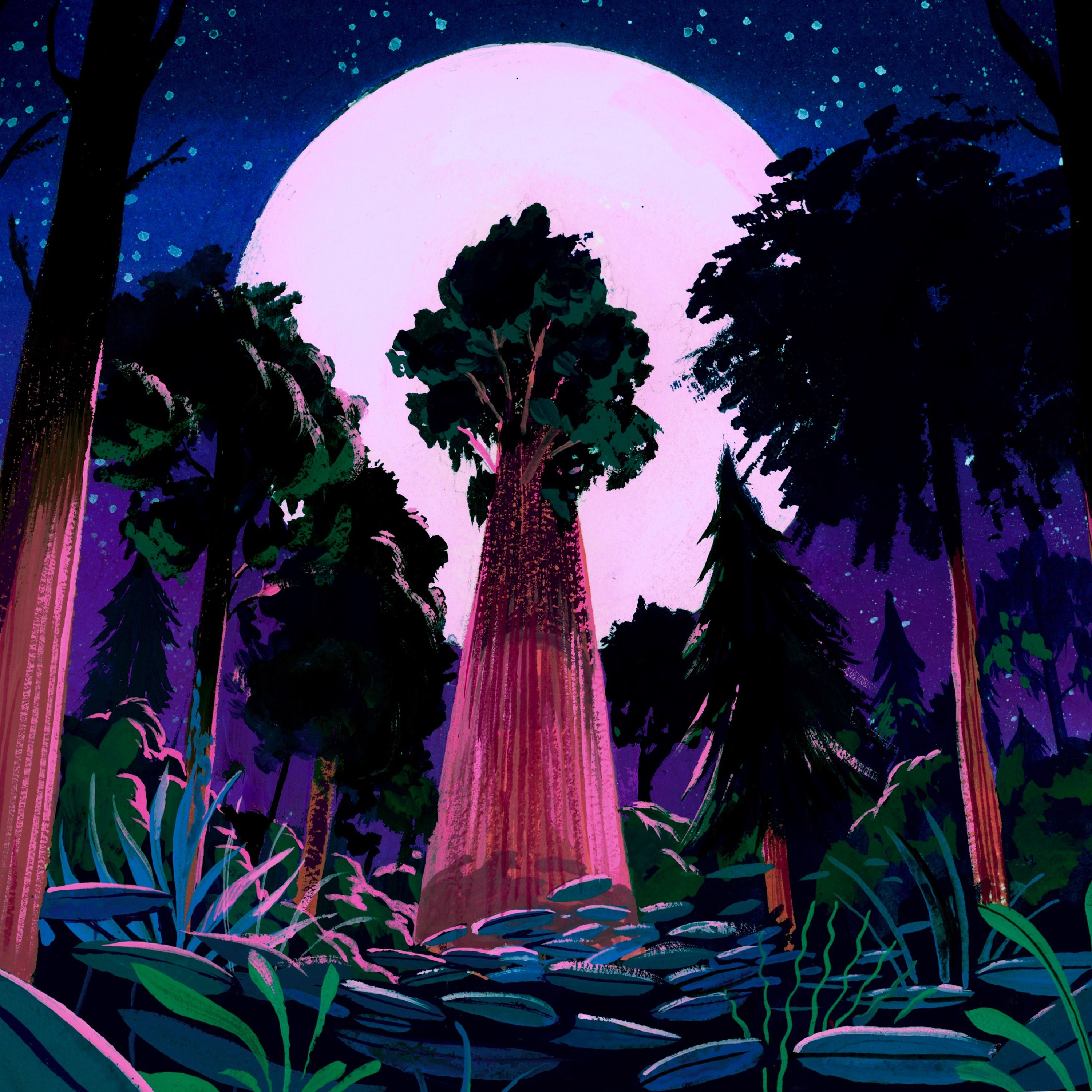
Radiolab
Moon Trees
00:35:06
In 1971, a red-headed, tree-loving astronaut named Stu ‘Smokey’ Roosa was asked to take something to the moon with him. Of all things, he chose to take a canister of 500 tree seeds. After orbiting the moon 34 times, the seeds made it back to Earth. NASA decided to plant the seeds all across the country and then… everyone forgot about them. Until one day, a third grader from Indiana stumbled on a tree with a strange plaque: "Moon Tree." This discovery set off a cascading search for all the trees that visited the moon across the United States. Science writer, and our very own factchecker, Natalie Middleton (https://www.nataliemiddleton.org/) tells us the tale. Read Lulu’s remembrance of Alice Wong for Transom.org: 13 questions I’ll never get to ask Alice Wong (https://transom.org/2026/13-questions-ill-never-get-to-ask-alice-wong/). Check out Natalie’s map to find your nearest moon tree on our show page (https://radiolab.org/podcast/the-travelers-how-moon-trees-hide-among-us)! Hel...
Loading summary
Transcript288 lines
- [00:01]
Lulu Miller
Radiolab is brought to you by Progressive Insurance. You chose to hit play on this podcast today. Smart choice. Make another smart choice with Auto Quote Explorer to compare rates from multiple car insurance companies all at once. Try it@progressive.com Progressive Casualty Insurance Company and affiliates not available in all states or situations. Prices vary based on how you buy. Oh, wait, you're listening. Okay.
- [00:29]
Latif Nasser
All right.
- [00:30]
Lulu Miller
Okay.
- [00:31]
Latif Nasser
All right.
- [00:33]
Lulu Miller
You're listening to Radiolab Radio Lab from wnyc. Happy New Year. This past year, we lost a great one, Alice Wong, the renowned disability activist, MacArthur Award winner, and writer and podcaster. And so many other things, including, we all feel lucky to say, friend of Radiolab. You may remember her from an episode we did in the fall called Voice. Alice brought us a very rad and real piece about how losing her speaking voice changed how she responded to the world and how the world responded to her.
- [01:17]
Alice Wong
I have observed people do talk over me because I guess they don't recognize the sounds I am making as a voice. And as you can guess, I see them silently plan their destruction.
- [01:29]
Lulu Miller
And so, to kick off the new year, we all wanted to pay some small tribute to Alice. And as we were trying to figure out how to do that, I went back and listened to the last conversation we ever had, which was just two months before she died. And I felt guided by this one.
- [01:48]
Alice Wong
Tiny moment to celebrate the recovery from my bed rest. I saw Lady Gaga in summer when she was in San Francisco.
- [01:57]
Lulu Miller
Oh, awesome. What was that like?
- [02:04]
Alice Wong
Oh, the energy and vibe was amazing. I dressed as Ziggy Stardust with full makeup and a sparkly pink shirt and silver pants and boots. I was really feeling myself and am pursuing pleasure as much as I can, while I can.
- [02:21]
Lulu Miller
Alice was so serious about what she was doing. She went to bat for disabled folks. She called out ableism. She did not mince words. But she was also so full of joy.
- [02:35]
Alice Wong
In fact, I am seeing Stevie Nicks in October and my witchy powers will be in full display.
- [02:44]
Lulu Miller
My text chain with her is full of really bad puns, memes of her mocking my children, and F bombs. So many F bombs. Women curse like a sailor. And one thing that her Ziggy Stardust comment made me realize that maybe not everyone knew about her is that she was really passionately into space. In a fake obituary that she wrote for herself, she said that she lived to the age of 96 and spent the last few decades of her life living on the moon. She said she lived in a zero gravity capsule as a member of quote crypts in space, a Group of scientists, creators and explorers. Now, when I look up at the Moon, I picture Alice is up there in lower gravity, experiencing less pain. In that same obituary, she also imagined that we all organized a, quote, multidimensional interstellar memorial on her behalf. So, as I wait for aliens to get back to me regarding logistical details, I figured as a little start, we could play an episode about this place she dreamed of living, the Moon. Funnily enough, it is also a story that ends up being about access and about how the Moon itself is more accessible to most of us here on Earth than we realize. It is an episode of Terrestrials. Alice was actually an advisor of terrestrials. She was always rooting for weird work and helped us make pieces that treated disability with care. So here we go. Thank you, Alice. We miss you. Please accept this humble lunar offering as a small token of our immense gratitude. 3, 2, 1.
- [04:52]
Natalie Middleton
Imagine that you're teeny, teeny tiny and you have this hard shell. But inside that hard shell is everything you need to start growing to 200ft tall.
- [05:08]
Lulu Miller
And you are all set to be an ursling. Until somebody launches you, hurls you toward.
- [05:15]
Natalie Middleton
The moon, and you travel 250,000 miles, the farthest that any living thing has ever been. You see the far side of the moon, where all there is is stars.
- [05:30]
Lulu Miller
And then you start falling back, back, back toward the Earth at faster speeds where nobody is sure if you'll survive. But when you hit the soil, you.
- [05:43]
Natalie Middleton
Feel the warm sun, and you unfurl from your shell. You have become a moon tree.
- [05:51]
Lulu Miller
A moon tree.
- [05:53]
Natalie Middleton
Yes.
- [05:54]
Lulu Miller
All right, now is the part where I make you sing the theme song with me.
- [05:57]
Alan
Terrestrials. Terrestrials.
- [06:01]
Alice Wong
We are not the worst.
- [06:02]
Lulu Miller
We are the best.
- [06:04]
Natalie Middleton
Reals.
- [06:05]
Alan
Bestials.
- [06:06]
Lulu Miller
Yes. You got it. Terrestrials is a show where we uncover the strangeness waiting right here on planet Earth. I am your host, Lulu Miller, joined, as always, by my songbud, if you believe Alan.
- [06:18]
Alan
We sent some seeds to the Moon.
- [06:20]
Lulu Miller
And today we are joined by one of our favorite storytellers, one of the people who fact checks our Terrestrials episodes to make sure everything we're saying is true. Can you please introduce yourself?
- [06:31]
Natalie Middleton
Hello, I'm Natalie Middleton.
- [06:33]
Lulu Miller
So it's funny that you are the person on our team who kind of certifies truth, because you are bringing us a story that sounds like science fiction, like sci fi.
- [06:44]
Natalie Middleton
Yeah.
- [06:45]
Lulu Miller
Where do we start?
- [06:46]
Natalie Middleton
This whole story begins, all thanks to a firefighter called Stu Smokey Russa.
- [06:54]
Ira Flato
Ooh.
- [06:55]
Lulu Miller
Smokey is his middle name.
- [06:57]
Natalie Middleton
That's his nickname.
- [06:58]
Lulu Miller
Smokey okay.
- [06:59]
Natalie Middleton
Smokey the firefighter, originally born in Colorado in 1933. Redhead, freckles, tall, kind of lanky prankster. He was whip smart, really good at math, and he absolutely loved trees.
- [07:17]
Lulu Miller
And after high school, he got a job with the Forest Service trying to fight this fungus called blister rust, which.
- [07:22]
Natalie Middleton
Is a fungus that is really hard for trees to survive.
- [07:27]
Lulu Miller
So you're saying he loved them so much, his actual job was to protect them from getting sick?
- [07:31]
Natalie Middleton
Yeah. And so every summer after that, he would go and fight fires. What he became is called a smoke jumper.
- [07:40]
Lulu Miller
A smoke jumper. That sounds a little scary.
- [07:46]
Natalie Middleton
It's pretty dangerous. So they're jumping out of planes with a parachute, basically into the fire.
- [07:53]
Latif Nasser
Wow.
- [07:54]
Lulu Miller
Are they wearing, like, fireman gear, like the jacket?
- [07:56]
Natalie Middleton
It's actually kind of similar to, like, an astronaut suit.
- [08:00]
Lulu Miller
Hmm. And at some point, as he's floating through space, he wonders what it would be like to float through space. Higher. Space. Outer space. So first he learns how to fly a plane.
- [08:20]
Natalie Middleton
Yes.
- [08:20]
Lulu Miller
Then he trains and becomes an astronaut.
- [08:23]
Natalie Middleton
He just kind of went up higher.
- [08:25]
Lulu Miller
In the sky, and one day, NASA tells him he's going to the moon.
- [08:31]
Natalie Middleton
Apollo 14. And his job, he's going to be the pilot.
- [08:35]
Lulu Miller
Whoa. He's flying the spaceship?
- [08:38]
Natalie Middleton
Yes.
- [08:38]
Lulu Miller
Wow. Go, Smokey.
- [08:40]
Natalie Middleton
It's a big job.
- [08:41]
Lulu Miller
So the year is 1971. The spacecraft is all loaded up with gear and fuel, and each astronaut gets to bring with them one little bag.
- [08:50]
Natalie Middleton
It's not big. It's almost like a pocket size.
- [08:53]
Lulu Miller
It's made of a special type of.
- [08:54]
Natalie Middleton
Glass that won't melt until it's hotter than over 1,000 degrees Fahrenheit.
- [09:00]
Lulu Miller
Whoa. That's like a furnace.
- [09:02]
Natalie Middleton
Very fireproof.
- [09:03]
Lulu Miller
And what can they put in there? Is it like their. Their license and toothbrush?
- [09:06]
Natalie Middleton
Yes. So astronauts actually just get to bring whatever is meaningful to them.
- [09:10]
Ira Flato
Aw.
- [09:11]
Lulu Miller
What would you bring?
- [09:12]
Alan
Oh.
- [09:14]
Natalie Middleton
So I have a. A daughter that's two. She drew a train, and, yeah, it would probably bring that.
- [09:21]
Lulu Miller
What did Smokey bring?
- [09:22]
Natalie Middleton
So out of everything that he could have fought to take on Earth, he chose to take tree seeds back to.
- [09:32]
Lulu Miller
His love of trees. He can't shake it. Yeah. He brought a big handful of five types of seeds. Sweet gum leafy trees from the east.
- [09:40]
Natalie Middleton
Coast of the US Loblolly pine. They're from the south.
- [09:43]
Lulu Miller
Loblolly.
- [09:44]
Latif Nasser
Loblolly.
- [09:44]
Lulu Miller
Loblolly. That's fun to say.
- [09:46]
Natalie Middleton
We have the redwood tree.
- [09:47]
Alan
Oh.
- [09:48]
Lulu Miller
Those big giants on the west coast that are too big to even hug.
- [09:51]
Natalie Middleton
Then we have the Sycamore, super tall, leafy ones.
- [09:54]
Lulu Miller
Lots of them in the middle of the country.
- [09:56]
Natalie Middleton
The last one is the Douglas fir.
- [09:58]
Lulu Miller
It's like a Christmas tree.
- [09:59]
Natalie Middleton
Often Douglas firs, right? Yes. They chose trees that could be grown all across the whole entire country. Yeah. And they put them in this aluminum metal canister. Very small. It fits in the palm of your hand. So 500 of these seeds fit in the palm of Smokey's hand.
- [10:18]
Lulu Miller
Wow. And so the day the launch, he puts this canister of seeds in his little white fireproof bag, waves to the masses, and steps onto the spacecraft.
- [10:30]
Natalie Middleton
From a scientific standpoint, people just didn't know what would happen to a plant or a seed if you took it up into deep space.
- [10:38]
Lulu Miller
Had no one ever taken one up before? No.
- [10:40]
Natalie Middleton
So this was the first time, huh?
- [10:42]
Lulu Miller
And he had a scientific question.
- [10:45]
Natalie Middleton
What would happen if we brought another living thing up into space with us that's different than us?
- [10:51]
Lulu Miller
Would it survive?
- [10:53]
Natalie Middleton
Yeah, would it survive? Would it grow differently? Would it look like a totally different kind of tree?
- [11:00]
Lulu Miller
Because, as Natalie explained, they knew that space affected humans.
- [11:05]
Natalie Middleton
When you're out in space, you're exposed to stronger radiation from the sun and galactic cosmic rays.
- [11:13]
Lulu Miller
And this radiation can wiggle its way into your DNA, the blueprint that tells your body how to grow and potentially warp things. Plus, the lowered gravity can weaken your bones and muscles. And oddly, because of something about how time works in space, you age just a tiny bit slower, which I still.
- [11:33]
Alan
Don'T really understand, but I gotta keep moving on with the story.
- [11:41]
Lulu Miller
And so Smokey and some of his fellow tree lovers at the Forest Service wondered, would space have an effect on the cells and DNA inside trees? Did he have any hypotheses on how space travel might affect growth of these trees?
- [11:58]
Natalie Middleton
I looked. There's nothing that indicates what he thought, except that he thought it was a cool idea.
- [12:07]
Lulu Miller
Okay. Well, lucky for you, Natalie, I put the question to a bunch of children.
- [12:12]
Natalie Middleton
Oh.
- [12:14]
Lulu Miller
And would you like to hear some of their answers?
- [12:16]
Natalie Middleton
Yes, I would.
- [12:18]
Child Listener
Maybe it'd have to grow. Not with any water. It would probably have different needs. Instead of, like, water, maybe something else. Different chemicals helping it grow. Maybe it would have to be growing on no gravity.
- [12:32]
Lulu Miller
So how would that make the tree look different?
- [12:35]
Child Listener
So branches and arch and then turn the spirals trying to go upwards a little higher because of just, like, the generally lower gravity on the moon.
- [12:44]
Natalie Middleton
Yeah.
- [12:44]
Child Listener
And there's also gonna be berries, golden berries, brine berry, a brine's berry. Maybe, like, blue leaves and white trunk. And it looks Like a palm tree.
- [12:59]
Lulu Miller
But it looks like a what tree?
- [13:00]
Child Listener
A palm tree.
- [13:01]
Lulu Miller
Oh. Oh.
- [13:02]
Child Listener
It's like a palm tree, but like white and gray. But inside of the coconuts is. Is a piece from the moon.
- [13:10]
Ira Flato
Ooh.
- [13:10]
Lulu Miller
Is it hard or soft inside?
- [13:13]
Child Listener
Tastes like yogurt. And probably have a little metal in it. Then at the end of them, they were like little moon, like half crescents and full crescents and stuff like that. And if you touch one, you'll start to feel, like, tingly in your hand. And if you give one to your animal, your animal will get this little moon shape on its forehead and then they'll be able to, like, fly and stuff.
- [13:46]
Natalie Middleton
Oh, my God, Lulu, these are so.
- [13:49]
Lulu Miller
I don't. I just put the question out. Isn't this great?
- [13:52]
Natalie Middleton
It just catches imagination, doesn't it? It's so fitting, Lulu, because it's really thanks to a third grader that we even know about this story.
- [14:03]
Lulu Miller
Wait, what? Yeah, that story. Plus blast off after this short. Hi, I'm Lulu Miller, and this episode is sponsored by BetterHelp. Well, happy new Year out there. You know what this time of year means. You might be seeing a lot of people making resolutions about how they are going to transform themselves. They are gonna have the perfect routine, the perfect discipline, and a wicked strong body. But what if we resolve to just be more okay with who we are? Life's short, and the you inside you is the only companion you are guaranteed to have for the whole ride. So why not love on that little you inside you, Work on how to give it some breathing room, some care, whatever the you inside you needs help with. I can say that therapy has absolutely helped me come to more peace with me. But finding an affordable, accessible therapist can be hard. BetterHelp is a great place to start. You fill out a short questionnaire and they help match you to someone they think you'll like. BetterHelp says they typically get it right the first time, but if it's not a good fit, switching is very fast and easy. If you want to try it out, you can sign up right now and get 10% off@betterhelp.com Radiolab that's betterhelp.com Radiolab.
- [15:27]
Ira Flato
This is Ira Flato, host of Science Friday. For over 30 years, the science Friday team has been reporting high quality science and technology news, making science fun for curious people by covering everything from the outer reaches of space to the rapidly changing world of AI to the tiniest microbes in our bodies. Audiences trust our show because they know we're driven by A mission to inform and serve listeners first and foremost with important news they won't get anywhere else. And our sponsors benefit from that halo effect. For more information on becoming a sponsor, visit sponsorship.wnyc.org 10, 9, 8, 7, 6.
- [16:13]
Natalie Middleton
5, 4, 3, 2, 1. Blast off.
- [16:23]
Lulu Miller
Goodbye, Smokey. Goodbye. What are the other names of the other astronauts?
- [16:27]
Natalie Middleton
Edgar Mitchell and Alan Shepard.
- [16:29]
Lulu Miller
Goodbye, Ed. Goodbye, Alan. Goodbye. Fireproof bag full of seeds. The fuel ignites, and on the outside, the spacecraft looks pretty slow. But on the inside, everything is rattling. The metal rivets are groaning and the seeds in the canister are bumping into each other. There's all this pressure from gravity trying to pull the spacecraft down. And then in one instant, it severs ties from Earth.
- [16:57]
Natalie Middleton
And suddenly the seeds and the astronauts are floating in zero G. And Smokey.
- [17:03]
Lulu Miller
Aligns his measurements and lurches the spacecraft toward the moon.
- [17:10]
Latif Nasser
Stuart, how's your peanut butter? Not enjoying any peanut butter.
- [17:15]
Lulu Miller
This is audio from the actual space flight.
- [17:17]
Latif Nasser
Incredible. God, this is really a wild place up here.
- [17:21]
Lulu Miller
For four days, they soar through space as that little moon in the sky grows bigger and bigger and bigger.
- [17:31]
Latif Nasser
It seems so close. Looks like you just reach out and.
- [17:34]
Lulu Miller
Touch it until they are right next to it.
- [17:37]
Latif Nasser
Stu, we just got word that your family's listening to you and they're outside looking up at that great big moon. I'm sure we'd all like to be up there with you over and then stuff.
- [17:48]
Lulu Miller
AKA Smokey.
- [17:49]
Latif Nasser
Yeah, I wish you could be.
- [17:51]
Lulu Miller
Releases Alan and Ed from the spacecraft to go land on the moon.
- [17:58]
Latif Nasser
Nothing like being up to your armpits in lunar dust.
- [18:03]
Lulu Miller
They get to go walk on the moon.
- [18:04]
Natalie Middleton
Yes.
- [18:05]
Lulu Miller
Lucky Alan. Lucky Ed. Yeah. Not only do they get to frolic around in moondust, Alan brought a makeshift. Makeshift golf club and golf balls to hit.
- [18:17]
Natalie Middleton
Because of the gravity, you barely have to tap it. And it just flies miles and miles and miles.
- [18:23]
Lulu Miller
I'm just picturing, like, it's like Alan and Ed playing on the moon, bouncing, feeling, doing what they do. And Smokey doesn't get to go.
- [18:36]
Natalie Middleton
Yeah, well, that's what I thought. But actually, for every moon mission where people land on the moon, there's one astronaut that stays in orbit around the moon. And it's a really important job because.
- [18:49]
Lulu Miller
That'S important, but it sounds less fun.
- [18:52]
Natalie Middleton
Okay, but you'll see why I say that. So the command module. So that's what Smokey is in.
- [18:59]
Latif Nasser
Stu Russa aboard Kitty Hawk.
- [19:00]
Natalie Middleton
Okay, he's gonna continue to orbit around. He's gonna take pictures he's gonna do all these science experiments while he's 15.
- [19:09]
Latif Nasser
19, 20th revolution of the moon.
- [19:11]
Natalie Middleton
Orbiting and orbiting and orbiting the 22nd lunar revolution.
- [19:15]
Latif Nasser
23. Rusa still apparently asleep.
- [19:17]
Natalie Middleton
I think he orbits 32nd revolution, 34th, 34 times.
- [19:22]
Lulu Miller
The moon.
- [19:23]
Natalie Middleton
The moon.
- [19:24]
Lulu Miller
Wow.
- [19:24]
Natalie Middleton
And what happens when you're orbiting the moon is that you end up going.
- [19:27]
Latif Nasser
Into the moon's shadow now passing over the back side of the moon, which.
- [19:32]
Natalie Middleton
Is called the far side of the moon. And when you do that, everything gets really dark. You can't see the sun. Sun, it's cold. The temperature drops. Things get, like, really clammy. And then you also lose contact with everyone on Earth.
- [19:51]
Latif Nasser
We have had loss of signal with the command module, Kitty Hawk, and everyone.
- [19:56]
Natalie Middleton
On the moon, literally. It's Stu Smoky Rusa, and these seeds.
- [20:03]
Lulu Miller
In his pocket are the only living things in that corner of the world.
- [20:08]
Ira Flato
Yeah.
- [20:14]
Lulu Miller
Okay, Natalie, you're not selling me.
- [20:16]
Natalie Middleton
I'm selling.
- [20:16]
Lulu Miller
Well, let me. You're just like. You are the most alone person of the entire living human race. You're cold. But get this. You're also clammy, and it's pitch dark. And the other guys are, like, having fun, bouncing, playing golf on the moon. So.
- [20:35]
Natalie Middleton
So, yes, I left out the best part. So when you're going around, what happens is you suddenly see just this sheet of stars that just goes on forever and ever and ever. The astronauts that have experienced that have just, like, plunged into that side of space that no one ever gets to see.
- [21:03]
Lulu Miller
But he can't admire the infinite void forever because he's starting to run out of gas. So he brushes by the moon, picks up Alan and Ed.
- [21:12]
Child Listener
Thanks, bro.
- [21:13]
Lulu Miller
Lurches the spacecraft back toward Earth.
- [21:15]
Latif Nasser
We'll see you on the other side. Over.
- [21:16]
Lulu Miller
Then starts dive bombing toward it, Traveling at over 16,000 miles per hour until.
- [21:23]
Natalie Middleton
They splash down in the Pacific Ocean. Ocean. Under these three huge orange and white parachutes.
- [21:31]
Lulu Miller
Huh.
- [21:32]
Natalie Middleton
So the seeds made it back to Earth. They traveled so far. And then during the decontamination process, the cleaning process, there was an extreme change in pressure. And the bag of seeds explodes.
- [21:50]
Child Listener
Oh, no.
- [21:54]
Natalie Middleton
So the seeds just exploded all over the place. And everybody thought that they had killed them.
- [22:05]
Lulu Miller
But the show must go on. The science must go on. So they sent them to forest service greenhouses where they planted all the seeds in soil. The sycamore seeds, which looked like tiny green pistachio nuts, and the Douglas firs, which looked like scales plucked from a pine cone, and the sweet gums and loblolly pines and the mighty redwood, which all begins in a tiny. That looks a little like a flattened corn kernel. They watered them and let the sun shine its warm rays. And then they waited. And they waited. And.
- [22:43]
Natalie Middleton
Almost all of them came up.
- [22:47]
Lulu Miller
Whoa. And so that's how many little saplings are growing.
- [22:51]
Natalie Middleton
The estimate is 420 to 450.
- [22:54]
Lulu Miller
50 of the 500.
- [22:56]
Latif Nasser
Yeah.
- [22:56]
Lulu Miller
And are they seeing any difference in that growth? I. I think about our kids and all the hypotheses and the spiral arms and the low gravity and the crescents. Like, was there. Were they seeing any difference at first?
- [23:09]
Natalie Middleton
Actually, there was no difference at first.
- [23:14]
Lulu Miller
But trees, famously long living, take a long time to grow, sometimes hundreds of years to reach their full height. So to continue the experiment, NASA planted the baby moon trees all over the country.
- [23:26]
Natalie Middleton
There was a moon tree planted at the White House, at state capitols, at.
- [23:30]
Lulu Miller
NASA centers, at a governor's mansion, a military fort.
- [23:33]
Natalie Middleton
But then they also got planted in front of a junior high, at a Girl Scout camp right outside of a cemetery. So just all of these places all over with regular people.
- [23:47]
Latif Nasser
Yeah.
- [23:47]
Lulu Miller
Did anyone like to get one in their yard?
- [23:49]
Natalie Middleton
Yes, people actually did.
- [23:51]
Lulu Miller
No, just like Diane in Nebraska or whatever.
- [23:55]
Natalie Middleton
Yes, there are moon trees at private residences.
- [23:59]
Lulu Miller
How cool. Yeah.
- [24:01]
Natalie Middleton
The funny thing is, though, so when they would do these ceremonies, sometimes they would put a plaque in, but other times they would just have the ceremony and they'd go along their merry way. And over time, people started to forget that these were moon trees.
- [24:20]
Lulu Miller
Time presses on. The Berlin Wall falls, and the Mount St. Helens volcano erupts. And the trees keep growing, holding their secret inside. And Smokey Roosa dies, and you are born, and the moon keeps shining. And the experiment is mostly forgotten until one day, a little girl in Indiana notices something funny at her Girl Scout camp. A sycamore tree with a little plaque.
- [24:50]
Natalie Middleton
Yeah, it just says, like, Moon Tree 1976.
- [24:53]
Lulu Miller
Huh.
- [24:54]
Natalie Middleton
Nobody remembers, even at the Girl Scout camp, like, what this was.
- [24:57]
Lulu Miller
So she tells her third grade class teacher, Ms. Goebel, about it.
- [25:00]
Natalie Middleton
Ms. Goebel emails.
- [25:02]
Lulu Miller
NASA just says, hey, NASA. Dear NASA, question.
- [25:07]
Natalie Middleton
Yes.
- [25:08]
Lulu Miller
Yes.
- [25:09]
Natalie Middleton
So the email finds its way to Dr. Dave Williams, who is a planetary scientist at NASA. And he doesn't know.
- [25:15]
Lulu Miller
Oh.
- [25:17]
Natalie Middleton
And he told me that nobody remembered.
- [25:19]
Natalia
Wow.
- [25:20]
Natalie Middleton
And that there was no official record of where the trees had been planted. So Dave decides NASA should go on a recovery mission of sorts. And he starts a website that basically says, if you have a moon tree or you know of a moon tree, let me know. And he started getting these emails from people who were like, hey, there's a moon tree in my plaza in my town. There's a moon tree in front of the hospital, where I went slowly. He's collected locations of these moon trees as people have kind of rediscovered them in their own backyards and made kind.
- [25:57]
Lulu Miller
Of like a map.
- [25:58]
Natalie Middleton
He didn't make a map. I made a map.
- [26:02]
Lulu Miller
You made a map?
- [26:03]
Natalie Middleton
Yeah. It's pretty cool.
- [26:04]
Lulu Miller
Wait, really?
- [26:05]
Natalie Middleton
Yeah.
- [26:06]
Lulu Miller
Whoa.
- [26:07]
Natalie Middleton
In my map, you can spin the earth and then you can, like, click on your. To see what moon tree is close to you.
- [26:15]
Lulu Miller
And we have linked this on our website and right here in the episode description, just click on Natalie's moon tree map.
- [26:23]
Natalie Middleton
Here we go.
- [26:25]
Lulu Miller
And Natalie, for about 63 miles, continue straight.
- [26:29]
Natalie Middleton
We're going to go find our moon tree.
- [26:30]
Lulu Miller
Now realized there was one not too far from her in California, in a.
- [26:35]
Natalie Middleton
Town by the sea called San Luis Obispo.
- [26:38]
Lulu Miller
Cool little surfing town.
- [26:39]
Natalie Middleton
I'm walking down some stairs, and I see a little creek. And it took me a while to find it. Holy cow. I found it. The plaque was very small. Like, I could see how people kind of just walk right by. And I'm going to try to hug it, see if I can get my hands around it. Oh, my gosh. Not even. Not even halfway around. And it smells so good. And when I saw it, it was just.
- [27:14]
Lulu Miller
It.
- [27:14]
Natalie Middleton
I actually got kind of emotional. Like, I went up to its trunk and I, like, touched its bark, and I started to cry.
- [27:27]
Lulu Miller
Why?
- [27:29]
Natalie Middleton
Space exploration is one of those things where not that many people get to experience it. And yet it's something that humans have wondered about for millennia, ever since we could wonder. We were looking at the stars and the moon. So to be able to touch a living thing that has actually traveled all the way to the moon and back and survived, it's a deep thing.
- [28:02]
Lulu Miller
So for you, the thing is like. Is it almost like access? It's like almost getting to touch the moon.
- [28:10]
Natalie Middleton
It's poignant. I don't know. I don't know. More of a kiddie word for that. It's like.
- [28:16]
Lulu Miller
Well, how would you describe poignant for someone who doesn't know what it means?
- [28:20]
Natalie Middleton
I would say it's like a joyful kind of ache. We usually tend to think of trees as rooted, and so to realize that these are travelers and that they've traveled so much farther than I will ever travel.
- [28:39]
Natalia
Yeah.
- [28:42]
Natalie Middleton
And then I looked up, and it just. It has redwood trees, have these huge kind of feathered branches that are just so beautiful. And there were, like, little Threads of spider silk that were like catching the sun Little rainbows of spider silk There was like a squirrel jumping around up there.
- [29:00]
Child Listener
There were birds.
- [29:03]
Natalie Middleton
I kind of went and sat on a bench nearby, and there was this whole construction crew that was on lunch break, and they all went and sat under the leaves of this moon tree. And I'm pretty sure they had no idea that it had been to the moon.
- [29:27]
Alan
I wanna know the truth Tangled in your roots the things you've been through that make you you I want to know the truth Tangled in your roots Every leaf, every tree holds a history Tangled in the ro. Did you float through the shadows alone Surrounded by a silence that no one else KN the room? Were you lost in the ocean of stars where it all fades the dark and the air goes cold in the room did you go to the dark side of the moon? Would you talk about the feeling Talk about the vehicle in the room Are you back down on the ground now? Just waiting around now hum in a tune Waiting to bloom Tangled in your roots the things you've been through that make you you I wanna know the truth Tangled in your roots Every leaf if every tree holds a history Tangled in the room Spinning towards the star your branches spin towards the stars Spirals of leaves defy gravity Spinning towards the star yeah this journey would travel it on this spindle of secrets Sprouts from a sea I wanna know the truth Tangled in your roots the things that you've been through that make you you I want to know the truth Tangled in your roots Every leaf every tree.
- [31:03]
Lulu Miller
Holds a history Tangled in the roots Alan Gofinski. And there's nothing else cool about that. What's that?
- [31:16]
Child Listener
Excuse me.
- [31:17]
Lulu Miller
I have a question.
- [31:17]
Child Listener
Me two, me three, me four.
- [31:19]
Natalie Middleton
The batters.
- [31:22]
Lulu Miller
Listeners with badgering questions for the expert.
- [31:25]
Natalie Middleton
Are you ready? Yes.
- [31:27]
Latif Nasser
Hi, I'm Alex Winter, also known as.
- [31:29]
Lulu Miller
Bill, from Bill and Ted's Excellent Adventure Most Triumphant.
- [31:33]
Latif Nasser
My question is, is it true that.
- [31:35]
Natalie Middleton
Time moves differently in space?
- [31:37]
Lulu Miller
Like, if I had a twin and.
- [31:39]
Latif Nasser
He went to space, would we be different ages?
- [31:42]
Natalie Middleton
Oh, yeah. Earth ages faster.
- [31:45]
Lulu Miller
Oh. So if you went to space, you'd be younger.
- [31:48]
Natalie Middleton
So Scott Kelly and his brother Mark Kelly are identical twin astronauts that did a science experiment. Basically, Scott went up and stayed for almost a year in space.
- [32:00]
Lulu Miller
Whoa.
- [32:00]
Natalie Middleton
And because of something known as the twin paradox, time passed more slowly for Scott up in space than for his brother Mark here on Earth. And what that means is that Scott returned to Earth younger than his brother Mark.
- [32:17]
Lulu Miller
How much younger?
- [32:17]
Natalie Middleton
8.6 million milliseconds. Younger.
- [32:20]
Lulu Miller
I don't understand, but I like it.
- [32:26]
Child Listener
Hi, I'm Tommy. I'm 11 years old. And my question is, would NASA ever plant seeds in space?
- [32:33]
Natalie Middleton
They did.
- [32:34]
Lulu Miller
They did.
- [32:35]
Natalie Middleton
Uh huh. So they were called like the veggie experiments.
- [32:40]
Lulu Miller
Okay.
- [32:41]
Natalie Middleton
In recent years, astronauts took vegetable seeds up to the International Space Station to see if they could grow them in hopes of, like, if and when we kind of push our way out to Mars, the astronauts are gonna have to grow their food. Like, they're not gonna be able to pack all the food they need.
- [33:02]
Lulu Miller
Oh, right, of course.
- [33:05]
Natalie Middleton
So Scott Kelly, the twin part of what he was doing in space for that whole year was trying to grow plants.
- [33:12]
Lulu Miller
Oh my gosh.
- [33:14]
Alan
Yeah.
- [33:14]
Natalie Middleton
But it's hard because watering them. So when you water plants in space, the water beads up in microgravity and it makes it really hard for it to reach the roots, and so you have to sort of like force it into the soil. And NASA also was making him wear gloves so that he wouldn't accidentally get a mold or something from the soil. But the thing was, is that with the gloves on, he couldn't tell if the flowers were getting enough water or too much water.
- [33:44]
Lulu Miller
Oh, like he couldn't feel the soil kind of. Yeah.
- [33:47]
Natalie Middleton
So finally he. He broke the rules and he took his.
- [33:51]
Lulu Miller
Off the gloves. He took his gloves off so he could feel the soil?
- [33:55]
Natalie Middleton
Yeah. And a little while later, check this out.
- [33:58]
Lulu Miller
Oh my gosh. You are showing me a picture of these gorgeous orange flowers. Are these, are these, did these bloom out in space?
- [34:05]
Natalie Middleton
Yeah, these are called zinnias and they bloomed in space.
- [34:09]
Lulu Miller
Twinkle, twinkle, little zinnia.
- [34:14]
Child Listener
Hi, my name is Theo and I'm nine years old. Does NASA have plans to keep studying moon trees?
- [34:22]
Natalie Middleton
So the Artemis mission recently took seeds again to the moon.
- [34:27]
Lulu Miller
So moon trees part two.
- [34:29]
Natalie Middleton
Yeah, Moon trees part two. Okay.
- [34:32]
Lulu Miller
And I have one last question. By this point, have they located all of Smokey's original, you know, 450 moon trees?
- [34:40]
Natalie Middleton
No, there's just over a hundred that they know the locations of now.
- [34:45]
Lulu Miller
Oh. So most of them are still missing.
- [34:48]
Natalie Middleton
Most of them are still out there growing. And nobody knows that they went to the moon.
- [34:55]
Lulu Miller
But you can look for them, look for their little plaques. And if you find one, drop an email to natalieataliemiddleton.org so that she can add its location to her map. And more people can also touch the moon via tree. That'll do it for today. Thank you for listening. And thank you again, Alice Wong, for lending your voice to this program. And to this world. I just published a longer remembrance about alice. It's called 13 Questions I'll Never get to Ask Alice Wong and you can go check it out@transom.org and if you just want more Alice. She has left behind many books and podcasts and essays and even a film, and you can find them all at Disability Visibility. I figure I'd end today with Alice's own words, the way she ended her own imaginary obituary. She wrote, instead of flowers, donations can be made to your local animal shelter, food bank, library, or mutual aid collective. Enjoy all of Alice's good shit, and may you create some good shit as well.
- [36:15]
Natalia
Hi, I'm natalia and I'm from brooklyn and here are the staff credits radiolab is hosted by lulu miller and latif nasser. Soren wheeler is our executive editor. Sarah sandbach is our executive director. Our managing editor is pat walters. Dylan keefe is our director of sound design. Our staff includes jeremy bloom, w. Harry fortuna, david gable, maria paz gutierrez, sindhu nyan sambundan, matt kielty, mona madgaoker, annie mckeown, alex neeson, sara khari, anissa vitsa, arianne wack, molly webster, and jessica young, with help from rebecca rand. Our fact checkers are diane kelly, emily krieger, ana pujol mazini, and natalie middleton.
- [37:10]
Latif Nasser
Hi, I'm Daniel from Madrid. Leadership support from Radiolab. Science programming is provided by the Simons foundation and the John Templeton Foundation. Foundational support from Radiolab was provided by the Alfred P. Sloan Foundation.
- [37:29]
Lulu Miller
NYC now delivers breaking news, top headlines, and in depth coverage from WNYC and Gothamist every morning, midday and evening. By sponsoring our programming, you'll reach a community of passionate listeners in an uncluttered audio experience. Visit sponsorship wnyc.org to learn more.