← Radiolab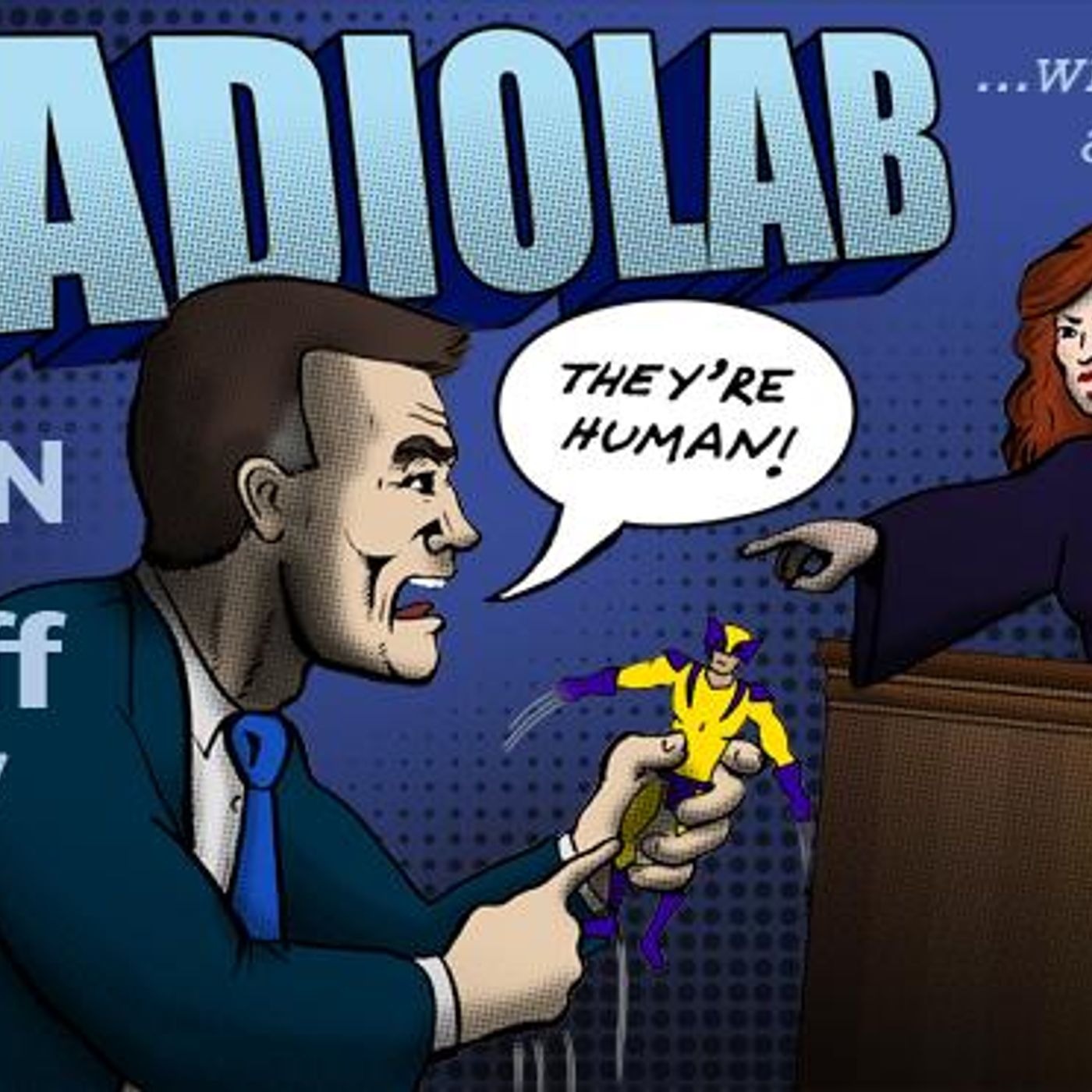
Radiolab
Mutant Rights
00:15:45
In this podcast short, a strange twist of legal taxonomy causes a dispute over whether X-MEN action figures are toys or dolls and sparks a court case about what it means to be human.
Loading summary
Transcript200 lines
- [00:00]
Jad Abumrad
Oh, wait, you're listening.
- [00:01]
Robert Krulwich
Okay. All right.
- [00:04]
Ike V. Khandaraja
Okay.
- [00:05]
Bryan Singer
All right.
- [00:07]
Sherry Singer
You're listening to Radiolab.
- [00:09]
Ike V. Khandaraja
Radiolab shorts from wnyc.
- [00:15]
Robert Krulwich
Yes.
- [00:16]
Jad Abumrad
And npr. Hey, I'm Jad Abumrad.
- [00:20]
Robert Krulwich
I'm Robert Krulwich.
- [00:21]
Jad Abumrad
This is Radiolab podcast, and today on the podcast, we're gonna talk about containers.
- [00:25]
Robert Krulwich
Well, no.
- [00:26]
Jad Abumrad
Yeah. Why not?
- [00:27]
Robert Krulwich
Well, because it's bigger than containers. It's categories.
- [00:30]
Jad Abumrad
Ugh.
- [00:30]
Robert Krulwich
Because it's the boring way.
- [00:32]
Jad Abumrad
It's the boring word for containers.
- [00:33]
Robert Krulwich
Well, it's not at all boring.
- [00:35]
Jad Abumrad
Taxonomy. Can we say that?
- [00:36]
Robert Krulwich
Yes, you could. Yes. This is a story about what goes where and what doesn't go there and what should go there if you were only smarter about it. Ike, Sweet. Are you around?
- [00:47]
Ike V. Khandaraja
Yeah. That's what I want to talk about.
- [00:48]
Robert Krulwich
So you have a story to tell us, right?
- [00:50]
Ike V. Khandaraja
Yeah, yeah, yeah.
- [00:51]
Robert Krulwich
So you tell us your story.
- [00:52]
Jad Abumrad
Yeah, set it up for us, Ike.
- [00:53]
Ike V. Khandaraja
Well, let's start back in 1993.
- [00:55]
Bryan Singer
Okay.
- [00:56]
Indy Singh
Yes.
- [00:56]
Ike V. Khandaraja
With two customs attorneys.
- [00:57]
Sherry Singer
I'm Sherry Singer, and my name is Indy Singh.
- [01:00]
Ike V. Khandaraja
Singer and Singh.
- [01:01]
Jad Abumrad
Singer and Singh.
- [01:02]
Ike V. Khandaraja
And one day, the two of them are looking at this customs book called the Harmonized Tariff Schedule.
- [01:07]
Jad Abumrad
What was it called again? The Harmonized.
- [01:08]
Indy Singh
Harmonized Tariff.
- [01:09]
Jad Abumrad
Harm, you almost harmonized the Harmonized Tariff System.
- [01:12]
Ike V. Khandaraja
It's this huge book, chock full of customs classifications.
- [01:17]
Sherry Singer
Meat products, milk products, vegetables.
- [01:19]
Indy Singh
It's got everything in it, literally thousands of provisions.
- [01:23]
Ike V. Khandaraja
So they're flipping through this big book, and what they noticed that day is that in this book were the following.
- [01:33]
Indy Singh
Words representing only human beings.
- [01:39]
Ike V. Khandaraja
They saw this fateful phrase right next to the word doll under the harmonized.
- [01:44]
Sherry Singer
A doll was something that represented only a human being.
- [01:48]
Jad Abumrad
A doll represented a human being.
- [01:50]
Sherry Singer
Only a human.
- [01:51]
Jad Abumrad
Only a human being.
- [01:52]
Sherry Singer
It could not be any other creature but a human being.
- [01:56]
Jad Abumrad
So Barbie is a doll.
- [01:57]
Ike V. Khandaraja
Right. But here's the thing. In this big book, right next to dolls is this whole other category called.
- [02:06]
Sherry Singer
Toys, which covers things like monsters, robots.
- [02:10]
Ike V. Khandaraja
Angels, basically anything that isn't only representing a human.
- [02:16]
Jad Abumrad
So the dolls are human and the toys are not human?
- [02:20]
Robert Krulwich
Yeah.
- [02:20]
Ike V. Khandaraja
And where it gets weird is that these two categories were being taxed differently.
- [02:25]
Robert Krulwich
How? How differently?
- [02:27]
Indy Singh
12% for dolls and 6.8% for toys.
- [02:32]
Jad Abumrad
Really? So getting a Barbie doll into the country would be more expensive than, like, importing a Transformer or something?
- [02:37]
Ike V. Khandaraja
Yeah.
- [02:38]
Jad Abumrad
Why?
- [02:38]
Indy Singh
I assume it was because there was a domestic industry, a domestic doll industry that wanted and needed protection.
- [02:48]
Ike V. Khandaraja
Do you think there was a powerful doll lobby? Anyhow, you got these two categories. You got these two ladies and they have a client called Marvel Comics.
- [03:02]
Robert Krulwich
Marvel Comics? This is the home of men with capes and superpowers.
- [03:06]
Ike V. Khandaraja
Yes, and beautiful boots tights.
- [03:09]
Robert Krulwich
Marvel. Yes.
- [03:09]
Jad Abumrad
What about Marvel?
- [03:10]
Ike V. Khandaraja
Well, Marvel Comics has this universe of action figures coming into our ports as dolls.
- [03:17]
Jad Abumrad
Wait, all their action figures were being classified as dolls?
- [03:19]
Indy Singh
Everything was a doll?
- [03:21]
Sherry Singer
Yeah, at 12% rate of duty.
- [03:24]
Ike V. Khandaraja
And Sherry and Indy realized that there's a huge opportunity here. If they can convince the government to remove the Marvel action heroes from the human Y Barbie doll category and push them into the robot demony toy category, they can save a huge amount of money.
- [03:43]
Robert Krulwich
We saw dollars, tens of thousands of, maybe hundreds.
- [03:48]
Ike V. Khandaraja
How much thousands of dollars?
- [03:49]
Robert Krulwich
50.
- [03:50]
Ike V. Khandaraja
A million dollars. And then some more than a million.
- [03:53]
Jad Abumrad
Dollars because they wouldn't be taxed as high.
- [03:55]
Ike V. Khandaraja
But this is about more than just business. This is about more than Saturday morning cartoons. This is about what it means to be a human.
- [04:03]
Jad Abumrad
What do you mean?
- [04:04]
Ike V. Khandaraja
Well, think about it. They have to convince government officials that under US Law, these characters are not considered human. Ooh. So Sherry and Indy headed to customs. Customs headquarters in D.C. with a giant bag full of superheroes.
- [04:23]
Indy Singh
We actually went down there, we had a meeting. We brought samples of all the items, and.
- [04:30]
Jad Abumrad
You brought action figures, you mean?
- [04:31]
Indy Singh
We did. We had 60 or 80 figures.
- [04:35]
Ike V. Khandaraja
And one by one, we tried to.
- [04:37]
Indy Singh
Convince them that these figures do not represent human being.
- [04:44]
Ike V. Khandaraja
And believe it or not, this meeting ended up in a series of court cases that went on for 10 years.
- [04:50]
Jad Abumrad
10 years.
- [04:51]
Ike V. Khandaraja
Because where it got really complicated and interesting is when they got to Marvel's crown jewel, the X Men.
- [04:57]
Sherry Singer
We really didn't even read the stories. Sherry and I were not familiar with comic books. Sherry.
- [05:02]
Ike V. Khandaraja
Well, they should have, because it's a great story. I mean, the story of X Men is kind of about the next phase of human evolution. Regular parents having regular kids. But some of these kids around their awkward teen years start to develop these strange mutant powers.
- [05:18]
Jad Abumrad
So the story is humans who mutate.
- [05:20]
Robert Krulwich
Yeah.
- [05:20]
Ike V. Khandaraja
Well, that's what makes this so legally tricky. I mean, are these characters still human, or have they evolved somehow out of humanness into something entirely different?
- [05:32]
Robert Krulwich
Now, the government says that all of the imported action figures, that they are representations of human beings. If they have things like a head, a mouth, eyes, nose, hair, arms, torso, breasts, muscles. If you look at any of these guys, Cyclops, he has all the basic elements that are the government's definition of a human being. And what do you say?
- [06:02]
Ike V. Khandaraja
Well, eventually, to make their point, Sherry and Indy pulled out a blue, furry guy that X Men Fans might know as Beast.
- [06:11]
Indy Singh
We can look at Beast that we won early on.
- [06:15]
Jad Abumrad
Well, he's called Beast, even customs.
- [06:18]
Sherry Singer
But he has a head. He has a head. He has two arms, he has two legs.
- [06:22]
Ike V. Khandaraja
He does have those.
- [06:23]
Sherry Singer
He wears glasses in response to Robert's comments.
- [06:25]
Jad Abumrad
But you know, Beast in the X Men storyline, he's a pretty, he's a pretty like sophisticated guy. Like, he's, he's a thoughtful intellectual. Am I right, Ike?
- [06:34]
Ike V. Khandaraja
Yeah. He would be the first X Men to.
- [06:37]
Robert Krulwich
He wears glasses.
- [06:38]
Unidentified Male Speaker
He quoted Shakespeare.
- [06:39]
Robert Krulwich
He quotes Shakespeare.
- [06:40]
Jad Abumrad
He quotes Shakespeare.
- [06:41]
Robert Krulwich
He ne' er so vile this day shall gentle his condition. And men in England now abed will count their manhoods cheap. So don't you think that puts him well down the human sort of bell curve?
- [06:57]
Sherry Singer
Well, in this case, our argument would be is human beings do not have blue skin. The judge agreed it doesn't resemble a human being.
- [07:07]
Robert Krulwich
That's. There are human beings of bluish skin.
- [07:10]
Joe Liebman
You should know least is harder to fit into the mold of what we customarily know as human.
- [07:17]
Ike V. Khandaraja
That's Joe Liebman. He worked on the case for the government side.
- [07:21]
Joe Liebman
He has aspects that perhaps are closer.
- [07:24]
Ike V. Khandaraja
To the monster, but it gets trickier. Take the most popular X Man. Oh, who's that?
- [07:30]
Robert Krulwich
Wolverine.
- [07:31]
Joe Liebman
Wolverine, he's got muscular arms and legs.
- [07:35]
Ike V. Khandaraja
He puts on a coat and a flannel shirt and he's a logger.
- [07:38]
Joe Liebman
Sure.
- [07:39]
Sherry Singer
But the eyes, they just didn't look human. And that's what our basic.
- [07:43]
Indy Singh
And the claws also.
- [07:44]
Sherry Singer
And the claws.
- [07:45]
Robert Krulwich
Metal claws, razor like adamantium claws.
- [07:48]
Ike V. Khandaraja
In the story, a mad scientist implanted them in his arms, under his skin.
- [07:53]
Jad Abumrad
But that just means he's a guy who had a little augmentation.
- [07:55]
Indy Singh
No.
- [07:55]
Joe Liebman
Well, he's developed something we don't know to actually exist.
- [08:02]
Ike V. Khandaraja
That does not mean that it might not exist in future humans in a.
- [08:07]
Joe Liebman
World that we have not yet seen.
- [08:09]
Ike V. Khandaraja
Joe's basic point is don't rule it out. He pointed to this runner, Oscar Pistorius.
- [08:15]
Unidentified Male Speaker
They call him the Blade Runner. The world's fastest man on no legs.
- [08:20]
Ike V. Khandaraja
The double amputee runner from South Africa who wears prosthetic legs that some people claim actually increase his speed, saying his.
- [08:28]
Unidentified Male Speaker
Prosthetics had more spring than human legs.
- [08:31]
Ike V. Khandaraja
And some people say he should be disqualified from competing against able bodied humans.
- [08:35]
Unidentified Male Speaker
The body that governs track and field banned him from competition.
- [08:39]
Ike V. Khandaraja
Well, forget about augmentation. What if we're just talking mutation? I mean, as a human we have about 20,000 genes and if one of.
- [08:47]
Robert Krulwich
Them just gives you claws. That doesn't mean that the other 19,999 genes are keeping you pretty much in the human classification.
- [08:57]
Sherry Singer
I studied. My undergraduate degree is in microbiology and biochemistry. So I know that we have mutations going on in our body constantly.
- [09:08]
Jad Abumrad
So we're all mutants.
- [09:09]
Sherry Singer
But in common language and in science fiction, when you use the word mutant.
- [09:13]
Ike V. Khandaraja
She says, you mean something or someone that's disfigured, alien that's no longer like us. So colloquially, if Marvel calls the X Men mutants, then they are not human.
- [09:27]
Robert Krulwich
On the Wolverine case, did you win or lose?
- [09:30]
Sherry Singer
We won.
- [09:30]
Ike V. Khandaraja
We won. Well, how do you feel about this, Ike? I don't know. I. I'm kind of seeing red. No, but seriously, here's the thing. In the X Men universe, all the X Men are trying to do is fit into our world. I don't want to hurt you, Eric.
- [09:56]
Jad Abumrad
I never did.
- [09:56]
Ike V. Khandaraja
To feel like a human being.
- [09:58]
Bryan Singer
Is it the truth?
- [09:59]
Ike V. Khandaraja
Marvel Comics has created this world where mutants want to be treated like humans and the government is persecuting them as monsters. But in the real world, it's exactly the opposite. You got Marvel saying they're monsters, and you got the government saying, no, let them be human.
- [10:18]
Bryan Singer
In the X Men universe, humans are very often out to get the mutants. Dismissive of the mutants, fearful of the mutants, liquidating them, experimenting on them.
- [10:26]
Robert Krulwich
First of all, tell us who you are.
- [10:28]
Bryan Singer
I am Bryan Singer. I'm a filmmaker.
- [10:31]
Ike V. Khandaraja
Brian directed a bunch of the X Men movies.
- [10:33]
Bryan Singer
X Men 1, X Men 2, X Men United.
- [10:36]
Ike V. Khandaraja
And he says all the movies at their heart are parables about living in a world where you don't fit, where you're not the right category. In fact, the first X Men film he directed, the US Government fears mutants so much that this US Senator puts forward legislation called the Mutant Registration Act.
- [10:54]
Bryan Singer
Mutants are very real, and they are among us. We must know who they are, and above all, we must know what they.
- [11:04]
Ike V. Khandaraja
Can do that us, them, conflict is key to the entire saga.
- [11:08]
Bryan Singer
Well, yeah, and it's no coincidence that it was born during the height of the civil rights movement.
- [11:13]
Robert Krulwich
Oh, so this is like. So this is modeled, then, on a moment in world history where people were trying to figure out how to either get along or not get along.
- [11:22]
Bryan Singer
Yeah, absolutely.
- [11:23]
Ike V. Khandaraja
This tension plays out within the mutants themselves, where you have two groups, the X Men, who choose to take the.
- [11:30]
Bryan Singer
Stance to defend a world that hates and fears them.
- [11:33]
Robert Krulwich
Don't give up on them, Eric.
- [11:34]
Ike V. Khandaraja
And then you got this other group of mutants led by Magneto.
- [11:37]
Bryan Singer
What would you have Me do Charles. And he doesn't have faith that humanity's ever going to embrace mutants. We are the future, Charles, not them. They no longer matter. He saw that. What happens when you're different is you get rounded up, experimented on, eliminated, and you're gassed.
- [11:53]
Ike V. Khandaraja
It's interesting to hear you describe that because when I walked out of the most recent movie, I felt such a strong, maybe a stronger connection with Magneto. After you saw what he went through.
- [12:06]
Bryan Singer
Yeah. You see the intimate victimization of him and you root for him because he's ultimately facing a monster.
- [12:14]
Ike V. Khandaraja
And when he was making these movies, he had that monster of intolerance and prejudice on his mind. And it was actually pretty personal to him.
- [12:23]
Bryan Singer
There's a photo album my family has, and it starts in the 20s. And I was looking through it and I recognized the lineage. And then there were a few pages of just these portraits of different people. I didn't know who they were. And I said to my dad, I'm like, who are these people? And my dad goes, they're all gone. They're the ones that are gone from Poland. They're just all gone. They're erased. There's no records, there's no property, there's no nothing.
- [12:48]
Robert Krulwich
So he doesn't even know their name?
- [12:49]
Bryan Singer
No, we just know that they're people that were part of the neighborhood and the family in the 30s that never left Poland like my grandparents did and disappeared.
- [13:02]
Ike V. Khandaraja
Well, I know this sounds pretty heavy for a comic book, but over the years, the X Men have been a stand in for first the civil rights movement of the 60s. And most recently, the story works as an allegory for gay rights.
- [13:15]
Bryan Singer
In fact, In X Men 2, we actually had a coming out scene.
- [13:18]
Ike V. Khandaraja
In the scene, this kid, Bobby Drake, he's hiding some of the X Men in his parents house.
- [13:22]
Bryan Singer
And then his parents come home and find him with these strangers.
- [13:26]
Ike V. Khandaraja
Aren't you supposed to be at school? Bobby, who is this guy?
- [13:28]
Bryan Singer
And he is forced basically to show his parents that he's a mutant.
- [13:32]
Ike V. Khandaraja
There's something I need to tell you. Everyone takes a seat in the living room. And Bobby, using his special mutant powers.
- [13:39]
Bryan Singer
He freezes a little cup of coffee. And the parents react in panic.
- [13:49]
Robert Krulwich
Bobby.
- [13:50]
Bryan Singer
And the mother actually says, have you.
- [13:51]
Jad Abumrad
Tried not being a mutant?
- [13:55]
Robert Krulwich
Really?
- [13:56]
Bryan Singer
Like it's a choice.
- [13:59]
Robert Krulwich
We have to find out what the ultimate legal disposition of this case was.
- [14:03]
Jad Abumrad
Yeah. So did they in the end say that these characters were human or did they perpetuate this retail bigotry, Ike. And say that they were non humans.
- [14:12]
Ike V. Khandaraja
You guys really want to know?
- [14:13]
Robert Krulwich
Yeah, we have to know.
- [14:15]
Jad Abumrad
We have to.
- [14:15]
Robert Krulwich
Come on.
- [14:16]
Jad Abumrad
Yeah, exactly. Tell us.
- [14:18]
Ike V. Khandaraja
Non humans.
- [14:21]
Jad Abumrad
Seriously?
- [14:22]
Ike V. Khandaraja
Eventually, the judge ruled that all Marvel heroes, not just the X Men, are not human.
- [14:29]
Jad Abumrad
Hmm. So Sherry and Indy won.
- [14:31]
Indy Singh
We're not civil rights lawyers.
- [14:37]
Ike V. Khandaraja
So when you're. When you're having your nice meal after the. After the case, and you don't feel at all that you have just robbed humanity from a whole population?
- [14:50]
Indy Singh
No, we had absolutely no guilt at all. Like, none.
- [15:06]
Jad Abumrad
Well, thank you, Ike.
- [15:08]
Ike V. Khandaraja
You're welcome, Jeff.
- [15:08]
Robert Krulwich
That would be Ike's V. Khandaraja, our reporter on this story. We also had a fine producer, Matthew.
- [15:14]
Jad Abumrad
Kielty, who has just left us for greener pastures. Thank you, Matt.
- [15:18]
Robert Krulwich
I am Robert Krulwich.
- [15:19]
Jad Abumrad
And I am Chad Apumrad.
- [15:20]
Robert Krulwich
And thanks for listening, whatever you may be.
- [15:26]
Mary from Douglas, Wyoming
Message one. Hi, this is Mary from Douglas, Wyoming. Radiolab is supported in part by the Alfred P. Sloan Foundation. Enhancing public understanding of science and technology in the modern world. More information about phone at www.phone.org. end of message.