← Radiolab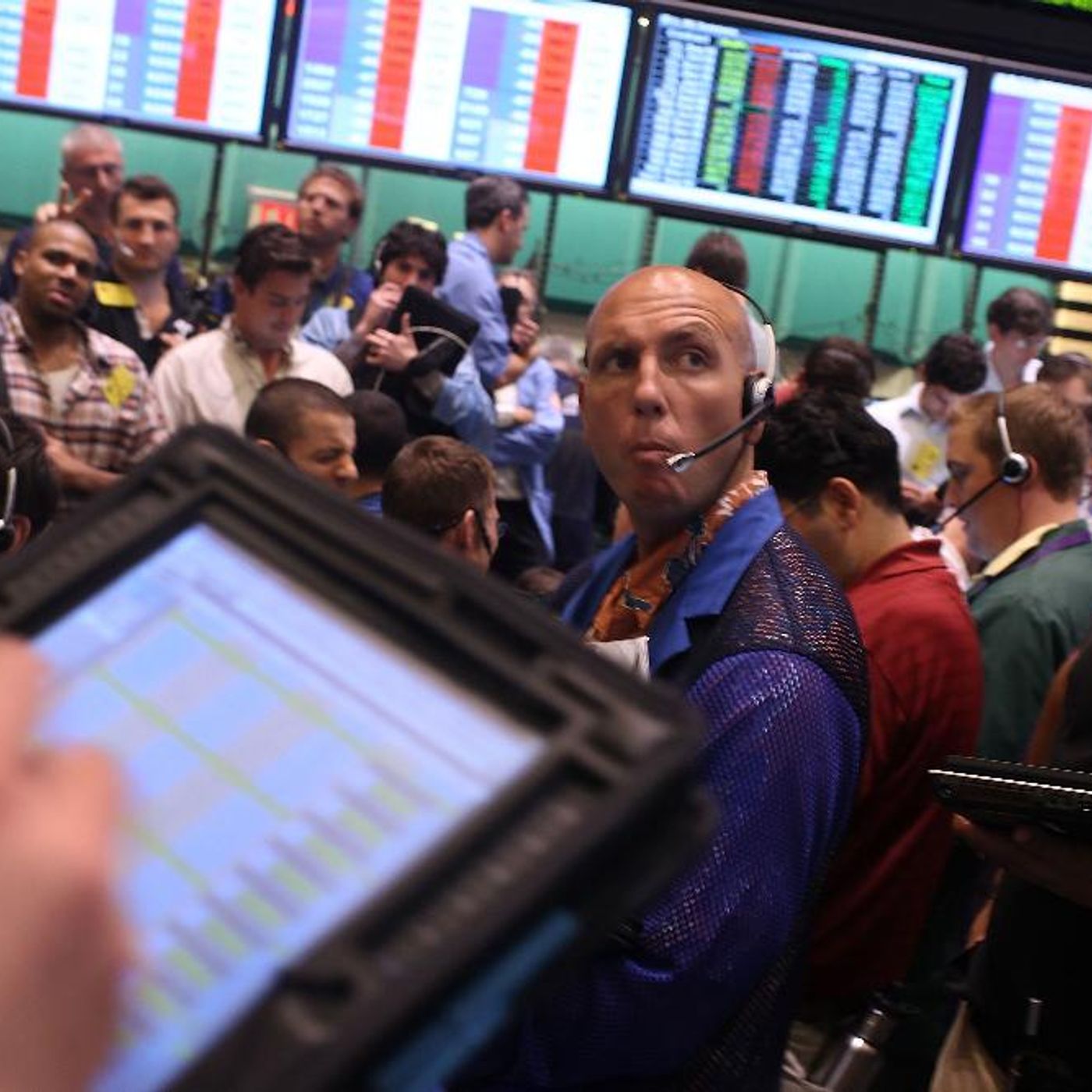
Radiolab
Open Outcry
00:09:55
Jad presents a piece by one of his favorite producers: Ben Rubin. Rubin created this audio portrait called 'Open Outcry' as a part of a sound installation called Sonic Garden commissioned to celebrate the reopening of the Winter Garden, an atrium space within the World Financial Center, after 9/11.
Loading summary
Transcript46 lines
- [00:02]
Jad Abumrad
I sh.
- [00:02]
Trader 1
Quiet.
- [00:03]
Jad Abumrad
You're listening to radio, the podcast from New York Public Radio.
- [00:08]
Trader 2
Public Radio, WNYC.
- [00:13]
Jad Abumrad
And npr. Hey, everyone. Jad here. For this week's podcast, I wanted to play you a piece from one of my favorite producers. His name is Ben Rubin, and he's. He's kind of hard to describe. He's sort of an audio artist, sort of a documentary producer, sort of a visual artist, if anyone's out there, has been to the New York Times building, the new one. He and his partner, Mark Hanson, did this sculpture, the crazy moving sculpture that is in the lobby. Any case, this is one of my favorite pieces from him. It's called Open Outcry. And I don't want to tell you too much about it, except that it's about commodities trading. You know, like when you picture the trading floor with hundreds of people screaming out the prices of commodities, there's a name for that. It's called the Open Outcry Trading System. And all those screaming people sort of in that roiling pit, determine on this sort of emergent level the price of oil or the price of an ounce of gold. So Ben decided to do a piece about this. And most of what you're going to hear in this is actual documentary sound he recorded on the trading floor of the New York Mercantile Exchange. There's also going to be a female voice, sort of an ethereal female voice that was recorded in the studio, obviously, which is actually her singing. The real price of commodities taken, you know, the raw data taken from one day, I think in September of 2002, though I'm not sure about that date. In any case, here it is. Open outcry from Ben Rubin on radiolabs.
- [01:52]
Trader 2
Heating oil up 81.
- [01:54]
Trader 1
50.
- [01:56]
Trader 2
Cotton up 45. 80. Cotton up 45. 90. Orange juice, down 94.55. Gold down 32. 14. Silver, up 44. 78. Platinum, down Crude oil 30.
- [02:15]
Jad Abumrad
48.
- [02:16]
Trader 2
Cotton, platinum, down 49. 00. Platinum, cotton, down 45.
- [02:23]
Jad Abumrad
85.
- [02:24]
Trader 2
Silver, up 44.78. Crude oil, up 30.
- [02:30]
Trader 1
50.
- [02:31]
Jad Abumrad
3.
- [02:32]
Trader 2
Silver, up.
- [02:33]
Trader 3
Silver.
- [02:35]
Trader 2
Platinum, down 49. 0, 40.
- [02:54]
Trader 3
Sometimes I say to people, didn't you hear me bidding? And I know if they say, I didn't hear you, I know they're not telling me the truth because people always hear my voice. It's unique and it's a strong voice, too. If I'm selling October's, you know, you don't say. You say ock, and you don't say the full handle. You'll say like, ock at 10. So I just yell out auc at 10 ock.
- [03:14]
Jad Abumrad
70. Bit.
- [03:15]
Trader 1
5.
- [03:15]
Jad Abumrad
5. 25.
- [03:16]
Trader 4
So 25. A 75 bid at 78. You're not listening to one person at a time. You're hearing everybody speak at the same time. It's like going to a symphony and hearing every piece of the orchestra, but yet hearing the music at the same time.
- [03:40]
Trader 1
And in the midst of that, you may observe, for instance, a broker that you've traded with for years. You know what his face looks like when he's laughing. You know what his face looks like when he's upset about something at home and suddenly he's got a nervous look.
- [03:56]
Trader 4
You can tell when somebody's bluffing, when somebody's not bluffing. And these are all skills that are learned over time. It's really an internal gut feeling. And as far as just seeing the expression on somebody's face, face, the way that somebody's breathing, the way that somebody's leaning on someone else. I always knew when the guy behind me had a real order, because when he had a big, big order, he used to take my shoulder and shove it to the ground, trying to hold himself up.
- [04:19]
Trader 5
These two. He's two minute two. So 50. These are two. He's too big, Nobody to have no. 5 and a half. W2. 4.
- [04:48]
Trader 2
Silver. Up. Orange juice. Cotton.
- [04:52]
Jad Abumrad
Up.
- [05:00]
Trader 2
Gasoline, Natural gas, Up. Crude oil, natural gas, up.
- [05:11]
Trader 1
Well, I've been in the ring 32 years. How do I sound? You know, the open outcry system, which is some people may look as an antiquated system, is probably the most sophisticated, timely system that's in existence today. If you believe in.
- [05:28]
Trader 6
If you believe in it in a.
- [05:30]
Jad Abumrad
Marketplace, this is as pure a form as it gets.
- [05:33]
Trader 6
If everybody's buying, it's gonna be tougher to buy.
- [05:35]
Jad Abumrad
Right?
- [05:36]
Trader 6
Simple as that.
- [05:36]
Trader 4
Just because you want to sell it at $29.55 and you're offering $29.55, the guy next to you could be selling it. The guy in front of you could be selling it, the guy behind you could be selling it, and you might not have sold anything.
- [05:48]
Trader 6
Volatility makes money. War creates turmoil. Turmoil creates opportunity. I'm not suggesting that people want terrible outcomes, but I am suggesting that a lot of people depend on them.
- [06:04]
Trader 4
It's all 50.
- [06:06]
Jad Abumrad
I'm out. October.
- [06:07]
Trader 5
October. Deck 100. Buy them. 100D sells D.
- [06:25]
Jad Abumrad
The Tempest player.
- [06:26]
Trader 4
There's a lot of money flying around moment to moment, you know, and there's a classic story, actually. It's about my father. And there was a time in Silver when he got into an argument with somebody and he had their neck down against the rail. And a guy looked at him and says, marty, even though that, you know, your chairman of the floor come in. I'm gonna have to find you 500 bucks for this. So he looks at the guy, he puts. He keeps one hand on the guy's neck, takes the other hand in his pocket, throws down a thousand bucks and says, double it, because I'm gonna finish him off, you know. Two minutes later, they're out having a cup of coffee together.
- [07:01]
Trader 5
Martine at 23, Martin at 23. Two big 50 and 23. Two big Monte 50 and 23.
- [07:10]
Jad Abumrad
Great.
- [07:21]
Trader 2
Aluminum up, orange juice, platinum down.
- [07:49]
Trader 6
There were members in good standing that had been on the trading floor the day before September 11th that we would never see again. I think people were very, very aware of their absence. In fact, the first trading day, for at least the first trading day, some of their positions in the pit were sort of silhouetted by the outline of their footprints. And people wouldn't step into those spots.
- [08:35]
Jad Abumrad
That's open. Outcry by Ben Rubin. As you can probably tell, that piece was written right after 9 11. He was asked to commemorate the reopening of part of the World Financial Center. Most of it was still in rooms, but this one part, the Winter Garden, was opening back up. And so he was asked to make a sound piece to install in the Winter Garden. And this is a huge space with a grid of palm trees in the middle, a very, very high domed ceiling. And what he did was he installed speakers underneath the trees. And that's where the voices of the traders came from. But way up top on the ceiling, he had speakers which played the voice of that female ticker. So it's as if the traders are on the floor and high up above them, almost ethereally, is the price of the commodities. Kind of a neat idea, except he said in the. In the space, the sound was totally terrible. No one could hear anything. So he was happy, as are we, to have it be a radio piece. In any case, you can learn more about Ben at his website, ear studio.com. that's www.earstudio.com. you can also check out our website, Radiolab.org. we are supported by the Alfred P. Sloan foundation, the Corporation for Public Broadcasting, and the National Science Foundation. I'm Jad Abumrad. Thank you for listening.